



Abstract
Young adults determined five needs which must be met to transition to adulthood: support, housing, study and work, income, and well-being. This study aimed to identify and describe subgroups of young adults and determine to what extent they meet the needs for independence, and to assess relations between subgroups and demographic characteristics. We conducted secondary data analysis of a population-based questionnaire, which included 2291 young adults (M age = 20.8 years, 71% female) living in South Limburg, the Netherlands. We adopted a person-centred approach, that is, latent class analysis, and identified four classes: Thriving (39%), Lacking support and well-being (29%), Widely struggling (18%) and Financially challenged (14%). Females and non-university students/graduates had higher odds of being members of the least thriving classes. Future research should focus on how support and cumulative disadvantage affect later life outcomes. We should broaden community, educational and institutional support systems to encourage and sustain meaningful relationships.
The transition to adulthood is a dense and turbulent period, in which young adults move towards independence, autonomy and responsibility in determining the direction of their own lives and futures (Buchmann & Kriesi, 2011; Furstenberg et al., 2005; Gauthier, 2007). This transition is characterised by essential trajectories, including graduation, entering the labour market, leaving the parental home and living independently (ibid.). To what extent certain developmental goals are met, has lifelong consequences and is therefore decisive for the further life course (Schoon et al., 2009). For many young adults this development happens naturally through trial and error and with the support of family and friends. Nevertheless, previous research underlined that transition outcomes predominantly depend on structural opportunities and barriers as well as individual resources (Clausen, 1991; Elder & Shanahan, 2007). In a previous study in the Netherlands, several youth service organisations collaborated with young people in youth care by organising focus group discussions. In co-creation, they identified five essential needs which must be met in order to smoothly transition to adulthood, respectively support, housing, study and work, income, and well-being (Expex, 2022). These insights were followed up by a qualitative multiple case study in which professionals from a wide range of municipalities, which had successfully implemented appropriate approaches for assisting in the transition to adulthood, were interviewed and were subsequently included in implementation and further improvement of the framework (The Association of Dutch Municipalities [VNG], 2023). The needs for support, housing, study and work, and income correspond with prior research in which British young adults determined four assets as beneficial for the transition to adulthood: the right skills and qualifications, personal connections, financial and practical support, and emotional support (Kane & Bibby, 2018). Positive mental health has also previously been identified as crucial for personal development, because it contributes to managing stress, realising abilities and building healthy relationships (World Health Organization [WHO], 2022). Moreover, Oman and colleagues (2015) described general and social health as relevant resources for a successful transition to adulthood. In this study we aim to identify subgroups of young adults in the general population based on their similarities regarding to what extent they meet the five needs for independence.
In order to fulfil the need for ‘support’, young adults require at least one adult who is always there for them as well as having supportive family, friends and/or acquaintances they can count on (Expex, 2022). Social support may contribute to positive transitioning outcomes for young people, for instance when an individual’s network provides a place to stay, financial assistance, emotional guidance or recreational activities (Dworsky & Courtney, 2009). Social connections are important to consider, as empirical research has established that support is closely associated with loneliness (Lee & Goldstein, 2016). Loneliness is commonly defined as a negative emotional reaction which arises due to a perceived gap between the actual and desired quantity and quality of one’s social connections (Perlman & Peplau, 1981). Nicpon and colleagues (2006) established that young people who indicated higher levels of perceived social support tended to experience less loneliness. Additionally, loneliness is a risk factor for numerous physical and mental health issues (Hawkley et al., 2008). Although loneliness is apparent across the life span, late adolescence and young adulthood have been recognised as phases in which loneliness is arguably the most prevalent (Qualter et al., 2015), which is not surprising as young people’s social lives become more complex during this time (Van Roekel et al., 2010). Social support is believed to equip individuals with a buffer to life’s stresses, meaning that young adults who have a social network tend to cope better with multiple risks compared to their counterparts without such support (Dean & Lin, 1977).
‘Housing’ entails having a suitable and affordable place to live for an extended period of time (Expex, 2022). In recent times, the capacity to achieve independent living has been undermined by extended educational careers, increasingly unstable labour market conditions and rising housing market entry costs (Hochstenbach & Boterman, 2015; Stone et al., 2011), which has caused housing transitions to become more chaotic and disjointed (Boterman et al., 2013; Hochstenbach & Boterman, 2015). This is alarming because The Forgotten Child Foundation (2023) found that young adults who experienced homelessness were more likely to have mental health problems, such as fear and anxiety, and were more at risk of addiction. Furthermore, homeless young adults were dependent on other people for help (e.g., providing a place to sleep), which in the long run often resulted in less contact with and social alienation from family and friends. They were also more likely to drop out of school. All these issues come in addition to the already existing problems which led to the young adults becoming homeless in the first place (The Forgotten Child Foundation, 2023).
The need ‘study and work’ involves young adults going to school, study or work, and making plans for the future (Expex, 2022). During the transition to adulthood, many young people acquire the education and training that will form the basis for their future income and career success throughout their adult lives. This phase is characterised by change and exploration of possible life directions (Arnett, 2000). Young adults who do not have a smooth school-to-work transition and thus are Not in Employment, Education or Training (NEET), may face many negative consequences for later life outcomes, including social marginalisation, low well-being and low re-employment rates (Dicks & Levels, 2022). When young adults do not participate in school or work for long periods of time, the distance to the labour market, along with the risk of poverty and debt, will continue to increase (Nederland et al., 2016).
‘Income’ is concerned with being well-prepared for financial independence as well as preventing or resolving any debt and having a stable income which is sufficient for now and the near future (Expex, 2022). Even though young adults continuously classify financial independence as key to becoming adults (Arnett, 1998), previous studies established that they need increasingly more time to achieve such independence (Furstenberg et al., 2005; LeBaron et al., 2018; Whittington & Peters, 1996). Van Gaalen and colleagues (2023) identified three groups of young adults in the Netherlands who are particularly prone to financial hardship: school-leavers who are unemployed and depend on welfare, school-leavers working at a youth minimum wage, and students who are in the entry and basic levels of vocational education. Due to barriers in applying for welfare and low youth minimum wages (e.g., the minimum wage for an 18 year old is 50 per cent of the regular minimum wage) and despite supplementary regulations and support, these groups are short of hundreds of euros every month (Arnett, 1998). Recently, there has been increasing concern that young people are not equipped to handle the complexities of managing finances (Lusardi et al., 2010). Prior studies demonstrated that middle-class parents appeared not only better able to transfer financial knowledge and skills to their children, but were generally also more proactive in teaching such matters to their children compared to their lower class counterparts (Lareau, 2011; Luhr, 2018).
Young adults satisfy the need for ‘well-being’ when they are doing well mentally and physically, they feel that they can handle the future, and they recognise when they are not doing well (Expex, 2022). Girls in secondary schools were more inclined to report experiencing emotional problems, low life satisfaction, low perceived resilience and low general health compared to boys. Furthermore, girls in vocational education or applied university were more likely to report being unhappy or depressed and they worried more about the future (Kleinjan et al., 2020). Also, vocational education students were more likely to have unhealthy lifestyles, which included smoking, substance use and low levels of exercise (Meister, 2023).
Some young people experience difficulties during their transition to adulthood and thus require extra help or support. In the Netherlands, about 15% of young people between the ages of 16 and 27 encounter serious problems during their transition to adulthood (The Association of Dutch Municipalities [VNG], n.d.). Strengthening the five needs for independence contributes to creating a solid foundation and enables young people from diverse backgrounds to become thriving and self-reliant adults (Netherlands Youth Institute, nd), which, in turn, promotes individual well-being, contributes to societal participation, fosters resilience, and allows for autonomy.
Previous studies have predominantly focused on studying a few of the needs for independence at the same time (e.g., Kleinjan et al., 2020; Meisters, 2023; The Forgotten Child Foundation, 2023; Van Roekel et al., 2010). However, to what extent each need is fulfilled may have a cumulative effect on each individual’s transition to adulthood, meaning that satisfying all needs for independence possibly amounts to more than the sum of its parts. In this study, we include all five needs for independence in order to gain a more comprehensive and holistic understanding of the transition to adulthood of young adults. Our objectives are: (1) to identify and describe subgroups of young adults and determine to what extent they meet the five needs for independence and (2) to assess relations between subgroups and demographic background characteristics, such as age, gender, educational level and migrant background.
Methods
Study Design
Prior research largely used variable-centred approaches, which studied homogeneous similarities between variables and in doing so, risk overlooking the possibility of establishing subgroups with distinct combinations of scores. In order to include multiple needs as well as refrain from continuing to view these needs as separate entities, we used a Latent Class Analysis (LCA), which is a person-centred approach that aims to identify unobserved subgroups of individuals (i.e., latent classes) based on their similarities regarding a set of variables (Bergman & Magnusson, 1997). In our case, this meant identifying latent classes of individuals which were characterised by particular combinations of their scores on each need for independence. What is more, rather than pushing for a singular continuum in which higher scores on one need imply higher scores on other needs as well, our approach allowed for exploring more complex constellations of scores (Meeusen et al., 2018) and as such, acknowledged a more nuanced understanding of the factors that shape young adults’ experiences and outcomes.
Participants and Setting
Large regional health differences are prevalent in the Netherlands. The region of South Limburg is characterised by health disparities and low socioeconomic status, such as high rates of obesity and high healthcare expenditure as well as high rates of school dropout and low labour participation compared to the rest of the Netherlands (Jansen & Kuppens, 2015; Jansen & Meisters, 2018; Meisters et al., 2022). The considerable diversity in socioeconomic, participation and health challenges make this context particularly relevant for research on young adults and their transition to adulthood, which is why this study specifically focuses on young adults living in the region of South Limburg.
We conducted secondary data analysis using data from all young adults (aged 16–25 years) living in the region of South Limburg who completed a population-based questionnaire called the 2022 COVID-19 Health Monitor for Young Adults. In keeping with the five needs for independence approach, which recognises that young adults need increasingly more time to successfully reach adulthood, we include 16- and 17-years-olds as opposed to more traditional distinctions based on legal adulthood. Our South Limburg study sample corresponds reasonably well to the general young adult population in the Netherlands in terms of age (our sample: 16% 16–17 years old, 29% 18–20 years old and 55% 21–25 years old vs. general Dutch population: 18% 16–17 years old, 30% 18–20 years old and 52% 21–25 years old) and current and highest level of education 1 (our sample: 9% low, 45% medium and 46% high vs. general population in South Limburg: 9% low, 43% medium and 48% high). The percentage of female participants in our study (71%) was higher than in the general population (49%) (Boekee et al., 2022).
Participants were recruited via an online campaign advertising on various social media platforms. In addition, offline campaigning via outreach workers, posters and flyers was used to increase response rates. The digital questionnaire was available to anyone within the target group, no additional sampling took place. Participants were excluded when they were younger than 16 years old, older than 25 years old or did not live in the Netherlands. The questionnaire was administered between April and August 2022.
Prior to completing the questionnaire, every participant provided active informed consent by checking a statement which indicated that the data would be pseudonymised and would only be processed at the group level. This is why categories with less than 10 participants are not available (indicated by N/A). The Medical Ethical Review Committee of the Amsterdam Medical Centre evaluated the proposal and confirmed the study was not subject to the Dutch Medical Research Involving Human Subjects Act (reference W22_195 # 22.243).
Measures
To identify classes of young adults, we selected five indicator variables which correspond with the needs for independence (Expex, 2022). The process of deciding which items best captured each need was twofold. First, the first author made a list consisting of items whose content matched the definitions of each need. Second, the first author performed a sensitivity analysis which meant that reliability tests including the original items (which with two to ten categories were the most information-dense) were compared to the same items, but these items had been dichotomised. In most cases, the dichotomous items yielded a higher score and therefore, we decided to favour these over the information-dense items. The dichotomous items also best matched the definitions of the needs for independence (i.e., each need is either met or not). Moreover, using dichotomous items allows for uniformity, is easier to understand and interpret for both researchers and readers, and is in line with comparable studies (e.g., Bury et al., 2024; Meijer et al., 2019; Weller et al., 2020).
Support
‘Social and emotional loneliness’ were measured using the short version of the loneliness scale (De Jong–Gierveld & Kamphuls, 1985; De Jong-Gierveld & Van Tilburg, 2010), which provides three cut-off points: not, moderate and strongly emotionally/socially lonely. These items were coded dichotomously (no, not lonely; yes, moderately to strongly lonely). Having someone to count on was assessed by the following question: ‘Sometimes you have a problem or are struggling with something. Do you have someone you can count on?’ and already included two responses (yes, no). The reliability test combining these items resulted in a low Cronbach’s α value of .535. However, considering that this is a small scale (i.e., only three items), Briggs and Cheek (1986) suggest that it is more appropriate to report the inter-item correlation which, in fact, constituted an optimal range (i.e., between .268 and .580). Accordingly, all three items were included.
Housing
Although ‘living situation’ was initially split into eight categories, this question was recoded binary (yes, has a permanent place to live; no, has no permanent place to live). This is the only item for this indicator variable.
Study and Work
The questionnaire provided one question concerned with being in education and another one with being employed. These two were combined and recoded (yes, is in education and/or employment; no, not in education and not employed). This indicator variable consists of one item.
Income
Two statements using a 5-point scale were part of the questionnaire: ‘I struggle with paying for all necessities’ and ‘I feel like I have little control over my finances’. Both were coded dichotomously, in which ‘(totally) disagree’ and ‘neutral’ were regarded as ‘no’ and ‘(totally) agree’ as ‘yes’. ‘Having debts’ did not include student loans or mortgage; it was already binary (no, yes). Combined, these items generated a Cronbach’s α of .748, which indicates acceptable to good internal reliability and resulted in the inclusion of all three items.
Well-Being
‘Perceived health’ was initially measured using a 5-point scale and therefore needed to be recoded: ‘average’, ‘good’ and ‘excellent’ were grouped together as well as ‘poor’ and ‘very poor’. Psychological health was derived from answers to five questions from the Mental Health Inventory-5 (MHI-5; Berwick et al., 1991). Its four outcomes were coded dichotomously (no, no to slight psychological symptoms; yes, moderate to severe psychological symptoms). Resilience was measured by two statements using a 5-point scale: ‘After a difficult time, I usually recover quickly’ and ‘I find it difficult to get through stressful events’. Both were coded dichotomously, in which ‘(totally) disagree’ and ‘neutral’ were regarded as ‘no’ and ‘(totally) agree’ as ‘yes’. Furthermore, participants were asked if they had seriously considered ending their life in the past 12 months, which resulted in the following two categories: ‘no, rarely or never’ and ‘yes, sometimes or (very) often’. The final item was concerned with rating on a scale from 1 to 10 how confident they are about their own future, high values meant high confidence and vice versa. This item was recoded: scores between 1 and 5 were coded as ‘no, not confident’; scores higher than 6 were coded as ‘yes, confident’. Together these items generated a Cronbach’s α value of .736 which indicates acceptable to good agreement and resulted in the inclusion of all six items
Background Characteristics
Consistent with similar Health Monitors in the Netherlands, we assessed the following demographic background characteristics: age, gender, education level and migrant background. In line with the legal drinking age (i.e.,
Statistical Analyses
Descriptive statistics were used and all percentages were weighted. SPSS version 28, including the poLCA package, was used to conduct all analyses. To identify classes of young adults and determine to what extent they meet the five needs for independence (i.e., objective 1), we used LCA for estimating a series of six models with an increasing number of classes. The optimal number of classes was determined by the following criteria and considerations. First, we used the Bayesian Information Criterion (BIC), which is considered to be the most reliable indicator of model fit (Nylund et al., 2007), as well as the Akaike Information Criterion (AIC; Weller et al., 2020). Lower BIC and AIC values indicate a better-fitting model. In line with Nyland-Gibson and Choi (2018), we plotted BIC and AIC values and examined where the fit visually changed (i.e., so-called elbow plot). Second, we considered Average Latent Class Posterior Probability (ALCPP), which measures the average probability of the class model accurately predicting class membership for individuals in which .80 is acceptable and .90 is ideal (Muthén & Muthén, 2000). Third, each class must contain at least 10% of the sample. Fourth, we considered theoretical interpretability in choosing a solution (Muthén & Muthén, 2000; Nylund et al., 2007), which included that classes should not be too similar (Jung & Wickrama, 2008). After identifying the best class model, we applied multinomial logistic regression analysis to assess associations between latent classes and demographic background characteristics, such as: age, gender, education level and migrant background (i.e., objective 2). In order to determine whether latent classes significantly differed, we performed one-way non-parametric ANOVA tests, in particular Kruskal-Wallis and Mann-Whitney tests.
Results
Characteristics of Young Adults: Unweighted n (Weighted %).
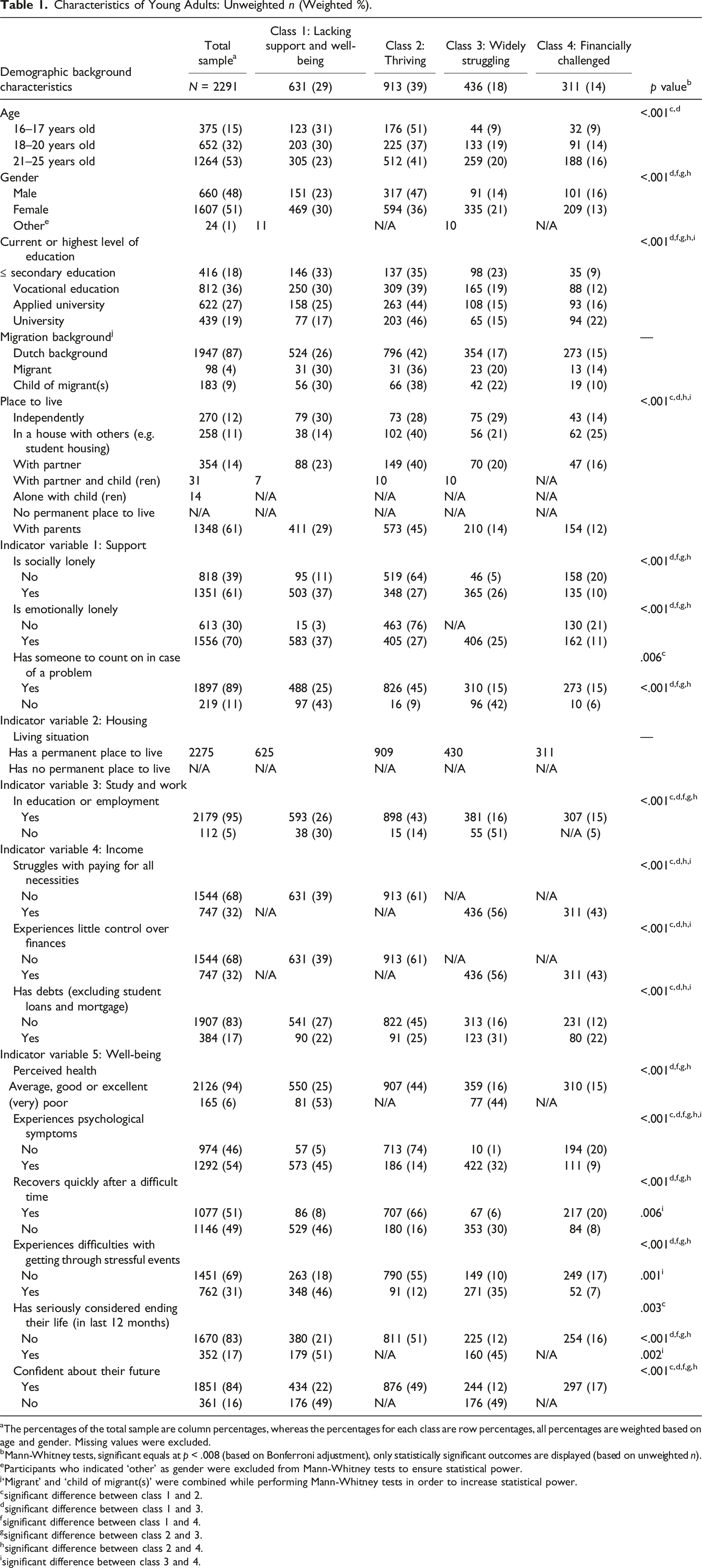
aThe percentages of the total sample are column percentages, whereas the percentages for each class are row percentages, all percentages are weighted based on age and gender. Missing values were excluded.
bMann-Whitney tests, significant equals at p < .008 (based on Bonferroni adjustment), only statistically significant outcomes are displayed (based on unweighted n).
eParticipants who indicated ‘other’ as gender were excluded from Mann-Whitney tests to ensure statistical power.
j‘Migrant’ and ‘child of migrant(s)’ were combined while performing Mann-Whitney tests in order to increase statistical power.
csignificant difference between class 1 and 2.
dsignificant difference between class 1 and 3.
fsignificant difference between class 1 and 4.
gsignificant difference between class 2 and 3.
hsignificant difference between class 2 and 4.
isignificant difference between class 3 and 4.
Identifying Latent Classes of Young Adults
Model Fit Statistics and Diagnostic Criteria.
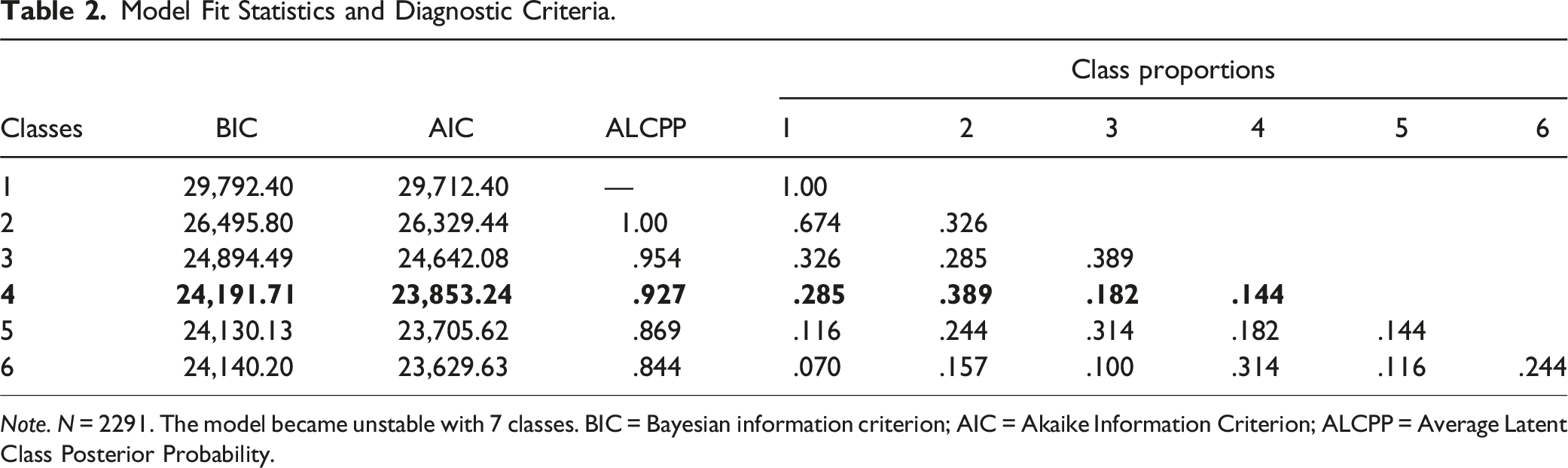
Note. N = 2291. The model became unstable with 7 classes. BIC = Bayesian information criterion; AIC = Akaike Information Criterion; ALCPP = Average Latent Class Posterior Probability.
Figure 1 shows a graphic representation of the four-class model. The upper part of the x-axis lists the needs for independence, while the lower part labels the corresponding items. The y-axis displays the average probability for each score. Higher scores reflect likelihood of scoring positively on the items; therefore, probabilities closer to 1 are desirable. Latent Classes of Young Adults and to What Extent They Meet the Five Needs for Independence. Note. N = 2291. Figure illustrates the characteristics of the four classes based on responses to the five indicator variables and corresponding 14 items.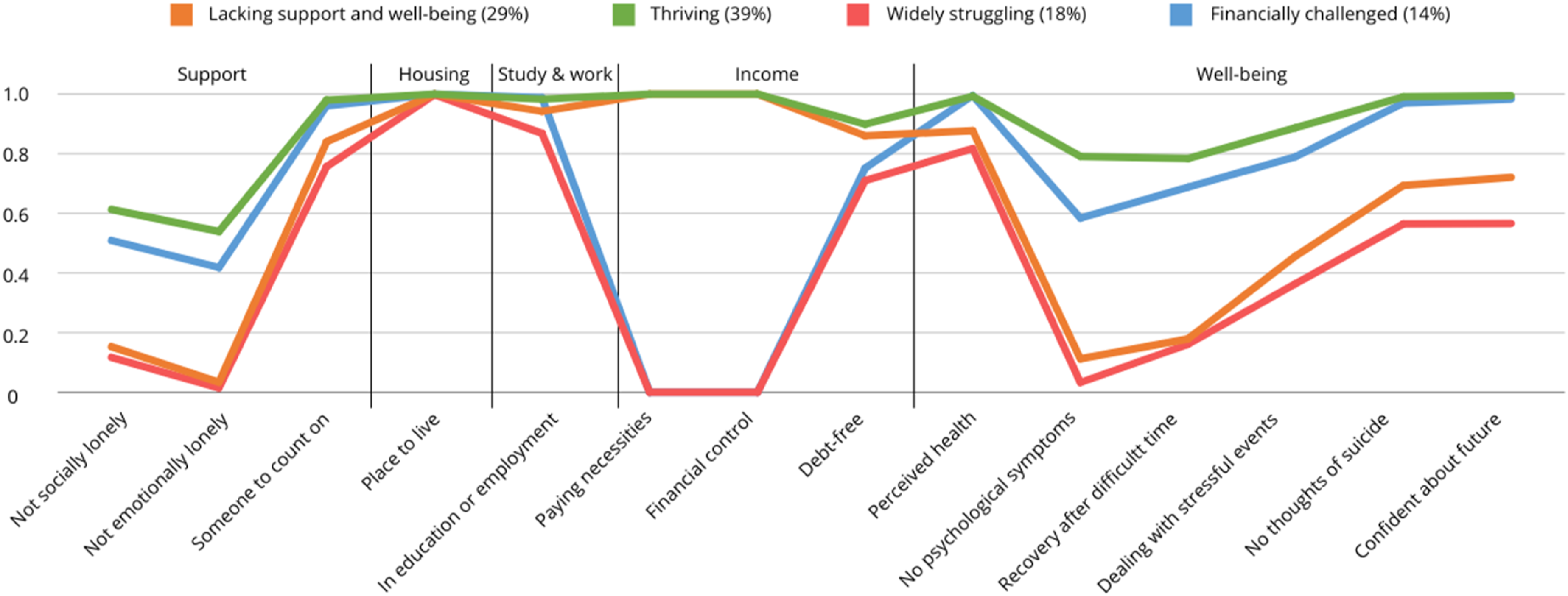
The largest group of young adults are in the Thriving class (39%; class 2), which scores reasonably well on all five needs. This class consists of almost half of all participating males, half of the 16-to-17-year-old participants and almost half of the participants who lived with their parents (see Table 1). Although the Financially challenged class (14%; class 4) has a similar profile to the Thriving class, the former scores very low on ‘income’. This class has the lowest share in
Association Between Classes and Background Characteristics
Results of the Multinomial Logistic Regression of Predictors of Class Membership With a 4-Class Model With Thriving Class as the Comparison Group.
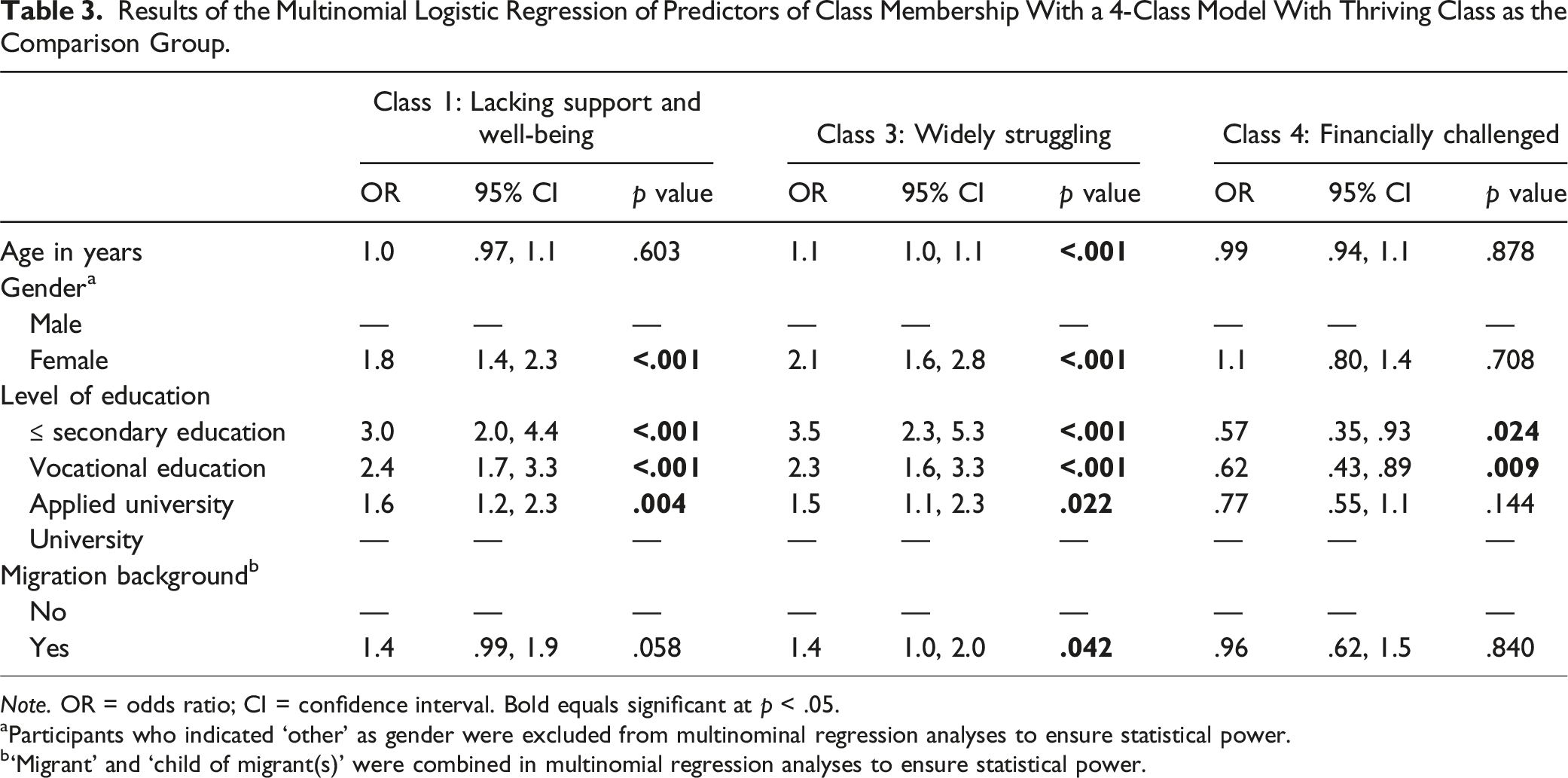
Note. OR = odds ratio; CI = confidence interval. Bold equals significant at p < .05.
aParticipants who indicated ‘other’ as gender were excluded from multinominal regression analyses to ensure statistical power.
b‘Migrant’ and ‘child of migrant(s)’ were combined in multinomial regression analyses to ensure statistical power.
Discussion and Conclusion
In this large study, we identified and described subgroups of young adults and determined to what extent they meet the five needs for independence, respectively support, housing, study and work, income, and well-being. Four latent classes of young adults were recognised. The Thriving (39%) and Financially challenged (14%) classes were reasonably well off and amounted to slightly more than half of the total sample. Members of the Thriving class met most needs for independence, which, with the exception of ‘income’, was comparable to the Financially challenged class. The Widely struggling (18%) and Lacking support and well-being (29%) classes were the worst off, scoring low on almost every need for independence, which should be a matter of great concern. We also assessed relations between subgroups and demographic background characteristics. Females and non-university students/graduates had higher odds of being members of the two least thriving classes.
To our knowledge, this is the first study which included all five needs for independence while adopting a holistic point of view, which resulted in a deeper understanding of the interconnected and potentially cumulative nature of these needs as well as possible implications for young people’s transition to adulthood. Using a person-centred approach allowed for identifying latent classes of young adults based on complex combinations of their scores on each need, generating four distinct classes which otherwise would have been overlooked in a variable-based approach. Our results confirm that vulnerable young adults can be found across all age groups and genders, and at all levels of education. Moreover, we established that high scores on one need are not necessarily accompanied by high scores on other needs; accordingly, two classes showed more diverse patterns of scores.
Our findings highlight that social and emotional loneliness were apparent in every class, in which social loneliness entails missing a wider social network, while emotional loneliness is concerned with missing depth and closeness in relationships (De Jong-Gierveld & Van Tilburg, 2010). Previous studies have emphasised that as young people transition to adulthood, they tend to shift their reliance for intimacy and companionship away from their families and towards friendships and romantic relationships (Levesque, 2011; Meadows et al., 2006). Indeed, Lee and Goldstein (2016) confirmed that the absence of support from friends and romantic partners was associated with increased feelings of loneliness among young people. Hence, in their conclusion, they highlight the importance of non-familial relationships for individual well-being during the transition to adulthood. They also demonstrated that although both male and female young adults experienced negative relationships, lower perceived support by family or friends had a greater negative impact on loneliness among females than males (ibid.). This corresponds with our findings which show that females are more likely to be members of the two classes which are the least thriving and accordingly score very low on support. In our study, we also pointed out another group which has higher odds of being members of the least-thriving classes, namely vocational education students. This finding confirms previous research by Meisters (2023), who established that these students tended to suffer more from severe loneliness compared to students from higher education.
Our study demonstrated large discrepancies between classes in terms of income. Indeed, for some young adults (i.e., members of the Widely struggling class), financial difficulties were associated with an accumulation of problems, while other young adults (i.e., members of the Financially challenged class) also experienced financial hardship but without low scores on the remaining needs. In other words, for some groups, disadvantages “stack up” and lead to a cumulative burden (Nurius, Green, et al., 2015; Turner, 2013), whereas for others they do not. According to Aneshensel (2009), cumulative disadvantage affects individuals’ health and well-being due to differences in societal structures, which result in variations in stress exposure, diverse access to psychosocial support resources and, in time, distinct effects of support resources in mitigating negative effects for disadvantaged groups. Indeed, previous research by Nurius, Prince, and Rocha (2015) demonstrated that youth with multiple disadvantages face increasingly greater risk for negative outcomes later in life. Simultaneously, these youth are being confronted with a lack of social support from family, friends, and the educational environment, which otherwise could have helped alleviate stress and promote positive growth. In our case, we suggest that the defining disparities found between the Financially challenged and Widely struggling classes should not solely focus on the financial domain, but should also encompass other needs, particularly support. As such, these differences between classes could be explained by stating that cumulative disadvantage tends to trap young people in circumstances in which they are confronted with additional stressors compared to their more privileged counterparts. In turn, this can lead to stress levels that surpass their ability to cope, negatively impacting their physical and mental well-being, and initiating ongoing challenges across developmental goals (ibid.) as well as the five needs for independence.
Some limitations are worth mentioning. First, the questionnaire was not designed with the five needs for independence in mind, which meant that we had to determine which items best suited each need. That is why we performed sensitivity analyses, which indicated acceptable to good internal reliability for every need. Second, we dichotomised all included items, which not only may have resulted in a loss of information, but also implies absolute distinctions between classes. Nonetheless, binary items were preferred due to their alignment with the definitions for each need of independence as well as previous studies. Additionally, dichotomised items encourage uniformity and allow for comparison between items. Third, it is well-known that certain groups are less inclined to participate in questionnaires, which can lead to selection bias. Our sample included very few young adults who did not have a permanent place to live or who were not in education and/or employment, which meant that all four classes scored well on ‘housing’ and ‘study and work’. Consequently, we continue to know little about young adults who face challenges in these domains. Nevertheless, in the Netherlands, we benefit from robust social support mechanisms as well as very low levels of young people Not in Employment, Education or Training (NEET) (Fazekas & Litjens, 2014), which means that fewer diversity was to be expected in terms of ‘housing’ and ‘study and work’. Fourth, females were overrepresented in our sample. This bias was minimised by assigning weights. Fifth, although our sample consisted of a decent number of non-binary young adults, it was not sufficient to conduct statistical analyses.
In terms of implications for practice, this study identified various opportunities for intervention and support aimed at smoothing the transition to adulthood. First, throughout the transitional years, it is crucial to enhance and broaden community, educational and institutional support systems to encourage and sustain meaningful relationships, especially with friends and romantic connections and with extra attention for female young adults. Within educational institutions, action could be taken via mentoring or coaching programs, after-school clubs and by improving classroom dynamics. These efforts should also incorporate community centres, buddy systems, local organisations, and online efforts (Lee & Goldstein, 2016). Vocational education students are another group who deserve special attention. Despite the fact that vocational education students in the Netherlands are gradually gaining equal rights to higher education students, social exclusion of vocational education students remains widespread. Vocational education students do not have an introduction week at the start of their studies, nor do they have their own student clubs, cafés, sports and leisure facilities or housing. While these opportunities are available to higher education students, vocational education students continue to be excluded from existing facilities (Van Teutem, 2024). Efforts should be made to fully include vocational education students in opportunities available to all students, especially those focused at building social relationships and nurturing connectedness. Second, in order to break the cycle of cumulative disadvantage, opportunities for nurturing resiliency resources among young people should be explored (Nurius, Prince, & Rocha, 2015). Appropriate coping skills, resourcefulness, emotional regulation, optimism and positive future beliefs have been connected to positive psychosocial adaptation as well as coping with cumulative stress (Jaffee et al., 2007; Wyman et al., 1993).
Future research should focus on studying loneliness among young adults more in depth, in particular gender differences and how emotional and social loneliness are perceived as well as the influence of various sources of support on the individual’s transition to adulthood and well-being. Furthermore, additional research is needed which examines cumulative disadvantage, including income inequality, among young adults and its influences on outcomes later in life. In line with Atzaba-Poria and colleagues (2004), we emphasise the relevance of considering various characteristics as well as environmental factors when examining young people’s transition to adulthood. In addition, the concept of cumulative disadvantage provides an interesting lens for studying young adults for whom financial difficulties were associated with an accumulation of problems, while comparing them to young adults who only experience financial hardship. As such, potential areas of vulnerability or resilience could be unravelled, which would contribute to developing interventions and policies which better address the diverse needs of young adults as they navigate the transitional years. Lastly, more diverse young adults should be included in future endeavours, specifically those without a permanent place to live, without education and/or employment, and non-binary young adults.
Footnotes
Acknowledgements
This publication is part of the project Integrated Public Health Monitor – COVID-19 Phase 2 GGD Zuid Limburg with project number 10430212120005 of the research programme COVID-19, as well as the project Trend Break: collaborating towards a healthy generation with project number 10190022010004, both (partly) financed by the Netherlands Organisation for Health Research and Development (ZonMw).
Declaration of Conflicting Interests
The author(s) declared no potential conflicts of interest with respect to the research, authorship, and/or publication of this article.
Funding
The author(s) disclosed receipt of the following financial support for the research, authorship, and/or publication of this article: This work was supported by ZonMw.
Open Research Statement
The raw data, analysis code, and materials used in this study are not openly available but are available upon request to the corresponding author. The data collection and analysis were not pre-registered.
