



Abstract
Gaining financial independence is a prominent marker of adulthood. This study explored the experiences of a group of South African students (MAge = 22.24), with a specific focus on how the psychological tasks of emerging adulthood are embedded in the socio-economic context. Through the thematic analysis of 26 interviews, participants’ hopes, fears, and well-being (while managing student life shaped by an economically contentious situation) were unpacked. Considering the academic, personal, and social threats in their quests for independence, participants appreciated the support from parents, the university, and funders. Despite financial obstacles, they portrayed a strong personal commitment and resilience to excel academically, be financially liberated, and break the cycle of poverty. Hardship inspired dreams to secure a better future, a ‘soft life’, for themselves and others. Findings are discussed in juxtaposition with the responsibility of institutions to ensure a just society where emerging adults can flourish into financially stable adulthoods and futures.
Keywords
Introduction
During the past few years, student movements in South Africa, such as #FeesMustFall echoed important societal discourses related to financial challenges, societal inequality, and social justice in post-Apartheid South Africa (Brunsdon, 2017; Habib, 2019; Kenyon & Madlingozi, 2022; Martinerie, 2021; Ngcaweni & Ngcaweni, 2018). While pursuing university education and preparing for stable adulthood, South African emerging adult students face various developmental and societal transitions. During this transition, their quest to gain financial independence is prominent.
This research study is part of a larger project titled Selves within Selves on a University Campus: The Intersectionality of Student Identity Development in a Transitional Society. The current research study aims to explore and describe South African students’ experiences as they transition into adulthood, specifically focusing on how the psychological tasks of emerging adulthood are embedded in the socio-economic context. The research question that guided the study was: How do socio-economic circumstances shape student life and the transition into adulthood?
A Developmental Perspective on Transitioning into Adulthood
Transition is a defining feature of the developmental stage of emerging adulthood, usually experienced between the ages of 18 and 29 (Arnett, 2000, 2016). Emerging adults often experience ambivalence regarding their status as adults as they have passed the stage of adolescence but do not yet have the means to fulfil all adult roles. As they develop from the fluidity of adolescence towards more stable adulthood, they gradually move from dependence to independence (Arnett, 2000, 2016; Nelson, 2021). This growing independence gives emerging adults more choices in their day-to-day activities and opportunities to make life decisions. Their social interactions are marked by changes in family-orientated socialisation and the forging of various new relationships. They learn about love, the world of work, and adult commitments. Furthermore, they develop a deepened understanding of the self, ideal views of life, political awareness, and particular individualised ideologies (Arnett, 2016; Hochberg & Konner, 2020; McAdams, 2013). Emerging adulthood is thus typically accompanied by increased agency/independence and decreased social and institutional support (e.g., schools and family) (Arnett, 2016; Wood et al., 2018), a time that can be experienced with optimism about the future and also trepidation about the mastering of new and (sometimes) daunting tasks.
Learning to stand alone (Arnett, 1998) and gaining financial independence are widely regarded as prominent markers of adulthood. Reaching financial freedom and finding their way in the world of work are significant milestones for emerging adults (Arnett, 2016), and their financial well-being, identity formation, and other dimensions of the emerging adulthood stage are intricately related (Ranta et al., 2024; Vosylis et al., 2020, 2022; Vosylis & Klimstra, 2020).
A Cultural Perspective on Transitioning into Adulthood
Arnett (2024) refers to ‘emerging adulthoods’ to explain the various pathways into adulthood. While the structure of this developmental stage might be consistent across countries and contexts, the content differs. Young people worldwide contemplate a stable adult life, aspire to become independent, and strive to have the agency to direct a future of possibility. However, the way in which this is achieved is dependent on historical and cultural context.
In sub-Saharan Africa, the interplay between the concepts independence, dependence, and interdependence reflects the complexity of the continent’s historical, cultural, and socio-economic realities. Themes of independence are prominent in the struggle for political liberation from colonial rule. However, the importance of a sense of autonomy is juxtaposed against cultural values and economic ties that continue to exist in neocolonial relationships. Often, individuals rely on extended family networks and community support systems. Interdependence thus reflects how the cultural values of interconnectedness and shared responsibility form the bedrock of many African societies. The African philosophy of Ubuntu typifies how humanity, communal values, collective well-being, and mutual reliance are deeply rooted in many African contexts and how personhood, spirituality and relationships with others are intertwined (Asante, 1998; Eliastam, 2015; Mkhize, 2004; Nwoye, 2017; Ratele, 2019; Sodi et al., 2021). The strive for independence and identity is thus not a solitary pursuit but a collective endeavour. Autonomy and agency are not understood as detachment, in isolation, or at the expense of others, but rather through harmonious relationships, accountability, and collective thriving. This is seen in studies with African emerging adults where family, social relationships, and religion are recognised as central to the self and personal resilience (Du Plessis et al., 2020; Obidoa et al., 2019; Theron et al., 2021). This echoes principles observed in other countries. For example, in China, there is an emphasis on filial piety, caring for parents, family obligations, and social relations as important markers of adulthood (Kuang et al., 2024; Zhong & Arnett, 2014).
A Societal (South African) Perspective on Transitioning into Adulthood
Emerging adults across the world often face instability while transitioning into adulthood (Arnett, 2000, 2016; Nelson, 2021). In an increasingly competitive world filled with global economic strain, emerging adults navigate various pathways through financial instability (Fonseca et al., 2020; Lanz & Serido, 2020). This instability is accentuated by the economic inequality and political instability of South African society (Alberts & Durrheim, 2018; Van Lill & Bakker, 2020).
South Africa’s emerging adult cohort is the first post-apartheid generation. While they are often colloquially referred to as the ‘Born Free’ generation (Du Toit et al., 2022; Kotze & Prevost, 2016; Malila, 2015), they are also at the heart of the profound challenges and complexity of life in post-apartheid South Africa. The contested nature of the term ‘Born Free’ (Chauke, 2018; Malaika, 2014; Maseti, 2018; Mokoena, 2014) is evidence of the fact that many young South Africans are still burdened by lingering inequalities, structural disadvantage, and related hardship, which prevent them from being economically, politically, socially, and culturally free (Du Toit et al., 2022; Fawzia, 2018; Karpen, 2016; Kotze & Prevost, 2016; Malila, 2015; Malila & Garman, 2016; Moore, 2016; Oyedemi, 2021; Theron et al., 2021).
Despite considerable strides in the transformation of South African society, socio-economic challenges of unemployment, poverty, and inequalities persist (Masipa, 2018; Statistics South Africa, 2024). Although various initiatives aimed at accelerating job creation (such as the Job Subsidy Bill in 2011) have been introduced, the high unemployment rate among the South African youth is discouraging (Kotze & Prevost, 2016; Masipa, 2018; Mseleku, 2022; Van Lill & Bakker, 2022). The number of unemployed emerging adults in South Africa is much higher than in other countries (Maka et al., 2021; Van Lill & Bakker, 2020). The Quarterly Labour Force Survey of Statistics South Africa (2024) reports that the youth recorded the highest unemployment rates, with 59.4% of those aged 15–24 years and 39% of those aged 25–34 years unemployed. The attainment of a degree increases the likelihood of securing employment, with the unemployment rate among young graduates (aged 15–24 years) being 32,6% and for those aged 25–34 years, 22,4% (in the first quarter of 2022). Baldry (2016) also found that a strong influence of structural factors (race and socio-economic status) persists in the employment prospects of graduates.
Emerging adults at the beginning of their careers and facing an important milestone towards entry into adulthood are particularly vulnerable to the effects of unemployment. Their inability to accomplish the aim of becoming independent can be a source of great distress (Van Lill & Bakker, 2022). Not only their future lives but also society at large are affected, as unemployment often leads to substance abuse, engagement in criminal activities, and increases in depression and suicide rates (Mokona et al., 2020).
Higher Education as a Means to Achieve Independence
Training, education, and secure employment are viewed as means to achieve economic independence. Many South African emerging adults pursue higher education studies with visions of an improved future lifestyle and upward social mobility (Wildschut et al., 2020). More than just a personal goal, this is a communal goal as financial stability will also improve the lives of their families and communities and contribute to eradicating societal equality (Van Lill & Bakker, 2022; Wildschut et al., 2020). The majority of South African emerging adults are the first in their families to attend higher education and thus hope to be in a position to have their families’ needs met (Centre for Teaching and Learning, 2023; Motsabi et al., 2020). This intention comes with considerable challenges as their parents often don’t have the financial or social capital to support their children’s higher education engagements (Nachinaab et al., 2019; Vincent & Hlatshwayo, 2018). During childhood, they are often enrolled in rural or under-resourced schools that are struggling to provide the quality education and academic foundation needed for higher education (Du Plessis & Mestry, 2019; Motsabi et al., 2020). Since their parents lack the financial means to support their children’s higher education pursuits, many emerging adult students depend on financial support, such as the government’s National Student Financial Aid Scheme (NSFAS) (McKay et al., 2018; Wildschut et al., 2020). The complexity associated with student funding (practical challenges in the present and structural inequalities culminating from the past) is, however, seen in the poorer academic performance of NSFAS-funded students when compared to students who are self-funded or have other means of funding (Wildschut et al., 2020).
Despite their efforts and investments in higher education, an increasing number of South African graduates are failing to secure work (Mseleku, 2022; Van Lill & Bakker, 2022). In addition to slow economic growth and lack of job opportunities in the country, misalignment between education and the job market, unfair entry-level requirements, a lack of formal experience, and large-scale corruption are perceived to be contributing factors in not finding employment (Maka et al., 2021; Mncayi, 2016; Mseleku, 2022). Since higher education studies require a considerable financial, time, and energy investment, this inability to secure employment is associated with much disappointment and distress (Van Lill & Bakker, 2020). For many emerging adults and higher education graduates, the state of being unemployed has adverse effects on their self-esteem and mental health (Maka et al., 2021), leading to feelings of hopelessness (Mseleku, 2022), decreased well-being (Van Lill & Bakker, 2020), and lack of meaning and sense of significance (Van Lill & Bakker, 2022).
Ruswa and Gore (2022) refer to the multidimensionality of poverty to explain how the interplay of various dimensions of deprivation affects the well-being and success of South African students. When exploring the quest towards financial independence during the transition into adulthood, research studies such as the current study should thus consider the societal inequalities, contextual complexities, and developmental-specific challenges emerging adults face.
Method
This qualitative study was conducted from an explorative stance (Creswell, 2013; Silverman, 2013) to better understand students’ perspectives and experiences of their economic situation as they transition into adulthood. It took place at a large public South African higher education institution, the University of the Free State. Situated in the heart of South Africa, it is one of the oldest public universities in the country. With seven faculties spread across three campuses, it offers a wide range of undergraduate and postgraduate programmes to nearly 50,000 students. Anchored in the values of excellence, innovation and impact, accountability, care, social justice, and sustainability, the university prides itself on being diverse, inclusive, and equitable with a student-centred focus.
A participatory peer design (Lushey & Munro, 2015) was followed. The research assistants were postgraduate students from the Faculty of the Humanities (from programmes such as Psychology, Social Work, and Communication Science). Before the onset of the study, they received training in research ethics, recruitment practices, interviewing skills, respect and sensitivity for participants’ experiences, and debriefing and referral strategies. They also attended an information session about the research aim and processes.
Sampling and Participants
Biographic Characteristics of the Sample.
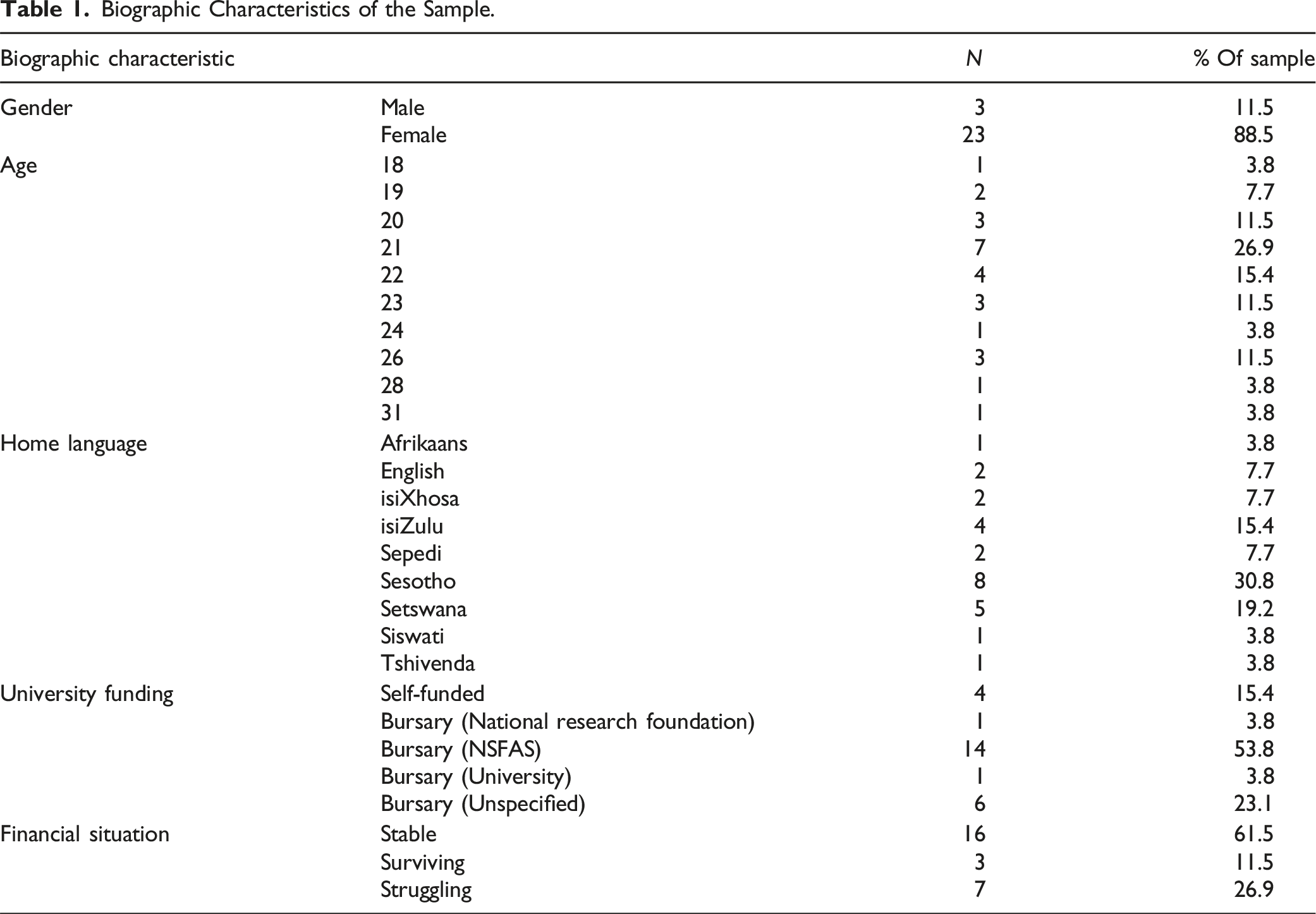
Participants were asked to describe their financial situation. Most participants indicated they felt financially stable (using terms such as Good, Fair, Sustainable, Stable, Average, Middle-class, Adequate, and Okay). About 10 percent experienced some difficulties, but their basic needs were met (Surviving). Approximately a third of the participants indicated that their financial situation is poor/unstable (Struggling).
Data Collection
Once informed consent was gained, individual interviews were conducted. Interviews were scheduled at a time and place convenient to the participants. After building rapport between the peer researcher and the participant, a semi-structured interview schedule was followed. Interview questions prompted participants to explain how their socio-economic status shapes/influences their transition into adulthood, specifically in how they perceive: “yourself?”; “your participation in campus life?”; “your ability to excel academically?”; and “your motivation?”. In addition, participants were asked to reflect on the extent to which the university either supported/hindered them in this transition. The interview questions were not focussed on financial challenges only but aimed to capture the diversity of possible experiences. The language of instruction at the university is English, and although this is not the participants’ first language, they were comfortable expressing themselves in English. Interviews were, however, conducted informally, and where participants struggled with expression, they were allowed to use their mother tongue. These statements were then contextually translated by the interviewer to confirm the English meaning of the participant’s statement. All interviews were audio-recorded and transcribed verbatim for later analysis.
Data Analysis
The research question that guided the analysis was: How do socio-economic circumstances shape student life and the transition into adulthood? Data were analysed following the good practice guidelines for reflexive thematic analysis provided by Braun and Clarke (2022, 2023). The two researchers (authors of this manuscript) first worked through the transcripts individually to familiarise themselves with the complete data set. Preliminary notes were made, and tentative codes of meaningful aspects of the data were generated. This was followed by an interactive conversation about initial reflections. The analysis then proceeded through subsequent coding cycles and the organising of recurring codes into thematic patterns of meaning. Interspersing individual reflexive analysis with interactive discussions between the researchers enriched the analysis, especially since the researchers are positioned in different disciplines (Social Work and Psychology) and brought varied professional experiences, personal backgrounds, and social roles to the process.
Trustworthiness, Rigour, and Reflexivity
Since we acknowledge that we, as researchers, are actively engaged in constructing a contextual truth, critical reflection was important throughout the process (Braun & Clarke, 2022). Ensuring the methodological integrity of our study required a continuous and thoughtful engagement with what we do, how we do it, and why we do it (Braun & Clarke, 2022, 2023; Levitt et al., 2018). The interdisciplinary nature of the research project facilitated disciplinary reflexivity regarding the academic assumptions that inform knowledge production. As mentioned, the interchange of ideas among the authors engaged in different university structures and disciplines allowed the synthesis of ideas and facilitated a deeper understanding. Functional reflexivity resulted in conscious consideration of the utility and fidelity of research procedures and the implications of research methods and actions. For example, realising the possibly sensitive nature of sharing personal information regarding financial situations and experiences, the decision was made to include peer researchers with whom the participants can more easily identify and share experiences. Peer researchers were sensitised during training. Personal reflexivity and continuous introspection (individually and also in interaction between all the researchers involved) emphasised the role of al the researchers’ positionality, identities, and views.
Ethical Considerations
This research study was informed by the ethical principles of beneficence, respect, and justice. Before the onset of the study, ethical clearance was gained from the General Human Research Ethics Committee (Ethical clearance number: UFS-HSD2022/1149/22). All participants signed an informed consent form and were aware of the voluntary and confidential nature of participation. Participants were also made aware of the support services (i.e., financial aid office, social work and student counselling services) available to students (at no cost). To thank them for their contribution and time engagement, each participant received an airtime/data voucher.
Results
Themes and Subthemes Generated From the Thematic Analysis.
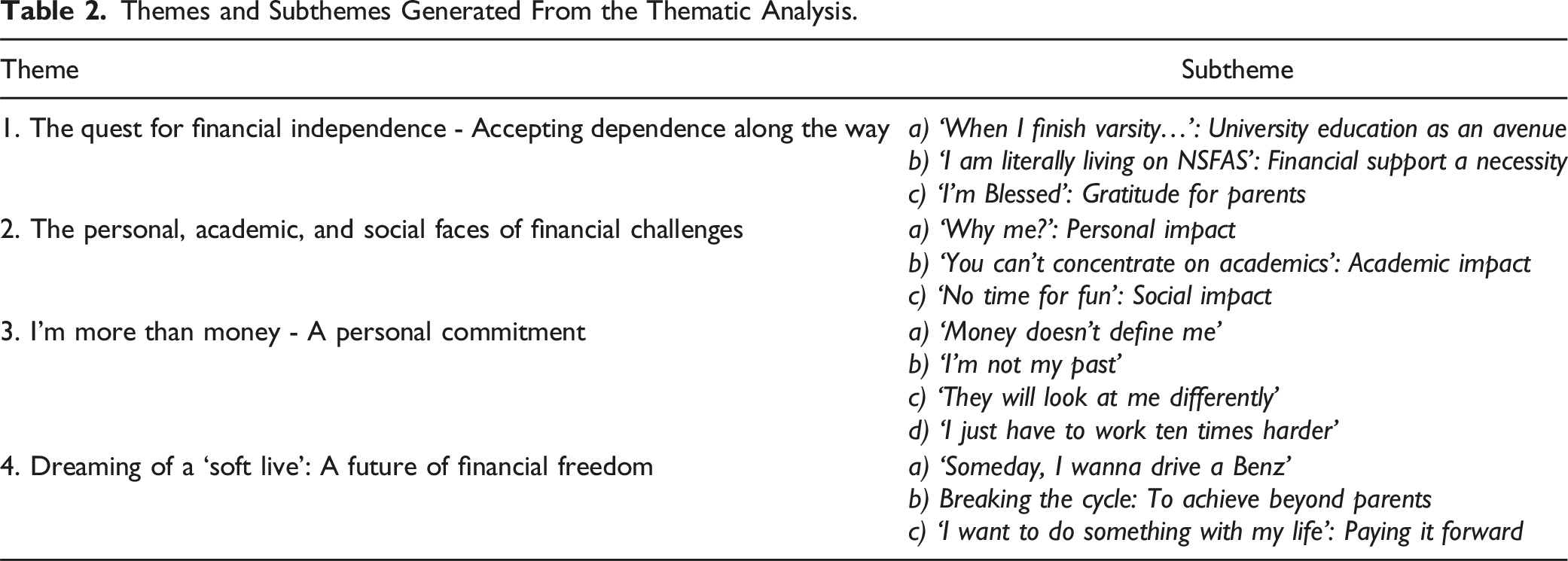
The Quest for Financial Independence - Accepting Dependence Along the Way
A prominent theme across all the interviews was participants’ need to become independent as they transitioned into adulthood. They often referred to the importance of making it on their own: “I can’t depend on my parents like the entire time. I feel like I need to do my own things, that I can’t be depending on my parents until my late 30s (Q48)”. To reach this goal, financial independence was regarded as a priority – they mentioned the importance of securing an income that would empower them: “and be financially liberated (N102)”.
To achieve independence, participants recognised the need to acknowledge their dependence and first accept support from various sources.
‘When I finish varsity…’: University education as an avenue
Many participants regarded a university education as an avenue to reach independence: “if I finish varsity, I am going to have a job and become that responsible adult everyone expects me to be, and independent…, Yhoo!, definitely, I will have that… when I finish varsity. I will have all these skills, so I would definitely have a foundation to start from (Y51-55)”. The majority experienced the university as supportive and felt empowered by knowledge and educational opportunities. They stated that the university allowed them to grow: “it [university] has empowered us to become better people in life, it has empowered us to achieve more, and accelerate in life (H45)”.
Beyond the educational role of the university, participants referred to various additional forms of support offered by the university, such as mentorship, preparatory modules, tutorial support, sports activities, religious activities, student associations, campaigns to promote inclusion, food parcels, and financial planning sessions: “everything that I needed, I was able to get through the university. Basically, I came here without a laptop, and I was able to go to campus and to go to the computer labs to do my work because we have access to the internet (O58)”. In particular, they highlighted the importance of mental health awareness programmes and free counselling services: “the university can always offer us psychologists if you ever feel like you are under pressure or anything, you can go there and get some help so most of the things that I am getting from the university I feel like they are motivating me and they also helps me in going through a student life (O58)”; and: “The course alone cannot just help you to thrive but also you need to keep your mental health in line. So having the opportunity to access the psychologists and the write site… a lot of resources that are found on campus do assist in building the future me (L64)”.
‘I am literally living on NSFAS’: Financial Aid a Necessity
Participants referred to the absolute necessity of financial aid through funding agencies, such as NSFAS: “being an NSFAS student, I personally only depend on that and on the allowance I get from NSFAS. I don’t get extra money from back at home, so I would say it’s easy for me… I actually depend on that money. I have to be more serious… I have to make sure that I spend it wisely (S48)”. For many, this was their only form of financial support which was not only used to pay academic expenses but also to survive day by day: “I am literally living off on NSFAS, and I do not have any other form of income (Y35)”; and: “I am an NSFAS student, and I get a meal allowance that helps me get by (D31)”.
‘I’m Blessed’: Gratitude for Parents
Participants expressed their appreciation for the support provided by parents. Where possible (for a minority of students), parents provided financial means: “I’ve always had my parents to come to the rescue (H35)”. Considering the financial challenges of many of their fellow students, these participants reflected on their own privilege: “I am very blessed… my parents are able to financially provide for me and put me through university… my parents were fortunate to put me through tutors and programmes and take me for assessments and everything when I struggled in high school… I needed a textbook or money to go and print for a project or something; I was able to do that. So, my socio-economic status did put me in a better place to excel academically (P45-9); and: “I think I’m privileged by the fact that my parents do help me with money and I am NSFAS funded. So, it makes life easy because I can get things that I need… it does boost me because I am never broke… (Q43)”. They explained that having money results in a sense of confidence: “I’m more confident when I have more money in the bank account. People don’t need to know about it, I just need to have it (E30)”.
In the absence of financial support from home, participants still valued the principles instilled by family members: “I think it helps that my parents remind me not to put it into my head. Like they are gonna say, ‘Oh K***, we didn’t manage to deposit money into the account this month, … don’t worry, maybe next month we will’. They are open to me about how the financial situation is at home. So, I am always aware of what is going on. So even when month end comes, and the statement comes, and I see that the money hasn’t changed from last month, I know… and I feel like God will make a way (J106-8)”. They reflected on life lessons learned from family members despite difficulty: “material things mean nothing. My mother always says that when you leave this world, you’re going to leave all of those things, and it will only be you and the Lord (P47)”.
The Personal, Academic, and Social Faces of Financial Challenges
From the interviews, it was clear that participants’ financial challenges impacted various spheres of their lives.
‘Why me?’: Personal Impact
Participants articulated various struggles in dealing with the high cost of living. They explained the personal distress related to negotiating multiple expenses on a limited budget: “I’m constantly thinking that I don’t have money to do what I wanna do, whether to buy clothes, whether to do some school work; it’s actually stressful… your mind becomes preoccupied with the thoughts of things that you wanna, and you can’t have that you can’t even focus… you get preoccupied with those thoughts, it’s gonna take you longer to sleep… so now you cannot focus on your studies (T45)”. For many, this negatively impacted their physical health: “I’m only gonna have one meal a day… if I’m hungry in the morning but I’m thinking that I can only eat at night, so that affects me… you ask yourself, ‘why me, why, why do I go through this?’ and the more you think about it, the more it stresses you (T35)”; and: “there was a time when I was sick, and I had to go to a doctor, but I did not have money… sometimes you do not have money for food, you do not have money for transport, and when you do not have money for those things, it’s difficult man (Y47)”.
‘You can’t concentrate on academics’: Academic Impact
Their personal distress negatively impacted their academic focus and performance: “when things get a bit shaky with finances, I remember the stress got me in a very bad place cause I felt like I didn’t belong here anymore… influence a person’s ability to excel because you are worrying about academic stress as it is, and then you have to worry about the fact that you coming here to school is taking its toll in the finances of the family… so you can’t concentrate on academics… there’s always something that’s worrying and eating away at you, so you end up doing not so great because there’s so many stresses (C30)”.
In addition to the role of distress mentioned above, practical challenges to academic success were mentioned. Many participants explained that they do not have the financial means to buy textbooks, make photocopies, purchase data, or get additional equipment or resources needed for practical work: “it becomes difficult for you to excel, to study… if you don’t have money, you’re not able to buy books, you’re not able to access the internet because it requires data or you can’t even pay rent (A68)”; and: “there are times where you want textbooks… but I have to balance. I have to do this and that, so you end up not buying textbooks… You then end up not having more knowledge on your course or whatever just because you are not financially there. That kind of influences your academic life (X52)”. Being entirely dependent on financial aid for academic expenses, meal allowances, and accommodation makes students vulnerable and unable to manage contingencies such as late payment of grants, electricity cuts (loadshedding), etc.
‘No time for fun’: Social Impact
The social domain of student life was frequently influenced. Participants explained how a lack of finances prevented participation in campus activities, social interactions, and relaxing with friends: “I’ve always felt like I’m not going to go there and spend money that I don’t have, you know?… especially when you’re on the lower end of the spectrum, it hinders your participation in that you feel like you don’t belong (C26)”; and: “I didn’t have like money left over for any fun activities (J96)”. This challenge was intensified for students living off campus: “when you’re off campus, then you don’t have access to a lot of resources; you don’t know most of the things that are happening on campus (B73)”. For students living off campus, this resulted in feelings of alienation: “I would be part of the community, right now, I feel like an outsider because I am not there (Y39)”.
Participants felt that this exclusion from participating in campus life affected their personal growth and social development: “most of the time, you feel like you are limited to having certain things just because… not having money to do those things. I feel like they influence who you are as a person (X50)”; and: “Because it limits my participation… it influences my growth in my social life… takes away from me developing my social self (C28)”.
A few participants mentioned how they feel belittled or inferior: “it gets to a point whereby you get to belittle yourself, feel like you do not belong here in the environment… you feel inferior (M.67)”; and: “you have to have money so that at least you can look the part. So, if you are not uhm financially stable, then you don’t afford the luxury clothes… You won’t feel like you are good enough to hang out with a certain group, so at the end of the day, it affects your self-confidence as well (L53)”. These feelings were exacerbated by the financial inequally they witnessed on campus and by comparing themselves with financially affluent students: “now you start thinking, no I don’t have what other people have (G52)”; and: “if they are able to afford things that I do not afford, I will always feel like I’m a parasite to them… sometimes it is a big deal… people are wearing expensive things I can’t afford, so I do not belong (U75-79)”.
Not all participants shared these feelings. One participant explained how social confidence is possible despite financial struggles: “I was the poor kid… us ‘have nots’ stuck together and the ‘haves’ stuck together. So, there was never a point where I personally felt that ‘Yoh, I am so poor what what’ because my circle of people were people in the same situation… We spoke the same language… I’m not the type of person who lets my ‘lack of’ exclude me. If I don’t have something, it’s okay; I don’t have it. But if I want to dance, me, I’m going to dance with my broken shoes or with my bare feet. I’ll include myself (Z120-2)”.
‘I’m More than Money’: a Personal Commitment
‘Money doesn’t define me’
Participants were adamant that their financial status does not define them: “titles don’t define us, money doesn’t mean anything; status means nothing to who you are as a person because there’s more to being you than just your socio-economic status (A64)”. They reiterated how they refuse to allow financial matters to determine or change who they are: “it doesn’t matter whether tomorrow I wake up a millionaire or what; I know I’ll still be the same person (I82)”; and: “I refuse to allow my circumstances to change the person that I am, I refuse that! (K64)”.
Rather than being defined by their financial circumstances, they emphasised the importance of personal characteristics and passion: “I believe that everybody is different and you might have the richest heart and your financial difficulties might be different… you might have the richest family… but your heart would be pure evil (H37)”; and: “It’s not about money, but passion… I still feel like me; there are some needs that I get, and then there are some ones that I can’t get, which is not a train smash (D29)”.
‘I’m not my past’
Many of the participants acknowledged that their past financial experiences and socio-economic status during childhood did shape how they see themselves today: “my socio-economic status influences how I look at myself; I need to remind myself where I am coming from; it’s just a reminder of where I am coming from and why I should not do certain things, why I shouldn’t lose track, because I am trying to change some parts of my socio-economic status (W93)”. Still, for these participants, their childhood experiences served as a reminder not to be defined by a complicated past: “where I’m from doesn’t determine where I’m going (S52)”; and: “I come from a lower like background family… that pushes me to go over my limits… it pushes me to do the best that I can do… you shouldn’t let your past determine your future (R48)”.
‘They will look at me differently’
Participants articulated their need to prove to themselves that they can be successful and to be recognised by others: “It definitely does motivate me to work harder and just prove myself; I can do it. Despite all the problems and challenges I am currently facing (G56)”; and: “If you doubt me, that’s motivation. For me, that’s when I excel the most (V81)”. They reiterated this intention to change their self (and other’s) perception, especially because they had the opportunity to study: “when I got to university, I told myself I’m done being mediocre, I’m done being the average girl in class… I can put in the effort; I can be number one. What’s stopping me from being number one? (Z130-2)”; and: “people actually look at me in a different way now (S60)”.
‘I just have to work ten times harder’
Participants refused to fall prey to self-pity: “I do not feel pity for myself… I do not choose to neglect my academics and feel sorry for myself (M69)”. They frequently mentioned how they believe that anything is possible through hard work: “if you put your academics first you will always achieve whatever that you wanna achieve (O48)”; and: “if you want something, go get it…. As long as you stand up and go get it, then you can do anything (V61)”. With statements such as: “push yourself to the point whereby you are going to be able to graduate on record time ((L55)” participants expressed how they intend to rise above their challenges. The amount of pressure they place on themselves to succeed despite adversity was evident: “it’s about you and what you want to achieve, and if you don’t push yourself nobody else is gonna push you (Z138)”; and: “I can be where I want to be; I can perform and it’s okay to sometimes get knocked down, but it’s getting back up again (P55)”.
Dreaming of a ‘Soft Live’: a Future of Financial Freedom
Financial struggles also instigated dreams of a better future. Participants envisioned a future with less poverty and more comfort (to afford the basic things in life and more) - not only for themselves but also for those around them.
‘Someday, I wanna drive a Benz’
Statements such as: “I just want to get out of this hellhole (E34)”; and: “improve myself so I do not live the life that I am living right now (O52)” show how reflecting on their past and present financial difficulties inspired participants to work towards a better future. Many were willing to make sacrifices in the present to reach a better future: “It actually pushes, it pushes… one day it will be better, if I study now the future looks more brighter… I just have to get rid of the obstacles in the mid-way in order for me to get to that bright side (U83-5)”. Some explained their dreams as a life of comfort without the constant need to worry about money: “have that financial freedom of not actually having to worry about stuff, you know; be able to take care of my family and do what I want to do where I want to do it and not be limited by money (Y49)”. For others, these dreams entailed a life of luxury: “I do envision my life in a certain way at a particular standard… I want to have money, I like the finer things in life (B67)”; and: “be successful… someday I also wanna drive a Benz (U87)”.
Breaking the cycle: To achieve beyond parents
Evident in the discussions was how important it was for participants to break the cycle of poverty: “I grew up maybe in a background where there is poverty… I am trying by all means to get them out of the poverty that [family] they are actually facing right now (S52)”; and: “I’d be staying in the shack. I wouldn’t let you put me down because of the situation at home… Where I’m going, I’m thinking of something big, and I’m also thinking of taking my family out of there (T37)”. They explained how they plan a life beyond that of their parents: “we learn from our parents… it definitely has motivated me to do not just work through the level that they are at but surpass that and make them prouder and you become a better person, achieve more (H41)”; and: “both my parents grew up very poor, so they started from scratch, so they had to work for everything that they have today… you always want to achieve beyond what your parents have, in a sense I do not want to feel like I am worse off (P51)”.
‘I want to do something with my life’: Paying it forward
Participants expressed the desire to improve their own situation but also that of their parents, siblings, and future children: “checking the background that I am from, like it actually makes it makes me strive for excellence because at the end of the day, I know that I’m here to get a degree so that I can actually change the situation at home and so that my younger siblings or cousins or whatever they can actually look up to me as their bigger sister (S54); and: “push me to achieve great marks academically, because at the end of the day, I want to take my parents out of situation… I would want to take us to the next level, you see? Live the lavish life (K66)”.
Being deeply aware of the sacrifices their parents made, they wanted to put their gratitude into action by repaying their parents and lessening their financial pressure: “I’m going to make her [mother] proud; as much as she’s losing so much money, I’m gonna make it an investment for her so that it’s all worth it in the end (Z134)”; and: “my dad had to take a loan… I’m gonna repay my father that money, whether I buy him a brand new car, whatever that I do, I must make sure that I repay him in any way possible… At home, they don’t have food because he’s paying for my loan, so I always thought about how my father struggled to get me where I am and how my sibling and my mom are suffering… they struggled to pay for you, and then you can’t come here and play. You have to study hard (T47)”.
This intention is accompanied by a vast amount of pressure: “I have to work ten times harder for me to achieve certain things, I have to get good grades for me to get my degree, for me to be financially stable for me to be able to provide for my family… I have to do my utmost best to help back at home (X38)”; and: “I see the pressure and the hard work that my parents put into this, and now I actually want to get those good marks so that I can alleviate the pressure from them. Now imagine if I get those good marks, and then I get a merit bursary and stuff like that. Then, they wouldn’t be going through half the things that they are going through now. So, yes, it does motivate me to put in the work (J110)”.
Beyond this, they wanted to bring about change: “I really believe in change… I want a better life for myself and anyone who will be around it. So, my socio-economic status motivates me to do better every day. I want to be better, I want life to be better (W95)”; and: “I wanna excel in everything that I do, so like all the things I do now, like I want them to have… a huge impact on my life on a later stage. So, if I do something now, I wanna make sure it will bring change (I96)”. They expressed aspirations to bring about change in the broader community – to lower the rates of unemployment in the country, create job opportunities for the youth, etc.: “me being able to help another person, being able to help, maybe they could also help me in future, knowing that it is a good thing to provide assistance and being actively involved (X48)”; and: “becoming a teacher is like giving back to the community. So I want to enhance the knowledge that I have; I want to share it with the younger generation that I left there in the community (S58)”.
Limitations of the Current Study
The current study responds to the call from Lanz and Serido (2020) for research studies that consider the vital role of cultural context in exploring the specificity of financial factors associated with emerging adult development. This study was explorative in nature and included the experiences of a small group of South African students from a specific university. As a student sample, the participants do not represent the voices of all emerging adults in South Africa. While the participants were diverse, they were mostly African-Black females. The skewed gender representation might be due to the fact that female students are more willing to share personal information. Furthermore, the peer researchers were postgraduate students from the Faculty of the Humanities from programmes such as Psychology, Social Work, and Communication Science that are dominated by female students. Female researchers might have found it easier to recruit female peers and more challenging to convince males to participate.
The study did not include specific exclusion criteria (i.e., students from any financial status were welcome to participate). Still, the possible role of volunteer bias should be acknowledged. For example, the dominance of narratives about inspiration, in contrast to a context where failure rates are prominent, might be partly due to the need to impress or avoid shame. This might also be explained by what Cloete (2017) refers to as ‘narratives of contradiction’ to describe how post-apartheid youth struggle with the mismatch between supposed political freedom, social equality, and economic opportunities on the one hand, with persistent structural inequality and lack of true social and economic transformation on the other.
Discussion, Implications, and Conclusion
In a South African society where economic complexities are persistent, and youth unemployment is rife (Alberts & Durrheim, 2018; Mncayi, 2016; Statistics South Africa, 2024), the well-being of emerging adults who cannot secure financial independence remains a significant concern (Van Lill & Bakker, 2022). The impact this has in the university context is also seen in student protest movements, such as #FeesMustFall, where emerging adults demonstrate their agency and struggle for liberation (Brunsdon, 2017; Habib, 2019; Kenyon & Madlingozi, 2022; Martinerie, 2021; Ngcaweni & Ngcaweni, 2018). The current study explored the experiences of a group of South African students as they transition into adulthood, with a specific focus on how the psychological tasks of emerging adulthood are embedded in the socio-economic context. The aim was to capture their diverse and nuanced experiences. Financial well-being is context-dependent, and economic life affects the emerging adulthood experience (Vosylis & Klimstra, 2020). The emerging adulthood life stage also differs according to, for example, critical life events and socio-economic status (Arnett, 2024; Landberg et al., 2019). The importance of a context-specific understanding of emerging adult development was evident in how participants’ experiences in this study were shaped by managing student life in an under-resourced and economically contentious situation. Emerging adults’ hopes and fears about the future, and thus also their psychological well-being, are affected during times of financial instability (Fonseca et al., 2020). Reflecting on their financial challenges, the participants highlighted not only academic pressures but also personal and social struggles (i.e., the subthemes: ‘Why me?’ and ‘No time for fun’). The impact on their mental and physical health was evident in their explanations of losing sleep due to worries, having to live on one meal a day, and not being able to seek medical help. Their frequent mention of the importance of mental health services on campus also portrays the psychological strain they experience. In addition, the limitations on their social development were apparent in feelings of exclusion and inferiority (being one of the ‘have nots’) and being discouraged from participating in campus leisure activities. In their research, Radmacher and Azmitia (2013) also emphasised the ambivalence and struggles upwardly mobile emerging adults face to find a sense of self and manage the social stigma associated with background differences.
The current study’s findings also indicated how education (specifically higher education) is prioritised to escape poverty-stricken circumstances and achieve financial independence. For the participants of this study, being at university changed their self-perception (i.e., ‘I’m done being mediocre’) and gave them hope to accomplish future goals. The precarious nature of building their future dreams on ‘when I finish varsity…’ is apparent when considering the South African reality where the increasing number of university enrollments are not absorbed in the labour market (Maka et al., 2021; Wildschut et al., 2020). Especially the mismatch between general degrees and labour market needs, the difficulty of meeting entry-level requirements, and the frustration of having to enter an increasingly competitive market while being excluded from the social capital and networks needed to accomplish this have been widely reported (Maka et al., 2021; Mlatsheni & Leibbrandt, 2011; Mncayi, 2016; Wildschut et al., 2020).
Due to the “in-betweenness” of their life stage, most emerging adults depend on their parents to support them in their studies (Fletcher & Alligood, 2022). Various previous studies have reported the importance of family financial socialisation on emerging adult development (Fonseca et al., 2020; Lanz et al., 2020; LeBaron-Black, Marks, Rosa, & Hill, 2020, 2022; Sirsch et al., 2020; Vosylis & Erentaitė, 2020). In these studies, healthy financial socialisation, such as quality communication, age-appropriate conversations, sharing financial experiences, involving children in decisions, and adopting parents as financial role models were associated with financial well-being and better mental health (Lanz et al., 2020; Lanz & Serido, 2020; LeBaron-Black et al., 2020; LeBaron-Black et al., 2022; Sirsch et al., 2020). The current study’s participants also reiterated the value of these multigenerational processes. Even in the absence of financial support, participants showed gratitude for their parents (i.e., ‘I’m Blessed’). They appreciated parents’ communication, the lessons learnt, and the values instilled. While they did not always have rolemodels of financial success, their childhood poverty and parents’ suffering and sacrifices served as motivators toward future financial well-being (i.e., ‘I am not my past’).
Other studies in Africa, Europe and the United States have also explored how financial considerations shape the pathways through college and higher education. Similar to the findings in the current study, Terriquez and Gurantz (2015) mentioned inequality in educational and labour outcomes and reported how, for US students in community and 4-year colleges, receiving government financial aid, attending to family financial obligations, paying for housing expenses, and rising tuition rates are key factors in their educational pursuits. The reciprocity expectations reported in the current study were also revealed in a study by Mazelis and Kuperberg (2022), where ‘to help family in return for help received’ framed the transition into adulthood. Abrica and Martinez (2016) also explained Latino male community college students’ strong desire for economic and academic success and how they navigate financial challenges shaped by race, gender, and immigration status by relying on complex strategies. In a study among students in Greece, Philippas and Avdoulas (2019) found that financially literate students are better able to cope with an unexpected financial shock. Kabonga et al. (2020) also considered how African students balance education and survival strategies (including transactional relationships and entrepreneurial activities) during economic difficulties. They refer to the agency of students during these times as them being “prisoners of hope,” Concerns regarding finances (among other factors) negatively influence especially first-generation South African students’ subjective perceptions of their well-being (Pretorius & Blaauw, 2020).
The participants of this study shared ample stories of hope and resilience – their hardship inspired dreams of a ‘soft life’. Hailing from difficult circumstances, they were focused on their personal commitment rather than financial limitations (i.e., ‘Money doesn’t define me’). With their dreams and desires to secure a better life for themselves and others, they were determined to excel academically, be financially liberated, and break the cycle of poverty (as seen in the subtheme: ‘I want to do something with my life’). Similarly, Van Lill and Bakker (2020) commented on the optimism displayed by their emerging adult participants despite disappointments and persisting challenges in South African society. The prominence of perceived possibilities and self-focus during emerging adulthood can make this an opportune time for changing one’s financial situation and outlook (Vosylis & Klimstra, 2020). Wood et al. (2018) also mentioned the importance of hope, self-efficacy, a sense of control, and other forms of personal capital in the youth. However, the instability experienced by emerging adults from lower socio-economic backgrounds and carrying more responsibilities intensify the pressure to achieve adult status (Landberg et al., 2019), as also seen in the subtheme of the current study: ‘I just have to work ten times harder’. Since achieving independence is a major milestone in their life stage (Arnett, 2016; Nelson, 2021; Wood et al., 2018), these obstacles can result in a feeling of not mattering in one’s social context and a lack of sense of significance (Van Lill & Bakker, 2022). In their research with unemployed university graduates in the UK, Cockshott et al. (2018) explained the vulnerability of this inability to reach a sense of maturity with experiences of ‘falling from grace’, ‘feeling left behind’, and a ‘life on hold’. The optimism and enthusiasm evident in emerging adults across the globe are also seen in this group of South African emerging adults. They want to be focussed on a better future, see opportunities to make a difference, and desire to thrive despite their difficult circumstances. They negotiate an uncertain world while visualising a better life not only for themselves but also for their family and community. Many researchers have pointed to the resilience of African emerging adults (Theron et al., 2021). South African emerging adults prioritise family relationships, embeddedness in relationships, spirituality and the importance of the educational context to promote their well-being (Du Plessis et al., 2020; Theron et al., 2021; Wilson et al., 2021). While facing an unstable society, structural disadvantage, and chronic poverty, they are expected to carry the responsibility of escaping generations of poverty (Davids, 2022; Malaika, 2014; Malila, 2015; Moore, 2016). They believe in their personal capacity to move outward and upward beyond the constraints of their realities. If these ambitious future aspirations do not come to fruition, they might consider this a reflection of their personal inability (and inherent inferiority) (Fawzia, 2018; Karpen, 2016; Malila & Garman, 2016).
The negative effects of student debt have been widely reported (Cherney et al., 2020). The participants of this study reiterated the essential role of external funding to survive (i.e., ‘I am literally living on NSFAS’). Their conversations echoed the South African reality of the poverty in which many South African families live, the inability of parents to finance quality education and the inequalities associated with this (Du Plessis & Mestry, 2019; Nachinaab et al., 2019). Despite the considerable investment from the government’s financial aid scheme (NSFAS) to improve the access and success of historically disadvantaged students, barriers to their optimal participation in higher education remain (Wildschut et al., 2020).
The injustice to a young generation at the brink of adulthood, trying to excel while fighting structural and systemic disadvantages, can not be ignored. The reality of their daily lives (filled with struggles to meet basic needs and concerns about their families back home) is in stark contrast with the images of student life where the focus should be on studying and ‘being young’. The participants of this study emphasised the importance of their own resilience and personal responsibility towards their personal and collective success. However, beyond personal resilience and accountability, resources from multiple systems are required for positive outcomes. Ranta et al. (2024), for example, argued that although personal resilience is an individual resource and protective trait that can contribute to emerging adults’ financial well-being, it is not enough to buffer the impact of financial loss and disruptions (especially in challenging times such as during the COVID-19 pandemic). They emphasised the importance of additional sociodemographic, governmental, and community resources. Also, Theron et al. (2021) have warned that the failure of social ecologies to co-facilitate positive outcomes can have a detrimental effect on youth resilience. Social redress, addressing unemployment, and creating employment opportunities for graduates through national initiatives and government policies thus remain essential. Such initiatives from the government and higher education institutions should not only make access to higher education possible through establishing a socio-economic system but also ensure sufficient holistic support to participate fully in the university experience and enable the translation of educational attainment into material shifts in socio-economic conditions (Tivaringe, 2019; Vincent & Hlatshwayo, 2018; Wildschut et al., 2020).
In addition to the importance of political will and societal responsibility, universities should also prepare students for the realities of the employment market. The structural inequalities in educational and social capital that have persisted over decades necessitate the inclusion of both the contextual and personal realities in constructing mature career identities (Watson, 2013; Watson et al., 1995). Universities should raise students’ realism, encourage an analytic and problem-solving approach to career planning, and provide exposure to the world of work. Fourie (2018), Farayibi (2015), and Musara et al.. (2020) are also calling for an appreciation of the employment creation potential of the informal sector (and not only university education) as a way to address realities in African countries.
From the findings of this study, it is clear that funding is sorely needed but surely insufficient to address students’ financial struggles. Financial support should be complemented with other forms of emotional and social support. Mentorship programmes and psycho-social interventions to alleviate psychological stress and stigma and access to resources related to all dimensions of deprivation are needed to address the interrelatedness of multidimensional poverty (McKay et al., 2018; Ruswa & Gore, 2022). In an empathic and enabling environment, the resilience and optimism of emerging adult students (as portrayed in this study) can be harnessed towards futures where they and those around them can flourish and, hopefully, experience the ‘soft life’ they are dreaming about.
Supplemental Material
Supplemental Material - The Quest for a “Soft Life” and the Transition into Adulthood: Views from South African Emerging Adult Students
Supplemental Material for The Quest for a “Soft Life” and the Transition into Adulthood: Views from South African Emerging Adult Students by Luzelle Naudé and Merlene Esau in Emerging Adulthood.
Footnotes
Declaration of Conflicting Interests
The author(s) declared no potential conflicts of interest with respect to the research, authorship, and/or publication of this article.
Funding
The author(s) disclosed receipt of the following financial support for the research, authorship, and/or publication of this article: The study was supported by an interdisciplinary grant from the Office of the Vice-Rector: Research and Internationalisation at the University of the Free State. It is part of a larger research project titled: “Selves within Selves on a University Campus: The Intersectionality of Student Identity Development in a Transitional Society”.
Ethical Statement
Transparency and Openness Statement
The raw data, analysis code and materials used in this study are not openly available but are available from the corresponding author upon request.

Supplemental Material
Supplemental material for this article is available online.
Author Biographies
References
Supplementary Material
Please find the following supplemental material available below.
For Open Access articles published under a Creative Commons License, all supplemental material carries the same license as the article it is associated with.
For non-Open Access articles published, all supplemental material carries a non-exclusive license, and permission requests for re-use of supplemental material or any part of supplemental material shall be sent directly to the copyright owner as specified in the copyright notice associated with the article.
