



Abstract
Social media use has been associated with negative effects on mental health, but little is known about the role of personality pathology in predicting social media use. To address this gap, this longitudinal study examined the relationship between self-reported pathological personality domains (Short Form Personality Inventory for the DSM-5; PID-5-SF), social media use (hours per day) and social media self-control failure measured 3 years later. A total of 368 emerging adults (M age = 24.86 years, SD = 1.11, 55% female) were included. Using a multivariate mediation model, we investigated whether pathological personality traits relate to social media use through social media self-control failure. Results indicated that while no direct relationships were observed, social media self-control failure served as an indirect-only mediator between the pathological personality domain of disinhibition and social media use. These findings have implications for clinical practice in identifying individuals at risk for higher social media use.
Keywords
Introduction
Social media plays an increasingly significant role in how individuals socialize. Currently, Instagram, Facebook, WhatsApp, TikTok, and YouTube are viewed as the most predominant social networks in Western society, all emphasizing real-time text and voice communication (Valkenburg et al., 2022; Zhao et al., 2010). Through these applications, users can both interact with and exchange a wide variety of information, ranging from photos and videos to links as well as share their status on activity timelines. Whereas social media has been adopted by most age groups, adolescent and emerging adult populations display the highest levels of usage ranging between 148 minutes for emerging adults to 184 min for adolescents per day (Statista, 2022). In fact, today’s adolescents and emerging adults represent a unique demographic, as they are the first generations to have grown up in a highly digitalized social environment. High social media use is characterized by a recurring pattern of behavior that requires a substantial time commitment to social media platforms (Pellegrino et al., 2022). There is ample empirical evidence that high rates of social media use are a risk factor for mental health problems such as depression, anxiety, loneliness, and psychological distress (Bekalu et al., 2019; Huang, 2022; Karim et al., 2020; Marino et al., 2018). This is in line with the Goldilocks hypothesis which points toward a balanced range of social media use—which should neither be too low nor too high—where users may benefit from social media without succumbing to problematic behavior (Przybylski & Weinstein, 2017). This perspective indicates that while spending a considerable amount of time on social media can be part of typical behavior, overuse may be associated with maladaptive outcomes. Since high social media use tends to develop early on throughout adolescence or emerging adulthood and may influence behavioral and mental health problems later in life, understanding the predictors and mechanisms that can explain high social media use is highly relevant (Ciarrochi et al., 2016; Huang, 2022; Shannon et al., 2022).
High (or elevated) levels of social media usage do not automatically equate problematic social media usage. Griffiths et al. (2014) suggest that problematic social media use is characterized by symptoms similar to those of substance or behavior addictions. These symptoms include relapse (failure to control one’s social media use behavior), tolerance (intensifying one’s own social media use to realize a preceding mood-enhancing effect), salience (compulsive thoughts about one’s social media use behavior), withdrawal (psychological distress in response to reduced social media use), and conflict (additional social media use reduces time invested in other life domains). Whereas high social media use plays a significant role in terms of paving the way toward addiction, it is just one vital aspect of the symptom cluster that constitutes problematic social media use (Pellegrino et al., 2022). Hence, increasing our understanding of factors that affect and predict high social media use is important to prevent mental health problems, especially with regard to adolescents and emerging adults.
Pathological Personality and Social Media Use
Recently, interest emerged in the association between high social media use and what is described in the latest version of the Diagnostic and Statistical Manual of Mental Disorders (DSM-5; American Psychiatric Association, 2013) as the five maladaptive domains of the Alternative Model of Pathological Personality (AMPD): negative affectivity, detachment, antagonism, disinhibition, and psychoticism. The core of the AMPD model is that normative personality and personality pathology exist on one continuum rather than as two distinct entities. This dimensional perspective on personality infers a focus on subclinical pathology, which often precedes the actual manifestation of syndrome disorders (Shankman et al., 2009). The pathological personality dimensions are conceptualized as maladaptive or pathological extremes of the Five Factor Model personality domains and strong correlations with the personality domains of the Five Factor Model have been observed (Clark & Watson, 2022; Monaghan & Bizumic, 2023; Widiger & McCabe, 2020; Zimmermann et al., 2014). Additionally, these pathological domains are widely supported in both clinical and personality research (Bach & Tracy, 2022; Krueger & Hobbs, 2020; Widiger & Costa, 2012).
In conjunction with understanding how personality pathology is associated with social media use, the Uses and Gratifications Theory sheds light on the diverse factors driving social media use. According to this theory, individuals engage with social media platforms based on habitual behaviors and individual characteristics, including the type of gratification sought after, age, sex, and personality make-up (see e.g., Falgoust et al., 2022; Kircaburun et al., 2018; Lee et al., 2015; Piwek & Joinson, 2016; Sheldon & Bryant, 2016). More generally, the Uses and Gratifications Theory (Katz et al., 1973; Liu, 2015; Ruggiero, 2000) serves as a well-established framework for elucidating user engagement across various traditional as well as emerging media forms (Hossain, 2019; Whiting & Williams, 2013). This theory posits that individuals select media outlets that fulfill their needs and provide gratification, and these gratifications significantly shape media usage patterns and repeated engagement (Kaye & Johnson, 2002).
Research points toward a potential link between pathological personality domains and high social media use, internet addiction, as well as gaming disorder (for examples, see Dong & Potenza, 2014; Gervasi et al., 2017a; Laier et al., 2018). More specifically, the pathological personality domain of negative affectivity, which is characterized by a higher tendency to experience discomforting emotions, ranging from anxiousness to hostility (DSM-5; American Psychiatric Association, 2013), has been found to be positively correlated (based on cross-sectional designs) with both higher social media use, higher problematic social media use, as well as higher internet addiction scores in emerging adults, and higher gaming disorder scores among adults (Gervasi et al., 2017b; Laier et al., 2018). Kardefelt-Winther (2014) postulates that individuals exhibiting elevated levels of negative affectivity may employ digital media as a dysfunctional coping mechanism to manage emotional distress or adverse life situations. The Uses and Gratifications theory suggests, that it may be the case that for these individuals, social media serves as a tool for seeking gratification via emotional support, distraction from negative emotions, or validation from online interactions (Grellhesl & Punyanunt-Carter, 2012). By engaging with social media, they may temporarily alleviate their discomforting emotions or find solace in online interactions, fulfilling their need for emotional connection. In consequence, their higher social media usage patterns may be driven by the desire to ultimately obtain these gratifications.
In terms of detachment, which includes social withdrawal and a tendency to mistrust others (DSM-5; American Psychiatric Association, 2013), cross-sectional studies have revealed a positive relationship with symptoms of internet gaming disorder in adults (Laier et al., 2018) as well as a negative relationship with social media use in emerging adults (Perugini & Solano, 2021). In contrast to the predominantly interactive nature of social media, individuals scoring high on detachment are hypothesized to find solace in online gaming media which does not force the individual to be socially active (Laier et al., 2018). Under the framework of the Uses and Gratifications Theory, the discrepancy in media consumption patterns observed among individuals high in detachment can be explained by their potential gratification-seeking behaviors (Liu, 2015). Social media platforms typically emphasize interactive communication and social engagement, catering to the needs of users seeking social interaction, validation, and relationship maintenance. However, individuals scoring high in detachment may not find these gratifications appealing due to their preference for social withdrawal and mistrust of others. There-fore, the lower engagement with social media observed among individuals high in detachment may be attributed to their preference for media platforms that cater to their desire for gratification of solitary activities and avoidance of social interaction.
With regard to antagonism, which encompasses antisocial facets as well as attention-seeking tendencies (DSM-5; American Psychiatric Association, 2013), research has shown a positive correlation with higher social media use, problematic social media use, higher internet use disorder scores, and internet gaming disorder (Gervasi et al., 2017b; Laier et al., 2018). Laier and colleagues (2018) speculate that individuals exhibiting elevated levels of antagonism may possess an inherent propensity for increased social involvement, primarily since many fundamental facets within this domain necessitate interaction and engagement with other individuals. According to the Uses and Gratifications Theory, individuals high in antagonism, might perceive social media as an avenue that provides gratification via seeking attention and social interaction, which in turn aligns with their inherent propensity for increased social involvement (Tanrıkulu & Erdur-Baker, 2021). The interactive nature of social media platforms allows individuals to assert themselves, garner attention, and engage with others, satisfying their need for validation, recognition, and social stimulation.
Regarding disinhibition, which is composed of impulsive decision-making, distractibility, and higher risk-taking behavior (DSM-5; American Psychiatric Association, 2013), studies have found a positive correlation with higher social media use, higher symptom scores of problematic social media use, as well as internet addiction scores in emerging adults, and internet gaming disorder among adults in cross-sectional studies (Gervasi et al., 2017b; Perugini & Solano, 2021). Individuals scoring higher on disinhibition are assumed to be especially vulnerable to continued use of digital media despite ensuing negative consequences. With regard to Uses and Gratifications Theory, for individuals high in disinhibition, social media may serve as a platform for impulsive expression, immediate gratification, and risk-taking opportunities (Krcmar, 2017; Morehead et al., 2016). The instantaneous nature of social media allows individuals to seek out a broad range of gratifications, such as engaging in spontaneous interactions, sharing impulsively, and seeking novel experiences, satisfying their need for stimulation, excitement, and instant rewards.
Finally, psychoticism, characterized by atypical thinking and cognitive dysregulation (DSM-5; American Psychiatric Association, 2013), has been observed as a positive, cross-sectional predictor for internet addiction (Boursier et al., 2020) as well as for higher social media use, and problematic social media use in emerging adults (Gervasi et al., 2017b). Gervasi, La Marca and colleagues (2017b) speculate that individuals demonstrating elevated scores on the trait of psychoticism may perceive social media platforms as a conducive environment for the exploration and expression of ideas and aspects of self that might remain uncommunicated in offline interactions. Consequently, these individuals may allocate greater time to their social media engagement. Regarding the Uses and Gratifications Theory, individuals scoring high in psychoticism, social media may offer a platform for unconventional expression, exploration of ideas, and self-exploration that may be inhibited in offline interactions (Orchard & Fullwood, 2009; Orchard et al., 2014). The anonymity and freedom of expression afforded by social media platforms provide an opportunity for individuals to communicate ideas and aspects of self that may not be easily conveyed in face-to-face interactions.
Taken together, various interesting associations have been revealed between high social media use on the one hand, and personality pathology on the other hand. However, as most previous work entails cross-sectional designs rather than longitudinal designs, no insights into the direction of the associations between both have been established. Given the potential negative outcomes of social media use as well as the fact that emerging adults are more prone to high social media use, the present study aims to investigate whether pathological personality traits are related to social media use three years later and whether this relation is mediated by social media self-control failure (see Figure 1; Path a, b, c, c’; a x b). Conceptual Multivariate Mediation Model. Note. Path c = total effect of pathological personality domains on social media use. Path c’ = direct effect of pathological personality domains on social media use after including social media self-control failure as a mediator. Path a = effect of pathological personality domains on social media self-control failure. Path b = effect of social media self-control failure on social media use.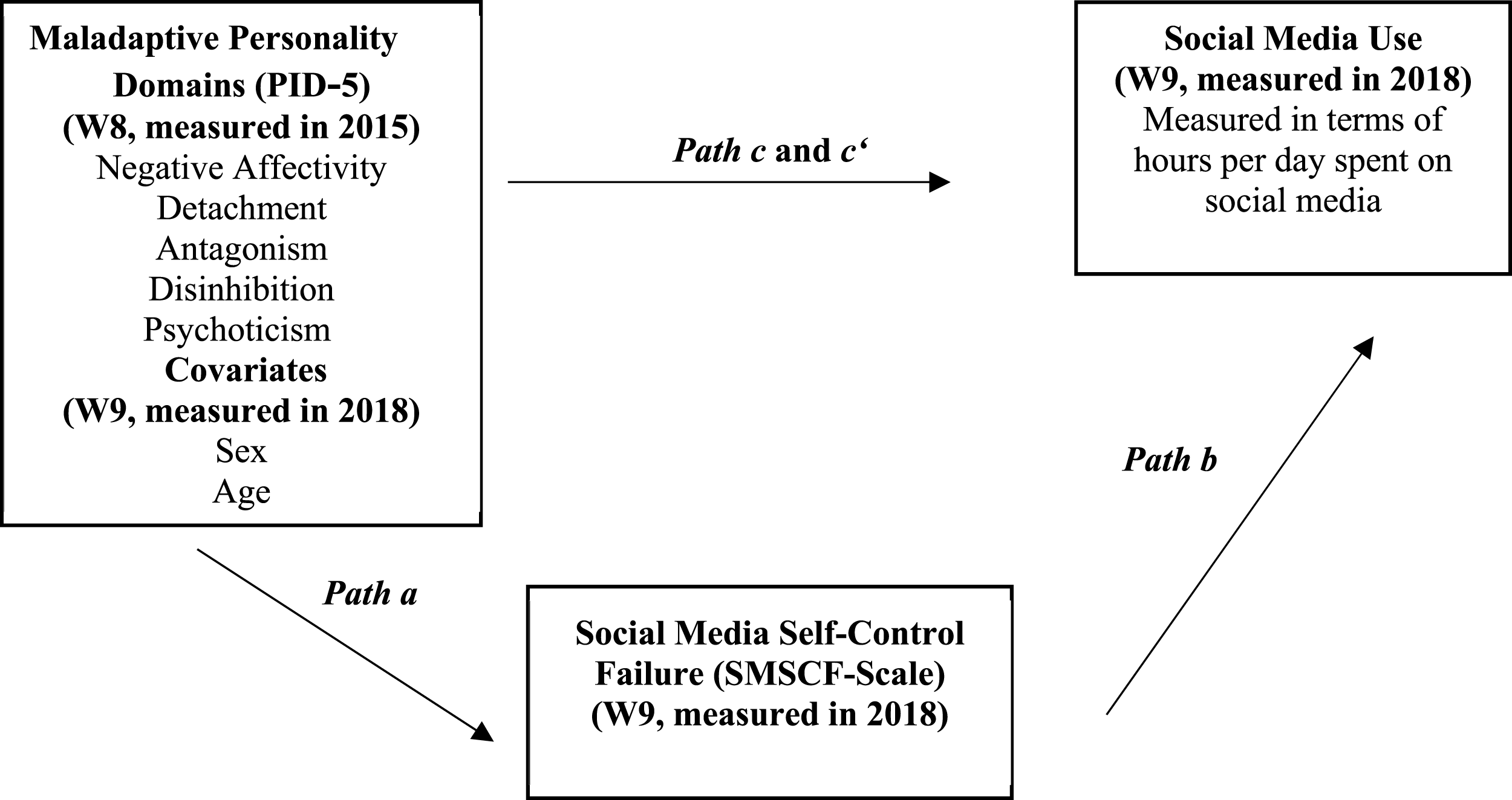
Pathological Personality Domains and Social Media Use: Mediation by Social Media Self-Control Failure
The mechanisms that can explain the relationship between personality pathology and social media use remain unclear. However, several studies link poor self-control with high social media use (Zahrai et al., 2022a) as well as with personality disorders (Holmgren & Coyne, 2017; Shaw & Black, 2008). In fact, one’s capacity for self-control has been found to be an important transdiagnostic aspect of general psychopathology, as well as personality pathology (Aldao, 2016; Freis et al., 2022; Santens et al., 2020). Self-control refers to the ability to modify one’s responses in pursuit of long-term goals (Gillebaart, 2018). More specifically, the Uses and Gratifications Theory (Katz et al., 1973; Zahrai et al., 2022a) defines poor self-control as an inherent incapacity to forego inconsequential immediate rewards in deference to more substantial, albeit delayed, rewards. A general lack of self-control has been found to be correlated with social media self-control failure, which is a context-specific measure of self-control and refers to the extent to which individuals disregard other goals in favor of using social media, resulting in maladaptive consequences like delayed tasks or inefficient use of time (Du et al., 2018). According to Du and colleagues (2018), despite many individuals reporting high failure rates in controlling their social media use, most do not score high on problematic social media use, which seems contradictory in nature. Therefore, Du and colleagues (2018) developed the social media control failure scale. In studies that utilized experience-sampling methods, emerging adults reported failure rates between 35 and 42% when trying to control their social media use while meeting other daily obligations (Hofmann et al., 2012; Meier et al., 2019). In addition, recent, longitudinal studies have shown that social media self-control failure is a strong predictor for higher social media use in adults, but less is known about the effects in other age groups such as emerging adults (Kerkhof and van Koningsbruggen, 2019; Meier et al., 2019).
Whereas the construct of trait self-control, which overlaps considerably with social media self-control failure, has been studied in relation to personality pathology (de Ridder et al., 2012; Johnson et al., 2017), no studies have investigated how personality pathology relates to social media self-control failure. Theoretically, the Uses and Gratifications Theory provides a conceptual framework for understanding the interplay between (adaptive) personality traits, (poor) self-control, heightened social media engagement, and the emergence of behavioral addiction, as articulated by Zahrai et al. (2022a). According to this theory, an individual’s inherent (adaptive) personality traits significantly influence their preferences for using social media, their interaction with these platforms, and the intensity of their social media use. Additionally, the Uses and Gratifications Theory emphasizes the pivotal role of self-control, elucidating how the presence or absence of self-control significantly impacts the trajectory of increased social media use, contributing to its escalation over time. Subsequently, individuals exhibiting certain domain-level constellations or specific deficits in the context of personality pathology, such as pronounced impulsivity or emotional instability in terms of scoring higher on the pathological personality domain of impulsivity, may have more deficiencies in self-control, which in turn might lead to challenges in regulating one’s inclination to seek gratification via one’s social media use. In consequence, it is conceivable that social media self-control failure may mediate the relationship between personality pathology and social media use. A recent review by Billen and colleagues (2022) highlighted several associations between higher scores on personality pathology and poor self-control in adults. However, limitations were also highlighted in terms of a general lack of studies and predominantly cross-sectional designs in available studies
The Current Study
To the best of our knowledge, no prior studies have investigated associations between all five pathological personality domains of the APMD and time spent on social media. Whereas most studies focusing on pathological personality domains and social media are based on a cross-sectional design, the current study investigated the 3-year longitudinal associations between pathological personality domains and social media use in a community-sample study of emerging adults aged 23–27 years. Furthermore, we empirically test the extent to which these associations are mediated by social media self-control failure.
Our first aim was to study the longitudinal associations between personality pathology domains and social media use. Based on emerging literature and rooted in Uses and Gratifications Theory, we expected that emerging adults with higher levels on the personality pathology domains of negative affectivity, disinhibition, and psychoticism would report higher levels of social media use three years later (see Figure 1; Path c). Additionally, considering the scarcity of longitudinal inquiries examining the association between pathological personality domains and heightened social media use and given the meaningful interrelations among pathological personality domains, we incorporated both detachment and antagonism as additional variables for exploratory investigation.
Our second aim was to investigate whether social media self-control failure mediates the relationship between pathological personality domains and social media use. Based on the reviewed empirical studies, we hypothesized that social media self-control failure would mediate the relationship of pathological personality domains in terms of negative affectivity, antagonism, detachment, and psychoticism, and social media use among emerging adults (see Figure 1; Path a, b, c, c’; a x b). We apply the same rationale as outlined in our first aim, thereby incorporating disinhibition to advance our understanding of the five pathological personality dimensions as an overarching framework.
Method
Participants and Procedure
Demographic Frequencies at Wave 9 (2018).
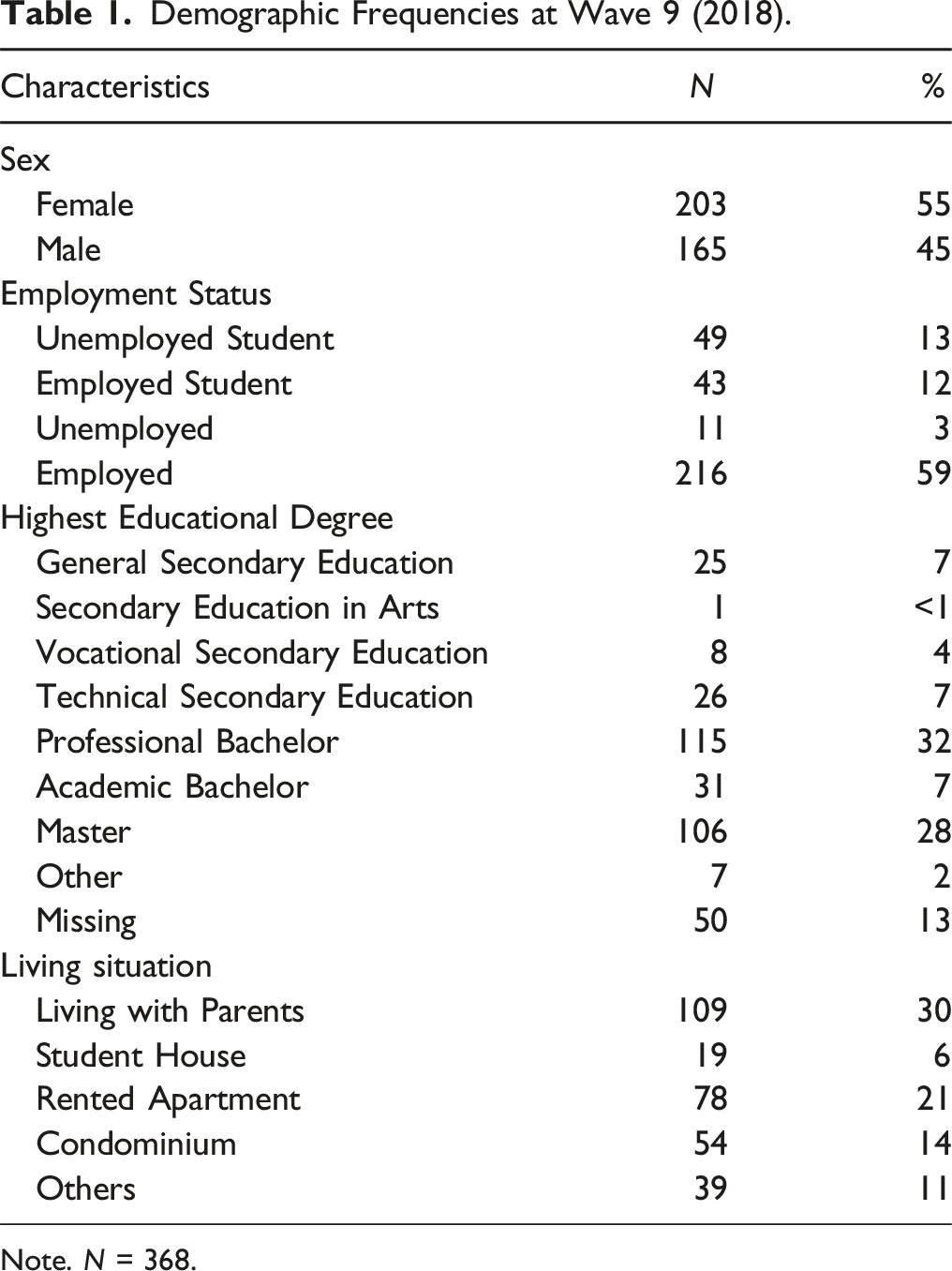
Note. N = 368.
Missing data points across the cases within the sample amounted to 4.86% (n = 58), and Little’s Missing Completely at Random test (Little, 1988) suggested that the data were missing completely at random (χ2(21) = 31.81, p = .06). We handled missing data through multiple imputation to ensure optimal utilization of the available data (Jakobsen et al., 2017). As per the recommendations of White and colleagues (2011), the number of imputed data sets (m = 5) was based on the percentage of missing data across cases. Among the variables for which multiple imputation was applied were age and sex, as well as scores for the PID-5-SF scale, the SMSCF scale, and social media use.
Materials
Pathological Personality Traits
Emerging adults rated their pathological personality characteristics at Wave 8 using the ‘Personality Inventory for DSM-5 Short Form’ (PID-5-SF; Maples et al., 2015). The PID-5-SF contains 100 items, measuring the five pathological personality domains. Answers are given on a 5-point Likert scale (ranging from zero = very false; 4 = very true). The domains are: (1) negative affectivity (“I get emotional easily, often for very little reason.”), (2) detachment (“I keep my distance from people.”), (3) antagonism (“I am good at making people do what I want them to do.”), (4) disinhibition (“I feel like I act totally on impulse.”), and (5) psychoticism (“I often have unusual experiences, such as sensing the presence of someone who is not actually there.”). Mean scores for each pathological personality domain range between zero to 4 and higher scores indicate greater personality dysfunction in that specific domain. The PID-5-SF has been shown to be a reliable, and valid measure of pathological personality domains (Combaluzier et al., 2018; Hyatt et al., 2021). In the current study, Cronbach’s alphas in this study were α = .85 (psychoticism), α = .87 (disinhibition), α = .91 (negative affectivity), α = .91 (detachment), and α = .91 (antagonism).
Social Media Self-Control Failure
Social Media Self-Control Failure was rated at Wave 9 using the ‘Social Media Self-Control Failure Scale’ (SMSCF; Du et al., 2018). The Social Media Self-Control Failure Scale contains 3 items, which are measured on a 5-point response scale (ranging from 1 = almost never; 5 = very often). The items are: “How often do you give in to a desire to use social media even though your social media use at that particular moment: (1) conflicts with other goals (such as: doing things for school, study, or work or other tasks), (2) makes you use your time less efficiently, and (3) makes you delay other things you want or need to do?”. An individual’s total score was obtained by summing their item responses, which range from 3 to 15, and higher scores between the three items indicate greater difficulty in attempting to control one’s social media use. The Social Media Self-Control Failure Scale has been shown to be a reliable and valid measure of social media self-control failure (Du et al., 2018). Cronbach’s alpha within the current study was α = .86.
Social Media Use
Social media use was reported at Wave 9 and measured using the following item: “How much time (in hours) do you spend on average per day using (viewing, receiving and/or sending messages) social media?”. The item was based on the ‘Digital Youth Project’ questionnaire (DiYo; University of Utrecht, 2018), on a slider (ranging from zero = an hour per day; 12+ = 12 hours or more per day). The reported number of hours spent on social media served as total score with higher scores indicating more time spent on social media.
Data Processing and Statistical Analyses
The software package SPSS 27 (IBM Corp., 2019) was used to perform the screening procedures for outliers, as well as to calculate descriptive statistics. Subsequently, Mplus 8.8 (Muthén & Muthén, 2017) was used for the multiple imputation as well as for the analysis of the multivariate mediation model. First, we screened for multivariate outliers. Descriptive statistics (i.e., means, standard deviations, ranges, and Pearson correlations) were calculated. After multiple imputation (m = 5), and to avoid multiple testing as well as taking interrelations among personality factors into account, we tested a multivariate mediation model (see Figure 1), in which five pathological personality domains predict emerging adult’s social media use both directly and indirectly through social media self-control failure. For the mediation model, we adhered to Alfons and colleagues’ (2021) recommendations and used the maximum likelihood (ML) estimator with a bootstrapping procedure (N = 10,000 samples). The bootstrapping method produces an approximation of the sampling distribution from the existing data and enhances the model’s robustness against violations of the normality and symmetry assumption. Mediation depends on the bootstrapping method utilization of a 95% confidence interval for estimating the indirect effect that an independent variable may have on an outcome variable (Hayes, 2022). Estimates of indirect effects were considered significant when zero was not included in the 95% confidence interval. In the mediation analyses, we controlled for age and sex. In terms of assessing goodness of model fit, we used the Tucker-Lewis Index (TLI), the Comparative Fit Index (CFI), the Root Mean Square Error of Approximation (RMSEA), as well as the Chi-Square Test. For the evaluation of a good model fit, we consider a non-significant Chi-square test statistic, CFI’s and TLI’s exceeding .95 (Kline, 1998), and RMSEAs below .08 (Browne & Cudeck, 1992).
Outliers
As recommended by Aguinis and colleagues (2013), we screened for multivariate outliers using both visual tools (i.e., scatter plots, and P-P plots) as well as quantitative techniques (leverage values, Cook’s D, and studentized residuals). Outliers with regard to studentized residual scores were defined as any studentized residual value higher than 3.3 standard deviations above the mean as this reflects less than 1% of a given population sample (Cohen et al., 2003). Using the recommendations of Rousseeuw and Leroy (2015), five cases, were observed with studentized residuals above 3.3 (Range = 3.31 – 4.91) as well as a Cook’s D above the threshold of .01 (Range = .02–.11). Subsequently, these outliers were not interpreted as normal variation within the sample and excluded from data analysis. Outliers in terms of predictor scores were defined as any leverage value higher than 0.08, as per Stevens’ (2002) leverage threshold recommendations. This led to the identification of another three cases that appeared to have leverage scores above the calculated threshold of 0.07 (Range = 0.08–0.10). Upon further inspection of Cook’s distance (Range = 0.01 – 0.02), we interpreted these cases not as normal variation within the sample and excluded them as well.
Results
Descriptive Statistics
Descriptive Statistics and Pearson Correlations of the Study Variables.
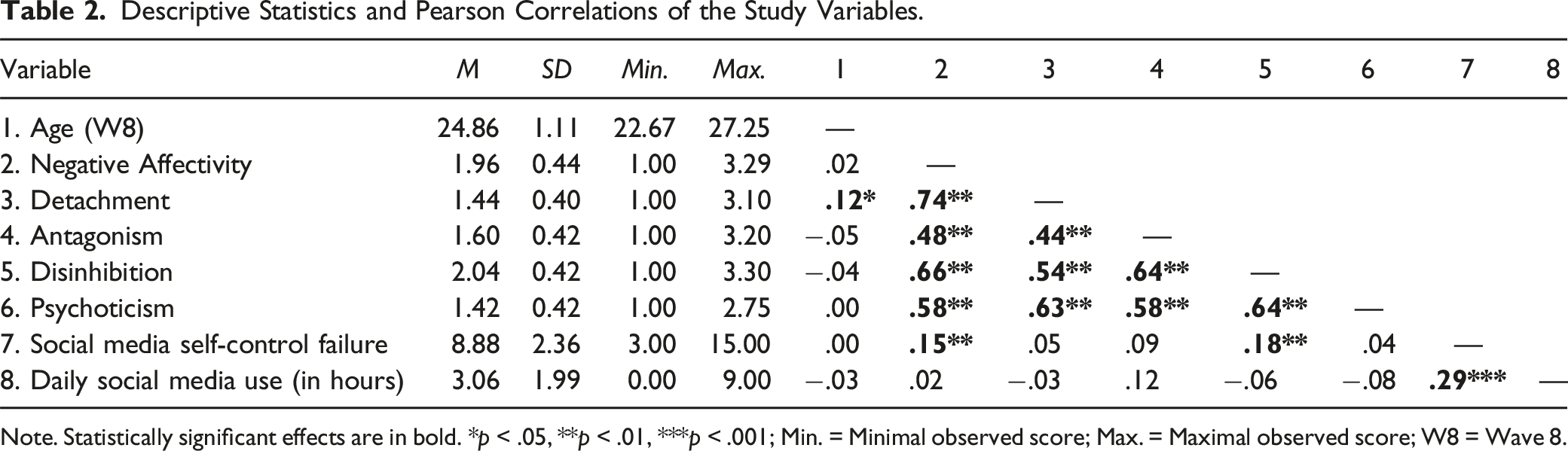
Note. Statistically significant effects are in bold. * p < .05, **p < .01, ***p < .001; Min. = Minimal observed score; Max. = Maximal observed score; W8 = Wave 8.
Results of the Independent Sample T-Test.
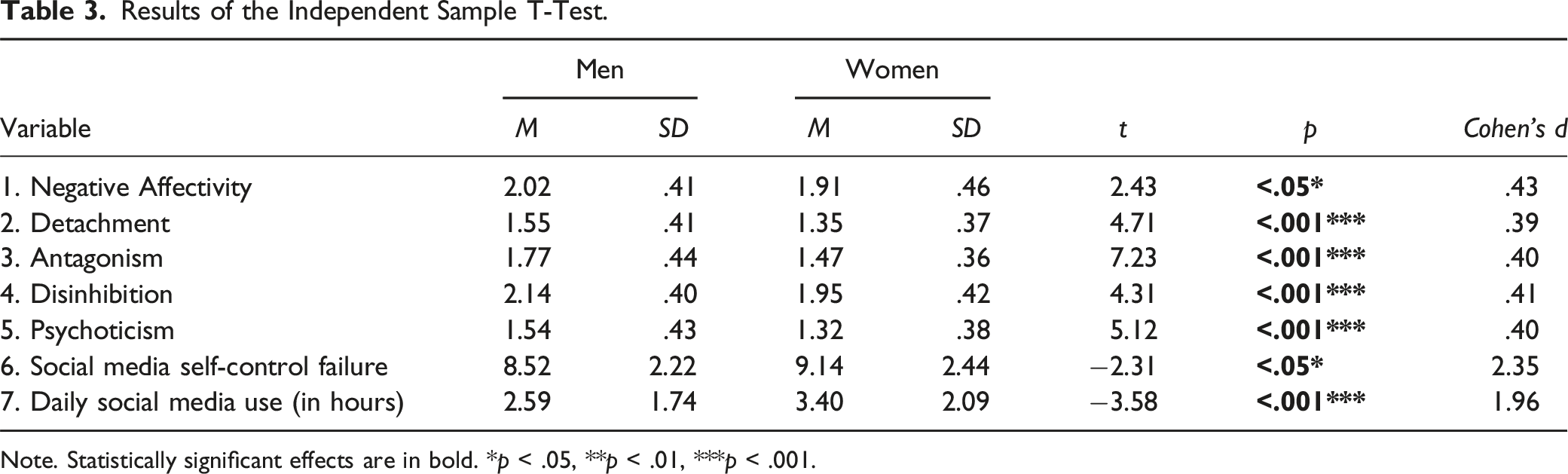
Note. Statistically significant effects are in bold. *p < .05, **p < .01, ***p < .001.
Multivariate Mediation Model
Standardized Total, Direct, and Indirect Effects of Pathological Personality Domains (IV) on Social Media Use (DV) Through Social Media Self-Control Failure (M).
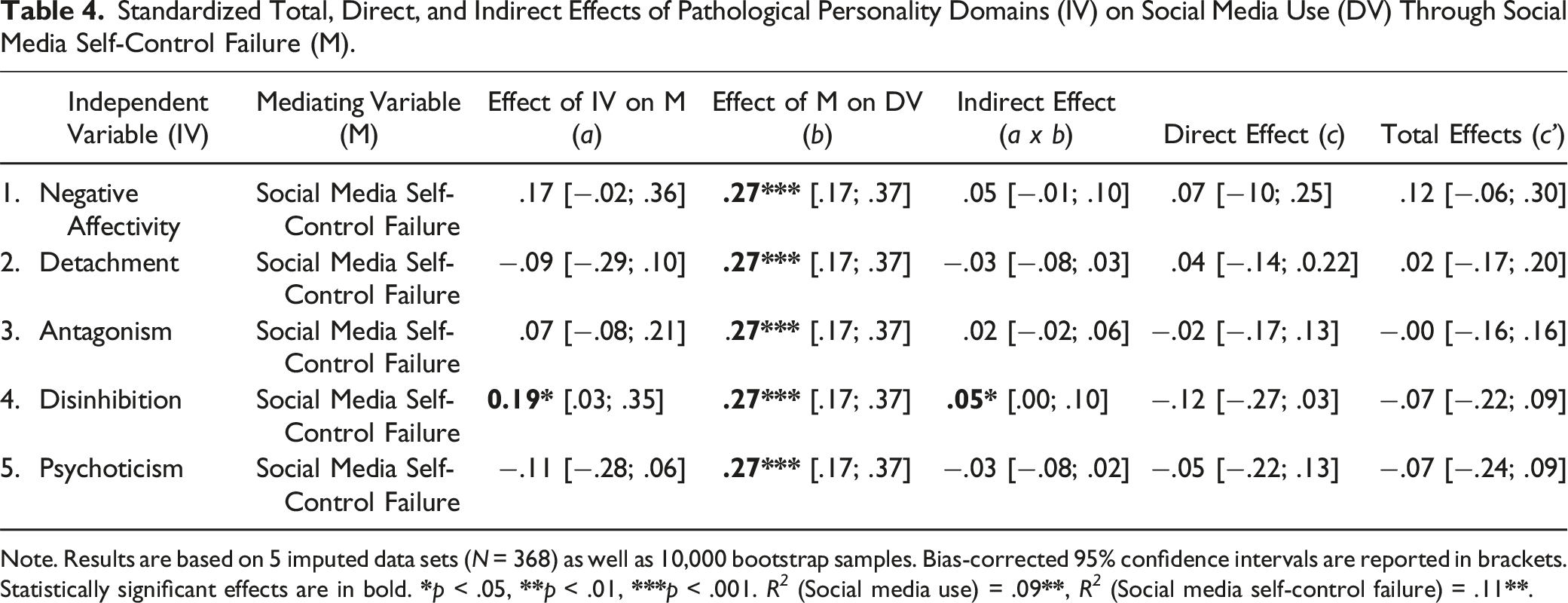
Note. Results are based on 5 imputed data sets (N = 368) as well as 10,000 bootstrap samples. Bias-corrected 95% confidence intervals are reported in brackets. Statistically significant effects are in bold.
With regard to our first aim whether pathological personality domains predict social media use, no statistically significant direct effects (Path c) across all the pathological personality domains were observed (p > .05). This indicates that pathological personality domains are not significantly related to the amount of time an individual spends on social media three years later.
Moreover, regarding longitudinal relationships between pathological personality domains and social media self-control failure (Path a), only disinhibition significantly predicted social media self-control failure (b = .19, p < .05). This means that individuals with higher disinhibition scores are more likely to have difficulty controlling their social media behavior.
With reference to the hypothesized relationship between social media self-control failure and social media use (Path b), a significant and positive association was found (b = .27, p < .001). This means, that individuals who experience more social media self-control failure are more inclined to spend more time on social media.
Our second aim was to determine whether social media self-control failure mediates the relationship between pathological personality domains and social media use (Path a x b). The observed small indirect effect indicates that social media self-control failure mediates the relationship between disinhibition and social media use (b = .05, 95% CI [.00; .10]). This small effect size suggests that while indirect-only mediation is present, it is not the primary driver of the relationship. Theoretically, indirect-only mediation implies that there is no direct relationship and disinhibition only predicts social media use through social media self-control failure (Hayes, 2022; Zhao et al., 2010). Subsequently, individuals with elevated disinhibition scores are more likely to fail at attempting to control their social media use, which in turn leads to more time spent on social media. Additionally, results revealed that females exhibited higher levels of social media use (b = 0.12, p < .05), which suggests that females may engage more with social media platforms than males do. Moreover, females exhibited higher levels of social media self-control failure (b = 0.17, p < .01) compared to males. This indicates that females may experience greater challenges in regulating their behavior in this context. Moreover, in terms of pathological personality domains, females exhibited significantly higher scores on negative affectivity (b = .25, p < .01), indicating that females might experience more frequent or intense negative emotions compared to males. In contrast, females had significantly lower scores on antagonism (b = −.33, p < .001), suggesting that females may be less likely to display confrontational or antagonistic behaviors. Additionally, females showed lower levels of detachment (b = −.24, p < .01), indicating that they might be more engaged or sociable than their male counterparts. No significant sex differences were observed in the domains of disinhibition and psychoticism (p > .05), suggesting there are no statistically significant differences between males and females in terms of impulsivity and unconventional thoughts or behaviors. Regarding age, a significant difference was found in the pathological personality domain of detachment, with older individuals exhibiting higher scores (b = .10, p < .01). This could suggest that as people age, they may tend to withdraw more from social interactions, indicating a greater tendency toward isolation or aloofness.
Discussion
The current study aimed to examine whether pathological personality domains are related to social media use three years later in emerging adults. As far as social media use by emerging adults is concerned, models of normative personality characteristics, such as the Big Five, have received substantial attention (Liu & Campbell, 2017; Romero & Alonso, 2019). However, less attention has been given to the five pathological personality domains that are based on personality disorders included in the DSM-5, which may enhance our understanding of social media-related problems commonly observed among emerging adults (Gervasi et al., 2017b). The role of social media continues to evolve, playing a focal role in our daily lives, and understanding how and why users engage with it is crucial to promoting both healthy and safe usage. Therefore, the present study investigated whether emerging adults’ social media self-control failure mediates longitudinal associations between pathological personality domains and social media use. With regard to our first hypothesis, the obtained results were contrary to what was expected, as the findings indicate that general pathological personality domains do not predict the time one uses social media three years later. Moreover, regarding our second hypothesis, a significant indirect-only mediation of social media self-control failure was observed indicating that higher levels of disinhibition are related to more social media self-control failure which was related to more time spent on social media.
The Direct Effect of Pathological Personality Domains on Social Media Use
Contrary to what was expected, pathological personality domains did not predict social media use three years later (Path c). This finding is in contrast with recent, cross-sectional research using the PID-5 as a measure of personality pathology to predict high social media use, problematic internet use, as well as online gaming disorder (Gervasi et al., 2017a, 2017b; Boursier et al., 2020). Subsequently, personality pathology might not serve as a reliable predictor for social media use over the long-term, while it may still be considered a viable short-term predictor. In consideration of the limited number of previous studies, the presence of contradictory findings may also be attributed to differences in the samples used or disparities in the selection criteria. For instance, whereas Gervasi and colleagues (2017a) acknowledged the limitations of their study’s generalizability based on a primarily homogenous university student sample, our present study uses a more diverse community sample. Subsequently, personality pathology may only be a viable predictor for increased social media use in a subset of the general population. In other words, subgroups of the population may be more susceptible to personality pathology as well as increased social media use. Moreover, the absence of significant associations between personality pathology and time spent on social media may also be due to how social media use was measured. Studies investigating social media use vary significantly in the methods used to quantify time spent on social media. For example, whereas the present study measured social media use in hours per day, other studies measured time spent on social media in minutes per day, minutes per week, or used a categorical approach of suggested timespans (Gervasi et al., 2017b; Olufadi, 2016). Moreover, the Uses and Gratifications Theory emphasizes the significance of individual differences in personality, providing insights into how these variations may impact the amount of time individuals spend on social media. Consequently, social media platforms serve diverse purposes and gratifications with significant variations in user motivations and intentions. A comprehensive review by Karim and colleagues (2020) underscores the multitude of potential metrics for evaluating social media usage. These include active and passive engagement, consumed content, frequency, and intensity of use, as well as the specific types of social media platforms utilized. Consequently, it is conceivable that individuals with high scores in domains such as negative affectivity, detachment, antagonism, or psychoticism may interact with social media in ways that inherently restrict their time spent on these platforms. For instance, individuals with higher negative affectivity scores often experience complex negative emotions, including anxiety, depression, and irritability, as well as intense emotional reactions to stressors (DSM-5; American Psychiatric Association, 2013). Given the unpredictable and potentially distressing content encountered on social media, individuals scoring high on negative affectivity might limit their time spent on these platforms. In the framework of the Uses and Gratifications Theory, this behavior aligns with the motive for media avoidance, defined as seeking to optimize one’s mood by avoiding negative stimuli (Grady et al., 2022). Both detachment and antagonism may lead to challenges in engaging with social media content in general and individuals on social media for distinct reasons. Whereas detachment is characterized by pathological personality facets such as social and emotional disinterest, antagonism is typified by pronounced difficulties in maintaining positive social interactions (DSM-5; American Psychiatric Association, 2013). In both cases, the aforementioned pathological personality facets may pose a potential constraint that could curtail their social media usage, in terms of negatively influencing overall social interaction. Within the framework of the Uses and Gratifications Theory, it is conceivable that individuals scoring high in either detachment or antagonism may exhibit behavioral patterns inadvertently resulting in reduced social media usage. This could, for example, be attributed to a propensity for repeated conflict in social engagements, as suggested by Greene and Krcmar (2005). Similarly, those with high scores in detachment may be constrained in terms of their social media use due to an overarching emotional disinterest in social relationships, where no gratification or mood enhancement is anticipated by the individual. Lastly, psychoticism, defined by unusual beliefs, perceptions, and behaviors, may lead individuals with high scores in this domain to express privacy concerns, prefer less conventional online communication methods, or encounter difficulties in forming and maintaining social relationships (DSM-5; American Psychiatric Association, 2013). In the context of the Uses and Gratifications Theory, individuals with high scores in psychoticism may customize their social media engagement to align with preferences addressing privacy concerns, deriving gratification from non-traditional online communication methods (Orchard et al., 2014). These distinct preferences (e.g., for privacy, lack of censorship, or free speech) could introduce challenges in satisfying their needs, potentially resulting in a reduction of time spent on social media platforms. Therefore, whereas the present study’s findings did not support the long-term predictability across all of the personality pathology domains on social media use, they underscore a complex and nuanced relationship between specific pathological personality domains and varied interactions with social media use.
The Effect of Pathological Personality Domains on Social Media Self-Control Failure
Part of our second aim concerned the longitudinal relation between pathological personality domains and social media self-control failure (Path a). Results indicated that disinhibition positively predicted social media self-control failure. In other words, emerging adults who are more disinhibited tend to have less control over their social media use and may also fail more often to self-control their social media use. This is in line with theoretical considerations of current literature, as individuals with higher scores on disinhibition are expected to also experience more difficulties with impulsivity, and resisting immediate gratification, which subsequently affects how they engage with social media (Billen et al., 2022; Diotaiuti et al., 2022; Zahrai et al., 2022b). Regarding the lack of a significant relationship between negative affectivity, detachment, antagonism, and psychoticism and social media self-control failure, it is likely that individuals with high scores in these personality domains may experience limitations in their interaction with social media platforms. In the framework of the Uses and Gratifications Theory, individuals are assumed to actively select and engage with media to fulfill specific needs and gratifications (Bowden-Green et al., 2021). Subsequently, individuals with high scores in these personality domains may experience reduced interest in seeking particular gratifications from social media platforms. Consequently, the observed lack of necessity to exercise self-control over their social media use (or failing thereof) may be linked to their lower engagement with the platforms.
The Direct Effect of Social Media Self-Control Failure on Social Media Use
Regarding our second aim about social media self-control failure predicting social media use (Path b), results showed that experiencing more social media self-control failure was concurrently associated with more social media use. This finding is in accordance with previous studies with emerging adults also reporting that experiencing failure to control social media use is associated with more social media use (Du et al., 2018; Hameed & Irfan, 2020). Goldstein and Volkow (2011) explain this proclivity through the heavily supported Impaired Response Inhibition and Salience Attribution (iRISA) model, which posits that psychopathology and addiction are grounded in poor self-control in terms of an individual’s inability to manage themselves or their environment. For individuals who have more difficulty controlling their social media use, social media may resemble addictive properties as opposed to being just a tool and is used to cope with a variety of difficulties through impulsive activities, such as constantly checking notifications or quick acquisition of new virtual relationships (Kim et al., 2021).
The Indirect Effect of Social Media Self-Control Failure on the Relationship of Pathological Personality Domains and Social Media Use
Our second aim (Path a x b) was to investigate whether social media self-control failure would mediate the longitudinal relationship between pathological personality domains and social media use. One significant indirect effect was found for disinhibition. There was no significant direct or total effect of disinhibition (Path c’) on social media use, implying indirect-only mediation through social media self-control failure (Meule, 2019). In other words, social media self-control failure is associated with whether an individual with high levels of disinhibition uses more social media. Thus, people scoring high on disinhibition may be more vulnerable to the distractions of social media, failing to self-control use of social media and high use of social media as a consequence. Within the perspective of the Uses and Gratifications framework, this suggests that scoring high in disinhibition may impact the extent to which an individual encounters challenges by failing to exercise self-control over their social media use, in the context of preferences of gratifications (e.g., habitual checking of notifications) that are immediate in nature (Zahrai et al., 2022b). According to Amichai-Hamburger and Vinitzky (2010) individuals who are less self-aware, characterized by higher distractibility, poorer self-control, increased impulsivity, and a tendency for immediate gratification, are more prone to spending excessive time on social media. Moreover, this is further exacerbated by how one’s social experience occurs on social media: Griffin (2017) argues that neural development in both adolescents and emerging adults may lead to a higher likelihood to seek risks as much as a digital validation on a relational level. Social media’s inherent stimulus-driven nature may result in disinhibited engagement and interaction, which may further distract individuals, leading to an increased failure to control social media use and ultimately to a higher overall social media use.
Strengths, Limitations, and Directions for Future Research
The present study has several strengths to note. To our knowledge, the present study was the first to use a longitudinal design. The longitudinal design of the present study allowed us to explore the relationship between all five pathological personality domains and social media use over a 3-year timespan in a community sample of emerging adults. Moreover, sound statistical methods were utilized to avoid multiple testing as well as ensure optimal use of our available data. Furthermore, the preregistration of our study ensures transparency and rigor in our research process, enhancing the credibility and replicability of our findings. These methodological strengths underscore the robustness of our study and the validity of our conclusions regarding the relationship between personality pathology and social media engagement in emerging adults.
There are also some limitations that should be mentioned. Firstly, as most studies concentrated on personality pathology and social media use, our study exclusively employed self-report measures. Araujo and colleagues (2017) point out problems with self-report measures of social media use regarding both under- and overestimating behaviors depending on how frequent a given social media behavior is. Future studies may consider using other reliable measures such as experience sampling and subsequently decrease susceptibility to information bias (Verbeij et al., 2022). Moreover, it is worth noting that although studies examining social media use have identified significant factors associated with time spent on a platform, relying solely on measuring the time individuals invest in social media may not fully capture their actual engagement with it. This limitation in measurement might restrict our understanding of how personality pathology manifests in relation to social media. In consequence, future studies could consider investigating whether associations between different types of engaging with social media (i.e., active vs. passive engagement, more sensitive measurements) and personality pathology exist (Ozimek et al., 2023; Valkenburg et al., 2022). Secondly, the present sample included emerging adults of a community sample, meaning our findings cannot be generalized directly to other age groups or clinical samples. Future studies are needed to investigate whether the observed findings apply to other (age or clinical) groups as well. Moreover, given that the current study’s participant sample comprises a moderately high number of individuals with a purely academic background, future investigations should consider acquiring a more heterogeneous sample that encompasses a broader range of occupational backgrounds and subsequently avoid potential biases. Thirdly, this study examined personality pathology in 2015 (Time 1, Wave 8) and social media use along with self-control failure in 2018 (Time 2, Wave 9) without encompassing all variables throughout. Subsequent research could delve into the interconnectedness of all concepts explored in this study simultaneously across multiple measurement waves. In line with that, the interplay between variables, that were not included in the present study, such as digital skills and the fear of missing out, might moderate the relationship between personality pathology, social media use, and instances of social media self-control failure. Future research may benefit from controlling for attitudinal factors and social pressures that can influence the amount of time individuals spend on social media. In fact, considering the influence of timing and spacing effects in longitudinal investigations of the interplay between personality pathology, social media use, and social media self-control failures is imperative. Consequently, future research could gain advantages by exploring alternative time intervals at a micro level, ranging from days to months, as well as at a macro level, spanning intervals beyond the 3-year time interval employed with the current study design. Given the relatively small observed indirect effect, further research is required to replicate our findings. This suggests that while the mediation effect is statistically significant, its practical impact may be limited, indicating the need for additional studies to validate and deepen our understanding of these relationships.
Implications
The present study contributes to the literature on how personality pathology relates to social media use as well as examining the prospective mediating role of social media self-control failure. Despite contradicting prior research concerning the associations between personality pathology and social media use, our findings are consistent with the elusive nature of both finding viable predictors of higher social media use and the mixed outcomes thereof across a substantially large body of research (Valkenburg et al., 2022). In light of these findings, more research into the substrates of personality pathology and the failure of social media self-control as well as more elaborate measures of how individuals engage with social media may provide a catalyst for both intervention and preventive measures to engage more positively with social media. Social media self-control failure in particular may help shed light on possible vulnerabilities that emerging adults might encounter when engaging with social media and potentially could be used as a starting point for interventions to alter social media use. According to Mullins-Sweatt and colleagues (2019), individuals who experience difficulties due to poor self-control or impulsivity and disinhibition are considered more vulnerable to physical as well as mental health problems. These problems usually tend to start in childhood and adolescence. The findings of our study are highly relevant for understanding the psychological mechanisms behind social media use among emerging adults. Given the pervasive influence of social media on daily life, particularly among young adults, gaining insights into the factors influencing their engagement with these platforms is crucial. This subsequently may be a first step toward promoting healthier online habits. Consequently, the current findings advance research on the psychological mechanisms of social media use, contributing to understanding why individuals spend more or less time on social media. In clinical practice, social media self-control failure may assist with identifying individuals at risk for higher as well as problematic social media use and hence inform indications of intervention. Moreover, investigations into how self-control changes over time have found that especially individuals with poor self-control experienced less stability and more improvements in their self-control capacity over time (Hay et al., 2018; Ray et al., 2013). For clinical practice, this could indicate that especially those with substantial difficulties in self-controlling their social media use may benefit the most from interventions as well as prevention measures. A notable example of current interventions and preventive measures is the work of Brevers and Turel (2019), which underscores the efficacy of proactive and reactive self-control interventions targeting social media usage. Lastly, Mullins-Sweatt and colleagues (2019) highlight interventions with a bottom-up focus, which implies targeting specific behaviors to combat difficulties with poor self-control. These would hone in on specific as well as measurable modifications in behavior and are observed as significantly effective in reducing lapses in self-control.
Conclusion
The findings of the current study highlight that pathological personality domains did not directly predict social media use three years later among young adults. However, disinhibition positively predicted social media self-control failure. Moreover, social media self-control failure was associated with more social media use. Lastly, indirect-only mediation was observed for individuals with higher scores of disinhibition and higher social media use through social media self-control failure. These results indicate that out of the five pathological personality domains, disinhibition indirectly affects social media use through social media self-control failure. Moreover, the present results highlight the importance of failing to self-control one’s social media use in terms of how individuals engage with social media as well as indicating a more complex relationship between personality pathology and social media use. Social media will continue to play a crucial as well as impactful role in the lives of emerging adults and thus future research is needed to further understand the nature of the observed associations.
Supplemental Material
Supplemental Material - Pathological Personality Domains and Social Media Use in Emerging Adults: Mediation by Social Media Self-Control Failure
Supplemental Material for Pathological Personality Domains and Social Media Use in Emerging Adults: Mediation by Social Media Self-Control Failure in Daniel Filip, Ruth Van der Hallen, Guus Smeets, Ingmar Franken, and Peter Prinzie in Emerging Adulthood
Footnotes
Acknowledgments
“In honor of my father, my education always at his heart.”
Declaration of Conflicting Interests
The author(s) declared no potential conflicts of interest with respect to the research, authorship, and/or publication of this article.
Funding
The author(s) received no financial support for the research, authorship, and/or publication of this article.
Ethical Statement
Transparency and Openness Statement
As part of the submission process authors must include a Transparency and Openness Statement. This statement will be included as part of the peer review process and will ultimately appear in the Author Note section of accepted manuscripts. The Transparency and Openness Statement must indicate the following:
1. Are the raw data contained in this manuscript openly available for download?
1. The raw data used in this study are not openly available but are available upon request to the corresponding author. The use of the pre-existing available data and analyses were pre-registered ( ), and we had no deviations from the pre-registration plan.
2. For quantitative analyses, is the analysis code/syntax used for the analyses openly available for download?
1. The analysis code / syntax used in this study is openly available and attached to the preregistration on OSF.
3. Are all materials used in the study openly available for download?
1. As the materials we used were general questionnaires, the material is publicly available for download. This includes the ‘Personality Inventory for DSM-5 Short Form’ (PID-5-SF; Krueger et al., 2011; Maples et al., 2015), the ‘Social media Self-Control Failure Scale’ (SMSCF; Du et al., 2018), and an item based on the ‘Digital Youth Project’ questionnaire (DiYo; University of Utrecht, 2018). We did include the sources as well as the DOI’s to all materials used.
4. Did this study include a pre-registration plan for data collection and/or analysis?
1. Yes, we did include a pre-registration plan for the analyses of the pre-existing available data.
2. We did not deviate from the pre-registration plan.
Supplemental Material
Supplemental material for this article is available online.
Author Biographies
References
Supplementary Material
Please find the following supplemental material available below.
For Open Access articles published under a Creative Commons License, all supplemental material carries the same license as the article it is associated with.
For non-Open Access articles published, all supplemental material carries a non-exclusive license, and permission requests for re-use of supplemental material or any part of supplemental material shall be sent directly to the copyright owner as specified in the copyright notice associated with the article.
