



Abstract
While latest research has accepted the importance of mindfulness in mental health, its role in interpersonal well-being receives less attention, including the necessary measurement tools. This study aimed to translate the Relationship Mindfulness Measure (RMM) into Turkish and explore its psychometric properties with unmarried Turkish emerging adults. A total of 191 university students (age range 18–29, M = 22.90, SD = 2.78) in committed romantic relationships participated in this study. The convergent validity analysis revealed a positive relation of RMM with trait mindfulness (r = .47, p < .001) and a negative relation with negative affect (r = −.21, p = .05). Internal and test-retest reliability of RMM was acceptable (α = .78, r = .67). The unidimensional factor structure of 5-item RMM was supported, and no common method variance was observed. Overall, findings indicated that Turkish RMM is a valid and reliable measure to assess emerging adults’ relationship mindfulness.
Keywords
Mindfulness has roots in ancient Eastern spiritual practices and has received significant attention in the field of psychology in the last decade. Simply put, mindfulness means paying attention to the present moment on purpose and non-judgmentally, leading to an increased awareness of thoughts, feelings, and bodily sensations (Kabat-Zinn, 1994). It helps individuals with clinical and non-clinical problems by promoting acceptance without judgmentally reacting to such experiences (Grossman et al., 2004). By some, mindfulness is considered an alternative treatment to pharmacology, and an increasing number of studies have emerged in the field of mindfulness, also studying the underlying reasons for its therapeutic effect by focusing on diverse psychological, biological, and social aspects (Shonin & Van Gordon, 2016). In 2022, more than 1400 journal articles were published in academic journals (American Mindfulness Research Association [AMRA], 2023), which is an important indicator of its increasing popularity.
However, interpersonal aspects of mindfulness, particularly in the context of romantic relationships, have received less attention (Karremans et al., 2017). Considering that romantic relationships are crucial to individuals’ well-being (Gómez-López et al., 2019), mindfulness has been recognized as a significant aspect of relationship research. Trait mindfulness is important for increased relationship satisfaction (McGill et al., 2016) and higher marital quality (Lenger et al., 2017). Nevertheless, simply tending to be intrapersonally mindful may not be sufficient in the context of romantic relationships (Kimmes et al., 2018). While trait mindfulness may influence an individual’s behavior in a romantic relationship, it might not necessarily mean that they will be mindful in the specific context of the relationship. Therefore, various context-specific mindfulness measures have been developed to assess an individual’s tendency to be mindful in specific contexts, such as Interpersonal Mindfulness in Parenting Scale (Duncan, 2007), Sexual Five-Facet Mindfulness Questionnaire (Adam et al., 2015), Interpersonal Mindfulness Scale, (Pratscher et al., 2019), The Mindfulness in Couple Relationships Scale (McGill et al., 2022), Mindfulness in Marriage Scale (Erus & Tekel, 2020), and similarly, Relationship Mindfulness Measure (RMM; Kimmes et al., 2018) to evaluate each person’s disposition for mindfulness in the setting of romantic relationships.
Despite limited research on context-specific relationship mindfulness, available findings are encouraging. For example, even after controlling for trait mindfulness, it has been demonstrated that relationship mindfulness, as measured by RMM, is related to one’s psychological functioning and the partner’s general psychological health (Kimmes et al., 2020). Moreover, it outperformed trait mindfulness when describing shifts in the quality of romantic relationships, both positively and negatively (Kimmes et al., 2018; Stanton et al., 2021). In addition, in their dyadic daily experience study, Gazder and Stanton (2020) discovered that practicing relationship mindfulness daily leads to more positive relationship behaviors. They found that one’s partner’s daily relationship mindfulness buffered the negative effects of one’s insecure attachment, especially for attachment avoidance. Similarly, Kimmes et al. (2018) and Jaurequi et al. (2022) found negative associations of relationship mindfulness to insecure attachments, which hold a long-standing link to countless adverse relationship outcomes (Hazan & Shaver, 1987).
Other studies have found that relationship mindfulness is positively linked to higher sexual and relationship satisfaction (Fincham, 2022; Jaurequi et al., 2022) and negatively correlated to negative emotional symptoms (Fincham, 2022). Additionally, relationship mindfulness has been identified as a mediator between satisfying romantic relationships and decreased negative emotional symptoms, which, in turn, are associated with decreased sleep problems (Jaurequi et al., 2022). It has also been identified as a mediator, linking childhood maltreatment to positive and negative relationship quality (Fitzgerald, 2022).
As demonstrated by the increasing volume of studies in this field, future studies employing relationship mindfulness may provide essential insights into relationship research. Therefore, the need to adapt RMM to Turkish culture is becoming significant for Turkish relationship literature. Türkiye, with a population of more than 85 million considerably young people (TÜİK, 2022a), has a complex structure in the individualistic-collectivist culture continuum; it is not possible to position Türkiye in a precise place in this continuum (Göregenli, 1995). However, it is apparent that relationships with family members and other people, especially with romantic partners, are very significant in Turkish culture. 67.6% of Turkish people stated that their families were the reason they were happiest (TÜİK, 2022b). In Turkish culture, starting a family and maintaining family unity are both individually and socially significant. Romantic relationships before marriage also occupy an essential place in the Turkish relationship literature as they prepare individuals for starting a family. As the age of first marriage has increased for both genders in Turkey over the years (TÜİK, 2022c), the number of pre-marital relationships has been increasing, especially among emerging adults.
Emerging adulthood, encompassing the transition period from adolescence to adulthood, shows distinct characteristics with regard to the importance of romantic relationships (Arnett, 2000). People at this developmental stage, between the ages of 18 and 29, explore their identities through romantic love (Arnett, 2000) and frequently contemplate substantial questions about finding the right person to spend their life with and maintain a healthy relationship (Fincham & Cui, 2010). However, despite the well-established importance of romantic bonds, emerging adults’ experiences and conception of this stage may differ according to cultural variations (Uçar & Demir, 2023). In the context of Türkiye, Çok and Atak (2015) revealed that emerging adulthood seems most applicable to those in urban groups who continue their education. Also, Turkish emerging adults’ non-marital romantic relationships were examined from different aspects, such as factors predicting non-marital romantic relationship satisfaction (Barutçu Yıldırım et al., 2021; Saraç et al., 2015), romantic relationship beliefs (Küçükarslan & Gizir, 2014), and romantic relationship patterns (Uçar & Demir, 2023). However, studies examining relational mindfulness in the context of non-marital romantic relationships in a Turkish emerging adult sample are almost non-existent. Similarly, this variable has been addressed in a limited number of studies in the context of marriage in Turkish literature (e.g., Deniz et al., 2020). This apparent gap in the literature might stem from the scarcity of reliable and valid instruments that measure relational mindfulness. Previously, a mindfulness assessment tool known as the Mindfulness in Marriage Scale (Erus & Tekel, 2020) was designed for Turkish married couples in the context of romantic relationships. Nevertheless, to the best of our knowledge, RMM will be the initial assessment tool that focuses on the relationship mindfulness of unmarried emerging adults in Türkiye.
RMM was developed by Kimmes et al. (2018) to address the significance and differential impact of interpersonal mindfulness in romantic relationship contexts. They applied Item Response Theory analysis to Mindful Attention Awareness Scale (MAAS) and modified those items for the context of romantic relationships, resulting in a valid and reliable unidimensional scale measuring relationship mindfulness, which is related to but a separate construct from trait mindfulness. A comprehensive set of analyses they conducted revealed that RMM works consistently over time to measure the same underlying construct. RMM includes five items (see Table 2 for the items) rated on a six-point scale with anchor points ranging from 1 (almost always) to 6 (almost never). All items are reverse-coded. Higher scores indicate higher relationship mindfulness.
Considering the need to measure relationship mindfulness, this study aims to adapt RMM into Turkish and to examine its psychometric features, especially for unmarried Turkish emerging adult university students. These tests included several indicators of validity and reliability. We hypothesized that the Turkish RMM would result in a one-factor solution as the original scale and would exhibit no common method variance. We also expected a high test-retest reliability coefficient.
Another hypothesis was a positive correlation between RMM and MAAS. The choice of MAAS for this study was guided by its established reputation for measuring mindfulness since its development and because MAAS and RMM are theoretically related. As mentioned earlier, in the development of RMM, Kimmes et al. (2018) applied Item Response Theory analysis to MAAS. They modified those items for the context of romantic relationships, resulting in a 5-item RMM. Therefore, MAAS acts as a foundation for measuring mindfulness, strengthens the coherence in different contexts, and serves as a valid instrument for measuring the convergent validity of RMM. Hereupon, we expected a positive significant relationship between MAAS and RMM.
Furthermore, a negative association between RMM and Negative Affect (NA) was hypothesized. Compared to those with higher mindfulness abilities, individuals with high negative affect feel psychological discomfort despite the absence of an external stressor (Watson & Clark, 1984), which conflicts with the idea of mindfulness. Also, as the term mindfulness has been linked to the regulation of dense negative emotions rather than a boost of positive emotions (Brown & Ryan, 2003), this study exclusively employed the NA subscale while addressing convergent validity and omitted Positive Affect (PA) subscale in the convergent validity analysis.
A longitudinal study has recently supported this theory, demonstrating that mindfulness leads to a significant decrease in NA over three months but no increase in PA (Jose & Geiserman, 2023). Hereupon, while we linked relationship mindfulness to NA, we separated it from PA. PA was exclusively used to address common method variance (CMV), for which we needed a construct that is theoretically unrelated to relationship mindfulness.
Method
Participants
In this study, a sample of non-married university students who were currently in a romantic relationship were employed. Participants were selected using a convenience sampling method from a large state university in the central part of Türkiye. The sample included 191 students (69.6% female, 29.8% male, and .5% non-binary) aged 18 to 29 (M = 22.90, SD = 2.78). Of the participants, 145 were undergraduates, 11 were master’s students, and 12 were doctoral students. Their romantic relationship length differed from one to 98 months (M = 23.12, SD = 19.67).
Instruments
Relationship Mindfulness Measure (RMM)
RMM assesses the individual’s tendency to be mindful in the context of romantic relationships (Kimmes et al., 2018). It is a targeted instrument to capture mindfulness in a relationship context, which was more effective than trait mindfulness (Kimmes et al., 2018). In the development of this instrument, first, a measure of trait mindfulness, MAAS, was analyzed using Item Response Theory. The five items that emerged were adapted to romantic relationships, resulting in the creation of RMM.
The scale has a one-factor structure and five items rated on a 6-point scale. The questionnaire includes statements such as “When I am with my partner, I find myself saying or doing things without paying attention” or “I get so focused on what I want my relationship with my partner to be like that I lose touch with what I am doing right now to get there.” Higher total mean scores on the questionnaire correspond to higher levels of mindfulness in romantic relationships. In the original study by Kimmes et al. (2018), the coefficient alpha was found to be .86 at Time 1 and .93 at Time 2 and interpreted as indicating strong internal consistency. The correlation between Time 1 and Time 2 was found to be .60 (p < .01), which was interpreted as having acceptable test-retest reliability by Kimmes et al. (2018) due to its significance value.
Mindful Attention Awareness Scale (MAAS)
MAAS measures dispositional mindfulness, which is defined as open or receptive awareness of and attention to what is taking place in the present (Brown & Ryan, 2003).
The scale has a one-factor structure and 15 items rated on a 6-point scale. Higher total mean scores indicate higher levels of mindfulness. In the original study, the coefficient alpha was found to be .82. The Turkish adaptation of MAAS was conducted by Özyeşil et al. (2011). The coefficient alpha was found to be .80. The test-retest reliability of the scale was measured at three-week intervals and was calculated to be .86.
Positive Affect and Negative Affect Subscale (PANAS)
Having a bifactorial structure, the Positive Affect and Negative Affect Scale (PANAS) measures two affective state dimensions: Positive Affect (PA) and Negative Affect (NA) (Watson et al., 1988). A high NA score, measured with ten items and rated on a 5-point scale, reflects negative states such as subjective distress and unpleasant experiences. This study exclusively employed the NA subscale in the validity analysis.
PA, reflecting positive states and rated on a 5-point scale, was employed only in analyzing common method variance as a marker variable. While PA subscale originally comprised ten items, this study selectively employed the four items with higher standardized factor loadings (>.5), representing the construct most effectively. This choice aligns with the small number of items in RMM.
The original study found the coefficient alpha to be .87 for NA and .88 for PA. The test-retest reliability was found to be .71 for NA and .68 for PA. The psychometric properties of the Turkish form of PANAS were investigated by Gençöz (2000). The factor structure was consistent with the original scale. The coefficient alpha was .86 for NA and .83 for PA. The test-retest reliability was .54 for NA and .40 for PA.
Procedure
Translation of RMM
For the Turkish form of RMM, first, the original scale was translated into Turkish by using a committee approach (see Douglas & Craig, 2007 for a review); therefore, including a team of experts consisting of two linguists and three academicians with doctorate degrees in psychological counseling, who were also highly proficient in English. After gathering five translations, the researchers discussed and agreed on the best translation for each item. Then, they sent the translation they chose as the best translation, along with all the other incoming translations, to three more experts. Experts were expected to evaluate whether the translation wholly and accurately captures the original text’s meaning. They rated each translation on a 5-point scale (1 = Strongly disagree, 5 = Strongly agree) and wrote additional comments when their ratings were not five. One expert suggested minor word changes for items 1 and 2. Two experts suggested changes in item 5. According to their suggestions, the item translations were developed.
Data Collection
Before data collection, necessary permissions were taken from the authors of the instruments, and the Human Subjects Ethics Committee of the Middle East Technical University, identified by a protocol number 339-ODTU-2020 in November 2020. Later, data were collected via an online survey platform, METU Survey. Participants were invited to the study with the help of faculty members. Faculty members, who were informed about the study and shared ethics committee approval, e-mailed the study announcement and the survey link to their classes. Each voluntary participant filled out a written informed consent form before completing the survey.
Data Analysis
Before the primary analysis, a series of initial analyses were carried out. By employing SPSS version 28 (IBM Corp., 2021), the data underwent screening using frequency, minimum, and maximum values. Subsequently, the assumptions of factor analysis were checked, and the data was cleaned by considering any missing values and univariate and multivariate outliers.
Later, descriptive analyses were conducted. To check the validity of RMM, the study variables were subjected to Pearson correlation analyses and Confirmatory Factor Analyses (CFA) with maximum likelihood estimation. The Cronbach’s alpha value of the scale and correlation coefficient values between total scores of RMM within 3-week internals were examined to assess the reliability.
To address common method variance (CMV), we implemented a post hoc statistical detection technique- the CFA-based marker variable technique- following the steps provided by Williams et al. (2010). We constructed three different structural equation models (CFA model, baseline model, and Method-C model using maximum likelihood estimation), each incorporating RMM and a marker variable (i.e., positive affect) along with their respective indicator variables. RMM had five indicator -observed- variables, and PA had four (items 3, 5, 12, and 17). Although the original PA subscale comprised ten items, only the four items with standardized factor loadings exceeding .5, which best represented the construct, were utilized. This decision aligns with Lindell and Whitney’s recommendations (2001), as a good marker variable should closely resemble the criterion regarding semantic content, format, and a small number of items.
In the CFA model, RMM and PA were correlated. Subsequently, the Baseline Model was constructed, mirroring the CFA model but with the restriction that PA did not correlate with RMM. Additionally, PA item factor loadings and error terms were fixed using the unstandardized factor loadings and unstandardized error variances from the CFA model. Then, Model-C was created by adding additional factor loadings from PA to items of RMM. These new loadings are set equal to each other. Later, the Baseline Model and the Model-C were compared using the chi-square difference test to determine the presence of CMV associated with the marker variable. R (R Core Team, 2022) and RStudio (Posit team, 2023) were employed while conducting all CFA-based analyses.
Statistical Analysis Criteria
A commonly used threshold for assessing univariate normality is that data is considered normal if it exhibits skewness values within the range of ± 3 and kurtosis values within the range of ±10 (Kline, 2016). Following the guidelines of Tabachnick and Fidell (2013) for univariate outliers, standardized Z-scores of the mean values exceeding ± 3.29 were considered outliers. Multivariate outliers were identified by examining Mahalanobis distances using a critical chi-square value with a significance level of p < .001 (Tabachnick & Fidell, 2013). The multicollinearity examination utilized the correlation coefficient values between the study constructs. The highly correlated constructs with correlation values exceeding .90 were accepted as an indication of potential multicollinearity (Tabachnick & Fidell, 2013).
Considering that the minimum required sample size for measurement models shows great variability depending on factors such as the number of indicators, latent variables, missing data, or complexity of the model (Wolf et al., 2013), we determined the sufficiency of our sample size in two ways. Firstly, Bacchetti (2010) recommended using a size similar to what has proven effective in comparable studies. In our case, we considered the initial development study of RMM that employed 185 participants. Secondly, we considered a simulation study that investigated sample size requirements for structural equation models. Wolf et al. (2013) demonstrated that the minimum sample size for models with factor structures similar to ours (unidimensional scale consisting of five indicators) required 50 to 190 participants. Overall, we considered an approximate sample size of 190 sufficient to test our model.
When interpreting the effect sizes, the guidelines outlined by Cohen (1988) were employed: .10 ≤ r < .30 for small, .30 ≤ r < .50 for medium, and r ≥ .50 for large effect size. Reliability levels were considered acceptable if Cronbach’s alpha values were .60 or higher and good if .70 or higher (Hair et al., 2010). The model fit was evaluated using several fit indices, including the χ2 test, the comparative fit index (CFI), the Tucker–Lewis Index (TLI), the standardized root mean square residual (SRMR), and the root mean square error of approximation (RMSEA). Based on the thresholds Hu and Bentler (1999) provided, with specific attention to the comprehensive insights by Kline (2016), an indication of an acceptable to good fit was observed with CFI and TLI values of .90 for an acceptable fit and .95 or above for a good fit. SRMR and RMSEA values of .10 showed an acceptable fit, and .05 or below showed a good fit. However, considering that empirical studies do not recommend universal cut-off points for RMSEA, and it varies greatly based on sample size, number of variables, and df values (Breivik & Olsson, 2001; Chen et al., 2008), less emphasis was put on the RMSEA criteria.
While addressing CMV using the CFA-based marker technique, the criteria outlined by Williams et al. (2010) were used when deciding upon the marker variable. A construct that is theoretically unrelated but elicits similar response tendencies -having the same source of bias- was determined to be PA. This decision is based on both theory and the low correlations between RMM and PA in this study. As explained earlier, mindfulness is theorized to be associated with regulating negative emotions instead of boosting positive ones (Brown & Ryan, 2003), which is supported by empirical evidence (Jose & Geiserman, 2023). Although no other empirical evidence is available to our knowledge (except for the low correlations in this study) concerning the relation between positive affect and the novel concept of relationship mindfulness, we assume this theoretical irrelevance would be similar to mindfulness in romantic relationships.
The presence of CMV was determined by the comparisons between the Baseline Model and the Method-C Model. If the Method-C Model significantly outperformed the Baseline Model in the result of the chi-square difference test, it indicated method variance associated with the marker variable (Williams et al., 2010). χ2 test, df, and CFI values are reported for each model, along with chi-square difference test results.
Results
Construct Validity of RMM
Bivariate Correlations of RMM.
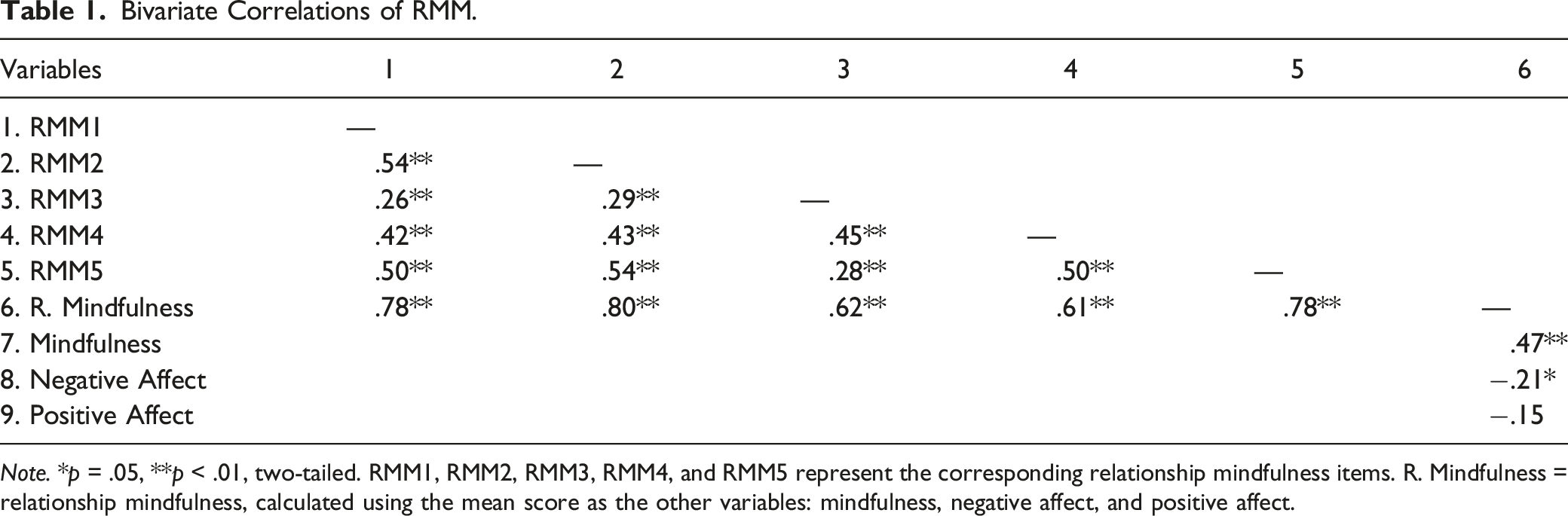
Note. *p = .05, **p < .01, two-tailed. RMM1, RMM2, RMM3, RMM4, and RMM5 represent the corresponding relationship mindfulness items. R. Mindfulness = relationship mindfulness, calculated using the mean score as the other variables: mindfulness, negative affect, and positive affect.
Means, Standard Deviations, and Factor Loadings for RMM Items.
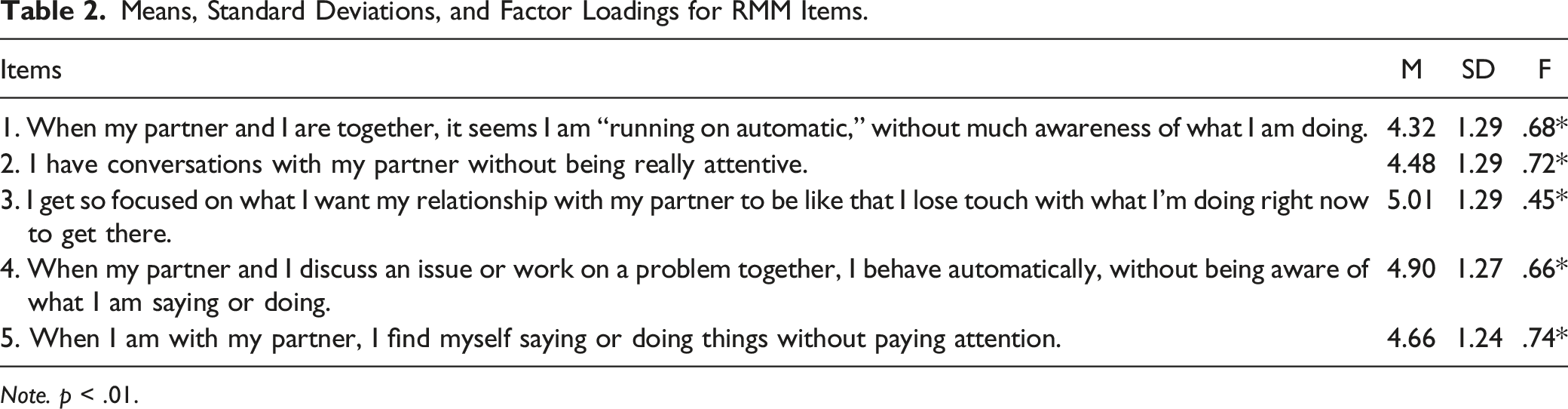
Note. p < .01.
Convergent Validity of RMM
After data screening, two participants were removed since they had missing values for more than 5% of their answers. With the remaining data from 86 participants, Pearson correlations between the mean values of RMM, MAAS, and NA subscale of PANAS were checked (see Table 1). As expected, RMM was found to be positively related to MAAS with a medium effect size (r = .47, p < .001) and negatively associated with NA subscale (r = −.21, p = .05) with a small effect size.
Internal Reliability and Test-Retest Reliability of RMM
Reliability analysis was administered to measure the internal consistency reliability coefficient. Cronbach’s alpha was found to be .78, which indicates acceptable reliability. Of these participants, 63 filled out RMM twice at a 3-week interval. The test-retest reliability coefficient of the Turkish scale was shown to be .67 (p < .001).
Common Method Variance
The CFA-based marker variable technique was implemented to investigate the presence of CMV. The first model, the CFA model including RMM and PA as a marker variable, showed the following goodness-of-fit results: χ2 value of 29.58, df value of 26, and CFI value of .98. The Baseline Model with fixed item loadings and error variances for orthogonal PA (uncorrelated with RMM) revealed χ2 value of 31, df value of 30, and CFI value of .99. Later, Method-C, having the same characteristics of the Baseline Model with an addition of fixed equal item loadings for RMM items, showed χ2 value of 28.92, df value of 29, and CFI value of 1.00. The comparison of the Baseline Model with the Model-C using the chi-square difference test indicated that the models did not differ significantly (Δχ2 = 2.08, Δdf = 1, p = .15). Thus, it is concluded that CMV is not present.
Discussion
This study aimed to adapt RMM into Turkish and examine its psychometric features. The findings supported the effectiveness of using RMM to measure mindfulness in romantic relationships in Turkish culture. The measure’s internal consistency was satisfactory, and the test-retest reliability coefficient of .67 was acceptable and consistent with the original study in which the value of .60 was reported (Kimmes et al., 2018). The convergent validity results revealed moderately satisfactory outcomes. As expected, a moderate positive correlation between MAAS and RMM was observed. It means that individuals with higher trait mindfulness are more likely to be mindful in their romantic relationships as well. This result is consistent with Zümbül and Okur’s work (2021), in which a strong positive correlation existed between the same scales.
However, the correlation coefficient of RMM and NA subscale was weaker. This might be due to conceptual limitations, such as the presence of potential moderators between relationship mindfulness and negative affect. For example, emotion regulation was previously shown to be linked to the relationship between mindfulness and negative affect (Chambers et al., 2008). Since studies on relationship mindfulness are minimal, these moderators might be explored further by using relationship mindfulness measures instead of trait mindfulness.
It was also discovered that the unidimensional factor structure of Turkish RMM was parallel to the original version. The structural model indicated a good fit except for the RMSEA value, which also exceeded the ideal threshold in the original study (Kimmes et al., 2018). As mentioned earlier, empirical evidence is scarce to support universal RMSEA cutoff values such as .05 or .10 for determining satisfactory model fit (Chen et al., 2008) because small models with a limited number of variables and df values are disadvantaged when it comes to RMSEA values, frequently giving a misleading impression of a poorly fitting model (Breivik & Olsson, 2001; Kenny et al., 2015). Similarly, Hu and Bentler (1999) stated that RMSEA is not preferred if the sample size is smaller than 250. Hereupon, although the RMSEA value of our model was above the traditional cut-off points, less emphasis was placed on it in the interpretation of model fit. This decision considers the models’ characteristics, such as including only five items, a low df value of five, and a sample size of 191 (N < 250).
In addition, the standardized regression weights of all the items were significant and ranged from .45 to .74. Previously, researchers indicated various cut-off points for item loadings in factor analysis. One accepted threshold is that the standardized loading estimates should be .5 or higher (Hair et al., 2010). However, there are other researchers opted for thresholds in favor of our results, such as loadings with a minimum of .4 (Mehmetoglu & Mittner, 2021) or proposing that the factor is reliable in the presence of four or more loadings exceeding .6 regardless of the sample size used (Guadagnoli & Velicer, 1988).
When RMM items were examined more closely, it was evident that item-3 had the lowest and item-5 had the highest regression weight, as it appeared in the original scale (Kimmes et al., 2018). When the content of item 3 was examined to reflect upon its relatively lower loading, it was observed that, unlike the other items, it centers on one’s future expectations regarding the relationship. In contrast, the remaining items address a lack of attention to the relationship in the present moment without providing alternative content for one’s mind to wander toward. Hereupon, we conclude that these results support the 5-item RMM model.
As the body of literature has been growing in context-specific forms of mindfulness, relationship mindfulness, which was previously shown to be more advanced at predicting relationship outcomes (Kimmes et al., 2018), might be an efficient alternative to trait mindfulness in relationship research. The current results showed that the Turkish RMM is a reliable and valid measure. Therefore, this study offers a new tool to study mindfulness in romantic relationships, especially for unmarried Turkish emerging adults.
Limitations
When interpreting the study findings, it is crucial to consider various limitations. To begin with, the utilization of the convenient sampling method might impact the generalizability of the results, given that it is one of the non-random sampling approaches. Additionally, the majority of the participants in this study were women.
It is also important to note that the study was comprised of self-report scales in the validation of RMM, which might affect the internal validity of the results. As Kimmes et al. (2018) mentioned, this might be especially prevalent for the mindfulness concept because people lack awareness of how often they lose touch with the present moment, making it unlikely to rate themselves accurately on their mindfulness predisposition. Future studies might employ more objective measures to validate relationship-specific mindfulness.
In addition, the study involved collecting data from individuals who provided information about their romantic relationships. Dyadic data collection was not intended. However, we did not control whether both partners participated in the survey or not. This might pose a limitation to the assumption that data is based on independent observations. Future studies might employ intended dyadic data collection to deepen the understanding of interdependence regarding relationship mindfulness.
Footnotes
Declaration of Conflicting Interests
The author(s) declared no potential conflicts of interest with respect to the research, authorship, and/or publication of this article.
Funding
The author(s) received no financial support for the research, authorship, and/or publication of this article.
Transparency and Openness Statement
The raw data and materials contained in this manuscript are not openly available due to privacy restrictions set forth by the institutional ethics board, but can be obtained from the corresponding author following the completion of a privacy and fair use agreement. The analysis code is not available. No aspects of the study were pre-registered.
