



Abstract
Emerging adulthood is a period of human development ripe for personal identity exploration and a college campus can be a conducive environment for this to take place. Historically, many transition-age adults with intellectual and developmental disabilities (IDD) have been denied access to college, but with the rise in inclusive postsecondary education (IPSE) programs across the country, that is changing. This study uses a combination of semi-structured interviews and photo elicitation discussions with 11 emerging adults enrolled in a southeastern IPSE program to better understand how these individuals understand and express their personal identity as well as the contextual factors contributing to their experiences with personal identity. Using thematic analysis, we uncovered seven salient themes across the data, including a theme related to the complicated nature of the participants’ disability identity.
Keywords
Emerging adulthood, typically spanning from late adolescence to the mid-20s, is a unique and transitional phase in human development, marked by significant changes in various domains of life, including education, work, relationships, and self-perception. Throughout this period, identity formation plays a pivotal role and provides a roadmap for personal growth, decision-making, relationships, and overall well-being (Arnett, 2000; Schwartz et al., 2005). Within the extant literature related to personal identity development, a college campus environment is a known facilitator for personal identity growth and development (Baxter Magdola, 2014; Chickering & Reisser, 1993; Kiecolt & Mabry, 2000; Renn, 2020). Often intersecting with emerging adulthood (Arnett, 2015), college is a time in a person’s life that is ripe for growth and change to take place (Erikson, 1968; Kiecolt & Mabry, 2000; Marcia, 1966). Barriers related to federal financial aid and academic prerequisites means college has historically not been an option for many students with intellectual and developmental disabilities (IDD) (Kleinert et al., 2012). The spectrum of support needs related to an intellectual disability is broad and can affect intellectual functioning or intelligence, which include the ability to learn, reason, and problem solve, as well as adaptive behavior, which includes everyday social and life skills. Down Syndrome, Fragile X, and Autism are examples of developmental disabilities where an intellectual disability can also be present (National Institute on Child Health and Human Development, 2021). Due to the emergence of inclusive postsecondary education (IPSE) programs within the past two decades, college opportunities have recently become an option for more individuals with IDD.
The proliferation of IPSE programs throughout the United States has been driven, in part, by legislative initiatives like the Higher Education Opportunity Act (HEOA) of 2008. This legislation contains provisions aimed at expanding higher education access for students with IDD (Plotner et al., 2023). Specifically, the HEOA (2008) eliminated eligibility barriers to financial support by stipulating that financially eligible students with IDD could access federal financial aid, such as Federal Pell grants and work-study opportunities, provided they are enrolled in an approved Comprehensive Postsecondary Transition Program. Furthermore, in years 2010, 2015, and 2020, the U.S. Department of Education Office of Postsecondary Education allocated substantial funding to IPSE programs (referred to as Transition and Postsecondary Programs for Students with Intellectual Disabilities; TPSID), totaling more than 29 million U.S. dollars across all three funding cycles. Currently there are more than 330 IPSE programs in existence on college campuses nationwide (Think, 2024).
Identity development theorists and researchers have built upon and added to the literature on identity development in the past three decades by studying historically marginalized populations such as women (Josselson, 1991), Latinx college students (Torres, 2003), and African-American students (Parham, 1989), among others. However, to our knowledge, no researchers have focused explicitly on the personal identity of college students with intellectual and developmental disabilities. Additionally, there is a vast body of recent literature examining the development of disability identity for young adults with a disability, (Forber-Pratt et al., 2021; Forber-Pratt & Zape, 2017; Raver et al., 2018), but a scarcity of studies examining identity more broadly (not solely related to their disability status) for the same population. A human’s personal identity refers to the many ways in which we may describe ourselves or understand ourselves in relation to others and all of us have more than one identity. The aim of this study was to better understand our participants’ identities broadly-across all intersections-not solely as it relates to their disability.
While many IPSE programs have done well to provide inclusive, typical college experiences for students with IDD, and their outcomes even reflect tangible benefits such as an increased chance at acquiring paid employment upon exit (Avellone, 2021; Shogren et al., 2018), IPSE programs currently appear to be primarily transactional in their approach (Singh & Gilson, 2020). College is not merely transactional for most who attend-it changes people and aids in their developing a sense of self and purpose in the world (Abes, 2016; Baxter Magdola, 2014; Singh & Gilson, 2020). Obtaining skills and achieving academic and employment-related goals cannot be the only benefits for enrolled students if an IPSE experience is to mirror a typical college experience. In order to truly reflect the enhanced sense of purpose and independence (Chickering, 1969) college typically offers as well as provide opportunity for students to define their own beliefs and identity (Baxter Magdola, 2014), IPSE programs should strive to provide more transformative experiences for students (Singh & Gilson, 2020).
Smith Hill and colleagues (2024) outline an interdisciplinary approach to supporting IPSE students’ personal development through individualized coaching using tenets from counseling, social work, and education. Their definition of personal development includes supporting individuals in personal growth and agency, identity development, self-determination, and overall emotional well-being. There is inherent risk involved as emerging adults explore all aspects of their personal identity. Social risks can include joining a new student organization or exploring dating or sexual relationships. A history of having little opportunity for choice, risk, or other meaningful types of self-determined behavior prior to college (O’Byrne & Muldoon, 2019) means many students with IDD come unprepared to tackle the social and emotional aspects of living independently and exploring their identity (Bumble et al., 2022; Plotner et al., 2023; Rooney-Kron et al., 2022), thus the need for personal development coaching and support in order to facilitate this aspect of student growth.
Developing identity as an emerging adult (Arnett, 2015) is dependent on environmental and contextual factors such as the ability to make mistakes, take risks, and individuate from parents and other “external influences” (Baxter Magdola, 2014; Singh & Gilson, 2020). For Erikson, revered by some scholars as the foundational researcher in identity development, the identity stage is potentially a time to enhance ego capacities, such as agentic abilities and strengths, and to master difficulties and obstacles presented by the social environment (Schwartz et al., 2005). Inclusive postsecondary education programs offer just such an environment for young adults with IDD: one in which they are offered dignity of risk (Bumble et al., 2022; Perske, 1972) and the opportunity to navigate independent living situations similar to those of typical peers in a college setting. Singh and Gilson (2020) have called for IPSEs to attend to students’ transformation as emerging adults, “to create a transformative experience for participants, thus better aligning themselves with definitions for success for programs aimed towards neurotypical peers” (p. 4). As opportunities for college become more prevalent for emerging adults with IDD, the purpose of this study is to better understand how this population understands and expresses their own personal identity. Our study was guided by the following research question: What are the contextual factors that contribute to personal identity for emerging adults with intellectual and developmental disabilities and how do they understand and express their personal identity?
Method
Using one-on-one semi-structured, open-ended interviews and photo elicitation discussions, this study investigated how emerging adults with IDD understand and express personal identity. Additionally, in this phenomenological qualitative investigation (Smith et al., 2009; Williams, 2021), we explored the contextual factors related to college attendance and IPSE-involvement for these students as potential influences on identity development. Interpretive phenomenology is a valuable research design and method of analysis when seeking to understand “what it is like from the participant’s view” (Smith et al., 2009, p. 37). While this manuscript reflects the first phase of this study, our investigation will be longitudinal in nature, as we will execute follow-up interviews with participants in subsequent years of their tenure in the IPSE, up to three years later.
Researcher Positionality
We undertook this study using a lens of critical constructivism (Friere, 1970; Kincheloe, 2005), in an attempt to uncover the ways in which members of a group that has been historically marginalized, construct or experience their reality in a socially constructed world situated within a power-laden society. For this study, we draw from social identity theory and also use intersectionality as a lens for understanding our participants’ experiences. Social identity theory is rooted in the idea that individual identity is attached to group membership and that the sense of belonging gained from group memberships influences one’s sense of self (Jones, 2019; Tajfel & Turner, 2004). In order to better understand the experiences of marginalized populations, we use intersectionality to foreground the impact of social systems and power on how these individuals experience the world and how society treats them (Wijeyesinghe, 2019). Intersectionality pushes us to view personal identity not solely as an individual endeavor, but as a product of social systems, informed by power and oppression (Duran & Jones, 2019).
The research team for this study comprises two recent PhD graduates and two doctoral students, all of whom were employed within the IPSE where the study took place. The principal investigator is a former middle and high school special education teacher and earned her PhD in special education. Three authors have earned or are doctoral students earning a doctoral degree in counselor education and supervision. The final author is a special education faculty member and has worked with students in IPSE programs and in transition for over 20 years. With our research team’s inherent identity-based privilege in society, we actively worked to recognize the ways in which we can dismantle the marginalizing structures inherent in traditional ways of doing research and instead defer to our participants as the experts in their own lives and experiences. Drawing upon Walmsley (2011) to address our roles as non-disabled researchers in the research process, we positioned ourselves as simultaneous facilitators and learners and sought to provide our participants with opportunities to authentically share their knowledge and lived experiences.
Prior to embarking on this study, researchers had varying degrees of familiarity with the study participants through their support work provided through the IPSE program. Four of the researchers had provided one-on-one personal development coaching to participants, lending the interviews and photo discussions a pre-established rapport and level of trust between researchers and participants. Because a level of trust, empathy, and familiarity is a hallmark of meaningful qualitative in-depth interviewing, (Bogdan & Biklen, 1998), this served us well in our study.
Participants and Setting
At the time of this study, all of the participants were enrolled in a four-year IPSE program located within a large southeastern university. All participants were informed and briefed on the study and the nature of qualitative research and volunteered to take part in the study. The study involved recruiting a diverse group of individuals with varying degrees of IDD, including individuals of different genders and racial and cultural backgrounds.
Participant Demographics.
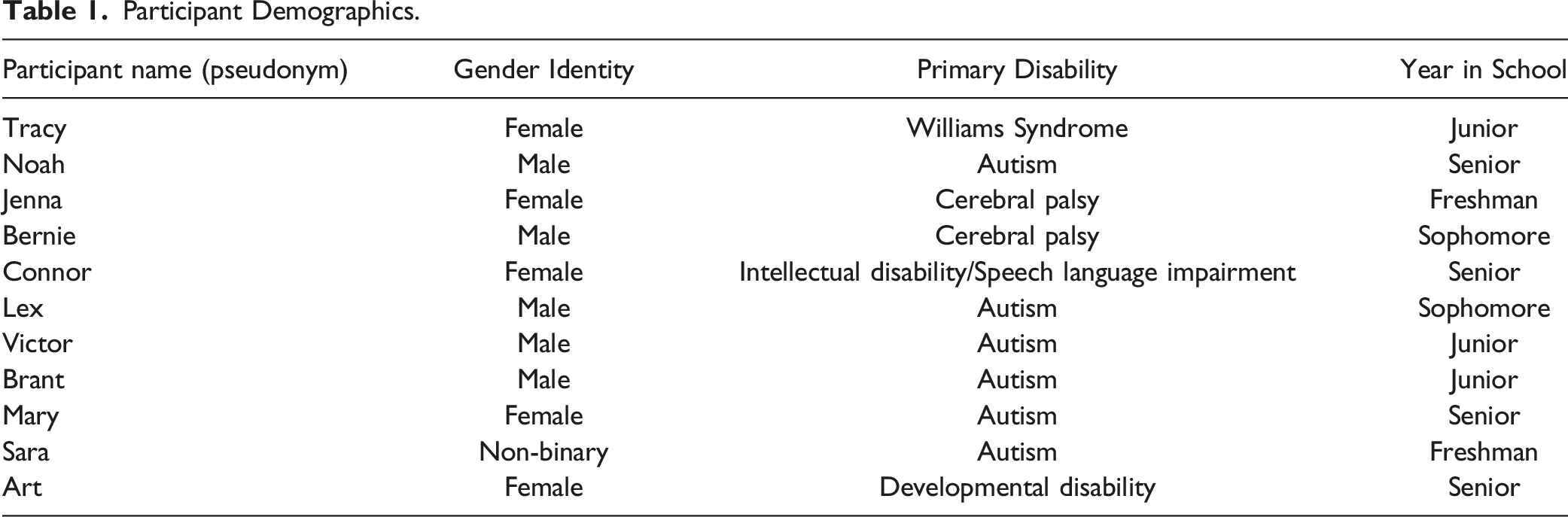
The IPSE program within which this study took place expects students to have a relatively high level of independence as the program is residential and students are expected to be able to live safely in a typical college dormitory. The program’s philosophy is founded on inclusion, individualization, and collaboration across university systems, based on each student’s interests and identified support needs. All students have the same opportunities as typical college students, including access to all college-level coursework (for audit), on-campus non-segregated dorm-living, and access to all university sponsored clubs and organizations.
Procedures
Identity is a difficult construct to explain, it can be difficult to understand, and therefore can be difficult to research. People have many intersecting identities and these often change over time. Age, maturity, education, changes in setting, and new interests and experiences all influence human identity over the lifespan. “Self-identity is intrinsic in an individual and not something that is frequently articulated explicitly” (Hatten et al., 2013, p. 6).
Semi-Structured Interviews
As an initial effort at exploring our participants’ experience with personal identity, each participant was interviewed using a one-on-one semi-structured protocol developed for this study. The concept of personal identity plays an important role in Arnett’s (2000, 2015) theory of emerging adulthood. A number of psychosocial identity theories contributed to our team’s understanding of the construct and creation of the protocol, namely Erikson (1968), Marcia (1966), and Josselson (1991). A semi-structured interview protocol allowed our research team to establish structure, while allowing additional probes to elicit participant-specific data (Glesne, 2016). Examples of questions in the protocol included: “how do you describe your personal identity?” and “how has being in college changed or not changed your identity; what are specific factors about being in college that have contributed to this?” The full protocol is available in Appendix A.
During the one-on-one semi structured interview, participants were provided a physical copy of the protocol. Further, participants were provided opportunities to clarify misunderstandings and encouraged to answer each prompt to the best of their ability. Regardless of clarifications and re-phrasing when needed, during a routine reflexive meeting, our research team noted participant struggles to address the concepts in the protocol on a consistent basis across participants. The spoken or written word can be particularly difficult when attempting to access participant thoughts related to a construct that is as abstract and nuanced as identity development. This is especially true for many of our study participants, who all had an intellectual or developmental disability.
Photo Elicitation
After recognizing the lack of depth we were accessing in our interviews with participants, the research team decided to add a photo elicitation component to the data collection process. Due to the nuanced and abstract nature of the concept of personal identity, photo elicitation can be a helpful method to attempt to understand this phenomenon. Moreover, a person’s lived experience is not something they often discuss or verbalize and photos can be a helpful way to share this information (Hatten et al., 2013). Photo elicitation is a qualitative method used to aid in understanding concepts or constructs that may be more abstract or difficult to articulate (Courcy & Koniou, 2022; Sigstad & Garrels, 2021). Photos, especially photos taken by a research study participant, carry psychological and emotional nuances and values (Hatten et al., 2013; Morley et al., 2011). Photos not only afford the participant the ability to talk about abstract ideas and constructs in accessible ways, but when participants take and share their own photos, it breaks down the power differential between the researcher and participant in important ways that can enable easier and more engaged communication (Hatten et al., 2013). As such, photo elicitation further enhanced the validity and trustworthiness to our data as we collected additional information related to personal identity from our participants.
For the photo elicitation portion of data collection, participants were provided photo prompts instructing them what to think about when taking the identity-revealing photos. Student participants were only asked to share their pictures if they were comfortable. The definition of personal identity that we used to guide this study was included on the prompt instructions, and examples of ways in which people may understand or show their identity were provided as well. For this study, we defined personal identity as “a person’s personal characteristics and beliefs about themselves; roles and positions in relation to significant others; and their membership in social groups and categories” (adapted from Schwartz et al., 2005).
Once the photos were taken and sent to the researcher, a photo elicitation discussion was scheduled. During the discussion, participants were asked to tell the researcher about each photo, including details of the way the photo explained their personal identity. Then the researcher asked guiding questions about each photo that was shared. Examples of questions include “How are these identities expressed in your everyday activities?” and “Can you tell me who or what influenced these specific identities or aided in your adoption of these identities for yourself? (e.g., family, friends, groups, specific experiences).” Examples of photos shared include Tracy’s photo with friends from her Christian sorority on campus, Noah’s selfie photo where he pointed out his branded clothing and jewelry, and Sara’s photo of their transgender pride flag hanging in their dorm room.
Data Analysis
Hatten et al. (2013) remind us that in photo elicitation, analysis occurs during the actual photo discussion interview, as the participant explicates their thoughts behind taking the photo as well as the meaning the photo holds, in this case, related to their personal identity. Researcher and participant reflexivity is key during the photo discussion process, as lived experiences and positionality will certainly color understanding and should be reflected upon. As the method encourages participants to share their lived experiences in their own voices, the researcher must show the utmost respect and acknowledge that participants are the experts in their own lives.
All one-on-one identity interviews and photo elicitation discussions were recorded and transcribed using Otter.ai(c). The transcriptions were subsequently coded by members of the research team using thematic analysis. The researchers created a coding framework from the initial codes and then through discussion and comparison, categorized the codes (Braun & Clarke, 2006; Glaser & Strauss, 1967; Strauss & Corbin, 1998) and through a series of discussions across multiple days, came up with seven overall themes from the categories. In order to enhance validity and reliability of the findings we coded all data from both the interviews and photo elicitation discussions in tandem, as many of the questions were similar and ultimately probing for the same core information and experiences. Analysis of data from two sources allowed for triangulation, enhancing data trustworthiness.
One researcher served as data auditor and reviewed all established codes and themes after the iterative analysis cycle was completed. Member checks with all participants were completed to ensure data trustworthiness. After researchers established themes, we reached back out either in person or via email to all participants to share findings and get their feedback to ensure their agreement and understanding. While not all participants acknowledged that their experiences aligned with all themes, they agreed that their experiences aligned with at least some of the themes.
Findings
Researcher analysis of the identity interviews and photo elicitation discussion transcriptions resulted in numerous open codes from the raw data. All codes were discussed and collapsed into 15 categories which were then combined into seven core themes. Based on the themes identified, we adopted two organizing frameworks through which to examine the data: 1) the role of college in identity development and 2) navigating identity expression. The seven themes are explored in the context of these frameworks below.
The Role of College in Identity Development
As mentioned, college is a time in a person’s life that is ripe for growth and change to take place (Erikson, 1968; Marcia, 1966). Nearly all identified themes are dependent on the college environment as the highly nuanced context through which participants currently understand their personal identity. While this is not exactly surprising given the fact that all participants were enrolled in an inclusive college program at the time of the study, our findings from the data transcend a mere recognition of the college environment as current setting and instead recognize college as a facilitator of transformational identity formation.
College: A New Chapter
Theme one is participants’ recognition that their identities have changed or that they have fully or better realized their personal identity since attending college. This theme is the embodiment of the idea that the experience of being in college in and of itself has inspired a recognition or transformation of personal identity. When responding to a question about understanding her identity, Jenna responded by saying “I’ve always been funny, but I haven’t actually put myself out there to other people. Not really showing people who I really am until like college.” Additionally, Victor spoke to his identity development primarily taking place in college as he realized “Hey, I have a disability. I have a disability and that’s not stopping me from completing what I need to do.” This was not something Victor reported feeling prior to college.
A number of participants identified being in college as providing a social community in which they are able to develop their identities further. When asked how college has changed their identity, Sara spoke to the number of people who identify the same way as them which reduces their feelings of loneliness. Further, Connor mentioned “I wasn't like a people-person when I was in high school, so I didn't have a lot of friends, but when I came here, I had a lot of friends” and that she “kept going to a lot of events and making new friends.” Lastly, speaking directly to his time in the IPSE program, Noah said “If it wasn't for y'all, I wouldn’t have gotten as far as I am now.” It is clear that being a part of a social community within a college program has aided in the development of identity within our participants.
Noah described college as being the “only thing that made me who I am.” Mary mentions that she gets “to express my identity in college.” Because the college environment allows for unprecedented independence, participants are newly given an outlet for discovering and expressing their identity. Connor stated that “In high school everyone was telling me what to do, but now when I got to college nobody is telling me what to do.”
Disability as a Complex Identity
Victor is quoted above as crediting college with helping him realize and embrace his identity as a person with a disability. While all 11 participants did discuss disability as part of their identity, some relayed feelings of pride in their disability identity and some merely acknowledged their disability as a part of their personal identity, but not one they necessarily share with others. Some participants expressed that their feelings related to their disability identity have changed over time. Bernie describes his experiences in claiming disability as part of his identity: Some people care about your disability. Like ‘Oh, you don't fit in because you have some type of disability, we don’t want you to be here.’ But college helps, like everybody teaches the same [as they would for] them. No matter if you have a disability or not. You’re just like them. They don't really care about anything. So that makes me feel better, being up here [in college].
Several participants described the process of first understanding their identity as a person with a disability. Victor describes: In high school, I think ‘I'm a normal student. I have no disability,’ until when I graduated from high school, when I was going to college, then people said I have a disability. And that surprised me and I was just a little bit nervous or upset for a little bit. Then I was like, ‘Hey, if I have a disability I have a disability. And that's not stopping me from completing what I need to do.’
Mary describes when her mother first told her about her disability when she was in middle school. She said she was not surprised: “I think I knew I was different from other people.” Mary went on to state that she has come to accept and embrace her disability as part of her personal identity.
Noah stated “At first I thought it [having Autism] was a bad thing. But now I see it’s a good gift.” He describes his mother sharing his diagnosis with him when he was in middle school and struggling with that at the time. He says since he has been in college he has grown to better understand his support needs and now considers “being a person with Autism” as a part of his personal identity.
While many participants described positive or neutral feelings related to their disability identities, some did describe ways in which their identity as a person with a disability could be difficult. Connor describes a time when she told a friend in high school about her disability: “I did tell one girl, that I thought she was my friend but no…I told her that I did have a learning disability and she was like, ‘Well you don't have to tell nobody that because you probably don't have a disability.’ So yeah…” Connor goes on to say that she talked with her mom about this interaction and her mom told her to be proud of her disability and feel free to tell anyone. Brant went so far as to say he denies his disability and does not claim it as part of his personal identity, largely due to societal stigma. “I never want to explain it or keep talking about it. I hate it so much.” Lex admits that having a disability “makes life a little bit difficult.” But he goes on to say that he is proud of his Autism and has used his success in the IPSE program to “show these people who I am, as a disability student.”
Gender and Sexuality as Identity Markers
We organized this theme under the college as playing a role in identity development framework, as our participants who discussed gender and sexuality playing a major role in their identity acknowledged their current environment’s contribution to this aspect of their identity. Our participants that identified as cis-gender, or identifying with the gender assigned at birth, typically mentioned their gender identity briefly and did not expand. However, Sara, a non-binary college student, expressed the importance of their gender identity throughout their interview and explained that “my they/them pronouns” are part of their personal identity. When asked about specific experiences in their life that influenced their identity understanding, Sara responded, “being misgendered.” Sara expanded upon this by describing how a supportive family helped them be more confident in their gender identity and the comfortability they have expressing this to others when misgendered. Sara also described that college has been meaningful due to the community they have built through people with similar identities and, “.the college professors call me by my proper pronouns, which I’m happy about.” Furthermore, a few of our college student participants made note of their sexuality as part of their identity. Similar to gender identity, sexual orientation was most noted for individuals who are from a traditionally marginalized group, the LGBTQIA + community. Mary stated, “I identify as a college student with [a] disability. And I also identify as a female who is a lesbian. I’m proud of it…” during her opening statement.
Throughout Mary’s interview, she frequently made note of the influence of her identity as a lesbian and how being a college student made it more comfortable to accept this identity because she was able to explore it through independence. Mary further reported that her sexuality influences her clothing choices and identity expression as, “wearing [clothes] that lesbians would wear…like shorts, t-shirts, jackets…and maybe the pride symbol…” Tracy echoed this notion and reported that she is currently learning more about her identity as a “bi woman.” In contrast to Mary, Tracy shared that she is less likely to share her identity due to negative responses in the past.
Navigating Identity Expression
The following four themes are organized under the framework navigating identity expression, as they are all related to ways in which participants described outward expression of their personal identities or barriers to expression. Intersectionality, or evidence of ways in which our participants are multiply marginalized is apparent through these themes. As well, ecological approaches to identity development can organize these themes, as they reference our participants’ interaction with their environment, including their relationships with others (Renn & Arnold, 2003).
Core Relationships as Driving Force in Identity Development
This theme focuses on the social influences on participant identity development, such as family members, friendships, and relationships established during their college attendance such as IPSE programmatic coaches, and university professors or instructors. Drawing heavily from social identity theory (Tajfel & Turner, 2004), this theme reveals how participants’ relationships with others contributes to their sense of self. Mary illuminates this theme in her interview by identifying the individuals she feels most comfortable to share aspects of their identity with, “I share my identity with my family, my mom, my grandma, my friends, my lab coach.” It was revealed in most student participant disclosures during our interviews that the experiences they encountered with these social supports have impacted their identity development in major ways.
The vast majority of participants described support or influence from family as a major contributor to their identity. Victor describes the encouragement received from his family to serve as supports in their identity development, specifically in adopting a “never give up mentality” in sharing, So my parents, they told me good things like ‘don’t give up’ and ‘you came so far in life. You say you have a lot to go, but I'm proud of you, you came a long way from being a freshman all the way to my junior year. And don't stop, just learn. Just do what you do most, and then you will succeed everybody.
This sentiment is echoed across many participants, for example Scarlet shared, “Family is a big part of it because without them, I wouldn’t know who I would be up here [college].”
Many participants considered friendships and other close relationships, such as romantic partners, as influences to their identity development as well. Connor shared that her partner’s check-ins with her often served as a source of support for them while in college by disclosing, Every time I get down, like mad or sad or something like that, he always made me feel better and say ‘What’s wrong with you?’ and stuff like that. That makes me come out of my comfort zone and ‘Tell me what’s wrong’ and stuff like that.
Sara additionally acknowledged feeling free and open to share with friends, naming that they enjoy “being sarcastic” and sharing humor with friends, aspects they do not believe they get to explore with their family.
Finally, program and university supports such as coaches and professors were remarked upon to be supportive towards student participants’ identity development. For instance, Mary describes IPSE coaches as a source for self-advocacy in sharing, “By telling them, my support team, about my identity and telling them, ‘Hey, I’m not this anymore. I’m this, or I prefer this over that.’” In a similar vein, Sara names college professors as supporting their identity by adopting gender-affirming language in the classroom through sharing, “The college professors call me by my proper pronouns, which I’m happy about.”
Spirituality and Race as Foundation of Identity
This theme represents the unique cultural backgrounds and influences that our student participants described as part of their overall identity. Participants commonly reflected on their nationality, race, or ethnicity to describe themselves. Connor described an important aspect of her identity as, “Black,” and shared that she intentionally seeks out Black photographers in the community with whom to build connections. Students that reported that they were adopted had a more complex description of their nationality or race. For example, when asked about his race or nationality, Victor reported how it is difficult for him to explain his Filipino heritage because people expect him to be Japanese.
Some participants noted aspects of their spirituality when describing their overall personal identity. Tracy shared a photo of her getting baptized in college and expanded on this photo stating, “...[this photo] tells you that, like, I'm a child of God. Always have been.” Tracy recounted how this photo represented her expressing her Christian faith and the spirituality development she experienced in college. She claimed to have started college as a “Catholic because of family…,” but believes she is more Christian now that she is free to explore spirituality more independently. Tracy, Scarlet, Connor, and Victor also shared that their faith has created a community on their college campus by connecting them with people that practice a similar religion. Yet, not all participants were comfortable sharing their spirituality with others, as Noah stated, “....I do keep [my faith] to myself. And sometimes I'm afraid to share it too, because I see a lot of people being hated for being a Christian. And I don't want the same thing to happen to me.”
Passions and Interests Drive Identity
Theme five represents the influence that hobbies, interests, and personality traits have on our participants’ personal identities. Participants commonly reflected and described themselves as it relates to their hobbies or interests through both their identity interviews and photo elicitation. For instance, Brant mentioned, “I like to game a lot…” early in his identity interview, followed by, “I am a gamer.” Brant also remarked that being “a gamer” explains his “rage” behavior because “that’s what we gamers do.” In addition, Art shared a photo of her in the marching band and stated, “…[this] expresses who I am as a person today.” Art expanded on how the marching band shaped her as person, reporting, It’s helped me being able to still, like, help me memorize more things and remember them and I’m able to express today like, how I feel, or how I, like, talk, and makes me be able to talk about my personal or my past things without having to hide anything.
Similarly, Connor shared a photo of a book and explained, “[this represents] that I love to read drama books, mysteries, and other odd types of books.” Connor continued discussing how reading is part of her personal identity and that it helped her develop a closer relationship with members of her family. Furthermore, participants noted that they developed certain hobbies and interests while in college and believe their new hobbies and interests are part of their personal identity. Noah reported in his identity interview, …things that made me who I am was the things that I was able to do in college….like, my thing for walking. Walking helps me think, helps me forget about some things. And it helps me to better myself.
When probed about Noah’s proclivity for walking, he shared that the freedom of being able to go wherever he chose was one aspect of the appeal of his walks, and he also enjoys the “me time” it affords him. Victor also shared this idea and described his volleyball intramural team that he joined in college as part of who he is as a person.
Beyond hobbies or interests, participants frequently referenced things they enjoy doing or characteristics as part of their personal identity. When asked about his personal identity in the identity interview, Lex described his experiences in clubs and organizations on campus and how these developed him as a “leader” and “motivator.” Lex recounted that he views his “leader identity” as a responsibility to help others learn to transition into postsecondary education.
Challenges/Barriers to Identity Development or Expression
Theme six of our study includes different challenges or barriers experienced by our participants in their identity development or expression of their identity. This finding can be organized within the navigating expression framework as well as the identity as relational framework, as some challenges were named by participants when considering expressing their identity with family members and new friendships. For instance, Brant disclosed challenging experiences with their family, “My parents don't know anything about that or know my pain.” He later describes his relationship with his family as difficult because they are “polar opposites.” Sara recounts similar experiences, identifying the differences in their behavior around friends and family, sharing, “Like with my family, I would be nice to them – because with parents you’ve got to be nice.” Mary describes additional limitations in expressing certain aspects of their identity to new friends or strangers on campus, wary of what she may share with others, “Because like they might post it online or something. Tell their family members or friends that I don’t know.”
Noah described a challenge he faced in their social media engagement and presence by sharing, “Sometimes when you're doing things on social media, you gotta have to be someone different but I just want to be me.” Though at the same time, Noah acknowledges that he uses social media as a source of personal styling inspiration amongst other means of self-expression (i.e., connecting with others, posting funny videos). Finding a balance in determining what aspects of their identity to disclose to others was certainly a common thread in participant experiences in sharing their identity with others or attending college. Noah reflects this in his interview as well in sharing, “I don't share that [disability identity] with everybody. Well, my mom already knows it. And, well, sometimes I might share it with a majority of my friends.”
Discussion
College attendance through IPSE participation can provide students with IDD a significant opportunity to develop their identity. The diverse experiences provided within these programs create fertile ground for emerging adults to enhance their personal growth, social integration, and self-advocacy through opportunities for independence. By equipping individuals with IDD with the necessary skills and opportunities, IPSEs can create an environment that fosters the ongoing journey of identity development. For the students involved in this study, a college experience provided through an IPSE program opened doors and provided opportunities to explore and discover aspects of their identity discussed here.
The Role of College in Identity
Overwhelmingly, the fact that our participants’ current living environment was on a college campus undeniably contributed to their understanding of their personal identities. Researchers have long-recognized the transformative power of a college environment to foster identity exploration and development for emerging adults (Baxter Magdola, 2014; Chickering & Reisser, 1993; Renn, 2020). However, there is a dearth of research exploring this phenomenon as it pertains to emerging adults with intellectual and developmental disabilities.
While the participants in our study overwhelmingly discussed many varied aspects of their identity, the primary identity which gave many of them pause and elicited complex feelings was, in fact, their disability identity. Some participants explained that they may not openly share their disability identity with all people. As well, many of our participants described how their feelings related to their disability identity have evolved over time, with many acquiring a greater level of acceptance and understanding since their enrollment in college.
Similarly, seven of the eight undergraduate student participants in Broido and colleagues’ (2023) qualitative study investigating disability identity described their understanding of their identity as a disabled person differently pre-college and after college enrollment. These seven participants were described as having “normative, ableist understandings of disability” and while they may have acknowledged a disability label or diagnosis, they in no way identified as being part of a disability community prior to college (Broido et al., 2023). Our findings mirror Broido’s, as many of our participants’ understanding of and acceptance of their disability identity evolved over time. Noah’s assertion that “At first I thought having a disability was a bad thing. But now I see it as a good gift.” is an example of how college has facilitated a change in his perception of his disability identity.
A positive disability identity is one worthy of cultivating in emerging adults, as Raver et al. (2018) have shown that an affirmative sense of disability predicts a sense of belonging for this population. Our findings are consistent with this assertion. Sara describes “embracing” their disability identity since being in college as they now see that “there are a lot of other people who identify the same, so I am not alone.” The majority of our participants embrace their disability identity, at least since being enrolled in their inclusive college program. Many, in fact, attribute the positive changes in their lives and changes in their identities to the very fact of their membership in the inclusive college program and their identity as college students.
Navigating Identity Expression
Across findings in our study, a common thread reflected in the extant personal identity literature is the idea that much of identity is relational. Our participants’ descriptions of how they express their identity to the world and through which social and cultural groups they gain a sense of self revealed that a sense of belonging is integral to understanding one’s personal identity. Social identity theory (Tajfel & Turner, 2004), the idea that individuals derive part of their identity from the groups they feel they are a member of or to which they belong, underpins these findings. This finding is highly dependent on our participants’ access to college, as research on this population has shown that young adults with IDD who do not attend postsecondary education have considerably less access to social networks and relationships than typically-developing peers (Amado et al., 2013).
Across marginalized communities, the literature acknowledges barriers to full identity expression for emerging adults with various disempowered identities, (Doyle & Barreto, 2022) including those identifying as gender non-conforming. Sara, our participant who identifies as non-binary/gender non-conforming, shared that they were uncomfortable fully expressing that gender identity around family members. They stated that they feel “more free and open” with friends in college than with family. Sara also stated that they feel emboldened in their non-binary identity since being in college because “The college professors call me by my proper pronouns.” This finding correlates with Cosgrove and colleagues’ (2020) finding related to the power of gender-affirming language. Co-researchers in their photovoice study concurred that affirming language is one of the most significant ways in which they felt supported in their identity (Cosgrove et al., 2020).
Implications for Practice
Findings from this study underscore the importance of college in contributing to emerging adults’ identity development. While this position is not necessarily revelatory, students with intellectual or developmental disabilities have not historically been included in college environments, or if they have their personal development may not have been adequately supported to foster identity exploration and development. Higher education environments can play a momentous role in supporting students’ identity development by creating inclusive, supportive, and diverse environments (Jones & Abes, 2013; Kiecolt & Mabry, 2000). As such, creating inclusive campus environments should be a fundamental goal for colleges and universities. Campus environments that emphasize the importance of diversity, furnish opportunities for exploration, and extend assistance to students during their identity journey help to foster a safe and supportive campus atmosphere where individuals with IDD can confidently explore their own identities and openly share their diagnosis (if they choose) with university staff without fear of encountering prejudice. In Hadley’s (2011) perspective, administrators are encouraged to incorporate disability considerations into the broader context of student development. Examples of this include ensuring that IHE faculty have a good understanding of the services available to students with disabilities on campus, faculty learning more about their students’ disabilities, or encouraging students with disabilities to find community through campus organizations interested in disability issues and activism (Hadley, 2011). Further, Taylor (2011) and Smith Hill & Stinnett (in press) advocate for the inclusion of disability status as an integral facet of diversity within the realm of higher education, which has begun to be adopted across the country. These efforts require ongoing commitment from IHE leadership to actively promote diversity and equity, and IPSE leaders should work closely with IHE professionals to foster these conversations as they work to support college students with IDD. However, these efforts are often still missing from the conversations and initiatives forged between IPSEs and IHEs.
A sense of belonging has been widely recognized as a predictor of success and retention for all college students (Keating et al., 2020; Strayhorn, 2018). Institutions must prioritize fostering a sense of belonging for all students, especially those from marginalized backgrounds (Vaccaro et al., 2015), as those students historically often have lower rates of persistence and graduation (Griful-Freixenet et al., 2017). These efforts contribute to a more inclusive and equitable educational and campus life experience for all. There are several ways IHEs can continue to promote student identity development within the context of belonging. For example, IHEs should bolster the investment in mentorship programs and academic advising to provide targeted support for identity development. Well-trained mentors and advisors can play a pivotal role in guiding students through their exploration of identity-related questions and challenges, helping them navigate their academic journeys effectively. Although fostering student sense of belonging has been a priority for many IHEs, and is gaining traction again in this post-pandemic era (Dost & Mazzoli Smith, 2023), identity development support is less discussed in the literature and needs further attention. This focus is more poignant for those with a disability, as their high school experience is often much different than the experience of students without a disability. Especially for students with IDD, who have historically not been meaningfully included in the general curriculum, support in navigating self-awareness and identity development is critical. These students may have been secluded in self-contained classrooms and given little opportunity for choice or self-determination (O’Byrne & Muldoon, 2019) to navigate who they are, what they want to study, and who they want to be prior to attending college.
Also, IHEs (as well as IPSE leadership) should promote inclusive pedagogy and culturally responsive practices through the incorporation of diverse perspectives into their curricula. For example, including readings and coursework related to identity, privilege, and social justice ensures that all students have opportunities to engage with these critical topics, contributing to a well-rounded education and equity-minded perspectives. There is considerable commitment to this endeavor for IHEs who have robust “first-year experience” programs (Rockey & Congleton, 2016); however, beyond these freshman orientation courses (e.g., University 101), there should be more focus on inclusive curricula at all levels of college curricula.
The cultivating of safe spaces, both physical and virtual, to ensure open and honest discussions and expression of identity, experiences, and concerns can also be important to students’ identity formation. IHEs must actively support and promote these spaces, creating an environment where students feel comfortable expressing themselves and learning from one another. Renn (2020) speaks to the importance and value in peer culture for emerging adults exploring identity, and specifically recommends that educators working with college students assist them in finding identity-based organizations on campus. Once identified, identity-based peer groups are often invaluable in assisting students in identity exploration, deepening a commitment to a specific identity, and enhancing a sense of belonging (Renn, 2020).
Another way that IHEs can support students to navigate their identity journeys is to invest in and enhance counseling services. There has been a focus on college counseling services with the uptick in mental health concerns experienced by college students nationwide (Kim et al., 2022; Lipson et al., 2022); however, supporting students with IDD who also experience mental health challenges is lacking (Oakes et al., 2020). College counseling centers should be equipped to address identity-related mental health concerns. Cultural competence training for counselors is essential, and ensuring the availability and accessibility of counseling services can contribute significantly to students’ well-being.
Limitations and Future Research Directions
One limitation of the current study is that all 11 student participants were enrolled in the same IPSE program and our IPSE places a heavy focus on personal development; personal development is one of the five domains in which we offer explicit and direct support for our students. Because our students receive coaching support related to their personal development, and this can include identity development, this could have influenced the extent to which the participants have explored and understand their personal identities. Our IPSE is underpinned by a philosophy of typicality, and with this, our students have access to all student organizations and groups on campus. Given this fact, our students are immersed in a robust culture of social engagement and opportunities for identity exploration. We recommend that IPSE programs with varying philosophies attempt to capture aspects of their students’ identity development and may use our data collection procedures as a framework.
Due to the scant literature available related to identity development for emerging adults with IDD, the directions for future research are plenty. While there is more literature focused on development of a disability identity specifically, (Forber-Pratt et al., 2021; Forber-Pratt & Zape, 2017; Raver et al., 2018) there is ample opportunity for research exploring the experiences of emerging adults at the intersections of many different marginalized identities. There is emerging research examining the lives of young adults who identify as disabled and LGBTQ+ (Dinwoodie et al., 2020; Smith et al., 2021; Toft et al., 2020) as well as at various other intersections such as Black and disabled (Miles, 2019), however, the literature specifically examining the development of these identities is lacking.
Another area of research ripe for exploration is how best to support emerging adults with IDD in exploring, understanding, and deepening commitment to their personal identity. While existing models of identity formation and development may be applicable, it is highly likely that nuanced supports would be beneficial for this population. Inclusive postsecondary education programs have transformed the landscape of what is available for emerging adults with IDD in the past two decades by providing a college option including inclusive academic, employment, and independent living opportunities. Furthermore, additional data collection procedures for identity development are encouraged (e.g., quantitative, longitudinal, and mixed method approaches). We have just begun to scratch the surface in investigating how best to support this population’s personal development while enrolled in IPSE programs.
Conclusion
Personal identity exploration, formation, and development is an important milestone in the lives of all emerging adults. While much attention has been paid in the literature to the disability-specific identities of young adults with disabilities, not as much attention has been paid to other facets of their personal identity. As well, little is understood about how this population understands and expresses all aspects of personal identity, including the contextual factors that contribute to identity formation and development. Our hope is that this study can contribute to the literature base in this important area for emerging adults with IDD. Attending to and supporting aspects of personal development, such as identity development, is one answer to Singh and Gilson’s (2020) call for IPSEs to provide a transformational college experience for emerging adults with IDD.
Footnotes
Declaration of Conflicting Interests
The author(s) declared no potential conflicts of interest with respect to the research, authorship, and/or publication of this article.
Funding
The author(s) received no financial support for the research, authorship, and/or publication of this article.
