



Abstract
The current study examined parental autonomy support in relation to the quality of youths’ interpersonal emotion regulation (IER) experiences with parents. 194 emerging adult college students (M age = 19.6 years; 52.1% women) recounted a recent instance of receiving IER from a parent. Youth reported on their parent’s IER behaviors (emotional responsiveness and cognitive support), the perceived effectiveness of the IER, who initiated it, and how autonomy supportive their parent typically was. As expected, parental autonomy support moderated the relation between IER and its perceived effectiveness, such that at higher levels of support, parental emotional responsiveness and cognitive support related to higher perceived IER effectiveness. Likewise, in conditions of low autonomy support, youth perceived unsolicited IER to be less effective than did youth who sought the support. Autonomy support likely plays a meaningful role in the effectiveness of various IER processes, thus furthering our understanding of emerging adults’ socioemotional development.
Keywords
Introduction
From time to time, everyone experiences challenges like feeling frustrated when stuck in traffic, or disappointed when a job application gets rejected. These emotional experiences can be managed alone, but people often interact with others to help regulate these emotions (e.g., they engage in interpersonal emotion regulation; IER). For emerging adults who are in the midst of a complex and unique phase of development, the effectiveness and implications of engaging in IER are not clear. Many youth remain reliant on and highly sensitive to the socialization efforts of their parents (e.g., Brenning et al., 2015; Carlson, 2016; Roth et al., 2009), while simultaneously engaging in identity exploration and becoming increasingly independent from family (Arnett, 2015). This period of development is intriguing for investigation of parent-provided IER, with some research suggesting that factors associated with autonomy fulfillment likely contextualize the utility of receiving IER from parents (e.g., Guntzviller, Ratcliff, et al., 2017; Lougheed et al., 2016; Ryan et al., 2005). Despite parents ostensibly doing all “the right things” to help their adult children regulate emotions, some youth may perceive these efforts as less effective. The current study aims to test a possible explanation for this by considering parent autonomy support—parents’ overall acceptance and support of their children for who they are and what they are experiencing (Ryan & Deci, 2017).
Emotion regulation, commonly defined as the modulation of the duration, intensity, and valence of emotion (Gross, 2014), is a well-studied topic that has fascinated developmental researchers for decades. While the majority of emotion regulation research has examined intra-personal emotion regulation, which is limited to a person’s own efforts in regulating their own emotions (Thompson, 2011), emotions are not experienced in an intrapersonal vacuum; instead, emotions are most commonly regulated within social contexts (e.g., Borowski & Zeman, 2018; Levy-Gigi & Shamay-Tsoory, 2017; López-Pérez & Pacella, 2021; Niven et al., 2019). Considering the transitional nature of emerging adulthood, youth may find themselves toeing the line between maintaining their own autonomy and receiving interpersonal emotion regulation (IER) from others. In fact, social support research has highlighted parental autonomy support (i.e., the encouragement of youths’ exploration, independence, and agency) as one factor that contextualizes the effectiveness of parent-provided support (e.g., Gong & Wang, 2021; Lougheed et al., 2016; Ryan et al., 2005). However, there has been little research that explores the role of parental autonomy support within recent, specific instances of IER (as opposed to general tendencies). Focusing our investigation on specific instances of IER aligns better with real-life interactions, providing a more ecologically valid picture of IER dynamics within the parent-child relationship. The goal of the present study was thus to examine discrete instances of parent-provided IER and investigate parental autonomy support as a possible moderator that would clarify the links between IER processes (both sought and unsought) and the perceived effectiveness of IER for youth.
Past research indicates that individuals who frequently engage in IER and perceive these interactions to be effective are more emotionally expressive, empathetic, and socially connected (Williams et al., 2018). IER effectiveness is also influenced by the type of support being offered (Sahi et al., 2022), as well as individual trait and state differences in emotional intensity, intrapersonal ER abilities, shame-proneness, relationship quality, and desire for IER (Swerdlow et al., 2022). Most research to date has emphasized IER’s influence on social and emotional functioning, focusing on outcomes like psychopathology (Dixon-Gordon et al., 2018), well-being (Chan & Rawana, 2021), and attachment (Altan-Atalay, 2019). Yet it is also crucial to acknowledge the function of a more proximal and immediate outcome, that of perceived IER effectiveness. Not only does an individual’s perception of IER effectiveness map onto positive socioemotional outcomes, but perception guides current and subsequent behavior (Mortenson, 2009; Pauw et al., 2018). An individual’s perception, or interpretation, of a social support experience likely informs their willingness/motivation to engage with future support opportunities (Guntzviller, MacGeorge, & Brinker, 2017). The true effectiveness of IER likely hinges on whether the receiver perceives the support as effective (e.g., Ntoumanis & Biddle, 1998). The long-term adaptiveness of engaging in IER processes is thus informed by both the quality of enacted support as well as the receiver’s interpretation of the support. As such, assessing youth’s perception of IER effectiveness is informative for understanding its utility.
Interpersonal Emotion Regulation
Interpersonal emotion regulation (IER) refers to management of one’s own and others’ emotions through social means (Zaki & Williams, 2013). This includes intrinsic IER processes, in which a person seeks/receives emotional support from someone else (the focus of the current study), and extrinsic IER, wherein another person attempts to change the emotional experience of the other. As a relatively recent direction for the field, the development and effectiveness of IER processes across childhood, adolescence, and early adulthood remains an understudied process. However, contemporary study of IER is informed by the wealth of research on social support (e.g., Cohen & Wills, 1985), social sharing of emotions (e.g., Rimé, 2009), and empathy and prosocial behavior (e.g., Eisenberg & Fabes, 1990). Such research paints a clear picture: although several supportive strategies and tactics typically tend to be more effective than others, this utility is context dependent.
The present research focuses on two common IER processes, which we operationalize as emotional responsiveness and cognitive support. This framework aligns with literature on the social sharing of emotions, in that support providers typically offer comfort and validation, or assist in reappraising or finding meaning in the experience (Pauw et al., 2018; Rimé, 2009). Emotional responsiveness, which includes the conveyance of caring, understanding, validation, empathic concern, encouragement of social sharing, and comforting physical presence (e.g., Chan & Rawana, 2021; Lougheed et al., 2016; Ray-Yol et al., 2022; Swerdlow & Johnson, 2022; Wang, 2019), tends to be associated with immediate alleviation of distress. Most research has associated the use of emotional responsiveness with beneficial outcomes, such as higher relationship quality (Cutrona & Russell, 2017), positive mood (Levy-Gigi & Shamay-Tsoory, 2017), and prosocial behavior (Eisenberg & Fabes, 1990).
The second IER pattern pertains to the use of cognitive support, which often incorporates the use of reappraisal, informational support, planning, problem-solving, and perspective-taking. Receiving cognitive support has been related to fewer internalizing problems (Chan & Rawana, 2021), decreased distress (Levy-Gigi & Shamay-Tsoory, 2017), and greater perceived helpfulness of given support (Sahi et al., 2022). Prior research has found that support receivers tend to perceive both emotional responsiveness and cognitive support as effective and beneficial methods of support (Swerdlow & Johnson, 2022).
Interpersonal Emotion Regulation Solicitation
It is well-established that receiving support is not universally beneficial (e.g., McLaren & High, 2019; Segrin et al., 2012; Wang, 2019). Research on the “support gap” has demonstrated that when emotional support is received, but was not sought, it is less likely to be experienced as effective (Segrin et al., 2012; Wang, 2019). Specific to emotional support, Wang (2019) found that receiving a surplus (i.e., more support than desired) of “nurturing” support from parents related to an increase in perceived stress. Such unsolicited support may reinforce feelings of emotional helplessness, or even engender feelings of resentment towards parents. Considering the long-term implications of unsolicited emotional support, recurrent parental over-solicitousness has detrimental effects on children’s socioemotional functioning. For instance, Roth and Assor (2012) found that parents who attempt to elicit emotional expression from their children using conditional regard had adult children with more dysregulated emotions. However, most of the research that explores the relation between IER solicitation and effectiveness does so through a social support framework. Although informative, social support research is typically split up into types of support, like emotional support, esteem support, informational support, or tangible support (Hofmann et al., 2016)—all of which have the potential to involve emotion and ER. Yet, these may not always be focused on accomplishing regulatory goals. By using an IER framework, we aim to assess the effectiveness of IER when the support is sought and when it is not.
Parental Autonomy Support in Emerging Adulthood
Research has highlighted parental autonomy support as an important factor in supporting healthy socioemotional development. According to self-determination theory (Ryan & Deci, 2017), autonomy refers to the need to experience choice and volition in one’s life. When this need is satisfied, individuals feel and behave in authentic ways; when autonomy is thwarted or undermined, individuals feel conflicted and often pressured to behave in inauthentic ways. Important others (e.g., parents) can either support or thwart autonomy. When supporting autonomy, parents are expressing that they accept and support their children for who they are and what they are experiencing. This can be conveyed through practices like providing meaningful choices, encouraging initiative and exploration, offering rationales when making rules or limitations, and acknowledging feelings.
Parental Autonomy Support and Emotion Regulation
The association between parental autonomy support and socioemotional functioning suggests that a lack of autonomy support contributes to the development of poor emotion regulation skills (Benita et al., 2019), in addition to several psychopathological outcomes (e.g., anxiety, depression, mood disorders; Brenning et al., 2015; Gong & Wang, 2021). In adolescence and early adulthood, higher levels of parental autonomy support are related to greater social competence, higher self-efficacy, effective emotion regulation, and general healthy psychosocial functioning (Brenning et al., 2015; Soenens et al., 2007; Won & Yu, 2018). Likewise, lower levels of parental autonomy support have been associated with emotion dysregulation (Roth & Assor, 2012), and greater likelihood of developing internalizing and externalizing problems (Gong & Wang, 2021; Pinquart, 2017). Past research regarding types of social support and wellness highlights autonomy support as one possible moderator (e.g., Guntzviller, Ratcliff, et al., 2017; Lougheed et al., 2016; Ryan et al., 2005), such that social support is most effective in conditions of high autonomy support. Cognitive appraisal theory provides a basis for this view, as it holds that individuals' interpretations and appraisals of events shape their emotional experiences and behaviors (e.g., Collins & Feeney, 2004; Davis et al., 2023; Hudek-Knežević & Kardum, 2000; Marroquín et al., 2019). Over repeated exchanges across development, parental autonomy support may influence youths’ cognitive appraisals, or interpretations, of IER interactions. When autonomy support is high, youth may tend to interpret emotional responsiveness and cognitive support as genuine care and understanding, leading to a positive appraisal of the interaction’s effectiveness. At low levels of autonomy support, however, youth may interpret these interactions as less genuine, leading to a less positive appraisal and reduced perception of effectiveness. We extend this reasoning further to highlight that cognitive appraisal perspectives additionally provide a theoretical basis for expecting parental autonomy support to qualify the perceived effectiveness of IER (i.e., a moderation effect). Specifically, the degree of autonomy support offered by parents may contextualize how youth appraise and interpret interactions with parents, ultimately shaping their perception of the effectiveness of parent-provided IER.
Despite the existing connections between intra-personal ER, social support, and autonomy support, these relations have not been examined in conjunction with contemporary IER frameworks. One benefit of utilizing an IER framework is that it is specific to emotional experiences—this is an advantage over broader social support frameworks, which can encompass support provided in non-emotional contexts (Cohen & Wills, 1985; Hofmann et al., 2016). Thus, our use of an IER framework allows for a more focused examination of emotional support processes, which can provide practitioners and other researchers with the necessary information to promote healthy emotion regulation. This approach may also help to identify key factors that contribute to healthy emotion regulation and social functioning, such as effective communication and trust in relationships.
Parental Autonomy Support and Support Seeking
While there is a clear link between parental autonomy support and youths’ socioemotional functioning (Assor et al., 2004; Distefano & Meuwissen, 2022; Gong & Wang, 2021), there remains a gap in our understanding of how this support may intersect with other social and emotional processes, such as the seeking of IER (i.e., IER solicitation) and its subsequent effectiveness. For instance, parental autonomy support plays a meaningful role in how IER is sought and perceived. Ryan et al. (2005) found that youth who experience more frequent autonomy support in a social relationship are more likely to rely on that social partner for emotional support. In turn, autonomy support mediated the positive relation between emotional reliance on a social partner and well-being. Interestingly, this study examined multiple types of relationships (i.e., friends, parents, romantic partners), and found an unexpected interaction that was unique to mothers: better psychological adjustment was predicted by both a willingness to rely on high autonomy supportive mothers, and by an unwillingness to rely on low autonomy supportive mothers. Such findings suggest that youths’ awareness of the quality of their parents' autonomy support informs their desire to utilize their emotional support. This tendency to calibrate support seeking to the context of the parent-child relationship may be protective, given that interactions with less autonomy supportive parents may be unhelpful or even injurious. Although these findings pertain to the moderating role of autonomy support on the association between emotion processes with youths’ overall well-being, it raises questions regarding the role of parental autonomy support in the relations between IER solicitation and youths’ subsequent perceptions of the IER’s effectiveness. Moreover, in exploring autonomy support alongside multiple socioemotional processes (emotional responsiveness, cognitive support, and solicitation), we hope to emphasize the importance of social context in IER functioning.
The Current Study
It is well established that parental autonomy support is a prominent contextualizing factor in emerging adults’ socioemotional functioning (e.g., Assor et al., 2004; Distefano & Meuwissen, 2022; Gong & Wang, 2021). Our study aimed to expand upon this key finding, with two goals in mind. The first was to examine how considering parental autonomy support in conjunction with discrete instances of parent-provided IER may inform our understanding of the perceived effectiveness of IER. Prior research has largely approached the study of IER effectiveness from a strategy perspective, delineating social tactics that individuals tend to use (e.g., perspective-taking, soothing, enhancing positive affect, and social modeling; see Hofmann et al., 2016). The current study took a new approach—we were interested in discrete instances of IER (as opposed to general tendencies to engage in IER) and utilized a measure that assessed youths’ perceptions of their parents’ emotional responsiveness and cognitive support during a recent IER interaction. We expected that both emotional responsiveness and cognitive support processes would be positively associated with perceived IER effectiveness. Moreover, these ostensibly helpful interactions would be qualified by parental autonomy support, such that at lower levels of parental autonomy support, youth would perceive these IER processes to be less effective, compared to youth receiving higher levels of autonomy support. Our second aim was to examine how IER solicitation (seeking vs. receiving unsolicited support) would relate to the perceived effectiveness of parent-provided IER. Exploring this in conjunction with parental autonomy support will allow us to further contextualize the circumstances in which sought or unsought IER is effective. Although we expected a negative association between unsolicited IER and IER effectiveness, we opted to explore the contextualizing role of parental autonomy support.
Method
Participants
Based on an a priori power analysis, we aimed to collect data from 200 participants after estimating that an N of 119 would enable detection of a modest effect size of .15 for a multiple linear regression (3 tested predictors) with an alpha level of .05 to achieve a power of at least .95. The final sample 1 consisted of 194 racially diverse (38.3% Asian, 33.2% Latinx, 10.4% multi-racial, 6.7% Middle Eastern, 4.7% Black, 4.7% White, 2% other) emerging adult undergraduate students (52.1% female, 44.3% male, 3.6% non-binary/genderqueer/undisclosed; ages 18–25, M = 19.6 years, SD = 1.3) enrolled in a Psychology course at a large southwestern public research university. Youth self-reported a recent instance of receiving emotional support from a parent (68.6% of selected parents were mothers). Youth additionally reported on their family’s annual income (US dollars): 13.4% reported less than $20,000, 21.1% reported $20,000-$39,000, 11.9% reported $40,000-$59,000, 17% reported $60,000-$100,000, 17.5% reported over $100,000; 19.1% did not know their family income. The majority reported living at home with one or both parent(s) (53.5%) and 56.2% of youth were first-generation college students.
Procedure
The study protocol was approved by University of California, Riverside’s Institutional Review Board [HS - 21–242]. All study materials were accessed remotely via Qualtrics. Participants provided consent and then completed a battery of questionnaires that assessed a recent instance of IER with a parent, whether they sought out the IER, their perceived effectiveness of the IER, their perceptions of parental autonomy support, and demographic information. Participants received course credit for their participation.
Before completing other study measures, participants were asked to write brief open-ended responses to a question about the most recent time they had received emotional support from a parent. We opted to use the term “emotional support” in this prompt rather than the phrase “interpersonal emotional regulation” to avoid jargon and make the question clear to our participants. Specifically, participants read the following prompt: “For the following questions, we are interested in your experiences with one of your parents. We will want you to think about a time when you wanted to feel more or less positive, more or less negative, or more or less calm, and your parent tried to help you. This is known as emotional support. For the next set of questions, please think about the most recent time one of your parents tried to help you manage or change your emotions, regardless of whether this was helpful or not.”
Participants were prompted to first think about and describe the events that preceded the emotional support (e.g., “Briefly describe the events that led to you receiving emotional support from your parent”), then to think about and describe how their parent tried to help them manage or change their emotions (“Briefly describe the emotional support interaction with your parent. Specifically, what did your parent do/say to help you manage your emotions?”). After this, participants completed the remaining survey measures.
Measures
Interpersonal Emotion Regulation processes
The Interpersonal Regulation Interaction Scale (IRIS; Swerdlow & Johnson, 2022) was used to assess youths’ retrospective evaluations of their reported IER interaction with their parent. The IRIS provides four subscales, measuring youths’ endorsement of various supportive behaviors their parents employed during the IER experience, rated on a 9-point scale (1 = “they didn’t do this at all”; 9 = “they did a lot of this”): responsiveness (items pertaining to caring, understanding, validation; e.g., “Encouraged me to share my feelings with them”), cognitive support (items pertaining to reappraisal, informational support, planning; e.g., “Suggested alternative interpretations of the situation”), hostility (items pertaining to invalidation, dismissiveness, interpersonal aggression; e.g., “Criticized my response to the situation”), and physical presence (items pertaining to physical availability, nonverbal communication; e.g., “Conveyed their availability through body language [e.g., eye contact, facial expressions, body posture]”). For the present study, we were specifically interested in IER processes that mapped onto emotional responsiveness and cognitive support, and thus utilized only the subscales of responsiveness (operationalized as emotional responsiveness) and cognitive support. Higher scores on these subscales indicated stronger endorsement of their parent’s use of these supportive behaviors.
Perceived Interpersonal Emotion Regulation Effectiveness
We derived a composite measure of perceived IER effectiveness specifically for this study using three additional items from the IRIS not captured by the emotional responsiveness or cognitive support subscales described above.
In the original validation of the IRIS, Swerdlow and Johnson (2022) summed six items to capture participants’ evaluations of the benefits of their received support: participants were asked to rate the interaction in terms of overall helpfulness (help), their changed emotional state (change), their feelings about themselves (self), their connectedness to the provider (connection), their perceived ability to cope with the situation (cope), and their sense of control over emotions (control). Due to a technical error, the present study assessed only five of these six items (help, self, connection, cope, and control; change was excluded). Because we were interested in items that reflected the effectiveness of IER, as opposed to overall benefits (such as connectedness to their parent) we created a composite using the “help”, “cope”, and “control” items (α = .86). Our composite is consistent with other research that has assessed perceived effectiveness of support (Pauw et al., 2018; Sahi et al., 2022; Zech & Rimé, 2005), focusing on components that are most aligned with the construct at hand (i.e., perceived IER).
Interpersonal Emotion Regulation Solicitation
Youth were next asked whether they actively sought the emotional support from their parent (“Yes, I approached my parent for emotional support” or “No, my parent offered support before I indicated (or without me expressing) that I wanted support”). Youth-solicited IER was coded as 1, and unsolicited IER was coded as 2.
Parental Autonomy Support
Youths’ perception of parental autonomy support was assessed by the Perceived Parental Autonomy Support Scale (24 items; Mageau et al., 2015), which includes autonomy support and psychological control. For the purposes of this study, we utilized only the autonomy support subscale (12 items). The perceived parental autonomy support items were rated on a 7-point scale (1 = “Do not agree at all”; 7 = “Very strongly agree”), with youth endorsing aspects of parental autonomy support including being aware of, accepting, and recognizing the youth’s feelings (e.g., “My parents encouraged me to be myself”); explaining the reasons behind the demands, rules, and limits (e.g., “When my parents asked me to do something, they explained why they wanted me to do it”); and offering choices within certain limits (e.g., “My parents hoped that I would make choices that corresponded to my interests and preferences regardless of what theirs were”). Higher scores indicate perceptions of greater parental autonomy support. Reliability of this subscale in initial measure development was excellent (α = .94, Mageau et al., 2015), as was the internal consistency in the present sample (α = .93).
Results
Overview
The results are organized in three sections. First, we present preliminary analyses to characterize the associations among IER processes, parental autonomy support, and demographics (age, gender, family income, ethnicity, co-habitation with parents). Next, we examine parental autonomy support as a moderator in the association between IER processes (emotional responsiveness and cognitive support) and youths’ perceived IER effectiveness. Lastly, we describe the role of parental autonomy support in moderating the relation between IER solicitation and youths’ perceived IER effectiveness.
Preliminary Analyses
Means, Standard Deviations, and Correlations With Confidence Intervals.
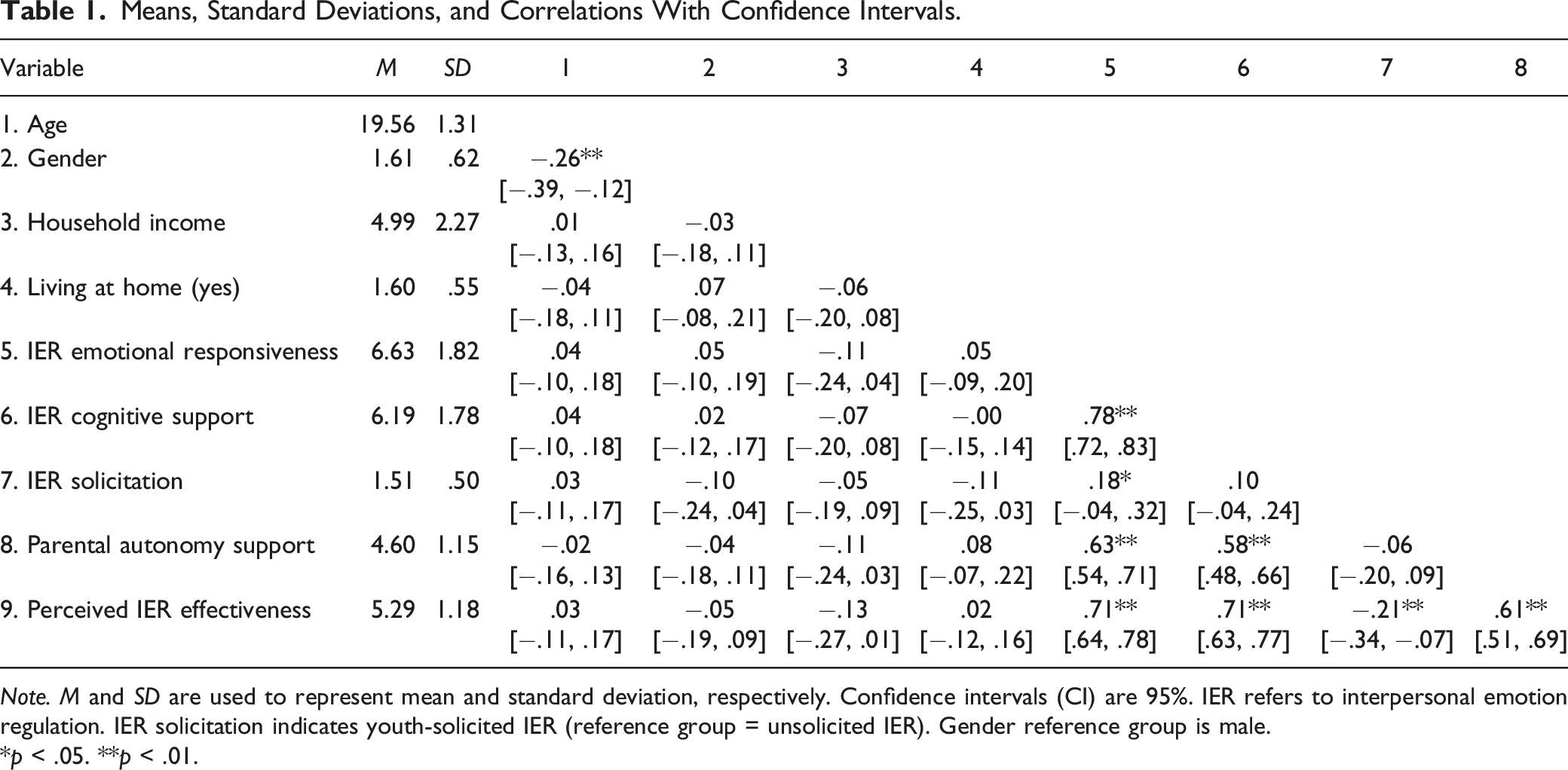
Note. M and SD are used to represent mean and standard deviation, respectively. Confidence intervals (CI) are 95%. IER refers to interpersonal emotion regulation. IER solicitation indicates youth-solicited IER (reference group = unsolicited IER). Gender reference group is male.
*p < .05. **p < .01.
Interpersonal Emotion Regulation Processes
Regression Model: IER Emotional Responsiveness and Parental Autonomy Support Relating to IER Effectiveness.
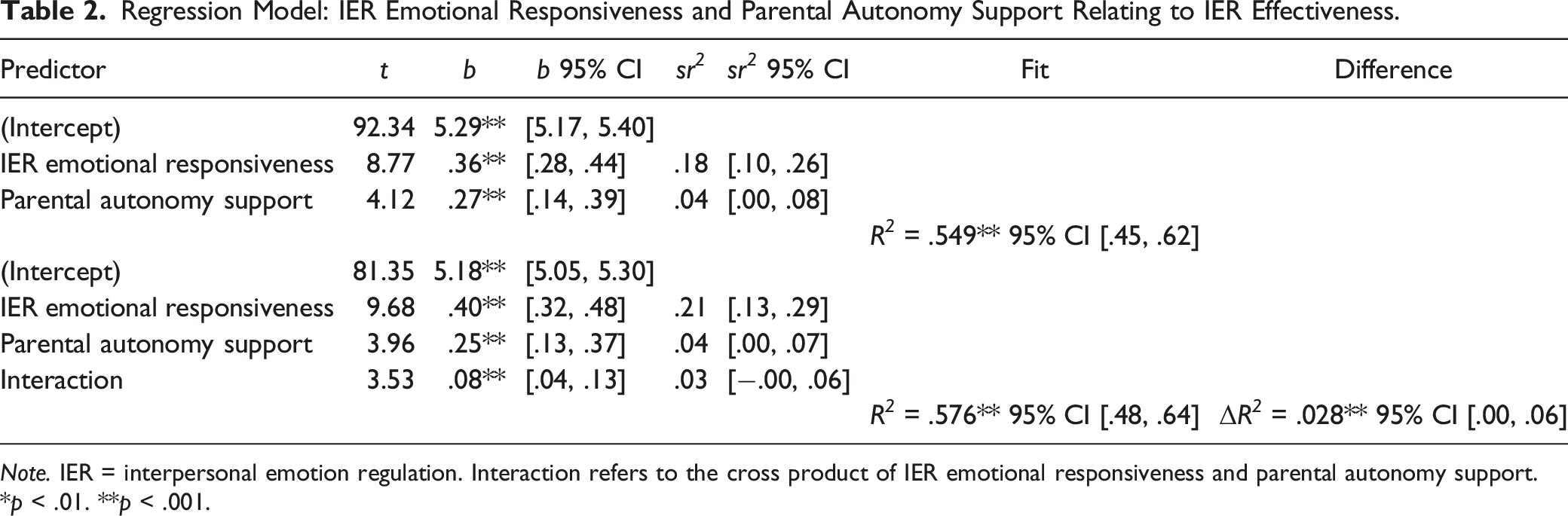
Note. IER = interpersonal emotion regulation. Interaction refers to the cross product of IER emotional responsiveness and parental autonomy support.
*p < .01. **p < .001.
Our first model examined the link between IER emotional responsiveness and perceived IER effectiveness, and whether parental autonomy support moderated this association (Table 2). The model was significant at step 1 (F(2, 191) = 116, p < .001), with positive main effects for both IER emotional responsiveness (b = .36, p < .001) and parental autonomy support (b = .27, p < .001) emerging; higher scores in both IER emotional responsiveness and parental autonomy support related to higher perceived IER effectiveness. As expected, step 2 revealed that parental autonomy support moderated the relation between IER emotional responsiveness and the perceived effectiveness of IER, ΔR2
adj.
= .03, F(3, 190) = 86.16, p < .001), b = .08, p < .001. The strength of association between IER emotional responsiveness and perceived IER effectiveness significantly differed at various levels of parental autonomy support (Figure 1(a)). The positive relation between IER emotional responsiveness and IER effectiveness was strongest at +1SD autonomy support (SD = 1.1, b = .49, p < .001), more moderate at mean levels of autonomy support (b = .40, p < .001), and weaker (though still significant) at −1SD autonomy support (b = .31, p < .001). (a) Plotted Interaction of Parental Autonomy Support and Emotional Responsiveness Relating to IER Effectiveness. Note. PAS = parental autonomy support. (b) Plotted Marginal Interaction of Parental Autonomy Support and Cognitive Support Relating to IER Effectiveness. Note. PAS = parental autonomy support. Interaction is marginally significant (b = .04, t(190) = 1.73, p = .09).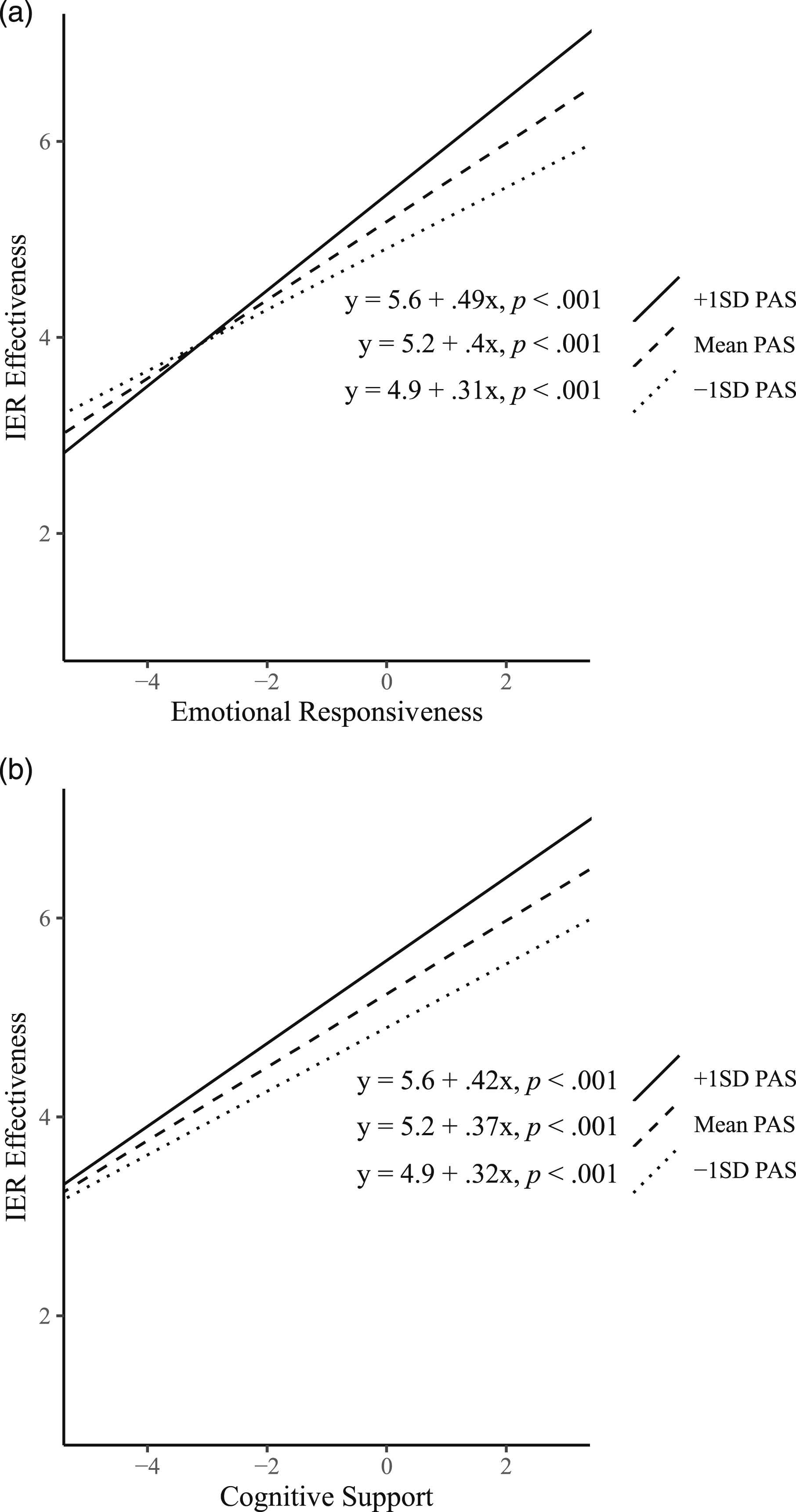
Regression Model: IER Cognitive Support and Parental Autonomy Support Relating to IER Effectiveness.
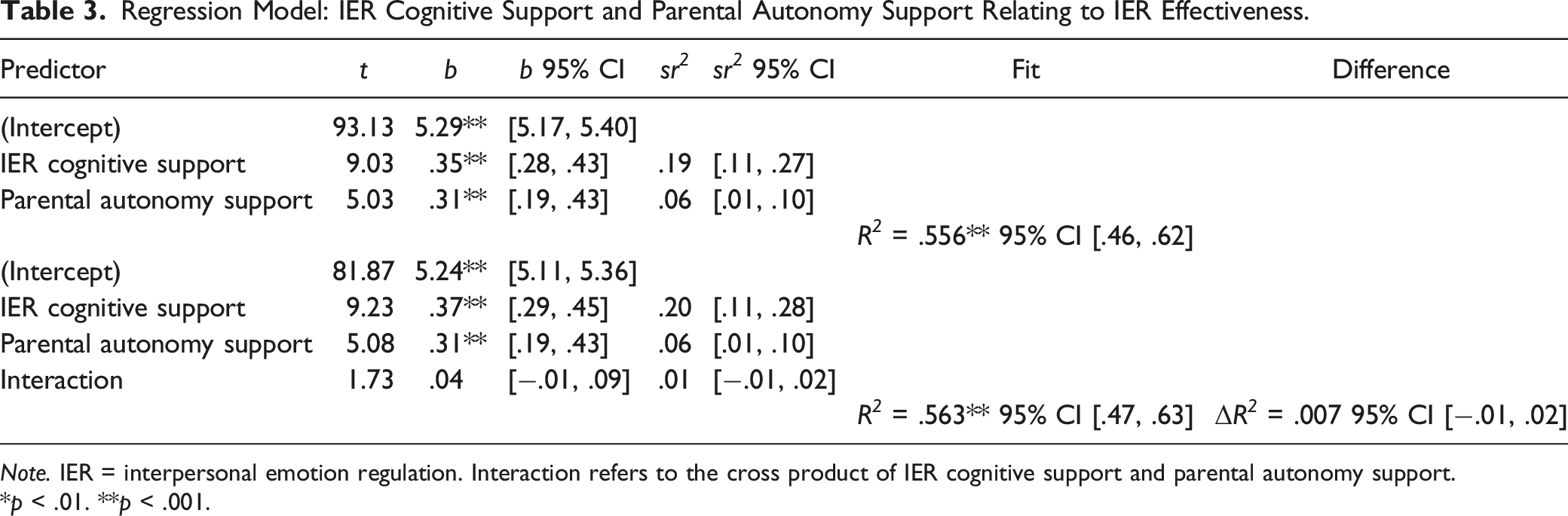
Note. IER = interpersonal emotion regulation. Interaction refers to the cross product of IER cognitive support and parental autonomy support.
*p < .01. **p < .001.
Interpersonal Emotion Regulation Solicitation
Regression Model: IER Solicitation and Parental Autonomy Support Relating to IER Effectiveness.
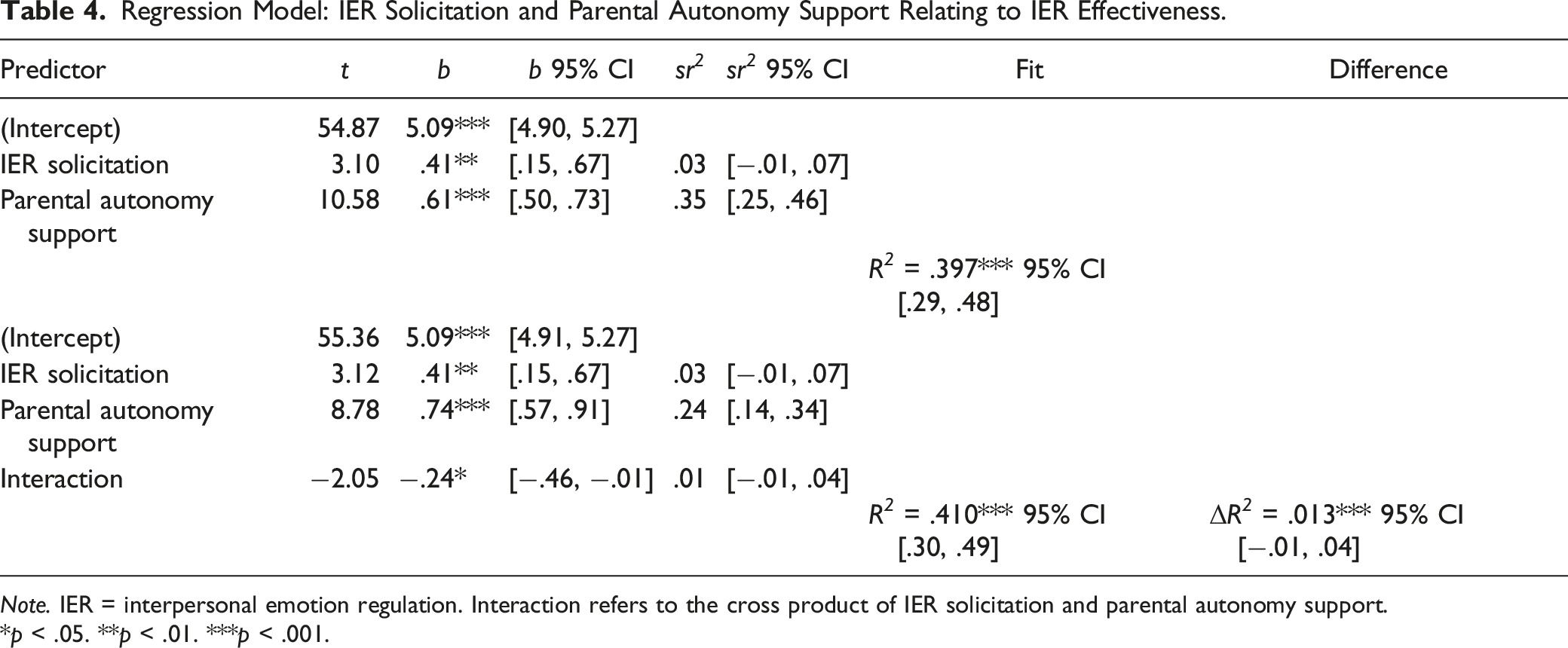
Note. IER = interpersonal emotion regulation. Interaction refers to the cross product of IER solicitation and parental autonomy support.
*p < .05. **p < .01. ***p < .001.
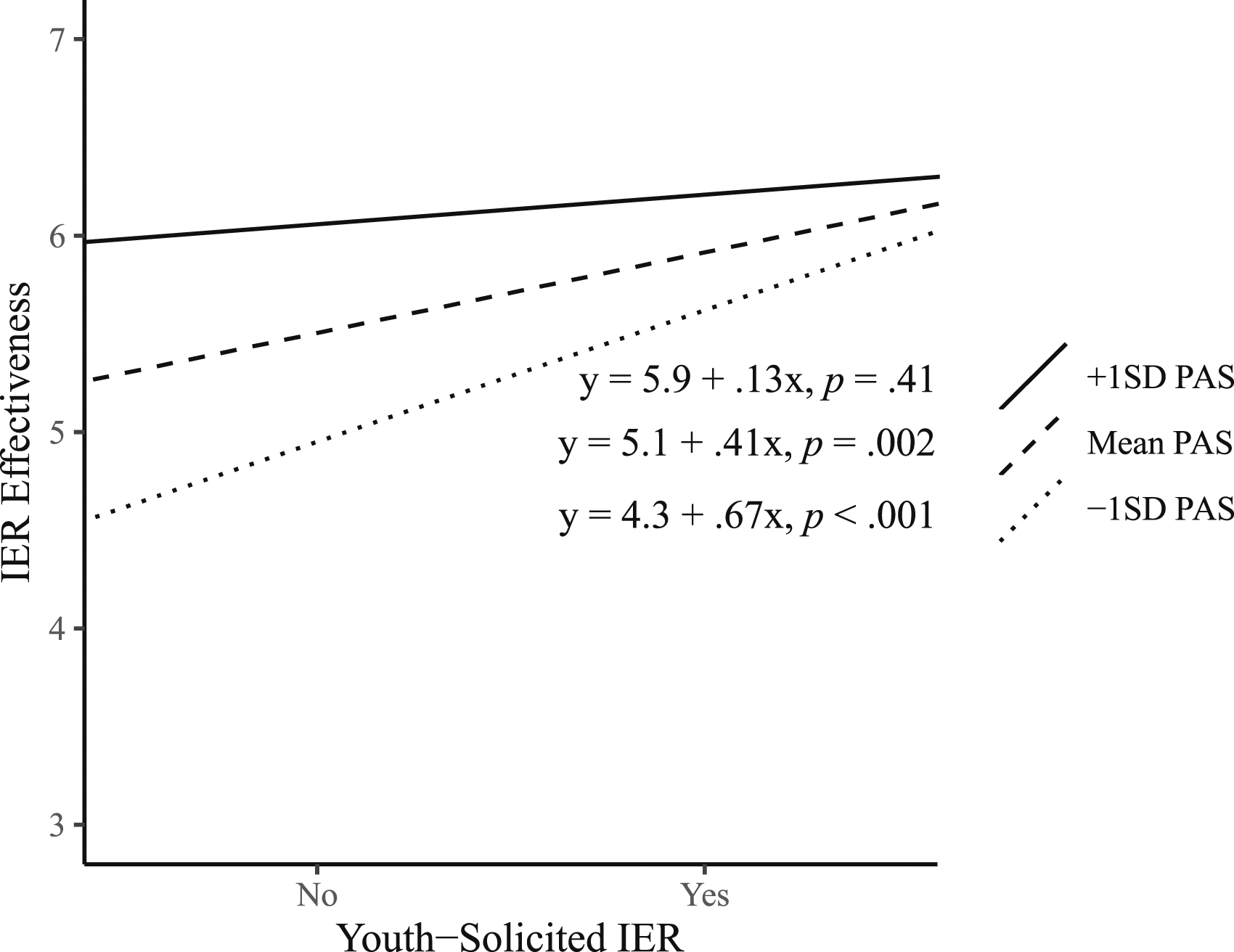
Plotted Interaction of Parental Autonomy Support and IER Solicitation Relating to IER Effectiveness. Note. PAS = parental autonomy support. ‘Yes’ refers to youth-solicited IER and ‘No’ refers to IER received unsolicited.
Discussion
The goal of the current study was to examine the individual and joint effects of youth–parent IER processes, IER solicitation, and parental autonomy support on IER effectiveness. To our knowledge, this is the first study to explore how these interpersonal processes relate to emerging adults’ perceptions of IER effectiveness during a recent instance of receiving IER from their parent. Our use of an IER framework offers a distinct advantage as it focuses specifically on emotional experiences, whereas broader social support frameworks consider support in non-emotional contexts as well (Cohen & Wills, 1985; Hofmann et al., 2016). The IER perspective adopted here enables us to shed new light on the crucial role parental autonomy support plays in parent-youth dynamics. The importance of investigating these processes during emerging adulthood is particularly high, as the parent–child relationship during this developmental period can have both short-term and long-term implications for socioemotional functioning. Our study’s specific hypotheses were largely supported, such that parental autonomy support moderated the relations between IER and its perceived effectiveness; at higher levels of parental autonomy support, parental emotional responsiveness related to higher perceived IER effectiveness. Our exploratory analysis also found that in conditions of low autonomy support, youth perceived unsolicited IER to be less effective than did youth with more autonomy supportive parents.
IER processes of emotional responsiveness and cognitive support were correlated, and each was robustly related to youths’ perception of IER effectiveness. Similar to existing research (Swerdlow & Johnson, 2022), we found that youth who reported receiving higher levels of emotional responsiveness also tended to report receiving higher levels of cognitive support. This aligns with the broader emotion regulation literature, specifically research regarding how the tendency to use one effective emotional support process is often accompanied by the ability to use additional effective strategies (e.g., Hofmann et al., 2016). Such associations are further bolstered by our findings that both emotional responsiveness and cognitive support were positively related to perceived IER effectiveness. Emotional responsiveness is known to signal validation and care, which in turn has been shown to facilitate down-regulation of negative emotions in social situations (Morelli et al., 2015; Pauw et al., 2018). The effectiveness of cognitive support is likely due to its ability to promote adaptive thinking and cognitive flexibility, such as with problem-solving and cognitive reappraisal (Chan & Rawana, 2021; Pauw et al., 2018; Sahi et al., 2022). By utilizing cognitive support provided by parents, youth not only benefit in the moment, but they can also learn to manage their emotions more effectively for future instances of emotional distress.
Consistent with past research, the effectiveness of parents’ emotional responsiveness was strengthened in contexts of high parental autonomy support and less pronounced in contexts of low parental autonomy support. The utility of emotional responsiveness likely lies in the receiver feeling validated and understood (Rimé, 2009). However, if youth have an overall perception of their parent as lacking in autonomy support, parental emotionally responsive behaviors may be interpreted as less sincere, and thus less effective. Specifically, parents’ emotional responsiveness, which is characterized by behaviors such as agreeing with youths’ opinion of the situation, allowing youth to vent, acknowledging the legitimacy of youths’ feelings, and expressing concern (Swerdlow & Johnson, 2022), may be less impactful if youth feel that their parents are not truly understanding their emotional experience. Alternatively, it is possible that even if youth do interpret their parent’s responses as genuine, fear of future insufficient support may leave them wary of relying on that parent’s IER efforts (Altan-Atalay, 2019; Ryan et al., 2005).
Regarding the moderating role of autonomy support when considering the link between IER cognitive support and perceived effectiveness, we must be cautious in our interpretation. The non-significant (marginal) interaction suggests that the utility of cognitive support may be less susceptible to variations in parental autonomy support than emotional responsiveness. Despite a robust main effect of cognitive support relating to perceived IER effectiveness, cognitive support did not interact with parental autonomy support. Although our study is cross-sectional in nature, we can speculate on the developmental impact (or lack thereof) that parental autonomy support has on various parent-child interactions. While the effectiveness of emotional responsiveness appears to be contextualized by parental autonomy support, cognitive support might be effective regardless of the level of parental autonomy support provided within the relationship. It is possible that cognitive support, with its focus on tactics like problem-solving and reappraisal, may be more task-oriented and less dependent on the broader socioemotional functioning between the parent-youth dyad (Gross, 2014; Levy-Gigi & Shamay-Tsoory, 2017). Therefore, it may be less influenced by the level of parental autonomy support provided, although further research is needed to fully understand the mechanisms behind such an effect. Lastly, it is also important to acknowledge the potential limitations in statistical power. Moderation analyses, by their nature, often necessitate larger sample sizes to reliably detect subtle interaction effects (Sommet et al., 2023). It is plausible that a more robust sample could reveal a clearer pattern of moderation.
A novel contribution of the current study is our consideration of how parental autonomy support contextualizes the effectiveness of solicited versus unsolicited IER. Parental autonomy support moderated the association between IER solicitation and its perceived effectiveness, such that when autonomy support was low, youth who solicited IER benefited more than those who received unsolicited IER. Our findings are new within the framework of considering parent-youth IER processes but align with prior research on the nuances of support seeking; when IER is received, but was not initially sought by the receiver, it is likely to be experienced as less effective (Carlson, 2016; Segrin et al., 2012; Wang, 2019). Beyond this main effect, a central question remains: Why might solicitation matter for youth of low autonomy supporting parents, but not for youth with high autonomy supporting parents? One possible explanation is that in contexts of lower parental autonomy support, the parent may not know when to offer help and this may necessitate the youth communicating their needs more explicitly for the IER to be perceived as effective. Moreover, parents who lack insight into who their child is and what they want may inadvertently intervene in unwelcome ways (Assor et al., 2004; Guntzviller, MacGeorge, & Brinker, 2017). This may explain why youth who receive unsolicited IER from low autonomy supportive parents perceive the IER to be less effective. Unsolicited IER may be particularly harmful to the stability of the parent-youth relationship; given that emerging adulthood is marked by increased independence from one’s family, unsolicited IER from low autonomy supportive parents may antagonize the parent-youth relationship during an already vulnerable period of transition. On the flip side, highly autonomy supportive parents may have increased insight into how to offer unsolicited support (Joussemet et al., 2008), and thus do not fall into the trap of giving unwanted support. Within a context of lower parental autonomy support, youth may be less willing to engage in the unsolicited IER (Benita et al., 2019; Roth et al., 2009). Such a conclusion was drawn by Benita et al. (2019), who found that when participants were allowed to spontaneously choose whether to regulate emotions, those who were in an autonomy-supportive condition were more likely to independently pursue emotion regulation goals than those who were in an environment of lower autonomy support. A similar effect could be present in our current study; a lack of autonomy support may undermine youths’ motivation to implement or consider the offered support, particularly when the support was unsolicited. Moreover, future research should explore the possibility of higher-order interactions between the type of IER (emotional responsiveness and cognitive support), IER solicitation, and parental autonomy support. The current study was underpowered to examine this, but it is possible that the way emotional responsiveness and cognitive support relate to perceived IER effectiveness may depend on both whether youth actively sought the IER and the degree of parental autonomy support.
One notable strength of this study is the diverse and primarily non-White sample, which deviates from the characteristics of typical samples. The inclusion of a substantial number of Asian and Latinx participants provides a unique opportunity to consider the role of parental autonomy support and IER processes within the context of cultures that emphasize values such as interdependence, filial piety, and familismo (Cole & Tan, 2015). The diverse sample of participants allows for a more inclusive study of parent-child relationships and emotional dynamics among participants from diverse cultural backgrounds. However, it is important to acknowledge that the present study did not explicitly measure ethnic identity or cultural values. This limitation prevented us from specifically exploring the possible impact of cultural factors on IER processes examined here. Future research should consider incorporating measures that will support further investigation of the influence of culture on parental autonomy support and the effectiveness of IER.
Despite the novel insights our study provides, there are several additional limitations to acknowledge. First, although our moderation hypotheses were largely supported, and despite our expectations being theoretically grounded, there are likely bidirectional, predictive effects between parent-provided IER and parental autonomy support. Most likely, parents’ support of their child’s autonomy and their provision of IER simultaneously influence one another. Future studies should explore how the reciprocal nature of autonomy support and IER informs dyadic social functioning. Related, our findings are correlational, and we cannot deduce cause and effect. The utilization of longitudinal and experimental designs may further untangle youths’ perceptions of IER effectiveness. We also did not utilize measures of parent-child relationship quality, and did not have complete data on parent gender, and thus could not include such variables as covariates. Furthermore, it is important to acknowledge that there may be potential discrepancies between our conceptualization and operationalization of IER. In our study’s prompts we used the term “emotional support” which may have biased participants to primarily recall instances of emotional responsiveness, while overlooking experiences of cognitive support. This issue highlights a potential limitation of our study, as it underscores the challenge of precisely operationalizing the multifaceted nature of IER. Lastly, we employed self-report questionnaires, which are prone to participant bias (e.g., social desirability bias, confirmation bias, halo effect; Rosenman et al., 2011), and utilized retrospective reports of IER, which are prone to memory bias (Bradburn et al., 1987). However, these designs are useful for laying conceptual groundwork within a newer field of study (such as in IER research), and the nature of our research (i.e., perceptions of IER effectiveness) is, in fact, best measured using self-report. Even within the context of remembered social interactions, our findings are still informative, as memory plays an influential role in motivating subsequent behavior (Kennedy & Shapiro, 2009). Nonetheless, to further advance our findings, future research would benefit from assessing IER processes and parental autonomy support through observations and live interviews.
To conclude, the current study suggests that emerging adults who perceive their parents as less autonomy supportive likely benefit less from parent-provided IER. Our focus on the utility of IER within the context of parental autonomy contributes to the growing field of IER research, providing a strong incentive to explore the mechanisms of IER effectiveness. Future research should continue to explore the unique developmental implications of IER during the transition from adolescence to adulthood.
Supplemental Material
Supplemental Material - A Helping Hand Isn’t Always So Helpful: Parental Autonomy Support Moderates the Effectiveness of Interpersonal Emotion Regulation for Emerging Adults
Supplemental Material for A Helping Hand Isn’t Always So Helpful: Parental Autonomy Support Moderates the Effectiveness of Interpersonal Emotion Regulation for Emerging Adults by Madeline Newman, and Elizabeth L. Davis in
Footnotes
Declaration of Conflicting Interests
The author(s) declared no potential conflicts of interest with respect to the research, authorship, and/or publication of this article.
Funding
The author(s) received no financial support for the research, authorship, and/or publication of this article.
Open Practices
The raw data, analysis code, and materials used in this study are not openly available but are available upon request to the corresponding author. No aspects of the study were pre-registered.

Supplemental Material
Supplemental material for this article is available online.
Note
Author Biographies
References
Supplementary Material
Please find the following supplemental material available below.
For Open Access articles published under a Creative Commons License, all supplemental material carries the same license as the article it is associated with.
For non-Open Access articles published, all supplemental material carries a non-exclusive license, and permission requests for re-use of supplemental material or any part of supplemental material shall be sent directly to the copyright owner as specified in the copyright notice associated with the article.
