



Abstract
As attending college became a normative life experience in the U.S., society developed a cultural narrative about what a “good” college experience looks like. But, for racially minoritized college students, this master narrative often excludes their experiences. Integrating narrative and ethnic-racial identity, the current study investigates how a sample of 11 Black and Latinx students (M age = 19.73) narrate their lives in college and make meaning of their racial experiences. Participants were prompted to construct their college story as if it were a book with chapters and describe the connections between those chapters. We analyzed students’ college stories and found that they used either chronological or thematic coherence to structure their narratives; this distinction in structure was related to the content of their stories. We discuss the theoretical and practical implications of using a racialized college story narrative to understand ethnic-racial identity for minoritized college students.
Introduction
College 1 is increasingly a normative expectation for high school graduates in the United States and, thus, a relevant developmental context for emerging adults (Arnett, 2015a, 2015b). While earning a college degree serves as a factor for socioeconomic mobility, better health outcomes, and longer life span (Hummer & Hernandez, 2013), it is inaccessible to some, and even for those who attend, the college experience is far from uniform or universally positive (Fischer, 2010). Students from minoritized backgrounds often have college experiences distinct from and negative compared to their peers with racial and socioeconomic privilege (e.g., Destin et al., 2021; Patton, 2016). Black and non-white Latinx youth, specifically, face several significant barriers as they develop into adulthood due to a sociocultural context that is ubiquitously and actively constructed to systematically disadvantage non-white, low-income people (Solórzano et al., 2000; Adams-Wiggins & Taylor-García, 2020). Thus, beyond the normative challenges of navigating college, Black and non-white Latinx college students also contend with discrimination, limited access to quality education, and fewer resources and social connections (Gonzalez, 2023; Hill & Okojie, 2022; Spencer, 2021).
In the current research, we examine how ethnic-racial identity (ERI) development is an integral part of the college experience, specifically for Black and non-white Latinx students. ERI refers to the process and content that defines one’s knowledge, attitudes, beliefs, enactment, and awareness of their ethnic heritage and racial background (Umaña-Taylor et al., 2014; Williams et al., 2020). Emerging adulthood is generally defined as ages 18 through the mid-to late-20s and is a key period for identity development, specifically ERI exploration and development (Arnett, 2015a, 2015b; Syed & Mitchell, 2013). It is a time of instability and possibility, when young people are experiencing new contexts and building new relationships while actively imagining and creating the future self they desire to be. Thus, emerging adults are particularly attentive to the social forces and expectations that influence their developing sense of self. To contextualize this period, we draw from critical theories that posit that all human development is shaped by structures of racism, anti-Blackness, and coloniality (Adams-Wiggins & Taylor-Garcia, 2018; Rogers, Niwa, et al., 2021). This starting point emphasizes the racialization of Black bodies through the white gaze that renders Black and non-white youth objects rather than full humans with heritage, culture, and language (Yancey, 2005). We conceptualize ERI using cultural, developmental, and social psychological frameworks, which locate identity as transactional and mutually constituted with the sociopolitical and sociocultural context; thus, the stories, traits, relationships, experiences, and meanings that are associated with people’s identities are situated within systems of power and cultural ideologies (e.g., Hammack, 2008; McLean & Syed, 2015; Rogers, 2018; Spencer, 2021). From these theoretical lenses, we examine how Black and non-white Latinx students narrate their college experiences, exploring how their lived realities during college are experienced through their ERI and how their college experiences facilitate the construction of their ERI.
To set up our analysis, we first describe the developmental affordances of the college context and then review research on ERI in context. Next, we provide an overview of our approach to narrative identity to understand students’ experiences and then summarize and integrate ethnic-racial and narrative identities to frame the current study contributions.
College as a Developmental Context
In the U.S., nearly 62% of individuals who graduate from high school or attain a GED immediately enroll in college, and nearly 40% of all youth between the ages of 18–24 years old are currently enrolled in college (NCES, 2023). As attending college became a more normative life experience, society developed a shared script – a cultural narrative – about what makes for a “good” college experience. In the U.S., this means leaving home to live “alone” (Tinto, 1987, 1993) and nurture one’s independence (Stephens et al., 2012), while continuing socialization and assimilation into U.S. racial and cultural norms, values, and belief systems (Destin et al., 2021). Baked into this master narrative are unarticulated assumptions about who college is for, namely white, economically advantaged, able-bodied individuals, and what type of college makes for a “good” college experience; namely, attending a predominately white institution (PWI), rather than a historically Black college or university (HBCU), for example, is the unmarked standard for having a “good” college experience and constructing a “good” college story.
Culturally shared stories shaping the sequence of life events one “normatively” navigates, such as going to college, have been conceptualized as “master narratives” (McLean & Syed, 2015). Master narratives are social scripts that guide how to live a “good life” in a given society; they outline the milestones one will traverse and offer a way to understand why things are the way they are. That said, master narratives reflect and reify power relations among individuals and societal systems (McLean & Syed, 2015). Indeed, a “good” college story is often a “raceless” story, a story that precludes the influence and power of race from shaping students’ experiences in college (Harper & Hurtado, 2007; Solórzano & Villalpando, 1998; Syed & Mitchell, 2013). Yet, a large body of research tells a very different college story for students who occupy marginalized societal positions. For Black, Indigenous, Latinx, and other racially minoritized groups, college is a place of growth and opportunity but is also full of structural and interpersonal barriers to one’s identity processes, sense of belonging, and academic success (Yosso et al., 2009; Syed & Azmitia, 2010; Solórzano & Villalpando, 1998). Thus, the master narrative of a “good” college story is neither representative of all college stories nor neutral in terms of whose experiences are centered or excluded.
The racial dynamics of a college or university setting can and often do play a role in students’ experiences. Research suggests that being a numerical minority in the university setting – “being the only one” - especially for students of color at a predominantly white institution (PWI) – can negatively impact various aspects of students’ experiences by invisibilizing and tokenizing them (Solórzano et al., 2000). Attending a PWI is often connected to expectations for racial and cultural assimilation (Destin et al., 2021) and increases the likelihood that minoritized students will experience discrimination, criminalization, and fear (Allen, 2022) and lower self-esteem and racial identity importance (Campbell et al., 2019). Compared to a PWI, Black students attending an HBCU report a higher GPA, greater levels of self-esteem, lower frequency of discrimination experiences, and greater positive feelings about their racial identity – or put simply, feel more positive about being Black (e.g., Campbell et al., 2019). Together, the evidence suggests that attending a PWI may negatively affect students, but how young people perceive and think about their own ERI is crucial to these experiences.
Ethnic-Racial Identity Development and College Experiences
The way a young person understands who they are is inherently embedded in context (e.g., Galliher et al., 2017). For emerging adults who attend college, this is an important context for identity development, a key task of this period (Arnett, 2015a, 2015b). College is a place to explore and “try on” new versions of oneself. For racially minoritized young people, one facet of this includes exploring and understanding one’s ERI. This involves negotiating the importance of one’s ethnic-racial group to overall self-concept (Sellers, Smith, et al., 1998), the ideologies one holds about their ethnic-racial group (Sellers, Chavous, & Cooke, 1998), and ways to explore and learn about one’s ERI (Syed & Azmitia, 2010; Williams et al., 2020). Because ERI develops in a context rooted in white supremacy and anti-Black racism, Black and non-white Latinx youth are simultaneously raced – their physical bodies are made hypervisible through the white gaze – and erased, as their cultural practices, ethnic heritages, and linguistic traditions are racialized, devalued, or invisibilized (Yancey, 2005). The fullness of their humanity and the complexity of their lives is flattened, and their claim to the reality of their experience is undermined. A core task of ERI development is making sense of this ontologically paradoxical context, and youth often do this through their identities (Spencer, 2021).
One particular insight from the vast literature on ERI development is the way students make meaning of this identity in the context of discrimination is related to important psychological and academic outcomes. Black, Latinx, Indigenous, and other minoritized students are often subject to hostile, psychologically harmful, discriminatory experiences in college. For example, they report experiencing discrimination from their peers, professors, and institutions (Solórzano & Perez Huber, 2020), which is associated with a greater incidence of depression (Eschmann et al., 2021) and other psychological disorders than their white peers. However, students’ ERIs can serve as personal characteristics that can reduce (i.e., protective factor; Butler-Barnes et al., 2018) or heighten (i.e., risk factor; Caldwell et al., 2004) the likelihood of a negative impact of racial discrimination. In a meta-analysis of discrimination experiences on adjustment outcomes, Yip and colleagues (2019) identified that ERI reduced the negative effect of discrimination on academic and physical health outcomes. Consistent with prior research, identity exploration increased vulnerability to discrimination, whereas commitment conferred some protection against it (Yip et al., 2019). Put simply, students who affirmed the role their ERI played in their self-concept were buffered from discrimination, while students who engaged in activities aimed at understanding their ERI but had not yet clarified what it meant to them, were more vulnerable. Collectively, these findings suggest that as young people navigate the college experience, their ERI may be a source of strength in the face of marginalization and discrimination, particularly once they have clarity about the role ERI plays in their overall self-concept. Given that emerging adulthood is conceptualized as a period of self-focus, instability, possibility, and feeling “in-between” (e.g., Arnett, 2015a, 2015b), each factor may shape ERI development in the college context.
While much of the research on ethnic-racial discrimination focuses on (or assumes) the experience from a monoracial perspective – that young people identify with a single racial or ethnic group (e.g., Black or Mexican), there is a burgeoning body of work that discusses multiracial identity (e.g., identifying as both Black and Mexican). Researchers have identified the unique discrimination experiences in college of navigating a monoracist society that assumes (or enforces) monoracial as the default (Johnston-Guerrero et al., 2020; Jones & Rogers, 2022). While there are similarities and shared experiences between monoracial and multiracial youth as their ERI develop, Multiracial youths must also learn to contend with a particular form of discrimination: Identity denial or invalidation, which is the active (and sometimes passive) rejection of Multiracial youth’s identities and repudiation of their membership in the groups with which they identify (Albuja et al., 2019; Franco et al., 2021; Jones & Rogers, 2022). Identity denial, like racial discrimination broadly, can lead to a host of negative outcomes for young people, such as lower life satisfaction, increased depressive and stress symptoms, lower self-esteem and motivation (Townsend et al., 2009), and even decreased physical health (Albuja et al., 2019). College may be a place where Multiracial youth encounter institutional erasure and other discriminatory experiences (Ford et al., 2021) that may influence how they come to identify and the labels they use to describe themselves. Thus, Multiracial students may be more likely than monoracial young adults to explore their ERI in emerging adulthood, exposing vulnerabilities to wellbeing (Jensen et al., 2023; Jones et al., in press).
In sum, college is a salient context for identity development, and the research on ERI development in college shows that it is an important part of how students experience and make sense of their college experiences. This raises the question of whether and how students’ college experiences may be “story-ed” or told through the lens of their developing ERI—constructed in tandem to tell a coherent narrative.
A Narrative Approach
Storytelling has been described as the “best available structure” for integrating and making meaning of one’s life (Bruner, 1990, Sarbin, 1986; McAdams et al., 2001, p. 475). It is a psychological phenomenon that helps individuals construct coherent narratives that tie together past, present, and future experiences (Fivush, 2011). Narrative is more than just understanding ones’ experience, it is about understanding oneself. Individuals use stories to represent their identities and make sense of otherwise disparate experiences (McAdams & McLean, 2013). The stories people tell about their lives, according to the Empirical Model of Narrative Identity, have three major components, two of which are focal for this study: structure and autobiographical reasoning (the third being motivational/affective themes; McLean et al., 2020).
The structure of narrative identity refers to the way participants label and organize their stories (McLean et al., 2020). Individuals who use facts and chronological time markers to structure their narrative are likely to be younger people with a less developed capacity for abstract thinking or individuals who do not have a theme or lesson that connects their life experiences meaningfully (McAdams, 2001). Individuals who use broader themes or patterns that connect life experiences beyond the mere passage of time or the facts that describe a particular life event are more likely to be adults or individuals who have reinterpreted life events in ways that indicate healthy and positive coping. Since we are interested in emerging adults in this paper, we do not expect that age specifically will differentiate the narrative structure. However, we expect that those with less clarity about their ERI and its role in their college experience may be more likely to rely on chronological versus thematic structures. Beyond the structure of a story, how people reason about the events, experiences, and relationships of their life stories also matters for their identity and broader development.
Autobiographical reasoning refers to how individuals interpret, evaluate, or make connections between their memories and experiences (McLean et al., 2020; Singer & Bluck, 2001; McAdams, 1985). In particular, this narrative component contains concepts like meaning-making, thematic coherence, exploratory processing, and change connections, all of which are narrative tools to make connections between important life events and establish one’s identity. The act of telling a story about one’s life motivates individuals to make sense of events, moments, and experiences that might otherwise conflict or have no obvious connection; they are motivated to provide a sense of coherence (Habermas & Bluck, 2000). The development of identity in the narrative approach is this very process of recalling memories, telling stories about them, and engaging in autobiographical reasoning. Thus, we might expect individuals who have a clearer understanding of their ERI to reason about their experiences in ways that meaningfully draw them together.
Using a narrative approach, scholars have identified key links between how young people narrate their lives and their ERI development (Devost, 2022; Moffitt & Syed, 2021; Russell, 2021; Singer, 2016; Syed & Azmitia, 2010; Syed & Azmitia, 2008). Moreover, the narrative approach, both as a theory and a method, offers several unique insights into how racially stigmatized emerging adults construct their ERI by making meaning of their experiences in college (Syed, 2015). We draw from this tradition to position students as authors of their own stories, to make meaning of how racially oppressive experiences in college shape their identity development (Solórzano & Yosso, 2002; Syed, 2015). Further, this approach has been shown to serve as an important therapeutic practice in interpreting oneself as overcoming, surviving, and resisting harmful racially stigmatizing experiences (Rodriguez, 2010). Prompting individuals to narrate their college experiences through the lens of ethnicity-race may promote meaning-making and the opportunity to articulate how ERI has influenced their life experiences (Syed et al., 2011). Finally, using narrative affords the opportunity not only to document the experiences of racially minoritized youths but to use science as a platform to “speak back” to the stereotypical, flat, and harmful ideas about minoritized youth (Adams-Wiggins & Taylor-Garcia, 2018; Rogers & Way, 2015).
Current Study
In the current study, we explored Black and Latinx (non-white) students’ ERI and meaning-making through narratives of their college experiences, responding to a call for greater integration of narrative approaches and ERI development (Syed, 2015). Our analysis was guided by two research questions: (a) What are the structural features of Black and Latinx students’ narratives? and (b) How do students make meaning of their racial experiences as they articulate their stories? We used the life story interview to address these questions and the empirical model of narrative identity to analyze our interview data. Extending prior research on ERI development among college-going emerging adults (Moffitt & Syed, 2021; Syed & Azmitia, 2010, Syed, 2012), we gather new insight into the meaning-making and active building of ERI through participants’ storytelling of their lives in college.
Method
The My College Story Project was a qualitative study of college experiences among Black and non-white Latinx students at a predominantly white, elite institution in the U.S. Midwest. The purpose of the project was to investigate how Black and non-white Latinx youth narrated the stories of their college experience to understand how they interpreted the racial experiences and challenges they faced.
Participants
We recruited 11 participants (M age = 19.73, SD age = 1.34): Three students identified as male, and eight identified as female. Three students identified as Black, five as Latin(o/a), and three with two or more racial groups (Black/White, Black/Latinx/Southeast Asian, Black/Latina). Nine students had annual household incomes below $90K, and six were first-generation college students (neither parent attained a 4-year degree). There were four first-year, one second-year, four third-year, and two fourth-year students. Students were recruited through flyers posted in university buildings, which asked students to enroll via email. Students were interviewed in March through June, the middle to end of the school year.
Procedure
The semi-structured interview protocol was adapted from the Life-Story Interview (Atkinson, 2002; McAdams, 1985). The six sections of the interview protocol were the following: (a) Life Chapters, (b) Turning Point, (c) High Point, (d) Major Challenges, (e) Central Theme, and (f) Reflection.
The first section was the Life Chapters section. First, we asked about race and ethnicity and asked participants to consider how race and their ERI shaped their experiences/chapters. Specifically, we asked participants: Please begin by thinking about your college career as if it were a book or novel. Imagine that the book has a table of contents containing the titles of the main chapters in the story. Please describe very briefly what are the main chapters in the book. As a storyteller here, what you want to do is to give me an overall plot summary of your story, going chapter by chapter.
After asking for chapter titles, we asked participants to describe a turning point in their college careers and a high point or a particularly happy or joyous scene in their college careers. Next, we asked participants to describe a challenge they faced in three distinct areas: (a) social, (b) academic, and (c) institutional. In the final section, each participant was asked to describe what they believed was the central theme of their interview and story. The purpose here was to allow participants the space to make meaning of their stories, which previous research shows is a predictor of positive mental health and wellbeing (McAdams, 2001).
The first author conducted nine of the interviews and the second author conducted two. All interview data were digitally recorded, professionally transcribed verbatim, and verified by the first author. Interviews were conducted during the 2019–2020 school year in a confidential location on campus and lasted about 50 min each on average. All research activities were approved by the Institutional Review Board STU00211385.
Coding and Analysis
For this analysis, we use narrative analytic concepts from the Empirical Model of Narrative Identity (McLean et al., 2020), focusing on two core components of narrative: structure and autobiographical reasoning.
RQ1: What are the Structural Features of Black and Non-White Latinx Students’ College Story Narratives?
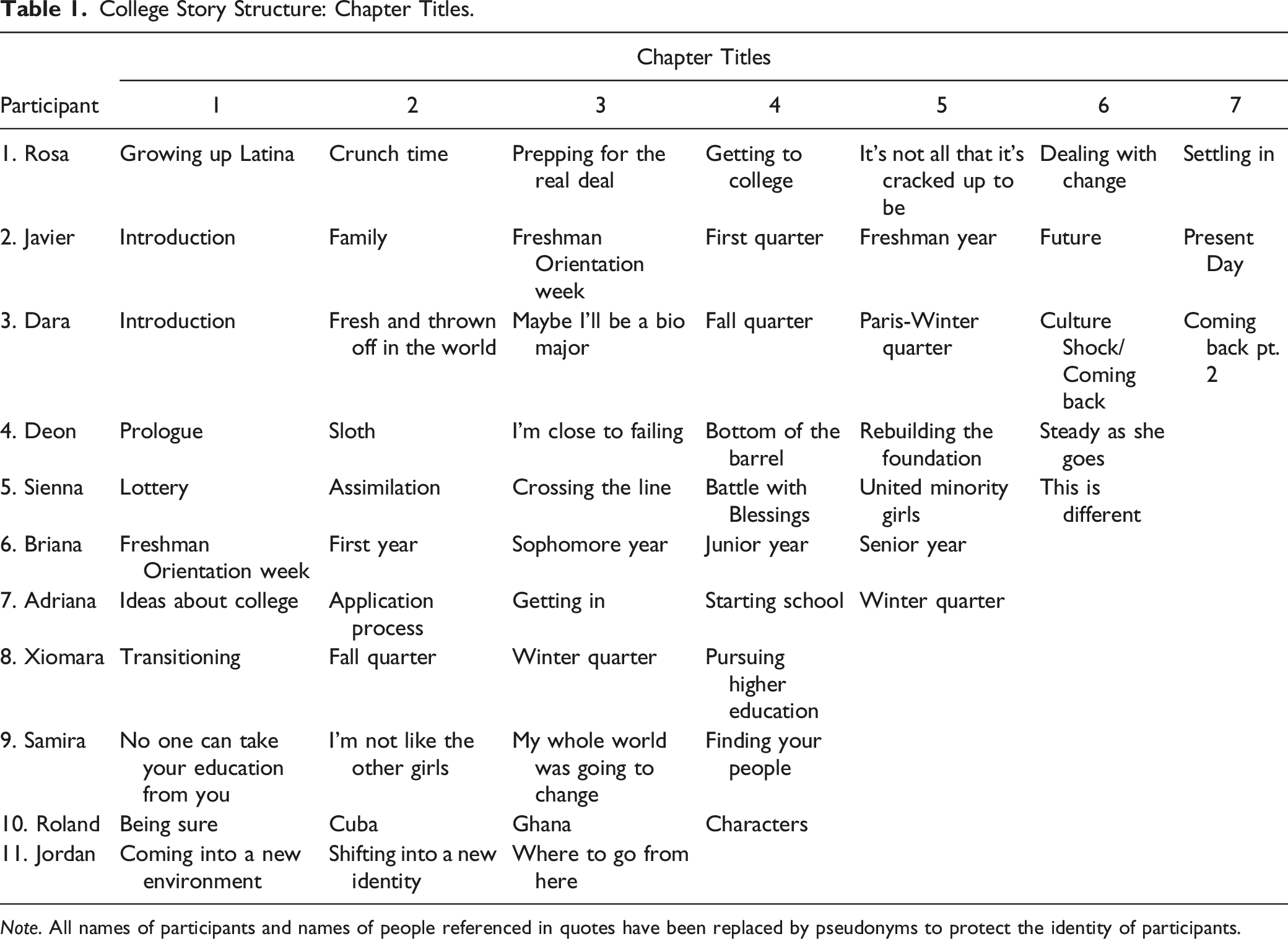
College Story Structure: Chapter Titles.
Note. All names of participants and names of people referenced in quotes have been replaced by pseudonyms to protect the identity of participants.
We observed distinct structural components in students’ narratives. The first was chronological, which was defined as student narratives that were organized over time, usually beginning with events that happened earlier in their lives (before college) and ending with the most recent set of events. The second narrative structure was thematic, which was defined as narratives that were organized using personally relevant life events connected by an overarching message or lesson learned during that phase (chapter) of the story.
RQ2: How do Students Make Meaning About Their Racial Experiences as They Articulate Their Stories?
Next, we analyzed the content of the chapters for autobiographical reasoning, which is comprised of exploratory processing, meaning-making, change connections, thematic coherence, and interpretations (McLean et al., 2020). We operationalize meaning-making as retelling past events and experiences, and using them to learn about oneself and one’s relationships (McLean et al., 2007). While the analysis of structure is centered on the titles of the chapters and their inter-relations, the analysis of meaning-making is centered on the content of the chapters. That is, why are students telling these particular stories, and how do they interpret the meaning of the college events, moments, and relationships they share? Emerging adults generally have the capacity for this kind of complex self-reflection, yet not all engage in it to the same degree (Arnett, 2015a, 2015b). This analytical step necessarily follows the structural analysis because the structure provides a form to the content. In other words, the way participants drew meaning from a particular experience is contextualized in the way they organized it in relation to other experiences.
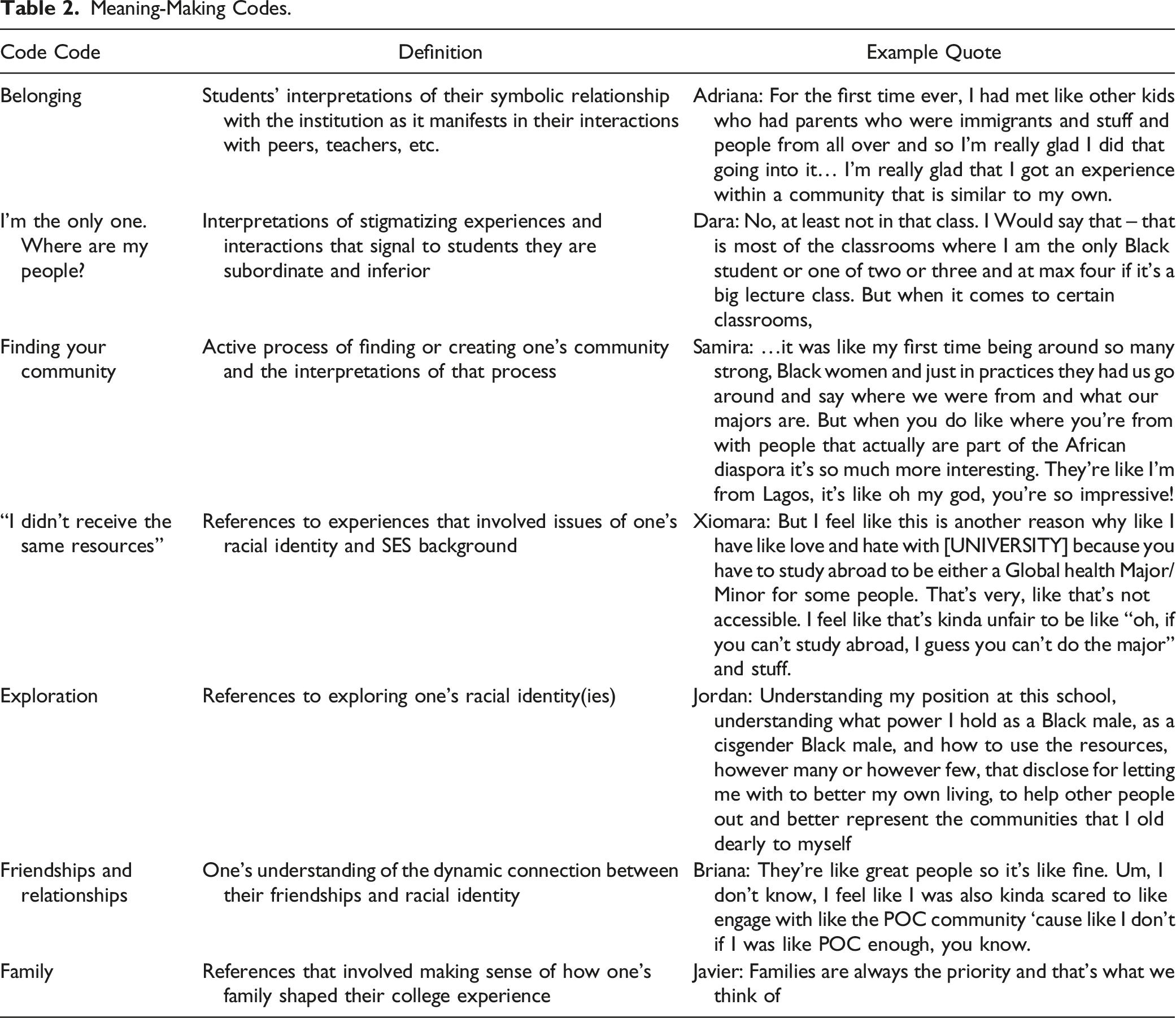
Meaning-Making Codes.
Reflexivity and Positionality
This analysis and interpretation are founded on a stance of “strong objectivity” (Fine, 2006). We assert that our identities and positionalities across systems of power shaped our understanding, our reading, and our collecting of students’ narratives. Indeed, we acknowledge that our positionalities both provide important insight and opportunities as well as limitations and drawbacks in this research. We reflect on how we understand and make sense of this to provide a more rigorous (i.e., “closer to the data”) analysis that does not pretend nor perpetuate the harmful idea that our perspective as scientists is without bias. Thus, we include a short statement from each author to highlight how each unique perspective interacted with the work.
The first author: As a first-generation college student from a working-class background with a brown (caramel-like) complexion and curly Afro hair, my Blackness and indigeneity are core features of my experience; I had similar experiences to the participants and often felt the tension of both offering a value-neutral space for participants to share their stories and engaging in the human experience of finding similarities with their experiences. As my colleagues and I analyzed the data, it became apparent how some of the participants’ stories relied on my having similar knowledge and experiences in life and college. Some details were trusted to my experience on the part of the participant. At some points, I felt the need to point out the obvious (between the participant and me) so that the detail would not be lost in the interview, but this may have risked the sense of shared experience that they felt could be rightfully assumed of me. Together, my experience enabled me to analyze the data with a particular eye on how their experiences both mirrored and diverged from my own.
Second author: The second author identifies as a white American cisgender woman from a working-class background. My race, class, and gender shaped the two interviews I conducted, first with a Black/Latino/Southeast Asian Multiracial man, and then with a Latina woman. In the first interview, the participant hesitated multiple times as he described his racial identity development, seemingly unsure of whether he could fully speak openly with me. I encouraged him to do so, and while he offered rich and complex narratives about his college experiences, his framing, level of detail, and overall comfort may have been different had the first author conducted this interview. In contrast, in the second interview, my working-class background and gender as a woman both offered a foundation of shared knowledge and experience that seemed to put this participant at ease. These experiences underscored the complexity of the oft-suggested practice of “matching” participant and interviewer – the intersectionality of our identities means that while some aspects may align, others will not, and which may be particularly salient for a given participant are difficult to judge a priori (e.g., Rogers, Moffitt, & Jones, 2021).
The third author identifies as a Black cisgender woman and a first-generation student from a working-class background. As the senior scholar and mentor on this work, her identities and positionality were relevant in guiding and designing theoretical and methodological approaches for data collection, analysis, and interpretation from a critical, intersectional perspective of youth identity development.
Results and Discussion
The results from our analysis are organized by the two research questions and are presented with theoretical discussion and interpretation.
Structure of the College Story
As we listened to how students organized their narratives, we observed two primary approaches: students who used chronological time to mark their stories (chronological coherence) and students who used themes of specific events (thematic coherence) to delineate their college experience. Contextual coherence did not emerge as a strategy employed by participants, in part because the time and place of events had been established by being in the space where most events took place (i.e., at the university or the context of the “college story”). These distinctions point to, as the literature already documents, interesting individual differences in the what and how of students’ college story narratives.
Chronological Coherence
Four students used chronological or time-sequenced markers to tell their stories, with relations between chapter titles that were general, relatively impersonal, and linear in structure. For example, Briana, a fourth-year Black/White “Biracial” woman, began her narrative with Freshman Orientation Week and ended with Senior Year; each chapter of her college story represented a year of college. All four students who used chronological structure used generic, culturally prescribed time markers to break down the subjective telling of their own college stories, such as Freshman Orientation Week, First quarter, or Second year. These universal chapter titles are not unique to the individual, providing neither an indication of what happened to a given student during each period, nor how they made meaning about that chapter of their lives – indeed, they could be used interchangeably across participants rather than offering anchors to personally meaningful events.
Despite the general nature of the chapter titles, the way students used time to tell their stories was not uniform across the four participants. We noticed that the relevance and flexible functionality of Time itself were used differently across their narratives. Some students simply used normative time markers associated with college; a chapter per year, from Freshman Orientation Week to Senior Year, like Briana. Others seemed to stretch time, particularly the early or transitional years. For example, Javier, a Latino third-year student, outlined his first year of college in three separate chapters: “[Freshman Orientation week],” “First Quarter,” and “First Year.” Despite being a third year in college, the first year of his college career was stretched across three chapters in his narrative, while the latter years of his college experience were never given their chapter titles. Javier’s decision to structure his narrative this way may point to the significance of the transition year into college. The transition to college is a notable period for all students and a particular challenge for those from lower-income, first-generation, and racially stigmatized backgrounds as they confront cultural norms, seek a sense of belonging (Hurtado & Carter, 1997), and navigate the pressures of feeling like one must represent their ethnic-racial group well (Sekaquaptewa & Thompson, 2003; Destin et al., 2021). These complex transitional expectations are exemplified in a quote from Javier’s Introduction chapter, where he said: I guess I’ll start with an introduction, right, so that would probably be like before my being here… I grew up with people that looked like me, dressed like me, spoke the same- they knew the same language whether it was English or Spanish, and I guess it was kind of tight-knit in which almost everyone knows everyone.
For Javier, it was important to begin here to set the scene for what he would say about college. He began his college story at home, laying the groundwork for the stark contrast at college, where the students around him did not look like him, dress like him, or speak like him. Javier introduced that where he came from was home, but where he ended up was not. Later, Javier said, “I was just looking around and I was like, shit where, like where’s my people?... there was like legit zero Latinos.” For Javier, the Introduction to college was an abrupt transition to being “the only one,” an experience that notably differed from his prior contexts.
For the four students who relied on chronological markers of time, it was not clear whether or how their interpretation of these moments connects to their storied sense of self. In other words, the generic time-based markers lacked a personally meaningful, overarching theme; the contrast is particularly evident when listening to the chapter titles organized by thematic coherence. The absence of a salient thematic connection between life events in their titles does not imply that it did not exist, instead, a deeper dive into the content of their chapters may illuminate their meaning-making more clearly.
To understand how and why students used chronological chapters, we examined how they discussed race in the content of their chapters. Interestingly, each student demonstrated some lack of clarity in articulating how race was connected to their experiences. For Briana, for example, she said, “I mean like, it’s just funny ‘cause this is like a race interview and it’s like, I don’t know if I’m the best POC (person/people of color) to like do this today.” Throughout the interview, Briana grapples with her sense of unfamiliarity with “POC culture” and whether other “POC” will accept her because of that. Adriana, a first-year, Latina woman, said, “…I never thought about my racial identity. Like, even now, when people ask me like I don’t know exactly what to say.” Adriana struggles to make sense of her own ERI because she always viewed herself as American but feels like she has been denied that despite doing “American” things. She is contending with racist nativism—the ideology that only white people have a natural, inherent claim to citizenship and an “American” identity while Latinx individuals are ascribed to an inherent foreignness (e.g., Pérez Huber, 2010). This structural racism and its instantiation in her interactions in college have made her question who she is because she “never thought about [her] racial identity” before this experience.
Javier, on the other hand, grapples with race but seems unclear about how to link his observations to broader racial systems that shape his experiences. For example, when talking about his interest in Economics, he draws a parallel between reselling stocks in the stock market and reselling shoes in his home community. While the principles are the same, he knows that “…one is viewed as, ‘oh you a hustla?—that’s kind of grimy,’ [while the other is] like, ‘Oh! Stocks man: suit and tie, briefcase, Wall Street’ you know? But it’s the exact same thing; you’re doing the exact same thing.” Though not explicitly racialized in this language, Javier’s references to being “hustla” versus “suit and tie…on Wall Street” are racialized, suggesting his awareness of structural inequities concerning who and what is valued as “good” economics. When asked, why he thinks reselling stocks and shoes are viewed so differently, he said: Probably just because of the media or video rolls of Wall Street [with]… like a white dude, suit and tie…[but] like sometimes when you are reselling like shoes… some scenes of some people fighting…[get] uploaded to YouTube and then NBC will get those and [say] a fight broke out at a Foot Locker.
When probed, Javier racializes the characters in this story (“white dude”) but does not name the racialized structures that connect them to a wider reality of racial capitalism, or his own identity.
These examples depict not an inability to be aware of racial realities, but rather a more nascent stage within an ERI developmental trajectory shaped by a limited articulation of how race is shaping one’s experiences. It is interesting to note that the surface-level meaning-making in racial content is matched at the level of chapter titles and provides important insight into how some students are navigating college –as a process separate from their (racialized) selves. This finding reinforces the master narrative of a raceless or race-neutral college story because their interpretations of meaningful chapter titles indicate race is, at the very least, inconsequential to their college story. This is contrasted however with students who used personally relevant chapter titles.
Thematic Coherence
Seven students organized their college stories using titles defined by a theme. Their chapter titles highlighted stories of personal growth and change. Unlike the chronological chapter titles, thematic titles were uniquely fit to each student’s story and set of experiences. For example, Roland, a Black/Latino/Southeast Asian Multiracial third-year student, titled his chapters after trips abroad for school that he took, such as “Cuba” or “Ghana.” To the listener, these chapter titles have no obvious temporal connection to one another, yet they are related in that they are both trips he took to understand himself and where he came from. Across the interview with Roland, it is clear that he is connecting life moments by describing how they taught him about himself. After being asked how Ghana shaped his later life experiences, he said: [G]oing to Ghana is really, like it strengthens the concepts that I had that Blackness doesn’t start with slavery, but we have like the whole history before and I think going to Ghana was just exploring that. Yeah, it was really important for that.
For Roland, going to Ghana was more than an academic trip abroad – it was an opportunity for him to explore and think about his Blackness in meaningful and new ways. Thus, how he positioned this chapter in relation to the next is not temporal but is instead linked to what they meant for him. This aspect of autobiographical reasoning is called growth in narrative identity research (McLean et al., 2020), how some people consider the arc and narrative of their story to document their own personal development and ability to overcome challenges.
Another example is how Jordan, a Black/Latino Multiracial third-year student, titled his chapters: “Coming into a new environment,” “Shifting into a new identity,” and “Where to go from here.” For Jordan, his story was structured through his changing identity. He began with who he was, how he shifted in his identity, and ended with what he wants to do now with what he’s learned about himself and the world. Race was central to how Jordan framed his narrative and is inherently a counter-narrative to the race-neutral master narrative of college. He describes how his relationships with white students were being strained because of the way the “POC community” was shunned by the rest of the college. This experience meant that he needed to seek, establish, and nourish friendships with people who shared his experiences. For Jordan, it meant that he was becoming a different person and that his (white) friends no longer reflected a version of himself that he could identify with. This structure is indicative of an interesting pattern in that the narrative itself is a story of identity change—the content of his story parallels the change in his Black male identity. His college story is his identity story, how he changed from who he was, to who he now is. Further, it was about how race was central to his college experience, crucial to understanding him and his trajectory.
Samira, a first-year student who self-identifies as “Afro-Latina” (Black/Latina), also used intentional thematic chapters, titled: “No one can take your education from you,” “I’m not like the other girls,” “My whole world was going to change,” and “Finding your people.” Each of these chapters is personal and unique to her, not explicitly chronological but developmentally connected nonetheless. These chapter titles also indicate the sort of meaning-making that she integrated into the structure of her narrative. For Samira, the arc of her story could only be understood as experiences that are linked to her development and change. Samira began her story by describing how different she was from others in her own home community and how different she was from “girls” broadly. Growing up, she “quickly noticed that…[her] dad primarily taking care of [her] and [her] mom working a full-time job…was not the norm.” She shared about her feeling different due to her academic interests in [high school/middle school/college]: I joined a competitive robotics league and I think there were nine of us and there were two Latinos including me and I was the only Black person and everyone else was white and I know there was one Indian person. So, I very, very quickly was like ‘Oh my god there is no one else that looks like me on my team.’
Both of these quotes indicate that Samira was cognizant of her unique positionalities and the fact that her identities and experiences were not commonly reflected in her social and academic communities.
This sense of identity distinctiveness and questioning her belonging defines the arc of her chapters. Samira ends her chapters by describing how she found an all-female Black dance group and what that was like for her: I was like you know what I have never – in fact when I found out about college I was like hard courses, thinking hard and I didn’t think about joining a dance team. But I remember our first performance I was so nervous! I remember being in the crowd and thinking I wanted to be like them… it was like my first time being around so many strong, Black women, and just in practices they had us go around and say where we were from and what our majors are. But when you do like where you’re from with people that actually are part of the African diaspora it’s so much more interesting.
For Samira, being a part of this dance group meant more than just dancing with people who looked like her. It meant being engaged in a social context with people by whom she was inspired, whom she admired, and most importantly who could help her learn more about herself. Her peers in the dance group were more than just dancers, they were, as she put it, the women “[she] wanted to be like.” Samira represents a group of students for whom college is the first chance they get to be around people of the same racial background, but more importantly, the first chance they get to be just themselves and not tokens or involuntary representatives of their racial group. This was the first time Samira was allowed to just be Samira in the fullness of her Blackness and her womanness: to be fully known and understood without explanation or caveat or asterisk. It also stands in contrast to her experience in her home community where “[she] was the only Black girl.”
Throughout this section, we see how students utilize race to clarify, articulate, and connect their college experiences to illustrate not only how central it is but also that they can experience connection and growth through it. Students whose chapter titles were characterized by thematic coherence organized their college stories in ways that signaled their interpretations of their life experiences into their identities and indicated the importance of doing so. While this integration of self was less evident among students who used chronological coherence, the following section provides a deeper analysis of how all students made sense of their college experiences.
Meaning-Making
The second research question centered on the ways students learned about themselves, their experiences, or their relationships through telling their college stories. We identified three types of stories: (1) stories about their relationship with the school community, (2) stories about exploring and understanding their identities, and (3) stories about relationships with close others in (and beyond) college. These were captured with seven codes that provide greater specificity to the meanings young people used to make sense of their experiences, as displayed in Table 2 with prevalence of the codes in Figure 1. Prevalence of Codes by Student.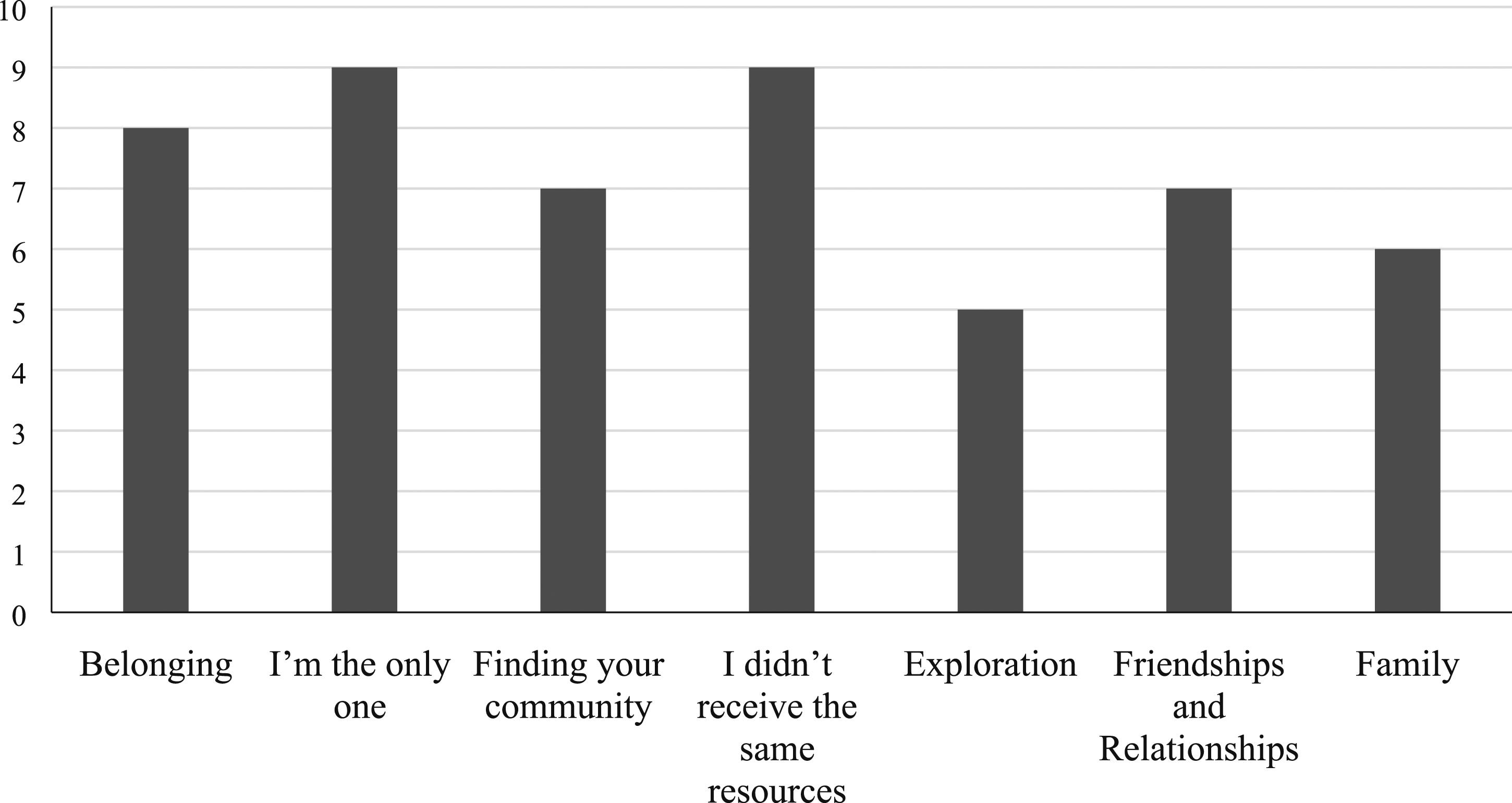
Stories of Belonging and Community
Our analysis indicated that students often made sense of their racial experiences in college through the lens of belonging. In describing their relationships with peers, teachers, and the institution itself, participants whose narratives aligned with this story type tended to make meaning about themselves in the context of community. These experiences were at times characterized by feelings of marginalization, but there were also instances of participants describing “finding [their] community” or simply being around others who shared similar identities or experiences.
For example, Xiomara, a first-year Latina woman, stated when talking about her transition to the university: For the first time ever, I had met like other kids who had parents who were immigrants and stuff and people from all over and so I’m really glad I did that going into it… I’m really glad that I got an experience within a community that is similar to my own.
By participating in a transition program, Xiomara’s exposure to students who also had parents who were immigrants was incredibly important. The college provided Xiomara with an opportunity to meet people just like her, and some of these people became her closest friends. Prior research suggests that first-generation students who find similar others are more likely to stay enrolled past their first year (Cushman, 2007). While the university setting can at times provide spaces for students, young people are also agentic in creating a community for themselves. Rosa, for example, a third-year Latina woman, started a dance group to build the community she lacked in her first years of college: I actually helped start a Latin dance group on campus, so that was the beginning of my junior year… the dance group really was a space for me to connect with my Latinx identity and other Latinx-identifying people …I worked really hard to make sure that the dance group was inclusive and anyone could join… the people I started the dance group with had very similar experiences to me in terms of like their first years in the Latinx community on campus… it felt like Familia.
Here we see Rosa contrasting her efforts to create an inclusive space with other spaces on campus that made her feel isolated and excluded. The way she made meaning of her experiences of the community indicated that she did not feel the university as a whole supported her sense of belonging. While there are certainly positives associated with establishing one’s community, this was an unequal burden placed on Rosa because of her identity. While students from privileged backgrounds also must work to “find their people,” they do not experience exclusion based on their ERI. Like Rosa, the literature points to the challenges young people from first-generation and/or racially stigmatized backgrounds have in finding their community in university settings, which can lead to a host of negative psychological and academic outcomes, persistence, and self-reported mental health (Gopalan & Brady, 2020). In contrast, building community and fostering a sense of belonging can buffer the negative impact of racism and exclusion (Comeaux et al., 2021), even if the process itself is taxing.
Stories of Identity Exploration
Students also used their experiences to make sense of their intersectional positionalities. Students with multiple marginalized identities are confronted with experiences that prompt deeper reflection about the ways their identities are positioned in relation to other groups. Take, for example, Sienna, a first-year, Black woman, who said: So, amidst those academic discrepancies, people around me were like – I would also hear people talking about how they were like ‘Oh yeah, we learned this in high school’ or like ‘I’m so ready for this’ and they had all these extra resources, I don’t know, like constant reminders that I didn’t receive the same resources…
Here we see that Sienna is describing what it is like to feel as though one’s high school did not prepare them for the rigor of college. First-generation students often experience the challenge of feeling unprepared for the rigor of college, which prior research has framed as an individual problem within students (Engle et al., 2006) rather than, intersectional discrimination on the basis of class and race. These experiences speak to a broader systemic reality in that high schools often fail students pedagogically and, as Sienna identifies, create conditions where students who attend mostly non-white, lower-income schools have fewer resources and opportunities than white, higher-income schools (Nasir et al., 2016). Through their narratives, young people are critiquing the race-neutral, meritocratic master narrative of the “college story.”
To that end, we see Jordan describe how through his experiences in college he was able to reflect on his positionality explicitly. He stated: Understanding my position at this school, understanding what power I hold as a Black male, as a cisgender Black male, and how to use the resources, however many or however few, that I hold for letting me with to better my own living, to help other people out and better represent the communities that I hold dearly to myself…
Jordan is grappling with how both his dominant and privileged identities, cisgender and male, and his minoritized identity, as a Black person, allow him to better himself and the communities he values. This form of identity development is similar to what others have conceptualized as “nigrescence” (Cross, 1971, 1991), however, he is displaying a more nuanced perspective in that he is also contextualizing his Black identity at its intersections with cisgender normativity and patriarchy. He acknowledges that his experience of Blackness is shaped by his other privileged identities and that he looks forward to leveraging that privilege in support of his community. Prior theoretical and empirical research suggests that as individuals come to learn about their experience of racial oppression it may open the door to understanding intersecting forms of oppression (Moffitt et al., 2022). Jordan is participating in what others have theorized to be one of the connections between identity development and critical consciousness (i.e., systemically minoritized individuals’ critical analysis and collective actions against social and societal inequities; Diemer et al., 2017; Freire, 1973)—reflection about how his ERI or his positionality in the racial system is connected to other forms of marginalization and privilege (Mathews et al., 2020).
Stories of Relationships
Another way young people made sense of their experiences was in how they shaped their relationships – on campus and beyond – with close friends, peers, romantic others, and family. Here we see that students were often evaluating their friendships in relation to their changing identities. For example, the racial dynamics of Jordan and Roland’s friend groups reflected their own ERI development, however, the way it emerges in their narratives differ. Some participants experienced difficulty and tension as they learned about who they were and the realities of racism around them. Jordan during a discussion about his changing and growing ERI said: I started understanding a lot more of the, I guess problems within [COLLEGE]
2
and I started like getting a better frame of reference for what possibly are just what microaggressions are expressed, and started trying to understand how I could face less of those and have to deal with less of those on a daily basis and a large part of that was just coming out of a group White people.
In this quote, we observe Jordan describing how his growing knowledge about microaggressions facilitated his separation from his majority-white group of friends. He realized that his interactions with his white friends also included experiencing microaggressions from them and to keep himself safe, it meant giving up those friendships.
For Roland, his friendships helped facilitate the exploration of his own identity. After describing his changing relationships in college, Roland said: …I’m only going to be friends with the people that I really rock with, which I guess connects to race because it’s mostly Black and Brown people. Especially [FRIEND], she’s always been really big on like Black issues, like Black Empowerment,… me and her were really spending a lot of time together and in conversations with her, I really tried to think more critically about what it means to be Black, what Blackness is…
Roland’s friendship with [FRIEND] helped him “to think more critically about what it means to be Black.” It was his friendship that helped him to consider and reevaluate his own identity. In both of these examples, Black students’ interactions with white friends either help facilitate shifts in identity or are affected by shifts in identity. Although Black students are more likely to have white friends than white students are to have Black friends (Harper, 2013; Harper et al., 2011), they experience a variety of negative interactions that shape their willingness to sustain these friendships over time. As evidenced by prior research, cross-race (i.e., white-Black) interactions and friendships often rely on a disproportionate amount of emotional labor on behalf of the Black person (Moffitt & Syed, 2021; Richeson et al., 2005; Richeson & Shelton., 2007), which requires them to overlook racial prejudice or work to decrease anxiety (of being prejudiced) in their white peer. Although peers are key to ERI development, the impact of experiencing racism from one’s friends remains under-explored in developmental research (Moffitt & Syed, 2021).
We also observed how participants invoked family to make meaning of their racial experiences. For example, Briana cites how her Ugandan mother’s unfamiliarity with Black American culture contributes to her inability to connect with “POC” on campus and her sense of exclusion from and isolation from these groups. This finding supports recent work demonstrating how multiracial youth draw on the ethnic-racial experiences, identities, and messages of their parents into adulthood as they navigate their own ERI development (Jones & Rogers, 2022). Rosa talks about the anxiety and worry that is created because her peers at school do not share the expectations that her Latinx family has of her. Her isolation and feeling of otherness in school were exacerbated by the fact that “they weren’t Latinx or Latinx-identifying” and could not “[understand] the dynamics.” Rosa’s family’s expectations, whether reasonable or unreasonable, were not the problem. It’s that she could not talk about them or get advice. Each of these examples points to the hardships created by a racial system in college that prioritizes and centers the experiences, familial and cultural, of white students, and makes all others marginal, “strange,” or “unfamiliar.” They challenge a supposedly race-neutral master narrative of college that is built on the assimilative project of whiteness.
Despite the limitations placed on families’ abilities to support their students, for some participants, including those already mentioned, their families still served as important sources of support and encouragement. Javier talks about the sacrifices his immigrant parents took to provide him with an opportunity to attain a college degree at an elite school in the U.S. He said: …so both my parents they never went to college. I mean they’re not from this country; they’re not from the U.S. so they immigrated here. They tried their best and all and it’s really great because my dad… Like when he was in Mexico the education that he got I think it went to high school…The same with my mom. So, I’m just fortunate enough to …not only like grow up in the States but also have citizenship as well… So just having the opportunity to have a piece of paper saying I was born here, get the help from financial aid or Northwestern, it’s really great.
For Javier, going to college meant more than just earning a degree; it meant living his parents’ aspirations for him and his siblings. While this can be a very motivating and inspiring reality for Javier, it creates an unequal burden on him—he must carry the aspirations of his family, and his educational success both now and later should be worth the sacrifice. This is often experienced as achievement guilt (Covarrubias et al., 2021), where students, like Javier, experience the socioemotional distress of feeling that they are the only one in their family, and that they must leave their family (and their struggles). Achievement guilt is positively related to depressive symptoms and lower self-esteem (Covarrubias et al., 2015).
In summary, the results of this study reveal how Black and Latinx students construct the narratives of their developing ERI in emerging adulthood. Their stories provide a rich perspective into the meaning-making processes and relevant experiences that shape students’ perceptions of the college setting.
General Discussion
We sought to understand how racially stigmatized students from predominantly first-generation, low-income backgrounds articulate their college stories through the lens of race. First, we found that students structure their narratives either using chronological or thematic coherence. While at face value these seem like benign choices, this distinction in structure was related to meaning-making processes in students’ stories. Specifically, thematic chapter titles imbued personal meaning and a narrative arc, whereas chronological chapter titles were impersonal, organized strictly by college-based time markers (e.g., freshman year, senior year). As such, just reviewing the chapter titles (Table 1), those who used thematic titles were organizing their experiences along a particular unifying message about their experiences and identities, while those who used chronological titles offered minimal identity-relevant insights.
Theoretically, the narrative approach provided insight into the myriad ways young people structure and make sense of their ERIs in college. We observed how students who relied on chronological (vs. thematic) organizations for their narratives displayed some uncertainty or lacked clarity about their own ERI. The sample is small, so we are cautious about generalizing, but this finding could indicate an interesting psychological connection between ERI commitment and autobiographical reasoning in narrative identity. Specifically, this analysis suggests that ERI commitment may hinge on thematic coherence across a developmental period, in this case emerging adulthood. Given that emerging adulthood is a time of instability, this insight may have cascading developmental implications.
The content of students’ college narratives orbited three key stories: stories about belonging and community, stories about identity exploration, and stories about relationships. All of their stories were relational and we observed how students cited their friendships as catalysts for ERI development, and as sources for belonging and community. Some research has documented how peers shape ERI development in emerging adulthood (e.g., Moffitt & Syed, 2021; Nelson et al., 2018), and the findings here provide greater support for increased attention to the role that peer socialization plays in ERI development in college. Put simply, students’ friendships, in this sample, are catalyzing ERI development, spurring deeper reflection about the meaning of one’s ERI. Beyond the content of ERI, the data call attention to how peers shape the initiation of ERI exploration and prompt critical consciousness development, and raise questions about relational conditions are needed to facilitate these developmental processes.
From a practical perspective, we found insights from students about how they found or established their communities, which involved both deepening their understanding of their intersectional identities and positionalities and at times distancing themselves from cross-racial friendships that caused harm. In this way, the current analysis not only demonstrates the challenges but also highlights how young people resist and use their backgrounds as sources of strength (Hernandez et al., 2021; Silverman et al., 2023). For example, Rosa talked about how her Latinx identity and her connections to it helped facilitate a better community on campus, and Javier talked about how his family served as an important inspiration for his college journey. Students’ ERI development opened opportunities for connection and strength. These data challenge existing approaches to understanding students’ racial experiences in college that often assume deficits and obstacles because of their race, class, gender, or their intersections.
Together, these narratives reframe the master narrative of a “good” (or normative) college story and show how race-centric the college experience is for minoritized students. The “normative” expectations of assimilation and independence in college are directly challenged as students cited the importance of connections to one’s ethnic-racial background and family as facilitators of ERI development and belonging in college. In fact, it was those experiences that created disconnection from one’s ERI and family that created hardship for students. Existing research and theory support these findings, which demonstrate the importance and influence of family and connection to one’s background as a source of strength in college (Silverman et al., 2023; Covarrubias et al., 2021). In sum, this analysis extends prior work by demonstrating how students themselves desire and, at times, establish a sense of home in college—a connection to their ethnic-racial backgrounds and communities—and how friendships, experiences in the classroom or among peers, and being a numerical minority can act as barriers to this endeavor.
Limitations and Implications/Future Directions
There are limitations to this research and important considerations for future work. First, with a small sample, we cannot make generalizable statements about Black and Latinx youth, however, this research provides a rich and deep analysis that can spur future research. Additionally, by centering their experiences around college, the study cannot offer a meaningful understanding of emerging adults who do not attend college, yet still contend with the same anti-Black racism and white supremacy that students in this study navigate. Finally, because we did not collect any other data either longitudinally or through survey-based designs, we cannot explore relations between their narratives and other psychological constructs, or over time.
Despite the important challenges of this work, there are promising paths for future research. Future research should conduct mixed-methods research using the full Life Story Interview protocol to understand how young people’s narratives change over time—how do the meanings they drew from their experiences in early adulthood change in middle and late adulthood? Additionally, researchers should consider the possibility of predicting psychological outcomes from students’ interpretations of their racial experiences in their narratives. Finally, future research should expand this work to conduct intersectional analyses and explore narratives with people who hold multiple marginalized identities.
Conclusion
Emerging adulthood is a complex stage of one’s life and it can be difficult to make sense of one’s experiences in college. This is especially the case for racially minoritized students, who in addition to navigating the academic difficulties of college, must contend with racial experiences that can make them feel othered, marginal, and invisible. By integrating narrative and ERI research, this study provided a context for students to tell the stories of their ERI in college. The stories they told were nuanced and, at times, challenged society’s assumptions about which experiences matter for students. More research is needed to unearth the stories that often go unsaid, unnoticed, or are actively silenced during emerging adulthood and in college.
Footnotes
Declaration of Conflicting Interests
The author(s) declared no potential conflicts of interest with respect to the research, authorship, and/or publication of this article.
Funding
The author(s) received no financial support for the research, authorship, and/or publication of this article.
