



Abstract
Psychological maltreatment is a severe form of abuse that can have a significant negative impact on an individual’s mental health and well-being. Examining the factors that reduce the negative effects of child maltreatment on the outcomes can, hence, contribute to the development of effective prevention and intervention strategies, providing resources and support for families, early detection, and education for parents and caregivers. The present study aimed to explore the mediating role of mindful awareness and self-transcendence in the association between childhood psychological maltreatment and mental well-being among Turkish emerging adults. The study sample consisted of 422 emerging adults enrolled in a state university in Türkiye (with 65% of female). Participants ranged in age from 18 to 29 years, with a mean age of 20.94 years (SD = 1.86). The present study found that psychological maltreatment was not only directly associated with lower levels of mindful awareness and self-transcendence, but also indirectly associated with poorer mental well-being through the mediating effects of these variables. The study suggests that childhood psychological maltreatment is a significant risk factor for mental well-being among emerging adults, and highlights the importance of promoting the development of mindful awareness and self-transcendence in preventions and interventions aimed at improving mental well-being. By cultivating these positive psychology states, emerging adults may be better equipped to overcome the negative effects of psychological maltreatment.
Keywords
Introduction
Psychological maltreatment is the least acknowledged and dealt with among the four primary types of child maltreatment, which include physical abuse, physical neglect, sexual abuse, and psychological abuse and neglect. It is a form of child maltreatment that encompasses various actions and neglect by parents and caregivers. American Professional Society on the Abuse of Children (APSAC) has defined psychological maltreatment as a “repeated pattern or extreme incident(s) of caretaker behavior that thwart the child’s basic psychological development needs (e.g., safety, socialization, emotional and social support, cognitive stimulation, respect) and convey that the child is worthless, defective, damaged, unloved, unwanted, endangered, primarily useful in meeting another’s needs, and/or expendable” (Brassard et al., 2020, p. 3). On a worldwide scale, it has been approximated that about 36% of children experience psychological maltreatment (Stoltenborgh et al., 2012). A study in Turkey revealed that around 51% of children faced psychological maltreatment (Korkmazlar-Oral et al., 2010). According to reports from organizations, the occurrence of psychological maltreatment in England, the USA, and Canada varied from 11% to 34% (Gilbert et al., 2009). Notably elevated rates, ranging from 31.3% to 68.5%, have been documented in the East Asia and Pacific Region (United Nations Children’s Fund [UNICEF], 2012). Moreover, numerous studies have highlighted the long-term impact of psychological maltreatment experienced during childhood (Arnow, 2004; Briere & Jordan, 2009; Lowell et al., 2014). These studies have shown that childhood maltreatment is a significant risk factor for psychiatric disorders and can result in physical symptoms (Arnow, 2004), emotional and behavioral difficulties (Lowell et al., 2014; Turhan, 2022), and psychological distress (Briere & Jordan, 2009) in adulthood. In addition, psychological maltreatment can have a negative impact on a child’s cognitive development, social relationships, and overall well-being. Children who experience psychological maltreatment may have difficulty regulating their emotions (Wu et al., 2022), struggle with low self-esteem and self-worth (Arslan, 2016; Brodski & Hutz, 2012), and have problems with attachment and forming healthy relationships with others (Arslan, 2021a; Baer & Martinez, 2006). Furthermore, the effects of psychological maltreatment can extend beyond the individual and have negative impacts on society as a whole. Research has shown that people who were exposed to psychologically abusive acts in childhood are more likely to engage in risky behaviors, including substance abuse, criminal behavior, and domestic violence (Arslan, 2022; Widom & Maxfield, 2001). Therefore, it is essential to address psychological maltreatment in childhood to develop strategies for preventing long-term negative consequences for the individual and society. The current cross-sectional study aimed to explore whether self-transcendence and mindful awareness mediated the relationship of childhood psychological maltreatment with mental well-being among emerging adults.
Mental Well-Being
Mental well-being encompasses more than the mere absence of mental disorders; it also encompasses a range of psychosocial resources that contribute to the fulfillment of an individual’s complete potential (Arslan & Yıldırım, 2021a; Lamers et al., 2011). The concept of mental well-being is most aptly elucidated by Keyes’s model, which posits that it consists of three interrelated dimensions: emotional, psychological, and social well-being (Keyes, 2002; Robitschek & Keyes, 2009). The emotional dimension gauges the frequency of positive emotions and contentment with life (Diener, 1984). The psychological dimension encapsulates one’s functioning both in relation to oneself and in interpersonal interactions (Keyes, 2002; Ryff & Keyes, 1995). Meanwhile, the social well-being dimension centers on an individual’s competence within society (Keyes, 1998; Ryff & Keyes, 1995). While these three dimensions are distinct in theory and empirically supported, they are inherently interconnected. Keyes et al. (2010) argue that individuals with high levels of mental well-being also have high levels of physical and psychological health. Mental well-being involves individuals realizing their potential in a positive direction and directing their energies towards a meaningful life, even in the face of challenges. It goes beyond just feeling good and encompasses a sense of purpose, positive relationships, and a sense of achievement. Individuals with high levels of mental well-being tend to be more resilient in the face of adversity and can adapt to changes in their environment more effectively (Arslan & Coşkun, 2023; Arslan & Wong, 2024). Ultimately, fostering mental well-being is critical for promoting a fulfilling and satisfying life.
Psychological maltreatment is a severe form of abuse that can have a significant negative impact on an individual’s mental health and well-being. Children who are exposed to psychologically abusive behaviors, such as verbal abuse, emotional neglect, or belittlement, can develop low self-esteem, feelings of worthlessness, and other emotional and behavioral problems that persist into adulthood (Barnett et al., 1991; Hart et al., 1997). Studies have shown that psychological maltreatment during childhood is a significant risk factor for psychiatric disorders, including depression, anxiety, and post-traumatic stress disorder (Brodski & Hutz, 2012; Higgins & McCabe, 2000; Humphreys et al., 2020; Stafford et al., 2016). Additionally, individuals who experienced psychological maltreatment in childhood are also likely to have difficulty forming healthy relationships and experiencing positive emotions (Arslan, 2021b; Tarber et al., 2016). These individuals may also struggle to regulate their emotions and cope with stress effectively (Arslan, 2017a). Therefore, it is essential to examine the negative impact of childhood psychological maltreatment on mental well-being and develop effective measures to prevent and address this form of maltreatment.
Mindful Awareness
Mindful awareness is defined as a state of purposeful attention to the present moment and has been found to be a powerful source of mental health and well-being, as well as a coping strategy for overcoming traumatic experiences (Arslan, 2021c; Vos et al., 2020). Numerous empirical studies have demonstrated that mindful awareness is negatively related to mental health problems such as loneliness, anxiety, depression, and negative feelings (Brown & Ryan, 2003; Hong et al., 2020; Kennedy et al., 2023; Yang et al., 2019), while also being positively correlated with subjective well-being (Bajaj & Pande, 2016; Brown & Ryan, 2003; Majercakova Albertova & Bolekova, 2022). Through mindful awareness, individuals can more easily overcome many of the problems they experience (Brown et al., 2015; Van Dam et al., 2018). Brown and Ryan’s (2003) have also highlighted that being mindful and aware is a crucial technique for self-regulation and reducing stress. This strategy can help individuals improve their mental health and overall well-being, particularly when dealing with challenging situations.
In addition to the link between mindful awareness and well-being, recent studies on childhood maltreatment have indicated that mindful awareness may mitigate the effect of psychological maltreatment on emerging adult mental well-being. For example, Arslan (2017) found that psychological maltreatment was indirectly associated with internet addiction through mindful awareness. Bolduc et al. (2018) found that childhood maltreatment was related to lower mindful awareness, which, in turn, was associated with fewer depressive symptoms. Despite this evidence highlighting the link between childhood maltreatment and mindful awareness, studies have mainly focused on the mediating role of mindful awareness in the relationship between maltreatment and mental health problems (e.g., Fitzgerald, 2022; Fitzgerald & Kawar, 2022). Very few studies have emphasized its mitigating effect on childhood psychological maltreatment and well-being indicators. Therefore, cultivating mindful awareness may be an effective means of coping with childhood maltreatment experiences and may ultimately lead to improved mental well-being.
Self-Transcendence
Self-transcendence is a key aspect of a healthy development and growth, which has been associated with improved mental well-being. Self-transcendence can be defined as the ability of an individual to move beyond their own self-interest and focus on a broader perspective that includes the well-being of others (Wong et al., 2021). Self-transcendence involves surpassing one’s personal limitations and challenges in life to achieve a connection with something greater or to serve a higher purpose (Wong et al., 2021). Self-transcendence is described as a positive personality trait and virtue that enables individuals to comprehend their existence (Cloninger et al., 1993). According to Frankl (1966), self-transcendence is the essence of existence. Although self-transcendence is regarded as a necessary source of health and well-being, it requires effort to achieve it (Acton & Wright, 2000). Previous research has showed that individuals with higher levels of self-transcendence tend to report greater life satisfaction, happiness, meaning, and positive feelings (Huang & Yang, 2022; Sari et al., 2017; Wong et al., 2021). For instance, self-transcendence has been linked to increased resilience, which refers to one’s ability to cope with and recover from difficult life events (Baijani-Gebara et al., 2019). Additionally, it can help individuals find meaning and purpose in life, which has been associated with higher levels of well-being (Sari et al., 2017; Wong, 2016).
Literature suggests that self-transcendence can play a crucial role in promoting and maintaining mental well-being, potentially alleviating the negative impact of psychological maltreatment on well-being. Studies have highlighted the significance of self-transcendence in overcoming adverse life events (see Wong et al., 2021 for brief review). Childhood maltreatment can have a complex and multifaceted impact on one’s psychosocial development, including the ability to experience self-transcendence. For example, childhood psychological maltreatment can lead to feelings of shame, guilt, or worthlessness (Sekowski et al., 2020; Webb et al., 2007), which can make it difficult for individuals to find meaning or purpose in their lives. In other words, people with higher levels of self-transcendence are less likely to experience mental health symptoms and are more likely to have greater well-being, even if they had experienced psychological maltreatment in childhood. Yang et al. (2021) found that self-transcendence mediated the association between early trauma and suicide attempt. Anli and Bilgin (2022) indicated the mediating effect of self-transcendence in the relationship between fear of COVID-19 and subjective happiness among emerging adults. Accordingly, individuals with higher levels of self-transcendence may be better equipped to cope with the negative effects of psychological maltreatment and find meaning and purpose in life despite their experiences.
Present Study
Attachment theory, pioneered by John Bowlby and further developed by Mary Ainsworth, highlights how the quality of the attachment bond formed between an infant and their primary caregiver serves as a blueprint for future relationships and emotional experiences (e.g., Crittenden & Ainsworth, 1989). Secure attachments, characterized by consistent caregiving and responsiveness, lay the foundation for healthy emotional regulation, self-esteem, and the capacity to engage in satisfying interpersonal connections. On the other hand, disruptions in this attachment process can lead to the development of insecure attachment styles, which may manifest as avoidant, anxious, or disorganized behaviors in adulthood. These styles can influence one’s emotional regulation strategies and perspectives on self and others, shaping their approach to mindful awareness and self-transcendence. Overall, this psychological framework, rooted in developmental psychology, posits that the nature of early caregiving relationships significantly influences an individual’s emotional and social development. Therefore, mindful awareness, closely tied to emotional regulation skills, and self-transcendence, which involves the internalized concepts of self and others, can find their roots in the attachment approach. The present study aimed to examine the mediating role of mindful awareness and self-transcendence in the link between childhood psychological maltreatment and mental well-being among Turkish emerging adults. To this end, the following hypotheses were addressed: that childhood psychological maltreatment would negatively associate with mindful awareness, self-transcendence, and mental well-being; and that mindful awareness and self-transcendence would mediate the link between childhood psychological maltreatment and emerging adult well-being. Understanding the factors that mitigate the negative effects of child maltreatment on well-being can contribute to the development of effective prevention and intervention strategies, providing resources and support for families, early detection, and education for parents and caregivers.
Method
Participants
The study sample consisted of 422 emerging adults enrolled in a state university in Türkiye, with 65% of participants identifying as female. The participants ranged in age from 18 to 29 years, with a mean age of 20.94 years (SD = 1.86). The majority of participants reported a medium socioeconomic status, with 25.8% reporting low SES, 60.5% reporting medium SES, and 13.7% reporting upper SES. The majority of the sample were first year students (38%), followed by second year students (26%), fourth year students (20%) and third year students (16%). Data were collected through a web-based online survey that included the demographic items (e.g., gender, age) and study inventories. Before starting the data collection, the participants were informed with a consent form outlining the study purpose and measures.
Measures
Psychological Maltreatment Questionnaire–Short Form (PMQ- SF)
Descriptive Statistics and Correlation Results.
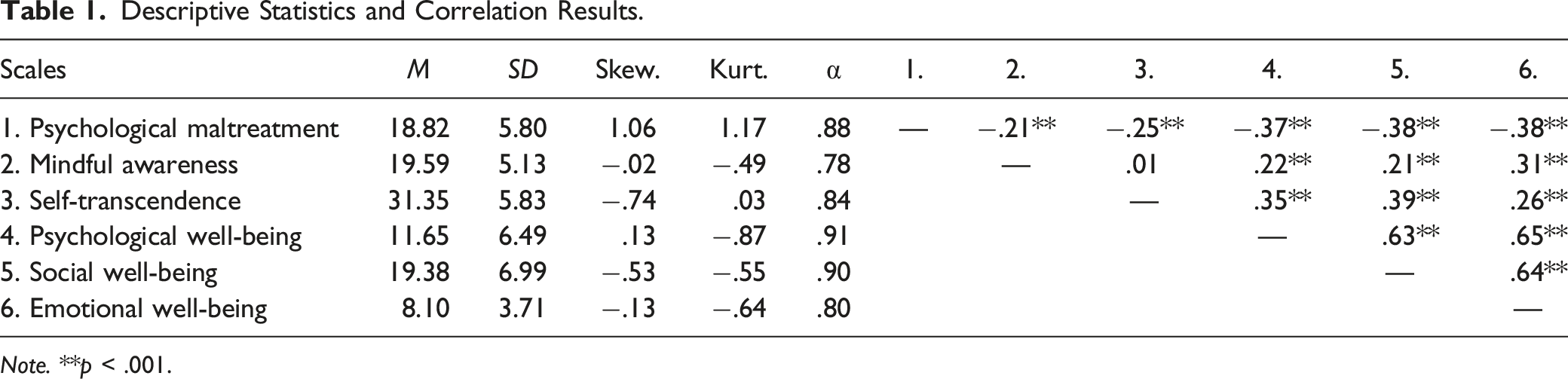
Note. **p < .001.
Self-Transcendence Measure (STM)
The STM is a 10-item scale developed to assess people’s self-transcendence (Wong et al., 2021). The items are scored on a 4-point Likert scale, ranging from 'not at all characteristic of me or my beliefs' (0) to 'a great deal characteristic of me or my beliefs' (4). Prior research has shown that the STM exhibits strong internal reliability with Turkish young people (Arslan, 2023a). In this study, the internal reliability was also found to be strong (see Table 1).
Mindful Attention Awareness Scale (MAAS)
The MAAS was employed to assess the level of mindful awareness (Brown & Ryan, 2003). The MAAS-state comprises 5 items, which are scored on a 6-point Likert scale ranging from 0 (not at all) to 7 (very much). Prior research has demonstrated that the MAAS has strong internal consistency when used with Turkish young people (Arslan, 2023b). In the present study, the scale had also an adequate reliability estimate (see Table 1).
Mental Health Continuum (MHC-SF)
The MHC-SF is a self-report tool with 14 items used to measure the emotional, psychological and social well-being (Keyes et al., 2008). The items are rated on a 6-point Likert scale, ranging from never (0) to every day (5). Research has shown that the scale has strong internal reliability estimates with Turkish people (Demirci & Akın, 2015). The measures had adequate internal reliability estimates with the current sample (see Table 1).
Data Analyses
Before conducting the structural equation analyses, initial analyses were conducted to examine the descriptive statistics, normality assumption, and internal consistency reliability estimates for the measured variables. Pearson correlation analyses were also performed to explore the relationships among psychological maltreatment, mindful awareness, self-transcendence, and mental well-being. The normality assumption was evaluated using kurtosis and skewness statistics, with cut-off values used to determine deviations from normality. Skewness and kurtosis scores lower than |2| indicate the data is relatively normally distributed (Curran et al., 1996). Finally, the structural equation analysis was performed to investigate whether mindful awareness and self-transcendence mediated the relationship between psychological maltreatment and mental well-being among emerging adults. The results of this analysis were evaluated using standard data-model fit statistics and their respective cutoff values, including the root mean square error of approximation (RMSEA), where values of ≤ .08 were considered adequate and ≤ .05 indicated close data-model fit. Additionally, the comparative fit index (CFI) and Tucker-Lewis’s index (TLI) were used to assess the goodness of data-model fit, with values of ≥ .90 considered adequate and ≥ .95 indicating good data-model fit (Kenny, 2020). All data analyses were carried out utilizing SPSS v27and AMOS v24.
Results
Descriptive Statistics and Correlations
Based on the descriptive statistics, as seen in Table 1, the measured variables in the study had a relatively normal distribution, with skewness values ranging from −.74 to 1.06 and kurtosis values ranging from −.87 to 1.17 (Curran et al., 1996). Moreover, the internal reliability estimates for the analyzed variables were strong, with coefficients ranging from .80 to .93.
Person correlational results reported that psychological maltreatment had significant and negative correlations mindful awareness, self-transcendence, and psychological, social and emotional well-being. Mindful awareness was positively and significantly correlated with psychological, social and emotional well-being. Self-transcendence was positively and significantly correlated with psychological, social and emotional well-being. The results of the descriptive statistics and correlation analyses are presented in Table 1.
Structural Equation Model
The proposed structural equation model was run to investigate whether mindful awareness and self-transcendence mediated the relationship between childhood psychological maltreatment and mental well-being among emerging adults, as seen in Figure 1. Structural equation model yielded close data-model fit statistics. The chi-square (χ
2
) value of 1.08 with 1 degree of freedom (df) suggests a non-significant (p = .299). The CFI and TLI value of .99 indicates a strong fit between the model and the data. The RMSEA value of .014 represents the extent to which the model fits the observed data. With a 95% confidence interval (CI) ranging from .00 to .13, the RMSEA indicates a relatively small amount of error in the model’s fit. Generally, RMSEA values below .08 are considered indicative of a good fit. The SRMR value of .012 is another measure of how well the model fits the data. Like RMSEA, lower values of SRMR suggest a better fit, and .012 indicates a favourable fit in this case. The mediation depicting the associations between the study variables. Note. **p < .001.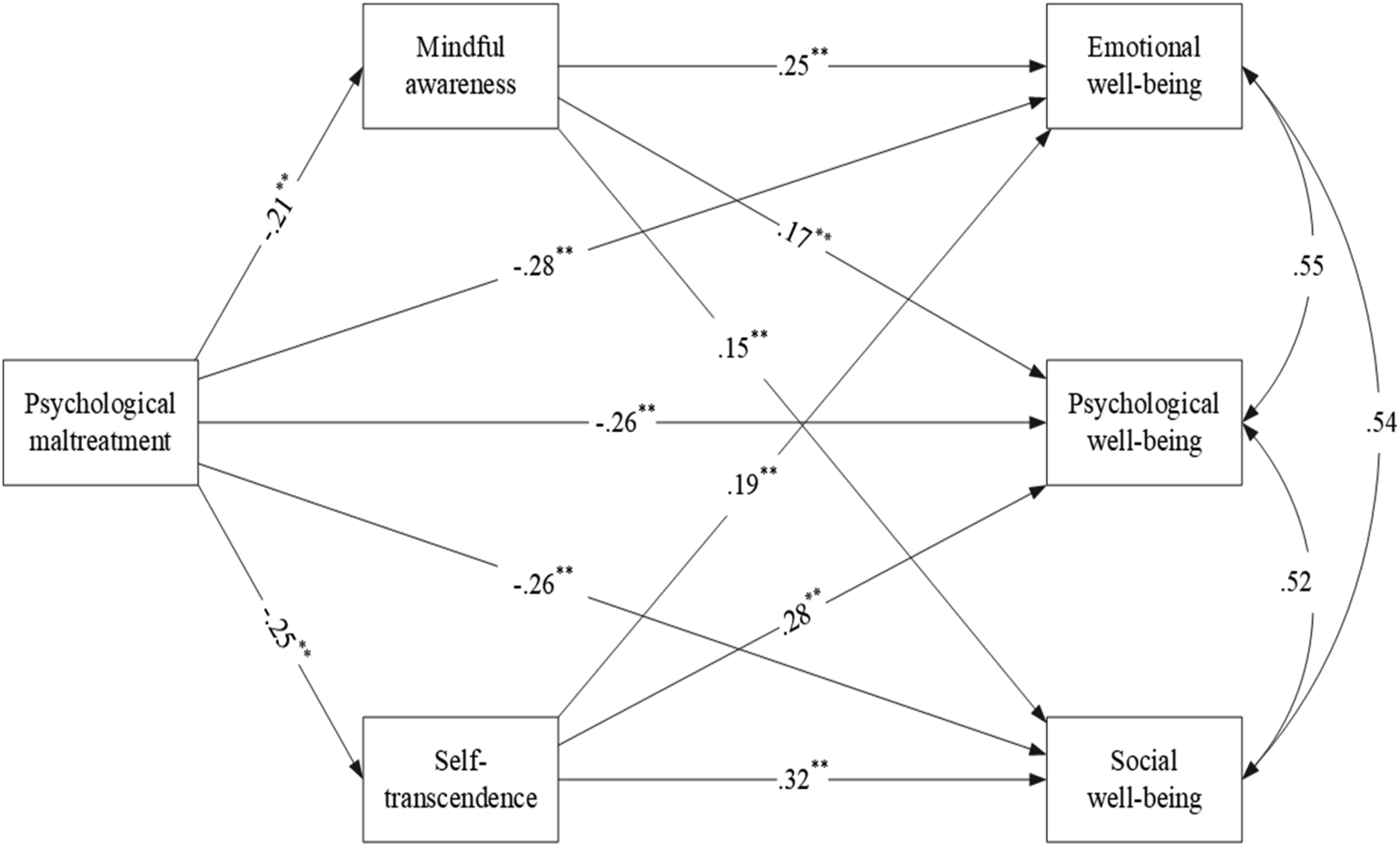
Findings also indicated that psychological maltreatment had significant negative and direct effects on mindful awareness and self-transcendence, with explaining 4% of the variance in mindful awareness and 6% of the variance in self-transcendence. Moreover, psychological maltreatment significantly and directly predicted psychological, social and emotional well-being. Further results demonstrated that mindful awareness had a significant and positive association with psychological, social and emotional well-being. Similarly, self-transcendence significantly and negatively predicted psychological, social and emotional well-being. Mindful awareness emerged as the most influential predictor of emotional well-being, while self-transcendence stood out as the primary determinant of social well-being.
Standardized Indirect Effects.

Note. Number of bootstrap samples for percentile bootstrap confidence intervals: 5000.
Discussion
Emerging adulthood is a term used to describe a developmental phase that typically spans from around ages 18 to 29, characterized by a distinctive combination of exploration, identity formation, and heightened autonomy (Arnett, 2000; Arnett et al., 2014). Throughout this stage, individuals frequently navigate significant life transitions, including higher education, career decisions, romantic relationships, and even geographical relocations (Arnett et al., 2014). Therefore, comprehending the risk and protective factors during this developmental phase is crucial to offer suitable support. With this objective, the present study aims to contribute further evidence by investigating the mediating role of mindful awareness and self-transcendence in the link between childhood psychological maltreatment and mental well-being among emerging adults. Findings from the study provided evidence supporting the first hypothesis of the study that psychological maltreatment had a significant, direct and negative effect on mental well-being indicators. We found that childhood psychological maltreatment had a significant predictive effect on psychological, social, and emotional well-being in emerging adults. These results suggest that individuals who have experienced higher levels of psychological maltreatment are more likely to report lower levels of mental well-being. Psychological maltreatment has been associated with increased psychosocial problems and decreased psychological, social and emotional well-being. Consistent with the study results, past evidence has, for example, shown that psychological maltreatment is positive associated with depressive symptoms (Humphreys et al., 2020; Infurna et al., 2016), suicide Ideation (Zhang et al., 2020), and addictive behavior (Arslan, 2017b; Moran et al., 2004), as well as negatively correlated with subjective (Arslan, 2018; Mosley-Johnson et al., 2019), social (Arslan, 2021a) and psychological well-being (Mosley-Johnson et al., 2019). Taken together, these findings add to the growing body of evidence indicating that psychological maltreatment represents a substantial risk factor for mental well-being, and that individuals with a history of maltreatment during childhood are more likely to experience difficulties in their psychological, social, and emotional functioning and well-being.
The present study found that psychological maltreatment was not only directly associated with lower levels of mindful awareness and self-transcendence, but also indirectly associated with poorer mental well-being through the mediating effects of these variables. These findings suggest that mindful awareness and self-transcendence may play a significant role in mediating the link between psychological maltreatment and mental well-being among emerging adults. Psychological maltreatment is inherently negative and involves persistent behaviors (e.g., criticism, rejection) by parents that impact children’s emotional development and well-being (Arslan, 2016; Barnett et al., 1991; Glaser, 2002). This traumatic experience in childhood has a significant negative impact on one’s sense of worth and self-esteem in adolescence and adulthood (Arslan, 2016; Finzi-Dottan & Karu, 2006), which makes it a critical risk factor for reduced self-compassion (Wu Q. Wu et al., 2018), particularly in terms of mindfulness. Due to its severe and long-lasting negative effects on an individual’s socioemotional development (as reported by Iwaniec et al., 2007; Shields et al., 1994), it can also result in challenges with being mindful of one’s current experiences (Arslan, 2017b) and with managing thoughts, judgments, or emotions towards oneself or others (Arslan, 2016; Yang et al., 2021). This, in turn, may lead to a decrease in mindful awareness and self-transcendence.
Mindful awareness and self-transcendence also mediated the link between psychological maltreatment and psychological, social and emotional well-being. These findings suggest that emerging adults who have experienced psychological maltreatment may have difficulties in developing and maintaining a sense of well-being due to impaired mindful awareness and self-transcendence. Mindful awareness involves aware of one’s thoughts, feelings, and bodily sensations without judgment (Barnard & Curry, 2011; Neff, 2003). Emerging adults who have experienced psychological maltreatment may have difficulty with mindfulness practices as they may perceive it as unnatural and challenging. Additionally, due to feelings of unworthiness, they may not make efforts to improve their well-being. In line with these findings, previous research has pointed out that mindful awareness is positively associated with individual well-being and mental health indicators, such as life satisfaction, depressive symptoms (Akin et al., 2016; Bajaj & Pande, 2016; Neff, 2023). Mindful awareness is a powerful resource for promoting mental health and well-being, enabling individuals to experience the current moment and avoid concerns about the past or future (Barnard & Curry, 2011). Childhood psychological maltreatment may predispose individuals to dwell on past threats, which can have detrimental effects on their mental health and well-being (Arslan, 2021a). However, young adults who possess high levels of mindful awareness tend to adopt positive coping strategies and regulate their thoughts and emotions by staying attuned to the present moment (Arslan, 2017b). This, in turn, enhances their resilience to negative experiences. In other words, even in the presence of a history of psychological maltreatment, mindful awareness may assist emerging adults in enhancing their mental well-being. It may also help mitigate the adverse effects of these childhood experiences on their current mental well-being.
In addition to the aforementioned studies that support the significance of mindful awareness in fostering mental well-being, there are also studies that have underscored the positive impact of self-transcendence on mental health and well-being, especially in challenging circumstances (Coward, 1991; Wong et al., 2021; Yang et al., 2021). Self-transcendence approach highlights the potential of individuals to integrate challenging life circumstances and the importance of this integration in improving mental health and well-being in the face of such experiences. For example, Wong et al. (2021) found the buffering effect of self-transcendence in the link between coronavirus-related suffering and psychological adjustment. Matthews and Cook (2009) pointed out that self-transcendence mediated the association between optimism and emotional well-being among women during treatment for breast cancer. Self-transcendence may help emerging adults overcome the negative effects of maltreatment by shifting their focus beyond their own personal interests and concerns, and towards a broader perspective that encompasses the well-being of others. Additionally, self-transcendence can lead to increased positive states such as meaning in life, compassion, and gratitude (Wong et al., 2021), which have been shown to improve mental health and well-being (e.g., Arslan & Yıldırım, 2021b; Neff, 2023). By cultivating these positive psychology states, emerging adults may be better equipped to overcome the negative effects of psychological maltreatment. Overall, these results highlight the importance of addressing the effects of psychological maltreatment and promoting the development of mindful awareness and self-transcendence in preventions and interventions aimed at improving mental well-being.
Limitations and Implications
The results of this study should be interpreted with some limitations in mind. Firstly, the sample only included students in emerging adulthood from a single state university in Türkiye, which may limit the generalizability of the findings to a larger population. Secondly, the study relied on self-report measures, which may introduce biases and may not accurately reflect the participants' actual experiences. Future studies could consider using alternative data collection methods, such as qualitative approaches. Additionally, the study used a cross-sectional design, which limits the ability to establish causality between variables. Longitudinal studies would be useful in gaining a deeper understanding of the relationships among variables. Lastly, the study may have limitations concerning its generalizability to diverse populations, cultures, or settings. Psychological maltreatment is a rapidly growing concern, and its prevalence is notably significant within Turkish society (Arslan, 2016; Korkmazlar-Oral et al., 2010). Cultural elements, encompassing societal beliefs regarding appropriate child rearing, alongside economic and geographical factors, play a pivotal role in psychological maltreatment due to variations in its definition and the accessibility of monitoring systems across different nations (Brassard et al., 2020). Consequently, gaining insights into the prevalence of psychosocial maltreatment and providing suitable protective interventions for affected children necessitates a deep exploration of the cultural context in which such maltreatment occurs. Therefore, there’s a need for future research to examine these relationships in various populations and cultural contexts.
Despite its limitations, the current study holds significant implications for both research and practice. The findings suggest that childhood psychological maltreatment serves as a noteworthy risk factor for the mental well-being of emerging adults. Furthermore, the study underscores the importance of fostering the development of mindful awareness and self-transcendence in preventive measures and interventions aimed at enhancing mental well-being. Consequently, mental health practitioners are poised to devise strategies that mitigate the potential impact of childhood psychological maltreatment on the mental well-being of emerging adults and are well-equipped to address this issue in their interventions. For instance, employing mindfulness-based strategies could prove beneficial for emerging adults who have a history of psychological maltreatment, as these techniques can help individuals focus on the present moment and foster a non-judgmental approach to their experiences. Nonetheless, future research is required to assess the effectiveness of these strategies on the mental health and overall well-being of individuals who have experienced psychological maltreatment. Additionally, cultivating self-transcendence can be a valuable strategy for enhancing well-being, particularly in the face of child maltreatment experiences. Mental health providers or other professionals can improve mental health and well-being by developing mindfulness and self-transcendence skills as a valuable strategy. In conclusion, the results of the study highlight the importance of addressing the negative effects of childhood psychological maltreatment and promoting the development of mindful awareness and self-transcendence in preventions and interventions aimed at improving mental well-being among emerging adults.
Supplemental Material
Supplemental material - Childhood Psychological Maltreatment, Mindful Awareness, Self-Transcendence, and Mental Well-Being in Emerging Adults
Supplemental material for Childhood Psychological Maltreatment, Mindful Awareness, Self-Transcendence, and Mental Well-Being in Emerging Adults by Gökmen Arslan, Zekavet Kabasakal, and Besra Taş in Emerging Adulthood
Footnotes
Declaration of conflicting interests
The author(s) declared no potential conflicts of interest with respect to the research, authorship, and/or publication of this article.
Funding
The author(s) received no financial support for the research, authorship, and/or publication of this article.
Ethical Statement
Transparency and Openness Statement
The raw data, analysis code, and materials used in this study are not openly available. The analysis code is available upon request to the corresponding author. The data collection and analysis were not pre-registered.

Supplemental Material
Supplemental material for this article is available online.
Author Biographies
References
Supplementary Material
Please find the following supplemental material available below.
For Open Access articles published under a Creative Commons License, all supplemental material carries the same license as the article it is associated with.
For non-Open Access articles published, all supplemental material carries a non-exclusive license, and permission requests for re-use of supplemental material or any part of supplemental material shall be sent directly to the copyright owner as specified in the copyright notice associated with the article.
