



Abstract
This 15-year longitudinal study investigated with follow-up data how romantic patterns from ages 16 to 24 are associated with romantic involvement and turnover (ages 25–30), romantic dispositions (age 30) and romantic relationships characteristics (age 30). A sample of 255 individuals (60.8% women) identified all their romantic partners between the ages of 16 and 24. Between ages 25 and 30, participants identified all their romantic partners and the length of each relationship. At age 30, they also completed a series of questionnaires regarding romantic dispositions and if it applied, characteristics of their current romantic relationship. Results indicated continuity in the romantic sphere from adolescence to established adulthood. At age 30, romantic patterns were associated with: avoidance of intimacy, jealousy, global romantic satisfaction, relationship status and the duration of the current romantic relationship. Together, these results bring new information on romantic development from adolescence to established adulthood.
Keywords
Introduction
Romantic relationships are a central component of individuals’ development. Furthermore, characteristics of romantic experiences evolve over time. For example, involvement in and nurturing a romantic relationship with the same partner increases from adolescence to adulthood. As adolescents age, their romantic relationships become progressively more stable and durable (Connolly & McIsaac, 2011), and the more they focus on learning romantic intimacy or conflict resolution skills (Laursen & Jensen-Campbell, 1999). By the end of adolescence, involvement and stability in the romantic sphere increase since being in a romantic relationship becomes normative, and intimacy is expected (Furman & Wehner, 1994). During emerging adulthood, opportunities for romantic exploration create more potential for romantic turnover (Arnett, 2004). This exploration might be more salient in the early phase of emerging adulthood (18–24 years) than in the later phase (25–29 years) since the latter is more characterized by a quest for romantic stability (Nelson, 2020). Therefore, romantic development is a long journey where romantic-oriented skills must be acquired to attain one of the major developmental tasks of adulthood: being committed in a satisfying, healthy, and long-lasting romantic relationship (Arnett, 2004).
To better understand differences and similarities among individuals regarding this romantic journey, distinct romantic relationship patterns have been previously identified between early adolescence and the first part of emerging adulthood (Boisvert & Poulin, 2016; Gonzalez Avilés et al., 2021; Rauer et al., 2013). These studies illustrate the presence of heterogeneity regarding romantic involvement (referring to the number of years someone is involved in a romantic relationship) and romantic turnover (referring to the number of different romantic partners) during a period where exploration is expected. However, little is known about this heterogeneity when individuals reach later emerging adulthood, a period where higher romantic involvement and less romantic turnover could be expected. Do individuals differ in terms of involvement and turnover as a function of their previous romantic pattern? For example, can individuals characterized by low involvement and/or more turnover between early adolescence and early emerging adulthood still be defined by these characteristics in later emerging adulthood (less involvement and/or more turnover)? Furthermore, once established adulthood is reached (30–45 years; Mehta & Arnett, 2023), do romantic dispositions and current romantic relationship characteristics vary as a function of their previous romantic patterns? This longitudinal study examined these questions using data collected between ages 16 and 30.
Romantic Relationship Patterns
Romantic relationship patterns are based on two dimensions of the romantic experience over a circumscribed period. The first one is the level of involvement in romantic relationships. Over a given period, some individuals will never be involved in romantic relationships, while others will be intermittently or continuously involved. The second is romantic turnover, which refers to the number of romantic partners over a given period. Among those intermittently or continuously involved in relationships, some will keep the same partner for a long time, while others will change partners frequently. Three recent longitudinal studies measured these two dimensions between late adolescence and the first half of emerging adulthood using a person-centered analytical approach. Rauer et al. (2013) asked an American sample of youth, ages 18 to 25, to annually report their current romantic status (single or in a romantic relationship) and the name of that romantic partner. Two variables were then compiled: (1) the number of waves the participant reported being in a romantic relationship and (2) the number of romantic partners named from ages 18 to 25. A cluster analysis based on these two variables identified five romantic patterns: steady involvement, later involvement, sporadic involvement, frequent involvement, and long-term commitment. Boisvert and Poulin (2016) conducted a similar study among Canadian youth interviewed yearly from ages 16 to 24. They identified five patterns: later, sporadic, frequent, long-term, and intense. Gonzalez Avilés et al. (2021) questioned a German sample regarding the romantic histories of young people from ages 10 to 20. Three variables were created: age at first relationship, turnover, and months spent in relationships between the ages of 10 and 20. Singles formed the first romantic pattern. A latent profile analysis with the remainder of the sample revealed three other patterns: late starters, moderate daters, and frequent changers.
These three studies also indicated that youth in these romantic patterns were not solely defined by their romantic history. Continuous singles were characterized by negative psychological correlates at age 25, such as lower life satisfaction and higher loneliness (Gonzalez Avilés et al., 2021). Those youth who reported later romantic involvement (e.g., later or late involvement pattern) disclosed higher levels of difficulties with the peer group during early adolescence and more significant delays in attaining adulthood markers at age 25, such as being financially independent or being active in the workforce (Boisvert & Poulin, 2016, 2017). Conversely, youth with the most frequent partner changes (e.g., frequent or intense involvement patterns) were characterized by advanced attainment of adulthood markers at age 25 (Boisvert & Poulin, 2017) and showed a mix of positive and negative antecedents in middle childhood and early adolescence. On the one hand, they reported positive peer interactions and higher levels of social competencies, but on the other, they also experienced more conflict with their parents (Boisvert & Poulin, 2016; Rauer et al., 2013). Those with fewer partners but who had maintained their relationships for several years (e.g., long-term or steady involvement patterns) showed positive peer and familial antecedents (Boisvert & Poulin, 2016; Rauer et al., 2013).
These three studies, each from a different country, identified similar romantic patterns from adolescence to emerging adulthood. They enlightened a general coherence among their antecedents and correlates: Romantic involvement and romantic turnover are intricately linked to psychosocial factors from childhood to emerging adulthood. However, these studies do not provide information regarding subsequent romantic dispositions and romantic relationship characteristics of individuals who follow each of these patterns once they reach established adulthood.
Romantic Involvement and Turnover in the Later Phase of Emerging Adulthood
The two dimensions used to identify romantic patterns, involvement (or not) in romantic relationships and turnover, vary considerably among individuals during the early phase of emerging adulthood (Boisvert & Poulin, 2016; Gonzalez Avilés et al., 2021; Rauer et al., 2013). In later emerging adulthood, this variability is expected to decrease since individuals should enter a romantic-committed stage of their life (Nelson, 2020). This idea is supported by Lantagne and Furman (2017), who found that the length and involvement in romantic relationships increased from ages 16 to 26. In their sample, the mean duration of a romantic relationship was 4.54 months at age 16 and 37.54 months at age 26. Also, 60% of their participants were in a relationship at age 16 versus 78% at age 26. However, a decrease in the variability of involvement and turnover doesn’t mean that heterogeneity in the romantic sphere will disappear. A recent study by Purol and colleagues (2021) reported lifelong heterogeneity in romantic histories. Therefore, it should be clarified how romantic patterns followed between adolescence and early emerging adulthood would be related to involvement and turnover in later emerging adulthood.
Romantic Patterns During Early Emerging Adulthood and Their Links with Romantic Dispositions and Romantic Relationship Characteristics in Established Adulthood
In a systematic review of 112 studies, Gòmez-Lòpez et al. (2019) concluded that well-being is higher for adolescents and emerging adults involved in a romantic relationship than for those who are single. Also, well-being improves as the relationship’s commitment or stability level increases. Furthermore, these authors suggested that maintaining a satisfying romantic relationship and having a secure attachment to a partner derives from previously acquired skills. These elements indicate that the type of romantic experiences someone has accumulated (involvement or not, turnover) during adolescence and emerging adulthood might be later associated with romantic experiences in established adulthood.
Romantic Dispositions in Established Adulthood
Romantic dispositions refer to personal dispositions in the context of intimate relationships and the appreciation someone has of their own relational life. Adolescent romantic patterns could be linked to romantic dispositions such as attachment, jealousy, and general romantic satisfaction once adulthood is established. First, attachment refers to how someone perceives, feels, and acts in intimate relationships (Bowlby, 1969). Hazan and Shaver (1987) propelled the idea of a strong continuity regarding one’s attachment style throughout life. However, Fraley and Shaver (2000) later questioned this idea, indicating that romantic attachment could evolve through relational and romantic experiences. Since romantic patterns reflect those romantic experiences, we may wonder if they could be associated with individuals’ attachment styles in established adulthood. Second, jealousy is a negative emotional experience that results from the potential loss of a significant relationship because of a real or imagined rival (Miller, 2012). In a romantic relationship, the more someone is committed, the less they appear to be jealous (e.g., Aylor & Dainton, 2001). Jealousy can, however, be found in romantic and non-romantic intimate relationships and can sometimes be interpreted as a way to maintain relationships (Krems et al., 2021). When individuals experience long-lasting committed romantic relationships, they might learn how to manage their feeling of jealousy better, and this benefit might generalize to their non-romantic intimate relationships. When individuals experience low involvement in the romantic sphere, they might be eager to use this strategy to maintain their romantic relationships when they have one. Third, general romantic satisfaction refers to the level of appreciation of one’s past and current romantic life, even in a celibate position (Neto, 2005). Since youth having different romantic patterns differ markedly in terms of their romantic involvement and turnover, differences in their general level of romantic satisfaction may be found once in established adulthood. A recent study indicated that general romantic satisfaction between ages 27–30 could be predicted by the capacity to form and maintain solid intimate friendships at ages 16–18 (Allen et al., 2020). Therefore, involvement and turnover in romantic relationships can also be linked to general romantic satisfaction. However, the links between the romantic patterns observed during earlier emerging adulthood and these romantic dispositions once established adulthood is reached remain unknown.
Romantic Relationship Characteristics in Established Adulthood
Romantic relationship characteristics refer to aspects of the current romantic relationship, such as being (or not) in a romantic relationship, cohabitation with the romantic partner, marriage, length of the relationship, the levels of conflicts, and the quality of the relationship. Romantic relationships during emerging adulthood are expected to be a learning context for important skills that are valuable for maintaining a healthy and committed relationship once individuals reach established adulthood (Brown, 1999). However, gaining these benefits solely by being involved in a romantic relationship seems insufficient since romantic involvement is linked to positive and problematic outcomes (Collibee & Furman, 2015; Joyner & Udry, 2000). A higher quality relationship seems optimal to increase the long-term benefits of this relational context (Kansky & Allen, 2018). Romantic relationship quality is known to be higher when romantic relationships are longer-lasting or when individuals are more committed to the relationship (Adams et al., 2001; Rostosky et al., 2000) and lower in the presence of poor conflict resolution (Madsen & Collins, 2011). Furthermore, the level of quality or engagement experienced in a romantic relationship in adolescence tends to be reproduced in subsequent relationships (Beyers & Seiffge-Krenke, 2010; Raley et al., 2007). These results suggest that individuals who experienced a romantic pattern characterized by long-term relationships in adolescence and early emerging adulthood may have more positive romantic relationship characteristics once they reach established adulthood. In a previous study using the same sample, we found that romantic relationship patterns between ages 16–24 are linked to romantic relationship characteristics at age 25, such as relationship status or relationship duration (Boisvert & Poulin, 2017). Furthermore, according to Mehta and Arnett (2023), the main characteristic of established adulthood, a period following emerging adulthood (30 and up), is a collision between romantic, familial, and professional responsibilities. With limited time to accomplish all their obligations, individuals, at best, may navigate through a romantic relationship using the skills they have previously acquired. Therefore, romantic patterns experienced from adolescence to the early part of emerging adulthood may be linked to aspects of romantic relationships later. The levels of engagement, conflict, and quality of a romantic relationship could be linked to previous romantic experiences.
The Current Study
Romantic patterns have been previously identified from adolescence to early emerging adulthood (Boisvert & Poulin, 2016; Gonzalez Avilés et al., 2021; Rauer et al., 2013). However, a gap remains in how these patterns are linked to romantic dispositions and romantic relationship characteristics in later emerging adulthood and established adulthood, given romantic relationships remain an increasingly important sphere of individuals’ age. So, to get a better grasp of emerging adults’ romantic experiences during the entire developmental period of emerging adulthood, three aspects need to be considered: (1) two subperiods in emerging adulthood (early and later) should be examined (Nelson, 2020), (2) different dimensions of the romantic experience should be measured in established adulthood to better understand if romantic relationship patterns are linked by any manners to these experiences later on and (3) to conduct longitudinal studies to better capture how what happens in later emerging adulthood is linked to what happened earlier (Purol et al., 2021). These considerations underline the relevance of examining how romantic patterns identified in early emerging adulthood reverberate on romantic experiences in later emerging adulthood when challenges are different.
The current study used a longitudinal follow-up of a sample up to age 30 from which we previously identified romantic relationship patterns between ages 16–24 (Boisvert & Poulin, 2016) and examined their outcomes at age 25 (Boisvert & Poulin, 2017). This current study had three goals. The first was to determine if romantic involvement and turnover during later emerging adulthood (ages 25–30) would differ as a function of the romantic pattern experienced between adolescence and early emerging adulthood (ages 16–24). Since Nelson (2020) proposed considering later emerging adulthood as a subperiod characterized by a quest for stability, we should expect to find few differences between romantic relationship patterns regarding involvement and turnover. The second goal was to examine how romantic dispositions (avoidance of intimacy, anxiety over abandonment, jealousy, general romantic satisfaction) at age 30 differ as a function of previous romantic patterns. The third goal was to determine how characteristics of romantic relationships (engagement, conflicts, quality) at age 30 differ as a function of previous romantic patterns. Our hypothesis for the second and the third goals was that youth who had experienced long-lasting romantic relationships in early emerging adulthood (long-term involvement pattern) might have gained more romantic and relational skills than their peers, which then could have turned into more positive romantic dispositions and romantic relationship characteristics in established adulthood. In contrast, we hypothesized that youth with a lower romantic involvement (later or sporadic involvement pattern) or more romantic turnovers (frequent involvement pattern) might display less positive romantic dispositions and romantic relationship characteristics in established adulthood.
Method
Participants
In 2001, 390 grade 6 students (mean age = 12.38 years (SD = 0.42); 58% girls) were recruited from 12 elementary schools in Québec (Canada). The sample was ethnically homogenous (around 90% Caucasian; 3% Black; 1% Asian; 3% Latino, and 3% Arabic). Most participants lived with both biological parents (72%) and came from middle-class families (mean family income = $45,000 to $55,000). Mothers and fathers had the same average number of years of schooling (13.10 and 13.20 years, respectively). These participants were assessed annually until age 26 and again at age 30. The initial sample’s retention rate was 83% at age 30. The subsample retained for the current study met the two following criteria: (1) having been previously assigned to Boisvert and Poulin’s study (2016) in one of the following four romantic relationship patterns between ages 16–24: late, sporadic, long-term or frequent and (2) participation in the assessment of the dependent variables at age 30. Compared to non-retained (n = 135), the retained participants (n = 255; 60.8% women) were not different in terms of demographics (family structure at age 12, gender, and ethnicity).
Procedures
In high school (ages 16–17), questionnaires were completed in the classroom under the supervision of research assistants. After high school (ages 18–22 and age 25), questionnaires were completed during a home visit by a research assistant. Less than 5% of the questionnaires were sent by mail each year. At ages 23, 24, and 26, structured phone interviews were conducted by trained and supervised research assistants. At age 30, participants completed a questionnaire online. Participants’ parents provided written consent at ages 16 and 17, and self-consented from age 18 onward. Participants received a gift certificate (to a movie theater, music store, or sports store) or monetary compensation each year. The study was approved by the Internal Review Board for Ethics in Research with Humans at University of Québec in Montréal.
Measures
Romantic Relationship Patterns from Ages 16 to 24
The current study follows Boisvert and Poulin’s study (2016), where romantic relationship patterns were previously identified among the same sample when the participants were younger (ages 16–24). Each year from ages 16 to 24, the participants were asked to provide the full name of all their romantic partners over the previous 12 months, including their current partner (maximum 5). Two variables were calculated based on this information: (1) the number of years in which the participant reported having had at least one romantic partner (involvement), and (2) the number of different romantic partners named throughout this period (turnover). A latent class analysis including these two variables provided a five-romantic patterns model. These patterns differed significantly from each other regarding external variables, such as the participants’ romantic status and the length of their romantic relationships at age 25. The first four romantic patterns were also found in another sample (Rauer et al., 2013). Participants in the later involvement pattern (11.7% of the sample; 36.4% women) had the lowest number of different partners (M = 1.30) and years in a relationship (M = 1.88). Subsequent analysis indicated they reported their first relationship later than any other pattern (M age = 19.88), and 42% were in a romantic relationship at age 25 (M length = 1.96 years). Participants in the sporadic involvement pattern (21.0% of the sample; 44.1% of women) reported relationships spread out over time that were characterized by a moderate number of different partners (M = 2.90) and years in a relationship (M = 5.31). At age 25, 58% were in a romantic relationship (M length = 2.85 years). Participants in the long-term involvement pattern (48.4% of the sample; 69.9% women) reported longer-lasting relationships (M length = 4.54 years) that were characterized by a moderate number of partners (M = 3.21) and a high number of years in a relationship (M = 8.17 years). At age 25, 81% were in a romantic relationship (M length = 4.54 years). The participants in the frequent involvement pattern (14.6% of the sample; 70.7% women) were characterized by a high number of partners (M = 7.08) and a high number of years in a relationship (M = 8.29). At age 25, 67% were in a romantic relationship (M length = 2.84 years). The participants in the intense involvement pattern (4.3% of the sample; 91.7% women) presented a remarkably high number of partners (M = 11.58) and a high number of years in a relationship (M = 8.42). At age 25, 83% were in a romantic relationship (M length = 1.52 years). Due to data attrition at age 30, this group was excluded from the analysis in the current study because of its small size (n = 10; less than 4% of the sample). In summary, participants in the long-term pattern were more likely to be in a romantic relationship at age 25 than those in the late and sporadic patterns but not more likely than those in the frequent or intense patterns. Furthermore, participants in the long-term patterns had longer-lasting romantic relationships at age 25 compared to all other romantic patterns.
Romantic Involvement and Turnover Between Ages 25 and 30
At ages 25 and 26, participants named all their romantic partners over the previous 12 months (maximum 5). No data were collected at ages 27, 28, and 29. At age 30, participants named all the romantic partners they had had since age 26 (maximum 5) and the duration (in months) of each relationship. Based on this information, two variables were computed: (1) involvement, which refers to the number of years in which the participant reported having been in a romantic relationship between the ages of 25 and 30 (M = 4.90; SD = 1.80; range = 0–6) and (2) turnover, which refers to the number of different romantic partners named between the ages of 25 and 30 (M = 1.73; SD = 1.18; range = 0–5).
Romantic Dispositions at Age 30
Avoidance of intimacy and anxiety over abandonment were examined using the short form of the Experiences in Close Relationship Scale (Brennan et al., 1998; Lafontaine & Lussier, 2003). First, each dimension was measured using a six-item response scale ranging from 1, “Totally disagree,” to 7, “Totally agree” (sample item for the avoidance of intimacy: “I try to avoid “getting too close to my partner.”); (sample item for anxiety over abandonment: “I often worry about being abandoned.”). Then, a score for each dimension was calculated by averaging the scores for participants six items (respectively α = .88; α = .88).
Jealousy in relationships was evaluated with the three-item Chronic Jealousy Scale (White, 1981). Items were answered on a 5-point scale (1, “Not jealous at all” to 5, “Really jealous,” with a higher score reflecting higher jealousy (sample item: “In general, do you consider yourself as someone jealous?”). A total score was obtained by computing the mean of the three items (α = .88).
General romantic satisfaction was assessed with the Satisfaction with Love Life Scale (Neto, 2005). This scale is comprised of five items, scored from 1, “Totally disagree” to 7, “Totally agree” (sample item: “In general, my love life closely matches my ideals.”). Scores were computed to obtain a mean score (α = .95).
Current Romantic Relationship Characteristics at Age 30
For relationship status, participants were asked to indicate whether they currently had a romantic partner (Yes/No). Those who were in a romantic relationship (n = 201) were then asked to report their cohabitation status (“Do you live with this person? (Yes/No)”), their marital status (“Are you married to this person? (Yes/No)”), and the duration of their relationship (“In all, how long have you been together? (in months)”). To examine subjective aspects of their romantic relationship, those participants were then asked to answer the following validated questionnaires.
Conflict in romantic relationships was examined with the three-item conflict subscale of the Network of Relationships Inventory (Furman & Buhrmester, 1985). Items began with “How much…” and ranged from 1, “Not really,” to 5, “Most of the time.” (“Do you and your partner get mad at each other?”). A total score was obtained by calculating the mean of the scores (α = .85). A higher score reflected a higher level of conflict.
The quality of the romantic relationship was assessed using a shorter version of the Dyadic Adjustment Scale (Sabourin et al., 2005; Spanier, 1976). Participants rated seven items on a 6 to a 7-point scale (0, “Never” to 5, “Always”; sample item: “Do you confide in your romantic partner?”). A score for the quality of participants’ current romantic relationships was obtained by computing a mean for these seven items (α = .84).
Data Analysis Plan
Three sets of variables were examined: (1) Romantic involvement and turnover between ages 25 and 30, (2) Romantic dispositions at age 30, and (3) Romantic relationship characteristics at age 30. Statistical analyses compared the four romantic patterns in these three sets of variables. We used chi-square analysis for the dichotomous variables and three MANOVAs with Tukey’s post hoc test for the continuous variables. Each variable was previously tested for normality, and each set of continuous variables was tested for multicollinearity. No correction was needed.
Results
Descriptive Analyses
Descriptive Statistics and Bivariate Correlations for Outcome Variables.
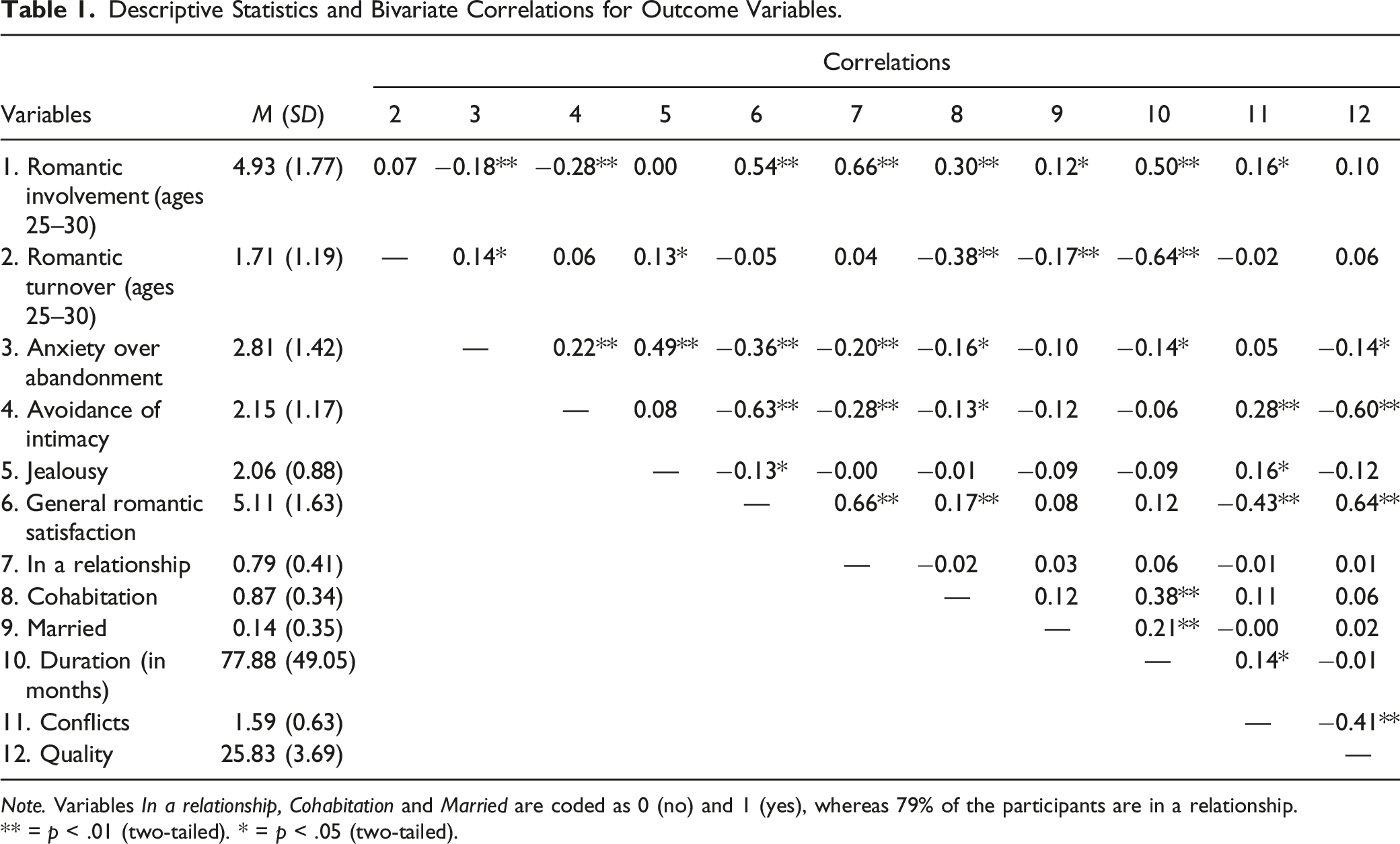
Note. Variables In a relationship, Cohabitation and Married are coded as 0 (no) and 1 (yes), whereas 79% of the participants are in a relationship.
** = p < .01 (two-tailed). * = p < .05 (two-tailed).
Romantic Involvement and Turnover Between Ages 25–30
Romantic Involvement and Turnover Between Ages 25–30 as a Function of Romantic Relationship Patterns.

Note. Means sharing a common subscript are not significantly different according to Tukey’s post hoc test.
Romantic Dispositions at Age 30
Romantic Dispositions at Age 30 as a Function of Romantic Relationship Patterns.
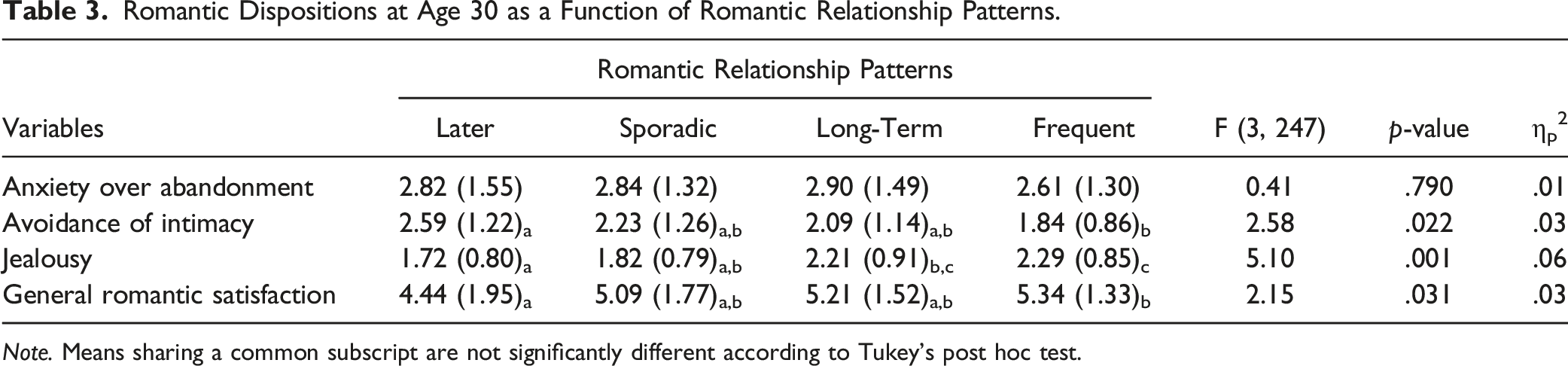
Note. Means sharing a common subscript are not significantly different according to Tukey’s post hoc test.
Romantic Relationship Characteristics at Age 30
Characteristics of the Current Romantic Relationship at Age 30 as a Function of Romantic Relationship Patterns.
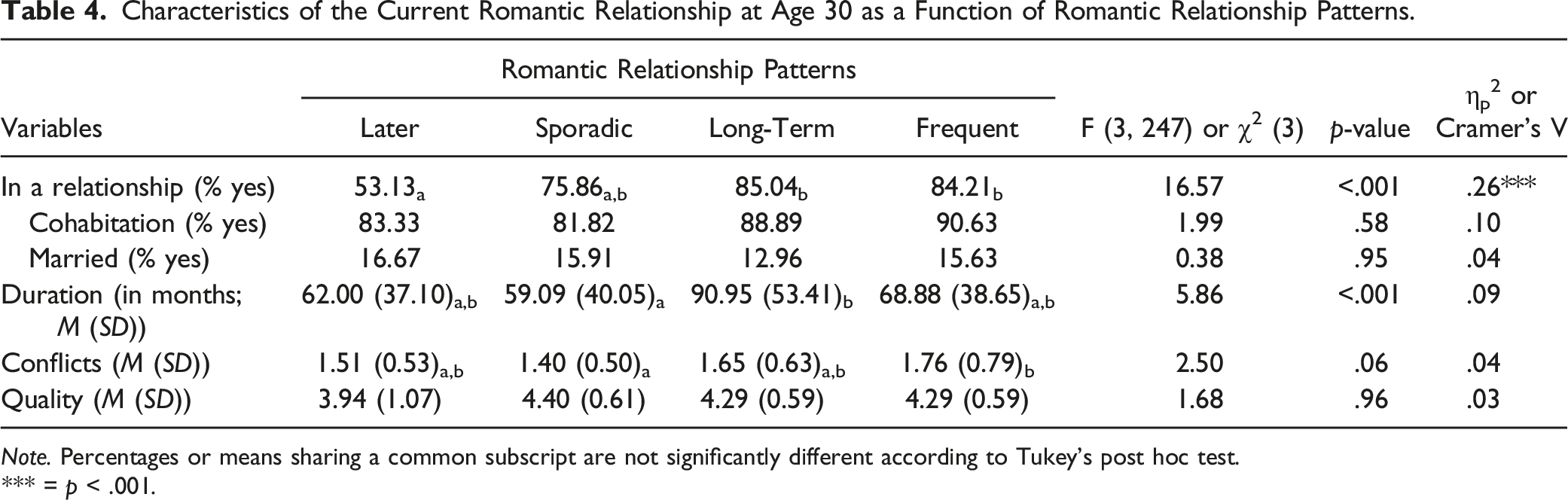
Note. Percentages or means sharing a common subscript are not significantly different according to Tukey’s post hoc test.
*** = p < .001.
Discussion
Romantic relationship patterns from late adolescence to early emerging adulthood have been recently identified (e.g., Boisvert & Poulin, 2016; Gonzalez Avilés et al., 2021; Rauer et al., 2013). Since antecedents and correlates of these patterns were found up to early emerging adulthood, new questions were raised about what happens later regarding romantic experiences, romantic dispositions, and romantic relationship characteristics. The current study provided some answers to these questions by comparing romantic patterns on these aspects at age 30. We found that romantic involvement and turnover in later emerging adulthood varied as a function of previous romantic relationship patterns suggesting some continuity in these two dimensions. We also found that romantic patterns were linked to romantic dispositions in established adulthood (i.e., avoidance of intimacy, jealousy, and general romantic satisfaction). Finally, results indicated that these previous patterns were related to romantic status at age 30 and the duration of the current romantic relationship at age 30.
From Exploration to Stability in the Romantic Sphere?
Nelson (2020) argued that later emerging adulthood differs from early emerging adulthood since there is a progression from exploration to commitment in diverse aspects of youths’ lives. Our results shed an interesting light on his proposition regarding the evolution of the romantic sphere during this period. On the one hand, we found continuity between the romantic pattern experienced between ages 16 to 24 and romantic involvement and turnover between ages 25 to 30. Those who were in a pattern characterized by a low romantic involvement (later and sporadic involvement patterns) continued to show a lower level of involvement in later emerging adulthood, while those in a pattern defined by frequent partner changes (frequent involvement pattern) stood out as having had more different romantic partners between the ages of 25 and 30. Continuity was also found for the long-term involvement pattern since the youth in this pattern pursued high romantic involvement and less romantic turnover. On the other hand, differences between patterns of romantic involvement were not as important in later emerging adulthood as in early emerging adulthood. For instance, participants in the four romantic patterns reported on average 1.20 to 2.29 different romantic partners (see Table 2) between ages 25 to 30 (a 6-year period) compared to 1.30 to 7.08 between ages 16–24 years old (an 8-year period; please see Boisvert & Poulin, 2016 results). At age 30, our results also indicated that most participants were in a romantic relationship (79%). Furthermore, individuals generally had long-lasting romantic relationships at age 30. Between all the romantic patterns, the lowest mean length of the current romantic relationship at age 30 still had an average duration of 4.91 years (a 6-year period) compared to 1.96 years (an 8-year period; please see Boisvert & Poulin, 2016 results).
Overall, two conclusions can be drawn from these findings. First, there is continuity in the type of romantic involvement individuals will experience from late adolescence to established adulthood. These results are aligned with the rare longitudinal studies on the development of romantic relationships that showed a degree of continuity from adolescence to early emerging adulthood (Collins & van Dulmen, 2006; Seiffge-Krenke et al., 2001), a concept that is now extended to later emerging adulthood. Second, our findings are aligned with Nelson’s (2020) idea that romantic stability increases in later emerging adulthood. Indeed, romantic turnover seems less salient during this period than during early emerging adulthood.
Romantic Dispositions nd Romantic Relationship Characteristics at Age 30
Romantic relationships are a rich developmental context for acquiring relational and romantic skills (Diamond et al., 2010). Therefore, we hypothesized that having had long-lasting romantic relationships in early emerging adulthood (long-term involvement pattern) would bring more positive romantic dispositions and romantic relationship characteristics once established adulthood is reached, while a lower romantic involvement (later or sporadic involvement pattern) or more romantic turnover (frequent involvement pattern) would bring more negative romantic dispositions and romantic relationship characteristics in established adulthood.
Our findings did not wholly support these hypotheses. Regarding romantic dispositions, the results were mixed. First, as we hypothesized, individuals in the later and sporadic involvement patterns had high avoidance of intimacy and low general romantic satisfaction. However, individuals in those patterns also reported lower levels of jealousy in their relationships. One explanation is that since they have been less engaged in romantic relationships, individuals might feel more distanced from intimate relationships, thus experiencing a lower level of jealousy. However, there was no correlation between jealousy and avoidance of intimacy. Instead, there were positive correlations between jealousy and anxiety over abandonment and romantic turnover. Since those participants have a romantic history of lower romantic implication, they might be better adjusted to being single. This could give them confidence that they would be fine if their romantic relationship ended. Therefore, their low level of jealousy might be a demonstration of good adaptation skills or a result of their lower romantic involvement. Second, individuals in the frequent and long-term involvement patterns showed the opposite profile: lower avoidance of intimacy, higher general romantic satisfaction, and a higher level of jealousy. While jealousy in intimate relationships is more than often lived as a negative experience (Krems et al., 2021), in this case, this attitude might be demonstrative of how difficult it would be for them to lose their intimate relationships, which is coherent with their romantic history marked by a high romantic involvement. Together, these results do not support the idea of a gain in relational skills for individuals implicated in long-lasting romantic relationships in early emerging adulthood.
Regarding the characteristics of the current romantic relationship at age 30, we observed differences between romantic patterns for involvement in a relationship and the duration of their relationship. However, these differences between romantic patterns seemed in continuity with their previous levels of involvement and turnover. Two main elements of discussion stand out regarding this finding. First, results support the idea of continuity in romantic involvement and turnover throughout adolescence and established adulthood, highlighting a continuity in romantic heterogeneity during those periods. This information is aligned with Purol and colleagues (2020), who found the presence of lifelong marital heterogeneity. Second, the fact that significant results were observed only with those variables indicates that the romantic characteristics of romantic relationships at age 30 are not necessarily linked to the previous romantic relationship patterns. Therefore, the romantic relationships of those youth with the longer-lasting relationships in early emerging adulthood did not gain an advantage over their peers since their romantic relationship did not have more positive characteristics at age 30. While this finding might be surprising initially, it is also great news for individuals from all patterns. First, the general quality of romantic relationships in established adulthood does not only derive from previous romantic experiences. Since established adulthood romantic relationships are expected to last, individuals might have chosen romantic partners that correspond more to their intimate needs than they would have earlier in their development (Tashiro & Frazier, 2003). For the same reason, individuals might be greatly invested in resolving the negative characteristics of their established adulthood romantic relationships (Carbonneau et al., 2015). Second, romantic relationships are not the only type of relationship in people’s lives. Participants’ skills could have been gained through other important intimate relationships, such as friendships and family (Allen et al., 2020; Surjadi et al., 2013).
Strengths, Limitations, And Future Research
This study includes the use of a longitudinal study design with data collection over a 15-year period (ages 16–30) and a high retention rate, and the examination of romantic dispositions and romantic relationship characteristics variables associated with these patterns at age 30. Furthermore, the results of the current study are relevant for anyone interested in romantic and relational development in youth and emerging adults (e.g., clinicians, researchers, parents) since they help understand and normalize a diversity of outcomes associated with previous romantic patterns.
Some limitations should nevertheless be noted. Regarding the sample, this study used a somewhat homogeneous sample from a single geographical area. Quebeckers might have a specific culture regarding the romantic sphere in adulthood. Their tendency to get married is the lowest in the country, and Canada has the lowest marriage rate in the G7 (Statistics Canada, 2022). Therefore, this study should be replicated with more ethnically and economically diverse samples. Also, the size of the current sample led us to exclude a marginal romantic pattern that was previously identified (n = 10; intense involvement pattern). Further studies should be conducted to obtain an adequate sample size for each pattern with larger samples or oversamples of individuals characterized by an intense involvement pattern. Furthermore, the constructs were measured using self-report questionnaires, while romantic relationships are dyadic. This may have resulted in some shared method bias.
Future research into romantic relationship patterns could benefit from pursuing at least two avenues. First, interesting results were obtained by examining participants' links with romantic involvement and turnover in later adulthood, as well as with romantic dispositions and romantic relationship characteristics in established adulthood. Links with other important aspects of adults’ lives, such as their transition to parenthood, parenting experience, well-being, and other psychosocial factors, should also be examined. The literature is clear about the links between romantic relationships and parenthood or psychosocial factors (e.g., Doss & Rhoades, 2017; Gòmez-Lòpez et al., 2019; Seefeld et al., 2022). However, the longitudinal links between romantic patterns and those factors remain unknown. This knowledge would help better understand if the heterogeneity in the romantic history can predict those factors. Second, this study did not capture the subjective experience of romantic relationships between ages 16 to 30 since only status variables were used (number of romantic partners and number of years in a romantic relationship). Qualitative data could greatly improve this lack of knowledge. Together, these future studies could help identify links between romantic patterns and future problematic outcomes, leading to better prevention and intervention programs regarding healthy romantic relationships.
Conclusion
Recent studies have documented romantic patterns from adolescence to early emerging adulthood and their antecedents and correlates from childhood to early emerging adulthood. This study contributed to extending the developmental knowledge of romantic patterns by demonstrating their links with romantic dispositions and romantic relationship characteristics from later emerging adulthood to established adulthood. Our results indicated that romantic patterns (identified between ages 16–24) are associated with involvement and turnover between ages 25–30, romantic dispositions at 30, and some romantic relationship characteristics at 30.
Supplemental Material
Supplemental Material - Romantic Relationships from Adolescence to Established Adulthood
Supplemental Material for Romantic Relationships from Adolescence to Established Adulthood by Stéphanie Boisvert, François Poulin, and Jacinthe Dion in Emerging Adulthood
Footnotes
Declaration of Conflicting Interests
The author(s) declared no potential conflicts of interest with respect to the research, authorship, and/or publication of this article.
Funding
The author(s) disclosed receipt of the following financial support for the research, authorship, and/or publication of this article: This research was supported by research grants from the Social Sciences and Humanities Research Council of Canada and the Fonds Québécois pour la Recherche sur la Société et la Culture for the second author. The first author received fundings from the Fonds Québécois pour la recherche sur la Société et Culture.
Ethics Approval
The study have been approved by the appropriate institutional research ethics committee. APA human subjects guidelines were followed in the collection of data.
Informed Consent
Informed consent was obtained from all individual participants included in the study.
Transparency and Openness Statement
As requested as part of the peer review process for the submission of the present manuscript, the authors would like to make the following statements: The raw data contained in this manuscript, the analysis syntax used for the quantitative analyses of this study, and materials used in the study are not openly available for download. This study did not used qualitative analyses and does not include a pre-registration plan for data collection and/or analysis. Although our scientific resources are not openly available for download, we consider that we have shown transparency in the writing of this manuscript, by describing the components of this scientific research in a clear, accurate and complete manner. We remain open to clarify any elements that the reviewers or the editor may deem necessary.

Supplemental Material
Supplemental material for this article is available online.
Author Biographies
References
Supplementary Material
Please find the following supplemental material available below.
For Open Access articles published under a Creative Commons License, all supplemental material carries the same license as the article it is associated with.
For non-Open Access articles published, all supplemental material carries a non-exclusive license, and permission requests for re-use of supplemental material or any part of supplemental material shall be sent directly to the copyright owner as specified in the copyright notice associated with the article.
