




Abstract
Intimate relationships, both romantic relationships and friendships, are of special importance for identity development in emerging adulthood. In the current study, we investigated longitudinal associations between Big Five personality traits and relationship quality (romantic relationships and friendships) and whether these associations are mediated by identity. A sample of emerging adults (N = 372, 55% women) completed self-report questionnaires on personality and identity in 2015 (Mage = 21.90 years, SD = 1.16) and on quality of friendships and romantic relationships 3 years later. By using MPlus, we tested the multivariate mediating effect of identity dimensions in the relationship among Big Five personality and quality of relationships. No mediation of identity dimensions was found. Extraversion predicted higher friendship quality 3 years later and exploration in depth was positively associated with friendship quality. Regarding romantic relationship quality, no significant direct or indirect effects were found. However, personality predicted multiple identity dimensions.
Keywords
Introduction
For emerging adults, satisfying romantic relationships and friendships are an important life outcome (Arnett et al., 2014; Demir, 2008). Emerging adulthood, often defined as the period between 18 and 29 years, is one of the most challenging and unstable times in human development (Arnett et al., 2014; O’Meara & South, 2019). Emerging adults encounter major developmental challenges in the domains of identity, work, and love relationships that resonate throughout life. Because so many developmental tasks intersect at this critical juncture in the lifespan, emerging adulthood entails unique challenges that are mastered successfully by most people but not by all. There is ample empirical evidence that Big Five personality traits (i.e., Emotional Stability, Agreeableness, Conscientiousness, Extraversion and Openness) predict relationship quality in emerging adults (Malouff et al., 2010; O’Meara & South, 2019). Next to dispositional personality traits, referred to as the having side of personality, there is a doing side of personality at the surface of the self. This side refers to individuals’ actions to construct a unique identity by making motivated choices, planning their lives and striving for certain goals (Cantor, 1990; Luyckx et al., 2014; McAdams, 2015). However, in contrast to the well-established link between personality traits and romantic relationships and friendships, less is known about the role of identity for relationship quality in emerging adulthood. Hence, in the current study, we investigate the prospective associations among personality traits with friendship and romantic relationship quality in emerging adults and we test whether these associations are mediated by identity commitment and exploration dimensions.
Relationships in Emerging Adulthood
Emerging adulthood refers to individuals between 18 and 29 years who are in the process of becoming an adult but are neither adolescents nor adults yet (Arnett et al., 2014; O’Meara & South, 2019). They have reached physical and sexual maturity but have diverse trajectories in education, occupation, and relationships. Societal changes in terms of high demands and pressures in multiple life domains, an overwhelming number of options as well as fewer direction-giving institutions enhance the complexity of this developmental period even further (Arnett et al, 2014; Bosch & Curran, 2011; Montgomery, 2005). On the one hand, emerging adults postpone adult responsibilities and are more vulnerable to mental health problems. On the other hand, these societal changes may enhance personal maturity, the development of new skills and diverse social roles (Arnett et al, 2014; Twenge et al., 2019). Given the complexity of emerging adulthood, Arnett (2014) characterized the period by five general features: instability in relationships and work, self-focus with few obligations, feeling in-between the life spans of adolescence and adulthood, possibilities and optimism for the future and identity explorations. In line with these features, the domains of occupation and close relationships (with romantic partners, family, and friends) acquire the strongest theoretical and empirical support for identity development (Erikson, 1968; Vosylis et al., 2018) and are of special salience in emerging adulthood.
Relationship quality is defined as the degree to which partners in a relationship manifest intimacy, affection and nurturance (Furmann & Buhrmester, 2010; Mirsu-Paun & Oliver, 2017). Relationship quality represents the individual´s subjective experience of how satisfied they are in their relationship (Mirsu-Paun & Oliver, 2017). Both friendships and romantic relationships are characterized by a unique interdependence and reciprocal and mutual exchange (Ryan & Deci, 2000). Nevertheless, they have slightly distinct functions. Whereas romantic relationships mainly satisfy intimacy needs and provide emotional support, friendships serve the need for social integration, feelings of worth and to a lesser degree intimacy (Barry et al., 2009). The overlapping yet unique features of friendships and romantic relationships, emphasize the importance of context-specific models of relationships (Barry et al., 2009; Wilson et al., 2015).
The Association Between Personality and Relationship Quality
Most research on personality characteristics adopts the Big Five approach, in which personality is captured by five factors labeled as Extraversion, Agreeableness, Conscientiousness, Emotional Stability (vs. Neuroticism), and Openness (Costa et al., 2019). The associations between relationship quality and the Big Five personality have been widely studied (Beck & Jackson, 2022; Bouchard et al., 1999; Holland & Roisman, 2008; Malouff et al., 2010; O’Meara & South, 2019). Two meta-analyses reported that all Big Five traits predicted higher romantic relationship satisfaction. The largest effect size was found for Emotional stability (r = .40, Bouchard et al., 1999; r = .22, Malouff et al., 2010). Significant but less strong effects were reported for Agreeableness (r = .25, Bouchard et al., 1999, r = .15, Malouff et al., 2010) and Conscientiousness (r = .17, Bouchard et al., 1999; r = .12, Malouff et al., 2010). Results concerning Extraversion are mixed and inconsistent. Whereas meta-analyses found a significant positive correlation (r = .21, Bouchard et al., 1999; r = .06, Malouff et al., 2010), Schaffhuser et al. (2014) reported that self-reported Extraversion was not related to relationship quality. Openness has consistently been found to have the smallest significant relation with satisfaction in romantic relations (r = .02, Bouchard et al., 1999; r = .03, Malouff et al., 2010; Schaffhuser et al., 2014; Watson et al., 2000). Taken together, previous results support the utility of the Big Five Model regarding intimate relationships (Bouchard et al., 1999; Malouff et al., 2010; Schaffhuser et al., 2014). However, most research is cross-sectional and focused on marital relationships and less on romantic relationships in emerging adults.
In contrast to romantic relationship quality, there is less evidence regarding associations between personality and friendship quality. The few studies that investigated quality of friendships, found that people scoring high on Agreeableness were more likely to make friends and reported more emotional support (Festa et al., 2012; Wilson et al., 2015). People scoring high on Extraversion developed more and closer friendships, and reported more positive friendship qualities (Festa et al., 2012; Wilson et al., 2015). Individuals with higher levels of Conscientiousness seemed to have their friendships reciprocated whereas persons scoring high on Emotional Stability were less likely to interpret conflicts in friendships negatively (Festa et al., 2012; Wilson et al., 2015). Individuals low on Emotional Stability showed less emotional support, and worse conflict management (Festa et al., 2012; Wagner et al., 2014). Evidence is unclear about the association between Openness and friendship quality (Demir & Weitekamp, 2007; Wilson et al., 2015; Zhou et al., 2017).
Taken together, the importance and relevance of personality traits may depend on the nature of the relationship. For instance, a person scoring low on Extraversion may prefer staying home at night, which may result in lower friendship satisfaction, but lower levels of Extraversion may not affect satisfaction of a cohabitating romantic relationship (Wilson et al., 2015). Given the unique characteristics of romantic relationships and friendships, the first and second aims of the current study were to examine the prospective longitudinal associations among the Big Five dimensions and relationship quality of romantic relationships and friendships in emerging adults 3 years later (see Figure 1; path c). Conceptual Model. Multivariate Mediation of Personality Relationship Quality Associations.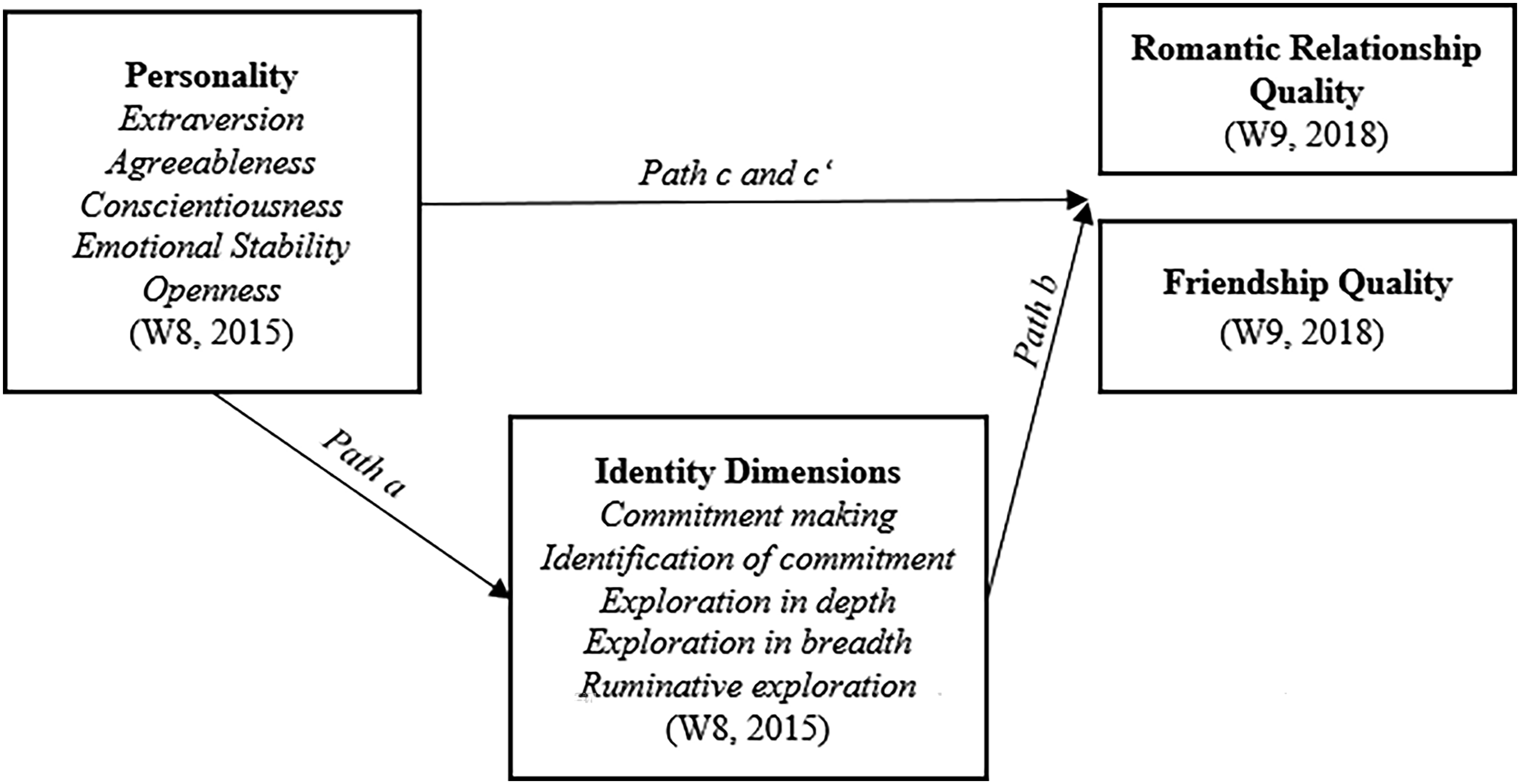
The Association Between Personality and Identity Dimensions
According to McAdams et al.’s (2010; 2015) theoretical model of personality development, personality consists of the following three layers: dispositional traits, the agentic self (agency), and a narrative identity. The first layer describes core fundamental interindividual differences in terms of dispositional traits, conceptualized with the Big Five in our study. However, these traits do not explain all human interactions and behaviours. In this model, identity resides in a different layer and refers to how individuals make choices, plan their lives or strive for goals (Luyckx et al., 2014; McAdams, 2015). Consequently, personality traits are referred to as the having side of personality, whereas identity is referred to as the doing side of personality, because people shape their individual life trajectory in close interaction with the social world. Luyckx and colleagues (2008) proposed a conceptualization of identity that captures dimensions of identity commitment and exploration. Commitment is distinguished into (1) commitment making: the degree to which individuals adhere to a set of choices, and 2) identification with commitment: the extent to which these commitments become integrated in the sense of self. Exploration is captured by 3) exploration in breadth: the extent to which individuals explore various alternatives before committing to one option, 4) exploration in depth: the evaluation of the current commitments and 5) ruminative exploration: delaying identity development as individuals are not able to commit among the limitless number of opportunities (Klimstra et al., 2013; Luyckx et al., 2014).
Further, Luyckx et al. (2014) provided empirical evidence for the role of personality traits in identity development. Specifically, the Big Five consistently predicted identity dimensions in adolescence (Klimstra et al., 2013; Luyckx et al., 2014). Extraversion was positively associated with commitment making, identification with commitment, exploration in depth and negatively associated with ruminative exploration (Klimstra et al., 2013; Luyckx et al., 2012; 2014). Concerning Agreeableness and Openness, Luyckx and colleagues (2014) found a positive association among exploration in breadth and depth. Openness was also positively associated with an extensive and ruminative exploration. A positive association of Conscientiousness with both commitment processes, exploration processes and a negative association with ruminative exploration was found. Finally, Emotional Stability was negatively related to exploration in depth and ruminative exploration and positively related to identification with commitment (Luyckx et al., 2012; 2014).
The Association Between Identity Dimensions and Relationship Quality
Erikson´s theory of psychosocial development provides a theoretical foundation for life span development and draws attention to identity as an important explanatory factor in development (Erikson, 1982). Erikson suggested that individuals move through nine stages characterized by crises. Only if a particular crisis can be solved, individuals achieve a positive outcome and move to the next developmental stage (see also Beyers & Seiffge-Krenke, 2010). Specifically, a successful development throughout the adolescence stage of identity versus role confusion (Stage 5) leads to knowledge and integration of social roles, fidelity, and feelings of continuity of the self. In turn, unsuccessful or incomplete resolution may be reflected in the inability to identify with the self and social roles (Beyers & Seiffge-Krenke, 2010). Moreover, some adolescents have difficulties moving to the next stage described by intimacy versus isolation (Stage 6). These emerging adults have difficulty forming and maintaining close relationships with friends and romantic partners and may experience loneliness, isolation and fear of relationships. Successful mastery of the crisis leads to the development of close friendships and loving and intimate relationships (Beyers & Seiffge-Krenke, 2010). Hence, Erikson proposed a developmental ordering, as “the condition of twoness is that one must first become oneself” (Erikson, 1982, p. 101). Thus, identity development may act as a precondition to develop healthy and committed relationships. In line with this, Malouff and colleagues (2010) emphasized the importance of studying mediators that can explain why personality and relationship quality are related. This information may inform interventions that aim to improve relationship quality and well-being in young adults. Given the empirical evidence that personality traits, identity dimensions and relationship outcomes are interrelated in meaningful ways (Beyers & Seiffge-Krenke, 2010; Klimstra et al., 2013; Malouff et al., 2010), we investigated whether identity dimensions mediate relations between Big Five personality traits and relationship quality (see Figure 1, path a, b, c’). More specifically, exploration is an adaptive process in identity formation, necessary to develop a self-determined sense of identity (Klimstra et al., 2012). One way identity can mediate the link between personality and relationship quality may be that extraverted people are more prone to exploring not only in breadth but also in depth. Further, exploring the partner and the relationship in depth may enhance knowledge and understanding about the partner which may be beneficial for relationship quality. Another mediating effect could be that more mature individuals (higher levels of Extraversion, Agreeableness, Conscientiousness and Emotional Stability) commit themselves more easily. Schwartz and colleagues (2013) described a reciprocal association between commitment dimensions and self-esteem in emerging adulthood, which in turn influences behaviour in relationships. Hence such a stable self-system provides an important resource for interpersonal relationships because individuals may be more securely interacting with others while remaining true to their own beliefs (Barry et al., 2009) making an individual more stable and better able to deal with conflicts in relationships. Another mediating effect may be that individuals high on Openness are likely to fall in ruminative exploration because they cannot decide on options, which may influence relationships because individuals high on ruminative exploration may be more insecure in relationships.
In addition to these theoretical links, empirical research supports the link between identity and intimacy. Regarding romantic relationship quality, Bosch and Curran (2011) found that a balanced identity (i.e., engaging in commitment while retaining exploration) was associated with positive relationship quality as indicated by higher relational maintenance. In line with this, identity achievement was positively related to companionship, affection and emotional support (Barry et al., 2009). Various studies have reported that individuals with a less secure identity (low commitment and exploration, high ruminative exploration) had a stronger tendency for conflict, higher social anxiety and reported less mature romantic relationships (Bosch & Curran, 2011; Kerpelman et al., 2008). Taken together, the link between identity dimensions and romantic relationship quality is quite well established but all studies conceptualize identity differently (Barry et al., 2009; Bosch & Curran, 2011; Kerpelman et al., 2008) which makes a comparison difficult. To the best of our knowledge, literature is scarce about the longitudinal associations between identity capturing the different dimensions of commitment and exploration (Luyckx et al., 2014) and romantic relationship quality. Therefore, the third aim of this study was to examine whether identity dimensions mediate the link between personality and relationship quality in romantic relationships (see Figure 1). Concerning friendship quality, studies that focused on relations between global identity dimensions and friendship quality in emerging adulthood are scarce and results are inconsistent. Johnson and colleagues (2007) reported a positive association between identity commitment and emotional closeness in same-sex friendships. Barry et al. (2009) found no association among identity achievement (high commitment and exploration) or foreclosure (high commitment, low exploration) and friendship qualities. Given these inconsistencies, the fourth aim of the current study was to investigate whether identity dimensions mediate the link among personality traits and relationship quality in friendships.
With regard to identity there is on ongoing discussion about the utility of global and domain specific assessment of identity in emerging adulthood (Vosylis et al., 2018). Nevertheless, in our sample of emerging adults, general future plans are central for identity formation. Hence, this study will provide information on whether satisfaction with relationships can be explained by a global identity measurement.
The Current Study
Based on the described theoretical framework, the current study investigated the longitudinal direct effects of Big Five personality traits I) on romantic relationship quality and II) on friendship quality in emerging adults. Further we tested whether identity dimensions mediate the longitudinal relationship between personality and III) romantic relationship quality and IV) friendship quality (see Figure 1) in emerging adults. Treating emerging adults as adolescents underestimates their capacities for independence, self-direction and -reflection, but seeing them as adults ignores the instability and uncertainty they experience (Arnett et al., 2014). Given the complexity of this life period and the high prevalence of psychiatric disorders in emerging adulthood (Arnett et al., 2014; Twenge et al, 2019), the present study focused on the crucial developmental period of emerging adulthood. The following hypotheses were proposed:
Method
Participants and Procedure
The study was conducted within the Flemish Study on Parenting, Personality and Development (FSPPD). This ongoing longitudinal study started in 1999 (for a detailed description of the recruitment of participants, see Prinzie et al., 2003; 2010). All participants provided written informed consent. For the present study, participants completed self-report questionnaires on personality and identity in Wave 8 (2015). The relationship quality was measured in Wave 9 (2018).
The total sample size was N = 372 (205, 55% females), N = 213 (57% of total sample) of them were in a romantic relationship. All participants were native Belgians and of mixed educational backgrounds. At wave eight (2015), the participants were between 18.9 and 24.2 years old, (M = 21.90 years, SD = 1.16). More demographic statistics are presented in Appendix A (Table A.1 and A.2). Little’s MCAR test (1988) indicated that, for romantic relationship quality missing values were completely at random (χ2 (11) = 17.69, p = .09), for friendship missing values were not missing completely at random (χ2 (21) = 41.4, p = .005). Full information likelihood (FIML) was used to consider missing data.
Materials
Item examples for all variables are presented in Appendix B.
Personality Traits
Personality was measured with the Hierarchical Personality Inventory for Children (HiPIC; Mervielde & De Fruyt, 1999). The HiPIC consists of 144 statements organized under five domains and rated from 1 (almost not characteristic) to 5 (very characteristic). The HiPIC can be used to measure personality from young childhood (De Haan et al., 2017) into emerging adulthood (Storm et al., 2023). The Big Five domains are: (1) Extraversion (32 items; α = .92); (2) Benevolence (similar to Agreeableness; 40 items; (α = .89), (3) Conscientiousness (32 items; α = .92); (4) Emotional Stability (16 items; α = .92); (5) Imagination (similar to Openness; 24 items; α = .86).
Identity Dimensions
Identity was measured with the Dimensions of Identity Development Scale (DIDS; Luyckx, et al., 2008). Five identity dimensions (Luyckx, et al., 2008) are measured by 25-items on a 5-point Likert scale ranging from 1 (strongly disagree) to 5 (strongly agree), measuring the following dimensions: (1) commitment making (α = .95), (2) identification with commitment (α = .89), (3) exploration in breadth (α = .85), (4) exploration in depth (α = .83), (5) ruminative exploration (α = .88). Previous work has supported both a good internal as well as external validity and reliability of the DIDS (Luyckx et al., 2008; Mannerström et al., 2017; Mastrotheodoros & Motti-Stefanidi, 2017), showing that this questionnaire is an efficient tool to assess identity dimensions.
Relationship Quality
Relationship quality was assessed by the relationship dimensions (1) emotional support (how much an individual can depend on the partner when dealing with problems or feeling upset; 3 items) and (2) satisfaction (how happy and satisfied an individual is in the relationship; 3 items) of the Network of Relationship Inventory- Relationship Qualities Version (NRI-RQV; Furman & Buhrmester, 2010). The 6 items assess the frequency of observable behavior on a 5-point Likert scale ranging from one (never or hardly at all) to 5 (always or extremely much). Each item is rated for friends and for the partner, if appropriate (Furman & Buhrmester, 2010). The Cronbach alphas were α = .93 for romantic relationship quality and α = .88 for friendship quality, respectively.
Statistical Analyses
First, descriptive statistics were calculated using SPSS 26 (IBM Corp., 2019). To answer our aims, we performed multivariate mediation analysis, using a bootstrap procedure (with N = 10,000 bootstrap samples; Alfons et al., 2022) in Mplus 8.8 (Muthén & Muthén, 2007). We tested a multivariate model with romantic relationship quality and friendship relationship quality as outcome measures, the Big Five domains as predictors and the five identity dimensions as mediators (see Figure 1). Age, sex, educational level, and living situation (living with parents/living without parents) were included as covariates in the model.
Results
Descriptive Statistics
Descriptive Statistics and Pearson Correlations of the Study Variables.
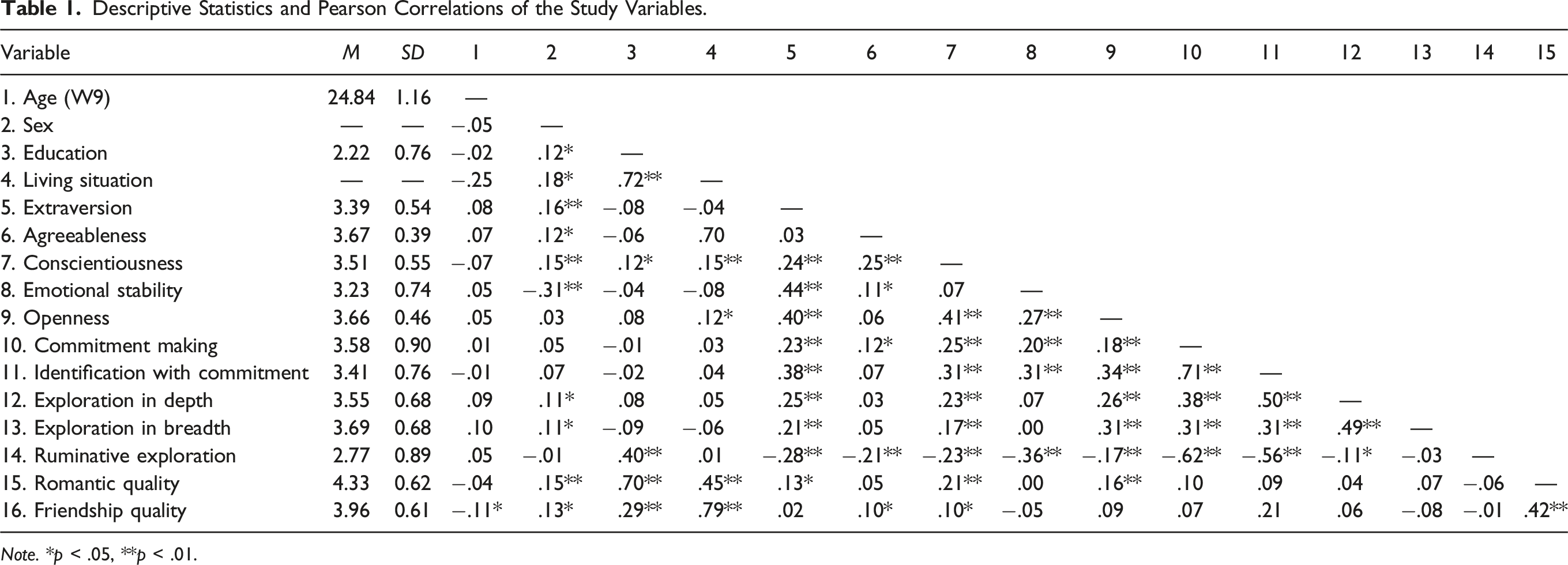
Note. *p < .05, **p < .01.
Multivariate Mediation Results
Results of Multivariate Mediation Romantic Relationship Quality and Friendship.
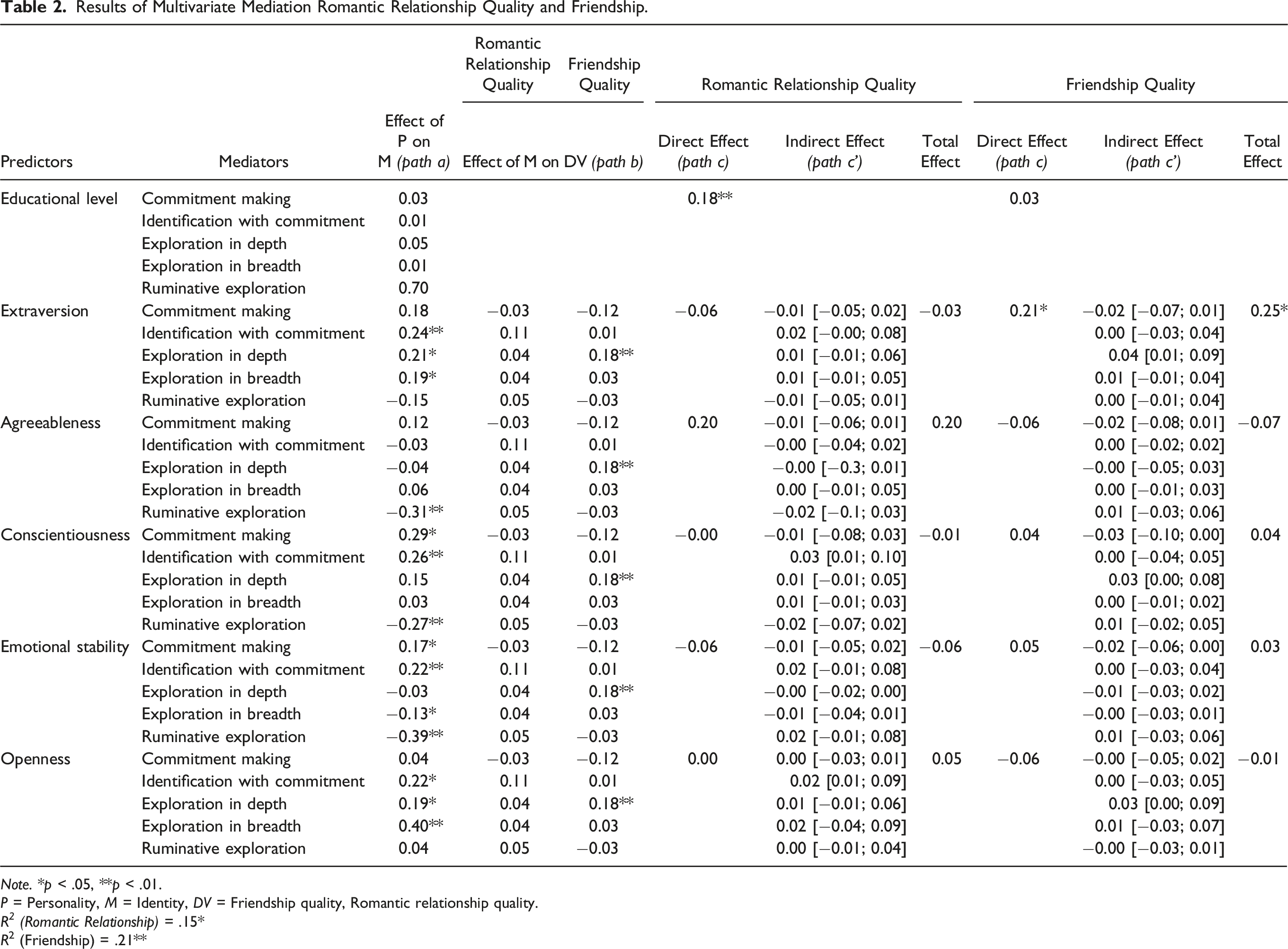
Note. *p < .05, **p < .01.
P = Personality, M = Identity, DV = Friendship quality, Romantic relationship quality.R 2 (Romantic Relationship) = .15*
R2 (Friendship) = .21**
Regarding our first aim, no significant direct or indirect effects of personality on romantic relationship quality were found. Results also indicated a direct effect of Extraversion on friendship quality (b = 0.21, p < .05). Concerning our third and fourth aim, results indicated that identity dimensions did not mediate the relationship between personality factors and relationship quality. However, several significant associations were found for personality on identity (path a) and for identity on relationship quality (path b). Extraversion positively predicted three identity dimensions positively: Identification with commitment (b = 0.24, p < .01), exploration in depth (b = 0.21, p < .05), exploration in breadth (b = 0.19, p < .01). Agreeableness negatively predicted ruminative exploration (b = −0.31, p < .01). Conscientiousness positively predicted commitment making (b = 0.29, p < .05), identification with commitment (b = 0.26, p < .001), and negatively predicted ruminative exploration (b = −0.26, p < .001). Emotional Stability significantly predicted commitment making (b = 0.17, p < .05), identification with commitment (b = 0.22, p < .001), exploration in breadth (b = −0.13, p < .05) and ruminative exploration (b = −0.39, p < .001). Openness significantly and positively predicted identification with commitment making (b = 0.22, p < .02), exploration in depth (b = 0.19, p < .05) and exploration in breadth (b = 0.40, p < .001). A significant effect of exploration in depth (b = 0.18, p < .01) on friendship quality was found. Identity dimensions were not significantly associated with romantic relationship quality. Further, a significant effect of educational level on romantic relationship quality (b = 0.18, p < .01) was found indicating that participants with higher educational levels reported a higher romantic relationship quality.
Discussion
Personality, identity dimensions and relationship outcomes have been found to be interrelated in meaningful ways (Beyers & Seiffge-Krenke, 2010; Klimstra et al., 2013; Malouff et al., 2010), but to the best of our knowledge, no research to date has examined the mediating role of identity dimensions in the longitudinal associations between personality and relationship outcomes in emerging adults. The first and second aims of our study were to investigate whether personality traits are longitudinally associated with I) romantic relationship quality and II) friendship quality, respectively. Previous work on relations between personality and relationship quality were mostly cross-sectional and few studies have examined through which mechanisms they are related. Therefore, we investigated whether identity dimensions mediate the link between personality on relationship quality in III) romantic relationships and IV) friendships of emerging adults.
Extraversion predicted higher friendship quality 3 years later. Except for the longitudinal association among Extraversion and friendship quality, and contrary to our hypotheses and the extant literature, no direct effects of personality on relationship quality were found. Contrary to our hypotheses, no mediational effects were found. However, all personality domains were related to identity dimensions and exploration in depth was positively related to friendship quality 3 years later. Further, we found an effect of educational level on romantic relationship quality.
The Association Between Personality and Relationship Quality
Consistent with previous findings on friendship quality (Festa et al., 2012; Wilson et al., 2015), people high on Extraversion reported a higher friendship quality 3 years later than people low on Extraversion. Young adults scoring high on Extraversion are more outgoing and experience more positive affect. Consequently, they have more opportunities to get to know people and are more likely to become friends with people than individuals low on Extraversion (Selfhout et al., 2010). As expected, Extraversion is more relevant in friendships than in romantic relationships. The positive affect and sociable character of individuals high on Extraversion that result in outgoing and social behavior may be more beneficial for friendships than for romantic relationships (Schaffhuser et al., 2014; Wilson et al., 2015).
Further, we did not find empirical evidence for our hypotheses. One possible explanation may be that previous research on romantic relationships concentrated on marital satisfaction of adults between 35 and 59 years (Malouff et al., 2010; O’Meara & South, 2019). In contrast, our study focused on emerging adults between 21 and 27 years. Emerging adulthood is, next to other features, characterized by instability in relationships, self-focus with few obligations, identity explorations and diverse trajectories in education, work and social life (Arnett et al., 2014). With regard to Emotional Stability, Watson and colleagues (2000) reported that people high on Neuroticism experience lower relationship quality over 18 years of marriage. This negative effect of Neuroticism may not be that pronounced in the early years of relationships. A potential variable influencing the association between personality and relationship quality is the partner´s personality or, even more influential, congruence between partners personalities, which correlates with relationship satisfaction (Gonzaga et al., 2007). There is evidence that congruence between self-rated personality and perception of the partners personality predicts satisfaction (Zentner, 2005). Finally, where most work is based on cross-sectional designs, this study is longitudinal, covering a time span of 3 years. Future research should focus on long-term effect of personality on relationship quality in emerging adults.
Do Identity Dimensions Mediate Relations Between Personality and Relationship Quality?
Our results indicate that the longitudinal associations between personality factors and relationship quality are not mediated by identity dimensions. An explanation may be that we did not assess identity processes with respect to friendship and romantic relationships, but rather with respect to the more generic domain of future choices. Whereas identity processes refer to how identity is formed, identity content expresses what part of identity is formed (Vosylis et al., 2018). Regarding identity content, research shows that the overlap between global and domain specific identity is only modest (Piotrowski, 2022), so a global identity measurement like the DIDS may only partly explain domain specific outcomes such as relationship quality. Vosylis and colleagues (2018) hypothesize that looking at a global identity process may suggest there is no effect whereas an effect may be present on a domain specific level.
The Association Between Personality and Identity Dimensions
Although we did not find significant indirect effects, our results revealed several effects among personality domains and identity dimensions and one effect between an identity dimension (i.e., exploration in depth) and friendship quality. Consistent with previous findings (Luyckx et al., 2014), all Big Five traits were associated with several identity dimensions. Extraversion predicted identification to commitment, exploration in breadth and exploration in depth. Individuals scoring high on Extraversion may be better able to deal with stress, are in general more enthusiastic about personal goals and show more goal-directed behavior (Klimstra et al., 2013; Luyckx et al., 2014). Consequently, they may show a higher identity achievement in terms of identification with commitment, exploration in depth and exploration in breadth. Our finding that emerging adults high on Agreeableness engaged in less ruminative exploration, was not found by Luyckx and colleagues (2014). This may be, that individuals high on Agreeableness are more willing and able to adapt to various demands and therefore less likely to be overwhelmed by different opportunities, showing less ruminative exploration (Klimstra et al., 2013). Conscientiousness predicted all identity dimensions but exploration in breath. Individuals high on Conscientiousness are planful, have high impulse control and consequently show more commitment making and identification with commitment. Their high goal pursuit also saves them from falling into ruminative exploration (Luyckx et al., 2014). All identity dimensions but exploration in depth were predicted by Emotional Stability. Individuals scoring high on the personality trait sense a high degree of inner security and a general open-mindedness (Luyckx et al., 2014), leading to more commitment making, identification with commitment, and exploration in breadth. They may also be better able to deal with challenges in a pro-active manner (Kobylińska & Kusev, 2019) and therefore report less ruminative exploration. Finally, Openness was associated with identification with commitment making, and both exploration dimensions. This is in line with previous research reporting that a general open-mindedness of individuals scoring high on Openness contributes to proactive identity exploration (Klimstra et al., 2013; Luyckx et al., 2014).
In general, the present study confirms the notion that personality maturity, characterized by higher levels of Extraversion, Agreeableness, Conscientiousness and Emotional Stability, is positively associated with commitment and exploration processes, and may protect against falling into ruminative exploration (Luyckx et al., 2014). Further, the differences in results between our study and previous studies (Klimstra et al., 2012; 2013; Luyckx et al., 2014) may be explained by the different samples. Luyckx et al. (2014) mainly investigated adolescent samples, focused on narrower Big Five facets instead of the broader personality dimensions (Klimstra et al., 2013) and investigated domain specific identity within an educational setting (Klimstra et al., 2012).
The Association Between Identity Dimensions and Relationship Quality
Regarding identity and romantic relationships, no significant associations could be found. For friendship quality, exploration in depth was positively related to friendship quality 3 years later. Individuals high on exploration in depth actively assess and evaluate their future plans and identity but also show more interest in their friends. Having good friends and being able to talk to them in depth, may increase closeness in friendships and therefore lead to high friendship quality 3 years later. Our results contradict the finding of Barry et al. (2009) that identity achievement leads to companionship, worth, affection and emotional support in romantic relationships but do not affect friendship quality. However, studies on identity and relationship quality are difficult to compare as researchers measured different relationship outcomes such as conflict, commitment, or satisfaction (Bosch & Curran, 2011; Kerpelman et al., 2008) and mostly focused on the identity status paradigm by Marcia (1966) or used domain-specific identity measurements (Vosylis et al., 2018).
Further, trends regarding higher societal demands, and more opportunities for emerging adults to explore without committing oneself (Bosch & Curran, 2011; Montgomery, 2005) let researchers question whether the developmental ordering proposed by Erikson is still valid today. Montgomery (2005) stated that the developmental task of constructing one´s own identity that previously took place in adolescence, nowadays extends well into emerging adulthood. Hence, intimacy may be established before or in parallel to identity development in emerging adults, rather than serious romantic relationships developing once identity is consolidated. However, Beyers and Seiffge-Krenke (2010) found contradictory results to Montgomery (2005) and reported that intimacy with a partner at age 25 was strongly predicted by ego development during adolescence. Whereas Erikson conceptualized a crisis at the transition to young adulthood, several authors (see e.g., Robinson, 2015) describe a crisis during young adulthood, the so-called quarter life crisis. The quarter life crisis is conceptualized with four phases. The first phase characterizes questioning past commitment to a job, group, or relationship. The second phase brings the emotional peak of crisis and stepping out of the commitment. In the third phase an individual adopts a new lifestyle, once again exploring identity and experimenting. The fourth phase is characterized by a more inner-directed commitment to new roles or relationships. However, those phases are not moved through sequentially but can differ in their sequence or even cycle back to previous stages. Hence, Robinson (2015) concludes that Erikson´s theory on developmental ordering needs an update in both vocabulary and structure. Instead of intimacy and isolation, he proposes the terms commitments and independence. Structurally, Robinson (2015) divides Erikson´s stage of early adulthood into two distinct stages, emerging adulthood (ages 18–25 years) striving for independence and early adulthood (ages 25–30 years) striving for commitments. The switch in-between is by no means easy and characterized by substantial instability and uncertainty and therefore called the quarter life crisis. Hence, our results may support this, showing that identity and intimacy may develop in repeating cycles rather than consequentially.
Research focusing on the quarter life crisis (Robinson, 2015; Robinson & Wright, 2013) may explain why some young adults are in more committed relationships than others. First, individuals in a committed relationship might have already dealt with their quarter life crisis or might still deal with it. Further, individuals in a relationship can still display explorative behaviour or experience a quarter life crisis in other areas of life while staying in a long term committed relationship. Second, the quarter life crisis can take the locked-in form (Robinson, 2015), in which individuals are committed to adult roles or relationships but inwardly feel trapped. Third, about 70% of emerging adults report a quarter life crisis (Robinson & Wright, 2013), so some individuals may not experience a quarter life crisis, which might be those in a committed relationship. Future research might investigate whether being in a relationship may protect from a quarter life crisis.
Strength and Limitations
The longitudinal design of this study offered the opportunity to investigate the relationship between concepts over a longer period in a large and heterogeneous sample. By including all Big Five domains and all identity dimensions in a multivariate model, we could empirically test the impact of each concept on two different kinds of relationships. Considering the overlapping yet unique features of friendships and romantic relationships (Barry et al., 2009; Wilson et al., 2015), the current study adds to the understanding of both types of relationships, allowing to compare associations among personality and identity and creating context-specific models of relationships (Barry et al., 2009; Wilson et al., 2015).
However, this study is not without limitations. A first limitation is that we relied on self-reported measures, which may give subjective and biased information (Schaffhuser et al., 2014). Whereas the self-perception provides a unique inside view on oneself, the perceptions of intimate partners or friends offers an outside perspective that can be more objective and less biased (Schaffhuser et al., 2014).
Further, identity was measured with the Dimensions of Identity Development Scale (DIDS; Luyckx, et al., 2008). This questionnaire measures identity dimensions with respect to future life choices instead of specific identity domains. As hypothesized by Vosylis and colleagues (2018) focusing on a global identity process may suggest there is no effect whereas an effect may be present on a domain specific level. The fact, that we found some significant links with a global concept of identity anyways, shows that there is much potential in the investigation of emerging adults’ identities and relationships. As the present study was conducted within the Flemish Study on Parenting, Personality and Development (FSPPD; Prinzie et al., 2003) not every concept was measured in each wave. Therefore, we could not control for stability of relationship satisfaction and a full longitudinal design allowing for cross-lagged associations and directionality of effects was not possible. In line with this, the present study cannot add to the discussion about the ordering of identity and intimacy as proposed by Erikson (1982) and as discussed in several studies (Bosch & Curran, 2011; Montgomery, 2005). In addition, there is some heterogeneity of identity within the individual (Lichtwarck-Aschoff et al., 2008; Schwartz et al., 2011). Specifically, identity processes on a macro-level (months and years) and a micro-level (days) may operate differently and should be investigated separately from each other. Whereas day-to-day changes may be rapid and reactive, long-term changes may involve slower and more agentic decision making. Future research should give more attention to the topic with longitudinal designs using domain-specific instruments and short-term identity processes to make the effects more pronounced and discover developmental trajectories. Further, future research should investigate the developmental ordering of identity and intimacy in today’s emerging adults and investigate potential underlying developmental processes such as adopting adult roles and achieving adulthood criteria (marriage, job, living situation) that may interact with both intimacy and identity development.
Second, our study was restricted to a Flemish sample of emerging adults. Given the universal importance of identity and interpersonal relationships over various cultures, both individualistic and collectivistic (Becker et al., 2012), our results are still instructive about identity and relationships in emerging adults. Nevertheless, it should be noted that culture has been found to moderate the associations of personality traits with well-being (Klimstra et al., 2012; McAdams, 2015). Hence, each culture´s own characteristic may have unique effects on each of our study variables and future research should assess these associations in other cultures, especially collectivistic cultures, as well.
Further, we assessed a population-based sample, so our results should not be extended to clinical populations. For example, among clinical populations, identity development may impact relationships differently than in non-clinical samples. Indeed, research reported that clinical samples show higher identity distress in adolescents than non-clinical samples (Wiley & Berman, 2013). Individuals with more identity distress also showed more psychological adjustment problems and psychopathology, which may also present as relationship problems. Therefore, future research should investigate associations between identity and relationship quality in clinical samples.
Our results have some implications for applied science. Emerging adulthood needs to be considered as an important and unique period in life, characterized by both opportunities and risks for mental health (Arnett et al., 2014). The task of establishing intimacy is considered a critical life span turning point, where key experiences affect trajectories of young individuals in either positive or compromising ways (Montgomery, 2005). In line with this, our results show that it is important to increase awareness about individuals low on Extraversion, Agreeableness, Conscientiousness and Emotional Stability that are at risk of falling into ruminative explorations and may get stuck by the countless opportunities and may not be able to commit to one option (Klimstra et al., 2013).
Conclusion
In sum, we found that emerging adults high on Extraversion report a higher friendship quality 3 years later. We did not find empirical evidence that identity dimensions mediate the link between personality and romantic relationship or friendship quality. Furthermore, we supported the notion that all personality domains are associated with identity dimensions in emerging adults and showed that exploration in depth is beneficial for friendship quality.
Footnotes
Appendix B
Declaration of Conflicting Interests
The author(s) declared no potential conflicts of interest with respect to the research, authorship, and/or publication of this article.
Funding
The author(s) received no financial support for the research, authorship, and/or publication of this article.
