



Abstract
This study employed the Individuation Test for Emerging Adults-Short (ITEA-S) to identify groups of emerging adults sharing similar individuation profiles (types) in relation to mother and father separately. Two-step clustering procedures of self-report data of Slovenian and Austrian participants suggested four internally replicable types of individuation across parents and countries: dependent, anxious, individuated-related, and individuated-independent. We revealed a moderate cross-parent structural consistency of the types and a fair cross-parent consistency of the participants’ type membership within each country. The structural consistency across countries was moderate for the types in relation to mother, but almost perfect in relation to father. Overall, individuals assigned to the anxious type scored the lowest and those classified as individuated-related scored the highest on emotional and psychological well-being (PWB. The results suggest the robustness of the ITEA-S types across parents in the two countries, and their associations with positive outcomes, supporting the validity of the types.
Keywords
Introduction
Individuation in relation to parents refers to a multidimensional process of autonomy development while retaining connectedness to parents. It represents one of the core developmental tasks of adolescence and emerging adulthood. To overcome the limitations of using adolescent measurements of individuation with emerging adults Komidar et al. (2014) constructed a reliable and valid five-dimensional measure, the Test of Individuation for Emerging Adults (the 36-item ITEA), to capture age specific features of individuation. The items are rated in relation to mother and father separately. The two forms differ only grammatically and suggest the same dimensional structure. The ITEA dimensions include connectedness to parents (mutual understanding, respect, trust, and open communication), seeking parental support (approval, advice, help in difficult situations), self-reliance (in managing personal affairs, important decisions), perceived parental intrusiveness (intruding into privacy, over-concern), and fear of disappointing the parents (worries, anxiety, guilt when not meeting parental expectations).
To capture the dynamics of the process within an individual, we should consider specific configurations of several dimensions. Employing the ITEA in a person-centered (typological) approach, Kavčič and Zupančič (2019) identified four groups of emerging adults in a Slovenian sample, suggesting distinct types of individuation in relation to mother and father. The structure of the types was strongly similar across parents, while the cross-parent type membership of the participants was moderately consistent. The dependent type reflected strong connectedness, support seeking and fear of disappointing parents, but low self-reliance and parental intrusiveness. The anxious type showed individuation difficulties (both parental intrusiveness and fear of disappointing); the individuated-related type scored high in connectedness and support seeking, average on self-reliance and low on individuation difficulties. The latter also characterized the individuated-independent type, along with strong self-reliance, but rather weak support seeking and connectedness.
In extending the applicability of the ITEA beyond the sociocultural context of its origin, the authors developed a shorter, more robust 21-item measure (the ITEA-S), adapted it into English (Komidar et al., 2016) and German (Komidar et al., 2021), and validated these versions with samples in Slovenia, U.S., Germany, and Austria. The same factorial structure to the original ITEA (in relation to both mother and father), as well as measurement invariance across gender and samples was revealed. However, the ITEA-S has not been employed in person-centered research yet. Therefore, we aimed to gain an insight into the potential robustness of the individuation types by using the ITEA-S with Slovenian and Austrian emerging adults. Given the instrument was validated in both countries, we selected these because they share important social-cultural commonalities (historically being parts of the Habsburg monarchy), as well as differences (e.g., in social welfare systems, resulting in stronger and longer reliance of Slovenian young people on family support associated with their later moving out of parental home; Zupančič & Sirsch, 2018).
Drawing upon the importance of individuation for healthy outcomes predominantly grounded in the dimensional approach (e.g., Lamborn & Groh, 2009; Zupančič et al., 2014), we opted for criterion measures of emotional well-being (EWB) and psychological well-being (PWB) as depicted by the Keyes’s three-component model (2006). Given individuation is an intrapsychic process that unfolds within close relationships, we targeted emerging adults’ experiences of their private life and not their functioning in the social world beyond close relationships (captured by the third component of social well-being). Both EWB and PWB namely refer to intrapersonal phenomena, with the former entailing the hedonic aspect of well-being, and the latter representing its eudaimonic aspect (including e.g., autonomy and positive relations with significant others).
Our goal was to (1) identify groups of emerging adults sharing similar and internally replicable individuation profiles (types) in relation to each parent in each country; (2) examine the structural consistency of the types in relation to mother and father within each country, including the consistency of type membership across parents; (3) explore the between-country structural consistency of the types in relation to the same parent, and (4) test the criterion validity of the types against two intrapersonal aspects of subjective well-being.
Method
Participants and Procedure
Sample characteristics and between country differences in demographics.
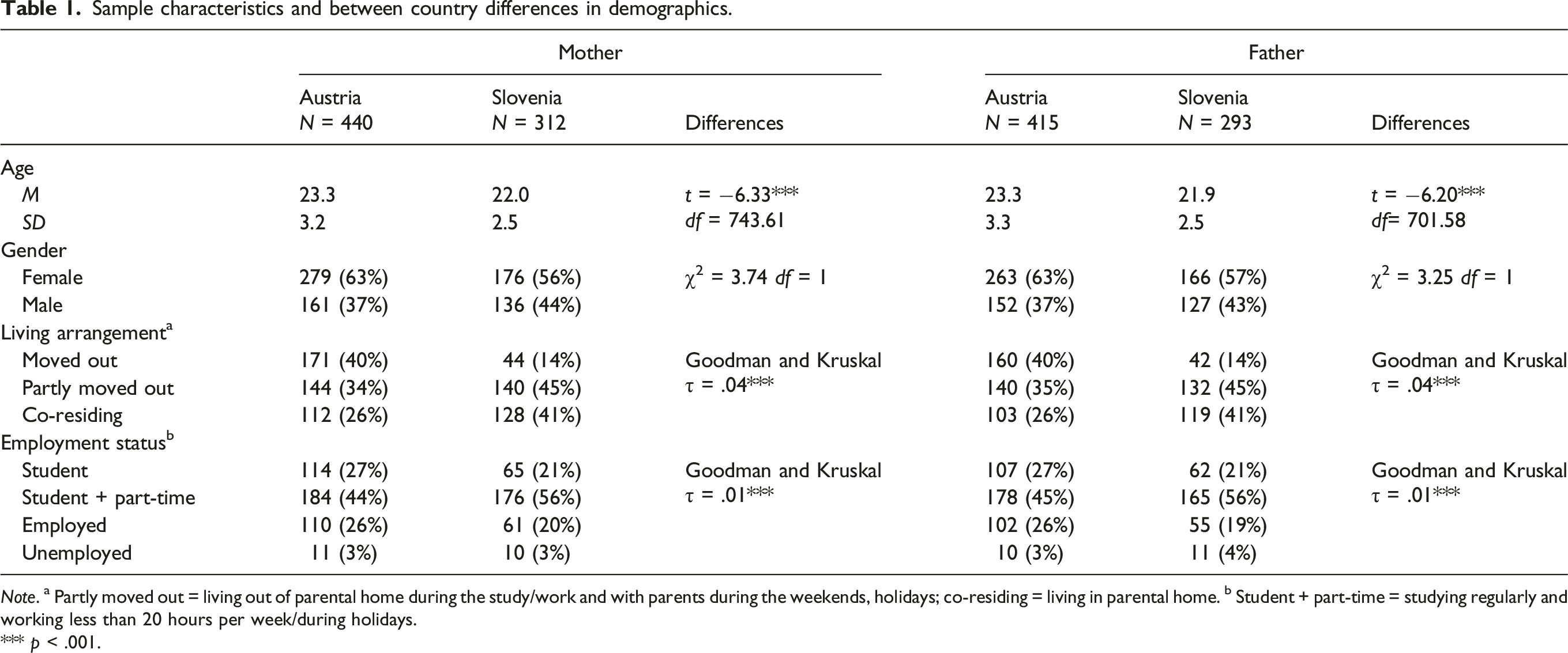
Note. a Partly moved out = living out of parental home during the study/work and with parents during the weekends, holidays; co-residing = living in parental home. b Student + part-time = studying regularly and working less than 20 hours per week/during holidays.
*** p < .001.
We asked psychology students to participate in an online survey and to recruit additional emerging adults (students of other study programs, employed or unemployed peers). The application first required potential participants to agree with the privacy policy, containing information on the purpose of the study, their rights concerning anonymity, data storage, and use of the data. The study was carried out in accordance with ethical principles of research with human subjects (APA, 2017).
Measures
Along with the demographic questions, we employed the Individuation Test for Emerging Adults–Short (ITEA-S; Komidar et al., 2016, 2021) in each country (i.e., the Slovenian and the German version) in relation to mother and father separately, which were automatically rotated to minimize a possible effect of the order of presentation. Using a 5-point rating scale (1 – completely untrue; 5 – completely true), participants responded to 21 items, which form five scales. These are Support seeking (e.g., When I am in doubt about important decisions, I turn to her/him.), Connectedness (e.g., I can talk openly to her/him.), Intrusiveness (e.g., I think she/he tries to control too much of my life.), Self-reliance (e.g., I can manage most things in my life without her/his help.), and Fear of disappointing the parent (e.g., I fear that I could disappoint her/him.). All items are scored positively, higher scale scores reflect higher levels of a given characteristic, and the scoring does not permit unanswered items (Komidar et al., 2014, 2016). In case participants did not respond to all items on each ITEA-S test page (separately for mother and father), they were alerted to complete their answers to proceed to the next page. Thus, all the participants completed the mother ITEA-S form. For the father form, 28 Austrians and 22 Slovenians did not provide responses (see Table 1) as they indicated the option of not being able to do so (no contact with the father, father unknown, deceased).
Sound psychometric properties of the ITEA-S were demonstrated in both Slovenia (Komidar et al., 2016) and Austria (Komidar et al., 2021), with internal reliabilities (Cronbach αs) ranging from .75 (Self-reliancefather) to .92 (Support seekingmother) and from .80 (Self-reliancefather) to .88 (Support seekingmother and Connectednessfather), respectively. The α coefficients for the present study are reported in Table A1 of the Supplementary material. The procedure of testing for measurement invariance of the ITEA-S across parents in each country are also presented in the Supplementary material, including Tables A2 and A3.
We considered two out of three scales of the Mental Health Continuum–Short Form (MHC-SF; Keyes, 2009), tapping (EWB; interest in life, life satisfaction, positive affect; 3 items), and PWB; autonomy, environmental mastery, personal growth, purpose in life, self-acceptance; 5 items). The participants responded using a 6-point rating scale (from 0 – never to 5 – every day during the past month). International evidence supports factorial structure, internal consistency, test-retest reliability, and validity of MHC-SF in adolescents and adults (e.g., Keyes, 2006; Lamers et al., 2011; Robitschek & Keyes, 2009; Zupančič & Kavčič, 2017). The internal consistency coefficients (αs) of the scales in the current study were .86 (EWB) and .83 (PWB) in Austria, and .89 (EWB) and .85 (PWB) in Slovenia.
Of the Slovenians who completed the ITEA-Smother and ITEA-Sfather, 7 and 6, respectively, had missing MHC-SF data. They did not differ statistically significantly from those with complete data by age, gender, living arrangement, or employment status. Among the Austrians, the MHC-SF data were missing for 28 (ITEA-Smother) and 26 (ITEA-Sfather) participants. Except for males who were less likely to respond to the MHC-SF (χ2 = 4.62 and 4.46 for ITEA-Smother and ITEA-Sfather data sets, respectively; dfs = 1, ps < .05), the participants with missing data did not differ statistically significantly from those with complete data.
Data Analyses
We derived types of individuation by applying a two-step clustering procedure used by Asendorpf et al. (2001). The entire procedure was conducted with z-scores for the five ITEA-S scales in relation to each parent and in each sample separately. Based on the previous person-centered study with the full ITEA (Kavčič & Zupančič, 2019), we focused on four-cluster solutions. We determined internal replicabilities of the four sets of cluster solutions by a double-cross validation procedure (Asendorpf et al., 2001), involving an estimation of replicability across 10 random splits of each sample in each condition (i.e., ratings in relation to mother and ratings in relation to father). The procedure provides 10 κ coefficients, averaged into a replicability coefficient, with its value of at least .60 considered as an acceptable value of internal replicability (Breckenridge, 2000).
Using a similar procedure (see De Fruyt et al., 2002 for details), we estimated the structural consistency of the types within each sample across the parent forms and between the samples across the same parent forms. In interpreting these estimations (levels of agreement), we followed Landis and Koch’s (1977) guidelines.
The ITEA-S measurement testing was conducted in R package Iavaan (Rosseel, 2012) and all other analyses were done in SPSS 25.
Results
Types of Individuation
The results of the double-cross validation procedure suggested satisfactory internal replicability of the four cluster solutions for the ITEA-S in relation to mother and father (all average κs exceeding .60). With the Austrian sample, the κs ranged from .45 to .85 (Mκ mother = .66) and from .43 to .96 (Mκ father = .69), and with the Slovenian participants, the κs ranged from .51 to .90 (Mκ mother = .63) and from .43 to .90 (Mκ father = .62). Moreover, there were statistically significant differences among the types across the five ITEA-S dimensions in relation to mother and father within each country (Supplementary material, Table A1).
Figure 1 displays average profiles of the four cluster solutions derived in relation to mother and father within each sample. An inspection of the profiles suggests several commonalities among the same-labelled configurations of the ITEA-S scores (transformed to z-values for comparison). Based on these robust similarities and parallels with the profiles identified by the full ITEA we retained the original labelling (Kavčič & Zupančič, 2019). The profiles reflect distinctive types of individuation (see Figure 1 for percentages of individuals assigned to each type). In general, the dependent type shows high levels of fear of disappointing parents and seeking parental support (z > 0.50), relatively strong feelings of connectedness to parents (z = 0.50 or above), and low levels of self-reliance (z < −0.50). The anxious type is characterized by high levels of perceived parental intrusiveness and relatively high levels of fear of disappointing parents, average self-reliance (−0.50 < z < 0.50), and low (though average in relation to Slovenian mothers) levels of connectedness. The individuated-related type scores relatively high in connectedness and seeking parental support (0.00 < z < 1.00), average on self-reliance, and low on both perceived parental intrusiveness and fear of disappointing parents (z < −0.50). The individuated-independent type appears particularly self-reliant, exhibits low levels of seeking parental support in difficulties (but average in relation to Austrian mothers) and connectedness (however, both with mean raw scores across countries/parents above the mid-point of the rating scale; Supplementary material, Table A1), and scores relatively low on both perceived parental intrusiveness (except in relation to Slovenian mothers) and fear of disappointing parents. Types of the Austrian and Slovenian emerging adults’ individuation in relation to mother and father. Note. (%) = percentages of emerging adults classified into the respective type.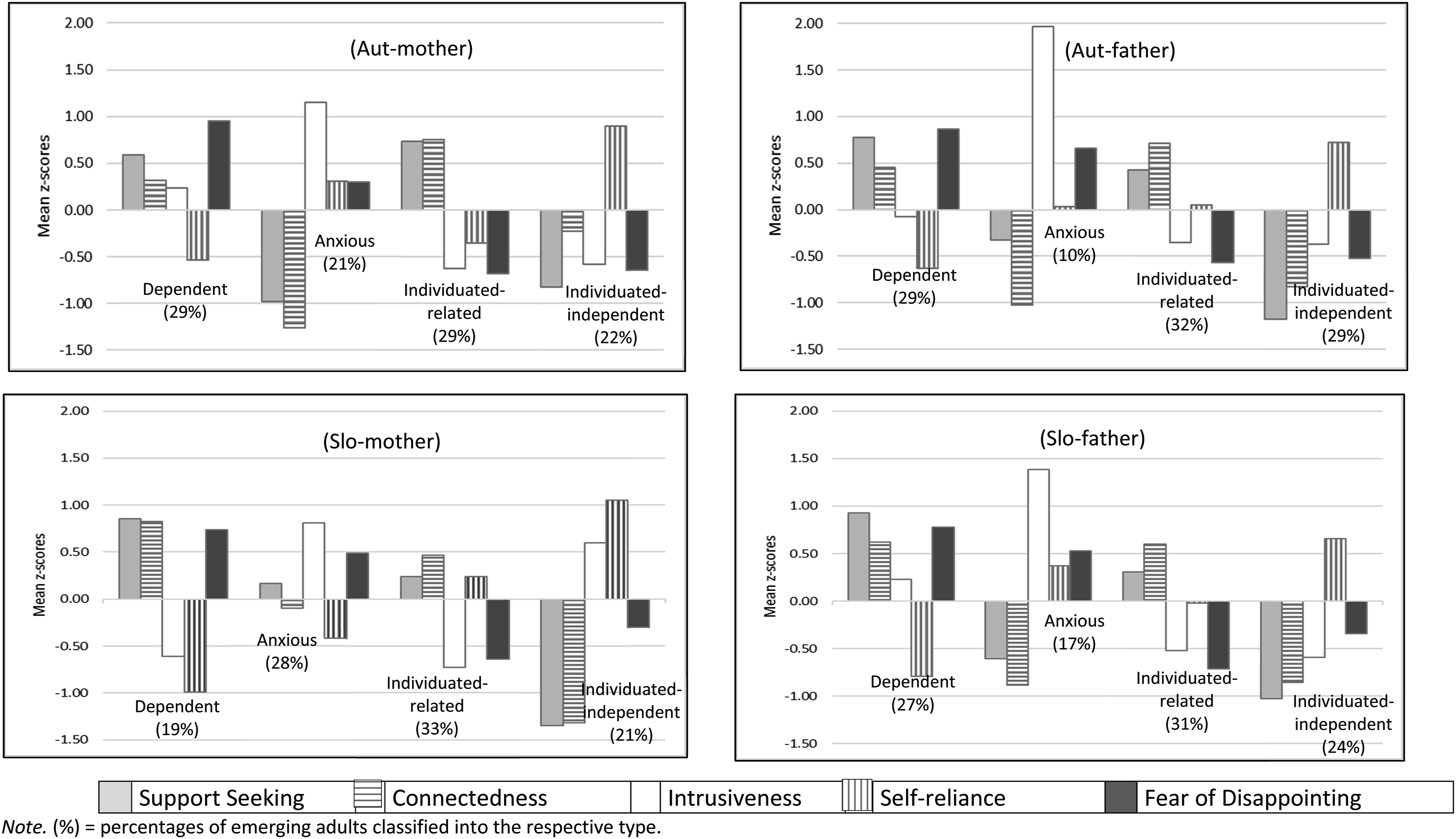
Type Consistency Analyses
We revealed a moderate cross-parent consistency of the structure of types, with the estimated κs of .51 in Austrian- and .57 (both ps < .001) in the Slovenian data set. The consistency of cross-parent type classifications resulted in κs of .27 (Austria) and .24 (Slovenia), with both ps < .001. Based on the guidelines by Landis and Koch (1977) this suggests a fair agreement. Specifically, 46% and 43% of the participants were classified into the same type of individuation in relation to both parents in the Austrian and Slovenian sample, respectively.
The structural consistency analysis between the countries resulted in a moderate consistency of the types of individuation in relation to mother (κ = .46, p < .001) and almost perfect consistency of the types in relation to father (κ = .90, p < .001).
Types of Individuation and Subjective Well-Being
Univariate Effects of Individuation Type Membership on Emotional and Psychological Well-Being.
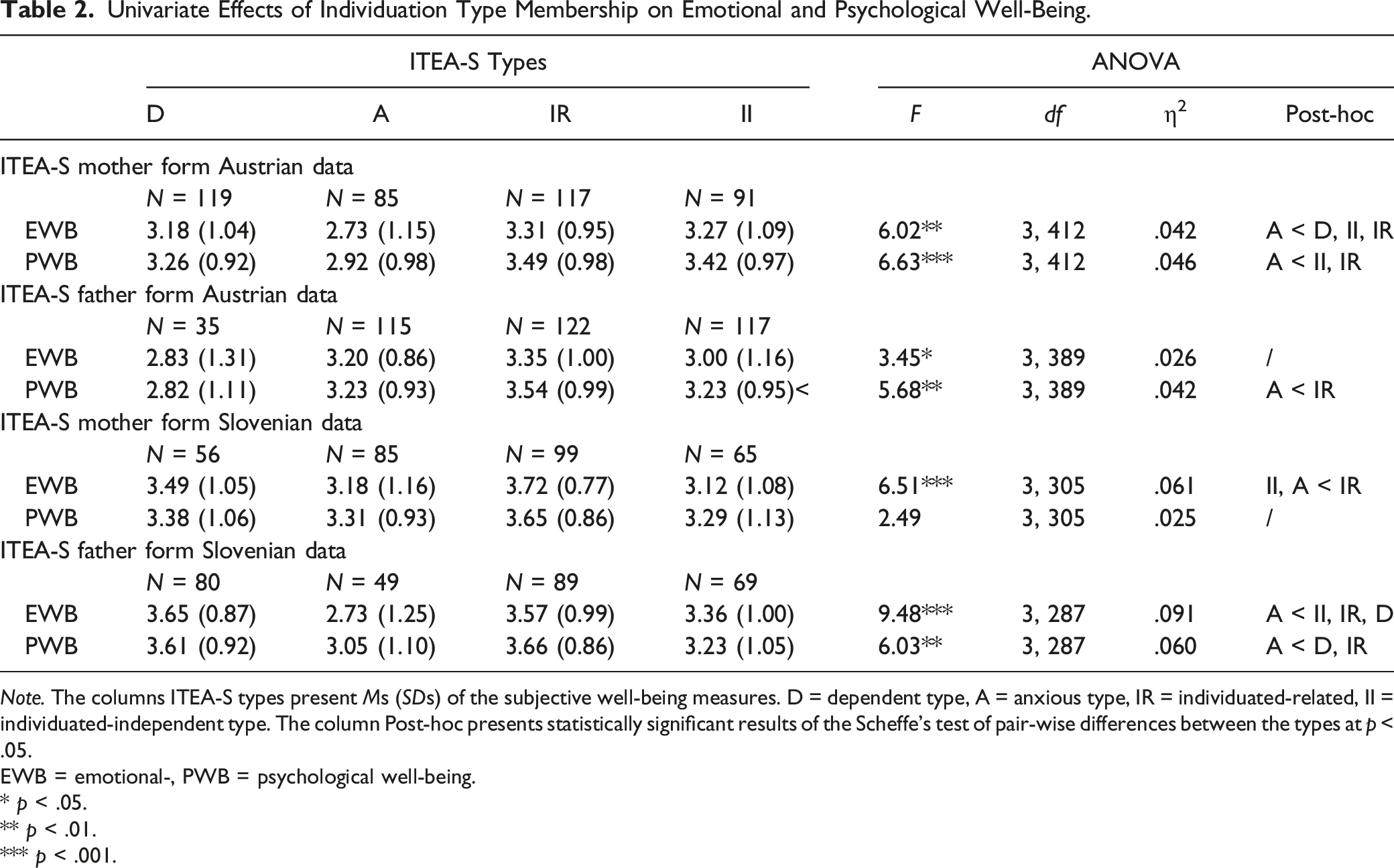
Note. The columns ITEA-S types present Ms (SDs) of the subjective well-being measures. D = dependent type, A = anxious type, IR = individuated-related, II = individuated-independent type. The column Post-hoc presents statistically significant results of the Scheffe’s test of pair-wise differences between the types at p < .05.
EWB = emotional-, PWB = psychological well-being.
* p < .05.
** p < .01.
*** p < .001.
Discussion
This study derived four distinct and internally replicable types of emerging adults’ individuation in relation to their mother and father across two Central European countries by employing the short version of the ITEA (ITEA-S; Komidar et al., 2016, 2021) in a person-centered approach for the first time. We roughly replicated the types identified with the full ITEA in Slovenia (Kavčič & Zupančič, 2019) in both countries, showed the structural ITEA-S type consistency across parents in both countries, and cross-country consistency of the ITEA-S type structure in relation to the same parent, which was almost perfect in relation to father. All this suggests that the characteristic profiles of the dimensions of individuation (dependent, anxious, individuated-related, and individuated-independent) are rather robust. To further support this claim replications in other social-cultural contexts are needed, starting with Germany and the U.S. where the ITEA-S has already been validated.
The types obtained refer to groups of emerging adults with different five-dimensional ITEA-S profiles, which reflect the characteristic ways young people currently navigate their process of individuation. Similar to the same labeled groups identified by the full ITEA (Kavčič & Zupančič, 2019) among Slovenian emerging adults, the two “individuated” groups of our participants exhibited the least difficulties (parental intrusiveness into privacy, and dependence on parental approval and recognition) in balancing autonomy and maintaining relatedness to parents. Whereas we can describe emerging adults assigned to the individuated-related type as rather strongly connected to parents (which does not appear to undermine their autonomy), those classified as individuated-independent show greater levels of self-reliance and weaker feelings of relatedness to parents. In general, both groups exhibit similar levels of well-being (in most instances higher than the anxious group). However, significantly lower levels of emotional well-being in the Slovenian individuated-independent group in relation to mother compared to the individuated-related group suggests that a comfortable balance between autonomy and relatedness may be moderated by culture. In the Slovenian context of strong and extended reliance on, and valuing of, parents as a source of various kinds of support (consistent with other Mediterranean countries; Buhl & Lanz, 2007; Zupančič & Sirsch, 2018), particularly within relatively high quality of relationships with parents (especially mothers) (e.g., Kuhar & Reiter, 2014), self-reliance prevailing connectedness may undermine young people’s evaluations of living a pleasant life (EWB). But this does not seem to be the case in Austria where independence of young people is expected earlier and valued higher than in Mediterranean countries, which is also reflected in considerably earlier leaving of parental home and more estimated working hours per week to earn their own money, even among students (BMBWF, 2020). A lack of the association between the individuated-independent type with EWB could also be expected among German and American emerging adults because potentially relevant social-cultural characteristics to individuation in these countries appear more similar to those in Austria than Slovenia (e.g., cultural expectations, norms and values about independence, age of leaving parental home, levels of family protection of youth against economic risks, social welfare systems; Douglas, 2007; Zupančič & Sirsch, 2018).
In contrast to the “individuated” emerging adults, but consistent with previous ITEA person-centered research (Kavčič & Zupančič, 2019), the group with the anxious profile seems to struggle with conflicting tendencies toward self-determination (trying to resist strong parental intrusiveness and overprotection) and comfortable levels of connectedness (worrying about parental disapproval and discontent). Accordingly, this group generally scores lowest across the aspects of subjective well-being. Finally, the dependent group members seem to be at the beginning of their individuation as they (still) rely heavily on parental approval, recognition, emotional and functional support, thus showing a lack of independence in decision-making and functioning. Nevertheless, the young (early twenties) emerging adults with this profile do not fare worse in terms of intrapersonal well-being than those with any other profile. This suggests that they may feel quite comfortable emotionally and psychologically in their current “intrapsychic relationship” with parents, and maintain a secure reliance on parents at the expense of autonomy.
It is important to note that about half of the individuals in our samples showed different dynamics of individuation in relation to their mother and father, an outcome also reported by Kavčič and Zupančič (2019) using the full ITEA. In support of the recommendations based on the variable-centered approach (e.g., Hoffman, 1984; Komidar et al., 2014, 2016; Zupančič et al., 2014), our findings on both type classification and moderate cross-parent structural consistency of the types call for collecting information on an individual’s individuation in relation to each parent separately in both research and psychological practice.
Our study further suggests that the four ways of emerging adult’s dealing with individuation in regard to the father figure are strongly alike between the country samples, but less (moderately) similar for the mother figure. The facts available about motherhood in the two countries (e.g., Puklek Levpušček & Zupančič, 2007; Wernhart et al., 2018) suggest differences in mothers’ employment status (a vast majority full-time employed in Slovenia, but mostly part-time in Austria) and embeddedness of a traditional female gender role in the culture in Austria. These differences may reflect in the qualities of mother-child relationships (and their history), and thus, affect the dynamics of individuation in relation to mother. From the psychodynamic point of view, the outcomes of primary individuation in toddlerhood (which may differ for Slovenian toddlers predominantly attending regular kindergarten care vs. those in Austria remaining in mother care) may have consequences in navigating the second process over the teens and twenties (e.g., Hoffman, 1984; Levine et al., 1986).
A considerable limitation of our study was a lack of heterogeneity of the two samples, mainly consisting of students. As later noted by Arnet (2011) and authors of several studies (e.g., Mitchell & Syed, 2015), there are different experiences of emerging adulthood and pathways to adulthood between students and non-students (even between those who previously experienced and did not experience college). Likewise, these groups of emerging adults may systematically differ in their current status and dynamics of individuation. Even though we sampled about 25% of non-students (employed and unemployed individuals), their number was too small and precluded separate person-centered analyses in non-student groups. Thus, we cannot generalize our results across emerging adults. Despite several shortcomings (e.g., convenient sampling, predominantly younger emerging adults still in education, differences in the structure of the two samples), the ITEA-S appears promising in longitudinal and cross-cultural person-centered research, as well as in counseling emerging adults and their families. In order to create tailored interventions for young people with various individuation difficulties, cross-national follow-up studies with normative and clinical samples are warranted. Our results namely suggest that similar individuation profiles may have different adaptive values in different social environments.
Supplemental Material
Supplemental Material - Four Types of Individuation: Further Evidence From Two Central-European Countries
Supplemetary Material for Four Types of Individuation: Further Evidence From Two Central-European Countries by Maja Zupančič, Ulrike Sirsch, Žan Lep, and Tina Kavčič in Emerging Adulthood
Footnotes
Declaration of Conflicting Interests
The author(s) declared no potential conflicts of interest with respect to the research, authorship, and/or publication of this article.
Funding
The author(s) disclosed receipt of the following financial support for the research, authorship, and/or publication of this article: This work was supported in part by the Javna Agencija za Raziskovalno Dejavnost RS; P5-0062.

Supplemental Material
Supplemental material for this article is available online.
Author Biographies
References
Supplementary Material
Please find the following supplemental material available below.
For Open Access articles published under a Creative Commons License, all supplemental material carries the same license as the article it is associated with.
For non-Open Access articles published, all supplemental material carries a non-exclusive license, and permission requests for re-use of supplemental material or any part of supplemental material shall be sent directly to the copyright owner as specified in the copyright notice associated with the article.
