



Abstract
The idea of a general working model of attachment suggests a high consistency among the attachments to different attachment figures. However, many empirical results show that attachments to different attachment figures differ substantially. In this study, 512 emerging adults rated their attachment quality to one parent, the romantic partner, and several friends over three measurement occasions. We used a multilevel structural equation model to examine the degree of consistency and different aspects of specificity. Attachment to parents was strongly associated with the attachment to friends (around r = .4) and less strongly with the attachment to romantic partners (around r = .3). However, most of the variance was specific to the different attachment figures. Attachments to different friends were more strongly correlated with each other than with the attachments to figures of other domains. The results hint at the existence of specific attachment patterns for every domain of attachment figures.
It is still an open question in attachment research how strongly attachments to different attachment figures correspond (Fraley & Dugan, 2021). In this context, the consistency of attachments is the extent of correspondence between attachments to different attachment figures. The opposite of consistency is the specificity, the extent to which the attachments differ. Thus, specificity is also the measure of the distinctiveness of different attachments. In this study, we examine the consistency and specificity of attachment quality in emerging adulthood.
According to Bowlby (1969, 1980), children develop an inner working model of attachment during the first years of life. The attachment to their primary caregiver (in many cases, the mother) constitutes the most essential foundation for the inner working model of attachment. This working model is considered a stable cognitive base that influences the quality of attachment in later relationships (Bowlby, 1988). The attachment quality can be more or less secure, and an insecure attachment can either be anxious (the child strongly shows the attachment needs by crying and clinging) or avoidant (the child suppresses the attachment needs and seems dismissive; Ainsworth et al., 1978/2015; Mikulincer & Shaver, 2016). Most small children do not have just one attachment but develop multiple attachments to different attachment figures, as, for instance, a mother, a father, and a nonparental care provider (Forslund et al., 2022; Posada et al., 2013). Meta-analyses showed that the attachment quality to mothers, fathers, and other care providers are weakly to moderately correlated (Ahnert et al., 2006; Fox et al., 1991).
Whereas the attachment to the parents already begins in infancy, the first friendships are typically formed during childhood. Preschool children have different but related working models for their relationships with parents and friends (Vu, 2014). In adolescence, the attachment to parents is related to the quality of friendships (Zimmermann, 2004). Also, during adolescence, romantic partners evolve as another domain of attachment figures besides parents and friends. Intimate partner relationships fulfill the same functions as best friends in early adolescence and develop into a loving and caring bond with an attachment quality in early adulthood (Meeus et al., 2007). There are contradicting results on the relationships of the different attachments. Furman et al. (2002) observed associations between adolescents’ attachments to friends and those to parents and between the attachments to friends and those to romantic partners. However, when controlling for the attachment to friends, the attachment to the romantic partner and the attachment to parents were not associated (Furman et al., 2002). For emerging adults, Klohnen et al. (2005) observed, that attachment security to partners is higher correlated with the attachment security to friends than with the attachment security to parents. However, other studies indicated that negativity in romantic attachments was stronger associated with the attachment security to parents than with the attachment security to friends (Ratto et al., 2016).
In this study, we examine German emerging adults’ attachment. Emerging adulthood is a time of many biographical changes (Arnett, 2000). In Germany (as in many Western countries), the most important changes are the end of schooling and the start of study, training, and first professional experiences (Buhl et al., 2003), moving out of the parental home (Jonkmann et al., 2014), and entering prolonged romantic relationships (Neyer & Lehnart, 2007). Attachment in emerging adulthood has often been studied primarily with a focus on romantic attachments (e.g., Bartholomew & Horowitz, 1991). However, attachment to parents remains important at this stage (Buhl, 2009; Caron et al., 2012). This age is therefore particularly suitable for investigating the relationship between different attachments. Therefore, we examine emerging adults’ attachments to parents, romantic partners, and friends and the relationships between these attachments.
General and specific working models of attachment
The different empirical results on the interrelationships of attachments correspond to different theoretical assumptions about working models. The idea of a general working model of attachment and the idea of specific working models form the boundaries of the range of theoretical assumptions. A general working model of attachment contains the expectations for all attachment relationships regardless of the specific attachment figure. This general working model would lead to similar levels of attachment security in different attachments and a general attachment style. This general working model is supported by some studies that showed a strong connection between the attachments of different domains of relationships in adolescence (De Goede et al., 2012) and it is the central assumption of other studies especially from clinical psychology (e.g., Freeman & Brown, 2001; Levy et al., 2011; Meyer & Pilkonis, 2001). The general attachment style is also described as a factor in the different ways people establish new relationships with, for example, psychotherapists (Levy et al., 2011).
Specific working models contain the stored memory and the expectations for a specific domain of attachment figures (like friends or romantic partners). The idea of specific working models is supported by many studies, that showed different attachment qualities for different domains of relationships (e.g., Caron et al., 2012; Doyle et al., 2009; Furman et al., 2002; Imamoğlu & Imamoğlu, 2006; La Guardia et al., 2000; Ross & Spinner, 2001; Umemura et al., 2015). Mothers, fathers, best friends, and romantic partners were used differently as a secure base, safe haven, and for proximity in adolescence and emerging adulthood (Markiewicz et al., 2006). Representations of relationships with parents, friends, and romantic partners were primarily predictive for interactions in the same type of relationships (Furman et al., 2013).
The specific peculiarities of the attachments to different persons also become apparent from the different associations of these attachments with other external variables. For instance, only attachment quality to peers but not attachment quality to parents was predictive for grades in adolescence (Burack et al., 2013). Romantic attachment had a higher association with well-being than attachment to friends in emerging adulthood (Guarnieri et al., 2015). There are also gender differences in the associations of attachments with other variables. Only for girls, insecurity with romantic partners and mothers was predictive of depression in adolescence (Margolese et al., 2005). For adolescent girls, the relationship between parental attachment and depression was mediated by emotion regulation; for peer attachment, this was only partial mediation, and for adolescent boys, the mediation effect was smaller (Kullik & Petermann, 2013).
General and specific working models are not mutually exclusive. It is possible that a hierarchy of one general working model and several specific working models exists (Overall et al., 2003). Fraley et al. (2011) reported correlations around .2 among adults’ attachments to figures of different domains. At the same time, they showed that relationship-specific measures of attachment predict intra- and interpersonal outcomes like commitment and satisfaction in a relationship better than measures of global attachment, whereas global measures were more highly associated with personality traits and depression. In emerging adulthood, specific mental models for different relationships appeared to be more strongly associated with properties of those relationships than general mental models (Cozzarelli et al., 2000).
Domain-Specific Working Models
Specific working models of attachment may refer to domains of relationships that contain multiple individuals. This is particularly clear in the case of attachments to friends. In the attachments to individual friends, elements of a general working model, a domain-specific working model of friendship, and an individual working model for that one friend may be operative. The working models thus have a three-level hierarchy in the case of attachments to friends. These attachments to friends were examined in many of the cited studies. However, they all have a limitation in terms of capturing attachment. Some studies measured attachment to friends by asking about attachment to a best friend (Doyle et al., 2009; Fraley et al., 2011; Klohnen et al., 2005; La Guardia et al., 2000; Margolese et al., 2005; Markiewicz et al., 2006; Meeus et al., 2007); other studies captured attachment to a group of friends or friends in general (Burack et al., 2013; Caron et al., 2012; Furman et al., 2002; Furman et al., 2013; Guarnieri et al., 2015; Imamoğlu & Imamoğlu, 2006; Kullik & Petermann, 2013; Umemura et al., 2015). Ross and Spinner (2001) examined attachment to several individual friends but then averaged these attachments. These three approaches do not allow to separate domain-specific attachment from the attachment that is specific to an individual friend.
In our study, we extended previous studies on attachment consistency and specificity by using modern psychometric models that separate measurement error from attachment-specific influences to obtain unbiased estimates of attachment consistency and specificity. We took the peculiarities of different relationships into account to analyze the predictive power of attachment to parents as a working model for other relationships. For the first time, we used a model that allowed us to look specifically at the attachment to multiple individual friends. This model allowed us to represent friends as a domain of attachment figures and to examine the similarities of attachments within that domain beyond the similarities that can be explained by a general working model.
Aims of the Present Study
This study examined the relationships between the attachments to different attachment figures in emerging adulthood. We focused on the attachments to parents, friends, and romantic partners. We examined the relative proportions of general and specific working models of attachment. According to attachment theory, the parents are, in most cases, the first attachment figures. A general working model of attachment would therefore be founded in the attachment to the parents. An influential general working model of attachment should lead to a high consistency between the attachment to parents and the attachment to partners and friends. If the different attachments are more specific and less correlated, the general working model has less or no influence. We used multilevel structural equation models to achieve a measurement error-free estimation of the consistency. The applied models stem from the tradition of multitrait–multimethod confirmatory factor analysis. These models allowed us to differentiate between the attachment to friends in general and the attachments to individual friends.
Method
Sample
This study was based on the second measurement occasion of a more extensive longitudinal study on emerging adults’ psychological adaptation during their first year after high school graduation (for more details, see Bohn et al., 2020, 2021). The study was approved by the ethics committee of the Freie Universität Berlin. The sample comprised of emerging adults from Germany who graduated high school in July 2014. Germany has a multi-track school system in which about half of a cohort achieves the highest level of graduation, the Abitur (which is necessary to study at a university in Germany). All participants in this study have passed the Abitur and they were recruited on their last days of school at their schools, through study fairs, or Facebook. They received a reward of 12.50 euros for each measurement occasion and a bonus of 50 euros if they participated in all measurement occasions. All surveys were conducted as online questionnaires.
On the first measurement occasion in September 2014, each emerging adult chose one parent and rated the attachment to this parent. The emerging adults rated their attachment to the same parent over the whole course of the longitudinal study. If the emerging adults were in a romantic partnership, they were also asked to describe the attachment to their partner. At the second measurement occasion in December 2014, the emerging adults chose 1 to 5 friends and additionally described their attachment to each of them. In total, the emerging adults described attachments to 1368 friends, which is an average of 2.67 friend attachments per person (with SD = 0.74 and a median and mode of 3). Our study uses data of the second measurement occasion, because this is the first occasion that included the attachment to friends. At the second measurement occasion, 208 emerging adults with a partner and 304 emerging adults without a partner participated. Most of the couples (98%) consisted of persons of different sexes. The average length of the relationship between the emerging adults and their partners had been 20.0 months.
The emerging adults with a partner had a mean age of 18.2 (SDage = 0.54; 72% female) at the first measurement occasion. The emerging adults without a partner also had a mean age of 18.2 (SDage = 0.60; 64% female). In the following, we will use the phrase partner group for emerging adults with a partner and single group for emerging adults without a partner. At the second measurement occasion, 51% of the emerging adults were students, 12% of the emerging adults did training, and 12% did voluntary service. Only a small group (5%) had a job that was not combined with a training and an even smaller group (0.6%) did military service. The remaining 20% of the emerging adults reported another occupation, which were “work and travel” or “au pair” in most cases. Half of the emerging adults (50%) lived in the house or apartment of their parents and the other half had left their parent’s home since graduation.
To verify that the results are robust and not specific for only one measurement occasion, we also computed the models for the study’s third and fourth measurement occasions. At the third measurement occasion in March 2015, 190 emerging adults with a partner and 264 emerging adults without a partner participated. At the fourth and final measurement occasion in June 2015, 168 emerging adults with a partner and 263 emerging adults without a partner participated. In our analyses, we compare emerging adults with partners and those without partners on each measurement occasion. Due to a separation, for example, an emerging adult may be in the partner group for the second measurement occasion in our analyses and in the single group at the third measurement occasion. The average length of the relationships was 21.3 months at the third measurement occasion and 22.5 months at the fourth measurement occasion. While the chosen friends and parents did not change during the study, partners did in a few cases. Of the 180 emerging adults who were in a relationship at the second measurement occasion and who participated at the third measurement occasion, 163 were also in a relationship at the third measurement occasion. Of these, 4 had a new partner and 159 were still with the same partner. In the following model descriptions, the emerging adults will be called targets as they are the target persons for whom the attachment to different attachment figures is investigated.
Simulation studies showed that comparable models with categorial items and Bayesian estimation require a sample size of 100 emerging adults, if each emerging adult describes the attachments to four friends (Holtmann et al., 2016, 2017). Since the average number of friendship attachments per emerging adult was less than 4, a larger sample of 200 per group is appropriate. In the partner group of the third and fourth measurement occasion, the sample sizes were below 200, so the results here should be treated with greater caution. In particular, the within-level loadings may be biased (see Holtmann et al., 2016).
Scales
A short version of the Inventory of Parent and Peer Attachment (IPPA; Armsden & Greenberg, 1987) was used to measure attachment quality. The IPPA measures three aspects of secure attachment: trust, communication, and relatedness. Trust represents the conviction that the other person will be there in times of need. Communication describes the extent and quality of the verbal communication with the respective attachment figure. Relatedness describes closeness and low alienation (see also Armsden & Greenberg, 1987). The German short version of the IPPA comprised nine items (with three items for each scale, e.g. “My mother respects my feelings” for trust, “I tell my mother about my problems and troubles” for communication, and “I feel safe with my mother” for relatedness). Reliability was estimated using the ω coefficient (McDonald, 1970) and the German version of the IPPA showed good reliability with ω coefficients of .81 and above (Bohn et al., 2020). Each item was answered on a five-point Likert scale, ranging from 1 (strongly disagree) to 5 (strongly agree). The targets answered the IPPA items for each attachment figure. Therefore, there are multiple attachment ratings nested within each target.
Model
Model structure
To examine the relationships between the attachments to different attachment figures, we used a multilevel confirmatory factor analysis model for the combination of structurally different and interchangeable raters introduced by Eid et al. (2008). This model is based on the correlated trait—correlated method −1 model (CTC(M-1) model; Eid, 2000; Eid et al., 2003) and extends it by including interchangeable ratings using a multilevel structure. This model is often applied for the combined analysis of different methods measuring the same traits in the context of multitrait-multimethod analysis (e.g., Carretero-Dios et al., 2011). In this study, we use an extended CTC(M-1) model to examine different attachments within one target person. We used two versions of the model. The larger version of the model was used for those targets who had a romantic partner and reported attachments to parents, friends, and romantic partners. The smaller version of the model was used for those targets without a partner, who reported attachments to parents and friends only. The larger version of the model is displayed in Figure 1. The larger version of the multilevel CTC(M-1) model.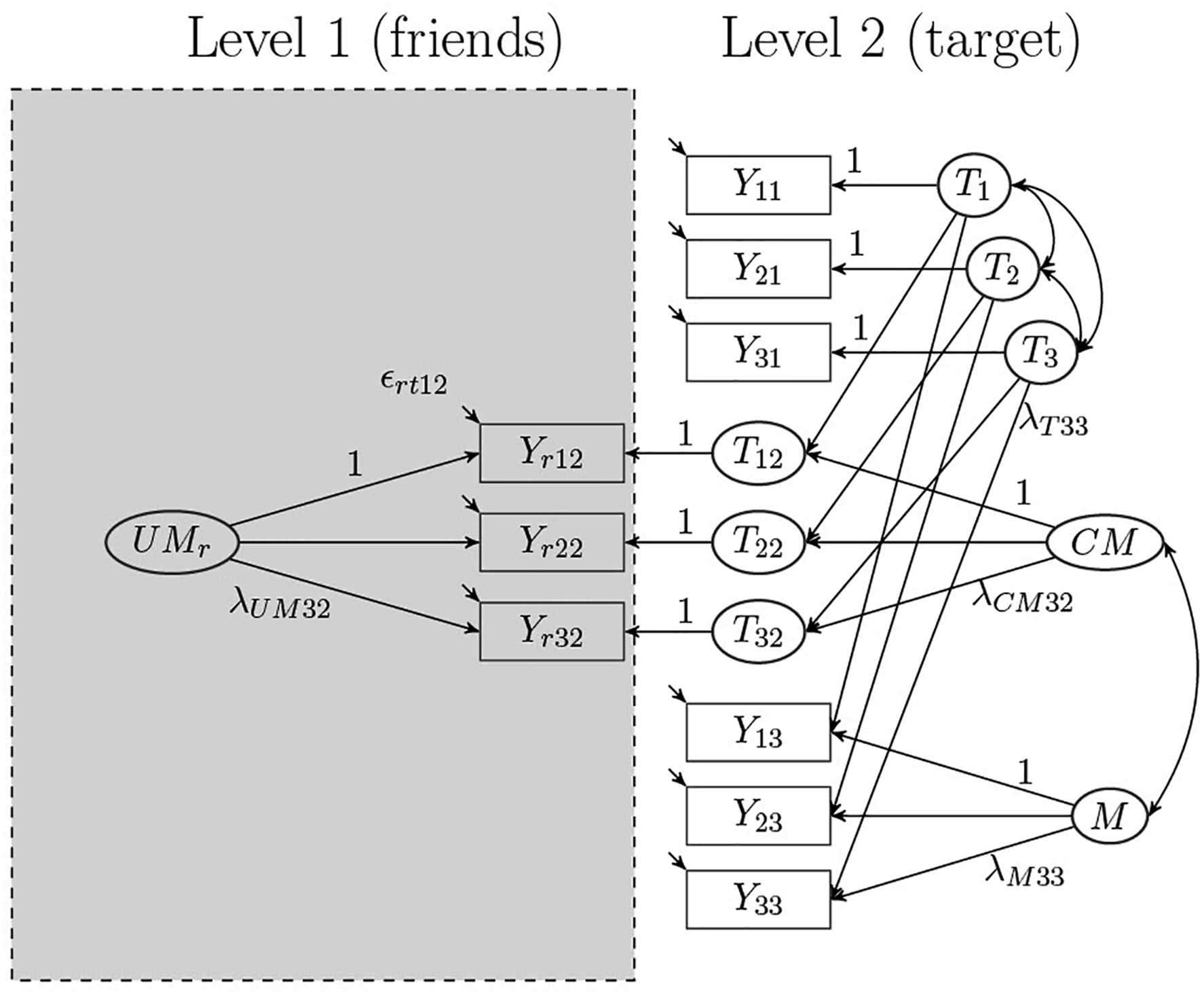
In Figure 1, the indicators Yi1 represent the three items (i = 1, 2, 3) measuring attachment to the parents. The true (measurement error-free) value of the attachment to the parent is represented in an indicator-specific trait factor T i . The three indicator-specific trait factors are correlated, with high correlations indicating item homogeneity. According to attachment theory, parents are the first attachment figures, and the attachment to the parents is the building ground for a working model of attachment. Therefore, the attachment to the parents is chosen as the reference factor for the attachments to other attachment figures in the model.
The indicators Yi3 represent the three items measuring the attachment to the partner. The trait factors are used to predict the values in these indicators (for a detailed description including the formulas, see Appendix A). Therefore, the factor M describes that part of the true variance in the attachment to the partner that cannot be predicted by attachment to parents. The factor M is a latent residual factor with a mean of 0. The factors T and M are uncorrelated. Targets with a positive (negative) value on M have a higher (lower) attachment to the partner than predicted based on their attachment to the parent. The indicators of the attachment to the partner are missing in the smaller version of the model used for the single group.
The indicators Yri2 represent the three items for the attachment to individual friends. Each target describes the attachment to several friends such that attachments to friends are nested within targets. This nesting implies a hierarchical data structure. On the within-person level (Level 1), the indicators represent the different attachment to different friends. On the between-person level (Level 2), the variable Ti2 represents the target-specific average latent attachment to the different friends. Like attachments to partner, averaged attachments to friends are predicted by the trait factors. The CM factor captures differences between the targets’ average attachments to their friends that cannot be predicted by their attachment to their parents. The UM factor captures the deviations of targets’ attachments to individual friends from the targets’ average attachments to their respective friends. These deviations represent aspects of attachment to individual friends that are not shared across friends.
In the larger version of the model (see Figure 1), the two residual factors on Level 2 (CM and M) are correlated. This correlation captures the association between the attachment to the partner and the average attachment to friends after controlling for the attachment to the parents. If this correlation is high, the attachments to friends and partners share something that is not present in the attachment to the parents. If this correlation is zero, all similarity between attachments to friends and partners can be explained by the attachment to the parents. Since the attachment to the parents is chosen as a reference, it also represents the general attachment style. If the general attachment style is the only reason for associations among the attachments to different attachment figures, the correlations between the residual factors should be zero.
Variance Decomposition and Coefficients
The research questions of this study can be answered by different coefficients that are based on variance decompositions. Due to the multilevel structure of friendship attachments, there are multiple coefficients for decomposing the variance of friendship attachments (see Eid et al., 2008; Koch et al., 2018). All coefficients denote proportions of the true (measurement error-free) variance, and they represent different aspects of consistency and specificity. As variance components, all coefficients have a range of values from 0 to 1. The formulas for defining the coefficients can be found in Table A1 in Appendix A.
The communality coefficient is defined as the proportion of true (measurement error-free) variance that is shared over the attachments to different friends. A high communality coefficient shows that attachments to different friends are very similar.
The unique figure specificity coefficient (UFS) describes the proportion of true variance that is unique to the specific friend attachments and that is neither shared with the attachments to other friends or the parents. The UFS is the counterpart to the communality coefficient (UFS = 1—Communality). A high UFS indicates that attachments are highly dependent on the individual friend and not shared across different friends.
The communality in the attachments to different friends can be further divided into a part which can be explained by the attachment to the parents and a part that cannot be explained by the attachment to the parents. The former is termed consistency coefficient (CON), and the latter is termed common figure specificity coefficient. The common figure specificity coefficient (CFS) describes the proportion of variance in the individual friend attachments that is shared across all friends but is not shared with the attachment to the parents. If the targets have similar attachments to their different friends that are not predictable by the attachment to their parents, the CFS is high. If the targets have similar attachments to their different friends only because of one general attachment style, this attachment style should also be visible in their attachment to their parents. In this case, the consistency would be high, while the CFS would be low. CON, CFS, and UFS add up to 1.
The Level 2-consistency coefficient (L2-CON) describes the proportion of variance that can be explained by the attachment to the parents in relation to all variance that is shared among the attachments to different friends. The L2-CON indicates how strong the (statistical) influence of attachment to parents is relative to the common attachment to friends. If the L2-CON is greater than 0.5, then more L2 variance is explained by attachment to parents than by shared attachment to friends.
For the attachment to the partner, only two coefficients can be defined. The first is the consistency coefficient, which describes the proportion of true variance that can be explained by the attachment to the parents. This coefficient has the same meaning as for the attachment to friends. The figure specificity coefficient (FS) describes the proportion of true variance that is specific to the attachment to the partners and that cannot be predicted by the attachment to the parent. CON and FS add up to 1. A high FS shows that the attachment to the partners cannot be predicted by the attachment to the parents. If emerging adults have a strong general attachment style that influences all their attachments, the FS should be low and the consistency should be high.
The consistency coefficient’s square root can be interpreted as the measurement error-free correlation of the attachment to the parent and the (common) attachment to the friends or partner, respectively.
Model Estimation
We used Bayesian Markov-Chain Monte-Carlo (MCMC) estimation in MPlus 8 (Muthén & Muthén, 1998-2017) to estimate the multilevel models with categorical indicators. We used 3 MCMC chains and a minimum of 400,000 iterations with a thinning of 20, resulting in a minimum of 10,000 post burn-in iterations used for the construction of posterior distributions. MCMC chains were assumed to have converged when the Potential Scale Reduction (PSR) factor fell below 1.01 for the first time after the minimum number of iterations was reached. The model fit was judged by posterior predictive p values (PPP value). A PPP value near 0.5 indicates a very good model fit.
Results
The PPP values for all six models ranged from .288 to .436, indicating good model fit. Visual inspection of trace plots showed good convergence.
Attachment to Friends
Latent variance coefficients for the items of attachment to friends.
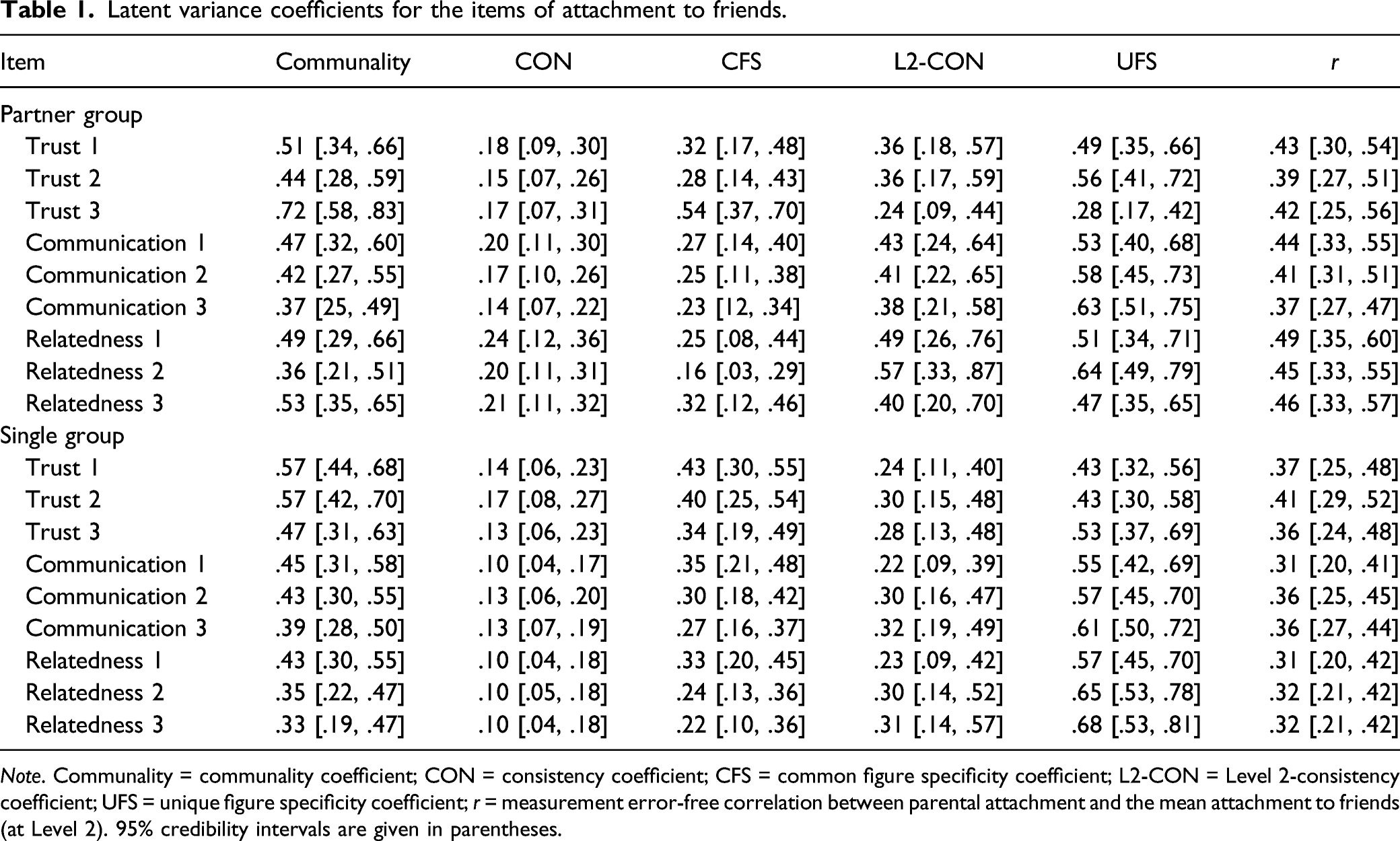
Note. Communality = communality coefficient; CON = consistency coefficient; CFS = common figure specificity coefficient; L2-CON = Level 2-consistency coefficient; UFS = unique figure specificity coefficient; r = measurement error-free correlation between parental attachment and the mean attachment to friends (at Level 2). 95% credibility intervals are given in parentheses.
Values of the consistency coefficient hint to a substantial but comparatively small association between the attachments to friends and the parent. The variance proportions of the attachment to friends in the partner group are shown in Figure 2, and those in the single group are shown in Figure 3. The consistency coefficient ranged from .14 to .24 in the partner group and from .10 to .17 in the single group. That is, between 10 and 24% of the true variance in the attachment to friends could be explained by the attachment to the parent. These values correspond to measurement error-free correlations between the attachment to the parent and the attachment to friends ranging from .31 to .49, indicating a substantial degree of consistency among the attachments to the different attachment figures (here: parents and friends). The translation of consistency coefficients into measurement error-free correlations are shown in the last column of Table 1. However, the consistency coefficient was smaller than the common figure specificity coefficient in nearly all cases and smaller than the unique figure specificity coefficient in all cases. Variance decomposition in the partner group. Variance decomposition in the single group.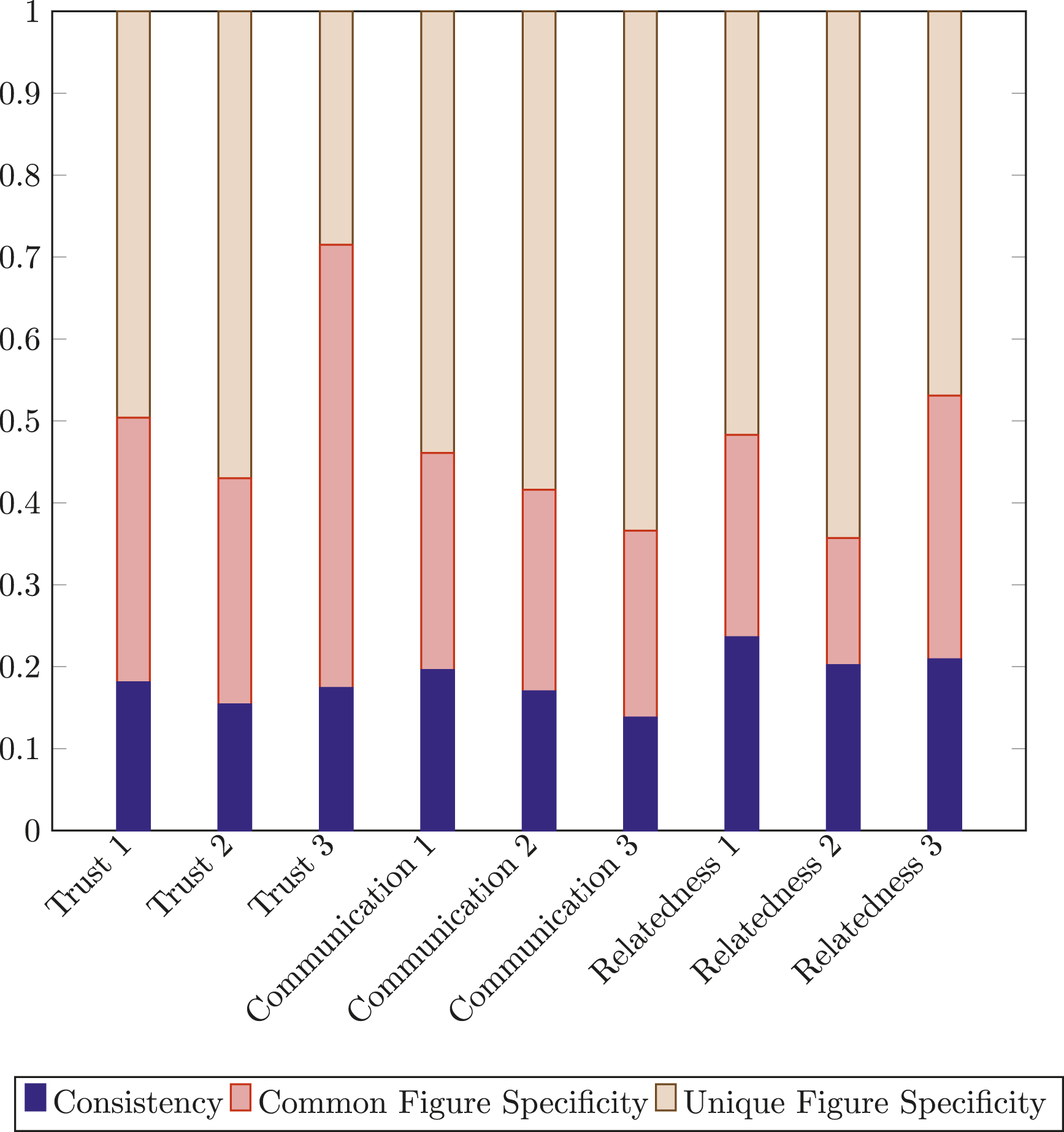
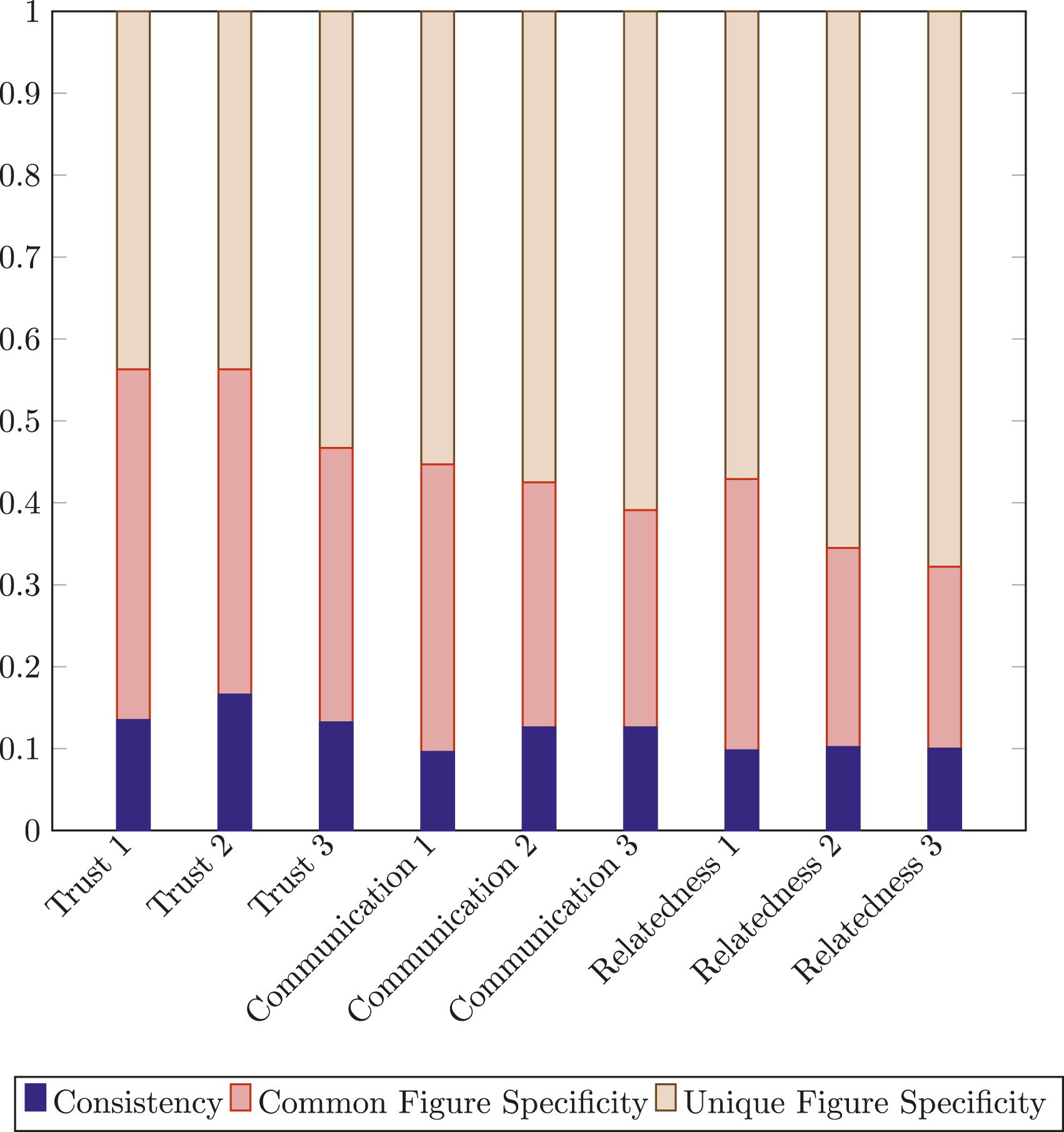
For relatedness, consistency coefficients were smaller in the single group than in the partner group. In the single group, the CON values were close to .1 (corresponding to correlations around .3); in the partner group, the CON values were close to .2 (corresponding to correlations around .45). The communality coefficients for relatedness were similar between both groups. Hence, the degree of communality among the attachments to different friends is comparable for singles and targets in a relationship. Nevertheless, for targets in a relationship, this common relatedness to friends had a higher correlation with the relatedness to the parent than for targets who are singles. In the case of trust and communication, slightly lower values of the consistency coefficient were found in the single group for almost all indicators.
The L2-CON indicated that the larger part of the Level 2-variance of the attachment to friends is specific to friendships and is not associated with the attachment to the parent. The L2-CON was below .5 in most cases, indicating that less than half of the Level 2 variance can be predicted by the attachment to the parent. For almost all indicators, L2-CON was substantially higher in the partner group than in the single group. This means that the common share of friendship attachment was more strongly related to attachment to parents among persons in a partnership than among singles.
Attachment to Partners
Latent variance coefficients for the attachment to partners.
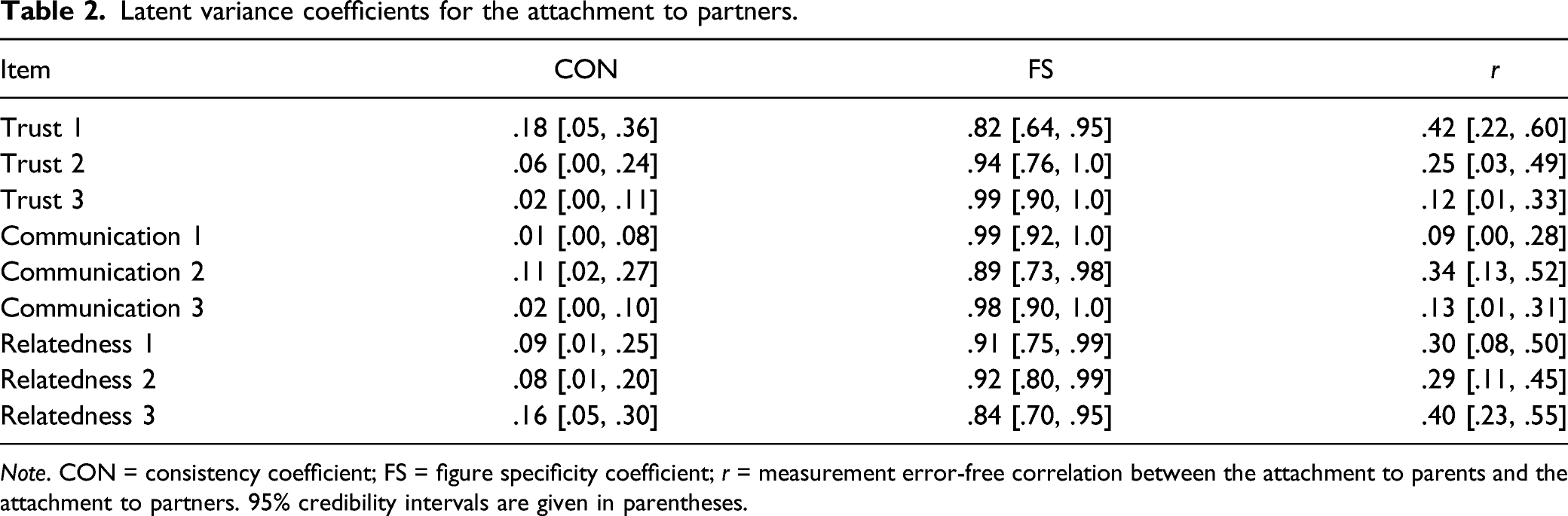
Note. CON = consistency coefficient; FS = figure specificity coefficient; r = measurement error-free correlation between the attachment to parents and the attachment to partners. 95% credibility intervals are given in parentheses.
In the partner group models, the common residual factor of the attachment to friends (CM) and the residual factor of the attachment to partners (M) were correlated. These correlations represent an association between the attachments to friends and partners after controlling for the attachment to parents. In the model of trust, this correlation was r = .13 (95%-KI: [−.12, .36]), in the model of communication this correlation was r = .28 (95%-KI: [−.01, .56]), and in the model of relatedness this correlation was r = .08 (95%-KI: [−.22, .34]). In no case, the association statistically deviated from 0. There were no shared aspects in the attachments to friends and partners beyond the parental attachment for all aspects of attachment security. All correlations between the attachments to friends and partners could be explained by the attachment to parents, which was also an indicator for the global attachment style.
Correlations between the indicator-specific trait factors.
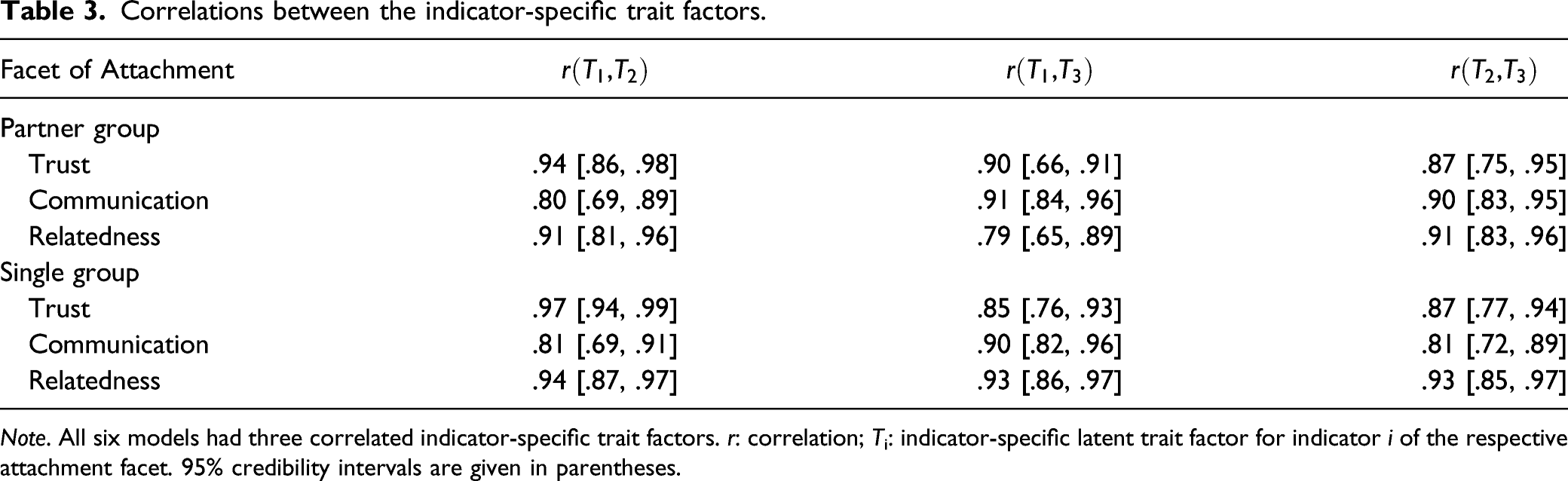
Note. All six models had three correlated indicator-specific trait factors. r: correlation; Ti: indicator-specific latent trait factor for indicator i of the respective attachment facet. 95% credibility intervals are given in parentheses.
Results for Later Measurement Occasions
To test if the results are replicable, we estimated the same models for the remaining two measurement occasions (the third and fourth measurement occasion of the study). Results are provided in the Appendices (Tables B1–B3 for the third and Tables C1–C3 for the fourth measurement occasion). The PPP values ranged from .283 to .431 for the third measurement occasion and from .216 to .477 for the fourth measurement occasion, indicating a good Model Fit for all models.
Coefficients for the attachment to friends were mostly similar to those of the second measurement occasion. The communality coefficients for relatedness were smaller on the third measurement occasion, with values ranging from .30 to .38 in the partner group and values between .18 and .30 in the single group. Additionally, consistency coefficients for the relatedness to friends were smaller at the third measurement occasion in the partner group, with values around .13. Moreover, the third indicator of trust had a communality coefficient of .45, which was a regular and no longer extreme value. The fourth measurement occasion repeated the results of the third with one remarkable exception: the consistency of the indicators of trust in the partner group had their highest values ranging from .19 to .26 at the fourth measurement occasion.
The results for the attachment to partners changed for the later measurement occasions. The consistency coefficients increased from the second to the third and then again at the fourth measurement occasion. On the fourth measurement occasion, consistency ranged from .34 to .50 for trust, from .16 to .32 for communication, and from .26 to .40 for relatedness. These values correspond to measurement error-free correlations around .5 and higher. The correlations between the trait-specific factors showed no systematic differences to the second measurement occasion.
The correlations between the common residual factor of attachment to friends and the residual factor of attachment to partners were higher on the third and fourth measurement occasion than on the second one. On the third measurement occasion, the correlation was r = .54 (95%-KI: [.31, .74]) in the model of trust, in the model of communication the correlation was r = .53 (95%-KI: [.25, .76]), and in the model of relatedness r = .38 (95%-KI: [.12, .61]). On the fourth measurement occasion the correlation was r = .39 (95%-KI: [.11, .65]) in the model of trust, in the model of communication, the correlation was r = .59 (95%-KI: [.32, .82]), and in the model of relatedness r = .23 (95%-KI: [−.07, .51]). These correlations were substantially greater than zero in most cases.
In summary, attachments to friends did not change in a substantive degree for the later measurement occasions. However, the values for attachments to romantic partners varied for the different measurement occasions. The consistency of the attachment at later measurement occasions was substantially higher.
Discussion
In this study, we examined the degree of consistency and specificity of attachments to different attachment figures. The study results show the influence of a general working model of attachment, but they also clearly show that to large degrees, attachment is specific to a particular domain of attachment figures or even to the individual attachment figure.
Consistency of Attachment
The consistency between the attachment to parents and the other attachments shows the strengths of a general working model of attachment. We used structural equation models, and therefore the consistency can be transformed to measurement error-free correlations. The correlations between the attachments to parents and the attachments to friends have values around .3 and .4 for the attachments to friends. Such values indicate large or even very large effect sizes (Funder & Ozer, 2019). These correlations are larger than those reported by Fraley et al. (2011). The correlations between the attachments to parents and the attachments to partners had values around .1 in some cases, which are small effect sizes, but the correlations reached values above .5 at later measurement occasion, which are very large effect sizes (Funder & Ozer, 2019). These correlations show that the targets described similar levels of trust, communication, and relatedness to their parents and to other attachment figures. The high consistency between the different attachments indicates the strong contribution of a general working model of attachment.
The consistency is smaller than the specificity in all cases. However, one should not merely conclude that the relationship between attachments to different individuals should be neglected. To better illustrate the effect sizes of consistency, we can use Rosenthal and Rubin’s procedure (Rosenthal & Rubin, 1982). With a correlation of .4, as in several cases in our study (and assuming a normal distribution of values), the probability that a person with above average secure attachment to the parent also has above average secure attachment to the other attachment figure is 70%. At the same time, this means that the probability of a below-average secure attachment to another attachment figure would be just 30%.
Specificity of Attachment
Two results are particularly relevant to foster the idea of attachment figure-specific working models of attachment. The first relevant result is that the common figure specificity coefficients show the large amount of shared variance among the attachments to different friends. The common figure specificity coefficients were higher than the consistency coefficients in nearly all cases, showing that the communality among the attachments to different friends is mainly due to the common attachment to friends that is unrelated to the attachment to the parents. The same information is also visible in the Level 2-consistency coefficient, which was below .5 in most cases. Emerging adults report similar attachments to different friends. These commonalities are not solely the result of a general attachment style but are mainly based on a similar design of different friendship attachments. A domain-specific working model of attachment could explain this similarity as it would lead to similar attachment quality in the attachments to similar attachment figures.
Overall, this study joins the ranks of studies that emphasize the specificity of different attachments (Caron et al., 2012; Cozzarelli et al., 2000; Doyle et al., 2009; Furman et al., 2002; Furman et al., 2013; Imamoğlu & Imamoğlu, 2006; La Guardia et al., 2000; Markiewicz et al., 2006; Ross & Spinner, 2001; Umemura et al., 2015). This study can contribute to the knowledge beyond the mentioned studies through the attention to several attachments to friends in one person. In this way, it was possible to show that attachments to different attachment figures of the same domain are more strongly related than different attachments within a person in general. The emerging adults in our study developed similar attachments to their friends, and this similarity cannot be described simply in terms of a general attachment style.
The second relevant result for the attachment figure specificity of attachment lies in the correlations between the residual factors. At the second measurement occasion, these correlations were not significantly different from zero. This result was not in line with earlier studies that found a correlation between the attachments to friends and partners beyond the attachment to parents (Furman et al., 2002; Klohnen et al., 2005). However, for the two later measurement occasions, the correlations were remarkably larger. This result showed that the attachments to friends and the attachment to a partner are related, and this relationship cannot be explained by a general attachment style alone. Unlike the first argument for attachment specificity, this argument is limited in its impact by the very different results at different measurement occasions.
Most of the variance in this study remained specific to the individual attachment. Because we used structural equation models, these large proportions of variance cannot be explained by measurement error influences but rather describe this attachment’s peculiarities. Ainsworth (1989, see also Ainsworth et al., 1978/2015) and Bowlby (1969) described that an attachment is always referring to a specific person, and this aspect is evident in our data. Attachment figures are unique, and thus attachments to different figures within a person are also different (Mikulincer & Shaver, 2016). This large degree of specificity indicates that while there are clear commonalities between attachments to different figures, the influence of general and domain-specific working models should not be overestimated.
Romantic Attachment
At the second measurement occasion, the attachment to partners had only a low correlation with the attachment to parents and the attachment to friends. For many items (especially those regarding communication), credibility intervals of the consistency coefficient covered 0. We can only speculate why the attachment to partners deviated from the other attachments at this measurement occasion. Our study captured the first year after high school graduation with many changes and new experiences. In many cases, emerging adulthood is the time of the first significant and long-lasting romantic partnership. Romantic partnerships have a much shorter history than relationships with parents and friends; this might lead to a lower consistency with other attachments. Because consistency is higher at the later measurement occasions, attachments to the partner may become more like a person’s other attachments over time. This effect could be amplified if relationships whose attachment is less in line with other attachments are less stable and dissolve more quickly.
Emerging adults without a partner had lower consistency coefficients than those with a partner. The relatedness with friends was less associated with the relatedness with parents. Interestingly, this did not lead to considerable differences in the communality coefficients. That is, singles also experience a similar degree of communality among the attachments to different friends as non-singles, but for singles the attachments to friends were less associated with the attachments to parents. Singles do not have a partner, a particular form of an attachment figure; this might lead to a more substantial differentiation among the attachments to other attachment figures. This is possibly because singles tend to see friends as a safe haven separate from their parents, whereas in partnerships this role may fall on the romantic partner.
Theoretical Implications
In summary, our study supports Fraley et al.’s (2011) idea of specific working models of attachment. Our findings contradict (to some degree) the reduction of working models of attachment to one general working model of attachment (as postulated by Bowlby, 1988; Levy et al., 2011; Meyer & Pilkonis, 2001). We could show that the association between the attachments is indeed useful for predicting attachment to other figures, but most of the variance in attachment is specific to a certain domain of attachment figures or to the single attachments.
Through our study and the use of new models, we were able to add new insights to the theory of specific working models. The different attachments to figures of the same domain correlate more strongly than the attachments as a whole. Thus, the specific working models for these attachment figures show a greater overlap. We assume that the specific working models are influenced by the domain of the relationship (e.g., friendship, partnership). These domain-specific working models contain subjective expectations and beliefs that the person has regarding topics such as friendship or love. These overarching beliefs in turn provide greater consistency of attachments within a domain. This consistency of attachments within a domain is an interesting topic for future research and theories.
The results of our study can be very well reconciled with the idea of hierarchically arranged working models of attachment (see also Overall et al., 2003). Here, we find a general working model of attachment, below that a domain-specific working model and below that a working model for specific attachment. By examining attachments to multiple friends per person, we were able to show the middle level in the hierarchy. Attachments to different friends are more highly correlated than attachments to different figures overall. This fosters the idea of domain-specific working models of attachment.
Our results show that attachment experiences are generalized to the attachments to other attachment figures to different degrees. Given the scope of our study, we can only speculate on the mechanisms. Some attachment experiences (probably especially those with the primary caregivers in early life) are stronger templates for later attachments. Some elements of these attachments are partially adopted in the working models that influence all later attachments. In addition, there seem to be elements of working models of attachment that are generalized within a domain of relationships. Attachment experiences in friendships are partially generalized to new friendships, but not in the same way to attachments of a different domain like romantic attachments. Our results show that emerging adults differentiate in their attachments between friends and parents (this differentiation is stronger among singles). We can therefore assume that parents and friends are used as attachment figures in different ways.
The different results on romantic attachments across the three measurement occasions could also be due to the fact that romantic partners in long, stable relationships emerge as a new category of attachment figure for many individuals only in emerging adulthood. Here, corresponding more specific working models have yet to form. In this study, consistency between romantic attachment and the longer-standing attachment categories (parents, friends) increased across measurement occasions. If this is confirmed in other studies, it would indicate that the emerging romantic partner category is increasingly experienced as an attachment figure alongside others over time.
Limitations
Due to the dropout and switches between groups, this study does not examine the stability of outcomes over time. Many of our results could be replicated across different measurement occasions. However, the partner communication results showed varying degrees of consistency across time. Unfortunately, we do not have a clear-cut answer for these results.
Our sample was rather homogenous with respect to age (almost all targets were 18 or 19 years old). In addition, all targets had just passed the Abitur in Germany, a qualification that only about half of a cohort achieves. Therefore, this study ignores large parts of the ‘forgotten half’ (Arnett, 2000). Although our study, unlike many others, is not limited to students, the results should not be readily generalized to other age groups or social or cultural contexts.
The data in our study have been collected in 2014, several years before writing this paper. Even if we assume that attachment is not subject to rapid historical changes, it cannot be ruled out that emerging adults experience their attachment differently today or that the relationships between the different attachments have changed, for example because of the COVID-19 pandemic.
Our results are based on studies using the short-form IPPA. While this shows high correlations with other measures of attachment security and comparable associations with external variables (Bohn et al., 2020), it is not a representation of the commonly used scales of attachment anxiety and avoidance. Therefore, additional analyses are needed concerning these attachment facets.
Conclusion
Our study examined the consistency and specificity of attachment. Although there was a certain degree of consistency across attachment figures, the results showed that different relationships differed strongly in the experienced attachment. The results are in line with the idea that the attachment to different attachment figures might ground in a general working model of attachment that builds the cornerstone for the evolution of specific working models over time and relationships.
Footnotes
Declaration of Conflicting Interests
The author(s) declared no potential conflicts of interest with respect to the research, authorship, and/or publication of this article.
Funding
The author(s) disclosed receipt of the following financial support for the research, authorship, and/or publication of this article: This work was supported by the Deutsche Forschungsgemeinschaft under Grant EI379/6–2 to Prof. Michael Eid.
