




Abstract
This article focuses on young people between 18 and around 30 in Germany returning to school after dropping out or finishing their education at a lower level than they are now striving for. The facilities they attend provide what is called a “second-chance education”; the possibility of upgrading their school-leaving certificate at a later stage. However, the curricula and school regulations of the secondary schools apply in these institutions. Therefore, despite their age, students must meet the expectations placed on secondary school students. Six focus group discussions show how students cope with what they consider a contradiction: institutional requirements and their own perception of age. The students' interpretations and strategies are analyzed in light of Erving Goffman’s concepts of role conflict and role distance. The findings indicate that such education programs need to be better adapted to emerging adults and offer clues as to how they might do so.
Keywords
Introduction
This article focuses on young people between 18 and around 30 in Germany returning to school after dropping out or finishing their education at a lower level than they are now striving for. The minimum age requirement for the type of educational institution they attend is 18 years while the upper limit for the entitlement to state funding when they recommence their schooling is 30 years. This age phase is characterized as “emerging adulthood”. This concept and the assumptions that underpin it, aptly capture the life situation of this group. They have returned to school in order to expand their opportunities for a more self-oriented career choice or social advancement. Returning to school means a return or partial return from a more adult life to a more adolescent life. The features of emerging adulthood, such as the state of being in between adolescence and adulthood, the exploration of identity and the staking out of a horizon of possibilities (Arnett, 2000; 2006, p. 7) apply to this group to a high degree.
The young people in our study face an additional problem that goes beyond the usual uncertainties of this age transition. It is that the classroom organization, the school rules, and the curriculum of their educational institution are not tailored to this age group. All of these, and hence the expectations of student behavior, are the same as those found in a secondary school. This is founded on a decree by the Ministry of Education stating that these schools should be subject to the same regulations as ordinary secondary schools. Consequently, students are learning in classrooms and under the supervision and guidance of teachers. When they learn and study by themselves, it is not the type of self-oriented knowledge acquisition expected of students in tertiary education; rather, the teachers ask them to do homework assignments. The students also have regular written tests, and they are constantly graded on their oral and written contributions as well as their attendance in class. The study asks how emerging adults cope with these institutional expectations that are normally directed at adolescents and how they reconcile them with their own perception of what is age-appropriate for them.
We take a sociological approach to examining how students deal with the expectations placed on them using Erving Goffman’s (1959, 1961) concepts of role conflict and role distance. Goffman sees age as a dimension of social status and, depending on which section of this dimension a person is currently classified as by others, different expectations are directed at them, that is, a different role must be assumed. It is by no means easy to meet these expectations, because getting older requires adaptation to new norms, but at the same time expectations from the earlier phase may still have to be met—therefore role conflicts may result and solutions will need to be found. Taking Goffman’s concepts as a basis, we look at how students deal in their everyday interactions with the problems that may arise from inconsistent institutional expectations. We conducted six focus group discussions that allowed us to identify the solutions that students choose in order to deal with potential conflicts.
Excursus on the German Educational System and “Second-Chance Education”
The school-leaving qualification that entitles the holder to study at university and which is also required for many qualified vocational training programs is the “Abitur” or “Fachhochschulreife.” About 50% of young Germans obtain such a qualification. 1 The young people in our study are pursuing it in a “second-chance” school and it may take between two and 4 years for them to do so, depending on their previous educational history. Some of them had previously participated in educational programs that would in principle have enabled them to pass the university entrance qualification but they failed before achieving it. Others had attended a branch of school in the highly socially selective German school system with its early tracking (Woessmann, 2009; Schleicher, 2019, pp. 19) that did not lead to the university entrance qualification at all. Although this is the function that second-chance education has in the German education system, institutions of second-chance education can be found in many countries, where they assume roles that correspond to the respective national education system (e.g., European Commission, 2001; for the US: Elman & Weiss, 2014).
Second-chance students in Germany have almost always left school some time ago as it is not possible to move to these institutions directly from regular school under the admission regulations currently in force. About half of the students were integrated into the labor market in a fairly stable way before starting to attend the second-chance school (i.e., mainly working during the previous 12 months or longer) and are now giving up all or part of their employment to obtain a higher quality secondary school leaving certificate. The remaining students, when asked about their main occupation during the 12 months before entering the second-chance institution, mentioned child rearing, illness, civilian service, bridging solutions at school, unemployment, mini-jobs, or similar things. This is reflected by a recent study of these institutions throughout Germany (Bellenberg et al., 2019). For this group of students, school attendance promises a way out of a rather precarious situation: in the short term through integration into a school program, attendance of which is supported by educational allowances (a financial support which is intended to make it possible to cover one’s living expenses independently of one’s parents), and in the long term through better qualification for the labor market.
According to a quantitative survey that we conducted in institutions of second-chance in North Rhine-Westphalia, one of the federal states of Germany, the students (N = 450) were on average 24 years of age. 49% of them had a migration background, that is, they or one or both parents were born abroad (Schuchart & Bühler-Niederberger, 2020). This is an overrepresentation; people with a migrant background constitute 34% of the German population aged 20 to 25 (Statistisches Bundesamt, 2019). On the one hand, this is due to the fact that first generation migrants partly immigrated only during or even towards the end of their school career on the other hand, to the aforementioned social selectivity of Germany’s education system.
Second-chance schools are welfare state institutions that meet the standards that social policy should establish for institutions supporting youth transitions (Walther, 2006). They enable access to high-quality graduation qualifications, not merely low-level labor market integration, and they grant educational allowances. With their orientation towards the ideals of educational equity, they thus assume an important socio-political function. They are quite successful in this, as about half of the students complete the program and thus obtain their university entrance qualification (Bellenberg et al., 2019). A longitudinal study shows that the career opportunities of such successful graduates do not differ from those who obtained their university entrance qualification on the first educational pathway (Schuchart & Schimke, 2019).
Theoretical Framework
Second-Chance Education—as Approached through Goffman’s Lens
In this paper, we will look at second-chance educational institutions from the perspective of emerging adults who are re-entering school. In contrast, previous research on these institutions has focused primarily on other issues. Many young people who attend such institutions tend to have unfavorable prerequisites for integration into the labor market (Looker & Thiessen, 2008; Marcotte, 2012; Ross & Gray, 2015; Schuchart & Bühler-Niederberger, 2020). Consequently, there is an educational policy interest in these institutions in many countries and most available studies on adult learners have focused on educational questions such as how the programs are organized, who can be motivated to attend them, who is successful and what the labor market return is (e.g., Blossfeld et al., 2014; Schuchart & Schimke, 2019). There has hardly been any research into how adult learners deal with having to return to being pupils and how this may affect the long transition between youth and adulthood. To the extent that such studies exist, they focus primarily on adult college students and how they reconcile their various commitments as adults and as students. Fairchild (2003) shows how adult college students juggle their multiple obligations by reducing their involvement in campus activities. In a review of recent studies, Osam et al. (2017) find that adult learners have to deal with barriers arising from their own situations, such as financial difficulties, family responsibilities, as well as institutional barriers, such as unfavorable time constraints or lack of access to faculty members. Again, these are college students, while studies of adult learners in secondary schools are rare, although the number of adults attending secondary school programs is growing (Elman & Weiss, 2014). An already older study (Cocklin, 1991) describes some adult learner practices in secondary schools and also finds what she calls individualized compromises that allow students to manage the commitments to school and their adult lives—to the displeasure of teachers.
However, our interest in the possible contradictions between being a young adult and being a student in a secondary school is not limited to the ways that individuals manage their daily commitments. We assume being categorized in two different age groups—which is what happens to adult secondary school students—is by no means just a problem of everyday coordination, time, and financial resources. Rather, it may lead to serious conflicts regarding a variety of behavioral expectations that must be met. These are expectations on the part of the people with whom they interact, but also of the individuals towards themselves, in terms of the degree of independence, personal responsibility, reliability, etc., which must be met, and which differ for the different age groups.
We refer to Goffman (1959, 1961) as a key theory when conceptualizing how people experience and deal with conflicting expectations. Goffman is the foremost sociologist to have studied what society inflicts on the individual and how the individual makes up for these societal pitfalls, for example, how the individual adheres to norms where these norms demand contradictory things of them. Goffman took age transitions to be triggers for conflicting expectations. We can speak of “transitional status systems”—this is a term coined by Coser (1966, p. 172) and based on Goffman’s work—when an individual moves up on the social ladder or grows up in age. In these status transition situations, the actor may disregard the conflicting requirements tied to the one status to prepare for the other. Although this could result in deviancy, Goffman showed how people cope with such impositions through skillful role performance and so avoid open deviation. He referred to the management of such tricky situations with the concept of “role distance.” Goffman (1961) gave the example of an actor who is growing up—a child on a merry-go-round (p. 97)—who at seven or eight years of age begins to perform caprioles when sitting on a wooden horse to signal their distance from this role of rider of a wooden horse. Through these actions, the children apologize for the role that they consider inappropriate to their status as big girls and boys—but that they perform nevertheless. As Goffman argues there are many ways of performing such role-distancing.
For our topic, then, we have to ask whether and to what extent emerging adults in institutions of second-chance education experience the role of a secondary school student as being conflictive and how they deal with that conflict and avoid deviance. Having outlined the basic theoretical framework, we will now attempt to elucidate the notions of role conflict and role distance by looking at research on emerging adulthood.
Role Conflicts and Coping Strategies of Emerging Adults
Although Goffman introduced the concept of role distance using the example of age transitions, such transitions were not the focus of his own research. Rather, he was quite generally concerned with how difficult interactions can be managed and how, in them, the individual can present a respectable self vis-à-vis their interaction partners and themselves (Goffmann, 1959). The interactions that he examines are difficult, for example, because the individual has to cope with inconsistent status constellations or with a discrediting status, a stigma (Goffman, 1963).
Research on emerging adulthood has drawn on his concepts with this thematic focus. These studies asked how one can present a self as a respectable adult, for example, where one has shown deviant behavior as an adolescent or even still does so (Massoglia & Uggen, 2010), where one is from a lower class or poor background and moves up socially, namely attending a college (Radmacher & Azmitia, 2013), or finally how individuals with a sexual minority status manage the transition into adulthood (Liu et al., 2019). Or they asked how inconsistent constellations-that is, coping with transition on individual dimensions (e.g., parenting), but not on others (e.g., occupation)—impact on self-perception as an adult (Eliason et al., 2015). The findings of these studies, which refer to Goffman, suggest that the perception and presentation of themselves as adults is important for emerging adults and that it does not take place smoothly under difficult circumstances, requiring specific strategies as a result. However, it is possible to obtain further insights into role conflict and coping strategies when research on emerging adulthood is more broadly reviewed and thus beyond the studies that directly refer to Goffman. This will be done here along three assumptions, on which this study is based. Although the first assumption concerns the experience of an age role conflict, the other two refer mainly to how students cope with it.
Three Study Assumptions
First assumption: emerging adults returning to school experience the role of a secondary school student as a (problematic) contradiction to their self-perception as adults
The concept of emerging adulthood does not assume a rapid transition from A to B—from one social age status to the next—but rather one that takes years. The protracted nature of coming of age, as experienced since the 1960s and 1970s, is the relevant starting point when applying this concept (Arnett, 2006). However, the straightening out of transition does not create a space beyond and free of age norms. On the contrary, research into this age phase indicates that social expectations linked to age still have some validity. There are expectations of some kind of “on-time” transition, and meeting these expectations plays a part in the well-being of young people as several studies show (Eliason et al., 2015; Pekel-Uludağlı & Akbaş, 2019; Settersten & Mayer, 1997; Sharon, 2016). In any case, later and more individualized entry into adulthood is not simply a voluntary decision but is also due to social conditions and expectations. In particular the need to achieve a higher level of education has had an impact, but economic conditions must also be taken into account (Heinz, 2009). For a longer period of time in the life course, this creates the very situation at the macro-social level that Goffman was interested in: the coexistence of contradictory norms, which it is largely left up to the individual to reconcile.
One well researched strategy to cope with the situation is to define so-called “markers”: Emerging adults assess their social age and their satisfaction in line with markers that they can adapt to their situation and possibilities. What this means is that they want to meet demands such as “taking responsibility for themselves,” “independence,” “equal social relationships with parents” (Sharon, 2016), and also “taking care of others” (Katsiaficas, 2017). These markers are their “personal conceptualizations of adulthood” (Sharon, 2016, p. 161). If they comply with them, this influences their “subjective sense of adulthood” (Katsiaficas, 2017, p. 395) and their well-being. In contrast, they consider other transitions that are still out of reach, such as integration into the labor market and economic independence as being less important to what they consider to be adulthood.
What do these findings suggest about whether emerging adults experience role conflict and whether this is specifically true for our group of students in second-chance education? Although emerging adults cannot be considered a problem group in general (Arnett, 2007; Konstam, 2015), it seems to be important not to be overly out of time and not to have problematic status constellations. The young people in our study are by definition out of step with their peers, as they are attending secondary school and not tertiary education. In addition, there are other problems. A rather large proportion of young people in the second-chance institutions that we examined have educational biographies in which they failed, in some cases several times, or were unemployed for a longer period of time or otherwise in a precarious situation (cf. introduction); they therefore have problematic status constellations. Finally, they are missing an important means of conflict resolution: while emerging adults base a satisfactory assessment of their adulthood on the importance they give to adaptive markers of adulthood, that is, to markers which they are able to attain, being able to skillfully handle the problems of this age phase is undermined in the situation on which our study focuses. By placing the young people under the regime of a secondary school, the institution downgrades them in terms of possible personal responsibility, experienced equal relationships with adults and independence.
Second assumption: emerging adults attribute different characteristics to individuals of different social age groups
Role conflicts concerning age are experienced and handled against the background of social definitions of age groups. These social definitions are constantly being worked on; the realities as well as the ideals of age categories are reshaped and redefined (Van de Velde, 2015). Several studies provide insight into the attributions to adults by young people and also into the mutual perceptions of young people and adults (Pitti, 2017; Plug et al., 2003; Tagliabue et al., 2016). In the study by Pitti (2017), young people aged 18 to 24 and adults—considered by the younger group to be significant adults—were asked about the characteristics that distinguish the other group. The “evaluative function” (p. 1236) of the attributions became very clear: To be “mature” was declared as the norm—this also emerged in the other two studies—although in Pitti’s study young people and adults accused each other of not living up to it.
If we refer to the studies on subjective markers, that were already mentioned in the literature discussed for assumption 1, it is evident once again that the attributions to age groups are value judgments: Taking responsibility for oneself or for others is a more valuable social behavior than not doing so. In this respect, it can be experienced as a devaluation to be classified at a lower point on the age scale that one actually is.
Third assumption: perceiving and dealing with age role conflicts is a peer process
Age transition processes ask for some synchronization with those of one’s peers. Being early or late in the timing of such processes—“out of sync” as Arnett (2017, p. 312) calls it—may reduce peer support. Rook et al. (1989) analyzed peer relations in a survey study. In their study, it was primarily staying behind schedule that increased psycho-social stress. Contrary to expectations, however, these individuals who were behind schedule received more support from their peers. Thus, peers can be a resource for coping. Studies on identity construction show that peer support is important for emerging adults in this process (Morgan & Korobov, 2012; Schachter, 2002). Young et al. (2015) even go so far as to describe the emerging adulthood as a “peer project,” referring to the emotional support, helpful advice and simply interest with which friends support each other in the transition.
In our study, the emerging adults’ peers come to the fore as a group of classmates, rather than as dyads and triads of friends as in the studies just mentioned. This is because our study does not examine the handling of expectations regarding age at the level of psychological processing, but at the level of the interpretation of age and the handling of role conflict in everyday interactions, that is, in their interactions as pupils, according to our sociological approach. Such peer group processes have been examined in other age transitions, for example, at the transition from childhood to adolescence. Here, Kelle (2001) and König (2008) found a mutual monitoring of the schedule among peers: One should not be too fast and not too slow, for example, as far as sartorial choices are concerned. Although different age markers apply to emerging adults (cf. assumption 2), the school situation of our group of students creates a similar peer context to that of adolescents, which is likely to unfold its normative effect. Therefore, peers may not only provide support but may also be the standard and an (evaluative) audience for coping with the transition.
Method—Qualitative Study Design and Study Participants
Six focus group discussions were held, with a total of 32 students participating. Below, we describe step-by-step the different decisions that were made in the empirical process. This provides a systematic overview; however, it might suggest that these decisions were made in this strict sequence, whereas in fact the process of qualitative research is a matter of constant forwards-backwards thinking, at least as far as steps “b” to “d” are concerned. The description of the steps follows the systematics of Schwab and Syed (2015), which they declare to be a step-by-step guide for the decisions in qualitative research.
Epistemological approach: how individuals interpret and enact their belonging to their age group On the epistemological level, this is not a study into how belonging to this age group as a given and objective condition has an impact on the young people. It is a study into how individuals interpret and enact their belonging to this age group in their daily interactions, and therefore about the social construction of this age category in the everyday world.
Methodological decisions: exploratory question, descriptive assumptions and the search for exceptions The research process can be characterized as a search for a suitable theoretical model that emerges from the interaction of theoretical assumptions and data. Accordingly, the project did not commence with pre-formulated hypotheses and concepts, and the three assumptions as presented in the theoretical section were in fact only defined during the research process. Instead, the study was guided by an “exploratory question” (Schwab & Syed, 2015, p. 391). This openly formulated question asked what the return to secondary school means for emerging adults, whether they experience it as appropriate to their stage of life or as a problem, and how they interpret and handle it. After the first two group discussions, the sensitizing question was fleshed out in greater detail by the three assumptions; this enabled the continuous development of four concepts as they give precision to the assumptions for the group we studied (cf. d). It also allowed a targeted search for exceptions. In this sense, the research-logical procedure was initially oriented largely towards “grounded theory” (Strauss & Corbin, 1990). In a more advanced phase, the “analytical induction method” (Bühler-Niederberger, 1985; Hammersley, 2010) was also used, in the sense of a systematic search for, and consideration of, exceptions. The latter then led above all to the discovery of a second pattern of role conflict resolution.
Data collection: Bringing emerging adults’ interpretations to the fore Sample
2
: The study is the qualitative part of a mixed-methods project on second-chance institutions, students’ characteristics and the success of the programs. For the complete project, we chose six different institutions in North Rhine-Westphalia. Six focus group discussions were conducted, one in each institution. We contacted students whom we had previously interviewed individually in order to organize group discussions. They then composed the groups by snowballing. So, the selection of participants for the focus group discussion was based in a first step on a purposive sampling strategy (the selection of one group for every institution). In the second step (the snowballing) this is rather a convenience sampling strategy; however, there are good reasons for this strategy, as it enhanced the students’ motivations for participating in the focus group discussions. Table 1 provides an overview of the groups and their participants. The participants are characterized by age, migration background (cf. introduction), school success (students who belong to the top third in terms of their grades), and vocational training (students who completed two or 3 years of training with a diploma before returning to school). They differ from the total group of 450 students at these institutions in only one characteristic: students with an immigrant background are underrepresented, at just under one-third instead of one-half. The snowballing has probably led to the fact that the friendships and maybe processes of exclusion among students were reflected. “Theoretical saturation” is mentioned as “a widely used criterion for sample size” in qualitative research by Schwab and Syed (2015, p. 394). This is the researchers’ decision: such saturation is reached when they conclude that the theoretical model they have developed in the analysis cannot be elaborated meaningfully by further data collection (Corbin & Strauss, 1990). We arrived at this assessment after the six focus group discussions, since many statements were repeated almost verbatim in the various groups. Focus group discussions: Participants signed a declaration of consent for their statements to be recorded, transcribed and used confidentially; they were rewarded for their participation with 10 euros. The group discussions took place during summer 2019 in the school buildings. This solution guaranteed the best participation. Discussion time was between 52 and 70 minutes for four groups, while two groups discussed for longer periods of time (80 minutes and 100 minutes). Most often, two interviewers—the authors themselves in four groups and trained and experienced research assistants in the other two—were present in order to pay attention to all of the participants and to bring them into the discussion. Group discussions started with an initial prompt: a couple of pictures showing learning situations—ranging from classroom situations for different age groups (from primary school to high school) and from seminary sessions to a lecture hall. We asked them which of the images reminded them the most of their current situation. Beyond this initial prompt, the students were not directly addressed in respect of their age; this stimulus—and obviously their own experiences—was sufficient to make age a recurring theme. A guideline (cf. Supplemental Appendix) provided interviewers with a series of questions to sustain the discussion on experiences of being a pupil in this institution. The interviewers were required to adapt the sequence and formulation of questions to the course of the discussion. Group discussions are not suitable for assessing the perspectives of individual participants (Barbour, 2018, p. 19), but instead the shared meanings (Bohnsack, 2010). Therefore, we aimed to keep the conversation going between the participants as much as possible.
Focus groups and participants.
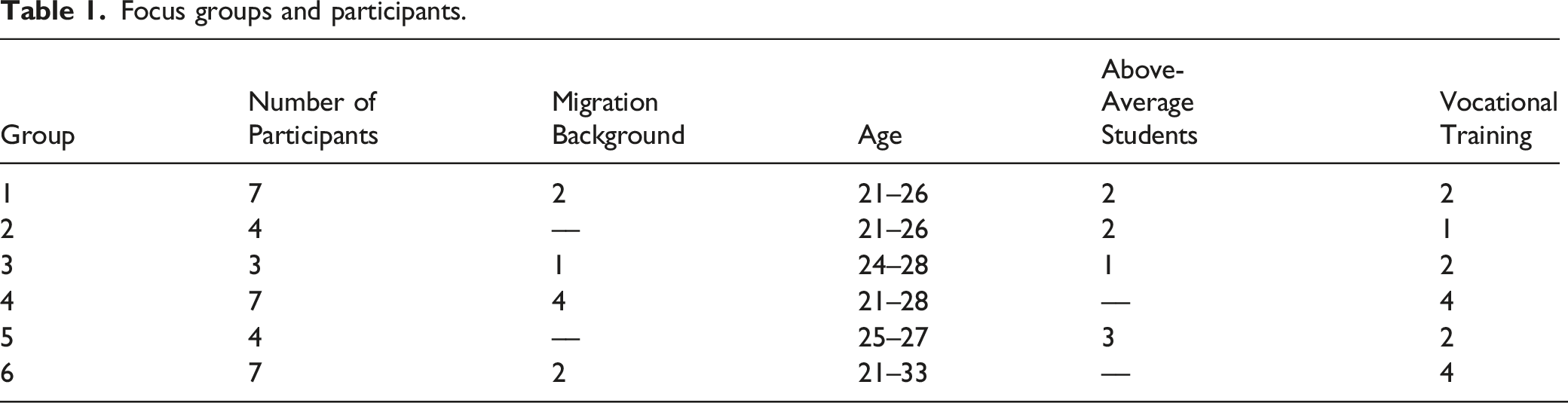
Data analysis: The researcher as discoverer and social analyst The discussions were audio-recorded and transcribed. Data analysis focused on the abundant statements that were made in the group discussions concerning age, the extent to which the school and their life situation took it into account and how they dealt with it. The three assumptions presented above were elaborated and made more precise with concepts developed in a process of constant (preliminary) analysis and memo-writing and hence in the inductive-deductive way that characterizes qualitative work (Corbin & Strauss, 1990). This process is called “coding.” It happens first in a very open and intuitive way (“open coding”) and, at a more advanced stage of the project, focuses on the connections in which the concepts are to be located and in which their content can be described and delimited in more detail (“axial coding”) (Corbin & Strauss, 1990, p. 423). As we worked with orienting assumptions, “axial coding” was always committed to linking provisionally defined concepts within the framework of these assumptions. The last step of the coding process is the coining of the “core category,” which sums up the insights gained, and the linking of all other categories to this theoretical core (“selective coding”) (Corbin & Strauss, 1990, p. 424). The core category (there may also be more than one category) answers the question “What does all the action/interaction seem to be about?” (Corbin & Strauss, 1990, p. 424) or we might say, “what is going on?” We derived what makes the core of our theoretical model from Goffman’s work: His concepts of role conflict and role distance seemed to us to be an optimal fit when it came to grasping what process our material is about. During this coding process the matching of text material, assumptions, and concepts was repeatedly revised. We also used tabular compilations of concepts and (empirical) indicators, which were revised and adapted several times to include the maximum amount of relevant material while remaining simple and catchy regarding the concepts. A discursive validation (Corbin & Strauss, 1990) sought to ensure the quality of the interpretation process, that is, a continuous questioning in the research team whether relevant material had been adequately processed and whether the elaborated concepts took into account variations of their empirical occurrence. In a qualitative study, this constant interpretive work ensures the agreement of ratings. The latter is thus not calculated, but discursively optimized.
Results
The results are presented in three sections, each of them substantiating one of the assumptions and the empirically established concept that specifies the assumption (for the first assumption these are two concepts). Statements are cited as evidence for each of the six groups, not in numerical order but in an order designed to introduce the concepts in as tangible a manner as possible. The translation from German was affected so as to be as close as possible to the original, but without any information about pauses, accentuation, etc., which was provided in the original transcript as these could suggest a tone that the translation cannot guarantee. In the following, where statements from the group discussion are quoted, substantial omissions are indicated with three dots and changes of speaker are indicated with a slash. As we looked for what might be called “collectively held views, close attention was paid to how participants reacted to, supported, or contradicted each other’s opinions.
“It is a culture shock!”—the role conflict (first assumption)
The first assumption was that these emerging adults attending a secondary school are confronted with conflicting age role expectations. In all of the group discussions, participants talked about how their student role entails behavior that they consider unsuitable for adults, but which they perform anyway. As the students put it, this behavior creeps into their behavioral repertoire almost unnoticed. With a dose of self-irony or with resignation and frustration, they then catch themselves behaving inappropriately. Acting juvenile—and that means unintentionally acting in a juvenile way—is therefore the first concept we use to describe the role conflict more precisely.
Group 5 illustrated this inappropriate behavior by snapping their fingers to get the teachers' attention: If you put adults back into school, they somehow become children again … (speaker indicates that they have become accustomed to snapping their fingers to signal to the teacher that they wish to speak). So I guess we all do that at some time or another (others laughing).
Group 4 addresses this in very general terms and then illustrates it with the experience of standing outside the classroom door for a full lesson as a sanction for being 5 minutes late: Here you are 12 again, sometimes it is just very silly with us, although we are actually all adults/ Sometimes we don’t behave in an age-appropriate way/ (The following problem is introduced into the discussion and the participants start to discuss it at length) If you don’t arrive in the class on time, you’re not allowed back in until the end of the lesson/ The teacher sends you out again like a little child.
For Group 1, a homework assignment that they were given and actually carried out was an example of a particularly unpleasant experience of not being respected as an adult: It’s just like he (another participant) said before, we are all adults … and so yes, on our level there were considerable protests in the pedagogy class when the teacher wanted us to paint a cover page and even graded it.
Group 3 and Group 6 mentioned with a certain resignation or actual frustration, that they were “just sitting there.” “Sitting there” or “coming here” meant that they were in the classroom but actually learned nothing. Just “sitting there” was clearly considered as unfitting for an adult: Sitting there, just sitting there, sitting there 5 days a week/ When we were children we just sat in school for Mom and Dad. (Group 3) Okay, I’m just sitting here … I’m not learning anything, although I want to learn. (Group 6)
Finally, students in Group 2 emphasize the irrelevance of what they are currently doing to the adult world, which they call “real life”: To apply in real life what we learn here? I don’t think so (other participants agree)/ So there are so many more important things you could actually be doing in class than the things we do now.
They blame the school as an institution for this behavior that they now catch themselves enacting, behaving like secondary school students, being idle and submitting to inappropriate demands. Acting this way causes the students to experience being cut off from adult life: they belong to another world now and recognize that this is not a free choice. This is the second concept that we use to specify the assumption of a role conflict. It means that school is perceived as a world of its own that has nothing to do with the adult world and now literally holds them captive. Moving from “normal life” to this other world is a “culture shock” for Group 1, for Group 5 it is a “stopgap solution” in a hopeless situation, and Group 6 even speaks of a “prison feeling.” Actually I will be really happy when I’m finished, and back to normal life … It was a culture shock for me when I came here from working life, honestly. And yes, I’m counting the weeks until I’m done/ In a way I can only echo the things that she said. (Group 1) This was only a stopgap solution, because I thought after 3 unfinished training courses nobody will take you anyway … you have to graduate somehow/ We all have similar reasons. (Group 5) Sitting here so that the paper will say I was here … that’s just a prison feeling/ … it’s mega monotonous. (Group 6)
For Group 2 it is a world that is at odds with the demands of the adult world: I heard a good line: I don’t know how many good doctors we’ve lost because they didn’t write a decent poem analysis (meaning that some people did not pass the “Abitur” who might have become good doctors; laughing support of the other participants).
Groups 3 and 4 characterize this world as one that is alien to them in that they clearly state that in it they are dictated too externally: You have to submit (repeated by several participants with slight variations). (Group 3) We have to accept … we have no choice/ We also submit ourselves. (Group 4)
School as an institution—with its classroom order, curriculum, (over)punctual start and grading practices—is blamed by the students for having to meet unsuitable role expectations; meanwhile, the behavior of teachers is mostly appreciated. “On eye level” is the expression the young people chose to describe their teachers’ behavior; the formulation shows how attentive they are to the hierarchical aspect of their situation. Groups 3, 4, and 5 said this, with slight variations like “equal eye level” and “rather on eye level.” In Group 2, the participants agreed that teachers “treat the students as people worthy of respect.” Group 6 expressed this as “that you can communicate with the teachers about private matters … or approach them.” Although in all groups there were also some or even many complaints about individual teachers (“that one to be not on eye level,” “unfair,” or “just teaching badly”), five groups agreed that, overall, teachers in their schools now were the best they had had in their whole educational experience—“one hundred percent of them,” as Group 4 said. The behavior of teachers that they complained about was to a large extent caused by other students who were disrupting the class. Even Group 1, the only one that did not praise the teachers for treating them with respect, but mainly criticized them, conceded that “the teachers should be excused a little bit in that sometimes the attitude of the students is suboptimal.” Many teachers were ready to make exceptions to the rules when students had to meet their adult commitments, that is, when employment or being a single parent made it impossible for them to provide the required homework or show up for classes on time.
Therefore, we summarize that the emerging adults we have studied experience a role conflict and that this is only to a small extent due to the fact that they could not fulfill their obligations as adults. Instead, it is largely due to having to submit to the role of a secondary school student.
About “adults” and “not yet adults”—the normative hierarchization of age groups (second assumption)
Participants in the group discussions sketch a picture of “other” students. The “others” are first of all described as an age group, which is not based on actual chronological age—this seems to be of minor importance—but on perceived behavior, which is described as not yet adult. This draft of adolescents—before the background of what being adult would mean—represents a normative hierarchy of age groups that could hardly be more blatant and all-encompassing. This is the concept that results from the closer examination of our second assumption.
When describing the youthful “others,” the participants in the focus groups speak of “most here,” “many,” “some” and in one group they ask each other about the quantity of such “kiddies” and conclude that “not all, but a lot” belonged to this category. The age designations used are “not yet grown up,” “little children,” “pubescent,” “toddler group,” or “kiddies.” Juvenile “others” are clearly devaluated, only rarely and partially are the “not yet adults” positively described as “nevertheless funny” or “charming as well.” The categorization as “not yet adult” is linked to other social categories; they are characterized as “from educationally disadvantaged families” or as “Hauptschüler,” that is, the pupils in the least demanding track of Junior High School in Germany. Connections with further social categories serve the purpose of further devaluing the “younger” ones. The devaluation happens not only by referring to common interpretations, but also by working such interpretations out in the specific context of a school for young adults. In two group discussions, for example, they are accused of dishonestly profiting from student grants. This refers to the age marker of economic independence, which here is transformed into the norm that adults earn their living by honest work as students. With the exception of one, all groups categorized such “not yet adult” students as “others” and participants confirmed this with each other constantly, as is shown by the string of excerpts below.
Group 1 describes them as infants, deviants and parasites: There are many students—you cannot help but notice—that they actually have no desire to really learn/ You have to call them parasites, too; they are only here for money/ Classes that are very loud, behave badly/ Some behave like infants.
Group 2 adds a lower-class origin: I find that many don’t take it seriously, right/ That many simply mean ‘I’m rocking here’/ Eighth graders, huh, we’re adults now/ Yes, and I find that a bit selfish, if you steal places from people who are willing to learn/ Such people come from a family with a low level of education.
Group 3 remains sober in describing groups of students as adolescents or adults; they primarily use adverbs of time to demonstrate the difference: You have people who simply crash the lessons/Who perhaps do not yet take it quite as seriously/They are often absent, so they have to ask a lot of questions…/ We simply previously had a completely different mind than we have now. Now we know what we do it for (emphasis by the authors).
Groups 4 and 5 were very alike in their description of “others.” Therefore, their statements can be presented together. They felt disturbed by these students, whom they characterized as immature, but described them in a less pejorative, humorous way: Sometimes you can’t be angry with them, even though it just, well, it is a pain in the neck/ They are no bad people or anything, just boys, well, they are quite charming. (Group 4) Depending on my own mood, I find them funny, too, but it’s too dull/ They are too young for us. (Group 5)
Meanwhile, the discussion in Group 6 was different. In the beginning, one participant started with a delimiting characterization of “others”: There are also a lot of students who have a lower educational level and need to have things explained to them more often. And then it feels more like being in primary school.
Another participant took up this thread and categorized himself in this low-level group: Then we are sometimes back in the toddler group, right? You may take that into consideration for some people, like me for example, because I am not as bright as others and they think ‘Great, we’ve only just heard that’, like that, right?
What looks like an emerging conflict is now solved by a third participant: Yes, but I personally don’t think so. I then take the people with me (means: she helps them to understand) and then it’s all good. And I have no problem with that either.
And a fourth one argues sympathetically: Okay. Well, I’m also really glad that we’re not going all straight up like last semester.
Although the identification of a group of “other” students also shone through clearly at various points in the discussion in Group 6, it was always blocked. The third time the topic came up, it was censored by the participant who had addressed it himself: When I then look at people who are almost never there and always absent without a medical certificate, and I work my ass off … but, that comes across as so comrade-piggish, as if I want to denounce someone. I have the feeling that the class has a good sense of unity.
As will be shown in the next section, this group tries to solve the role conflict in a different way.
“I always do my own stuff now!”—demarcation of peers (third assumption)
In the five groups that described “adolescent” students negatively, the participants characterized themselves as adults in contrast to these “others.” The third assumption, that the age-appropriateness of behavior is worked out by peer process, can be specified in our context by the concept of a constant demarcation in the peer group according to behavior that is either age-appropriate or not. Age-appropriate student behavior means independence: autonomous learning, intrinsic motivation, and goal orientation:
In Group 4, participants praise themselves for their own discipline and independence after having complained at length about the immaturity of “others": I know my goals. I know what I have to do. And yes, to learn everything and to have a good grade point average/ I really try as hard as I can to acquire the knowledge, I’m very disciplined/ I always do my own stuff now/ There are videos on YouTube.
Group 1, 2, and 5 combine this self-praise with an explicit reference to their adulthood: We’re all adults, everyone should know why they’re here. It wastes time, it slows down the class when they behave like babies … and then you can’t keep up with your material. And then we do the rest as homework or something else. (Group 1) We’re adults now/ You just become more mature, right? … You know ‘Okay, it’s all about something’; but if you really want to do it in such a way that you can get something out of it, then you just have to sit down at home and learn. (Group 2) My grades are really good now, and this comes from this adult way of thinking, this ‘I (with emphasis) have to do this now’. (Group 5)
Group 3, which had tactfully resolved the description of the immature others by using adverbs of time, also praise themselves modestly with the emphasis on “now": Now we know what it's for; if there are problems, I am my own master to solve them/ Yes, we have the material in the book and have a look at Wikipedia/ I just check the material at home myself. (Group 3)
Peers are therefore not emphasized in five groups as offering support in resolving the role conflict. Rather, they are drawn upon as a possible foil for contrast, as a background against which their own mature independence is presented. Group 6, which did not draft a group of “others,” also did not fit into this demarcation pattern. It was the only group that invoked mutual support and unity in the peer group; the relevant statements have already been quoted in the previous section. They did not underline their independence. They exposed a notion of adulthood in a different way. For them, adulthood means having a right to have individual problems taken into account and it has to entail a generous handling of rules and grading by teachers. Therefore, whether they are adults or not depends on how the teachers behave—and in lengthy discussions they stated which teacher behavior they approved of and which they did not, as well as how they negotiated with the teachers—during class, after class, with written complaints, and submissions, with complaints via the school principal, etc. However, the number of such negotiating points seemed almost infinite. This was one reason why this interview took by far the longest.
Figure 1 provides an overview of the concepts that were found to be applicable in the various groups for capturing the relevant characteristics of the role conflict and how it was dealt with. Two solutions of adult students’ role conflict.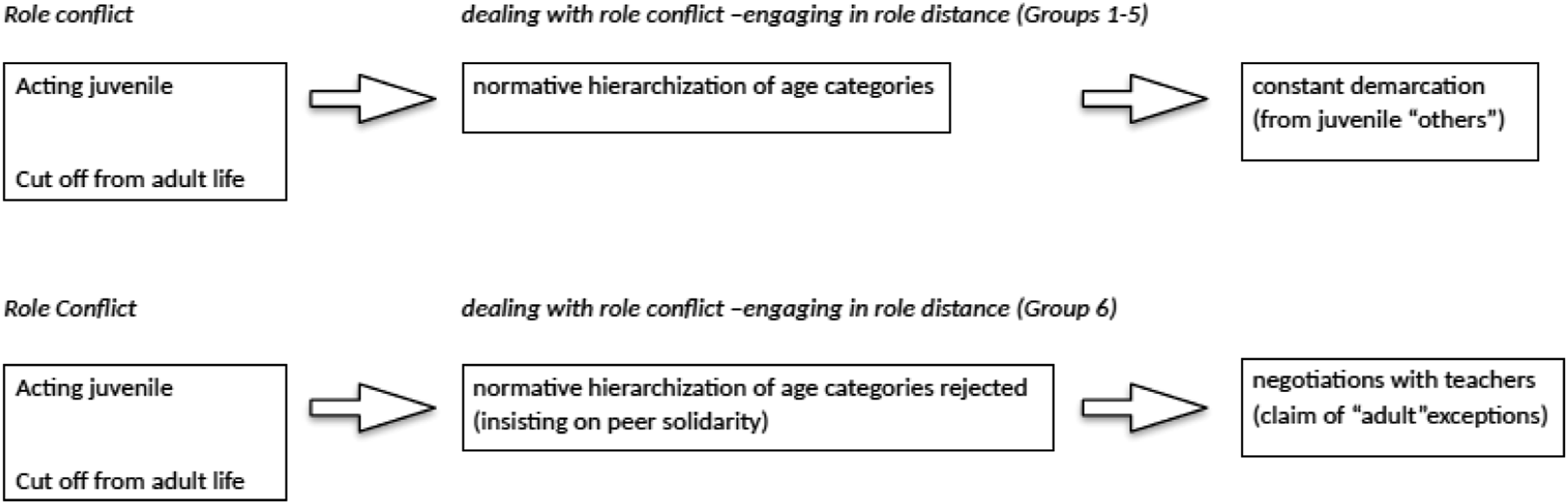
Discussion and Conclusion
Emerging adults’ role conflict: Second-chance education provides emerging adults with a broader range of educational and career prospects and offers support during difficult transition processes. However, the institutions we studied subject students to the rules of a secondary school and in this way confront them with expectations that these young people cannot reconcile with their self-perception as adults. Previous research on young adults returning to school has focused primarily on the problem that they may not be able to meet adult obligations since they are students (Cocklin, 1991; Fairchild, 2003; Osam et al., 2017) However, this problem is obviously not a big issue for our students. This seems to be mainly due to the understanding that teachers have for such problems. As we have stated, in all groups there was talk of “a few” or “some” teachers not understanding such commitments. But students in all groups also agreed that “many” teachers had this understanding, made “exceptions,” and were “on eye level,” as they put it.
Another finding should be mentioned here to provide a broader frame for the results we have presented: we also explored the question of whether second-chance education students experience returning to school, and thus being behind in the trajectory of becoming an adult, as socially discriminatory. Because none of the groups brought this up on their own, we asked the students about this point directly. We received information from four groups: In Group 3, they obviously found it a bit uncomfortable, and one statement was “I hate the age question!” But they also said that most of the people, such as friends, work colleagues and relatives, that they had told about their return to school reacted positively. In Group 4, boredom in the previous job was spoken of and one participant said: “Yes, and then I was eagerly waiting to be able to attend this school.” The discussion in Group 6 was similar, where a participant spoke of years of feeling unchallenged by their job saying: “And that just, I don’t know, completely killed me off mentally,” and expressed gratitude for the opportunity they would now have with this school. In Group 2, a participant even spoke of it being “nice to still be young.” So, the fact that they had returned to school, despite the age they had already reached, was considered to be worth it.
If the group discussions nevertheless always revolved around age and the impositions, they experienced in this regard by being at school, this discomfort remained narrowly related to what happens in the world of school. That is why we have made this aspect the focus of our analysis. The rules and regulations of the school keep the young adults—in their own perception—trapped in a “student-mode”: They take on the role of adolescents, against their will, and feel cut off from the world of adults. How they describe their behavior as students—snapping fingers, “just sitting there,” painting a cover page, etc.—shows how degrading it is for them. In the same way, the phrases they choose to describe the forced transfer into a world that is foreign to them—such as “culture shock,” “prison feeling,” “stopgap,” “counting the weeks” until they are done—leave no doubt about the conflict they experience.
We found that the students chose two patterns of solution. A first pattern clearly dominates and is described by five groups in very similar terms, almost word for word. It involves a strong distancing from the role of the student very much as Goffman outlines it as “some disdainful detachment of the performer from a role he is performing” (1961, p. 110). Specifically, it involves pejorative attributions to peers who are not yet thought of as adults. And this results in the decision to study independently. The students do not need the others and ultimately also the school, instead they find things out for themselves and are diligent—and are met with success. They consider that they are good students precisely because of this. For these groups, all three of our assumptions were confirmed.
There was a second pattern of conflict resolution, that was only partially consistent with our assumptions, and was only addressed by one group. Here, too, role conflict was experienced, in the same way as in the other five groups. However, a strong norm of unity among peers prevents the devaluation of immature “others.” It is this standing together as peers that is expressed in negotiations with the teachers. Here, too, they distanced themselves from the all-too-youthful role of a secondary school student, but in a different way: As an adult, they have the right to concessions in the application of the rules and must demand this again and again in negotiations with teachers. However, this kind of role distancing is not associated with success. Negotiation is not seen as the basis of academic success, nor, as the narratives indicate, does it lead to different teacher behavior in reality. Evidently, however, a great deal of time and energy is put into these negotiations.
The group composition, as far as we recorded it, did not give rise to any discernible reasons why one or another pattern was chosen. Although there was one particularly old participant in Group 6, the overall age composition was similar to that of the other five groups, and the one older student did not drive the discussion in any particular direction with his contributions. After all, there was a fine line that distinguished the adoption of one or the other solution path. First, the same strand of discourse was initiated but then, however, blocked in Group 6. This happened, firstly, because one of the participants obviously revealed himself to be one of the mocked “primary school” pupils and thus as one of the “others,” and secondly, because from then on, the norm of peer unity was repeatedly invoked in the interview. However, we cannot rule out that some of the students actually chose the first pattern for themselves but now no longer wished to express this in the group. The group discussions were primarily designed to capture something like a peer culture, and not so much the individual solutions.
Educational institutions and age categorization: However, concerning the situation of emerging adults who attend an institution of the second-chance education, another issue is now crucial: why the school imposes these regulations on them. It is clear that grading practices are behind all the objectionable rules. The schools are obliged to grade constantly; not only are written tests graded but also what is called “other cooperation.” This consists of regular attendance, activity during class, and doing homework and this grading should basically be independent of the actual academic performance—as the current rules require. No doubt, this is a grading of conformity to the student role. That is why the students adopt behavior that they dislike but with which they seek to convince the teachers of their willingness to perform. Behind these grading practices are decisions by the Ministry of Education. They subject all schools leading to the university entrance qualification to the same regulations, regardless of whether they teach students from usually 10 to 19 years of age or, as in the institutions of second-chance education, students from 18 years of age to their early thirties. This reflects the logic that the education system follows very fundamentally in terms of the age of individuals: certain educational steps—the acquisition of certain skills and certificates—are scheduled for specific, narrowly-defined age phases. Individuals who are ahead of or behind schedule must then somehow find their way, and the solutions they are offered often seem to be more of a stopgap. When Arnett (2017) points to the “apparent human tendency to take continuities in human development and make them discontinuous, by introducing roles, statuses and responsibilities that are distinctive to each life stage” (p. 312), it can be said that the education system is even taking a pioneering role in this problematic age categorization. Second-chance educational institutions have an important function here in correcting such rigid classifications, and the students' statements show how much they valued this in principle. It is precisely for this reason, however, that institutions of second-chance education should follow rules that are not felt to be pejorative by adults. In other words, they should at least implement rules that apply to tertiary educational institutions, even if they offer secondary school qualifications. The statements of the students quoted here give quite clear indications in which direction the revision of the rules should go. Teachers and school principals cannot be accused of this age insensitivity, or only to a small extent, as the discussions clearly showed.
In trying to explain why second-chance education institutions do not apply such rules, it is also important to point out that they did not originate with the goal of providing an opportunity for emerging adults. Second-chance educational institutions came about almost a hundred years ago on the basis of political demands. Under the heading of “democracy needs democrats” (Hättich, 2015, p. 7) such demands sought better representation of the working class in academic circles. The relevant authorities gave in to the demands, but obviously tried, as far as possible, to incorporate the resulting provision into the logic of existing school types. The relevance that reorientations of educational biographies have nowadays gained within the life phase of emerging adulthood, has therefore not yet been sufficiently taken into account. Overall, the proportion of students earning their university entrance qualification through the second educational pathway has risen considerably in recent years (Sterrenberg, 2014). Together with the internationally lamented divergence between the requirements of labor markets and existing educational qualifications, this would undoubtedly also justify institutional regulations expressing a greater degree of sensitivity to age.
Limits of our study: Our empirical basis is rather narrow with only six focus group discussions. However, the strongly consistent statements in the different groups suggest that the experience and resolving of age-role conflicts may indeed be relevant for emerging adults. The methodological approach we used, though, was only aimed at capturing students’ collectively shared views—and not individual solution patterns and their effect on coping with the transition. Furthermore, our study focuses on the very specific challenges that are faced by emerging adults in second-chance education. However, it can be assumed that it is reasonably common for institutional frameworks not to take into account this particular group. Seiffge-Krenke (2019) and Tanner (2015) mention mental health systems of care which are organized into two separate spheres, one for adults and one for infants, children and adolescents, but do not consider emerging adults. Other examples include the lack or inadequacy of appropriate institutional provision for young care leavers (e.g., Adley & Jupp Kina, 2015; Wilson et al., 2019) or for young adult delinquents (e.g., Farrington & Loeber, 2012). The fact that emerging adults have to defend their own understanding of their age against the impositions of institutions can thus be seen as a relevant and little-researched conflict. Our results may provide an impetus for the analysis of emerging adults’ ways of experiencing and handling such conflicts.
Supplemental Material
sj-pdf-1-eax-10.1177_21676968211069214 – Supplemental Material for Doing Adulthood While Returning to School: When Emerging Adults Struggle With Institutional Frameworks
Supplemental Material, sj-pdf-1-eax-10.1177_21676968211069214 for Doing Adulthood While Returning to School: When Emerging Adults Struggle With Institutional Frameworks by Doris Bühler-Niederberger, Claudia Schuchart and Aytüre Türkyilmaz in Emerging Adulthood
Footnotes
Declaration of Conflicting Interests
The authors declared no potential conflicts of interest with respect to the research, authorship, and/or publication of this article.
Funding
The authors disclosed receipt of the following financial support for the research, authorship, and/or publication of this article: This research is supported by Federal Ministry of Education and Research (01UM1818Y).

Supplemental Material
Supplemental material for this article is available online.
Notes
Author Biographies
References
Supplementary Material
Please find the following supplemental material available below.
For Open Access articles published under a Creative Commons License, all supplemental material carries the same license as the article it is associated with.
For non-Open Access articles published, all supplemental material carries a non-exclusive license, and permission requests for re-use of supplemental material or any part of supplemental material shall be sent directly to the copyright owner as specified in the copyright notice associated with the article.
