




Abstract
The COVID-19 pandemic is impacting emerging adults during a crucial developmental period, which may have long-lasting effects on their developmental task progression and psychosocial adjustment. Because self-efficacy is a well-researched psychological resource to deal with substantial challenges, the present study examined the link between emerging adults’ life- and domain-specific satisfaction during the pandemic and self-efficacy before the pandemic. Drawing on a sample of 377 German emerging adults (56.5% female), we found that self-efficacy prior to the pandemic was not associated with life or domain-specific satisfaction during the pandemic. However, results revealed that associations between domain-specific satisfaction during the pandemic and self-efficacy varied by educational attainment. Results are discussed in light of specific circumstances related to the progression of the pandemic in Germany, possible non-response bias, as well as implications for social policy and future research.
Since the beginning of 2020, the spread of the respiratory pathogen coronavirus SARS-CoV-2 (hereafter, “COVID-19”) became an unprecedented pandemic of recent history (World Health Organization [WHO], 2021), that is affecting the lives and daily routines of individuals of all ages and all over the world (Eurofound, 2020; Settersten et al., 2020). For example, social distancing measures put in place to prevent the spread of COVID-19 among high-risk groups, such as older adults or individuals with pre-existing conditions, have shown to increase social isolation, which was in turn linked to lower levels of mental health and well-being (Krendl & Perry, 2020; Whitehead, 2020). Many areas of life are affected; for instance, COVID-19 reinforced educational differences between low- and high-performing school children (Blasko & Schnepf, 2020).
Less is known about the pandemics’ impact on emerging adults, who are in a crucial developmental period during which many developmental tasks and transitions need to be tackled simultaneously (Arnett, 2000). Emerging adulthood is characterized by great variability and instability in role transitions in multiple life domains (Furstenberg et al., 2005), which the COVID-19 pandemic may complicate further. It is therefore particularly important to examine the toll that this pandemic puts on emerging adults’ psychosocial adaptation. Because prior research has shown that self-efficacy serves as a resource in challenging times, such as coping with social change (Silbereisen, 2005), our study uses German survey data gathered before and during the COVID-19 pandemic to examine whether self-efficacy buffers pandemic-related changes in emerging adults’ life and domain-specific satisfaction. Specifically, we focus on the domains of work and peer relations because these are crucial developmental domains for emerging adults (Furstenberg et al., 2005; Scharf et al., 2004).
Mastering Developmental Tasks During the Pandemic
Settersten and colleagues (2020) stated that even though not everyone might be infected with COVID-19, everyone is affected by the pandemic. It may nevertheless be the case that certain subgroups are more severely affected than others because the ripple effects of major historic events, such as the COVID-19 pandemic or potential economic recessions subsequently, can vary depending on the timing of its occurrence in one’s life course (Elder & Shanahan, 2006). For example, attaining education, entering the workforce to gain financial independence, and establishing a social network of peers are, among others, important developmental milestones in emerging adulthood, which might be delayed due to the pandemic (Furstenberg et al., 2005; Scharf et al., 2004). If the COVID-19 pandemic hinders emerging adults’ progress on these developmental milestones, it is possible that this might lead to increased rates of singlehood, childlessness, a higher risk of loneliness due to interactions with fewer social contacts and lower lifetime earnings among the current cohort of emerging adults in the long run (Settersten et al., 2020). Because mastering developmental tasks has shown to increase well-being (e.g., Salmela-Aro et al., 2015), especially gaining employment (van Lill & Bakker, 2020), stalled progress on these tasks due to the pandemic may be particularly detrimental for emerging adults.
More specifically, the domain of work was profoundly affected by COVID-19 and will likely shape employment patterns, earnings, and the overall well-being of workers long after the pandemic is contained (International Labour Organization, 2021). For example, the monthly unemployment rate increased in Germany from 5.3% in February of 2020 to 6.2% in June of 2020 (Destatis, 2021). Rates of underemployment where workers are forced to reduce their monthly working hours (namely “short-time work”), which was an instrument introduced to prevent the skyrocketing unemployment rates during the Great Recession of 2008 (Rinne & Zimmermann, 2012), rose from 0.4% in February of 2020 to 13.4% in June of 2020 (Statistik der Bundesagentur für Arbeit, 2021). Even though emerging adults may have more time to make up for losses during this crisis compared to other age groups, they often lack the financial or personal resources to deal with this extreme situation (e.g., personal savings or lack of years of seniority in the workforce as protection from layoffs and unemployment; Buchholz & Kurz, 2008). However, it could be the case that individuals with higher levels of schooling are shielded from the most severe ripple effects of the pandemic because educational attainment is a strong predictor of job security and higher lifetime earnings (e.g., Woessmann, 2014), which partly explains why young, highly educated workers were less affected by the Great Recession than their lower-educated counterparts (Jenkins et al., 2013).
Peer relations and friendships were strongly affected by the pandemic as well because of strict social distancing measures put in place to reduce the spread of COVID-19. The pandemic forced individuals worldwide to change how they interacted with each other (Settersten et al., 2020). For example, universities and schools switched to distance learning conducted online. This led to higher levels of perceived loneliness among students because, for example, they interacted with fewer peers, if any, and were not able to maintain or form friendships at the university (Lippke et al., 2021). Interactions between students and chances to study with peers were limited due to the pandemic (Elmer et al., 2020). Consequently, the need for social contact led to an increase in user numbers of mobile social media apps (e.g., dating apps; Statista, 2021). Furthermore, it is known that lower-educated emerging adults can rely less on the emotional support of peers and friends (Vowels & Carnelley, 2020).
Self-Efficacy as a Resource in Critical Times
Self-efficacy, which is defined as the ability to “produce desired effects by their [individuals’] actions” (p. 28) within social structures (Bandura, 1999a), has shown to be an important resource to cope with adversity (Silbereisen, 2005). It has shown to be a protective factor for one’s mental health, both in light of major traumatic events (e.g., episodes of homelessness; Epel et al., 1999) and daily stressors (Schönfeld et al., 2016). With regard to the COVID-19 pandemic, higher levels of self-efficacy were linked to better mental health (Yildirim, & Güler, 2020). One could further assume that, for example, higher levels of self-efficacy may make it easier to accept and cope with social distancing measures because it would booster individuals’ ability to deal with these challenges and to navigate within these set boundaries successfully.
In emerging adulthood, self-efficacy could be shown to be associated with higher levels of well-being (Reed et al., 2016), academic achievement, and resilience among university students (Hernández et al., 2019). In another study examining unemployed and underemployed emerging adults, McGee and colleagues (2020) found that self-efficacy moderated the association between stress and depression in the way that more self-efficacy weakened the association between stress and depression. Individuals with higher levels of self-efficacy have further shown to deal with stressful environments more constructively by making the best out of new situations (Bandura, 1999b). Because of the strong link between developmental task progression and well-being (Salmela-Aro et al., 2015), as well as between self-efficacy and well-being (Bandura, 1999a), we assume that emerging adults’ satisfaction with their life overall and with those life domains most affected by the pandemic is likely to be shaped by their perceived level of self-efficacy.
More specifically, we expect that higher levels of self-efficacy prior to the COVD-19 pandemic are associated with higher levels of satisfaction during the pandemic (
Method
Data
We used data from the first wave of the large-scale, representative German survey “Growing up in Germany,” which was collected via standardized computer-assisted interviews in 2019, and a COVID-19-specific module completed for a subgroup of the sample during summer and fall of 2020. For the first wave, a sample of minors and emerging adults up until Age 32 were drawn randomly from the municipalities’ population registers. These target persons, or the primary caretaker for minors, were then contacted by professional interviewers to schedule an appointment for the interview. The survey covered a wide range of topics, such as the socio-economic circumstances of individuals, values and attitudes, as well as indicators of well-being.
For the purpose of this study, we restricted our subsample to emerging adults aged 18 to 29 in 2019 (N = 3,727; 50.7% female). Of these respondents, a subsample of 377 emerging adults (56.5% female) was re-surveyed for a module on COVID-19 between August and October of 2020. A descriptive overview of the composition of the analytical sample is displayed in Table 1. Logistic regression models predicting the likelihood of being re-surveyed in the COVID-19 module showed that individuals with secondary and tertiary levels of schooling compared to those with primary levels of schooling only were significantly more likely to have participated in the COVID-19 module. Respondents with high levels of self-perceived levels of economic deprivation were significantly less likely to have taken part in the COVID-19 module compared to those with no self-perceived economic deprivation.
Descriptive Statistics of Key Variables (N = 377).
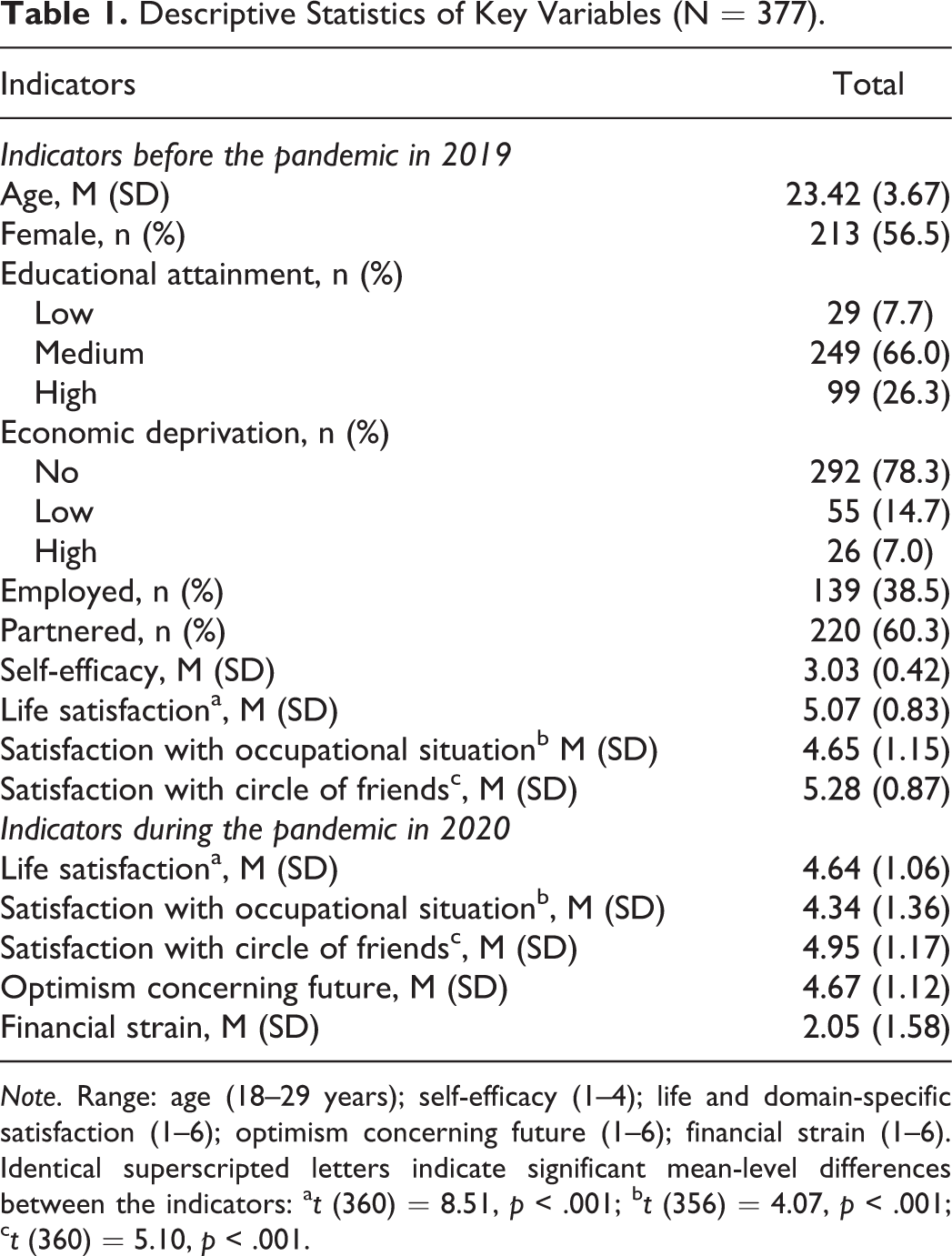
Note. Range: age (18–29 years); self-efficacy (1–4); life and domain-specific satisfaction (1–6); optimism concerning future (1–6); financial strain (1–6). Identical superscripted letters indicate significant mean-level differences between the indicators: at (360) = 8.51, p < .001; bt (356) = 4.07, p < .001; ct (360) = 5.10, p < .001.
Measures
Dependent variables
We used both individuals’ overall rating of life satisfaction and ratings in two areas of domain-specific life satisfaction (i.e., with the current occupational or educational situation and with one’s circle of friends) before and during the COVID-19 pandemic to measure one’s well-being. Both in 2019 and 2020, respondents were asked to rate how satisfied they were with their life overall, with their current occupational or educational situation, and with their circle of friends on a scale from 1 (not satisfied at all) to 6 (very satisfied). Life and domain-specific satisfaction in 2020 served as the dependent variables in the subsequent regression models (i.e., one model for each indicator). Life and domain-specific satisfaction in 2019 were further entered as control variables in the respective regression models. Note that the mean-level differences between the respective indicators in 2019 and 2020 were significant (see Table 1).
Independent variables
Respondents’ levels of self-efficacy prior to the COVID-19 pandemic served as our main predictor of life and domain-specific satisfaction during the pandemic. It was assessed with a short version of the general self-efficacy scale (Schwarzer & Jerusalem, 1999; 4 items; e.g. “I can find a solution for every problem,” or “I can deal with new situations”). Answers were given on a scale from 1 (do not agree at all) to 4 (fully agree). The scale had an internal consistency of 0.61 and a mean composite score was formed for all subsequent analyses.
We further entered the following socio-demographic information prior to the COVID-19 pandemic into our regression models to control for potential confounders: respondents’ age (in full years); sex (0 = female; 1 = male); levels of schooling based on the Comparative Analysis of Social Mobility in Industrial Nations index (Brauns et al., 2003; 1 = primary; 2 = secondary; 3 = tertiary); and whether they were employed (0 = not in the labor market [i.e., in training, on parental leave, or unemployed]; 1 = full- or part-time employed); and partnered (0 = single; 1 = partnered). Respondents’ levels of schooling further served as effect modifier in Model 2 (see Table 2).
Linear Regression Results Predicting Change in Life and Domain-Specific Satisfaction in 2020.
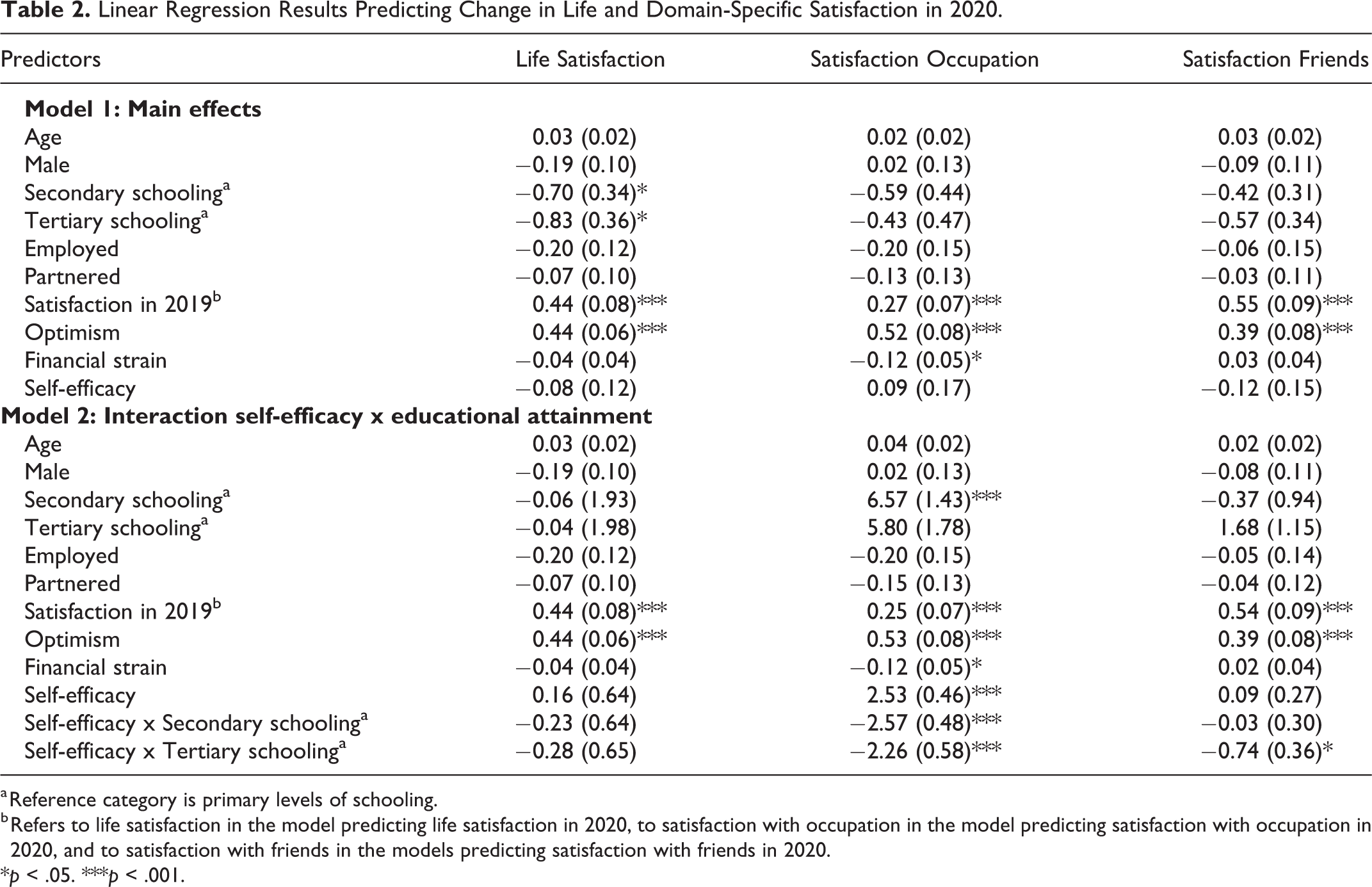
a Reference category is primary levels of schooling.
b Refers to life satisfaction in the model predicting life satisfaction in 2020, to satisfaction with occupation in the model predicting satisfaction with occupation in 2020, and to satisfaction with friends in the models predicting satisfaction with friends in 2020.
*p < .05. ***p < .001.
During the COVID-19 pandemic, we included ratings on how optimistic respondents felt concerning their future (1 = not optimistic at all, to 6 = very optimistic), and whether they had to cut back financially (1 = do not agree at all, to 6 = fully agree) as confounders of individuals’ satisfaction in 2020.
Results
Results of our regression models predicting respondents’ ratings of life and domain-specific satisfaction during the pandemic while controlling for satisfaction prior to the pandemic (one model for each indicator) are summarized in Table 2. Our first hypothesis stating that higher levels of self-efficacy prior to the COVID-19 pandemic would buffer individuals from lower levels of satisfaction during the pandemic was not supported because there were no significant associations between self-efficacy and life or domain-specific satisfaction (see Model 1). We further assumed that individuals with higher levels of schooling report higher levels of life and domain-specific satisfaction because higher levels of educational attainment may have served as a buffer from the impact of the pandemic, which was not confirmed. In contrast, having secondary and tertiary levels of schooling was associated with lower levels of life satisfaction during the pandemic compared to those with primary levels of schooling. Reporting higher levels of optimism concerning one’s future during the pandemic and higher levels of satisfaction before the pandemic were related to higher levels of life satisfaction and both areas of domain-specific satisfaction during the pandemic. Lastly, experiencing financial strain during the pandemic was associated with lower levels of satisfaction with the occupational or educational situation during the pandemic.
We further entered interaction terms between self-efficacy and educational attainment (Model 2) into the models to examine our third hypothesis on the buffering effect related to higher levels of self-efficacy among individuals with lower levels of schooling. This hypothesis was not supported for life satisfaction during the pandemic. However, results revealed two significant interaction terms for the satisfaction with one’s occupational or educational situation: one between self-efficacy and secondary levels of schooling (vs. low levels of schooling) and one between self-efficacy and tertiary levels of schooling (vs. low levels of schooling; see Figure S1 in the Online Appendix). This indicated that, among respondents with low levels of schooling, higher levels of self-efficacy were indeed associated with higher levels of occupational or educational satisfaction during the pandemic. We also found a significant interaction between self-efficacy and tertiary levels of schooling (vs. low levels of schooling) for the satisfaction with one’s circle of friends (see Figure S2 in the Online Appendix). This interaction indicated that, contrary to our expectation, self-efficacy prior to the pandemic was negatively associated with satisfaction with one’s circle of friends during the pandemic among respondents with higher levels of schooling only.
Discussion
This study examined the link between self-efficacy before the COVD-19 pandemic and emerging adults’ life and domain-specific satisfaction during the pandemic. This is a particularly salient issue because self-efficacy has shown to be a protective factor of mental health both in light of major traumatic events and daily stressors (e.g., Epel et al., 1999; Schönfeld et al., 2016). We further examined whether higher levels of self-efficacy served as a buffer for certain subgroups of emerging adults (i.e., those with lower levels of schooling), who may have been affected more severely by the pandemic (McGee et al., 2020). Our results showed that, contrary to our expectations, there was no significant link between emerging adults’ level of self-efficacy and life and domain-specific satisfaction during the pandemic. These surprising null effects could be related to the relatively mild first wave of the pandemic in the spring of 2020 in Germany. By the end of June 2020, 194,259 cumulated confirmed cases of COVID-19 infections were reported in Germany in contrast to, for instance, 2,537,636 confirmed cases in the U.S. (WHO, 2021).
Furthermore, domain-specific satisfaction did not vary by educational attainment and, in contrast to our expectation, individuals with secondary and tertiary levels of schooling even reported lower levels of life satisfaction during the pandemic. This could be due to the fact that individuals with lower levels of education tended to be overrepresented in the group of essential workers (e.g., working as a grocery clerk) and hence, experienced a lot of appreciation in pandemic times (Blustein, 2011). Additionally, the response of the German labor market to the COVID-19 pandemic was similar to its response during the economic recession of 2008. Once again, rates of short-time work were increased, which reduced but did not eliminate working hours for people with fixed-term or permanent contracts (Rinne & Zimmermann, 2012). This may at least buffer the economic consequences of the COVID-19 pandemic for German emerging adults regardless of their level of schooling compared to those in other countries without these measures because spikes in youth unemployment were reduced.
We also found that self-efficacy prior to the pandemic was negatively associated with satisfaction with one’s circle of friends during the pandemic among respondents with higher levels of schooling only. This could be due to the fact that youth and emerging adults with higher socio-economic status tend to be more likely to socialize with friends in person and do not chat as often with friends compared to those from lower socio-economic status groups (Hurrelmann et al., 2019). Even though the use of mobile social media apps likely increased for all emerging adults, those with lower levels of schooling could have been more used to maintaining friendships this way, which could have meant that the reduction of in-person contacts due to the pandemic-related social distancing measures were not as much of a change for these emerging adults. Consequently, emerging adults with higher levels of school attainment may have been more dissatisfied with their circle of friends due to the reduction of in-person exchanges. This is underlined by the findings from Elmer et al. (2020) showing that undergraduate students had fewer interactions with other students and, consequently, felt lonely during the first lockdown (Lippke et al., 2021).
Limitations and Conclusion
Our study has three main limitations. First, the analytical sample was not representative for the German population because the participants of the COVID-19 add-on were more likely to be better educated and more affluent. Even though the experiences of emerging adults differ by socio-economic status (Landberg et al., 2019), it is possible that we did not find significant differences for different socio-demographic subgroups due to ceiling effects among a relatively homogenous, and potentially more privileged, subgroup of the population. Second, the data collection took place throughout the summer and fall months when the situation was quite mild compared to early spring or the surge of cases observed in many countries during its second wave at the end of 2020 (WHO, 2021). Hence, one could speculate that our findings would have been more pronounced if data collection would have been during those periods with a surge of observed cases. Third, the internal consistency of our scale for self-efficacy was rather low, which may threaten the reliability of this measure.
In the present study, we leveraged the rare opportunity to examine ratings of emerging adults’ satisfaction in the social and work domain before and during the pandemic. Even though our sample was quite selective, we saw some first evidence that COVID-19 is nevertheless affecting emerging adults across the social strata. However, its detrimental effects can vary strongly between subgroups within a population, which is oftentimes visible in responses to natural disasters (Sastry & VanLandingham, 2009). Social policies should therefore aim to counteract the accentuation of social disparities for more vulnerable groups (Settersten et al., 2020), as well as potential harmful side effects of pandemic-related measures, such as increased rates of loneliness due to the implementation of social distancing measures. Furthermore, more research on the identification of resources to cope with the pandemic in the short and long run is needed, and future studies should include other dimensions of psychosocial adjustment, recruit more diverse subpopulations, and use more fine-grained repeated measures (e.g., weekly or monthly diary data).
Supplemental Material
Supplemental Material, sj-pdf-1-eax-10.1177_21676968211019287 - Emerging Adults’ Self-Efficacy as a Resource for Coping With the COVID-19 Pandemic
Supplemental Material, sj-pdf-1-eax-10.1177_21676968211019287 for Emerging Adults’ Self-Efficacy as a Resource for Coping With the COVID-19 Pandemic by Claudia Recksiedler and Monique Landberg in Emerging Adulthood
Footnotes
Author Contributions
Monique Landberg contributed to conception, design, and interpretation; drafted the manuscript; critically revised the manuscript; gave final approval; and agreed to accountable for all aspects of work ensuring integrity and accuracy. Claudia Recksiedler contributed to conception, design, analysis, and interpretation; drafted the manuscript; critically revised the manuscript; gave final approval; and agreed to accountable for all aspects of work ensuring integrity and accuracy.
Declaration of Conflicting Interests
The authors declared no potential conflicts of interest with respect to the research, authorship, and/or publication of this article.
Funding
The authors received no financial support for the research, authorship, and/or publication of this article.

Open Practices
Data and materials for this study have not been made publicly available. The design and analysis plans were not preregistered. The raw data contained in the manuscript is not openly available for download at the time of submission, but the datasets and questionnaires will be publically available for scientific use at some point through the research database of the German Youth Institute, Munich, Germany. Analysis code/syntax used for the analyses is available upon request from the authors.
Supplemental Material
The supplemental material for this article is available online.
References
Supplementary Material
Please find the following supplemental material available below.
For Open Access articles published under a Creative Commons License, all supplemental material carries the same license as the article it is associated with.
For non-Open Access articles published, all supplemental material carries a non-exclusive license, and permission requests for re-use of supplemental material or any part of supplemental material shall be sent directly to the copyright owner as specified in the copyright notice associated with the article.
