




Abstract
Major sport events attract large audiences, making them an attractive platform for political actors seeking to engage the public. However, to date, there is little research on how the public perceives mediatized political incidents during sports events. This study examines the intersection of sports and political communication by analyzing how audiences perceive political incidents during the UEFA Euro 2024 football tournament. Using survey data from Switzerland (n = 435), we investigate the extent to which individuals were exposed to political incidents during the tournament and whether news consumption, social media use, and watching broadcasts of games were related to the exposure and recall of these events. The study shows that political incidents related to the tournament reached a large audience. Self-reported exposure to political incidents was positively related to news consumption and interest in politics and sports. However, the ability of participants to recall specific political incidents was positively associated with watching broadcasts of games and interest in politics, but not with news or social media consumption. The large reach of politics on the pitch and the controversial matter of the incidents captured in our study highlight both the potential and risks of politics in sports for society.
Keywords
Introduction
Sports and politics don’t mix—so the saying goes. However, scholars highlight that, in fact, sports are an intrinsically political business (Gift & Miner, 2017; Peterson & Muñoz, 2022; Reiche, 2018; Strenk, 1979). One of the main reasons why sport is so attractive for political actors is because it is highly mediatized (Frandsen, 2016; Ličen et al., 2022; Skey et al., 2018). Major sports events attract larger audience than any other type of event (Tang & Cooper, 2013) which makes them an attractive stage for political actors seeking to engage large audiences with their messages (Mittag, 2017). This diagnosis was once again confirmed by political incidents that happened during the recent UEFA Men’s European Football Championship (henceforth Euro 2024). 1 During a press conference, superstar Kylian Mbappé called on his compatriots to vote in the upcoming French parliamentary election to prevent an impending slide to the right (Ames, 2024). Mbappé’s statement prompted a reaction from French far-right leader Marine Le Pen, who stated that rich footballers should not lecture French people on how to vote. Later in the tournament, Turkish player Merih Demiral celebrated his second goal against Austria with the so-called Wolf Salute. This hand gesture is associated with the Grey Wolves, who are classified as a right-wing extremist group in Germany, the host country of the Euro 2024 (Bundeszentrale für politische Bildung, 2024). German Interior Minister Nancy Faeser condemned the action in a post on X, stating that it is unacceptable to use the tournament as a platform for racism. The incident subsequently became the subject of a diplomatic exchange, as the Turkish government accused Germany of xenophobia and President Recep Tayyip Erdogan announced that he would attend the upcoming game against the Netherlands to support the Turkish team (Connolly, 2024). Aside from these controversial incidents, several other politicians, including the President of the Swiss Federal Council, Viola Amherd, and Germany’s Federal Chancellor, Olaf Scholz, used the broadcasts of the games for appearances in front of their supporters and voters.
The strong presence of political leaders at major sporting events such as Euro 2024 illustrates that when countries compete through their national teams, these events often serve as platforms for political communication (Billings et al., 2015; Smith, 2019; Strenk, 1979). Presidents and prime ministers celebrate with their teams and use these events for self-promotion, players and coaches publicly comment on politics, and fans display political gestures and symbols (Reiche, 2018). All of this happens in front of a growing number of microphones and cameras in and around the stadiums (Miller, 2014). Mobile devices equipped with cameras have increased the amount of audiovisual content captured by fans, players, politicians, and other actors (Hutchins, 2016). This content is distributed and amplified within minutes on digital media channels like news websites, social media platforms, and messaging apps (Gonzalez et al., 2023). Overall, mediatization has left sports increasingly permeated with politics.
The huge attention for sports events like the Euro 2024 makes them an especially attractive stage for political actors (Mittag, 2017). With ‘politics on the pitch’ they might reach segments of the population that are increasingly difficult to engage through traditional means of political communication—such as news media (Bennett & Iyengar, 2008; Gantz & Lewis, 2016; Wojcieszak et al., 2023)—even if those audiences are not initially seeking and interested in politics. Therefore, sports could serve as a means of involving the population more deeply in the political process and fostering political learning, participation, and social integration (e.g., Makarova & Herzog, 2014). However, the previously mentioned examples also illustrate the potential harms of polarization and radicalization that can accompany the politicization of sport (e.g., Waas, 2023).
With our pre-registered online survey (n = 435) conducted in the German-speaking region of Switzerland, we investigate the factors related to perceived exposure to and recall of political incidents during the Euro 2024 tournament. Specifically, we analyze the extent to which people in Switzerland, one of the participating countries in the tournament, are exposed to political content during Euro 2024, whether this exposure is related to news consumption, social media use, or watching football broadcasts, and which individual interests are related to this exposure and recall. Thus, our research addresses the question of who can be reached with political communication ‘on the pitch’ through which channels.
Conceptual Framework
The existing literature in political science and related fields points at an increased interaction of politics with the realm of sports (Cha, 2009; Gift & Miner, 2017; Peterson & Muñoz, 2022; Seippel et al., 2018). A central force driving this interaction is the mediatization of society (Birkner & Nölleke, 2016; Frandsen, 2016; Ličen et al., 2022; Skey et al., 2018). Mediatization encompasses the process of social fields or systems adapting to media logic (Hjarvard, 2008) but also the role of the media in the communicative construction of social and cultural reality (Couldry & Hepp, 2013). One can argue that mediatization is the foundation of sports’ societal and economic success. Mediated communication of sports events generates public attention and makes it attractive for advertisers and sponsors (Gantz & Lewis, 2016). The success of sports, and football in particular, as mass events, is closely linked to the dissemination of television starting in the 1950s (Frandsen, 2017; Whannel, 2013). However, the mediatization of sports also “involves a loss of autonomy—for example, rules and schedules for sports events have been adapted to accommodate the needs and schedules of broadcast television partners, not those of the needs of athletes or attending fans (in fact, they are sometimes adversely affected by them)” (Ličen et al., 2022, p. 797).
Digitization has added to the mediatization of society, including sports, but has also changed some of the basic mechanisms. In earlier days, the popularity of sports events and their ability to reach large audiences depended on a very limited set of broadcasters or news organizations. Program directors and journalists in news organizations selected the topics to cover, determined the angles of coverage, and chose the voices to feature (Wallace, 2018). In digitized media environments, athletes and sports organizations but also political actors can use their own media channels like websites, social media platforms, and messaging apps to reach dedicated audiences (Gonzalez et al., 2023). In fact, they are very successful in doing so: Athletes and sports organizations are among those with the largest followership. For instance, footballers Cristiano Ronaldo and Lionel Messi are currently the most-followed individuals on Instagram (Brandwatch, 2025).
Mediatized Interactions Between Sports and Politics
Mediatization is also a precondition for sports as a means of political communication. It allows athletes and sports organizations to engage in political communication and voice their opinions on political issues, thereby using their celebrity status to receive large attention. Athletes have, from time to time, used their popularity to take a stance on political issues. In the 1960s, boxing legend Muhammad Ali spoke out against poverty, racism, and the Vietnam War. More recently, in 2016, the kneeling of NFL player Colin Kaepernick during the national anthem before the game—a gesture against racism and police brutality—led to polarized debates in the US media (Doehler, 2021; Smith, 2019). Similarly, during the COVID-19 pandemic, athletes publicly expressed political positions—for example, U.S. basketball player Steph Curry urged compliance with health measures (Sharpe et al., 2020), while German footballer Joshua Kimmich became involved in controversies over vaccination (Mittag & Nieland, 2022). Also athletes in Switzerland, the case for this study, engage in politics. An internationally notable incident occurred during the 2018 FIFA World Cup in Russia, when Swiss players were fined for making hand gestures with political connotations during their match against Serbia. The gestures were intended as a statement for Swiss players with roots in Kosovo, a country Serbia does not recognize (Auer & Ruedin, 2023). Even though the literature on such athlete activism highlights the action of athletes to promote progressive politics and social change (Park et al., 2020), athletes also engage in political issues that are not necessarily progressive, for instance, when they endorse conservative policies or politicians (e.g., Jackson & Darrow, 2005; Waas, 2023).
Mediatization also makes sports an attractive stage for political actors like politicians, parties and governments trying to reach large and diverse audiences with their political communication (Kessler & Gerhard, 2017). Political actors have instrumentalized sports events for strategic political communication for decades as part of soft power strategies (Dubinsky, 2024; Jiang, 2013; Rowe, 2019). As early as 1936, the Nazi Party in Germany used the Olympics in Berlin as an opportunity to foster an image of a prospering and peaceful country, thereby relying on newly available broadcasting technology (e.g., Heck, 2011). More recently, China and Russia hosted the Olympics and/or the FIFA Football World Cup as part of their public diplomacy (Giulianotti, 2015; Vladimirova, 2020). Also efforts by countries such as Qatar and Saudi Arabia to host major sporting events have been linked to strategies aimed at reshaping their international image (Samuel-Azran et al., 2016). Widespread protests against the host countries, for example over human rights issues, led to a strong politicization of these events (Samuel-Azran et al., 2022). However, also leaders of liberal democracies use sports as a means of political communication. For instance, President Emmanuel Macron used the 2024 Olympics in Paris to, in his words, show the world the true face of France amid the political crisis triggered by a snap election earlier in the year.
Scholars have already referred to sports events as one of the last mediated campfires when the country gathers around the screens to watch the performance of the national (football) team (Ludwig & Bruns, 2017). However, despite the relevance of large sports events as a stage for political communication, there is astonishingly little research on the audience of political communication in sports. First of all, we do not know whether or not political communication during sports events finds an audience. Thus, looking at political incidents during the Euro 2024 tournament, we ask the following research questions: RQ1: What share of the respondents perceived and recalled political incidents related to the Euro 2024? RQ2: Which political incidents related to the Euro 2024 did the respondents remember most?
Incidental Exposure to Political Incidents Through the Media
Given the mediatized intersection of politics and sports, individuals who follow sports through the media may encounter political content even if they are not actively seeking it. Such incidental exposure can occur when reading sports news, following sports on social media, or watching live broadcasts of games. Previous studies have documented incidental exposure to political news through social media or search engines (Feezell, 2018; Valeriani & Vaccari, 2016). However, empirical evidence on incidental exposure to political content specifically through sports-related media consumption remains very limited.
Ample research shows that people learn about politics through the news and that news media consumption is positively related to political knowledge (Moeller & de Vreese, 2019; Prior, 2003; Van Erkel & Van Aelst, 2021). Sports are a well-established beat in journalism (Vogler, 2021) and sports journalists also regularly address political topics in their reporting (Broussard, 2020). Coverage of large sporting events often intersects with politics, as research on the political content of sports reporting in the context of the Olympics shows (Hayashi et al., 2015; Jiang, 2013; Rowe, 2019). Furthermore, political incidents—such as statements by players or symbolic gestures—tend to attract substantial media coverage due to their scandalous or unexpected nature, such as athletes not ‘sticking to sports’. These stories frequently evolve into political news, often resonating with audiences beyond sports fans. Therefore, we assume that people are more likely to learn about political incidents related to the Euro 2024 if they consume news about the tournament and hypothesize: H1a: The higher the news consumption about the Euro 2024, the higher the perceived exposure to political incidents related to the Euro 2024. H1b: The higher the news consumption about the Euro 2024, the more likely the recall of political incidents related to the Euro 2024.
Since the emergence of social media, researchers have examined whether its use affects political knowledge—with highly ambiguous and context-dependent results. In their meta-analysis, Amsalem and Zoizner (2023, p. 3) found that the “contribution of social media toward a more politically informed citizenry is minimal.” Specifically for Switzerland, Vogler et al. (2023) found no relationship between knowledge gains and social media consumption. However, research on incidental exposure to (political) news shows that users will encounter political news on social media even though they might not have been looking for it in the first place (Feezell, 2018; Valeriani & Vaccari, 2016).
Social media communication surrounding large sports events shows tendencies of politization. A study by Meier et al. (2021) on the Twitter communication about the 2018 Football World Cup in Russia showed attempts to politicize the event, which declined over the course of the tournament. This pattern was also found by Hassan and Wang (2024) in the Twitter debate surrounding the 2022 World Cup in Qatar. A study by Gonzalez et al. (2023) also found that athletes at least occasionally post political content on Instagram. Thus, we assume a positive relationship between using social media for information about the Euro 2024 tournament and encountering information related to politics. Analyzing political incidents related to the Euro 2024, we therefore hypothesize: H2a: The higher the use of social media for information about the Euro 2024, the higher the self-reported exposure to political incidents related to the Euro 2024. H2b: The higher the use of social media for information about the Euro 2024, the more likely the recall of political incidents related to the Euro 2024.
Whereas the relationship between news consumption and (political) knowledge is well-researched, the relationship between so-called non-news or entertainment sources and political knowledge remains ambiguous. In his seminal study, Prior (2003) concluded that there is very little evidence that viewers learn from soft news, such as sports. However, research has meanwhile drawn a more nuanced picture, showing that the consumption of entertainment-oriented media can positively affect the acquisition of political knowledge under certain circumstances (Bartsch & Schneider, 2014; Hollander, 2005; Kim & Vishak, 2008). One reason for this finding is that a substantial amount of political content is disseminated through non-news sources. In a recent study, Wojcieszak et al. (2023) used online behavioral data to measure the prevalence of political content outside news domains and show that “most exposures to politics online take place outside news sites, far more than within news” (p. 131). Their analysis shows that although political content makes up only a minor part of visits to these sites, the high traffic on entertainment and celebrity gossip platforms means that most people encounter more political information outside traditional news sources (Wojcieszak et al., 2023). A survey by Broussard et al. (2021) conducted in the US showed low but substantial levels of incidental exposure to political content in televised sports media. Therefore, we argue that watching football games, where political incidents receive live coverage or are discussed in contextual formats, for instance, the pre- and post-game analysis, will be positively related to the exposure to political incidents and the likelihood of being able to recall them. H3a: The higher the consumption of football games of the Euro 2024, the higher the self-reported exposure to political incidents related to the Euro 2024. H3b: The higher the consumption of football games of the Euro 2024, the more likely the recall of political incidents related to the Euro 2024.
Individual Interest in Politics and Football
Dual information process theories have shown that information is differently processed depending on the motives and capabilities of an individual. The Elaboration Likelihood Model (ELM) proposes that individuals can process information comprehensively and in detail (high elaboration) or only superficially (low elaboration), which eventually can affect stability or changes in attitudes (Petty & Cacioppo, 1986). The Cognitive Mediation Model emphasizes the role of elaborative information processing as a key factor in learning from the news (Eveland, 2001). According to this model, individuals who are highly motivated to engage with information are more likely to learn from it. A central argument is that interest in a particular topic encourages deeper processing of related information, increasing the likelihood of learning from the consumed content.
Indeed, there is ample research on the positive relationship between political interest and political knowledge. Interest in politics has been shown to be related to knowledge about structures and general facts about the political system and political institutions as well as current policy-related events (e.g., Barabas et al., 2014; Van Erkel & Van Aelst, 2021; Vogler et al., 2023). Broussard et al. (2021) also showed that political interest is positively related to exposure to political content in televised sports media. In our case, we expect that interest in politics will also be positively related to the exposure to and recall of political incidents related to the Euro 2024 tournament. We therefore formulate the following hypotheses: H4a: The higher the interest in politics, the higher the self-reported exposure to political incidents related to the Euro 2024. H4b: The higher the interest in politics, the more likely the recall of political incidents related to the Euro 2024.
Evidence on the relationship between interest in topics other than politics and political knowledge remains scarce and ambiguous as most studies do not explicitly focus on such topics. For instance, Vogler et al. (2023) show that interest in sports is negatively related to knowledge about referendums in Switzerland. This finding supports the argument that sports viewers are not necessarily interested in politics or simply have needs other than acquiring political information when they turn to media content. However, until now, studies have not investigated the relationship between interest in sports and knowledge about political incidents related to sports events. We argue that interest in football is likely to be associated with greater knowledge of political incidents related to the sport, as such events often occur during games and may involve players directly. This argument draws on the concept of dual processing of information, which posits that individuals engage in more attentive media reception when they are motivated and interested in the content. Consequently, even when exposure to political content is incidental, interest in football may facilitate learning about related political events. We, therefore, expect a positive relationship between interest in football and exposure to and recall of political incidents during the Euro 2024. H5a: The higher the interest in football, the higher the self-reported exposure to political incidents related to the Euro 2024. H5b: The higher the interest in football, the more likely the recall of political incidents related to the Euro 2024.
Methods
The Euro 2024 tournament is one of the largest sports events in the world with millions of people watching the games on television or in online live streams (Kessler & Gerhard, 2017; SRG, 2024). According to the UEFA, it attracted a global cumulative audience in excess of 5 billion viewers (UEFA, 2024). The Swiss public service broadcaster SRG SSR aired all the tournament games, attracting over 4 million television viewers and generating 63 million visits to live streams of games on its websites (SRG, 2024). Thus, the tournament presents a compelling case to analyze the significance of mediatized political incidents during large sport events.
To test our hypotheses we conducted an online survey with n = 435 participants in Switzerland. All hypotheses were pre-registered at https://aspredicted.org/9mcm-gxcm.pdf. 2 After the completion of a checklist provided by the Ethics Committee of the Faculty of Art and Social Sciences at the University of Zurich, the study received an exemption from full review of the ethics committee. Data collection started after the final game of the Euro 2024 tournament on July 14, 2024, and lasted until July 21, 2024. The sample included residents of the German-speaking part of Switzerland, aged between 18 and 80, with internet access. Quotas were defined for gender and age. The participants were recruited through the panel of the market research company Bilendi and were representative of the population of German-speaking Switzerland. The survey was programmed using the LimeSurvey software. The survey included an attention check item instructing participants to select “strongly agree” from the answer options. Participants who failed this test (n = 77) were excluded on the subsequent page and unable to complete the survey. Additionally, participants who completed the entire survey in under 4 minutes were excluded for data quality reasons. Consequently, 16 participants who fell below this threshold were excluded, resulting in the final sample of 435 participants. Participants ranged in age from 19 to 79 years (M = 46.52, SD = 16.18). Gender distribution was balanced, with n = 213 females (48.96%), n = 218 males (50.11%), and n = 4 participants (0.92%) identifying outside the gender binary. Lastly, most participants held Swiss citizenship, either exclusively or in combination with another nationality, while only 8.51% (n = 37) did not. With a sample size of n = 435, we have a power of 0.9 for the regression model with 8 predictors and a small to medium effect size of f2 = 0.05. Power was calculated with the pwr package in R. The regression models were calculated with the glm package in R.
Measures
We measured perceived exposure to political incidents during the Euro 2024 with four items on a 7-point scale (see Appendix B for the full questionnaire). The items cover self-reported exposure to (1) political statements of players and trainers, (2) the use of political gestures or symbols by players and trainers, (3) the use of political gestures or symbols by fans, and (4) visits of politicians to games (M = 3.1; SD = 1.5; Cronbach α = .85). Events of all four categories occurred during the Euro 2024.
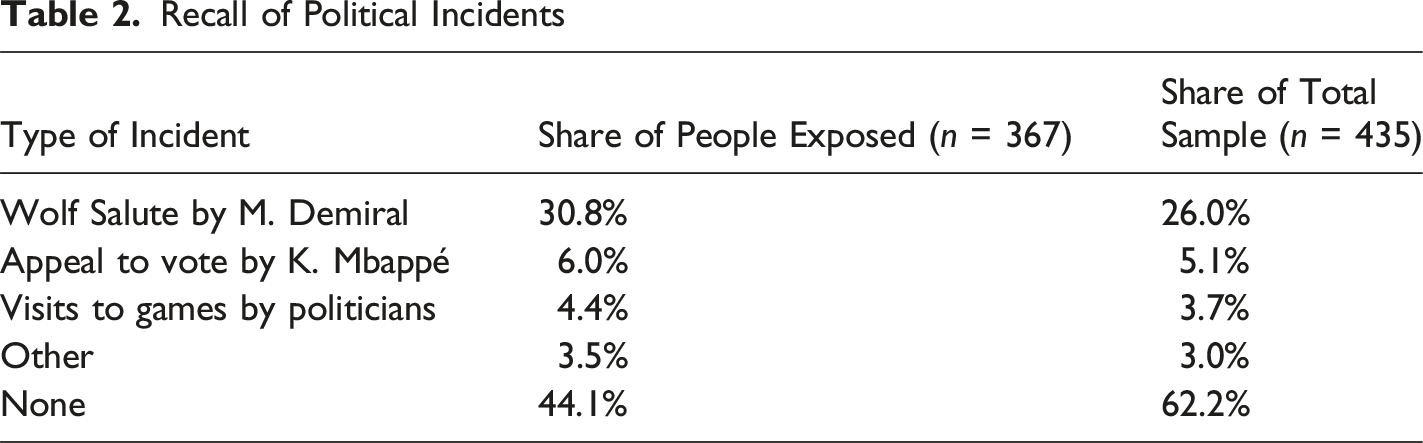
We measured whether participants could recall political incidents during the Euro 2024 with an open-ended question. We then manually coded the answers and created a binary variable with (1) people who recall a factually true incident and (0) participants who did not do so (no or incorrect answer). Additionally, we manually coded which political incidents were mentioned by participants.
Consumption of news about the Euro 2024 is measured with four items on a 7-point scale (mean index) covering reading news about (1) games and results, (2) the tournament and UEFA, (3) the teams, and (4) the fans (M = 2.9; SD = 1.7; α = .88). Use social media for information about the Euro 2024 was measured with a single item (M = 1.49; SD = 1.28). Here, we deviated from our pre-registration as we did not consider this variable when conceptualizing the study. Models without this variable are shown in Appendix C. Consumption of football games of Euro 2024 was measured with a single item instead of an index (M = 5.0; SD = 2.3). We initially planned to use three items on a 7-point scale (mean index) covering watching the games through the media (1) live, (2) non-linear, and (3) as summaries of games. However, as the Cronbach's Alpha values were below 0.7 for three items (α = .50) as well as for two items without the least reliable item (α = .55), we switched to a single item (watching live broadcasts of games) in line with our pre-registration. Interest in politics (M = 4.6; SD = 1.8) is measured with a single item on a 7-point scale. Interest in football is measured with three items on a 7-point scale (mean index) covering (1) being a football fan, (2) following pro and amateur football, and (3) football as the favorite sport (M = 3.3; SD = 2.1; α = .95). We used age, gender (male vs. non-male) and educational attainment (higher education vs. no higher education) as covariates.
Results
Self-Reported Exposure to Political Incidents
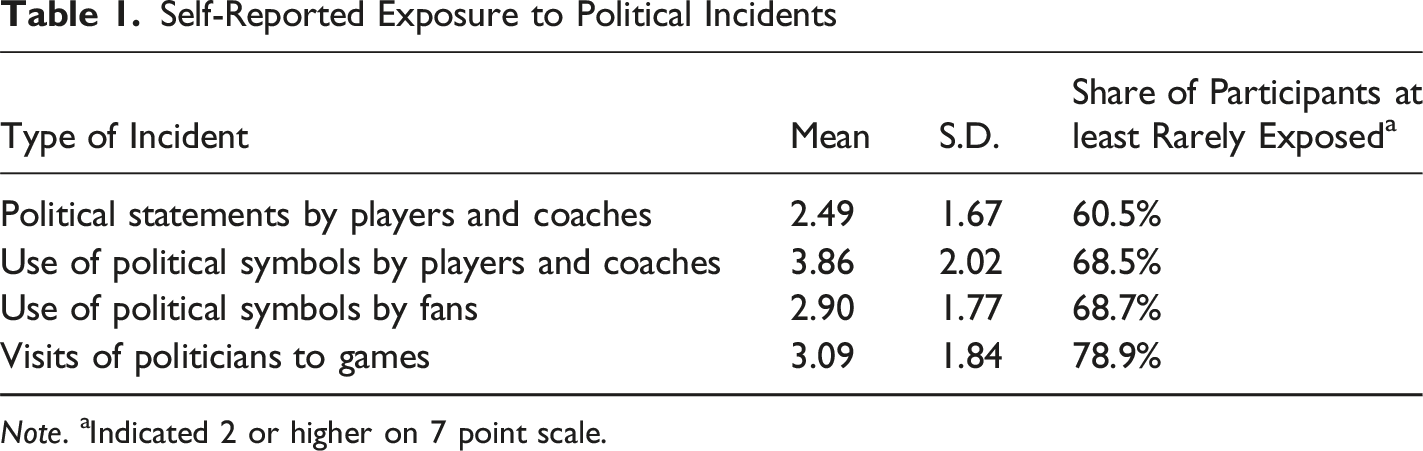
Note. aIndicated 2 or higher on 7 point scale.
Recall of Political Incidents
Self-Reported Exposure to Political Incidents During the Euro 2024
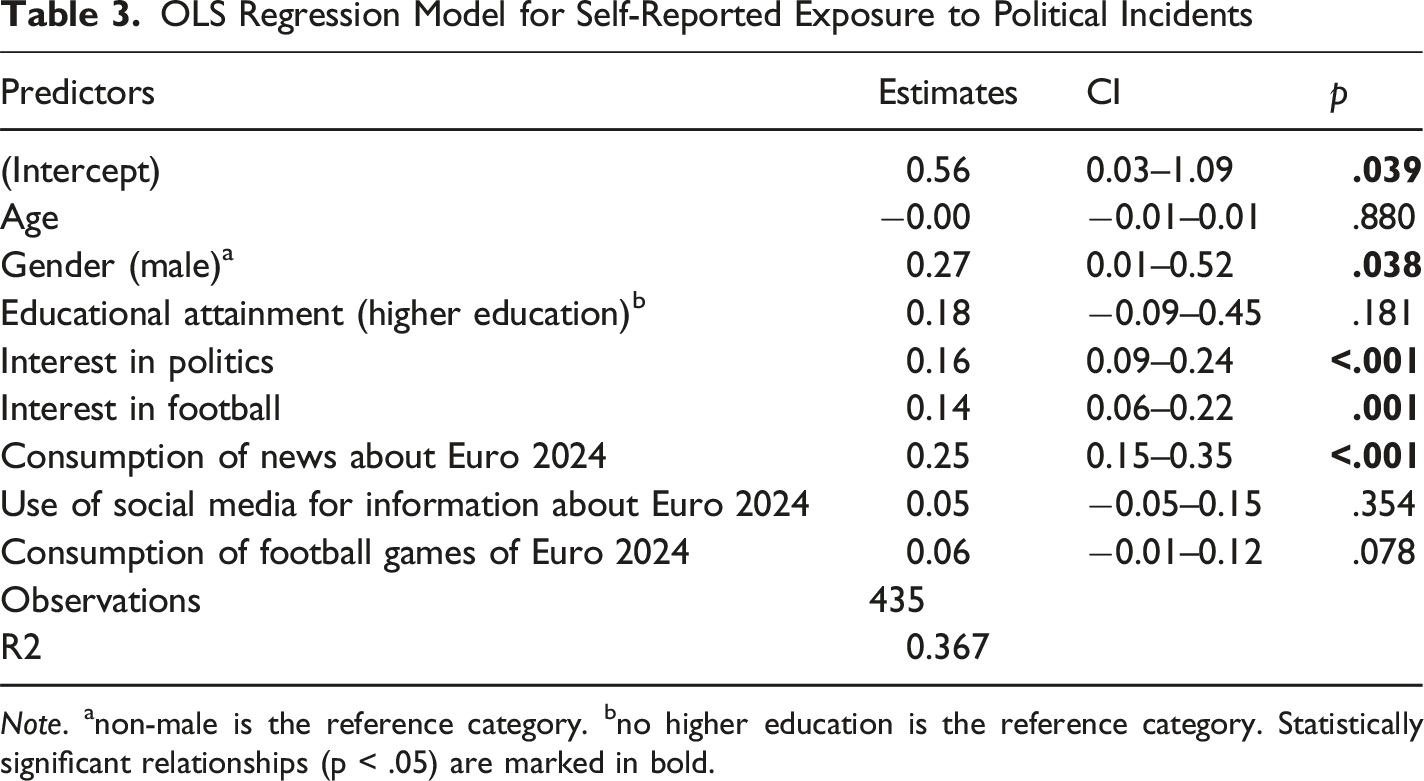
OLS Regression Model for Self-Reported Exposure to Political Incidents
Note. anon-male is the reference category. bno higher education is the reference category. Statistically significant relationships (p < .05) are marked in bold.
Recall of Political Incidents During the Euro 2024
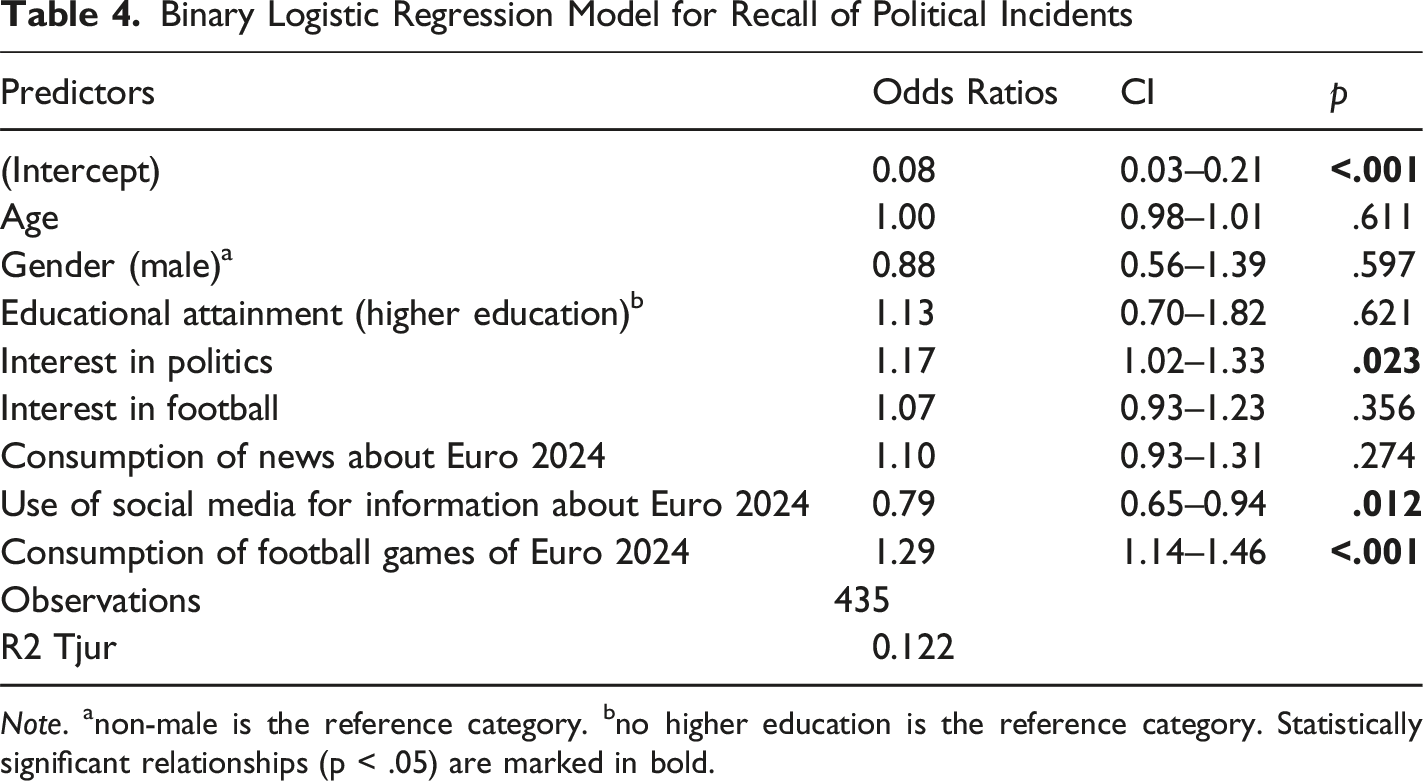
Binary Logistic Regression Model for Recall of Political Incidents
Note. anon-male is the reference category. bno higher education is the reference category. Statistically significant relationships (p < .05) are marked in bold.
Discussion and Conclusion
By looking at mediatized political incidents in sports, this article contributes to the study of political communication in the fullest sense, taking into account “the enlargement of the political sphere with an increasing number of problems and actors in the political limelight” (Wolton, 1990, p. 11). The study shows that political incidents surrounding major sports events indeed reach a substantial audience, supporting the notion of sports as mediated campfires (Ludwig & Bruns, 2017). A large part of the respondents could recall a political incident. One in four participants (26.0%) recalled the Wolf Salute by Merih Demiral. Even though we do not have any good benchmark values, this number seems quite high, especially as the incident was not directly related to Switzerland, and we surveyed the broad public and not only sports fans or regular sports viewers. Therefore, at least for this incident, the study’s result implies substantial mass media effects as supposed, for instance, in research on agenda setting (McCombs, 2005). The study also underscores the high degree of mediatization surrounding major sports events (Ličen et al., 2022; Skey et al., 2018), a trend that is likely to intensify further in digital media environments. Therefore, future research could benefit from a more detailed examination of the specific channels through which political communication reaches its audience.
Our study indicates that political incidents are at least partly mediated through various media channels. Following the news about the Euro 2024 is positively related to higher self-reported exposure to political incidents. However, following the news about the tournament did not increase the likelihood of being able to recall a factually true political incident that happened during the tournament. Although recalling political incidents represents only one aspect of political knowledge, our findings challenge the established link between news consumption and political knowledge (e.g., Moeller & de Vreese, 2019) when it comes to events outside the traditional political arena. Conversely, watching broadcasts of Euro 2024 games is positively related to recalling political incidents, a more rigorous measure for knowledge about political incidents than self-reported exposure. Thus, our study supports the literature showing that individuals can learn about political content from non-news sources (Broussard et al., 2021; Hollander, 2005; Wojcieszak et al., 2023). Most notably, our results provide further support for the findings of Broussard et al. (2021), who reported low but meaningful exposure to political content in televised sports media among Americans. Interestingly, using social media for information about the tournament is negatively associated with recalling political incidents, consistent with a meta-analysis by Amsalem and Zoizner (2023, p. 3), which found that “the contribution of social media toward a more politically informed citizenry is minimal”. However, these findings must be interpreted cautiously. We did not investigate the content provided by the news, on social media, or during football live broadcasts, nor did we consider which information about the Euro 2024 the participants actually encountered on the different channels. Future studies could examine the specific content participants consume across different channels during major sports events. This approach would enable stronger conclusions about the relationship between politics and sports, beyond measuring the correlation between channel usage and exposure to political incidents.
Our results underscore the role of interest in the two central societal spheres under study—politics and sports—a relationship we theoretically frame through dual processing of information (Eveland, 2001; Petty & Cacioppo, 1986). These approaches highlight that individuals who are highly motivated to engage with information are more likely to learn from it. Our study shows that political interest is related to the exposure and recall of political incidents related to the Euro 2024 tournament. This finding confirms, in the realm of sports, the ample research showing a positive relationship between interest in politics and knowledge about current political facts (Barabas et al., 2014). The study, therefore, indicates that mediatized political incidents during sports events reach an audience that is already interested in politics rather than new segments of the audience that are not interested in politics. However, our study also supports the argument that individuals exposed to political incidents during the tournament are not part of the typical audience of political communication: Interest in football is positively related to self-reported exposure to political incidents, even when controlling for interest in politics. However, these findings must be further validated and replicated, for instance, by examining the reception process of politics in sports in experiments that use dual-process approaches as a theoretical framework.
This study is a first step in exploring the relationship between large sports events and political communication. Naturally, the study has limitations, including its relatively small sample size and focus on a single country, which limits the generalizability of the findings for other countries. More specifically, even though the Euro 2024 is a prototypical large sports event, the generalizability of the findings to other sports events and beyond the realm of sports is questionable. Further studies could try to replicate our study in different countries and consider other sports events, for instance, the Olympics, the Football World Cup, or the Super Bowl. A promising direction for future research would be to examine sports from a comparative perspective, considering other so-called ‘non-political spaces’ or ‘third spaces’ (Bruns, 2023), for instance, political communication by musicians or actors. The recent outcry during the 2024 US presidential elections, as popstar Taylor Swift announced her support for Kamala Harris, further highlights the relevance of political communication in ‘third spaces’.
Furthermore, our study focuses on Switzerland. As it was among the countries participating in the Euro 2024, the tournament generated considerable interest among the public. Even though the most significant political incidents during the tournament were not directly related to Switzerland, they were still relevant for parts of the Swiss population, given the country’s proximity to France and its substantial Turkish migrant community. Future research could therefore focus on countries that were the primary targets of the political communication—in this case, France and Turkey. It would also be valuable to examine within Switzerland, how minority identities (e.g., Turkish, Kosovan, North African), the country's linguistic regions (German, French, and Italian), or sociodemographic variables (e.g., income, urban vs. rural residence) influence perceptions of political incidents and related experiences of national belonging. In a similar vein, it is necessary to examine how political debates in Switzerland or other countries, such as those concerning immigration, may shape the politicization of sport domestically.
Additionally, our study did not distinguish between the different types of political incidents that occurred during the tournament. We observed that factors such as celebrity status (e.g., Kylian Mbappé) and strong visual symbols (e.g., the Wolf Salute) seem to play a significant role in the reach of these incidents. Future research could, therefore, explore various types of political incidents, the factors driving their impact, and their effects on the audience. Related to this, the concept of political incidents was quite restricted in the study. For feasibility, we focused on some types of incidents and did not ask what participants perceived or evaluated as politically relevant content or actions. Even though we did not give any specific examples of incidents, the four items used for the study gave hints and predefined the scope of what type of incidents people would eventually recall. Finally, we also did not test actual knowledge about the incidents, for instance, the possible background and motivations of the involved actors. Future studies on political incidents during sports events could investigate people’s knowledge about these incidents in more detail.
As a highly visible and mediatized domain, major sporting events offer significant opportunities for political actors. Given its potential reach, we must ask how ‘politics on the pitch’ should be assessed from a normative perspective. Does this kind of political communication benefit society and democracy or not? Our study shows that there is potential in political communication through sports events to reach segments of the population that cannot be reached through established channels of political communication. In this regard, activities to mobilize voters can be seen as a legitimate act in the political process. However, the display of extremist symbols like the Wolf Salute also shows the potential downside of political communication on the stage of sports events. Our study indicates that provocative and emotional gestures, like the Wolf Salute, attract widespread attention and can fuel societal polarization—strengthening in-group identity at the expense of out-group exclusion. Indeed, the suspension of Merih Demiral following his controversial gesture led to solidarity with the team and resulted in large groups of Turkish fans displaying the Wolf Salute in the stadium during the subsequent games. Therefore, future research on political communication in sports should explore its adverse effects, such as polarization and radicalization, as well as its potential for political learning, participation, and social integration. This study provides a starting point for such research by investigating the audience and reach of ‘politics on the pitch’ during the Euro 2024, a prototypical large sports event.
Supplemental Material
Supplemental Material - Politics on the Pitch – How Is Mediatized Football Consumption Related to the Exposure to and Recall of Political Incidents During the Euro 2024?
Supplemental Material for Politics on the Pitch – How Is Mediatized Football Consumption Related to the Exposure to and Recall of Political Incidents During the Euro 2024? by Daniel Vogler, and Manuel Arrigo in Communication & Sport
Footnotes

Ethical Considerations
After the completion of a checklist provided by the Ethics Committee of the Faculty of Art and Social Sciences at the University of Zurich, the study received an exemption from full review of the ethics committee.
Consent to Participate
Participants provided informed consent before taking part in the survey of this study.
Funding
The authors received no financial support for the research, authorship, and/or publication of this article.
Declaration of Conflicting Interests
The authors declare no potential conflicts of interest with respect to the research, authorship, and/or publication of this article.
Data Availability Statement
The data that support the findings of this study are available from the corresponding author upon reasonable request.
Use of AI Tools
We used ChatGPT 3.5 for language editing and translation of the questionnaire.
Supplemental Material
Supplemental material for this article is available online.
Notes
References
Supplementary Material
Please find the following supplemental material available below.
For Open Access articles published under a Creative Commons License, all supplemental material carries the same license as the article it is associated with.
For non-Open Access articles published, all supplemental material carries a non-exclusive license, and permission requests for re-use of supplemental material or any part of supplemental material shall be sent directly to the copyright owner as specified in the copyright notice associated with the article.
