




Abstract
Female athletes and activists often advocate for ‘equal pay’ or criticize existing gender pay gaps in sport. In their efforts to draw attention to persistent gender inequalities and to initiate change, they rely on media visibility. Therefore, this article examines how athlete activism for equal pay resonated in the German media. We analyze how often equal pay was reported on, and which events prompted this coverage. Given that a variety of arguments in favor of and in opposition to these demands exist, we also examine the framing of the articles in detail. Our analysis is based on 96 articles that appeared in seven highly popular German news outlets between January 2020 and December 2024. Our findings reveal that female athletes were able to mobilize some positive media resonance, but only for shorter periods and for narrowly targeted claims. A majority of articles framed gender pay gaps in sports as unjust and unfair, but then suggested market-conform solutions. This means that a reduction of existing pay gaps would imply that women’s sports must ‘catch up’ by following the designated path of commercialization as known from men’s sports.
The development of women’s sport has been impeded by deeply rooted traditions of gender-based discrimination. Sport has been culturally constructed as a male domain, which inspired the exclusion of women in the past (Pfister, 2017). As a result, men’s sports have occupied and continue to dominate the ‘public sport space’ (Markovits & Hellerman, 2001). In contrast, women’s sport and female athletes have faced an uphill battle for legitimacy, media visibility and acceptance among sport consumers who have continued to be drawn to the men’s sport (Cooky, Messner, & Hextrum, 2013; Cooky et al., 2021; Meier & Leinwather, 2012). However, recent trends show that the gendered character of sport and sport fandom is dynamically evolving. Women’s football is achieving increasing commercial success and is gaining more recognition among both female and male fans (e.g., Allison & Kossakowski, 2024; Antunovic & Whiteside, 2018). For instance, the most popular German TV broadcast in 2022 reaching 17.9 million viewers was the final match of the UEFA Women’s football EURO between England and Germany (Haddad et al., 2023). However, although women have made substantial progress to assert their right to equal access to popular and elite sports, the legacy of this historical marginalization persists. Women’s sport remains at a disadvantage in terms of professionalization and commercialization, with far-reaching consequences that materialize in a dramatic gender pay gap in many sports.
Following a resurgence of athletes’ political activism, female athletes have become more vocal in their resistance against persistent gender discrimination in sports (e.g., Cooky & Antunovic, 2020; Crawford, 2023; Hill, Erlandson, & Price, 2023; Steidinger, 2020). This growing wave of activism has led to calls for more rights, improved training conditions and, not least, equal pay (Steidinger, 2020). Several prominent examples of successful activist actions exist: Billie Jean King’s landmark fight for equal prize money in tennis marked a pivotal moment in the struggle for equity (Schultz, 2011). More recently, the US women’s national football team’s legal battle for equal pay (Culvin et al., 2022), and Spanish female footballers’ strike for a minimum salary (Valiente, 2021) demonstrate the lengths to which athletes are willing to go to address systemic inequities. Many more examples exist, including basketball, tennis, and golf (Munro-Cook, 2024; Zerunyan, 2017), which emphasize the ongoing fight for fairness and equality.
Given the complexity of the debate on the gender pay gap in sport, with its numerous normative lines of reasoning and justification (e.g., Archer & Prange, 2019; Kowalenko, 2022; Morgan, 2021), it is likely that activists’ prospects of mobilizing public support depend on whether their demands are taken up in the media and, if so, how they are portrayed. Media coverage and support may not only help to raise public awareness, but also increase the likelihood that decision-makers in sports organizations or in politics will take up and publicly support the demands of athletes. For instance, Germany’s ex-Chancellor Olaf Scholz released a tweet during the UEFA Women’s Euro 2022 advocating for equal pay in football, which helped to further stimulate media attention and put the German Football Association (DFB) under pressure. Therefore, the current contribution examines the coverage and framing of the ‘equal pay’ debate in sport by leading German media outlets. Assuming that media coverage and framing is decisive for the success of political activists, we will address the following key research question: How did German media cover and frame the debate about the gender pay gap in professional sports?
The paper proceeds as follows: We provide a brief overview of gender discrimination in sports, with a particular focus on the gender pay gap. After this, we explore the demands for equal pay through the lens of social movement research and collective action frames. Then, we present our research design and methodology. Our findings indicate that German media generally acknowledge complaints about a gender pay gap in sports, yet their attention to this issue is sporadic and their framing of equal pay claims rather inconsistent. While gender pay gaps are frequently portrayed as unjust, the dominant narrative also frames demands for equal pay often following a market-driven logic, according to which women’s sports must first demonstrate commercial viability before salaries can improve.
Literature Review
Gender Discrimination in Sports
Sport has been characterized as a major site for the reinforcement of masculinity and the exertion of men’s power over women (e.g., Dworkin & Messner, 2002; Sabo & Jansen, 1992). Historically, women were excluded from participation in sports in general and competitive sports in particular (Pfister, 2017). Women’s sport was only hesitantly accepted by sports associations and, if so, often only under conditions that restricted it to an amateur pastime, which strongly impeded the development of professional structures (Williams, 2003). The arguments justifying such gender discrimination included the alleged physical ‘weaknesses’ of women’s bodies or the purported detrimental effects on fertility (e.g., Meier, 2020; Pfister, 2017). These notions have been instrumental in perpetuating gender-based barriers in sports. Gaining access to competitive sports has commonly been a result of a long and insistent fight by female sport activists, who often employed a liberal-feminist discourse advocating for equal rights and opportunities (Scraton et al., 1999). In addition, sports media trivialized and marginalized women’s sporting competitions for decades (Crawford, 2023; Hartmann-Tews, 2019). Only recently has media attention become more responsive to female athletes and their achievements, signaling a shift in the recognition of women’s sports (Antunovic & Whiteside, 2018; Bruce, 2016). For example, analyses conducted by Parry et al. (2023) of news coverage of women’s football in the UK found an empathetic and positive attitude as well as a critique of the dominance of men’s football in terms of commercialization. In a study of English tabloid print sports media, Clayton et al. (2025) provided evidence that gendered reporting, such as, stereotyping, sexualization and trivialization of women athletes, had markedly declined over last two decades. Yet, they noted a relative invisibility of women’s sports. The latter finding echoes the result of the study by Cooky et al. (2021), who found a dismally low quantity of coverage of women’s sports in televised sports news, highlights shows, online sports newsletters and social media. Hence, although there is undeniable some progress in the coverage of women’s sports and athletes, men’s sports continue to dominate sports media.
These findings indicate that gender discrimination has left a lasting imprint because it created a significant first-mover advantage for men’s sports. As traced by Markovits and Hellerman (2001), men’s sports were able to occupy the ‘public sport space’ at the beginning of the era of mass media and popular culture. Often by closely linking sports, masculinity and national identity, men’s sport came to embody what Markovits and Hellerman (2001) have called the ‘hegemonic sports culture’. With the advent of early mass media, such as newspapers and radio, the public interest in these hegemonic male sports provided the base for their early commercialization and professionalization and turned male athletes into superstars and national icons. Moreover, sport spectatorship and fandom have also been gender stereotyped as primarily masculine pursuits (McCabe, 2007), which has materialized in persistent gender differences in sport consumption (Meier et al., 2017; Wann et al., 2008). Notwithstanding a ‘feminization’ of sport consumption and fandom (Mewett & Toffoletti, 2011), female audiences are still predominantly drawn to men’s sports, which still receive the lion’s share of public attention (Meier & Leinwather, 2012). Yet, the fact that the gendered character of sport is dynamically changing is indicated by the commercial growth and increasing popularity of women’s sport, in particular women’s football (e.g., SportFive, 2025), which has materialized in a number of audience records. For example, FC Barcelona Femení attracted more than 91,000 visitors for their match against Wolfsburg on 22 April 2022. There is also evidence that women’s sport is gaining increased recognition among male fans (Allison & Kossakowski, 2024).
However, the fact that sporting organizations have either failed to promote women’s sports or have actively suppressed its development, whilst the media has neglected or stereotypically portrayed female athletes, has had a lasting detrimental effect on the commercialization of women’s sports. Hence, it should not come as a surprise that huge gender pay gaps in professional sports exist. Thus, for the professional basketball and ice hockey leagues in the U.S., it has been estimated that the average male player earns approximately 100 times more than the average female player (Oliveira, 2024). Similarly, the average male footballer in the English Premier League receives a salary which is about 60 times higher than the average female footballer (see Cruz, 2024). Even in tennis, a sport that is often considered to be more gender-equal – since the Grand Slam tournaments award equal prize money – there is still a gender pay gap (Flake, Dufur, & Moore, 2013; Akabas, 2023). Wicker et al. (2023) found a gender pay gap of 14.5% even in semi-professional sports, where salaries are substantially lower for both genders. Hence, gender pay gaps exist in most sports.
Scholars have pointed to various reasons why a gender pay gap in sports could be criticized, but does not necessarily have to be (Archer & Prange, 2019; Morgan, 2021). Critics often refer to the moral principle of equal pay for equal work. Using football as example, Archer and Prange (2019) state: ‘Both male and female footballers compete in the same sport at the highest available level, playing games that last the same length and dedicating as much time to training’ (p. 420). In contrast, Dilger and Scharfenkamp (2020) argue that the performance of women and men in football is not equal, because second-rate men’s teams would prevail against the best women’s teams, so that a financial advantage for men is therefore not unfair. By shifting the focus from ‘equal work’ to ‘unequal performance’ they justify the existing gender pay gap. A second rationale refers to equal pay for equal audience, whereby arguments are made within the framework of a market-based, economic logic (Archer & Prange, 2019). Athletes who reach more paying viewers and consumers can demand a higher wage. As long as these are male athletes and male teams, the wage difference to women would be legitimate expression of consumer preferences. However, arguing from a legal standpoint, Morgan (2021) claims that clubs and leagues are not allowed to discriminate against female athletes just because consumers have prejudices. Adding complexity to the discussion, Kowalenko (2022) distinguishes between an ‘actual’ and a ‘possible’ audience, thus calling attention to the conditions of men’s and women’s sports, in terms of professionalization, ideology, and culture, that impact to what extent gender differences manifest. Archer and Prange (2019) advocate for another view that emphasizes historical injustice against women sports and athletes. They argue that from discrimination in the past follows a moral obligation to compensate for the injustice through reparation payments. Sports organizations must thus abandon a purely economic logic of distribution and instead invest more of their revenue in women’s sport and its development today.
This brief review of normative reasoning suggests that the media can adopt and justify very different points of view. In this way, the media provide their audience with an important aid to interpretation. Hence, it is relevant to analyze how exactly they frame their positions – for or against equal pay in sport.
Political Activism and Framing
In the wake of a resurgence of athletes’ political activism (Broussard, 2020; Magrath, 2022), women’s sports activists have become increasingly vocal in addressing persistent gender discrimination, notably the gender pay gap. In accordance with previous research, we define ‘athlete activism’ as an intentional act of athletes using their popularity to take a stance on political or societal issues to bring about change (e.g. Frederick et al., 2018; Schmidt et al., 2019). This definition includes advocacy, that is, the attempt to generate support for a marginalized or disadvantaged group by means of persuasive communication. While some scholars would agree to characterize advocacy as subtype of activism (O’Neill et al., 2023; Toledano, 2016), others claim that advocacy is fundamentally distinct from more radical and disruptive forms of activism, since advocacy operates more within the system to promote particular causes through insider actions (Knowles et al., 2024, p. 440). Yet, our more inclusive definition allows us to consider a broader range of public statements and actions.
Following social movement research, we assume that the success of athletes’ political activism, which challenges existing gender hierarchies and power structures, depends on the ability to mobilize broader support. Social movement research provides a framework for theorizing how female athletes can garner this support. Benford and Snow (2000, p. 613) have claimed that ‘the struggle over the production of mobilizing and counter mobilizing ideas and meanings’ is central for the success of political activists and marginalized social groups. Accordingly, political activists who aim to build a network of allies and to mobilize public support need to develop what has been called an effective collective action frame (Den Hond & De Bakker, 2007). A collective action frame represents an ‘interpretative schemata that simplifies and condenses the “world out there” by selectively punctuating and encoding objects, situations, events, experiences, and sequences of actions’ (Snow & Benford, 1992, p. 137). Effectively framing a political issue comprises three key components: diagnostic framing, which identifies and explains the problem; motivational framing, which provides moral justification for action; and prognostic framing, which offers solutions (Snow & Benford, 1988). Prognostic framing also serves to justify abstract solutions and renders ideas into understandable and compelling formats. It resembles what Strang and Meyer (1993, p. 491) defined as ‘theorizing’, including ‘the formulation of patterned relationships such as chains of cause and effect’. Thus, social movement research has developed a rather elaborate concept of collective action frames, which emphasizes that activists have to engage in broader advocacy activities (Den Hond & De Bakker, 2007; Perkmann & Spicer, 2008).
However, even if political activists manage to present a compelling collective action frame, their success depends on whether they find ‘frame resonance’ (Snow & Benford, 1988; Williams, 2004). The concept of frame resonance emphasizes the pivotal role that the media, as traditional gatekeepers and potential allies, have historically played for the success of political activism. However, the inherent selectivity of media attention and framing suggests that the alignment between media narratives and the collective action frames designed by activists may not always be congruent. Consequently, media frames may not fully align with the collective action frames constructed by activists. In media research, frames are understood as interpretative schemata but primarily employed as discursive tools, which are used ‘to select some aspects of a perceived reality and make them more salient in a communicating text’ (Entman, 1993, p. 52). The process of media framing encompasses various elements, such as the manner in which topics are reported, the emphasis placed on particular aspects, the expression of diverse positions and counter-positions, the use of specific linguistic depictions or metaphors, and the invocation of values and morals. These elements collectively significantly impact audience reception (Dahinden, 2018).
In sum, in order to achieve their aims, political activists need to mobilize broader public support, which depends on the ability to develop effective collective action frames. These frames must resonate within the media, which serve as key intermediaries. Therefore, it is relevant to examine how the media respond to claims for equal pay and how these claims are framed in relation to the different rationales and values outlined above.
Methods
Research Design
We conducted a systematic qualitative and quantitative content analysis of German media coverage of equal pay claims articulated by female athletes. Using a qualitative approach, we analyzed the key frames that recur in the media and how they are linked to overarching political debates, issues and values. Moreover, we were interested in quantifying how frequently and in which specific combinations they appeared. Our mixed-methods design thus combined a qualitative and quantitative perspective.
Sample
The analyses built on a comprehensive review of the daily newspapers with the highest circulation in Germany, including Frankfurter Allgemeine Zeitung (FAZ), Süddeutsche Zeitung (SZ), tageszeitung (taz), Welt, and Bild. These newspapers cover the political spectrum from left-leaning, alternative (taz), left-liberal (SZ), conservative-liberal (FAZ) to conservative (Welt), and they include Germany’s most popular tabloid (Bild), which shows conservative and populist leanings. The analysis was complemented by the inclusion of Deutschlandfunk, a nationwide public service radio station, and sportschau.de, a particular prominent sports program on German public TV with an accompanying website, thereby broadening the scope of the study and facilitating a more comprehensive examination of framing elements. Our analyses focused only on the online articles published on these websites not on audio-visual content. However, in the case of the Deutschlandfunk, some of the online articles represented transcripts or edited versions of radio broadcasts.
The search strategy was initially established with a broad scope, identifying all articles referencing (a) ‘equal pay’, salary, prize money or income, the German search terms were ‘Equal Pay‘, ‘Gehalt’, ‘Prämie’, ‘Bezahlung’, ‘Pay Gap‘, and ‘Gleichberechtigung’: (b) elite sport in general or a particular sports discipline, the German keyword was ‘Sport’, and (c) different form of activism, the German search terms were ‘Protest’, ‘Statement’, ‘Aktion’, and ‘Forderung’. The search period was defined as ranging from January 2020 until December 2024, thus covering five years. The search was performed in the online archives of the respective media outlets and was slightly adapted, if necessary, depending on the archive. For example, in the case of sportschau.de, there was no need to include a reference to sports.
Number of Articles per Medium, Including Media Characteristics
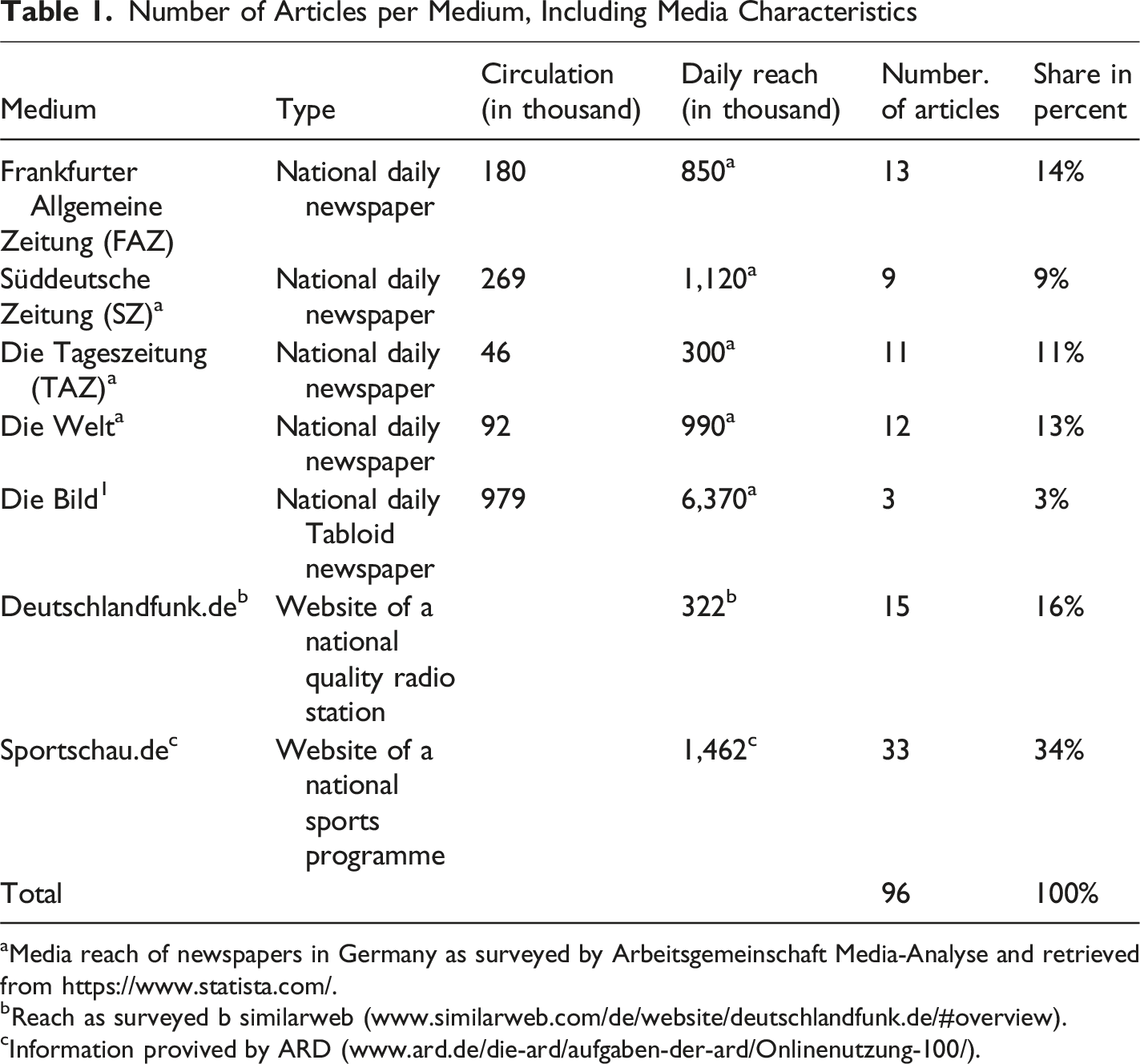
aMedia reach of newspapers in Germany as surveyed by Arbeitsgemeinschaft Media-Analyse and retrieved from https://www.statista.com/.
bReach as surveyed b similarweb (www.similarweb.com/de/website/deutschlandfunk.de/#overview).
cInformation provived by ARD (www.ard.de/die-ard/aufgaben-der-ard/Onlinenutzung-100/).
Qualitative Analysis: Identification of Problem Diagnoses and Frames
In a first qualitative step, we aimed to analyze the problem diagnoses associated with the notion of equal pay. In a strict sense, equal pay means the equalization of income between men and women. However, professional athletes have multiple sources of income, ranging from prize money, sponsorship deals, salary or state subsidies implying that quite different organizations and rationales are involved and distinct remedies might be needed. Therefore, we analyzed which income source a gender pay gap or equal pay claim referred to under the notion of equal pay.
In a second step, the research team jointly developed a codebook for the framing analysis based on initial reading of the identified articles and extensive discussions. First, a random sample of N = 44 articles was analyzed by all team members in order to inductively identify a first set of potential frames to be coded. In a second step, another random sample of N = 11 articles was retrieved and coded by the four members of the research team. Then, we examined the intercoder reliability. Based on the results, two categories that showed rather low reliabilities were discussed and carefully refined. After another round of random sample coding, a sufficient level of reliability was achieved (Cohen’s kappa = 0.71) so that the research team could proceed with coding the entire sample of articles. At this early stage of the coding process, it became clear that the articles were not exclusively and consistently dedicated to one single frame. Rather, articles often employed several distinct frames. For example, a single article may have identify shortcoming in sports policy as a key problem, then describe athletes as agents for progressive change but also emphasize market-based proposals as primary solution to gender pay gap problems. Therefore, we decided that multiple frames could be coded for one single article.
As a result of these efforts, the research team agreed to code nine frames in total. These frames were defined as (1) gender inequality of pay as a fundamental injustice, (2) pay in sports as expression of a market-conform logic, (3) professionalization of women’s sports, (4) redistribution of resources from men’s to women’s sports, (5) inertia of sports organizations in terms of promoting women’s sport, (6) change through (athlete) activism, (7) women’s sport as a progress and success story, (8) symbolic recognition of female athletes, and (9) women’s sport as an anti-commercial alternative. These frames are described in detail in the results section, which depicts their key arguments and the primary values they endorse.
Quantitative Analysis: Trends, Frequencies and Patterns of Frames
First, we conducted some primarily descriptive statistical analyses. We traced (a) how media attention for equal pay related topics evolved within the period under scrutiny, (b) which events and sports invoked equal pay debates, and (c) which frames dominated media discourse on equal pay. Secondly, we explored the ‘ideological space’ of the German debate on equal pay in sport. In order to do so, we treated our data as a two-mode network with the individual articles as the first type of nodes and the coded frames as the second type (Grandjean, 2015). We projected these data into a one-mode network, which is then displayed in a two-dimensional space. The visualization employs the Fruchterman–Reingold force-directed placement algorithm (Fruchterman & Reingold, 1991). Adjacent frames are close to each other in the sense that they are frequently used in the same article and can thus consistently be combined within the same ‘equal pay’ narrative.
Findings
Media Attention for Equal Pay Issues in Sport
Descriptive statistics indicate that German media’s attention for equal pay issues in sport has been highly selective and sporadic. Moreover, our findings demonstrate once again the hegemonic role of football in Germany, which dominates sport media (e.g., Hess & Zubayr, 2023; Horky et al., 2025) and sport entertainment since almost half of Germany’s private consumer budget for sports entertainment is spent on football (BMWi, 2021). Football’s dominance in Germany’s sport culture is reflected in the fact that the media discussed the gender pay gap most often in relation to commercialized football (77%). Sports, such as road cycling (6%), basketball (5%), and handball (3%), follow by a wide margin (see Figure 1). Gender pay gaps in other sports (golf, ski jumping, etc.) were usually only covered by one article within the 5-year period under review. Events and Sports Appearing the German Sport-Related Gender Pay Discourse 2020 – 2024. Note: Figure contains only events to which at least two articles refer (exception: not event-related articles)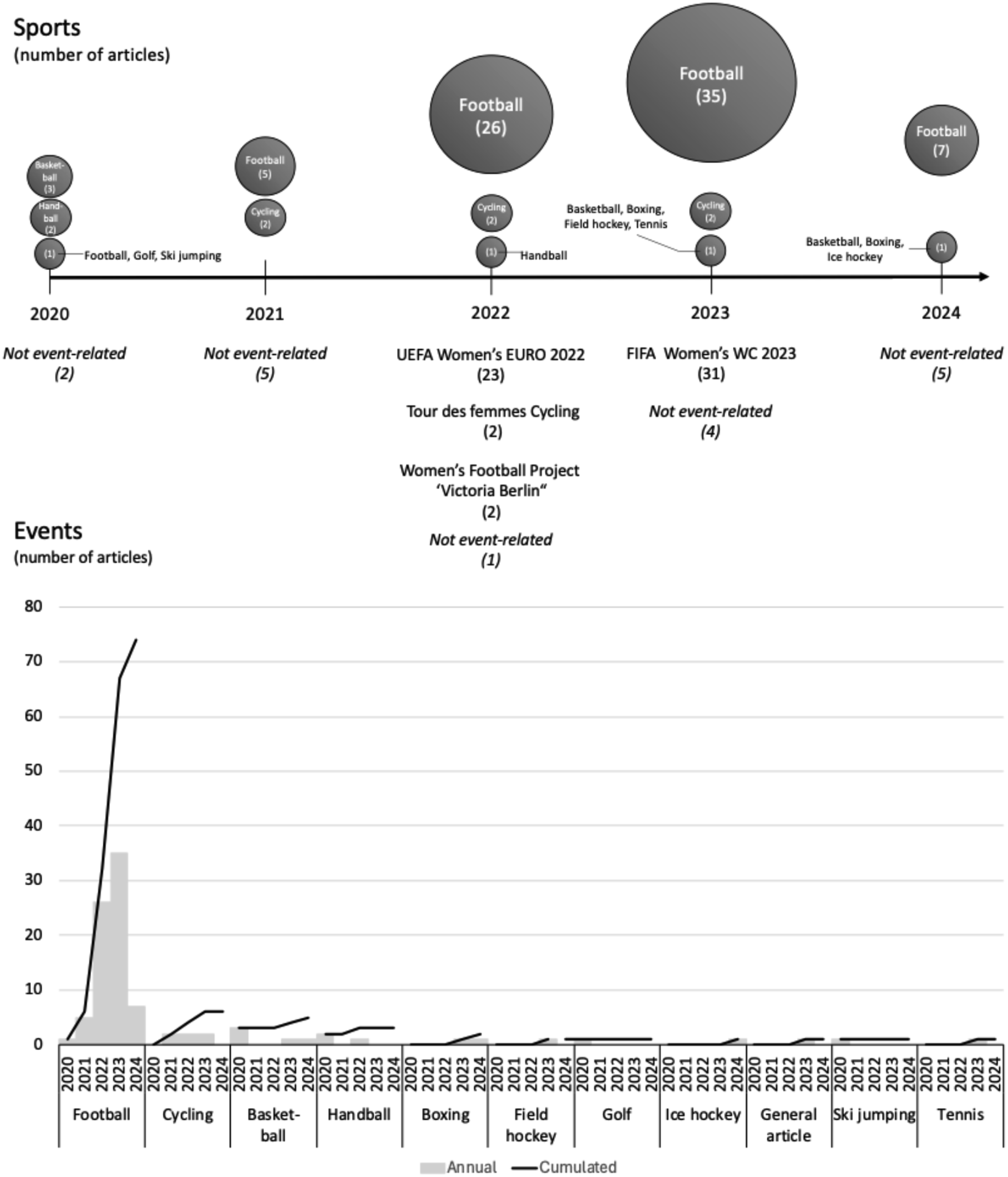
The selective coverage of gender pay gap themes is further indicated by the dominance of two mega sport events: 23 articles referred to the 2022 UEFA Women’s EURO hosted by England and 31 articles referred to the 2023 FIFA Women’s World Cup hosted by Australia and New Zealand. The absence of the Olympics is notable as the International Olympic Committee (IOC) has persistently emphasized its commitment to gender parity in participation (IOC, 2024). However, equal pay issues are almost irrelevant with regard to the Olympics as athletes do not get compensated for participation. In contrast, the women’s football events, which invite comparisons with the men’s editions, provided media with suitable opportunities to reflect upon the gender pay gap and its development. It is important to note that Germany’s then Chancellor Olaf Scholz fueled the debate in 2022 when he released a tweet on Twitter criticizing lower performance-related bonuses that female footballers received in comparison to their male counterparts. He tweeted: ‘It is 2022. Women and men should be paid equally. This also applies to sport, especially to national teams. Spain is ahead of the game.’ This brief statement provoked huge media response for a few days and forced current and former footballers as well as the DFB to take a stand [e.g., 24, 45, 46, 54, 68, 69, 70, 79, 90, 91].
Another event, which attracted substantial media attention, was the take-over of the private law football entity of FC Viktoria 1889 Berlin by an all-female management team, including former national team players as well as top managers from major corporations [9, 16, 30, 92]. The combination of sporting celebrities and economic expertise, as well as the vision of combining the pursuit of social change through a women’s football project with a feminist focus and generating future profits, attracted the media, who portrayed the take-over as the advent of a new era in women’s football.
These findings suggest that German media’s attention for gender pay gaps in sports is primarily event-driven and focused on football. It might be speculated that the discussion of gender discrimination as well as progress of women’s sports has become a ritualized component of the coverage of major women’s football events. Less commercialized niche sports are hardly covered and if so, claims made by athletes from these sports are only given one-off attention.
The Vagueness of the Media’s Use of ‘Equal Pay’
A detailed analysis reveals that German media associated a broad range of diverse problems and demands with ‘equal pay’. In the articles examined, the term was used with reference to salaries [e.g., 50, 52, 63], sponsor support [96], tournament prize money [e.g., 4, 10], or performance bonuses paid by sport organizations [e.g., 7, 79]. Thus, the media employed the notion of equal pay as a signifier of a wider range of gender inequalities in terms of monetary rewards.
The rather generic use of the term reflected to some extent ambiguities in public statements of athletes. Hardly any athlete demanded ‘true’ equal pay in terms of equalization of overall income derived from sports between women and men. Moreover, athletes used equal pay often to refer to prize money, sponsor donations or bonuses. Former boxing champion, Regina Halmich, demanded an alignment of purses for bouts [32]. Hockey player Kira Horn criticized ‘that 80% of sponsorship money in sport goes to men’ [96]. With regard to professional golf, cycling or ski jumping, media reports noted that female athletes criticized lower tournament prize money in the women’s branch, but also a lower number of high-class tournaments [4, 12, 85]. Thus, Deutschlandfunk mentioned that the male winner of the Tour de France received €500,000, but the female winner of the Tour de France Femmes just €50,000, which was criticized by Olympic track cycling champion Mieke Kröger [12]. The fact that the DFB offered lower bonuses for winning the European Championship title – €60,000 for the women compared to €400,000 for men – sparked a much bigger debate in Germany [e.g., 7, 14, 79].
Sometimes, the term ‘equal pay’ was also used to call for a reduction in the inequality of incomes between male and female athletes, but not for complete equality [e.g., 23, 50, 55]. In the context of professional men’s football or men’s basketball, articles often referred to the astronomical salaries common in these sports and emphasized that women could only earn a small fraction of that. Athletes then demanded first steps towards equalization or even only minimum salaries. For instance, sportschau.de cited German national football player Lisa Magull with the claim: ‘It is not about exploiting the millions like the men do. But we simply have to come a little closer in terms of money’ [55]. Magull as well as former football player Tabea Kemme advocated for a minimum salary of at least €3,000 per months in the women’s Bundesliga [11, 50]. The salary should be high enough so that ‘no one should have to go to work in addition to doing sport’ [49].
Finally, a number of articles mentioned equal pay as a way to demand more professional conditions for women’s sport. Thus, former national team football player Almuth Schult, prioritized ‘equal play’ instead of ‘equal pay’. Schult criticized the precarious situation of many female Bundesliga players: ‘Girls have to take time off from their jobs because of a game during the week on Monday or Friday’ [59]. Professionalization was then regarded as a possible way to catch up financially, but it does not imply equalization of salaries in men’s football.
In sum, for German media the notion ‘equal pay’ has served to indicate gender inequalities in monetary rewards in sport. Viewed from the perspective of collective action frames, the media did not provide an effective diagnostic framing, which identified and explained a well-defined social problem. Rather, the notion of equal pay has been ambiguously used referring to a plethora of different claims and perspectives.
The Framing of Gender Pay Gaps in Sports
Descriptive analyses reveal that ‘Inequality as injustice’ was the most often employed frame in media coverage, followed by ‘Professionalization’, ‘Market-conforming pay’, and ‘Progress of women’s sport’. All other frames enjoyed less popularity (Figure 2). Proportion of Articles that Include a Particular Frame (in Percent). Note: On Average, 3.27 frames were found in each article.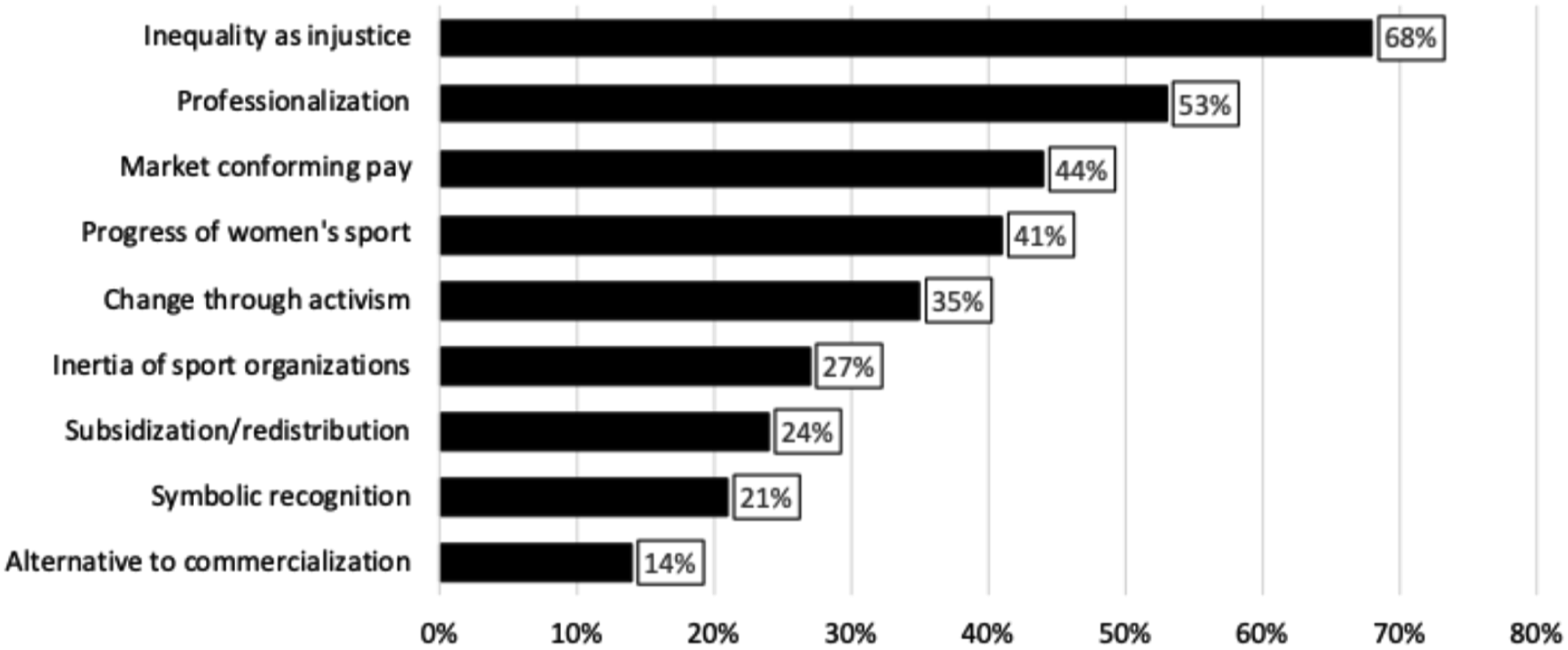
Inequality as Injustice
The most popular frame, which describes gender inequality of pay as a fundamental injustice, appeared in 68% of the articles. The frame criticizes inequality in salaries, bonuses, and working conditions as unjust, emphasizing that effort or success are similar for female and male athletes. The injustice claim is usually based on the principle of ‘equal pay for equal work’, whereby in the context of elite sport the meaning of work relates, for instance, to training load, time investment, number of competitions or, as stated below, the ‘same passion’. After winning the WNBA title with New York Liberty, national basketball player Leonie Fiebich denounced the low wages in the US women’s league compared to men. ‘It is just a bit sad because ultimately you put in the same work, have the same passion, invest a lot and get less out of it than the men,’ said the 24-year-old. On average, women in US basketball only earn about a 10th of what men do and that is despite the fact that women make the same sacrifices [63].
Other articles that employed the injustice frame complained that some women’s sports do not meet minimum standards or neglect basic financial needs of female athletes. The articles emphasized precarious employment conditions claiming, for instance, that women ‘earn so little that you cannot call it professional sport’ [17], ‘cannot make a living from sport’ [96] or are ‘only reimbursed for travel costs’ [55]. The dominance of the injustice frame indicates that there is some normative consensus in the German media concerning the rejection of gender pay gaps in sports.
Professionalization
The second most popular frame, which was identified in 53% of the articles, refers to professionalization. This frame relates demands for equal pay to ‘equal play’. More precisely, the frame emphasizes the lack of professional conditions in women’s sports in particular with regard to training, access to professional support, competition opportunities and precarious employment conditions. The articles often depicted professionalization as a development perspective that could be paving the way into a financially better and, eventually, more equal future. Typical for this view, Deutschlandfunk cited former footballer and FIFA World Cup winner Nia Künzer, who emphasized that professional conditions are fundamental and should be prioritized: The professional footballers themselves want equal play, i.e. better structures and a basic salary […], so that they can concentrate fully on football and do not have to work on the side. I always say: ‘good or very good conditions - very good performance, very good results.’ So somehow, they are mutually dependent [16].
Former football player Svenja Huth was quoted as demanding more coaches, physiotherapists and analysts in women’s football [7], while national coach Martina Voss-Tecklenburg spoke out in favor of training and performance centers specifically for girls and a professionalization of talent development for girls [69].
Market-Conforming Pay
Another prominent frame characterizes elite sport in economic terms as an entertainment product whose financial viability is ultimately determined by consumer demand. Accordingly, salaries in professional sports are depicted as reflecting the result of market forces. The reduction of existing gender pay gaps thus requires the stimulation of demand through promoting the visibility of women’s sport and increasing its entertainment appeal. This frame is found in 44% of the articles. It is not surprising that this frame is employed by actors opposing equal pay demands, for instance, sport organizations. The former DFB national team manager, Oliver Bierhoff, justified the gender differences in performance-related bonuses with the argument that ‘the men’s national team regularly achieves higher TV ratings and advertising revenue than the women’s team’ [90]. The popular football player Thomas Müller relativized the gender pay gap in football by emphasizing that salaries for (male) football players are substantially higher than for (male) handball players: ‘It is not about performance. It is about how much revenue the product generates’ [21].
However, many articles also used the market frame to present a positively connoted vision for women’s sports. This vision includes the need for investment into the visibility of women’s sport, e.g. with improved TV coverage as well as more top-class competition formats, which are expected to result in increased attractiveness for sponsors and higher revenues. This market-conform path could lead into a ‘positive economic cycle’ [55], and self-sustaining and even profitable growth, as Charly Classen, the head of the Sky Sports division, argued: According to UEFA forecasts, the commercial value of women's football will increase by the year 2033 sixfold - to 686 million euros. We strengthen women’s sports in our program also not as a ‘force for good’, i.e. not from the perspective of social responsibility. We see it as a clear growth market, we want to earn money with it in the long term [30].
Progress of Women’s Sports
Notwithstanding complaints about persistent gender pay gaps, many articles characterized the development of women’s sports as a success story. They depicted the development of women’s sport over the last decades as progress in terms of performance, visibility, attractiveness, popularity, or profitability. The ‘progress’ frame thus refers to the development of women’s sport from the past to the present in a descriptive, yet highly positively connotated manner. In contrast, the ‘professionalization’ frame, as elaborated above, describes the current state of women’s sport in negative terms by emphasizing deficits and providing a clear vision for future development. We identified the theme of progress in 41% of all articles. Some football-related articles stated, for example, that the 2023 FIFA Women’s World Cup ‘is on course to become the most-attended women’s sporting event of all time’ [82]; ‘football is becoming more female […] It is time to keep the hype going’ [16]; or ‘there is continuous advancement and development’ [7]. DFB vice president, Sabine Mammitzsch, referred to a variety of indicators to describe the progress, women’s football has made: Visibility has increased enormously – and with it the marketing revenues. We were able to increase the reach by 60%. On social media, even by 200%. The average number of spectators at the women’s Bundesliga games has increased by 200% [16].
The progress frame is not limited to football. Thus, former tennis player Barbara Rittner acknowledged: ‘We are the best-paid women’s sport in the world [...] Tennis is trending in the right direction’ [57]. Progress was even recognized by athlete activists, such as Athleten Deutschland’s president, volleyball player Karla Borger, who described the progress in women’s sport with the metaphor ‘the tanker has started moving’ [37], to illustrate slow, but steady and unstoppable development.
Change through Activism
Another frame characterizes activism and bottom-up initiatives as key drivers for improvements and changes in women’s sport. In 35% of the articles this frame was present. Typically, the frame assumes that pressure ‘from below’ is needed to enforce progressive changes in the elite sport system or in sports organizations. Activism means that players must ‘express their opinion with clarity’, because ‘nothing changes when women do not stand up for themselves’ [72]. It is implied that sometimes such activism has to resort to unconventional and maybe even confrontational means. A couple of German articles referred to the US female football players, who successfully sued their own association to enforce equal pay. Foreign national teams and players who used boycotts and strikes were also cited. Athlete spokesperson and volleyball player Karla Borger regarded confrontational tactics as a last resort in the dispute over equal pay: I am more in favor of resolving things differently, but if there is no other way and if no one listens, then that would be a measure for escalation. If you’re not getting anywhere, I could certainly understand that [37].
Often the frame was invoked in order to inspire not only more activism, but also to emphasize that athletes should act with more self-confidence. The FAZ cited marketing expert Katja Kraus, who stated that female players ‘have been told for so long that they should be grateful, to be able to participate’, but instead they should take a confident position and ‘be a strong voice’ [30]. Many younger athletes, such as the German Basketball player Satou Sabailly, expressed their confidence and ambition to initiate progressive change: ‘I never wanted to be seen as just an athlete. I want to use my platform to initiate debates about gender equality and racism’ [65].
Inertia of Sport Organizations
In 27% of the articles, we identified a frame that characterizes the inactivity of sports organizations and the power relations in their governing bodies as a problem for the development of women’s sport. Sports organizations and officials were described as being too conservative, too traditional, and too inert resulting in ineffective policies for women’s sport. Hence, sport organizations are depicted as unable to fully recognize the potential of women’s sport or to seize opportunities. A couple of articles linked this inertia of sport organizations to the underrepresentation of women in leadership and top management positions. A Deutschlandfunk article described the International Ski and Snowboard Federation (FIS) as too male dominated, a view shared by Ski jumper Katharina Althaus: A woman at the top of FIS would probably have helped. There is still a lot of headwinds, especially from men. I would have like to see a few more women involved, who are perhaps more on our side and fight for us [4].
Some articles stated that women running for top positions within sport organizations face massive resistance [78]. One of the female managers of the women’s football project Viktoria Berlin depicted the male-dominated structures in football as ‘outdated’ that ‘finally need to be broken down’ [9]. At first glance, the ‘inertia’ frame might appear to be just the other side of the coin of the ‘change through activism’ frame. Yet, the ‘inertia’ frame emphasizes the conservatism and inflexibility of sport organizations in a primarily descriptive manner not implying a particular remedy, while the ‘change through activism’ frame is not only rooted in progressive values but promotes athletes’ activism as key driver of changes and targets not only sport organizations.
Redistribution of Resources
A number of articles argued for a redistribution of resources from men’s sports to women’s sport (24%). Some articles cited solidarity as a moral reason to justify a subsidization of women’s sport by men’s sport. Others referred to redistribution as a moral duty either because of the enormous revenue disparities between men’s and women’s sport or as a form of reparation for a long history of gender discrimination. Former national player Almuth Schult, for instance, suggested that professional football clubs could do more to support their women’s teams financially: ‘If every Bundesliga club gave 0.5% of its income to the women’s division, it would probably be enough to have a certain level of support there’ [59]. However, redistribution of revenues is characterized to be just one among other means to support women’s sport. Other resources include popularity and media attention. Schult expressed her hope that male stars – she mentioned famous goalkeeper Manuel Neuer as an example – would use their influence to draw attention to the achievements of women: ‘If Mala Grohs makes a super save and Manuel Neuer would post it on social media – that would have a social impact’ [59]. Other female athletes indirectly suggested a popularity transfer: Ski jumper Svenja Würth demanded more joint and mixed competitions [4]. Football player Giulia Gwinn recommended joint marketing citing Spanish club Barcelona FC as a best practice example: ‘In Barcelona there are pictures of men and women in the Camp Nou, hence the whole club is lived and represented in the stadium’ [88]. All of these examples involve redistributing men’s resources or sharing men’s visibility to promote women sports.
Symbolic Recognition
This frame refers to the appreciation of sporting achievements of women in comparison to men. The frame is not about demands for material resources or about joint marketing, but rather about demands for respect and social esteem, criticizing deep-seated social gender stereotypes and a devaluation of female performances. Symbolic recognition was identified in 21% of the articles, hence this frame figures less prominently. Some female athletes expressed their disappointment that they are not taken seriously enough as athletes and that people ‘ridicule our performance’ [81]. Football player Almuth Schult complained that female players do not receive due respect: ‘You go somewhere and people say: No, women should not play football. They have no business being there. You cannot watch them. It still happens today’ [59]. Valentina Adames, a player from a club with a third league women’s football team and a fourth league men’s team, criticized her own club, stating: ‘The argument made to us is always: The boys do competitive sports, you do popular sports’ [81]. In addition, female players criticized the terminology used by sports organizations, which implicitly set men’s sport as the norm and distinguish it from women’s sport: FIFA World Cup and FIFA Women’s World Cup, UEFA Champions League and UEFA Women’s Champions League: Why does that have to be shown separately? This is exactly the kind of downgrade you don’t need [88].
Anti-commercial Alternative
The least popular frame depicts women’s sport as an alternative to a hyper-commercialized men’s sport. According to this frame, men’s sport is characterized by a ‘blunt growth agenda’ [82], driven by greed, immorally high salaries, and increasing alienation from fans and spectators. Sometimes it was suggested that women’s sport should follow its own path, find ‘its own identity’ [30] or seek a ‘sustainable vision’ [82], which should not be oriented towards profit maximization but more towards values and the common good. Women’s football measures its success by 20th century criteria. In a society whose dream of eternal growth has failed miserably, this will take its toll. […] A real vision would be to reward and encourage true achievement: meaning, benefit and joy for society and those involved. Impact on local communities, the planet, workers, local sport, sustainability [82].
The frame thus imagines a future for women’s sports that differs from that of men’s sports. This view is particularly emphasized in football-related articles that claim women’s football should neither become ‘an appendage of the men’s business’ [78] nor ’a copy of men’s football that has gotten out of control in many ways’ [72]. While acknowledging that female athletes should be paid appropriately, the frame criticizes the fact that the most commercialized male sports set the benchmark for equal pay.
The Ideological Space of the Equal Pay Discourse
In order to provide a concise overview of the discourse, we mapped the ideological space by employing basic techniques of network analysis (Figure 3). The two-dimensional projection illustrates the structure and proximity of frames, i.e. adjacent frames that tend to appear within the same article. The figure demonstrates once again the centrality of the ‘Injustice’-frame. In addition, two more frames occupy the center of the discourse, ‘Market-conforming pay’ and ‘Professionalization’. This finding supports the general interpretation that, although gender pay gaps are criticized as unjust, the favored solutions to this perceived injustice are the development and further professionalization of women’s sports in accordance with a market logic, which aims to stimulate demand. There are hardly any articles that fundamentally question the underlying assumption that market forces should ensure equality of pay. The Ideological Space of the Sport-Related Gender Pay Gap Discourse. Note: Graphical depiction of the one-mode network of frames projected by the procedure described in the main text. Darker shades indicate stronger ties. Visualization with Gephi Software Package using the Fruchterman-Rheingold algorithm (Grandjean, 2015)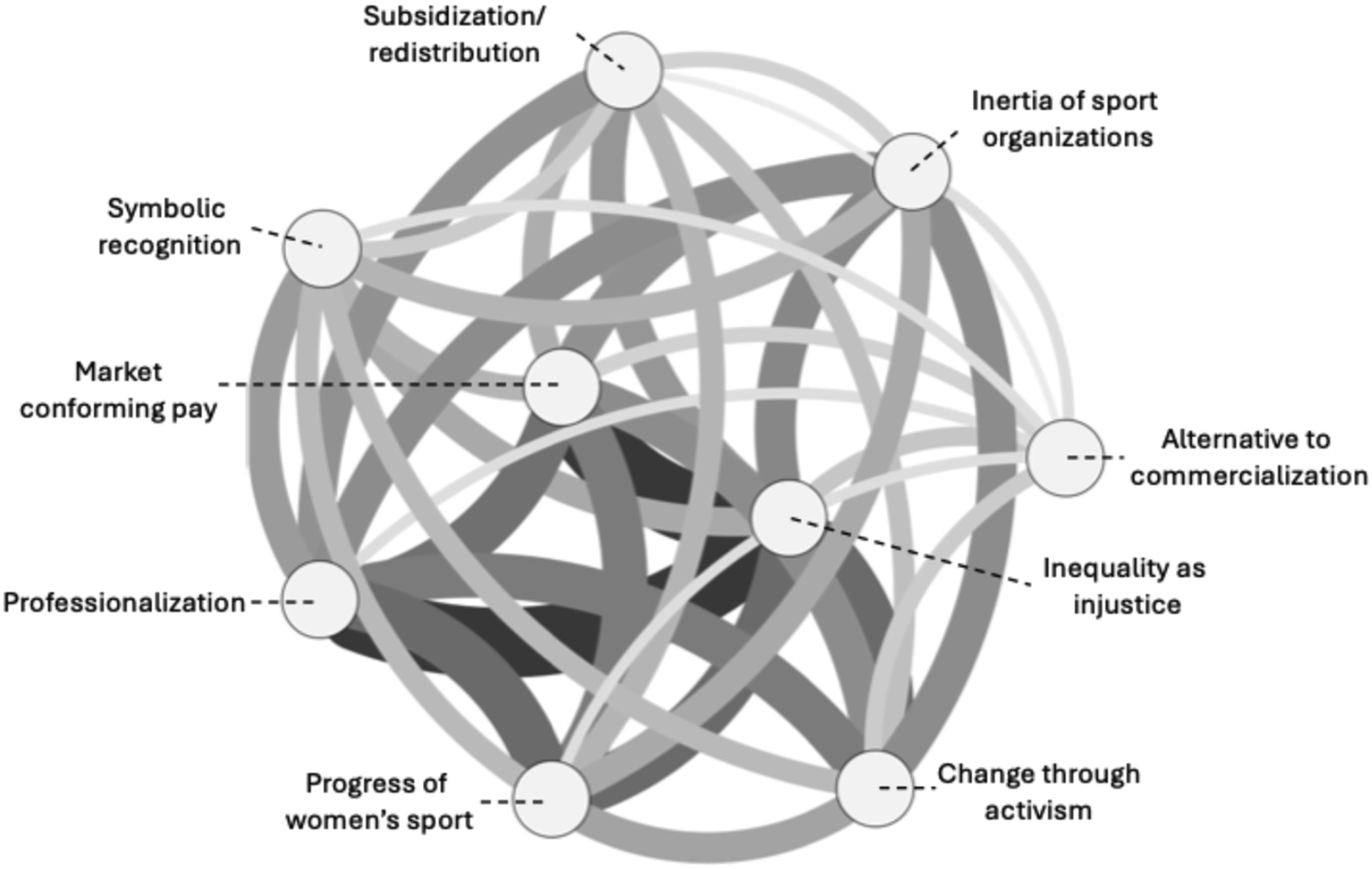
However, it should also be noted that the ‘Professionalization’ frame is also relatively closely associated with the narrative of ‘Progress’ of women’s sport. This association strikes an optimistic note insofar as women’s sport is characterized as a success story over the last decades, linked to professionalization of conditions and structures, higher visibility in the media and increased revenues, and that this success story will continue in the future. To some extent, redistribution of resources from men’s sport is framed as a suitable solution to catalyze professionalization.
Moreover, the ‘Change through activism’ frame is closely but not exclusively associated with the ‘Inertia’ frame, that is, the characterization of sport organizations as too conservative, too slow and too much dominated by (old, white) men. When organizations do not support changes, hinder progress in the direction of gender equality or even discriminate against female athletes, pressure and activism ‘from below’ is depicted as the only possible way forward. Finally, the fact that the frame ‘Alternative to commercialization’ is the least connected within the ideological space is highly relevant. It indicates that the dominant German media discourse on gender pay and compensation gaps in sport is unable to envision a future for women’s sports, which substantially differs from the one of hyper-commercialized men’s sports. Rather, women’s sport is supposed to ‘catch-up’ to men’s sports in terms of demand for sport entertainment and professionalization.
Discussion and Conclusion
Our research started from the assumption that women’s sport activists, just like other formerly marginalized social groups, must gain favorable media coverage in order to generate public support for their claims. Therefore, we examined the discourse about equal pay issues in sport over five years (from 2020 to 2024) in seven key German media outlets. We analyzed 96 articles, published in said period, which took a certain standpoint and included at least some elements of framing.
Our findings can be summarized as follows: (1) Attention for sports-related equal pay issues in German media is sporadic and event-driven. Equal pay issues primarily appear in the German media when promoted by female athletes before and during a few major sporting events. Our findings suggest that the media do not pursue a long-term agenda with regard to equal pay in sport. (2) The use of the notion ‘equal pay’ is rather ambiguous and vague. It includes wages, bonuses and prize money and sometimes refers to actual equalization, but often just to a reduction of existing inequalities. (3) The analysis of frames reveals that media employed a variety of narratives that depict different causes and solutions for pay gaps. Some of the underlying arguments and moral reasons have also been discussed in the scientific literature, such as ‘equal pay for equal work’ or ‘equal pay for equal audience’ (Archer & Prange, 2019; Kowalenko, 2022; Morgan, 2021). Yet, a consensus exists in the media that gender pay gaps in sport represent some kind of injustice. Although the German media criticize these pay gaps and give plenty of space to critical athlete’s voices, articles still frequently intend to achieve equal pay by developing and exploiting the alleged so-far underutilized commercial potential of women’s sport. Hence, the preferred solution is largely market-driven.
Our findings come with some implications. The fact that gender pay gaps in sport are only sporadically addressed might seem hardly surprising and indicates that media attention follows mundane news routines and cycles related to major events (e.g., Andrews & Caren, 2010). In particular sport journalism – commonly derogated as the media’s ‘toy department’ – is characterized by short news cycles, limited media resources and a predominant role as an uncritical promoter of sport (Boyle, 2017; Rowe, 2007; Weedon et al., 2018). Given that a ‘sportainment’ model used to dominate sport coverage, the fact that media address gender pay gaps in sport at all is a relevant finding in itself. It indicates that German sport media have partly abandoned hegemonic masculine scripts. There is not only consensus about the unjust character of gender pay gaps but also awareness for the decades-long communicative injustices against women (Crawford, 2023). Yet, although German media have been very responsive to claims and campaigns of women’s activist, they show some limitations as potential ally of women’s activists. The fact that German media cover gender pay gap issues in sport only sporadically might reflect more fundamental limitations characteristic for an era in which traditional sport journalism faces budget and staff cuts resulting in de-professionalization (Bertling, 2025; Konieczna, 2018).
In addition, articles discussed pay gaps most frequently in relation to football. German top football, at least in the male domain, has evolved into a hyper-commercialized entertainment industry. While other sports, such as handball, basketball, ice hockey or volleyball, have also created professional competitions and enjoy some commercial success in men’s sports, they still rely primarily on voluntary sports clubs and public subsidies. In Germany, all national Olympic athletes and other selected elite athletes, among them also female football players who fail to earn a minimum salary, as well as selected athletes from other federations receive only very low financial support through a (small) monthly contribution from the German Sports Aid Foundation, which is a partially state-funded non-governmental, non-profit organization. This includes female footballers who do not exceed a specific annual salary (Stiftung Deutsche Sporthilfe, 2025). Direct state funding exists only for a very small number of athletes (approximately 1,000 in total) who are publicly employed by the Federal Police or the Armed Forces (Bundeswehr) (Konjer & Meier, 2025). Pay gaps exist in these sports, but nowhere are they as drastic in absolute terms as in football, where men earn millions in salaries while women often have to work alongside playing football. The focus on hyper-commercialized football as a reference point neglects therefore fundamental differences between distinct sports. Moreover, the focus on football facilitates the idea that there might be a one size fits all solution to gender pay gap issues in sport all the more as the commercial growth of women’s football (SportFive, 2025) seems to provide an example that investment in women’s sport can be profitable.
When viewed from the perspective of social movement theory, we might conclude that there exists only partly an effective collective action frame. With regard to diagnostic framing, there is not a consistent concept of equal pay. Athletes, activists and media professionals alike seem to have different interpretations of ‘equal pay’, in terms of both the meaning of ‘equality’ and the meaning of ‘pay’. A certain level of ambiguity might increase political support by catalyzing what has been called a ‘scale shift’ by social movement scholars (Soule, 2012). Such a scale shift refers to ‘a change in the number and level of contentious actions leading to broader contention involving a wider range of actors and bridging their claims and identities’ (McAdam et al., 2001, p. 331). Seen from such a perspective, it could be a skillful political maneuver from activists to exploit conceptual ambiguities. However, this can also obfuscate relevant targets, measures, and responsibilities. For instance, regarding equal bonuses, the DFB, as the national football association, is rather vulnerable to public criticism. As non-profit organization representing also the entire grassroots football sector, the DFB is almost a semi-public body heavily reliant on political support and subsidies, which might have contributed to the organization’s commitment to gender equality. It will be much more difficult to exert pressure to purely commercially oriented sport operators, which actually act as employers in professional sport, such as, football clubs.
Moreover, from the perspective of social movement research, the restricted range of acceptable policy solutions in the German debate is striking. The dominant preference for market-conforming solutions for overcoming a legacy of gender discrimination seems to indicate a hegemony of neoliberal ideology. However, the exclusive focus on market-conforming solutions might also reflect the fact that most of the articles cover football as the hegemonic sport in Germany. The hyper-commercialized football industry where financial resources are abundant (and transferable) serves as the reference point for discussing gender pay gaps. Here, the story told by the media seems to be that – notwithstanding substantial gaps – women’s football has started ‘catching up’ to the commercial and professional template of men’s football. The sole focus on football ignores, however, that even the men’s branches of many other, less popular sports often reach only semi-professional levels, making the question how equal pay should be achieved much more intricate. The relative ignorance towards other sports, which are hardly covered, might contribute to a rather narrow (economic) perspective on potential remedies. In any case, the majority of articles are unable to imagine a future for women’s sport substantially distinct from the hyper-commercialized men’s sport. Only the rather left-leaning newspaper taz consequently adhered to an idealized vision of women’s sport as alternative and counter model maximizing social value rather than revenues.
We can conclude that in the period under scrutiny, female athletes and activists advocating for equal pay found strong sympathy for their demands in German media, who almost unanimously depicted gender pay gaps as an outdated relict and unfair legacy. Nevertheless, female athletes and activists seem to face two dilemmas:
First, despite a widespread rejection of the sense of outrage at injustices, the solutions depicted by the media all understand wages in elite sports as driven by economic forces. By implication, in case moral standards conflict with market forces, it is the market that usually prevails. Thus, it can be claimed that the media reduce athletes’ activism against gender pay gaps in sport to what Antunovic et al. (2024) have called ‘advocacy as advancement for the business case of women’s sport’. Such less radical advocacy resonates with corporate agendas that employ social justice language in order to promote and commodify women’s sport.
Secondly, by invoking diffuse complaints about gender pay gaps in professional sport on occasion of major sport events, activists can generate media resonance. However, short-lived news cycles limit opportunities to mobilize sustainable support for more specific claims. Thus, while female athletes can manage to generate public attention by scandalizing blatant gender inequalities, it is hard to motivate the media to follow the difficult disputes about more complex and intricate issues.
Recommendations for Activists
Our findings support the idea that activists should align with journalists’ attention cycles, criteria for newsworthiness, and news gathering routines (Andrews & Caren, 2010). Activists face much higher chances to gain media resonance for their claims if they manage to present them related to major sport events. Emphasizing blatant inequalities in monetary rewards also appears as a useful tactic to attract media attention. Finally, it seems that demands for ‘equal play’ rather than ‘equal pay’ will find media resonance as ‘professionalization’ is a widely employed frame. Our analyses also suggest that the media are more responsive to advocacy making a business case for women’s sport in contrast to more confrontative and radical activism.
Suggestions for Future Research
Concerning future research, it would be useful to conduct expert interviews with women’s sport activists in order examine which of their claims found no resonance among German media (e.g., Antunovic et al., 2024). Sport journalists should be interviewed as well in order investigate, which media routines and news criteria factors drive media attention for equal pay issues and which factors might motivate media to investigate more thoroughly into equal pay issues. Finally, we also believe that research on the media’s impact is important for determining the persuasive power of individual frames on recipients.
Limitations
The present study is not free from limitations. Our sampling strategy deliberately chose outlets with a broad reach (e.g., BILD, sportschau.de) and/or a good reputation for high quality coverage (Deutschlandfunk, FAZ, SZ), thereby also covering left-leaning and right-leaning newspapers (taz vs. WELT). However, these outlets only represent some significant section but the entire German media landscape. Moreover, with the exception of sportschau.de, we did not include purely online or social media outlets. In addition, we chose to apply an inclusive definition of activism for this study. This means that we have essentially labelled any opinion expressed by a female athlete as ‘activism’. These athletes may not necessarily see themselves as activists. Sometimes, their stance on equal pay is just one (political) topic among many unpolitical topics that they comment upon in an interview. Finally, we did not investigate the effects of frames on recipients.
Footnotes

Funding
The author(s) disclosed receipt of the following financial support for the research, authorship, and/or publication of this article: This work was supported by the Bundesinstitut für Sportwissenschaft (ZMI4-070901/24-26).
Declaration of Conflicting Interests
The authors declared no potential conflicts of interest with respect to the research, authorship, and/or publication of this article.
Appendix
ID
Media
Date
Title
Author
Section
1
BILD
2021-05-20
Frauenquote und Kraus als Präsidentin
Schmidt, M. & Bossmann, B.
Sports
2
BILD
2022-08-01
Kommt endlich der Fußball-Boom bei den Frauen?
Sports
3
BILD
2023-01-01
„Wir haben es gerockt!“
Schreier, R.
Sports
4
Deutschlandfunk
2020-12-19
Gender pay gap im Skispringen – Frauen kämpfen um gleiche Bezahlung und Aufmerksamkeit
Löffler, L.
Online
5
Deutschlandfunk
2021-04-25
Radsport – Frauenpower in der alten Männerdomäne
Mustroph, T.
Online
6
Deutschlandfunk
2021-04-27
Fußball-Managerin Doris Fitschen – „Wir sollten und mit den Männern nicht vergleichen“
Heise, K.
Online
7
Deutschlandfunk
2022-07-13
„Equal pay“ im Fußball – Gleiche Prämien für Nationalteams bei Frauen und Männern
Rieger, M. & Mixa, C.
Online
8
Deutschlandfunk
2022-07-16
Entwicklung des Frauenfußballs – „Wir sind auf einem guten Weg“
Späth, R.
Online
9
Deutschlandfunk
2022-07-17
Frauen im Fußball – Viktoria Berlin: Visionär in der Bundesliga
Eckner, C.
Online
10
Deutschlandfunk
2022-07-24
Tour de France Femmes – Der lange Weg zur Gleichberechtigung
Heeß. J.
Online
11
Deutschlandfunk
2022-07-24
Fußball-Nationalmannschafts-Prämien – Tabea Kemme erwartet keine Unterstützung durch Männer-Team
Schweizer, M.
Online
12
Deutschlandfunk
2022-07-24
Equal pay im Radsport – “Auf jeden Fall Luft nach oben“
Jabs, T.
Online
13
Deutschlandfunk
2022-08-02
Voss-Tecklenburg facht Grundgehalts-Debatte neu an
Schweizer, M.
Online
14
Deutschlandfunk
2022-08-09
Equal pay im Fußball – Eine Diskussion wird nicht reichen
Schültke, A.
Online
15
Deutschlandfunk
2022-09-18
Bundesliga-Start der Frauen – Lena Lotzen: „Nicht alles von den Männern kopieren“
Rieger, M.
Online
16
Deutschlandfunk
2023-07-16
Vor der WM – Wie der Frauenfußball in Deutschland boomt
Treusch, W.-S.
Online
17
Deutschlandfunk
2023-07-20
Gehälter, Quoten: Frauen Fußball-WM im Schatten der Männer?
Rieger, M.
Online
18
Deutschlandfunk
2024-01-14
Neue Liga in Nordamerika – Profi-Eishockey endlich auch für Frauen
Oldörp, H.
Online
19
FAZ
2020-04-20
Nur keine Illusionen
Kalwa, J.
Sports
20
FAZ
2020-11-05
Bloß keine großen Überschriften
Heike, F.
Sports
21
FAZ
2022-06-29
Van Almsick zu equal pay – „Zu viel Gebrüll”
Sports
22
FAZ
2022-07-10
Abgehängt vom DFB
Heinrich, M.
Sports
23
FAZ
2022-08-07
Voss-Tecklenburg möchte „Talentgerechtigkeit”
Sports
24
FAZ
2022-08-10
Keine Einigung mit dem Kanzler
Heinrich, M.
Sports
25
FAZ
2022-08-15
Kein Vergleich!
Horeni, M.
Sports
26
FAZ
2022-09-16
Wenn nicht jetzt, wann dann?
Westhoff, A.
Sports
27
FAZ
2022-11-01
Handballspielerinnen vor EM – “es hat super viel Spaß gemacht”
Sports
28
FAZ
2023-02-23
Dem Kanzler versprochen – Die DFB-Frauen brauchen vor WM noch routine
Westhoff, A.
Sports
29
FAZ
2023-07-17
„Da lacht mir heute noch das Herz”
Heinrich, M.
Sports
30
FAZ
2023-07-20
Auf Expansionskurs – Die Superchance für den Frauenfußball
Horeni, M.
Sports
31
FAZ
2024-02-29
Ihre härteste Prüfung
Meduna, M.
Sports
32
Sportschau
2023-01-13
Ex-Profi-Boxerin – Regina Halmich musste bessere Bezahlung hart durchboxen
Online
33
Sportschau
2023-01-18
Equal pay im walisischen Fußball
Online
34
Sportschau
2023-02-15
Popp: Saudi-Arabien “kein optimaler sponsor” für Frauen-WM
Online
35
Sportschau
2023-02-21
DFB-Frauen mit Remis gegen Schweden
Online
36
Sportschau
2023-02-21
Kanzler Scholz setzt sich weiter für gleiche Prämien ein
Online
37
Sportschau
2023-03-07
Borger sieht Frauen im Profisport “prinzipiell benachteiligt”
Online
38
Sportschau
2023-03-24
“Der Kampf um Gleichberechtigung muss irgendwann enden”
Online
39
Sportschau
2023-04-03
Neuendorf zu equal pay: “Nicht ad acta gelegt”
Online
40
Sportschau
2023-06-08
FIFA garantiert Spielerinnen Mindestprämien
Online
41
Sportschau
2023-06-12
Das Ende der Klappstühle - Boom im Frauen-Radsport
Online
42
Sportschau
2023-06-26
WM-Prämien für Frauen: DFB belässt es bei FIFA-Geldern
Online
43
Sportschau
2023-06-26
Niedrigere WM-Prämie: Scholz will sich nicht einmischen
Online
44
Sportschau
2023-06-28
Flicks job für Bundestrainerin Voss-Tecklenburg “kein Thema”
Online
45
Sportschau
2023-07-18
“Unser Vermächtnis”: Frauen-WM mehr als nur Fußball-Bühne
Online
46
Sportschau
2023-07-19
Infantino übernimmt keine Garantie für Weiterleitung der Prämien
Online
47
Sportschau
2023-07-21
Huth: Mit den DFB-Männern eine Fußballmacht werden
Online
48
Sportschau
2023-07-27
Boom im Frauen-Radsport: “Entwickelt sich etwas”
Online
49
Sportschau
2023-07-27
Laudehr: DFB-Frauen hätten auch 400.000 Euro Prämie verdient
Online
50
Sportschau
2023-07-28
Gehälter im Frauenfußball - viel Aufwand, wenig Ertrag
Online
51
Sportschau
2023-08-02
Klose über Popp: “Versucht, ein Vorbild zu sein”
Online
52
Sportschau
2023-08-09
Was Fußballerinnen verdienen
Online
53
Sportschau
2023-08-12
Ex-Nationalspielerin Kemme: “Angst vor Machtverlust” bei DFB
Online
54
Sportschau
2023-08-14
Ministerin Paus: Gleiche Bezahlung für Leistungen im Fußball
Online
55
Sportschau
2023-08-17
Gleichberechtigung im Frauenfußball – großer Traum, riesige Hürden
Online
56
Sportschau
2023-08-18
Australien und Neuseeland haben geliefert
Online
57
Sportschau
2023-08-28
“Noch ein weiter Weg”: Kampf um Gleichberechtigung im Tennis
Online
58
Sportschau
2024-01-13
Šašić fordert equal pay beim DFB
Online
59
Sportschau
2024-01-17
Almuth Schult fehlt Respekt und Förderung für den Frauensport
Online
60
Sportschau
2024-02-19
Frauenbasketball ist zehn Punkte hinterher
Online
61
Sportschau
2024-02-19
DFB plant Mindestgrundgehalt für Fußballerinnen
Online
62
Sportschau
2024-08-20
Kurt wer?! Wieso es bei der Trainersuche im Frauenfußball oft Überraschungen gibt
Online
63
Sportschau
2024-10-18
Fiebich beklagt schlechtere Bezahlung im US-Frauen-Basketball
Online
64
Sportschau
2024-10-30
Sandra Abstreiter lebt ihren “Canadian dream”
Online
65
SZ
2024-11-27
Das nächste Einhorn
Schmieder, J.
Sports
66
SZ
2020-04-20
„Ich will als Aktivistin gesehen werden“
Schmieder, J.
Sports
67
SZ
2020-05-16
Mindestlohn für Fußballerinnen – Für die Attraktivität eines ganzen sports
Dreher, A.
Sports
68
SZ
2022-07-11
Frauenfussball – Gleiches Geld? Gleiche Chancen!
Catuogno, C.
Sports
69
SZ
2022-07-30
Martina Voss-Tecklenburg – Equal play statt equal pay
Sports
70
SZ
2022-08-07
Olaf Scholz beim DFB – Der Kanzler trifft ein paar wunde Punkte
Fischer, S.
Sports
71
SZ
2022-08-09
Equal pay im Fußball – Erst einmal Chancengleichheit
Dreher, A.
Sports
72
SZ
2022-08-09
Darf´s ein bisschen mehr sein?
Dreher, A.
Sports
73
SZ
2023-07-20
DFB-Frauen – Equal play
Catuogno, C.
Sports
74
TAZ
2023-08-04
Mehr Platz für Frauen
Sports
75
TAZ
2020-01-29
„Mir fehlt als Mannschaftssportlerin das Team“
Pfafftaz, P.
Sports
76
TAZ
2020-06-08
Wo bleibt die Tour der Frauen? Sie rückt näher
Schwermer, A.
Society
77
TAZ
2021-04-07
„Kinder zaubern jedem ein Lächeln ins Gesicht“
Götz, A.
Interview
78
TAZ
2021-10-23
Wird doch!
Rüttenauer, A.
Focus
79
TAZ
2022-07-06
Warum Prämien plötzlich equal pay heißen
Krauss, M.
Sports
80
TAZ
2022-08-11
Gegen die gut geölte Maschine
Schwermer, A.
Sports
81
TAZ
2023-04-01
Platz da – die Frauen kommen!
Schwermer, A.
Sports
82
TAZ
2023-06-10
Glitter auf Morast
Schwermer, A.
Sports
83
TAZ
2023-07-20
Eine spaßige Niederlage. Echt?
Völker, M.
Sports
84
TAZ
2023-08-01
Dänen, die es verdienen
Haagen, F.
Society
85
WELT
2024-06-20
Ein Schwung voraus
Himmel, P.
Sports
86
WELT
2020-07-19
„Den Adler auf der Brust zu tragen, ist Bezahlung genug“
Online
87
WELT
2021-03-25
„Von mir wird kein „Outet euch!“-Aufruf kommen“
Angerer, N.
Online
88
WELT
2021-07-01
Warum heißt es Frauenfußball, aber nicht Männerfußball?
Online
89
WELT
2022-06-28
Sollten Profifußballerinnen mehr Geld verdienen?
Neller, M. & Karich, S.
Online
90
WELT
2022-07-04
So kontert Bierhoff Olaf Scholz´ Forderung nach equal pay
Online
91
WELT
2022-07-13
Besuch vom Kanzler
Wolff, J.
Sports
92
WELT
2022-08-10
„Möchte etwas bewegen“: Van Almsick im Viktoria-Aufsichtsrat
Online
93
WELT
2022-09-22
„Mein Hund hat mehr Follower als ich“
Wolff, J.
Sports
94
WELT
2023-03-24
„Von Wolke sieben in die Hölle“
Meinhardt, G.
Sports
95
WELT
2023-05-28
Sport Kompakt – Fußball: Peretz vor Wechsel zu Bayern München ++ Rekordeinnahme bei WM der Frauen
Sports
96
WELT
2023-08-19
Noch immer nicht gerecht
Ponath, N.
Hamburg