



Abstract
This article examines public attitudes towards the media coverage of women’s sport in a context of recent growth but also continued inequality in both quantity and quality of coverage. Drawing from literature on the role of gender ideology in underpinning the unequal media treatment of women’s sport, we focus on ‘gender essentialist’ ideology as a predictor of attitudes. We draw on 2023 survey data from a national sample of U.S. adults (N = 2032), with results showing that just under a third of respondents feel the amount of media coverage for women’s sport is ‘about right,’ while 25.6% feel it is ‘too much’ and 42.5% feel it is ‘too little.’ Gender essentialist views of women’s sport as lower quality and less entertaining than men’s sport are associated with the belief that women’s sport receives adequate or too much media coverage. Respondents with negative evaluations of the quality and entertainment value of women’s sports attribute increased media attention to social and political pressures rather than genuine demand and interest. Counterintuitively, however, we find that perceptions of women’s sports as higher quality or more entertaining than men’s sports are associated with the belief that women’s sports receive ‘far too much’ media coverage.
Introduction
A large body of scholarship over the past 50+ years has used diverse methodological approaches and theoretical perspectives to document gender disparities in the quantity and quality of media coverage across media forms, with women’s sport receiving less quantity, less respectful, and poorer-quality coverage than men’s sport (Biscomb & Matheson, 2019; Cooky et al., 2021; Fink, 2015; Kane, 2013). Of course, there are important variations across sport and competition type, among other factors. There are also signs that these longstanding patterns may be shifting towards greater and more respectful media attention for women, albeit slowly and unevenly (Coche & Bell, 2024; Johnson et al., 2022; Pope et al., 2024). Within an evolving media landscape where power has shifted towards digital and social media, for instance, women athletes have been more able to tell their own stories, women’s sport-specific platforms have gained some prominence, and recent professionalization and commercial growth in some women’s sports has been accompanied by new broadcast deals which grant mainstream visibility (Crawford, 2023; Wasserman Collective, 2023). At the same time, women athletes must often expend considerable labor to build their online and digital presence given their underrepresentation in mainstream media, and their status as public figures is often accompanied by the risk, if not experience, of harassment (Scovel, 2025; Toffoletti & Thorpe, 2018).
The degree of gender (in)equity in media matters. This is because media are the primary way that most consume sport, and available images and storylines may be influential to whether or how individuals think about women athletes (Bruce, 2012; Coche & Bell, 2024). Women’s media invisibility also supports a gendered hierarchy of power through which men’s dominance over women is maintained (Cooky et al., 2021; Fink, 2015). Despite the relevance of patterns of media attention to public perceptions of women athletes, however, little research has considered public attitudes towards the media coverage of women’s sport. Instead, the field is dominated by content analyses, with a lesser focus on either production or reception (Guyot et al., 2024). While media content is, of course, critical in disseminating information and ideas, and reception studies have identified how individuals interpret and make meaning from such content, a study of attitudes marks a new contribution to the field by enabling understanding of how the public perceives larger patterns of media content in a moment characterized by enduring gender inequality but also some degree of change, notably in tandem with a shift towards online and digital consumption of sport.
We draw from a 2023 survey of U.S. adults to assess public attitudes towards the amount of coverage of women’s sport in media and understandings of its recent increase. We focus in particular on the role of gender essentialist ideology in shaping these attitudes, referring to the ideology of all women’s biological difference from, and physical inferiority to, all men (Goorevich & LaVoi, 2024; Messner, 2011). Existing explanations for the underrepresentation of women’s sport in mainstream mass media point to a variety of factors that include work routines within media organizations and the predominance of men in media ownership, management, and leadership (Sherwood et al., 2017). Yet cultural ideologies about gender, including essentialist ideas, have also been theorized as central; when men are perceived as ubiquitously more athletically talented than women, there is believed to be less public interest in watching women play, and thus lower demand for media coverage (Allison, 2018; Delia, 2020).
This “nobody’s interested” narrative (Kane, 2013) blaming women for their own underrepresentation has been challenged by recent evidence that investments of attention and resources often increase fan interest (Parry et al., 2023). In fact, a recent T-shirt proclaiming “Everyone Watches Women’s Sports” has become a prominent item of apparel at some women’s sporting events and among celebrities both as a challenge to longstanding gender essentialist thinking and evidence of growing audiences for women’s sport (Holtermann, 2024). Amid recent increases in viewership and the media coverage devoted to some women’s sports, our analyses provide the first estimates of public opinion on this development, offering an important benchmark from which future studies on changing media attention and its reception can build. While existing scholarship has posited that gender essentialism on the part of media gatekeepers accounts in part for the paucity of coverage of women athletes, we extend this argument to the public, considering whether gender essentialist attitudes shape perspectives towards existing media coverage for women’s sport. In identifying an empirical relationship between gender ideology and public attitudes, we provide additional support to longstanding arguments in feminist media studies.
Background
Media and Women’s Sport
Women athletes and women’s sport have historically received substantially less attention in mass media than men and men’ sport, and the coverage women do receive often furthers the second-class status of women to men (Bruce, 2012). Women athletes have been sexually objectified, reduced to their relationships as wives or mothers, addressed as children or as jokes, and their athletic talents have been minimized or trivialized (Kane et al., 2013). Gendered patterns of media coverage and content preserve a longstanding gender hierarchy in which men and masculinity are valued and rewarded above women and femininity (Biscomb & Matheson, 2019; Fink, 2015; Kane, 2013).
However, the most overtly sexist tropes have declined, with attention to performance replacing an earlier focus on physical appearance (Biscomb & Matheson, 2019; Wolter, 2015). Women have received substantial, respectful coverage during recent Olympic and Women’s World Cup tournaments (Coche & Bell, 2024; Johnson et al., 2022; Pope et al., 2024), especially as “nationalism can escalate a women’s sports story temporarily into the foreground of sports news” (Cooky et al., 2021, p. 360). Uneven, but growing and improved coverage is evident in the U.S. (Coche & Bell, 2024; Johnson et al., 2022; Romney & Johnson, 2020; Wolter, 2015), the location for this study, and elsewhere in western Europe (Martínez-Corcuera et al., 2023; Parry et al., 2023; Pope et al., 2024), both sites for the growing commercialization and professionalization of many women’s sports. Quantitative increases are particularly challenging to establish definitively given the paucity of longitudinal research on the same outlets. However, a Wasserman Collective (2023) study of U.S. linear television networks, social media sites such as Twitter (X), streaming services and digital publications between 2018 and 2022 found that the average proportion of coverage devoted to women’s sport across these media forms increased from 10 to 15%.
In addition, the rise of digital and social media has given women new platforms for gaining visibility and respect, as well as control over their image and storytelling, though there are concerns that digital, women’s-sport specific outlets enable women’s continued absence from the most prestigious mainstream media outlets (Crawford, 2023) and that women face substantial risks of harassment online, as well as expectations for self-marketing that men do not to the same extent (Scovel, 2025; Toffoletti & Thorpe, 2018). Gender inequality itself has become a theme within some recent media on women’s sport, in line with the activist and feminist orientation of much of women’s sport in recent years amid the greater politicization of women’s sport in the U.S. (Cooky & Antunovic, 2022; Martínez-Corcuera et al., 2023). Yet gendered patterns of media coverage remain variable, illustrating a process of change that is far from linear. For instance, Biscomb and Matheson’s (2019) study of print media found that the percentage of coverage devoted to women athletes declined between 1984 and 2014, Romney and Johnson (2020)’s study on Instagram images from four American sports networks found women’s underrepresentation, and Cooky et al.’s (2021) longitudinal study of televised sports news found a pattern of “gender-bland sexism,” or presentation of women’s sport stories as dull through lackluster production.
To account for gender disparities in media, scholars have pointed to a variety of organizational and cultural factors, including institutionalized work routines in media organizations, assumptions about audience interests, the dominance of men in editorial and leadership roles, the veneer of “objectivity” attributed to media decisions, and the influence of powerful, often taken-for-granted ideas about gender (Bruce, 2012; Guyot et al., 2024; Sherwood et al., 2017; Wolter, 2015). Among these factors, there is clear evidence that gender ideologies held by those working in media influence patterns of attention and content decisions. For example, Tejkalova and Kristoufek argue that the idea circulated through media that women’s tennis results are less predictable than men’s, while not reflecting empirical truth, illustrates the continued “assumption that gender overarchingly determines the degree of an athlete’s physical performance and psychological stability” (2021, p. 743).
Gender Essentialism
Gender essentialist ideology relies on constructions of binary and concordant sex and gender to propose that differences between men and women are total and the result of biology (Allison, 2021; Messner, 2011). Essentialism is a contrasting perspective to social constructionism, which emphasizes the social and cultural roots of gender differences, indicating their malleability, as well as the substantial overlap between men’s and women’s abilities, interests, and beliefs. Rather than empirical reality, gender essentialism is an ideological lens often used to interpret and naturalize difference and inequality as the inevitable and static result of biology (Lorber, 1993).
In the context of sport, gender essentialism is extended to the realm of athletic ability, proposing that women are understood to be universally different from and physically inferior to men (Goorevich & LaVoi, 2024). In commercial sport contexts, gender essentialist assumptions justify the under-resourced status of women’s sport as an inevitable consequence of their low-quality play, and thus low levels of audience interest (Allison, 2021; Kane, 2013). Amid a dearth of empirical evidence on audiences, gender essentialism among journalists generates assumptions about low audience interest in seeing women’s sport in media; as Sherwood et al. note, “Sports newswork prioritizes men’s sports based on sports newsworkers’ personal belief that men’s sports are more newsworthy and important to their audience” (2017, p. 651). In support of this proposition, Organista et al.’s (2021) interview study of Polish sports journalists found a reliance on biological essentialism to argue for the inferiority of women’s sport to men’s; further, journalists argued for low audience interest on this basis (see also Bruce, 2012; Guyot et al., 2024). This argument fails to reflect reality. Gomez-Gonzalez et al.’s (2024) experimental study shows that when the gender of players was unidentifiable, individual athlete ratings did not differ by gender, challenging “the idea that the relatively low demand for women’s professional soccer is due to the poor quality of female players’ technical performance” (47; see also Brown et al., 2024). In fact, rather than a consequence of women’s weaker athleticism to men, existing patterns of media coverage reinforce this notion (Fink, 2015).
Thus, while empirical research has identified connections between journalists’ gender ideologies and inequalities in media coverage, in this analysis, we extend a focus on gender ideology to the public and consider how ideology may shape perspectives on the media coverage of women’s sport. Our focus is akin to audience reception research, an understudied area within scholarship on gender and media (Kane et al., 2013) and yet distinct in examining largescale patterns of public attitude, rather than responses to specific media images or text. Glazbrook et al. (2024) found that traditional gender role ideology was associated with less positive attitudes towards consumption of the Australian Football League Women (AFLW). In line with this study, we expect that those with gender essentialist views feel that women’s sport is underserving of substantial media attention; thus, we predict association between essentialism and feeling that women get too much media coverage and that increased coverage of women’s sport is due only to social and political pressure. Specifically, we address the following research questions:
How do American adults assess the overall amount of media coverage of women’s sport and the reason(s) for its recent increase? Does gender essentialist ideology predict attitudes towards the overall amount of media coverage of women’s sport? Does gender essentialist ideology predict attitudes towards the perceived reason(s) for the recent increase in media coverage of women’s sport? Responses that women’s sports are lower quality and less entertaining than men’s sports will be associated with responses that women’s sports receive too much media coverage. Responses that women’s sports are lower quality and less entertaining than men’s sports will be associated with responses that increased media coverage of women’s sports is due to social and political pressure.
Data and Measures
Survey Questions and Response Categories Used in the Analysis of This Paper.
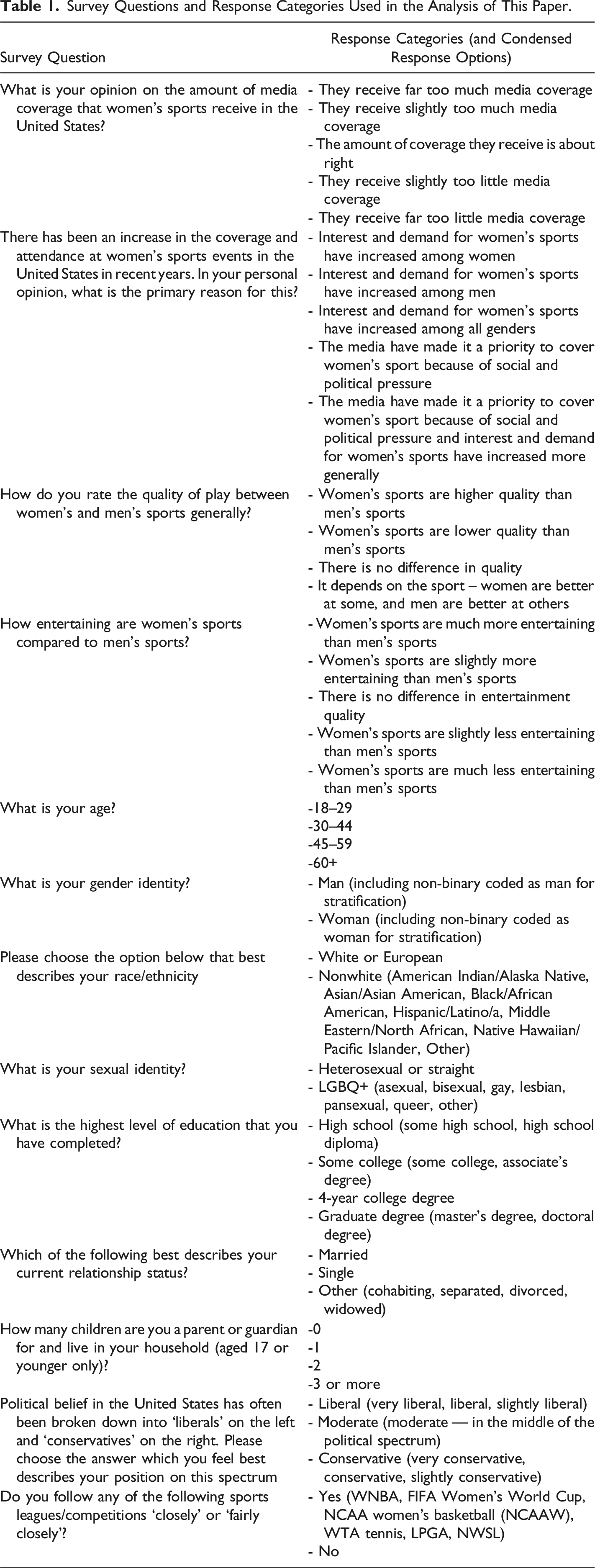
We include two dependent variables to measure attitudes towards the media coverage of women’s sport. One measure derives from the question, “What is your opinion on the amount of media coverage that women’s sports receive in the United States?” Response options included “they receive far too much media coverage,” “they receive slightly too much media coverage,” “the amount of coverage they receive is about right,” “they receive slightly too little media coverage,” and “they receive far too little media coverage.” The second measure is based on responses to the question, “There has been an increase in the coverage and attendance at women’s sports events in the United States in recent years. In your personal opinion, what is the primary reason for this?” Response options included “The media have made it a priority to cover women’s sport because of social and political pressure,” “interest and demand for women’s sports have increased among women,” “interest and demand for women’s sports have increased among all genders,” and “the media have made it a priority to cover women’s sport because of social and political pressure and interest and demand for women’s sports have increased more generally.” The response options for these questions were informed by previous literature (e.g., Pope et al., 2022), which identifies “political correctness” and “positive discrimination” as factors people cite for increases in the coverage of women’s sport. For the current American context, these factors are phrased in this study as “social and political pressure.”
Two independent variables are measures of gender essentialist ideology. A survey question asked, “How do you rate the quality of play between women’s and men’s sports generally?” Response options included “Women’s sports are lower quality than men’s sports,” “there is no difference in quality,” “it depends on the sport – women are better at some, and men are better at others,” and “women’s sports are higher quality than men’s sports.” This question was followed by a prompt to provide a written explanation. Qualitative comments were open coded to assess appropriateness of the question as a measure of gender essentialism. Findings showed clear evidence of gender essentialism; for instance, those who responded that women’s sports are lower quality to men’s commonly justified this through referencing biological gender difference and the lesser athletic abilities of women to men. For instance, one respondent argued, “Women’s athleticism seems slower than men’s making it less enticing to watch.”
In addition, a second measure of essentialism is based on the question, “How entertaining are women’s sports compared to men’s sports?” Response options were “women’s sports are much less entertaining than men’s sports,” “women’s sports are slightly less entertaining than men’s sports,” “there is no difference in entertainment quality,” “women’s sports are slightly more entertaining than men’ sports,” and “women’s sports and much more entertaining than men’s sports.” These categories were also constructed from previous literature, such as studies finding people, perhaps particularly men, may cite quality of play and entertainment value as reasons for theirs or others’ disinterest in women’s sport and/or its inferiority to men’s sports (e.g., Pope et al., 2022). The survey instrument did not include a qualitative response option following this question.
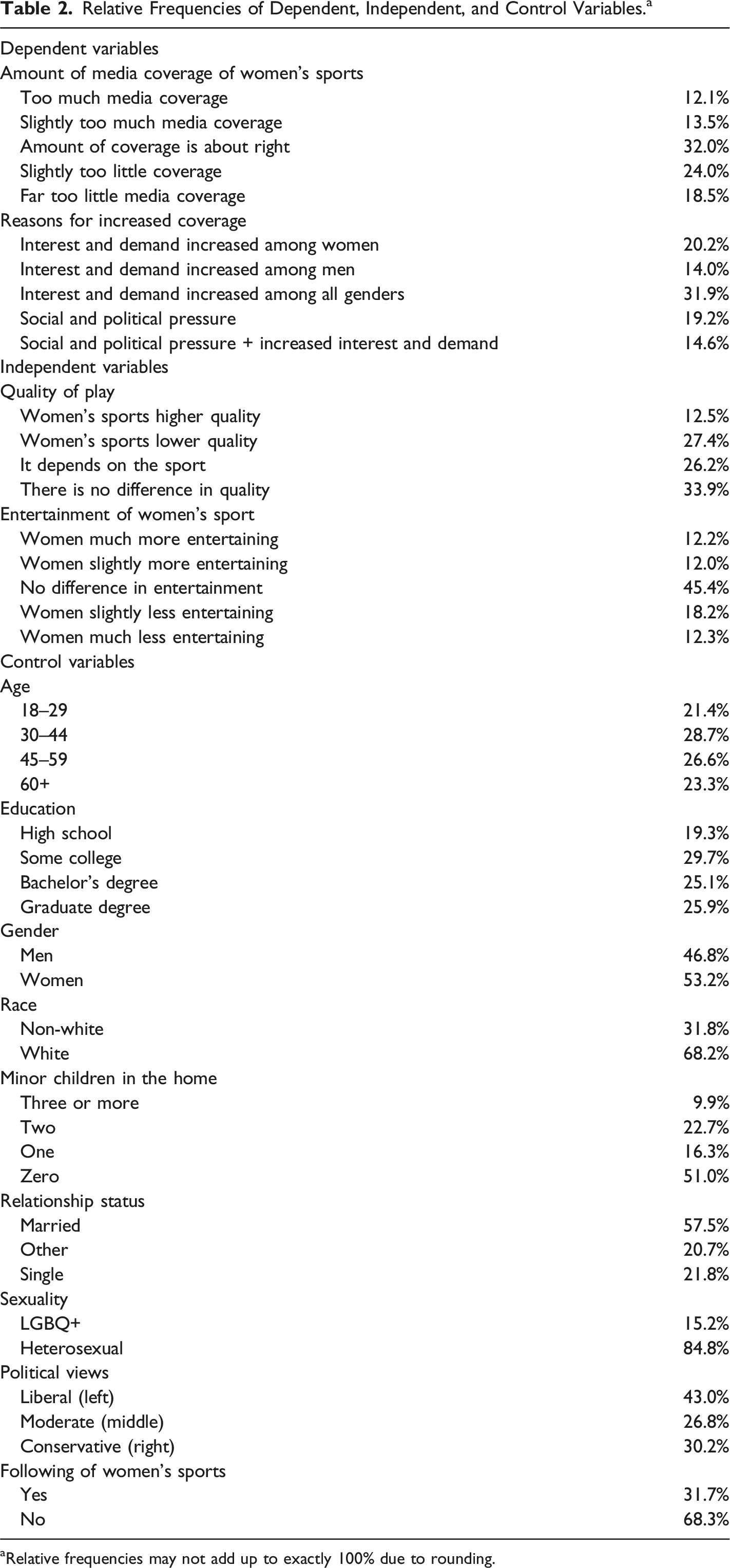
Relative Frequencies of Dependent, Independent, and Control Variables. a
aRelative frequencies may not add up to exactly 100% due to rounding.
aReference category = Far too little.
b*p < .05; **p < .01; ***p < .001.
aReference category = all other categories.
b*p < .05; **p < .01; ***p < .001.
Results
Descriptive Statistics (R1)
The results from our descriptive statistical analysis reveal the answer to our first research question, which asked, ‘How do American adults assess the overall amount of media coverage of women’s sport and the reason(s) for its recent increase?’ The descriptive statistics in Table 2 show answers to these questions, and outline key characteristics of the study’s dependent, independent, and control variables. For the first dependent variable of perceived amount of media coverage of women’s sports, responses were distributed across five categories. Approximately one-third of respondents (32.0%) believed the amount of media coverage was ‘about right’, while a combined 42.5% felt the coverage was insufficient (‘slightly too little’ at 24.0% and ‘far too little’ at 18.5%). Conversely, 25.6% felt there was too much coverage (‘slightly too much’ at 13.5% and ‘too much’ at 12.1%). Therefore, it is notable that the plurality response that there is not enough coverage of women’s sports displays a desire for increased coverage, presumably largely formed from interest in seeing more coverage of women’s sports themselves, or perceived interest from others. Regarding the reasons for increased coverage of women’s sports, the most frequently cited reason was increased interest across all genders (31.9%), followed by increased interest specifically among women (20.2%) and social/political pressure alone (19.2%).
The independent variables capture several socio-demographic and attitudinal factors. With respect to gender-essentialist attitudes, respondents’ views on the quality of play showed that 12.5% perceived women’s sports as higher quality, while a larger portion (27.4%) viewed it as lower quality. About a third (33.9%) believed there was no difference in quality, and 26.2% felt that the quality depends on the specific sport. In terms of entertainment value, nearly half of the respondents (45.4%) reported no difference between women’s and men’s sports, while 24.2% found women’s sports to be slightly or much more entertaining. The remaining 30.5% viewed women’s sports as slightly or much less entertaining.
Gender Essentialist Attitudes and Perceptions of the Amount of Media Coverage for Women’s Sport (R2, H1)
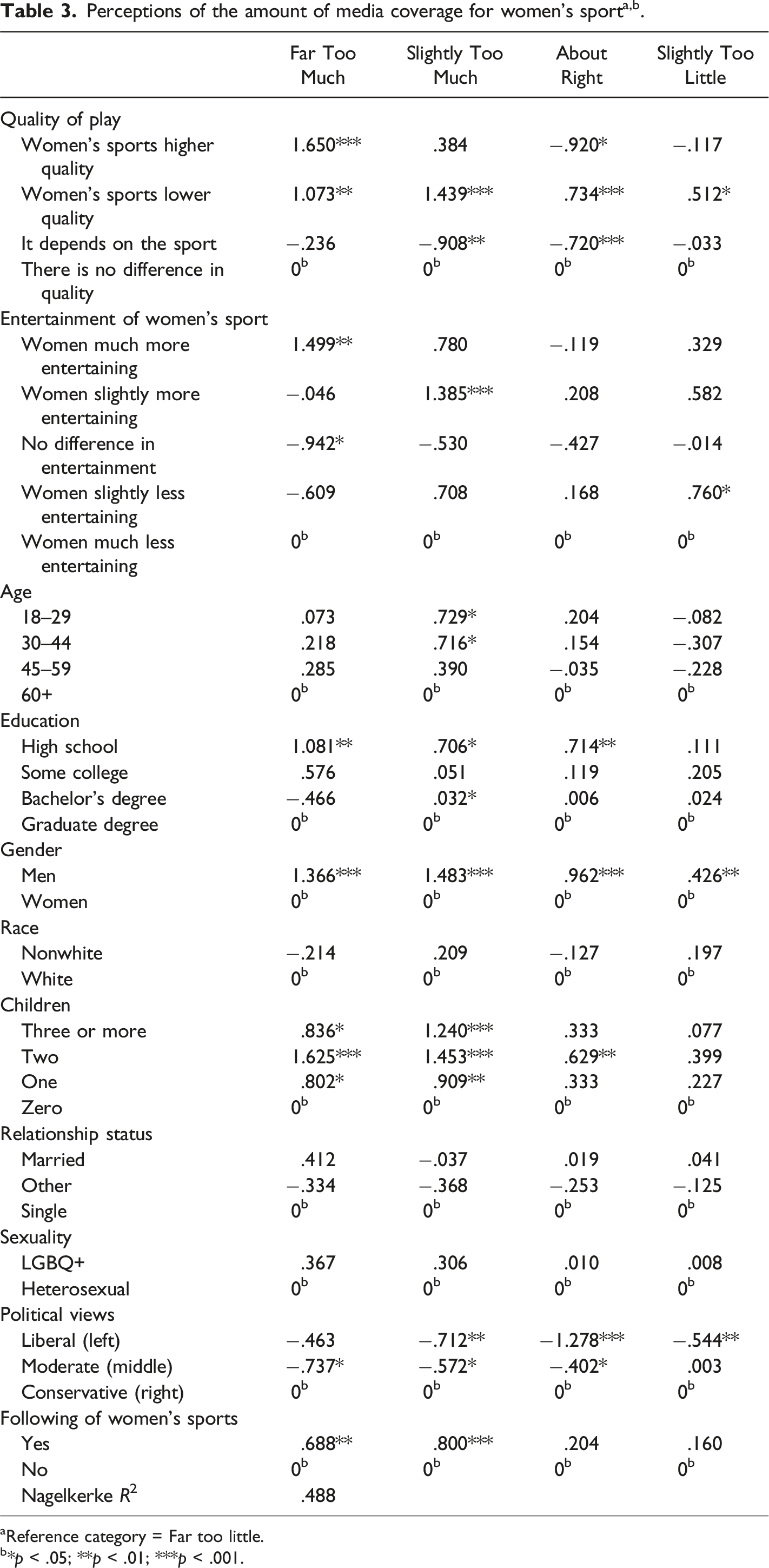
The regression analysis in Table 3 examines how gender essentialism towards women’s sports predicts public attitudes toward the amount of media coverage for women’s sports. This helps to answer the first part of our second research question, which asked, ‘Does gender essentialist ideology predict attitudes towards the overall amount of media coverage of women’s sport?’ In answer to this question, a significant relationship emerged between beliefs about the quality of women’s sports and views on their media coverage. Respondents who rated women’s sports as ‘higher quality’ than men’s were notably more likely to believe that women’s sports receive ‘far too much’ media coverage compared to ‘far too little’ (see Discussion section). In contrast, those who viewed women’s sports as ‘lower quality’ were less likely to feel that women’s sports received ‘far too little’ coverage in general. Furthermore, respondents who perceived women’s sports as ‘higher quality’ or said that quality ‘it depends on the sport’ were more likely than those who saw no quality difference to believe that women’s sports receive ‘far too little’ coverage rather than ‘about the right amount’. Therefore, those rating women’s sports as lower quality than men’s were more likely to feel that women’s sports received either too much or an adequate amount of media coverage, making them overall the least likely to believe that coverage was ‘far too little’. This result aligns with our first hypothesis that responses that women’s sports are lower quality than men’s sports will be associated with responses that women’s sports receive too much media coverage.
Perceptions of the entertainment value of women’s sports also significantly shaped public opinion on the media coverage women’s sports receive, though perhaps to a lesser extent than perceptions of quality. Like views on quality, respondents who considered women’s sports ‘much more entertaining’ than men’s were notably more likely to believe that women’s sports receive ‘far too much’ rather than ‘far too little’ media coverage, compared to those who found women’s sports ‘much less entertaining’. A similar trend appeared among those who rated women’s sports as ‘slightly more entertaining’—they were more likely than those who viewed women’s sports as less entertaining to say that women’s sports receive ‘slightly too much’ coverage. Conversely, those who saw no entertainment difference between women’s and men’s sports were significantly less likely to believe that women’s sports receive ‘far too much’ rather than ‘far too little’ coverage, compared to respondents who viewed women’s sports as ‘much less entertaining’. Finally, while Table 3 also shows socio-demographic and political factors as statistically significant, the coefficients for these results are generally not as strong as they are for variables of gender essentialism for determining respondents’ attitudes towards the amount of media coverage that women’s sports receive. Therefore, while showing some similar trends to quality of play, gender essentialist attitudes regarding entertainment value appear less predictive of judgements on the amount of media coverage than views on the relative quality of play between women and men’s sports.
Gender Essentialist Attitudes and the Perceived Reasons for Increased Media Coverage of Women’s Sport (R3, H2)
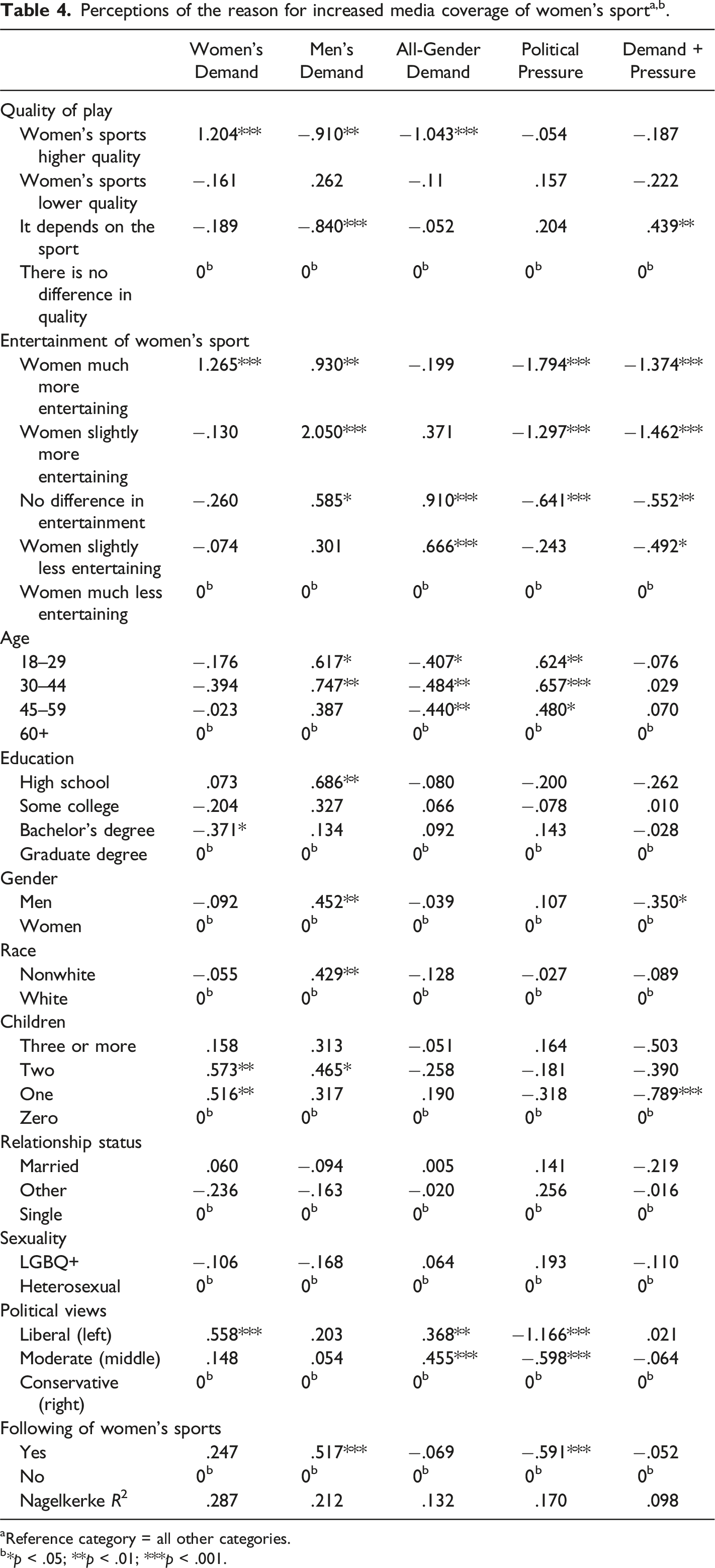
The regression results in Table 4 examine public opinion on the reasons behind the recent increase in media coverage of women’s sports. This helps to answer our third research question, which asked, ‘Does gender essentialist ideology predict attitudes towards the perceived reason(s) for the recent increase in media coverage of women’s sport?’ In answer to this question, gender essentialist beliefs were again the most prominent predictor of respondents’ perceived reasons for the increase in coverage. Those who rated women’s sports as higher quality were more likely to attribute the increased coverage to rising demand from women, and less likely to see it as driven by demand from men or all genders. Respondents who believed that quality depended on the specific sport were less likely to attribute the increase to men’s demand, and more likely to view it as a product of both demand and political and social pressure. This generally aligns with our second hypothesis that gender essentialist attitudes towards quality of play will be associated with responses that increased media coverage of women’s sports is due to social and political pressure.
In an inverse finding to the perceived amount of media coverage, perceptions of entertainment value were even stronger predictors than quality of play for attributions about increased media coverage of women’s sports. Respondents who viewed women’s sports as ‘much more entertaining’ were more likely to attribute the coverage increase to demand from both women and men, while being much less likely to cite political or social pressure as a factor. For those who found women’s sports ‘slightly more entertaining’, men’s demand was the primary attribution, with political pressure seen as less significant. Respondents who rated women’s sports as ‘slightly less entertaining’ or saw no entertainment difference largely attributed the media coverage rise to demand from all genders and were similarly less inclined to attribute it to political or social pressure. Conversely, respondents who viewed women’s sports as ‘much less entertaining’ were the least likely to cite increased demand and most likely to attribute the coverage to political and social pressures. This strongly aligns with our second hypothesis that responses that women’s sports are less entertaining than men’s sports will be associated with responses that increased media coverage of women’s sports is due to social and political pressure. While Table 4 again shows certain socio-demographic and political factors as additional statistically significant predictors, the coefficients for these results are generally not as strong as they are for variables of gender essentialism for determining respondents’ perceived reasons for the recent increase in media coverage of women’s sports. Therefore, the results here show strong predictive relationships between gender essentialist attitudes, particularly around the entertainment value of women’s sport relative to men’s sport.
Discussion
Drawing on survey data from a sample of U.S. adults, this analysis is the first to examine patterns of public attitude towards the media coverage of women’s sport. This focus is novel and important given both celebrations of the recent rise of women’s sport in metrics such as in-person attendance and television viewership, yet persistence of gender inequality, including in the quantity of media attention (Biscomb & Matheson, 2019; Cooky & Antunovic, 2022; Kane et al., 2013). Our first research question asked how American adults assessed the amount of media coverage of women’s sport and the reasons for its recent increase. The findings reveal that public perceptions of media coverage for women’s sports are divided. Approximately one-third of respondents (32.0%) consider the current coverage ‘about right’, while a substantial proportion (42.5%) believes the coverage remains insufficient. Meanwhile, 25.6% feel there is too much coverage. Importantly, that a substantial minority of respondents perceive too little coverage for women’s sport challenges the assertion of limited interest in women’s sport by recognizing that demand has been suppressed by women’s underrepresentation in media.
The most frequently cited reason for the recent increase in media coverage is growing interest across all genders (31.9%), followed by increased interest specifically among women (20.2%) and social or political pressure (19.2%). These results may reflect both progress and ongoing inequality in media coverage. Ultimately, there is no clear answer to characterize these perceptions, in large part because public attitudes toward media coverage of women’s sports have not been previously assessed. The media landscape itself shows both increases in coverage for certain sports and persistent inequalities (Kane, 2013; Pope et al., 2024).
Our second research question concerned whether gender essentialist ideology was predictive of attitudes towards the amount of media coverage of women’s sport and the reasons for its recent increase. We find that gender essentialism does significantly influence public opinion on media coverage of women’s sports. Respondents expressing essentialist views, who perceive women as inherently of lesser quality than men as athletes or entertainers, are more likely to view media coverage of women’s sport as either sufficient or excessive than lacking, aligning with historical patterns that justify limited representation through presumed audience disinterest (Allison, 2018; Organista et al., 2021). This pattern reflects the broader ideological framework in which women’s athletic achievements are overshadowed by entrenched notions of inferiority in physical performance, which limits public support for equal media coverage (Fink, 2015; Tejkalova & Kristoufek, 2021). Conversely, respondents who do not hold gender essentialist views are more inclined to support enhanced media representation, suggesting that dismantling these ideologies could shift public support towards parity in sports coverage.
This is true with a notable exception that may seem counterintuitive and in need of explanation. Specifically, those who perceive women’s sports as higher quality and more entertaining than men’s sports are among those most likely to say that women’s sports receive ‘far too much’ media coverage. This finding seems counterintuitive, given that those who value women’s sports most would, in theory, want more coverage. Indeed, considering persistent disparities in coverage relative to men’s sport, this result appears even stranger. There are several possible explanations for this result, all of which present opportunities for future investigation.
In the United States, the issue of whether and under which conditions transgender girls and women may participate in the sport category that corresponds to their gender identity has become a highly contested and politicized issue. It receives recent disproportionate media and political attention, resulting in highly politically charged policy initiatives (Travers, 2024). This disproportionate media coverage, which encourages viewers and readers to “take sides” (Scovel et al., 2023), may create a polarization in which the coverage of these controversies in women’s sport is viewed as excessive by those who are supportive of transgender athletes and their rights to compete in the category aligning with their gender identity. Alternatively, it may be that gendered assumptions about sport persist even among those who are seemingly supporters of women’s sport. Those who feel that women’s sport is more entertaining than men’s, for instance, may embrace ideas of the “purity” of women’s sport (Delia, 2020) that support their perceptions in ways that rely on and enhance gender essentialism, and thus may not lead towards support for greater or more equal media coverage. Of course, these and other propositions require additional study, and interviews or focus group studies of women’s sport supporters would be well-positioned to investigate how and why attitudes towards patterns of media coverage develop.
In summary, the results confirm our hypothesis that responses viewing women’s sports as lower quality and less entertaining than men’s sports are associated with responses that women’s sports receive too much media coverage, and that increased media coverage is due to social and political pressure alone. The results of our analysis align with this hypothesis because respondents with negative evaluations of the quality and entertainment value of women’s sports largely attribute any increase in media attention to external social and political pressures rather than genuine demand and interest. Those who view women’s sports as lower quality are also the most likely to say that women’s sports receive too much coverage, along with the ‘right amount’, despite the current amount being substantially lower than men’s sports, on average (Romney & Johnson, 2020). This aligns with the “nobody’s interested” narrative (Kane, 2013), where similar (low) quality and entertainment ratings correlate with the view that increased coverage is politically driven rather than merit-based (Allison, 2021; Organista et al., 2021). Respondents who positively rate women’s sports’ quality and entertainment value, however, are less likely to attribute increased media coverage to political and social pressure and are rather more likely to perceive increased coverage as stemming from increased demand across diverse gender audiences.
In the commercial sports context, the growth in women’s sport has presented clear opportunities to “de-naturalize close connections between gender ideology and inequality in sport” (Allison, 2021, p. 158). Yet, gender essentialist assumptions continue to justify assumptions from journalists that women’s sport is lower status, lower quality and ‘naturally’ will have lower audience interest levels than men’s sport (Organista et al., 2021; Sherwood et al., 2017). This study is the first to examine how such gender ideologies extend to, and influence, wider public attitudes towards women’s sport. The results of this analysis do not suggest substantial challenges to these connections by most of the U.S. public, but this is perhaps unsurprising given such attitudes are dominant within the media industry itself. In order to challenge gender inequalities and promote social justice, we argue that there is a need to break this self-perpetuating cycle whereby ideologies around gender essentialism that are dominant amongst many sports journalists in what remains a male-dominated industry trickle down to potential audiences.
The limitations of this study include that we cannot fully know which types of media respondents had in mind when answering the survey questions, meaning we cannot control for what they have seen, or whether they are considering political or news media rather than sports talk or game broadcasts. These results, however, provide important benchmark figures that reflect the current state of media coverage—both progress and inequality—and show that public attitudes are also shaped by specific soocio-demographic characteristics, such as gender, education, parenthood, and political ideology. Our noted limits in interpreting the findings could be addressed through qualitative research, such as interviews or focus groups, to better understand what types of sports media respondents are consuming and how they interpret what they see. This suggestion also aligns with calls for more audience reception research on the meanings individuals give to media texts and images depicting women athletes (Brown et al., 2024; Bruce, 2012; Fink, 2015).
Sport remains an arena of divided, perhaps even divisive opinions, where many perceive women’s sports positively and feel women athletes deserve greater media coverage, while others maintain essentialist views that lead them away from supporting additional media attention. Despite the potential for commercial growth in women’s sport to “de-naturalize close connections between gender ideology and inequality in sport” (Allison, 2021, p. 158), the results of this analysis do not suggest substantial challenge to these connections by most of the U.S. public. Sport remains an arena of divided, perhaps even divisive opinions, where many perceive women’s sports positively and feel women athletes deserve greater media coverage, while others maintain essentialist views that lead them away from supporting additional media attention. The presence of essentialist thinking and its extension to opinions about media coverage may reflect understandings of the longstanding paucity of media coverage of women’s sport but also serves to naturalize this inequality.
Our results should be understood within the context of the recent politicization of women’s sport in the U.S. and high political polarization more broadly (Travers, 2024). In addition, the inroads women have made into the masculine-defined and male dominated institution of sport have long been accompanied by expressions of backlash, as well as newer, more subtle practices that maintain men’s privilege over women (Cooky & Antunovic, 2022; Wolter, 2015). As the gender dynamics of the complex media landscape remain in flux, the evolution of public opinion of women in sports media is worth capturing through a range of research methods, with concomitant attention to the media individuals are exposed to in future investigation. In a ‘new era’ of media coverage of women’s sport (Pope et al., 2023), with increased viewership and media coverage of women’s sport, this article serves as a landmark study in providing the first estimates of public opinion on these developments, which can be used as an important benchmark for future studies.
Footnotes
Declaration of Conflicting Interests
The author(s) declared no potential conflicts of interest with respect to the research, authorship, and/or publication of this article.
Funding
The author(s) disclosed receipt of the following financial support for the research, authorship, and/or publication of this article: The data for this research was facilitated by an internal grant of the University of Cyprus.

Data Availability Statement
Due to funder restrictions, original data for this research is not publicly available at this time.