




Abstract
Metajournalism is the term used in communication science to describe the public discussion of journalism. Studies on how reflexive reporting occurs in sports journalism are rare, which is surprising considering the close sports media intertwining. When tennis player Naomi Osaka declared her intention to skip press conferences during the 2021 French Open to raise awareness of the psychological pressures placed on elite athletes, this triggered a sports-related metajournalistic discourse. This study provides a systematic description of this discourse using a qualitative content analysis of 102 online articles in quality, tabloid and sports media. Only minimal self-criticism was found, and journalists primarily attributed the responsibility for the topic of mental health to the system of competitive sports. Unsurprisingly, there are significant differences in the quality and quantity of reporting in the various genres. In every form of media, Osaka’s own representation occupies a significant amount of space. All media genres have a tendency to portray the arguments of non-media representatives, especially those from the tennis world, rather than articulate their own perspectives. This study contributes to the understanding of public negotiation processes regarding roles and responsibilities in sports journalism.
Keywords
Communication scholars have dealt with questions about the function and self-image of sports journalists for some time. For many years, the sports department suffered a difficult fate in the editorial office, being regarded as the “toy department” (e.g., McEnnis, 2021, p. 2). One reason for this was the close connection between journalists and their object of observation, competitive sports, which continues to generate much public criticism. By now, sports journalism has gained prestige, also due to its enormous financial potential (Boyle, 2017; Perreault & Nölleke, 2022). Simultaneously, media attention and broadcasting fees are essential to the economic survival of sports organizations and athletes (Bertling & Schierl, 2020; Hutchins & Rowe, 2009). As the sports and media systems are closely intertwined and form a symbiotic relationship, at least in part, the question arises: What happens when sports journalists are publicly criticized, and their profession is scrutinized by powerful actors within the sports system?
When Naomi Osaka, professional tennis player and multiple Grand Slam winner, and one of the world’s highest-earning female athletes (Forbes, 2023), announced a personal press boycott shortly before the 2021 Roland Garros tournament (“French Open”), she made serious allegations against sports journalists. She emphasized the psychological stress caused by obligatory media appointments and journalists’ repeated lack of consideration for athletes (Osaka, 2022a). This case sheds a light on the complexity of the relationship between athletes and journalists and how they can be negotiated in a particularly sensitive field, such as mental health.
When media-related topics like this are addressed in public, communication science refers to this process as metajournalistic discourse or self-referential reporting. Such metajournalistic debates are theoretically and practically valuable because they demonstrate how the system of journalism responds to criticism and crises and presents itself to the outside world (Carlson, 2016). Therefore, the study aims to answer the following research question:
As “the discursive justification and legitimation of a profession involve both internal practitioners and external social actors” (Carlson, 2016, p. 348), it is worthwhile to take a closer look at the voices in the discourse as well as those who have received less attention. Consequently, I ask the following subquestion:
While sports and media actors, for example, journalists, athletes and sports officials, are aware of their mutual economic dependencies (Bertling & Schierl, 2020; Birkner & Nölleke, 2016; Röhr, 2015), society in general and professional sports in particular are becoming increasingly conscious of the importance of mental health (Billings & Hardin, 2023). Given the uniqueness of this case and the sensitivity of the topic of mental health, especially in the field of professional sports (e.g., Elsey, 2019), I will further analyze how the press boycott and Osaka’s reasoning is evaluated:
In view of the close links between the media and professional sport mentioned above, the role that sports journalists want to play in this system is constantly being reassessed (Carlson, 2019; Zelizer, 1993). This leads to the following question:
Osaka attributed a certain responsibility to the media, particularly to interactions during press conferences, regarding the mental health of athletes. The question arises as to what attributions of responsibility are, in turn, made by journalists.
Literature Review
The first part of the literature review examines the mutual dependencies between professional sports and sports media, along with the resulting consequences and recent changes in their relationship, to define the framework conditions for this case study. Building on this, the concept of metajournalism is employed to establish a theoretical foundation that facilitates the analysis of public negotiation processes concerning journalistic legitimacy and boundary work, particularly in relation to the sport-media intertwining and its effects.
Sports Journalism and the Sport Media Intertwining
Sports journalists hold a unique position within the journalistic system for a variety of reasons. Journalists are supposed to be impartial about the objects they observe (Vos et al., 2012), but this is probably only true to a limited extent. A dilemma among sports journalists is that they are expected to report critically on this very system, which must grant them access to sources and places necessary for their job (Boyle, 2017; McEnnis, 2021; Suggs, 2016). The journalistic role definition in this field reflects at least some of these challenges, for example, when the boundaries between sports journalism and team media become blurred in one’s own professional perception (Perreault & Bell, 2022). Consequently, sports journalists are often considered “uncritical booster and promoter of sport and its culture rather than a sector that called the powerful in sport to account” (Boyle, 2017, p. 493). At the same time, many sports reporters identify as critical observers (English, 2017; Perreault & Bell, 2022; Schaffrath, 2010). At the organizational level, sports reporting plays a central role financially and in the reach of journalistic media (Boyle, 2017; Perreault & Bell, 2022).
However, sports journalism is not only reliant on competitive sports; the sports system also depends on the media. Empirical studies in the field of mediatization research have shown that several actors in professional sports have attempted to generate attention and (positive) coverage by aligning themselves with perceived media logic (e.g., Birkner & Nölleke, 2016; Frandsen, 2016). For instance, professional tennis has also changed and made adjustments in favor of media professionals and the public, as evidenced by the introduction of the tie-break and the more intensive self-marketing of individual players (Röhr, 2015). The use of specific strategies for press conferences and interviews, like adapting to “to the perceived expectations of the media,” (Küpper et al., 2022, p. 883) are a further indication of mediatization.
Sports actors are also critical of the interdependence of sports and media as well as the resulting adaptations. Some of the active and retired tennis players interviewed by Röhr (2015) emphasized that the sport of tennis should not suffer from an overly entertainment-oriented focus. In the autobiographies examined by Küpper et al. (2022), Serena Williams, Rafael Nadal, Monica Seles, and Andre Agassi report on the pressures and psychological strain brought on by permanent media attention and often lurid reporting. As a result, some athletes make use of defensive strategies (Nölleke et al., 2021), “to shield and immunize themselves from the press […], for example, not giving interviews, skipping press conferences, or keeping their families away from the press whenever possible” (Küpper et al., 2022, p. 884). Athletes from other disciplines also criticize the pressure and negativity created by the media and the “emptiness of media interactions” (Mirer, 2023, p. 12). Nonetheless, the benefits of athletes’ media presence and the importance of extensive media coverage for the sports system remain prominent in public and scientific discourse (Nölleke et al., 2021).
Currently, the “magic triangle” of sports, business, and media (Bertling & Schierl, 2020, p. 297) is undergoing transformation. Frandsen identified a “new wave of mediatization” (2016, p. 297). Digitization and globalization increase competition in journalism while also providing fresh prospects for the sports system (e.g., McEnnis, 2021). Social media offer new opportunities for athletes and other actors in the system to build reach without the use of intermediary mass media (“by-passing”) (Nölleke & Birkner, 2019; for similar observations, see Hutchins & Rowe, 2009; McEnnis, 2021). Fans follow their favorite athletes through various media (Skey et al., 2018), and sports celebrities can rewrite stories and frames (Mirer, 2023; Razack & Joseph, 2021). With this reach, athletes are able to build individual brands and enhance their attractiveness to sponsors and advertisers. As a result, advertising funds are increasingly flowing to the businesses that operate the major social media platforms or even to the athletes themselves, rather than to the traditional mass media system (Bertling & Schierl, 2020; Doyle et al., 2022). The “public attention market” (Bertling & Schierl, 2020, p. 24) is no longer monopolized by journalism (McEnnis, 2021). When media-related topics, such as the sports media intertwining or, as in the case of Osaka, the relevance and legitimacy of press conferences, are communicatively outlined in public debates, communication science labels this as a metajournalistic discourse.
Metajournalism and Boundary Work
As a theoretical framework, metajournalism is defined as “public expressions evaluating news texts, the practices that produce them, or the conditions of their reception” (Carlson, 2016, p. 350). There is a distinction between self-thematization and thematization by others, depending on whether journalistic or non-journalistic actors initiate the discourse. These can occur in a journalistic or non-journalistic setting, and there is a difference between event-bound, reactive discourses, and overlapping, generative discourses (Carlson, 2016).
Following Zelizer’s (1993) approach of “journalists as interpretive communities” journalism is considered a social construct that constantly explores its boundaries. Social discourses play a crucial role in demarcating good and bad journalism as well as acceptable and unacceptable journalistic practice (Carlson, 2019; Carlson & Lewis, 2019). Consequently, self-observation and media criticism are tools for controlling one’s own system and professional standards; self-description and self-criticism are both crucial factors for system control and governance (Liebler, 2010; Malik, 2004). When such processes of “boundary work” (e.g., Carlson, 2019) are carried out in public, these metajournalistic discourses shape the public perception of journalism (Carlson, 2014). As identity and innovation can emerge from “self-knowledge” and “adaptability” (Malik, 2004, p. 144 1 ), reflective journalistic observations enable journalism to persist and evolve as a system. The relationships between the journalistic system and its surroundings are investigated in public discourse, for example, to establish legitimacy and encourage follow-up communication in the form of feedback (Carlson, 2016; Malik, 2004).
With the ongoing changes in journalism, new players and platforms, professional contextualization, demarcation, and transparency are more important than ever (Carlson & Lewis, 2019; Chyi et al., 2012; Hedman, 2016). However, self-referential reporting as a special form of metajournalistic discourses where journalists report on their own system in the media (Malik, 2004), is fraught with paradoxes. On the one hand, journalists reporting on media topics are part of the system and can easily become company-blind; on the other hand, they are unable to transform some facts into critical reporting for reasons of system preservation (Haas, 2006). Critical reporting about one’s own system and journalistic practices runs counter to the commercial interests of one’s own employer (Fengler, 2003; Haas, 2006). Intra-media self-thematization (i.e., the thematization of other media organizations) can be perceived and condemned as “bashing of the competition” (Malik, 2004, p. 176). Although in some situations, self-affirmation is an established strategy in metajournalistic discourses (Thomas & Finneman, 2014), the praise and positive description of one’s own system is also viewed negatively as questionable PR practice (Malik, 2004). Accordingly, self-reporting has long been subject to critical observation (Chyi et al., 2012; Haas, 2006), and journalists are often reluctant to conduct self-observations (Thomas & Finneman, 2014).
Empirical research on metajournalistic discourses is dominated by case studies of reactive discourses. For example, studies have been undertaken on the coverage of the involvement of the paparazzi in Princess Diana’s death (Berkowitz, 2000; Frank, 2003) and on the issue of Missing White Women Syndrome (Liebler, 2010). Other studies have focused on metajournalistic discourses in specific outlets or on individual platforms, such as The New York Times’ Caliphate podcast (Perdomo & Rodrigues-Rouleau, 2022) or a column in The Athletic (Ferrucci, 2021). According to these studies, journalists engage in “paradigm repair” and boundary work to create reputation and trust in their own system by distinguishing between good and bad journalism and by making explicit distinctions between different types of media and media formats. Distancing, third-person rhetoric, boundary work and transparency serve to legitimize one’s own position and generate authority (Berkowitz, 2000; Frank, 2003; Liebler, 2010; Perdomo & Rodrigues-Rouleau, 2022).
In general, the field of sports journalism and sports reporting still seems largely unexplored from a metajournalistic perspective. Initial findings indicate that athlete-centered platforms, such as “The Players Tribune,” give media criticism and attributions of authority a public stage and “shape long-term perceptions of the sporting press, and by extension journalism” (Mirer, 2023, p. 14). Journalists engage in metajournalistic discourses, for example, on the New York Times platform “The Athletic” to provide a self-critical perspective on sports journalism and to conducting boundary work (Ferrucci, 2021). During the COVID-19 pandemic, U.S. sports journalists positioned themselves to serve both as “community-building and the market driver of the field” (Perreault & Nölleke, 2022, p. 1868). Internationally, sports writers “used metajournalism as a stabilizing agent within the field by normalizing experiences and perspectives on those experiences” in times of crises (Perreault et al., 2022, p. 376).
The Case of Naomi Osaka and the Interest of Research
Given the close structural bonding between sports and the media, research on metajournalism in the context of sports should be expanded. The present study analyses the key actors and metajournalistic evaluations of the press boycott of Naomi Osaka and provides insights into journalistic boundary work with regard to the role of sports media and their responsibility.
Naomi Osaka is a professional tennis player and a four-time grand slam winner. From 2020 to 2022, the Japanese tennis player was the world’s highest-earning female athlete, mainly because of her high-paying advertising deals (Forbes, 2023; Knight & Birnbaum, 2022; Razack & Joseph, 2021; tennisnet.com, 2022).
On May 26, 2021, Osaka announced that she would not attend press conferences during the French Open because she wanted to draw attention to the psychological toll that these mandatory events take on athletes. She won her first-round match at the tournament and was fined US$15,000 afterwards for not attending the subsequent press conference. The organizers also threatened to exclude her from the tournament. On May 31, Osaka withdrew from the tournament and stated that she was suffering from depression. She apologized to the “tennis press” and “all the cool journalists who [sic] I may have hurt,” but added that she still considers press commitments to be “outdated” in parts and described the stress these appointments represent for her (Osaka, 2022b).
According to Carlson’s (2016) assessment, the case can be described as a meta-journalistic discourse that is clearly linked to the specific event of the boycott and is therefore classified as “reactive.” It was originally initiated by a non-media actor, namely Naomi Osaka, in a non-journalistic social media setting, but also migrated to journalistic settings.
The case touches on a particularly sensitive issue: Mental health has long been a taboo subject, particularly in elite sports (e.g., Elsey, 2019; Parrott et al., 2020). Athletes have repeatedly criticized the stress caused by press engagements, especially press conferences (Küpper et al., 2022; Nölleke et al., 2021). However, Osaka was one of the first to explicitly link these two controversial topics. Public reactions to Osaka’s mental health disclosures have already been examined and generally described as positive (Chen & Kwak, 2023; Kumble et al., 2022). What has so far been lacking is a metajournalistic review of this discourse, which initially centered on severe allegations against the media system.
Methods
Many researchers have already resorted to content analysis for the systematic description of (metajournalistic) discourses (e.g., Berkowitz, 2000; Carlson, 2014; Ferrucci, 2021; Perdomo & Rodrigues-Rouleau, 2022). The current study applies this approach along with textual analysis, which allows researchers to “analyze and contextualize how ideas and concepts are being constructed in the data” (Ferrucci & Rossi, 2022, p. 4100). Using a qualitative combination of the structuring and the summarizing approach, both introduced by Mayring (2014), 102 online articles from German quality, tabloid, and sports media were analyzed.
Sample
Media Included in the Sample.
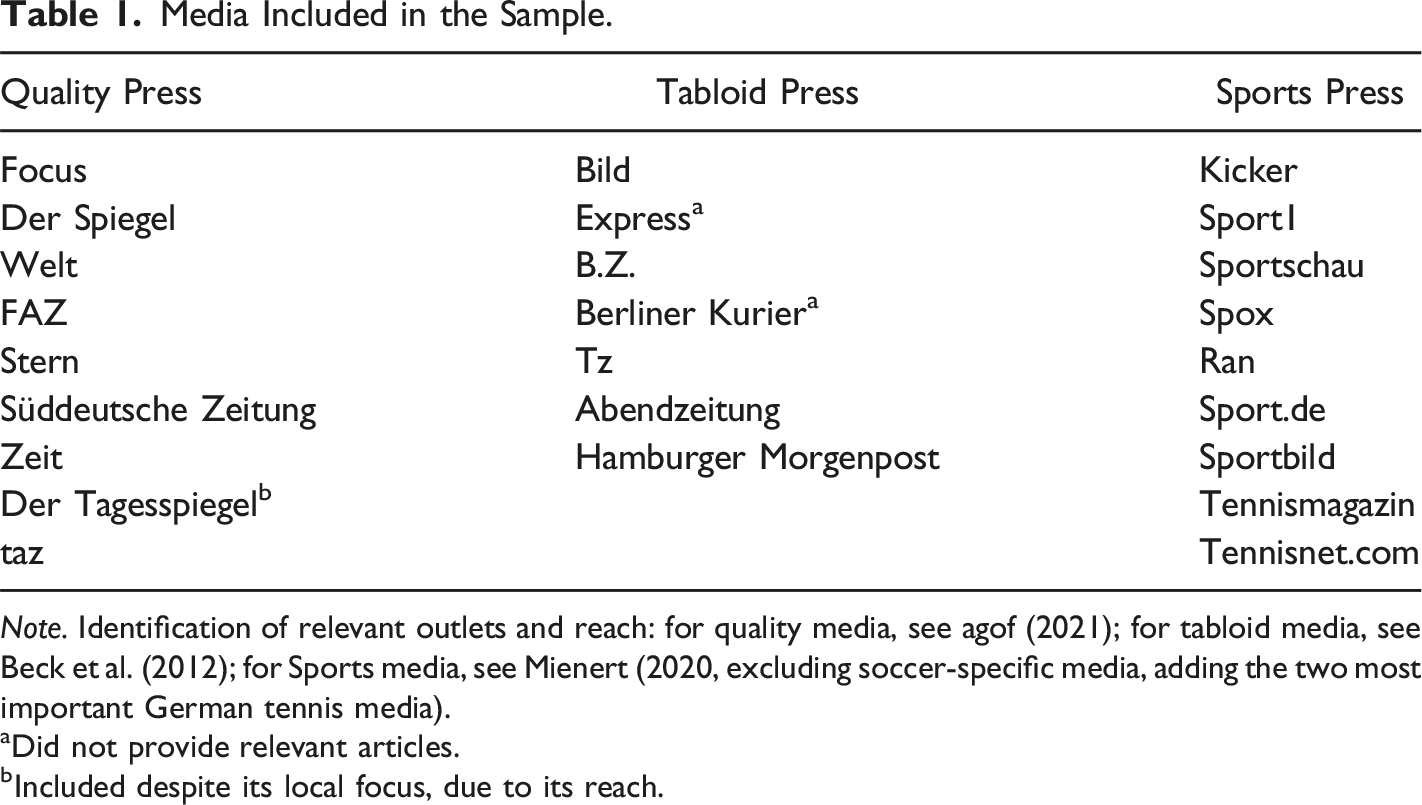
Note. Identification of relevant outlets and reach: for quality media, see agof (2021); for tabloid media, see Beck et al. (2012); for Sports media, see Mienert (2020, excluding soccer-specific media, adding the two most important German tennis media).
aDid not provide relevant articles.
bIncluded despite its local focus, due to its reach.
Using LexisNexis, Google news search via search operators, and the archives and search functions of the portals, all articles containing the following search terms were first collected: “Naomi Osaka” AND “media” OR “journalism” OR “press” OR “boycott.” The search period spanned from May 24 (start of the tournament and before the boycott was announced on May 26) to June 18, 2021 (1 week after the finals of the French Open and leading up to the Wimbledon tournament). As a check and in view of the manageable results per medium, the individual pages were searched again only for “Naomi Osaka” in the corresponding period under investigation, and the articles were checked with regard to their relevance to the topic and, if necessary, supplemented in the sample.
In the process of data cleansing, all articles that did not mention the press boycott itself were deleted. A total of 54 relevant articles in the quality press, 12 in the tabloid media, and 57 in the sports media were identified. Subsequently, the sample was examined for its degree of reflection. Following Denner and Peter (2017), three levels were distinguished: mentioning the boycott without any context (level 1); references for providing contextual information (level 2), and (critical) reflection (level 3).
Level of Reflection in Articles.
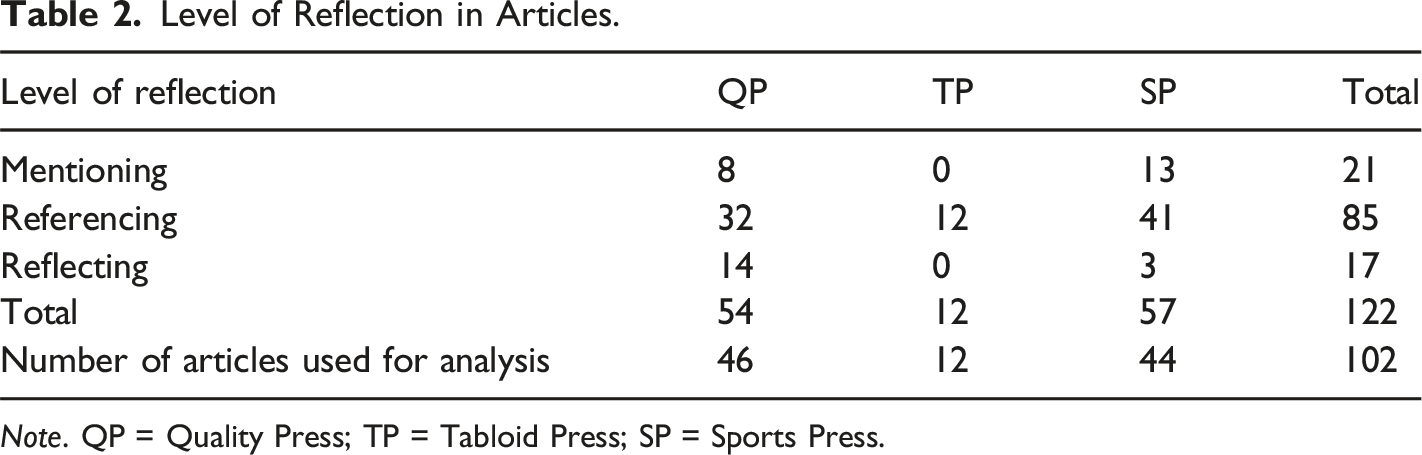
Note. QP = Quality Press; TP = Tabloid Press; SP = Sports Press.
Category System
Major parts of the category system were deductively derived from the research questions and then operationalized with the help of existing literature. The category system included one category each for the journalistic perspective and for the external comments on the constructs of evaluation (operationalization based on Gerhards, 2010, p. 344), journalistic roles (operationalization based on Malik, 2004, p. 65; Weischenberg et al., 2006, p. 355), and responsibility (operationalization based on Heidbrink, 2017, p. 4). In addition, formal criteria were coded in the discourse, namely publication date, authorship, and external actors. The latter was collected by coding the names of those who were directly or indirectly quoted in the reporting on the press boycott, following the approach of Gerhards (2010, p. 343).
A pretest was conducted using this category system, consisting of three formal categories and six content categories for evaluation, role understanding, and responsibility, each from a journalistic and external perspective. One result of the pretest was an inductively developed category that described general statements about the relationship between (tennis) sports and the media, as this information sets the framework for the actions of journalists and athletes in the public discourse. Furthermore, coding instructions were added to various categories, which set boundaries between the categories and specified them. During the coding process, more categories were developed inductively, one to capture the representation of Naomi Osaka’s position, including a subcategory to analyze her evaluations of the discourse, and other subcategories to not only capture evaluations of the boycott, but also evaluations of the discourse on the topic. The aim was to deepen the analysis of the discourse structure and of the evaluation of Osaka’s actions. The German category system, including coding instructions, can be found in Appendix A.
Content Analysis
After the coding process, individual analyses were performed for each media genre to compare genre-specific discourses later. I coded all passages dealing with an evaluation of Naomi Osaka’s press boycott, the role of journalists, the responsibility for top athletes’ mental health, and the relationship between sports and the media. The mere mention of Osaka’s boycott was regarded as insignificant without an explanation of the background, evaluations, and so on. The immediate reactions and evaluations of Osaka’s depression disclosure were also regarded as unimportant if not contextualized in terms of metajournalism or accountability for mental health issues.
The use of MAXQDA software allowed for the creation of category systems, the colorization of sample text, and the export of all coded segments to an open Excel spreadsheet for further data processing. After coding was completed, all coded segments were generalized and reduced, following Mayring’s (2014) summarizing content analysis. Specifically, this means that I elevated and abstracted all relevant content to a uniform language level. Redundancies were eliminated, and whenever possible, summaries were formulated. A second reduction was carried out to compare the categories by media type. The research questions were then answered based on descriptions of these reductions and illustrative anchor examples.
Results
In quantitative terms, the sports press covered Osaka’s announced boycott by far the most, until the disclosure of Osaka’s depressions. Before May 31, the day of Osaka’s withdrawal from the French Open, 14 articles were published in these specialized media. During this period, the quality press published six stories (13%), and the tabloid media published two (out of 12 items, 16%). Overall, it appears that Osaka’s depression admission and departure from the tournament drew far more attention than her stated press boycott.
Although the number of articles was almost identical for the sports media (44) and the quality press (46), the depth of coverage varied across the two media genres. Fourteen articles in the quality press reflected the boycott, while only three articles in the sports media did so. In general, the German tabloid press showed surprisingly little interest in Osaka’s case. Almost every argument structure and topic feature presented here can also be found in sports publications and/or high-quality newspapers. With regard to journalistic evaluation, role reflection, and attribution of responsibility (i.e., the categories of journalistic self-thematization), the difference between the quality media on the one hand and the sports and tabloid press on the other is particularly striking. The inductively constructed category “contextual information on sports-media-intertwining” further enhances the image of the quality press covering the top in great detail. Even though all media genres addressed the relationship between professional sports and the media to some degree and the multitude of mandatory media appointments were touched upon throughout all genres as well, the quality media described in comprehensive detail the extent of media obligations, especially in individual sports, while outlining the financial relevance of media attention (e.g., FAZ_0605; Tagesspiegel_0601; for a list with all sample elements quoted in this paper, see Appendix B). Overall, the portrayal was particularly detailed, also due to the integration of descriptions by athletes such as Mischa Zverev and Britta Steffen (e.g., Spiegel_0603; Spiegel_0605) and background information, for example on the ongoing changes in the sports media intertwining due to the growing prominence of social media (e.g., SZ_0602; Zeit_0601).
Actors and the Depiction of Naomi Osaka’s Position (RQ1a)
Naomi Osaka’s position was portrayed in various shades throughout the discourse, and her statements had an enormous impact on the coverage: Her willingness to pay fines and her wish for the use of this money made it into many news pieces. It was occasionally mentioned that she announced the boycott out of self-protection, but her criticism of press conferences, the behavior of individual journalists, and the media rules of professional tennis was widely echoed. Phrases from her social media statements were often integrated into the coverage, for example, her criticism regarding the repetitiveness of questions asked in press conferences and the condemnable “kicking a person while they’re down” (e.g., MOPO_0527). The sports and tabloid press even published articles that exclusively depicted her position.
Overall, the quality press featured the greatest variety of voices, followed by the sports press. Aside from Naomi Osaka, many of the actors frequently quoted in the course of the public debate were active players such, as Serena Williams, Rafael Nadal, Novak Djokovic, Cori Gauff, and Ashleigh Barty. The organizers of the four Grand Slam tournaments, the tournament organizers in Paris, and the president of the French Tennis Federation, Gilles Moretton, were mentioned many times on the side of sports organizations. Former tennis players Billie Jean King, Chris Evert, Boris Becker, and Pam Shriver were also quoted. Athletes from other sports also joined the conversation, with NBA star Stephen Curry standing out in particular. In addition to present and retired sports professionals and managers, psychologists, a US politician, and Theresa Enke, widow of Robert Enke and mental health crusader, gave their voice. However, the focus here is on the disclosure of Osaka’s depression and less on the boycott itself.
Evaluations (RQ1b)
Journalistic reactions to the press boycott ranged from friendly and understanding to condemning. The boycott was considered especially regrettable because of Osaka’s remarkable personality both on and off the court (e.g., SZ_0529). Osaka made a strategic decision, although her true motivations were unknown (BZ_0531; FAZ_0601). Some journalists made explicitly negative comments: “To lump sports journalists together and to suggest that they were responsible for her mental problems was inconsiderate, if not even unfair on the part of the Japanese” 2 (Kicker_0601) was written in the sports magazine with the widest reach. A daily newspaper commentator called the boycott “indecent” and “egoistic” (Tagesspiegel_0528). The topic culminated in a “power struggle” (MOPO_0531; sport.de_0531). There was a “big fuss about Osaka” (BILD_0601), and the debate was marked by communicative mistakes (Sportschau_0601). Conversely, according to some journalists, Osaka once again made a statement beyond the sport with her boycott (Spox_0527), and her request was understandable to anyone who had ever been involved in insensitive situations at press conferences (SZ_0529). Moreover, it created an impetus for an important debate and paid attention to the relationship between sports and journalists (SZ_0602; Zeit_0601).
From a metajournalistic perspective, it should be emphasized that Osaka’s understanding of the media, specifically her “friendly relationship” with some journalists, was criticized in the quality press (Zeit_0601; Spiegel_0601). The image that the boycott created of the media and its working methods was also described as problematic (taz_0604).
The initial reactions to Osaka’s press boycott from sources outside the media were generally described as very dismissive. Specifically, active professionals are frequently cited. Among the most commonly offered arguments were that press work is part of the business (Novak Djokovic), that it promotes the sport (Rafael Nadal, Iga Swiatek), and that every athlete understands what they can expect in the system (Ashleigh Barty). According to the descriptions of the evaluations, there was confusion about unclear motivations (e.g., BZ_0531), the media boycott was controversial (e.g., Welt_0601), and Osaka did not receive much solidarity (e.g., SZ_0601).
The sports press, particularly the specialized Web site Tennisnet, offers reviews of several tennis-internal players. An article used colleagues’ reactions as a hook and included new voices (e.g., Naomi Broady and Daniil Medvedev; Tennisnet_0529). The highest-ranked German player, Alexander Zverev, showed his support for Osaka shortly after her first speech, and his perspective was covered only in the sports press. Conversely, Daniil Medvedev had little sympathy for Osaka’s media boycott.
The tone of the evaluations turned with the disclosure of Osaka’s depression, specifically with other professional players criticizing the public communication and the organizers’ responses. Former player Pam Shriver, who was quoted verbatim in various media genres, and Formula 1 driver Lewis Hamilton, whose severe criticism of “ridiculous reactions” (e.g., Spox_0604) appeared numerous times in the quality and sports press, deserve special mention.
Journalistic Roles (RQ1c)
In general, the categories of journalistic roles reflect the low level of reflection in the German mass media’s coverage of the Osaka case. The tabloid press did not address journalistic roles at all. The few journalistic voices that explicitly addressed journalistic roles in quality outlets emphasized that journalists should not act like fans or athletes’ buddies. In particular, one article published in Süddeutsche Zeitung (SZ_0602) directly criticized the questions commonly posed by journalists, especially in the United States. The fact that sports journalists are also involved in the entertainment business is not hidden either. However, the article highlighted journalism’s role as a sports analyst and critical control authority that must also raise uncomfortable questions. In this context, there is a call to strengthen professional sports journalism (e.g., taz_0604; Zeit_0601). In the sports press, only one paragraph in a Kicker article dealt with the importance of journalists: “However, questions from journalists are also needed. As well as an understanding audience” (Kicker_0601).
The external definitions of journalism’s duties and functions were confined to the comments of Mischa Zverev, Britta Steffen (both quality press), and Julia Görges (sports press) in interviews (Spiegel_0603; Spiegel_0605; Sport1_0604). A persistent issue here is the desire for professional and courteous interactions.
Attribution of Responsibility (RQ1d)
Regarding the journalists’ attribution of responsibility, the focus was clearly on the system of professional sports, which must ensure a better handling of the subject of mental health. This was observed in headlines such as “The sports system devours its children” (FAZ_0606). Two articles in the quality press explicitly rejected direct media responsibility (Zeit_0601; SZ_0612). Conversely, some individual authors reflected on the relationship between sports and media and highlighted, among other things, the mental pressure in press conferences, referring to it as the “flip side of attention” (SZ_0529). The stress was exemplified in the Frankfurter Allgemeine Zeitung by the vast number of obligatory appointments, using the example of Angelique Kerber (FAZ_0605). In this context, journalists deal publicly with the pressure that “their” media system places on athletes, which can be interpreted as introspection and self-criticism. Furthermore, the quality press published an interview with psychologist Marion Sulprizio, the only expert testimony of a person who did not or had not made money as a professional athlete (Tagesspiegel_0602). She emphasized the psychological burdens of press conferences for people with social anxiety, but also stressed that the tournament organizers could not have known about Osaka’s situation in this specific case.
Osaka’s willingness to take responsibility and cooperate in improvements was also reflected in all media genres (e.g., FAZ_0601; MOPO_0531). She not only put the issue on the agenda, but also wanted to work with tour organizers to improve the circumstances for the players, press, and spectators after her return. However, she blamed the organizers for failing to take adequate care of mental health despite their responsibility.
Similar attributions of accountability were found in the statements of Stephen Curry and Martina Navratilova. The NBA player highlighted the need for “the powerful” to protect their people. Navratilova observed that in the sports system, the emphasis was on physical health, while mental and emotional health were often overlooked. Lewis Hamilton demanded more assistance and less pressure, but the media should also show more respect for athletes.
According to their own statements, the organizers of the Grand Slams, the Association of Tennis Professionals (ATP) and the Women’s Tennis Association (WTA) were committed to the well-being of athletes and wished to collaborate with them on future developments and media relations. Here, support for Osaka and her commitment to athlete health was articulated (e.g., Sportschau_0601). The WTA also underlined the importance of mental health. However, only the sports press reported, even before Osaka’s depression was revealed, that the organizers of the Grand Slam tournaments declared their intention to support Osaka’s efforts to promote mental health (e.g., Tennisnet_0530). The tabloids ignored these statements and focused on Stephen Curry’s claims and Martina Navratilova’s thoughts on the subject.
Discussion
Journalistic self-thematization and problematization play a central role in the continuous differentiation of journalism and the role perception of journalists as well as in the audience’s understanding (Carlson, 2016). In practice, however, there is tension between the benefits of such critical reflections and the economic and reputational interests of media organizations, which are primarily concerned with system and organizational preservation (Haas, 2006; Malik, 2004). This study seeks to answer central questions about the meta-journalistic discourse on Osaka’s press boycott “by looking at the key components of who is speaking, where they speak, what they say, and how it is disseminated” (Carlson, 2016, p. 362).
Genre Differences in the Metajournalistic Discourse and Journalistic Self-Defense
Before she revealed her personal mental illness, Naomi Osaka’s press boycott and criticism of press conferences sparked a metajournalistic discourse, particularly in the sports and quality media. A review of literature suggested that “[j]ournalists [would] actively fashion an image of journalism against a backdrop of broader criticism” (Carlson, 2014, p. 34). However, there is minimal self-criticism or reflection published by journalists in the sample in this study. Instead of explaining their own positions, all media genres tended to present the (mostly press-friendly) arguments of non-media representatives, particularly those from the tennis world. The targeted, strategic selection of sources and quotation providers has also been described in other studies as a meta-journalistic practice, as the journalistic end product enables statements to be made about credibility attributions (Chyi et al., 2012).
The tabloid press coverage is not as graphic as one might expect, and it is also scarce in quantity. Descriptions within the quality press are the most versatile. The only exception is for the boycott evaluations made outside of the media: while they are less diversified in their system affiliation than those portrayed in the quality press, the sports press represents the most widely varied people and perspectives here. Overall, the quality media provides significantly more depth in terms of self-reflection and context information than the other media genres. These findings, as well as the distribution of reflection levels in the sample, are consistent with the tendency described by Malik (2004) that such public reflections and self-criticism can be provided only by select media with large resources.
Given that there is little discussion on journalistic roles and that responsibility for the issue of mental health is primarily attributed to top-level sports, the tendency to present certain sports-internal voices paints an overall consistent picture of what journalists would like to convey to the public about the Osaka case. The fact that the currently top-ranked German tennis player Alexander Zverev expresses far more sympathy for Osaka’s boycott and is quoted only in the sports press is remarkable. This observation gives the impression that journalists wanted to protect their image in the context of Osaka’s case, comparable to other media scandals in which journalists conduct boundary work and image repair for self-preservation (Berkowitz, 2000; Carlson, 2014; Liebler, 2010).
These findings may also be connected to the introductory remarks about the specifics of sports journalism. More than most departments, sports journalism is dependent on its object of observation (Wenner, 2015). Combined with the dilemmas of public self-criticism (Haas, 2006; Liebler, 2010; Malik, 2004), this evokes a doubly difficult situation for sports writers, making self-referential reporting a balancing act for those involved.
Discursive Power and Athlete Activism
Although Osaka was able to generate attention with her accusations against the press and tennis institutions, the majority of the reporting occurred in response to her personal mental health disclosure. It is notable that actors outside of the athletes’ system entered the discourse only in the second phase. There is much sympathy for Osaka’s illness and, as a result, much talk about responsibility and potential for improvement, but there is almost no comprehensive discussion of the role of (sports) journalism. To put it bluntly, the individual fate of superstar Naomi Osaka outperforms her solo press boycott by far in terms of its effectiveness as a discussion starter. Based on this, it can be debated whether Osaka is still treated as a subject in metajournalistic discourse or whether she primarily becomes an object of observation.
However, it should be stressed that this analysis highlights the significant influence that athletes like Naomi Osaka wield in shaping discourses, and underscores how individuals of similar sporting and societal stature can strategically position themselves through effective communication. Factors such as Osaka’s professional and personal identity, her gender, ethnicity, and sporting impact should also be considered when looking at her role from the perspective of athlete activism. The work of Leppard (2022), for instance, already takes a first step in this direction, pointing out similarities with other athletes like the Williams sisters “breaking through racial and gendered glass ceilings” (Leppard, 2022, p. 1216), while also recognizing Osaka’s uniqueness (e.g., her racial intersectionality, activist engagement early in her active career). Despite concerning study results and points of criticism regarding the reporting on Osaka, particularly early in her career (Razack & Joseph, 2021), Osaka demonstrated her “discursive power” (Calow, 2022) during the Black Lives Matter protests. The present study confirms this impression and implies, that this also holds true for sensitive, former stigmatized topics such as mental health (Baer et al., 2016; Cassilo & Kluch, 2023; Kaier et al., 2015; Parrott et al., 2020).
Mental Health Discourses
The issue of mental health has become significantly more prevalent in professional sport in recent years, when several professional athletes have opened up about their mental health problems and illnesses (Billings & Hardin, 2023). Even though some athletes faced critical comments and reporting (e.g., basketball player Royce White, Parrott et al., 2020), the reactions to Osaka’s statements suggest that awareness and understanding of the issue are increasing overall (Chen & Kwak, 2023; Kumble et al., 2022). This must also be taken into account when evaluating the journalistic handling of the athlete and her accusations against the media, as criticism related to the promotion of mental health, whether justified or not, may lead to a public backlash.
However, the ongoing discourse on the pressure that weighs on athletes was cherished in several articles and the fundamental importance of the topic was recognized (e.g., FAZ_0605; Kicker_0601; SZ_0602), hinting at further changes in public mental health discourses, especially against the background of longstanding stigmatization of mental illness in the field of professional sports (Cassilo & Kluch, 2023; Elsey, 2019; Kaier et al., 2015). Further, the tonality in the second part of the discourse after Osaka’s disclosure is particularly encouraging. The media interviews with athletes, such as Britta Steffen on this subject after May 31 and the articles entirely devoted to Lewis Hamilton’s stance in this matter (“Hamilton’s demand to the media,” Focus_0603), also partly suggest that journalists are willing to listen to athletes’ concerns in this situation.
De-mediatization and the Future of Self-Referential Reporting
Undoubtedly, sports journalism relies on a well-functioning competitive sports system to fulfill its role effectively (Wenner, 2015), and the mental health of the athletes is a major component of this. However, the constant alignment of sports with the interests of the media system, fueled by enormous revenues stemming from advertising deals and broadcasting rights, are not only advantageous for the athletes (Birkner & Nölleke, 2016; Küpper et al., 2022; Nölleke et al., 2021), leading them to develop and practice de-mediatization strategies (Nölleke et al., 2021) like skipping press conferences. Osaka bypassed (Nölleke & Birkner, 2019) the journalistic system through her social media communication, providing another example for the shifts of power in the sports-media relationship.
Journalists will have to face more challenges affecting the (sports) journalism system, such as increased competition in the online market and the loss of relevance as a result of increasing social media power (McEnnis, 2021; Nölleke & Birkner, 2019). Examining their own profession’s self-image and external image on a regular basis, both internally and publicly, might strengthen their own identity and the understanding of the transparency-loving public (Carlson & Lewis, 2019; Hedman, 2016; Perdomo & Rodrigues-Rouleau, 2022; Zelizer, 1993).
Limitations and Further Research
The results of qualitative studies can only be generalized to a limited extent. However, the present analysis examines the most popular media outlets from three media genres (quality media, tabloid press, and sports platforms), including leading media such as FAZ and Süddeutsche Zeitung, thus the results can be considered comprehensive for the period of investigation and the geographical context of Germany as one of the most important (sports) media markets worldwide (Statista, 2024). Nonetheless, comparative quantification should also be sought in the long term, especially in an international context, as the present study only examines national reporting in a singular Western European country.
Furthermore, the chosen method of content analysis to describe discourse should be reflected upon again: As in other discourse analyses (e.g., Gerhards, 2010; Thomas & Finneman, 2014) and metajournalistic studies (e.g., Carlson, 2014), content analysis was used to draw a detailed picture of the coverage of Osaka’s press boycott. The background and genesis of this coverage can play an important role in discourse analysis. Supplementary interviews with journalists and those responsible in the sports editorial offices can undoubtedly provide more profound insights into the decision-making processes within the institutions.
Conclusion
Athletes like Naomi Osaka possess significant discursive power, even when addressing sensitive topics, and it can be assumed that this power will likely grow in the coming years. For journalists, this implies a changing field of action in which they must continue to renegotiate their role. Meta-journalistic discourses can play a central role in this; however, in sports journalism, the topic remains a marginal phenomenon in both research and practice. This study deepens our understanding of legitimation processes in the field of sports journalism, by focusing on the participating actors, evaluations, journalistic roles and tasks, and attributions of responsibility. The relatively low level of reflexivity and the pronounced reliance on supportive statements from influential sports actors suggest that future discourses could be better utilized by sports journalists to evaluate their own system, potentially reform it, and thereby strengthen it communicatively.
Supplemental Material
Supplemental Material - Representatives, Reflection, Roles, and Responsibilities: The Metajournalistic Discourse on the Press Boycott of Naomi Osaka
Supplemental Material for Representatives, Reflection, Roles, and Responsibilities: The Metajournalistic Discourse on the Press Boycott of Naomi Osaka by Lena Küpper in Communication & Sport
Footnotes
Acknowledgments
I would like to thank Thomas Birkner for his valuable feedback throughout the completion of this research.
Declaration of Conflicting Interests
The author declared no potential conflicts of interest with respect to the research, authorship, and/or publication of this article.
Funding
The author received no financial support for the research, authorship, and/or publication of this article. A professional proofreading service was funded by the research support fund of the Department of Communication at the University of Münster.

Supplemental Material
Supplemental material for this article is available online.
Notes
References

Supplementary Material
Please find the following supplemental material available below.
For Open Access articles published under a Creative Commons License, all supplemental material carries the same license as the article it is associated with.
For non-Open Access articles published, all supplemental material carries a non-exclusive license, and permission requests for re-use of supplemental material or any part of supplemental material shall be sent directly to the copyright owner as specified in the copyright notice associated with the article.
