




Abstract
In this paper we focus on the posthumous media image of the deceased professional ice hockey player Pavol Demitra. He was a world-famous athlete, starring in both the NHL and KHL, but this paper primarily focuses on his fame in Slovakia, his native country. Demitra became a legend in his own lifetime, but his story only gained its true shape after he had died. The media played a dominant role in this deeper reflection of Demitra’s life. First, we monitored the Slovak media in the ten years following his tragic death. Next, we focused on the quantitative analysis of two categories, heroism and cultural and societal overlaps, which formed the basis of Demitra’s fame legacy. Through our third step, a qualitative frame analysis, we demonstrated how the media dealt with athlete’s framing. The results showed how Demitra was put on a pedestal and, in some aspects, immortalized as a divine, heroic statue made of marble. At the same time, his legacy has continued thanks to his son Lucas, a successful athlete, keeping the name alive.
The concept of athletes as an essential part of celebrity culture has long been part of the media studies discussion and appears in both journals and monographic sources (e.g., Leslie, 2011; Rojek, 2001). A quality surrounding competition provokes the discussion that athletes go beyond the standard understanding of celebrities. Scholars (e.g., Boyle, 2006; Crepeau, 1981; Holland et al., 2023; Wenner, 2013) have repeatedly addressed that athletes, with their impressive and breathtaking victories, have often mobilized the national spirit and self-esteem, becoming contemporary heroes.
Boorstin (1992) points out a sharp distinction between celebrity and hero. In the context of contemporary media practices, however, we note that the traditional anchoring of the hero usually extends into alternative representational frameworks beyond the realm of their professional practice. In the moment of the conjunction of heroism and celebrification, we find a crucial point of departure for this study. We operate on the premise that successful athletes are, first and foremost, heroes whose narrative oscillates on the axis of media production and audience. Athletes become celebrities in the strictest sense of the word, but what specifies them is that they are a priori heroes; they themselves are responsible for their success. In the case of non-living individuals, their narrative is closed, while their celebrification is semantically open-ended, free to different types of interpretations.
This study analyzes the development of Slovak ice hockey player Pavol Demitra’s media image in the decade following his tragic death. Internationally famous, especially in his home country, Demitra, born in 1974, reached significant milestones in his career as a player in the American NHL and Russian KHL. Ice hockey has long been one of the most popular sports in Slovakia. Special attention is focused on the national team, and this is where Demitra was one of the most prominent personalities, although as national team captain, he achieved only one medal success (3rd place at the 2003 World Championships). Demitra died along with the whole Lokomotiv Yaroslavl team on September 7, 2011 when the plane carrying the team crashed.
In addition to Demitra’s sporting qualities, fans appreciated his positive attitude, passion for the result, national pride, team spirit and his commitment to fair play. He was also known for his willingness to support sports in his country in any way he could. Just before his death, he said: “I also plan to invest my own resources. Everyone should put something back into the sport. It’s not about the A team at all, it’s about the kids,” (Jurčo, 2011). Although Demitra was known to enjoy the fortune he earned, no excesses were ever leaked to the public, except perhaps for his fondness for fast driving and one media-covered traffic accident.
The ambition of this paper is to enrich the discussion on the continuing legacy of the famous athlete in the context of a smaller European culture, mapping the broader contours of the role of sport and their variability in contemporary society. The example of Demitra can be used to illustrate how a particular society, through the prism of its media scene, socially (post)constructs a hero and what contexts enter into this process. The meaningfulness of the topic also lies in a closer understanding of the so-called memory culture embodied by a real-world example. This is based on the fact that “Cultural memories… need vehicles of memory to transport them across space and time beyond the finite human bearer of memory…” (Thylstrup, 2018, p. 183) and we believe, Demitra can be seen as a very rich vehicle. Finally, we aim to establish a comparative research base for further exploration of heroization today.
Theoretical Framework
As Rojek (2001) points out, three approaches lead to an understanding of celebrities: subjectivism, structuralism, and post-structuralism. Subjectivism focuses on the uniqueness of the subject, referring to a specific “unique chemistry,” charisma, or emotionality without a rational framework. Celebrity is perceived as a phenomenon without precedent, and its production frame remains outside the observed horizon. Even divine essence can be revealed, verbalized on an explicit (Mother Teresa) or implicit (John Lennon) level (Alpion, 2006). Fundamentally opposed to subjectivism are structural approaches. Unique celebrity qualities are neglected or even rejected. Instead, “celebrity is investigated as the expression of universal structural rules embedded in culture,” (Rojek, 2001, p. 33). In doing so, it is essential to note that there are no universal rules; each culture creates its own. Therefore, a particular celebrity is always a manifestation of a specific cultural space.
The mechanisms responsible for the fabrication of public notoriety play an essential role (celebrification) and broader social processes (celebritization), as discussed by Driessens (2013). Structuralism focuses on understanding the social and cultural structures behind the genesis and functioning of celebrities, understanding these structures universally and often placing them in binary oppositions. Post-structuralism, inspired by the work of Michel Foucault, goes further, focusing on the representational codes forming the omnipresent image of celebrities, which have distinct dynamics. Within this context, “celebrity is a set of discourses that regulate the relationships between what it means to be an individual and what it means to be part of a wider collective identity,” (Evans & Hesmondhalgh, 2005, p. 121). As summarized by Rojek (2001): “Post-structuralist approach confirms the importance of understanding celebrity as a developing, relational field of power, and it emphasizes the versatility and contradictions of the public face,” (p. 45).
The issue of generating public notoriety can also be looked at from the perspective of the social construction of reality often associated with the media. “Social construction refers to the processes by which events, persons, values and ideas are first defined or interpreted in a certain way and given value and priority, largely by mass media, leading to the (personal) construction of larger pictures of reality,” (McQuail, 2010, p. 101). As has been suggested in previous work (Mikuláš, 2020), celebrities fulfill a wide range of roles expected by Lasswell’s Functionalist approach to media and can be seen as an important element that correlates the different functions of media in the present.
Media Coverage of Deceased Celebrities
Most monographic literature examining the cultural impact of celebrities is partially devoted to posthumous issues. Posthumous extension is understood as a continuation of spectacle (Turner, 2004), promotional opportunity (Petty & D’Rozario, 2009), a demonstration of the mechanisms of the development of media technologies and the normalization of death and dying (Gibson, 2007), a free continuation of the religious cult of saints in a secular society (Rojek, 2001) or as a specific kind of media event connected with contemporary culture (Burgess et al., 2019). The dominant part of the research is focused on media coverage of death (Courbet & Fourquet-Courbet, 2014; Garde-Hansen, 2010), with some of them stressing the immediate reaction factor (Chen et al., 2022; Walters, 2021).
From a broader perspective, the topic is part of the concept of necrotainment, i.e., the commodification of elements related to death and dying and its stylization into forms of media products (Moravčíková, 2013; Wojciechowski & Malíček, 2014). The posthumous existence of celebrities undoubtedly becomes a stimulus for a large spectrum of media rituals (Burgess et al., 2019), resulting in specific cultural texts.
Deceased celebrities are a permanent focus of the media: they are repeatedly present in journals, biographies, and documentaries. Additionally, through technical developments, even posthumous acting in movies (Petty & D’Rozario, 2009), holographic performances (Heugas, 2021), and advertising (Pringle, 2004) have become viable platforms for their media afterlives. Besides their genuine popularity, the cultural experience and creativity of the media content producers (see Fichnová, 2015) are crucial.
Kitch (2000) analyzes media coverage of celebrity deaths, summarizing that they are inscribed with “moral tales” that seek to reflect upon the celebrity’s life and their impact upon and, in relation to, society. Media coverage can also be viewed as a nostalgic frame leading to broader reactions on the part of the media audience, from social sharing to prosocial behaviour (Myrick & Willoughby, 2019). Social media and the mourning process among fans are also analyzed by Courbet and Fourquet-Courbet (2014).
Previous research focused intensely on deceased celebrities from pop culture, e.g., Elvis Presley (Alderman, 2002), David Bowie (Black, 2016) or Princess Diana (Fürst, 2020). What is almost forgotten in research is the posthumous presence of sports celebrities in the media space over time.
Media Framing of Deceased Athletes
Since the topic of death and celebrity provokes the emotions of both journalists and audiences, we believe an analysis of the media construction of Demitra’s posthumous image through the lens of media framing theory is suitable. From the beginning of its establishment in communication studies by Entman (1993), this approach has been repeatedly used not only for general news analysis but also for sports media coverage (Billings & Eastman, 2002; Johnson et al., 2022; Tejkalová, 2019).
Media frames help to organize the living experience and facts (Carter, 2013; Goffman, 1974) and make certain features of the events or personalities in the media more prominent (salient), emphasized, or excluded (Entman, 1993). In the cases of deceased celebrities, the attempts to erase questionable or problematic parts of their lives and, at the same time, to glorify the prominent phases are traceable (Black, 2016). Since these media (re-)constructions of personality contribute to a certain kind of immortality, it is convenient to focus on aspects like the persistence of frames in time or the symbolic nature of frames (Carter, 2013). The longer the frames stay (or repeat) in the media coverage, the more persuasive they are, and when media framing highlights the symbolic aspects of deceased people’s characters and lives, it creates a more lasting impression in the audience’s minds.
As Carter (2013) shows, alternative framing (introduced as a possible framing typology by Kitzinger (2007)) of very same, often controversial topics (e.g. steroid abuse) can lead to different media interpretations of the event or the athlete. Nevertheless, we can observe from other studies of deceased sports celebrities, e.g., Kobe Bryant, that the death of such a great athlete almost immediately erases any alternative frames of his personality. The U.S. media coverage of Bryant’s tragic accident paints a portrait of a strong fighter, a passionate athlete who overcame all adversities in his way, with his alleged sexual assault in 2003 left far behind (Chen et al., 2022). Still, few studies have focused on developing any famous athlete’s posthumous reputation over a more extended period. As Walters (2021) summarizes McElroy’s (2013) findings, media in “obituaries often end up reproducing complex themes and histories into oversimplified frames” (McElroy, 2013; as cited in Walters, 2021, p. 4).
Methodology
The research problem addressed in this study regards the nature of deceased athletes in the media space. Based on this, we formulated two research questions:
How had the extent of media reporting about Demitra changed in the decade following his tragic death?
How had Demitra been framed in this decade in connection with the legacy of his fame?
A mixed method (Guest, 2013) approach was selected to first explore all the material statistically, and then based on the results of quantitative analysis, to focus qualitatively in greater detail on the most interesting frames. The Slovak media outputs were extracted from the Newton Media database, which gathers archives of all the media types (print, online, radio and TV), using a keyword search with “Demitra” in the headlines. We included all media types published between 2012 and 2021, ten years after Demitra’s tragic death. The results were then cleared of duplicated media content. In addition to the quantitative reduction, the selection (Demitra’s name in headlines only) allowed us to concentrate on those media outputs that primarily treated the research subject as the main reported topic.
Besides the frequency of categories, we also dealt with the Gross Rating Point (GRP), a metric measuring the impact of media output. Technically, this metric quantifies impressions of media products multiplied by the frequency in which the audience is exposed to them. While it is primarily designed for advertising and PR, it can also be applied to media outputs in general, and it is a standardized part of media monitoring services. GRP was calculated for every year, as the quantity of the media outputs does not have to correspond with the intensity of the topic in the media. We were interested in discovering if the GRP would correlate with a quantity of media outputs. Additionally, the media type was coded for each media output.
Initially, a quantitative content analysis (Krippendorff, 2004) was used, focusing on the two main themes: (1) heroism and (2) cultural and societal overlaps (hereinafter referred to as CaSO). We proceeded by categorizing each of the outputs according to its observed occurrence. To differentiate between the importance of variables in relevant media outputs, we distinguished between primary or secondary topics in the analyzed outputs. A main topic scored 1 and a secondary 0.5. We focused only on the textual aspect of the media outputs; the visual elements remained outside the scope of our research.
The category of CaSO refers to various posthumous references to Demitra in the studied media space, namely media mentions of any cultural artifacts and social events connected to him. It includes all media mentions connected with any reference to Demitra: physical objects, events, media products, or descendants. As indicated by Petty and D’Rozario (2009), posthumous motifs in media products are very popular and well received by the audience. Due to the intense media exposure generated during Demitra’s lifetime, a number of challenges are available in this respect. In this selection, we have included only references that occurred after Demitra’s death, also taking into account current productions in progress (e.g., shooting a film, works on the memorials, etc.). This orientation ensured the elimination of any repetition of important awards that he received during his lifetime.
Heroism, in this case, refers to media expressions denoting Demitra as a hero both in explicit and implicit ways. Heroism, as an archetypal social construct, results in the dramatization of its subject, or in its perception manifested in the sensitivity and willingness of the journalist to assign such a label to the subject. By focusing on heroism, we wanted to understand the extension (quantitative level) and structure (qualitative level) of the posthumous heroization, respectively, to map the sensitivity of the media to label Demitra as a hero and to find out what the manifestations and connotations of this labeling in media language are. To achieve this goal, we coded any expressions explicitly referring to Demitra as a hero (words “hero” or “heroic”) and those clearly highlighting the heroic nature of his personality, including supernatural abilities attributed to him.
In CaSO, we focused on factual execution and the embedding of Demitra in wider social contexts, while in heroism, procedural expressions were investigated. These two categories were chosen to further understanding of the media elaboration related to a hero label as well as understand the complex social and cultural nature of Demitra’s legacy, i.e., to find out whether and to what extent this legacy is implemented in Slovak society via media. To set the fitting codes, we started with a common preliminary analysis of 25 (ca. 5% of the total amount of analyzed media outputs) randomly selected outputs to identify the elements which created heroic and CaSO codes. For the analysis, the media outputs were first divided into two parts and independently coded by two researchers, then each part of the coding was revised by the other researcher and, where discrepancies arose, they were settled in a mutual discussion. In cases where both heroism and CaSO motifs occurred in a single output, we categorized the output into both categories, and again, a main topic scored 1 and a secondary 0.5.
The quantitative assessment allowed us to understand the breadth of the phenomenon under study and the representation of the two categories under investigation in the overall context of media coverage, reflecting a long-term developmental perspective.
Media Monitoring of Pavol Demitra (2012–2021).
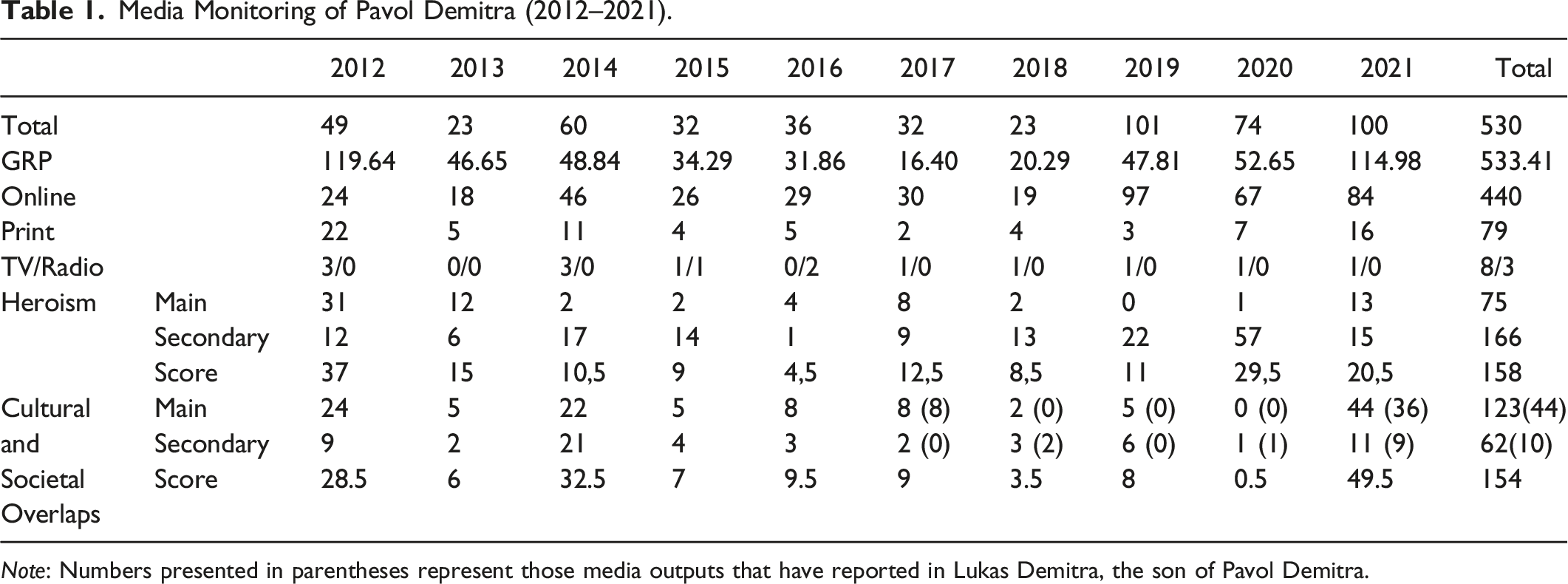
Note: Numbers presented in parentheses represent those media outputs that have reported in Lukas Demitra, the son of Pavol Demitra.
The frequently mentioned limitations of quantitative content analysis (a lack of context or superficial mapping of a phenomenon) were overcome by the more detailed, qualitative framing analysis, whose disadvantages (greater subjectivity and interpretative position of the researchers) were mitigated by its combination with a quantitative analysis.
Findings
In this section, we start with a presentation of quantitative analysis, followed by a qualitative interpretation of dominant framing. The sample for quantitative analysis consisted of 530 media outputs containing the headline keyword “Demitra”. By far, the most frequented media platform was internet portals (440 outputs), followed by print (79), with television and radio represented in only a small number (8 and 3 respectively). The overall results are presented in Table 1.
The total output amount was highest in 2012 and 2021, i.e., in the first and last years. Except for 2014, the curve had been steadily declining, only to see the trend reverse in 2018. It peaked in the last year measured. The GRP curve clearly corresponds with the frequency of media outputs, reflecting the above trends more clearly (Figure 1). Media Outputs versus GRP (Media Monitoring of Pavol Demitra (2012–2021)).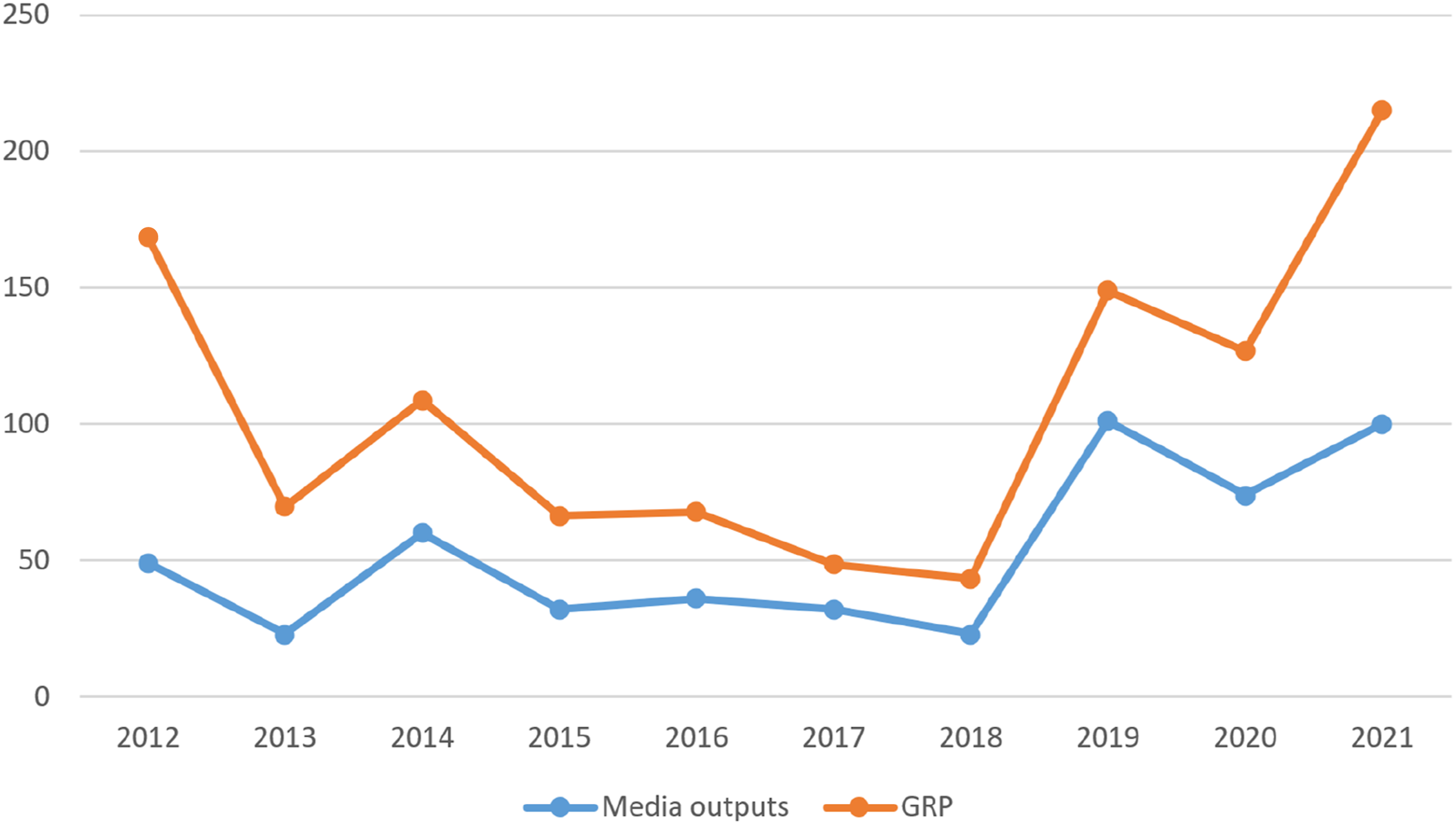
2012s substantial share of the output is unsurprising as it was the first anniversary of Demitra’s death. At the level of societal environment there was a psychological coming to terms with the loss of a personality. In 2014 we observed a renewed interest in the media, spurred primarily by the release of the biographical film “38” (2014). After 2014, newsmakers lacked the impetus for a new treatment of the topic and reporting on Demitra gradually faded. There was a significant change in the trend in 2019, when the number of media outputs quadrupled year-on-year (23–101), with the strength of media coverage rising even more markedly. This change in trend is a crucial moment for our research as it is something we had not anticipated and has not been commonly witnessed in the analyses of posthumous media portrayals. In 2020, there was a slight decline in media coverage, but the upward trend continued again in 2021.
We also measured the extent and representation of the categories of heroism and CaSO by quantitative analysis (Figure 2). We assume there is a significant loss of media interest that follows the initial boom, more so for heroism (since 2012) than for CaSO (since 2014). In both cases, there is a later stabilization, replaced by unprecedented growth in the last two years under review. Categories of cultural and societal overlaps (CaSO) and heroism (Media monitoring of Pavol Demitra (2012–2021)).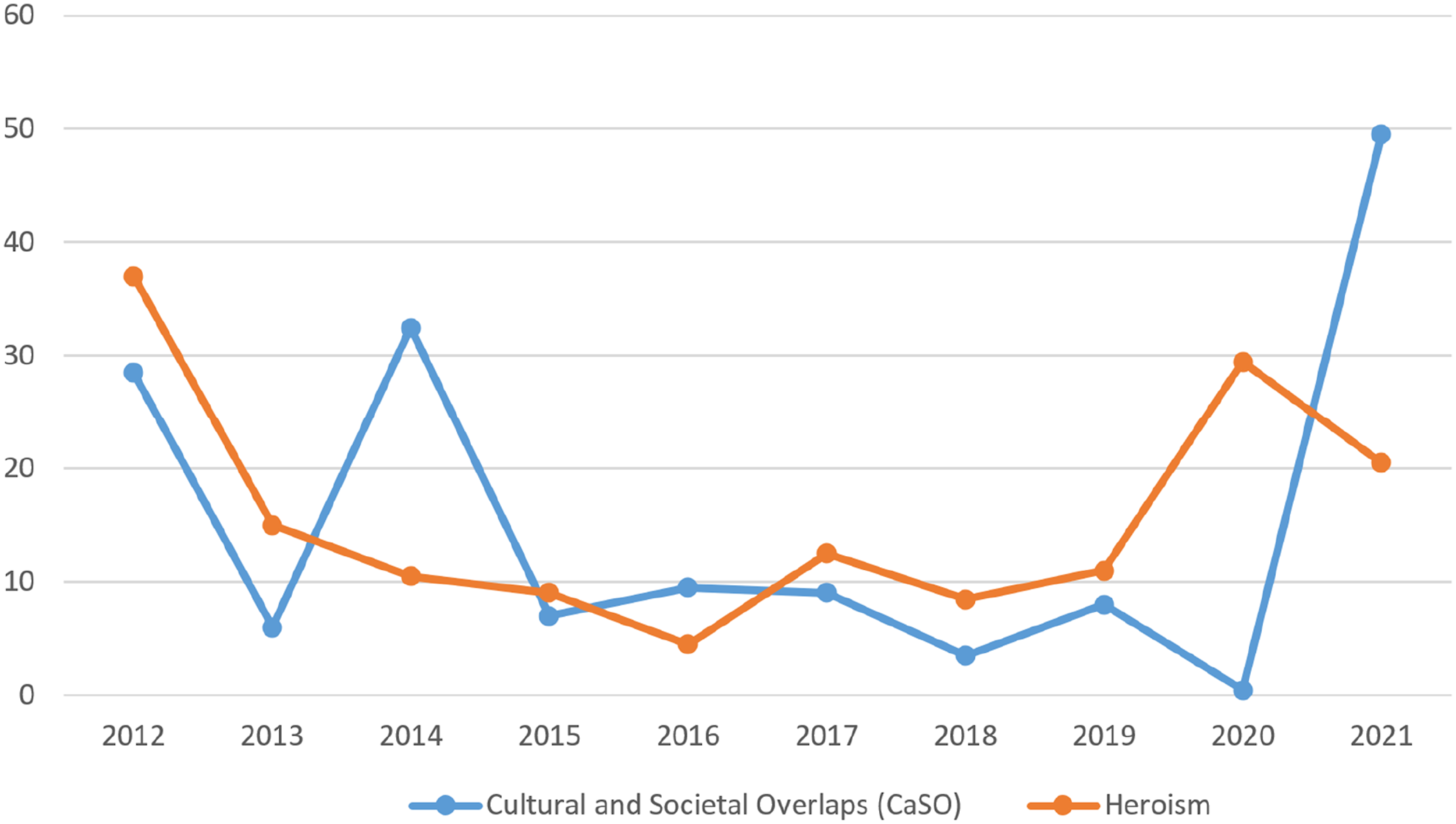
A large majority of outputs come from digital media, so it might seem that the topic is less interesting for traditional, and especially electronic, media. However, it should be pointed out that media monitoring for television and radio is aimed at news programs only. Thus, we assume a significant part of the content was outside the data set. The low radio results show the visual nature of the topic addressed or the absence of documentation usable for the needs of the audio broadcasting.
Immortal 38 and its Manifestation in the Focus on Lucas Demitra’s Story
Coverage of CaSO in the decade following Demitra’s death has focused on a number of areas, adding further meanings and values to his continued memory, and this coverage contributes to his heroic media framing. It has also brought to light various manifestations of the culture of memory (see Palárik et al., 2018). We frequently encountered awards in memoriam, e.g., the Sports Photography Award ([ml], 2012), inductions into the Slovak Hockey Hall of Fame (Gajdoš, 2012) and the International Hockey Federation Hall of Fame (Aktualne.sk, 2012), etc. Moreover, additional information has also appeared in the media, such as the discovery of a planet which was subsequently named after Demitra. It rated among the top news at the time of publication and was even included as one of the most watched prime-time news sessions broadcasted on Slovak TV Markíza (TV Markíza, 2012), and since then, the framing of Demitra as a star has conveyed more than just the sports meaning.
After the CaSO’s initial boom, the media’s interest faded. The public’s immediate reactions had already been processed in the previous year, and no new ones were emerging. We have identified only two media outputs where CaSO functions as the central theme: information regarding the beginning of the filming of the film “38” (see below) and the establishment of the Hall of Fame at the Elementary school attended by Demitra and named for him since 2011 (Tvnoviny.sk, 2013). Pravda Daily reports that a collection of poems about Demitra written by his wife has become compulsory reading at the school and that the school regularly organizes events dedicated to the athlete (Kráľ, 2013). Aside from that, there is only sporadic information, e.g., that Demitra became the subject of artistic representation by a contestant on a TV talent show (Zoznam.sk, 2013b).
During the previous decade, several events focused on the number 38 worn by Demitra on his jersey. A good example is the journal article reporting on a unique coin commemorating Demitra’s 38th birthday, which weighed 38 g and had a diameter of 38 mm (Korbel, 2012). The special significance of this number was further expressed by the title of a biographical documentary “38”. Already a year before its release, mentions of the preparation and filming were noticeable as part of the media’s agenda (Hnonline.sk, 2013; Zoznam.sk, 2013a). In 2014, the film was reported on very insightfully. It was released symbolically in the year when Demitra would have turned 38. It portrayed Demitra as someone who could beat not only the best hockey players in the world but also movie producers. This achievement was articulated in a headline pointing to the documentary’s success even in competition with the blockbusters of the time: “Demitra surpassed both The Hobbit and Shrek” (Kucman, 2014). Since 2015, however, the CaSO associated with Demitra has become less frequent. The media have stopped reporting on events of national importance and focused more on fragmented, smaller events, e.g., local commemorations.
In 2021, the last year analyzed, the name Demitra returned to the headlines due to the appearance of a gifted soccer player, Lucas Demitra (born in 2003), Pavol’s son. In fact, the sub-motif of Lucas started to appear in 2017 due to his participation in the Slovak national junior soccer team. He scored in his first match when he debuted in the Slovak national league (Fortuna Liga) in 2021 at 17. The media associated his sporting career with his famous father’s name, garnering him much attention.
Lucas medially further develops Pavol’s story, and the media outputs evoke the greatness of his father using phrases such as: “son of ice hockey legend” (Dopirák, 2021), someone who “inherited his talent from his father” (Dnes24.sk., 2021), or “bears a famous name” (Sportinak.sk, 2021). As is typical for epic heroic tales, this kind of resurrection of Pavol Demitra’s talent in his successful son adds a touch of immortality framing to his posthumous media portrayal and, from a commercial perspective, creates the opportunity to report on a famous ice hockey celebrity with name recognition.
Ice Hockey God and Nation’s Favorite: Demitra’s Heroic Framing
When we dive deeper into textual and narrative structures, we realize that the heroic part of Demitra’s media portrayal consisted of two components, one of them based on his ice hockey achievements and the other on his personality traits, being traceable also in connection to CaSO media coverage.
Beginning with his sports achievements, in Slovakia, the majority of people interested in ice hockey know the so-called “Demitrovka”, a nickname for a daring trick when the player scores a goal with the stick poked through his legs, which Demitra debuted in the match against Slovan Bratislava in 2004. After his death, whenever someone scored in this manner, and the media noticed it, Demitra was glorified (e.g., (sita), 2012a; Sport7.sk., 2019 or Sport7.sk, 2021). In 2013, he was posthumously named the best Slovak player of the last five years in the KHL. The analyzed media covered this event intensely, using laudatory words to strengthen his exceptionality: “Demitra overcame all the expectations in Lokomotiv. He performed fantastic ice hockey. In only one season, he managed to steal the fans’ hearts, and everyone could watch his game forever,” (SITA, 2013). Demitra was repeatedly referred to as an ice hockey god, with the most representative sentence of this trend published in the article by Boškovič (2017): “It has been exactly six years since that immense disaster. The ice hockey god went to ice hockey heaven.” Demitra was also remembered as an ice hockey genius and, sometimes solely or together with other famous Slovak ice hockey players of his generation, was pulled up for comparison with younger players, e.g., “Slovakian first line? They played like Hossa, Demitra and Gáborik, states the expert,” (Berzedi, 2021).
When interviewed, athletes from various sports named Demitra as their personal hero and childhood idol, such as Paralympic winner in boccia Samuel Andrejčík who admired Demitra’s creativity and leadership (Šport, 2016). Another example is one of the promising young Slovak ice hockey players Martin Chromiak who has grown up with the legend of Demitra: “I went to a school, which carried his name, as well as the ice rink in Trenčín where I used to play,” said 18-year-old Chromiak in the interview conducted ten years after Demitra death (Mlčúch, 2021).
When Demitra’s character and substance were taken into account, he was called the nation’s favorite (e.g., Pravda.sk, 2018), someone who can connect people, whether living or dead: “Unfortunately, Paľo achieved something that no one else did for a very long time in Slovakia, he bound the nation into one community. I could only think about Alexander Dubček, but it has been a while. It was in 1968,” quoted Michal Bunja (2013) in a text for TVnoviny.sk, a producer preparing a film about Demitra. This unity was also expressed by Slovak players at the World Championships in 2012 when Zdeno Chára, the team captain, put on Demitra’s jersey for the medal ceremony. The Slovak media also noted Demitra’s legacy of fostering good relationships in connection with a charitable exhibition in 2014. “Demitra († 36) would be happy... The Šatan versus Chára feud is over for good!” stated one of the headlines (Cas.sk, 2014), addressing long-standing issues between the aforementioned well-known hockey players, who reconciled during the event.
In various texts, these sports and personality components complement each other, as in the article from the news website Europrofit.sk (2012) where we can find the following statements: “Ice hockey virtuoso Pavol Demira became the 27th member of the Slovak ice hockey hall of fame (…) Demitra was an enormously creative player, ice hockey artist, charismatic and noble man with a sensitive soul,” (Europrofit.sk, 2012). When highlighting his ice hockey ability in connection to his character, the fact that Demitra was awarded the Lady Byng Memorial Trophy for the most gentlemanly player in the NHL during the 1999/2000 season was repeatedly mentioned in the articles to support the admiration stemming from these texts, sometimes naming him “unique”, “unforgettable”, or legendary “ice hockey gentleman” ([rh], 2015; Neubauer, 2019 or Glob.zoznam.sk, 2019).
Star in the Sky and His Divine Abilities
It is not uncommon for exceptional athletes to be called gods of their sports, however, in the case of Pavol Demitra the heroic framing was connected to seemingly divine abilities. The discovery of a small planet named after him has occasionally been presented in a metaphoric, even religious way, accompanied by headlines such as: “Demitra is already among the stars in the sky” (Tvnoviny.sk, 2012) or “Demitra is the star of the sky” ([sita], 2012b). Even the fact that the space object was technically an asteroid did not negatively affect the reporters’ enthusiasm.
In some of the articles, Demitra’s posthumous influence is framed as something almost miraculous, the most prominent examples being the texts from the World Championships 2012 ([mz], 2012) and about three charitable matches organized to celebrate Demitra’s legacy (Rojková, 2015). The first one has the headline “Is Demitra helping us from heaven?” ([mz], 2012), and it describes the fans’ speculations on social media if it was or was not a sign that Miroslav Šatan scored the decisive goal with just 38 seconds left in the match (38 being the number Demitra wore on his jersey).
In the second case, 118,000 euro raised from charitable matches was donated to gifted young ice hockey players from poorer families in Demitra’s hometown, Dubnica nad Váhom, so they could be fully equipped and have an equal opportunity to play with others. The article was called “Demitra sent the equipment for young ice hockey players from heaven,” (Rojková, 2015) and quotes the touched headmaster of the school who accepted the donation: “Paľo Demitra signed the last ice hockey contract in heaven and it was fulfilled today (...),” (Rojková, 2015).
Discussion and Conclusion
In response to RQ1, we note that the presence of Demitra in the Slovak media environment has evolved quite dynamically. A fundamental finding is that it is more dominant ten years after his death than ever. However, the volume of the topic over time, underscored by its impact as measured by the GPR, does not represent a linear development but rather strongly resembles a U-curve. Based on this, we abstract three phases of reporting about Demitra: mourning, forgetting, and revival.
As Burgess et al. (2019) stressed, “The celebrity death as a highly mediated public event is largely a 20th and 21st century phenomenon,” (p. 225). Similarly, the media mourning phase is given much attention in the context of a well-known personality’s death, depending on his fame (Braudy, 1997). Mourning is the immediate reaction of the media, a symbolic act that transposes the individual experience and sets it apart as a public event. This phase lasted until 2014 when it gradually faded into forgetting. It is consistent, for example, with the work of West, Leskovec, and Potts (2021), who show a significant decline in media interest in deceased public figures in the intermediate time interval following their deaths. If new facts stop appearing in the reporting of a media topic or their quantity stagnates or even decreases, its market value declines as it no longer reflects the demand and expectations of the audience.
The final phase, which we have called revival, is characterized by a significant return to the topic, which suddenly began in 2019. This phase is characterized by special events, such as the 45th birthday, the 10th anniversary of Demitra’s death, but above all, by the discovery of a new motif: Lucas Demitra. While we do not want to downplay his athletic accomplishments, in terms of our topic, Lucas served as a medium for his father’s return. To some extent, it is a substitution of the absent developing stories on a new basis, a posthumous survival of Pavol Demitra in the body of his descendant, and in a certain sense a physical proof of the immortality of the hockey legend. This fact shows that Pavol Demitra has great media potential even ten years after his death. It is also a basis for further elaboration of the topic.
As mentioned above, Demitra’s media image in the analyzed decade had been positive and stable. His heroic framing notably contributed to that, supported by particular frames of divinity and immortality, helping to gradually create a more idealistic portrait of a Slovak hero made of marble. The emphasis on formulations related to the deification of Demitra are evidence of an amalgamation of celebrity culture and religious tradition, as Rojek (2001) described this deep anthropological phenomenon. With the passing of time, Demitra’s heroic framing has become even more simplistic, with only several aspects from his life repeating over again (e.g., ice hockey competence and his fair play attitude) as previously observed by McElroy (2013), as cited in Walters (2021) in the case of obituaries.
When the texts were examined more closely using the qualitative method, the media appeared to always need to confirm that writing about Demitra was meaningful and justified even years after his death. Thus, they added a little (or greater) bit of heroic framing in their stories (e.g., by highlighting his immense ice hockey achievements and comparing them to the more recent Slovak accomplishments). This powerful narrative was in no way disrupted; no alternative framing (Kitzinger, 2007) was found, which brings us to the answer of RQ2: Demitra was always presented as an exceptional and successful player, natural leader, unifying and inspiring personality (even posthumously), ice hockey gentleman, exemplary husband and father, these aspects were made salient (Entman, 1993). This framing was further pushed forward as more layers of myth (Wenner, 2013) were added to his legacy through the stylistic use of various posthumous events, such as naming a minor planet after him (interpreted by media that he was a star in heaven), etc.
When comparing our results to previous research, we can add Demitra’s media portrayal to those described by, e.g., Wenner (2013) as sports heroes or authentic celebrities (Boorstin, 1992), as opposed to artificial ones created by show business managers. Demitra was a true hero, whose public perception was influenced by his achievements while he was alive and the impact of his legacy on Slovak society. Without his tragic death, which resembles mythical narratives (Crepeau, 1981), the story would not be as powerful. Reading about Demitra’s life and difficulties on his way to (not only) ice hockey immortality, often mentioned in media stories, reinforces the familiar narrative archetype of a hero’s journey previously depicted by Campbell (1949). What we found particularly interesting about Demitra’s media coverage and framing in comparison to previous research on deceased athletes, is the degree of attribution of almost divine abilities to him (c.f. Chen et al., 2022). This needs further exploration, but it could be associated both with the simplified frames of the positive, scandal-free life Demitra lived and with a high part of the Slovak population believing in God or any other divine entity (76.2% in 2021, according to Statistical Office of the Slovak Republic, 2021).
In summary, Pavol Demitra’s heroism manifests in the posthumous reporting on him, not only being verbalized by journalists, but to a similar extent it is also proven by real artifacts bearing his label. Moreover, Demitra’s (post)presence in culture reproduces, memorializes and personalizes events with a broader social validity (c.f. Rojek, 2001). His canned narrative also manifests as a guide to the values that society perceives as ideal, in contradiction with the fluid reality of post-modern values. His celebrification explored in this context consists of a petrification of meanings anchoring his heroism, which is complemented by a search for actual motifs, the insertion of his name into contemporary cultural and social discourses, culminating in a meaningful reincarnation underlined by a physical connection with his son.
Our research has also highlighted some facts worthy of further elaboration. For example, we found that journalists often turned to the practice of announcing the topic of Demitra in headlines, but these do not always correspond with the core text itself. In these cases, we can refer to intense usage of clickbaits, which on the one hand shows the appeal of the term Demitra, but on the other hand sponges off of it, which could be considered borderline unethical behavior due to the nature of the person being deceased. Indicated manipulations have a potential to enrich discussions on the necrotainment phenomenon. Given the richness of the topic, it is also possible to turn our attention in the future to an analysis of the Hero’s journey, inspired by the work of Campbell (1949).
Footnotes
Declaration of Conflicting Interests
The author(s) declared no potential conflicts of interest with respect to the research, authorship, and/or publication of this article.
Funding
The author(s) disclosed receipt of the following financial support for the research, authorship, and/or publication of this article: This article has been supported by Charles University’s funding scheme Cooperatio Sport Sciences – Social, and Slovak national project VEGA 1/0650/22 Mass media texts in digital and print forms and their comprehension by different target groups.
