




Abstract
This study examined the seasonal sustainability reporting of Formula E for its content, variation, and linearity. Formula E was chosen since it was built as a sustainable sport enterprise rather than one which integrated sustainability into existing operations and for the accessibility of its annual sustainability reports. Using an exploratory approach for content and variation, and the Green Waves of sport sustainability for linearity, eight seasons of sustainability reports from Formula E were collected and examined via content analysis. Findings revealed the major content areas for Formula E concerned event management, car design, and community engagement with these initiatives classified as internal or external efforts. Reports were inconsistent in their structure, language, scope, and focus. The Green Waves suggest that while some efforts progress, others may regress according to strategy or the initiative’s life cycle. Formula E is progressing overall in their sustainability efforts, but exemplifies the lack of an end point to sustainability efforts. It is suggested that better coordination could yield higher strategic success and recognition.
Introduction
The environmental footprint of sport has been established as a significant aspect of a sport organization’s strategic and operational systems (e.g., Inoue & Kent, 2012; Lenskyj, 1998; Thibault, 2009). Concern for the natural environment is a broad and deep societal issue and one that fits in the world of sport, which has a long history of impacting and being impacted by social, economic, and political difficulties, discord, and changes (e.g., Billings et al., 2009; Butterworth, 2007; Cunningham & Hussain, 2020; Doherty & Chelladurai, 1999; Evans & Pfister, 2021). While sport ecology research is growing, the depth of organizational understanding, as a collective and as individual entities, is still in its early days (Mallen, 2018).
When examining the strategic and operational aspects of sport organizations, it is apparent that issues related to the natural environment coalesced into clear priorities for sport managers at any level (McCullough, Orr, & Kellison, 2020). These priorities manifest themselves in a variety of ways including how communication and engagement about their environmental work is shared with the public at large. One sport organization worthy of examination for such work is Formula E.
Motorsport of all kinds (i.e., two-wheel, four-wheel) has been a magnet for criticism and comment about its role in environmental issues for more than twenty years (Dingle, 2009). The use of exotic fuels and vehicle construction materials, from the smallest bearing to the advanced powerplants, to the global travel required, there is a clear negative environmental impact made to go racing. Automotive manufacturers and motorsport governing bodies have been advancing their environmental efforts via motorsport. The largest governing body in motorsport and that of Formula E specifically, the Fédération Internationale de l’Automobile (FIA), laid out its plan to contribute to the betterment of society through environmental action in 2020. It’s three main goals, grounded in the United Nations Sustainable Development Goals and the strategic goals of the International Olympic Committee, are to “accelerate net zero transformation … foster sustainable and innovative solutions … [and] drive sustainable change” (FIA Environmental & Sustainability Committee, 2023, pp. 14–16) across its spheres of influence ranging from its own actions as an organization through its network of connections with manufacturers, road users, government/non-governmental agencies, and more (FIA Environment & Sustainability Committee, 2023, pp. 9–11). Furthermore, the FIA positions Formula E at the forefront of its environmental efforts alongside global motorsport giant Formula 1, showing its importance to the governing body in no uncertain terms: With the introduction of hybrid engines in Formula 1, the creation of Formula E (the world’s first fully electric motor sport championship), ongoing research into environmentally friendly fuels, the establishment of the Environment and Sustainability Commission, and our adhesion to the United Nations Sport for Climate Action Framework, the FIA is committed to leading positive change on environmental issues. (Fédération Internationale de l’Automobile, 2023, paragraph 1)
Launched in 2014, Formula E is now a FIA sanctioned single-seat world championship and the world’s first fully electric racing series. Nine seasons in, its electric nature flies in the face of historical motorsport competition while being grounded in traditional motorsport. Formula E defines itself differently from other racing series. The all-electric nature of its vehicles is only the beginning of the value structure underlying the series. Building on the FIA’s initial strategic framework, series personnel showcased the series as “…the first sport to be Net Zero since inception, we’re more than just the race,” which indicates that while profitability is important, there are higher order drivers behind their overall strategic planning (Formula E, 2023a). Environmental issues and global sustainability efforts facilitated the idea of Formula E and are at the core of its strategic planning. Formula E’s approach to sustainability was built into its operating infrastructure and is holistic, considering the environmental, social and economic impacts of its actions (e.g., Environmental Management System for air pollution reduction and the Legacy Programme for social awareness of sustainability issues at a local level) (FIA, 2016; Kew, 2021). More specifically, Formula E was built on four key pillars: energy, environment, education, and entertainment. From that foundation, several strategic objectives were laid out to achieve during each season and nine areas of commitment were developed as part of their environmental policy. The result of Formula E’s work is a complicated organizational operation spanning the entire ecological sport value chain (i.e., education, operations, venues, fan engagement, and fan behavioural change) that is intentional in its outreach to its fanbase, the corporate world, and the public in general.
Beyond its internal strategic development, Næss and Tjønndal (2021) observed that Formula E’s unique placement within the FIA structure (i.e., exclusive global electric racing series) and the only racing series to hold ISO 20120 credentials puts the series in a position that favors successful outcomes. However, the series has been critiqued as, at best, not fully altering environmental issues (e.g., still transport the vehicles by road and air, though working to improve in this area with logistics partner DHL), and at worst, greenwashing alongside its corporate partners (DHL, 2022; Miller, 2016; Miller, 2018). Perhaps the most crucial outcome is fan response, which according to various measures concerning the series itself and the series against other forms of motorsport elicits mixed reactions (Næss & Tjønndal, 2021).
Given this position as a wholly, and intentionally sustainable competitive sport, Formula E merits focus for its organizational strategy and communications that pertain to the environment. The environmental footprint is a significant aspect of a sport organization’s strategic systems (Inoue & Kent, 2012), making it highly contextual within an organization while seeking to find potential commonalities among them. With more than a decade of increased attention on sport and the environment (Cury et al., 2023), it is inevitable that an entire sporting series like Formula E would embrace green ideals as part of its sporting ambition.
Yet, Formula E must do more than race in order to advance its strategy. Despite environmental visibility within sport and sport organizations, it is both important to contextualize or to temper a sport organization’s role within the broader environmental movement if sustainability is to be achieved (Kellison & McCullough, 2018) and difficult to generalize among organizational actions based on their strategies as they are highly contextual with variance in scope and conduct (Mercado & Grady, 2017; Pfahl, 2013, 2015; Pfahl et al., 2015). Understanding how strategic processes work in each organization is a key step (e.g., operational, communication, and engagement) towards understanding commonalities across organizations as well as the public space responses to them. The advocacy nature of Formula E’s very existence requires open communication with the public sphere. This involves the spectacle of the events/races themselves, the consumption of the racing via its broadcasting, and the asynchronous fandom that emerged with the growth of digital media platforms that keep Formula E present for fans between races and in the off-season (Finn, 2021; Hamm, 2023; Sturm, 2014). Formula E purports to use the spectacle to inform, to educate, and to change its fanbase and society at large. Doing so challenges convention and norms in motorsport and opens the series up to a scrutiny that is similar (e.g., environmentally damaging and wasteful), yet different (e.g., greenwashing, ineffective) than done in the past (Næss, 2020; Sturm, 2018). In other words, by basing the entire premise of the series on ecological issues, Formula E must communicate differently than other motorsport entities (i.e., constantly be green) in order to fulfil its mission and strategy.
Given its unique placement within the overall picture of motorsport and its ecological strategic starting point, how would the reporting of Formula E’s ecological activity, separate from corporate sponsored actions and marketing/promotional efforts, communicate the strategy of the series? Functioning as de facto corporate environmental reports, the annual sustainability reports are part of a web of communicated/mediated dialogues with the public sphere, and are the focus of this study because of the richness of information compared with other options like websites, social media content, and email communications. Relying on Web site information could be limited and misleading as scholars have indicated that such information can be outdated and may not represent the full scope of sustainability efforts (McCullough, Pelcher & Trendafilova, 2020; Trendafilova et al., 2021a, 2021b). Choosing the official reports assumes that more effort and thought was devoted to the production of these reports. Previous work focused on how messages were conveyed regarding sustainability has been based on content analysis of official reports (Landrum & Ohsowski, 2018; Wickham & Lehman, 2015). Therefore, the objective of this study is to examine the sustainability reports of Formula E to determine the ways in which it communicates its strategic purpose, fosters stakeholder engagement, and communicates its overall strategy over time.
Literature Review and Conceptual Framework
Sport managers at all levels are the starting point for strategy and perspectives, and decisions impact a wide variety of organizational operations (e.g., Ross & Mercado, 2020; Ross & Mercado, 2023). The perspectives they hold concerning environmental issues vary depending on the person and the issue at hand. It is from these individual and collective perspectives that environmentally related decisions are made (Cury et al., 2023; Inoue, 2015; Pfahl, 2013). Likewise, decisions are influenced by pressures from market and societal stakeholders (Todaro et al., 2023). Studies that examined pre-manager perspectives shed light on how the next generation of leaders might behave when faced with environmental issues and challenges (Casper & Pfahl, 2012; Graham et al., 2018; Mercado & Grady, 2017; Pfahl, 2015). As a result of this rise in education, skill sets, and knowledge, sport organizations are being managed differently as the new generation of managers rises to the fore. Formula E fits squarely in this new sport landscape, especially as historic motorsport giants such as the World Rally Championship, Formula 1, and NASCAR re-tool their operations to meet the demands of a new fan base and changing technical standards (e.g., FIA mandated changes for sustainability).
Strategic Planning and Sustainability
F-E Strategic Environmental Elements.
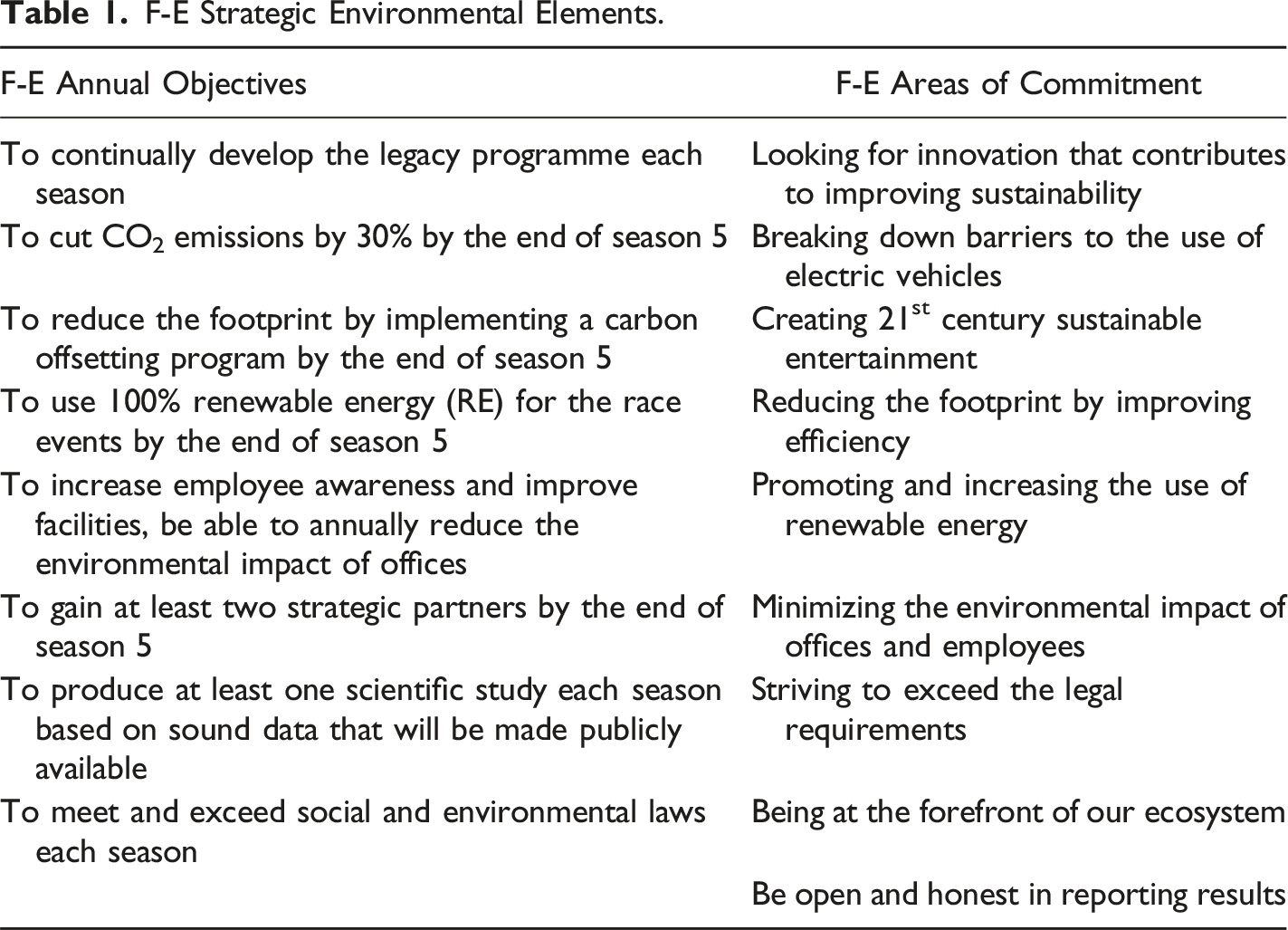
Strategic commitments to environmental activities and change inevitably manifest themselves in a variety of strategic partnerships, which in turn, foster additional strategic issues and opportunities. Examples include the cooperation between the organizers of the Olympic Games who work with international, national, and local partners to green the events and host communities (e.g., Kietlinski, 2021; Trendafilova et al., 2017), the aforementioned FIA’s international motorsport plans (in conjunction with the auto industry and the United Nations), and efforts aligned with governmental and non-governmental organization operations around the world (e.g., Casper & Pfahl, 2015; Dingle, 2009; Natural Resources Defense Council, 2013). As these activities allow new voices and ideas to emerge around the world, sport organization personnel are forming a global platform for discussing sport and the environment (Cury et al., 2023; Vanderplancke & Sobry, 2022). In the end, all organizational actions concerning environmental activities in sport use the events, venues, and all other ancillary strategic elements to engage with the public space, most notably, the fans. Formula E, then, is an example of an organization built with intentionality and a strategy focused on environmental issues making it a rare entity.
Holistic Understanding
Environmental action is a race without a finish line and there will be ebbs and flows to the strategic planning and operational work done. Formula E was designed with a purpose to be different. Motorsport is a form of sport that has been rife with the political side of environmental issues given its long association with the automotive industry and related environmental problems (e.g., Bustad & Andrews, 2023; Lowes, 2004). This is a natural occurrence, but is also influenced by contextual factors, changes in management support, and numerous other possible scenarios including addressing the issue of greenwashing (Miller, 2018; Sturm, 2023). Despite the engineering and promotional efforts of Formula E, the series has had to face such criticisms in light of the continued cost of environmental activities at the races, each centered in an urban space as well as with the conduct of the events themselves (e.g., Smith, 2019; Sturm, 2018; Tranter & Lowes, 2009). Further complicating the issue (or adding to its solution, depending on one’s point of view), there is the relationship between sponsors and Formula E/its events, which have been raised against the series (Naess, 2020).
The complexity of Formula E, both operational and political, requires an analytical framework that can handle all the variables in play simultaneously and one that looks for flexibility and uniqueness rather than standard practices across organizations. McCullough et al. (2016) put forth an analytical framework that allows for flexibility and uniqueness within organizational operations and encapsulates this idea through three waves over time. Recently, McCullough (2023) revised the waves typology to add a fourth wave, reflecting on the internal and external pressures organizations are subject to. Cury et al. (2023) noted, this waves approach helps to understand the fluid or transitional nature of strategic environmental work overtime. It is both a way to identify organizational environmental strategic choices and activated operations in a given moment, but also, over time, as the assessment of those choices and operations. The waves provide a lens through which to explore how organizational goals and objectives change over time, and how communications to the public are framed and delivered, specifically in relation to the environment. The framework also reflects on how current and popular environmental trends can affect the organizations’ specific goals. For example, pressure to address carbon neutrality may lead to some activities to be downsized (moving from wave 2 to wave 1), while others to progress (moving from wave 1 to wave 2). Such fluctuation in activities is reflected in communication and the specific content of any public report. Accepting the lack of linearity of the waves is important as it helps us understand that no standardized or prescribed way of being can be enacted across all organizations.
As a result, study of an organization’s environmental strategy and actions becomes one of internal comparison before any attempt at comparison among other organizations. The multiplicity of waves of action coalesce into a meta level wave that speaks to where an organization is at in a given moment (i.e., the state of Formula E over time and in a specific year). The waves progress through a system of understanding and skills: initial awareness and baseline strategy and activities (i.e., wave one), higher order knowledge and advanced strategic planning activities (i.e., wave two), increased complexity of existing strategic planning and engagement (i.e., wave three), and contradictions between environmental values and organizational operations (i.e., wave four). An organization might be at any given wave within a single activity, which complicates the task of assessing success. As a result, where planning and action meet public opinion, there is critique (Casper et al., 2017) and sport organizations face issues or perceptions of greenwashing (e.g., Boykoff & Mascarenhas, 2016; Inoue & Kent, 2012; Miller, 2016). As environmental action is a public act, studies also noted the care in which environmental messages must be disseminated to sport organization stakeholders if credibility is to be achieved and sincerity shown in their efforts (Chard & Mallen, 2013; Chen et al., 2018; Spector et al., 2012). It is not surprising that the assessment always includes a question mark, but strategy, contextualized in this manner, reinforces clear and DNA-level strategy, as opposed to more marketing gains, is the starting point for sustainable environmental action.
This would be akin to Formula E’s entire approach to its series, and reflects various aspects of the diffusion of innovation found in the waves, as the series attracted long-time motorsport organizations and encouraged new start-ups. Both bring unique contributions to study in order to envision a new way forward for the series itself, for motorsport as a sport, and for the sport industry overall. In the end, how Formula E positions and explains itself to its fanbase, and the sport world at large, is key to defining its success. Knowing that environmental action is grounded in organizational strategy, conducting that strategy over time means facing situations that change it in numerous ways, and examinations of individual organizations must privilege their individuality. As McCullough et al. (2016) note: “… organizational conditions could be further explored and could answer the questions related to the level of impact of various organizational characteristics have on responsiveness, capacity and capability to manage environmental sustainability demands” (p. 20). The public space engagement, via environmental reports by Formula E, is one of the key areas of study within the wave infrastructure, as it is accessible, enacted over time, and an avenue to learn more about its overall ways of being.
McCullough (2023), in revisiting the waves topology within the context of today’s sport ecology context, wrote that the “…moralization of wave and permeation of sustainability values through a sport organization allow standardized practices to be revisited because of inconsistencies with emerging sustainability values” (p. 11). Noting the continuing lack of strategic planning among sport organization personnel in general, he called for examinations into contradictions between organizational principles/values and strategic development/activation (McCullough, 2023). Examination of inconsistencies between values articulation and strategic activation are instructive when assessing the legitimacy of organizational actions, perhaps even a requirement for a mindset that accepts the inherent contradictions in environmental action over time (i.e., a fourth wave) (McCullough, 2023). Further study into the inconsistencies is required in organizational/strategic examinations of environmental activities and calls out for equally flexible and integrative methodologies of study to understand them.
Purpose
The literature illustrated the need to understand Formula E from a web of interconnected lenses (i.e., strategic, operational, and advocacy) because the ultimate aim of the series is not only to crown a series champion and to turn a profit, but also to win the environmental hearts and minds of the public and foster change. The wide net cast by Formula E’s strategy and operations requires a nuanced and flexible approach to its study, namely, an approach that integrates and balances inductive and deductive elements. Given Formula E’s value chain approach and the ebb and flow of activities, including technological development, the Green Waves theoretical foundation (McCullough, 2023; McCullough et al., 2016) offers an important lens from which to view Formula E, especially in terms of the integrated temporality of past, present, and future work in the organization’s strategic and operational worlds. Such an approach is both relevant to the study, but also helps constrain the findings by generalizing within the Formula E system before broadening generalizations to other sport organizations. This study was guided by three research questions that utilize a holistic approach in order to assess Formula E in a strategic sense RQ 1: What are the content areas that Formula E has employed in its season reports to stakeholders? RQ 2: What variations (if any) have occurred in relation to the sustainability efforts of Formula E over the span of eight years? RQ 3: To what extent Formula E’s communications can be explained via McCullough and colleagues’ Green Waves?
Methods
Research Design
The method utilized to address the research questions of this study begins with an exploratory approach for the first two questions as they relate to an area that has not been previously studied. Adopting an exploratory approach allows for analysis without adding any preconceived notions or assumptions yet. The waves framework (McCullough, 2023; McCullough et al., 2016) was then used to address the third research question as it accommodates shifting strategies and outcomes without necessarily having to judge them as successful, unsuccessful, or having an end state, rather, as evolving and iterative as needed. The waves not only can be viewed as a series of change points that allow movement forward (i.e., wave to a higher order wave), but also ones that can re-emerge as contextual variables allow (i.e., regression) (McCullough et al., 2016). As McCullough et al. suggest, the waves approach shapes the organizations goals based on past events, current expectations, and future trends. This, in turn, makes evaluating success a moving target depending on one’s viewpoint and a rather challenging task.
Building on these foundations is the use of content analysis with specific focus on document collection and analysis. Content analysis is a research tool used to determine the presence of certain words, themes, or concepts within given qualitative data (i.e., text) and has been utilized in previous sustainability and sport research (cf. Mallen et al., 2011). Artifacts collected as part of the analysis are interpreted by the researcher to give voice and meaning around an assessment topic related to the research question (Bowen, 2009). More specifically, document analysis is a systematic procedure for reviewing or evaluating written documents which was deemed as appropriate for this study given the purpose, temporal nature of the study, and artifacts collected for analysis.
Data Collection and Analysis
Documents collected as artifacts for analysis were the official sustainability reports of Formula E. These were chosen for focus due to the richness of the information they provide compared to other sources of information on Formula E’s sustainability communication strategy (e.g., Formula E Web site, email newsletters, or press articles), as well as their regular publication for a consistent comparison across seasons. These sustainability reports are published annually and are available to the public via the official Web site of the organization (Formula E, 2022). The first report was published for the 2014–2015 racing season, and the most recent for the 2021-2022 season. This provided for a total of eight reports. The length of these reports varied from 15 to 80 pages, for a total of 342 pages. Given that these reports are a consistent form of communication about the sustainability efforts of Formula E going back to its inception, they were the most credible artefacts to collect for the analysis.
The first coding cycle data analysis made use of Miles et al.’s (2019) open coding techniques to highlight relevant data to the research questions. Subsequent iterations made use of the waves framework to code relevant pieces of data via a deductive process (e.g., awareness and strategy). The higher order themes that result from the data are those presented as part of the findings. These coding steps were independently completed by all three members of the research team according to the previously mentioned protocol, and then notes were compared for consistency and reliability throughout the coding process.
Findings
The sustainability strategy and communication for Formula E changed and evolved over time. The questions driving this study were intended to reveal more about the path the series has taken in terms of its external engagement concerning internal strategy and operations. The content of the reports had specific strategic rationale, but was inconsistent (RQ1), while also showcasing the development path Formula E was on as a racing series (RQ2). These two areas (and research questions) are clearly related. Additionally, the findings from the first two research questions illustrate the extent to which Formula E’s report communications exemplify the Green Waves strategic framework of McCullough et al. (2016); McCullough (2023) (RQ3).
Content Areas of the Reports (RQ1)
The analysis found considerable variation over the course of the eight seasons which will be addressed as part of the second research question. Despite the inconsistency in the reports, our analysis identified three main areas that were classified as routine or regular features: 1) how ePrix events are held to ensure sustainable planning and hosting practices, 2) the establishment of partnerships with leading technology companies to advance sustainable and competitive cars, and 3) relationships to local communities via stakeholder engagement and promotion of Formula E and STEM skills to younger generations – particularly women.
Event Management
Accreditation
Regarding the sustainable management of ePrix events, a variety of practices were discussed across the reports that qualified as event based. To begin, Formula E achieved the highest level of environmental accreditation from the FIA Institute (Achievement of Excellence), and successfully achieved the ISO 20121 standard across the series by Season 4. The report from this season states (Formula E, 2019, p. 17): “With the ISO20121 [sic] certification, we will enhance our reputation and strengthen relationships with our partners and suppliers.” Formula E established positive strategic partnerships with the United Nations Environment Programme (UNEP) (and as a signatory to the UNFCCC Sports for Climate Action Framework), other environmental NGOs, local charities, and firms like Enel. These actions communicate a certain level of excellence for each event and indicate a planning framework that factors in sustainability from the start.
Operations
There were operational strategic priorities and tactics with specific, reportable data. One hundred percent renewable energy was used at each ePrix event including the use of glycerine generators to create a circular economy, which closed the loop in term of addressing event needs as well as those of the global caterer and eVillage food vendors. Carbon management was tracked in an effort to reduce emissions, waste was recorded and monitored in order to increase diversion rates over the course of the eight seasons, and a significant effort was put in place to minimize the environmental impact even more by engaging all office employees. Season 8’s report makes note of their carbon reduction efforts: “Overall Season 8 emissions: 33,800t CO2eq, a 24% reduction compared to the Season 5 baseline.” (Formula E, 2023b, p. 23). Formula E personnel went so far as to place every staff member in the Institution of Occupational Safety and Health’s Managing Safety Course becoming the first known organization to undertake the 4-day course. This point in particular is interesting as it speaks to the “DNA-level” work done by Formula E personnel to build itself as a green entity. These efforts are integral to Formula E’s spectacle of sport, and within the control of Formula E itself. In other words, they are internal sustainability efforts. It also indicates continued maturation of strategy because to achieve such levels of certification, the series would need a strong internal structure and reporting system. Formula E’s overall strategy, including for ePrix events, was aimed at being at the forefront of the ecosystem and proving their talk was backed by the walk.
Car Design
Partnerships
The second content area focused on the Formula E racing cars themselves, which are as integral to the spectacle as the drivers and venues. This content focuses on a mixture of internal sustainability efforts by Formula E to ensure the development of their own race cars, but also external efforts that contributed to the development of technologies to benefit the strategic partners as well. In most motorsport series, partnerships between teams and manufacturers lead to the development of technologies that decrease weight, increase speed, and have the capacity to decrease their consumption of finite resources. For example, a partnership Formula E developed with Michelin (Formula E’s technical partner for tires) was mentioned in the reports and showcased tire recycling as well as how the development of a durable all-weather tire would survive an entire race rather than require multiple changes. Season 4’s report highlights this: “our bespoke tires are hybrids. Designed by Michelin to be suitable for all weather conditions, they last the entire race and are all recycled at the end of the day” (Formula E, 2019, p. 7). These efforts benefit Formula E through improvements in racing, but also benefit Michelin through development of their tire technologies.
Innovation
Other areas of sustainable car development were reported over time including information concerning the batteries and energy supplies. In terms of digital technology overall, and non-petrol-powered vehicles in particular, batteries are an important, but potentially controversial topic (e.g., Ali et al., 2021). In the first four seasons, poor battery capacity and long charging times meant that two cars with two separate batteries were needed to complete a race, which forced drivers to switch their cars and made a statement about non-petrol vehicles outside of racing that could be harmful (i.e., drivers being stranded by electric vehicles losing power). By Season 5, battery capacities had increased such that only one battery and one car is necessary to complete a race. Additionally, all cars are charged with 100% renewable energy and all batteries are recycled post use. Season six’s report confirms this: “Recycled 100% of Season One and Two battery cells via Umicore reclaiming over 90% of metals and 60% of lithium.” (Formula E, 2021, p. 18). Again, internal improvements for Formula E and external sustainability benefits to the strategic partners. Through the reports, this information does not capture all efforts on sustainability reflected in the racing cars, but brings to light some of the more salient and relatable efforts made.
Community Engagement
Lastly, there is a continuous thread of community engagement content found within the reports. The strategic infrastructure of Formula E events required a clear plan for community engagement at each event to raise awareness and to spread the sustainability message. These are sustainability efforts external to Formula E that do not directly benefit the racing or sport spectacle mission of Formula E but provide Formula E an avenue for promoting sustainability benefits to stakeholders. For example, the FIA Smart Cities initiative was developed with key stakeholders brought together to promote a positive agenda for safe, sustainable and connected mobility. Through the UNEP BreatheLife campaign, Formula E joined forces with UNEP to promote inner-city air quality and increase uptake of electric vehicles (EVs). The supply chain sustainability efforts revolved around the selection of food vendors, ensuring that food in the eVillage included local resources, seasonal, vegetarian, vegan, organic and fair-trade options. One final effort involved the FIA’s Girls on Track initiative to promote gender equality in motorsport and STEM fields as described by the season 6 report: “In Season 6, Formula E hosted over 400 girls… participating in numerous technical workshops to develop their Science, Technology, Engineering and Math (STEM) skills while being encourage to be creative and work as a team” (Formula E, 2021, p. 11). It is clear that Formula E is focused on the impact of their events on communities and their potential for the promotion of sustainability initiatives, which includes writing sustainability broadly to encompass a variety of issues that lead to societal improvements overall.
Variations in the Reports (RQ2)
Despite these three common content areas, inconsistency plagues the reports from Formula E. Even within these content areas, the consistency of the information was low and the reports, which one might presume would be relatively similar year to year, were not.
Report Structure
Over the course of the eight seasons, there was considerable variation in the reports. At first glance, there is no consistency in the reports in terms of the length as they varied from 15 pages to 88 pages, nor in terms of the content and structure. The report for Season 1 included many goals and aspirations, while the reports for the following seasons were more accomplished and enterprising in their efforts. The Season 3 report, for example, is a brief 15 pages with little to no depth in the content covered, while the Season 7 report is 44 pages that profiles efforts of each circuit, certification, initiative, and partnership for Formula E. Thus, the reporting of initial sustainability efforts was gradually expanding in scope and magnitude, with a few large variations, but scaling up year-after-year.
Report Language
One immediate area to highlight for variation in the reports is the language used in the reports pertaining to three “objectives” or “pillars’” (the terminology varied report-to-report) of sustainability for Formula E. These were particularly found in the reports from Seasons 3, 4, 6, 7, and 8. A snapshot example is shown below from the Season 3 report where they are listed as three “objectives”: 1) Monitoring and measuring our event operations performance, environmental and social impacts. 2) Developing a strategic community engagement plan to engage with our stakeholders and leave a positive legacy. 3) Engaging the supply chain to effectively meet our common sustainability goals (Formula E, 2018, p. 5).
One can observe, in these “objectives”, that the first is an internal effort by Formula E, the second is an external effort by Formula E, and the third is a mixture of both internal and external efforts. In the following season, a fourth pillar was added: “caring for people.” The reports for Seasons 5 and 6 indicated only three pillars, with “caring for people” having been removed. The reports from Seasons 7 and 8 raised the number of “pillars” back to four and re-named these to the following: 1) Leadership and innovation 2) Environmental excellence 3) Social progress 4) Creating value through values
These “pillars” completely diverge from Formula E’s original “objectives” and no longer contain specific internal or external sustainability strategies. Thus, it appears that Formula E lacks a consistent strategy with constant variation in what their foundational principles may be across the seasons. This inconsistency has the potential to raise questions from external stakeholders concerning strategic problems or strategy formulation in Formula E.
Report Scope and Focus
Early efforts in relation to the ePrix event management pillar were aimed at building the internal sustainability strategy. Activities included certifying the entire championship to the highest level of the event sustainability standards from the International Organisation for Standardization (specifically ISO 20121) by the end of Season 4. Furthermore, a comprehensive study was conducted to calculate the championship carbon footprint, relying on sustainability experts from Quantis International. Once these were accomplished, it allowed Formula E to pivot its ePrix event management strategy to other focal points and to evolve as sport and sustainability evolved along with it. For example, in Season 5, Formula E also pledged to become one of the first sport events to commit to the UN Sport for Climate Action Framework and adhere to the following principles: • Undertake systematic effort to promote greater environmental responsibility. • Reduce overall climate impact. • Educate for climate change. • Promote sustainable and responsible consumption. • Advocate for climate action through communication (Formula E, 2020, p. 16).
The report content took a unique turn in Season 6 because of the COVID-19 pandemic. Without races, and thus content, Formula E needed to pivot its report to focus on external, off-track growth and strategic priorities for itself. Formula E personnel reported their persistence via development of a partnership with UNICEF to fundraise and increase awareness for the protection of vulnerable children and families, launched the “Race at Home Challenge,” and adapted the FIA “Smart Cities” program to a fully digital format using a virtual platform. Of note was the focus on COVID-19 and the broader impact of it on urban mobility issues. In Season 7, Formula E reported that it was the first global sport to join the Science Based Targets Initiative and Business Ambition Pledge for 1.5°C.
What is evident is that the reporting of data and information did not show the consistency expected from the series as it grew. In other words, no clear reporting structure was determined and, as a result, the information shared ebbs and flows across moments rather than a coordinated narrative of strategic action underscored by verifiable data. It could be that as the series evolved with time, the sustainability strategy evolved with it. Despite the variations, Formula E’s efforts continued to focus on breaking down the barriers to the use of electric vehicles. What was most consistent (although not necessarily consistent overall) was the reporting of sustainability metrics related to the events (e.g., carbon emissions, waste diversion, water management, and certifications), the car (e.g., battery, chassis, and tires), and external partnerships to engage the community (e.g., money raised, children impacted, awards earned). While the variation in the sustainability efforts is considerable, there does appear to be growth over time despite the lack of consistency. This inconsistency is instructive and not necessarily a failure on the part of Formula E.
Green Waves (RQ3)
This section examines the extent to which awareness, knowledge, and strategy exist in Formula E’s sustainability communications in accordance with the Green Waves (McCullough, 2023; McCullough et al., 2016). Data analysis indicated that overall, the content of the reports presents evidence of knowledge dissemination, although the inconsistency of the reports makes it unclear how well incorporated this is in the strategic planning. For example, early in Season 3, Formula E established three sustainability pillars with specific targets in each. Another pillar was added in Season 4 (i.e., “caring for our people”). In Season 6, the #PositivelyCharged initiative was launched, representing Formula E’s commitment to not only counteract climate change, but to make a positive impact on the world. Related to this initiative, a number of educational programs were developed for youth in London, Rome, and other Italian cities, with the goal of supporting children’s education throughout the COVID-19 pandemic and educate them on various topics such as sustainable mobility and lifestyles.
These examples indicate a constant, but non-linear, flow in the sustainability effort communication from Formula E. The reports varied in content and there was no consistent content element that appeared in each one. One might expect that a standard content item or set of items might be put in place (e.g., data from each race, a spotlight on partnership efforts). Instead, the findings show that solid and verifiable information was reported, but without a strategic intent behind it. At least, not one more advanced than informative. In terms of the Green Waves typology, the reports vary between content that would be considered significant strategic steps forward (i.e., Wave 3) (McCullough et al., 2016), while others seemed to focus on basic or fundamental level information (i.e., Wave 1).
Examples of this third level information appeared when Formula E’s ISO 20121 certification was renewed, which made it the first and only motorsport with this certification since Season 4, and it held status as Net Zero Carbon (since its inception). Also, their participation in the FIA Environmental Accreditation Programme was acknowledged with the successfully renewed three-star certification in 2020 (first FIA championship to have it). An example that can span the different waves is that of specific team or race data such as information on carbon emissions being acknowledged, measured and decreased, and efforts disseminated. In relation to vehicle development, all car parts were recyclable (e.g., chassis, battery, tires) and cars were powered by 100% renewable energy. Additionally, Generation 3 cars were carefully designed with life cycle strategic thinking for second use. It would be possible for the reports to show this over time, but the existing documentation do not progress through the stages of the life cycle in a consistent manner, which would be akin to moving from Wave 1 to Wave 3. The possibility is there, but the follow through is lacking. Lastly, Formula E phased out single use plastics from all races, which could be placed in Wave 3 area as it is instructive for other entities to learn from while at the same time offering opportunities for outreach to stakeholders (e.g., fans) through engagement activities, though it appears that the latter has not happened.
Related to the organization and its strategic management, it is important to note that the inconsistency within the environmental pillars presents evidence for both internal and external pressure such as governmental regulations, social pressure, and competitive pressure (e.g., Lowes, 2004; Smith, 2019; Todaro et al., 2023) (Wave 4), which in turn affects how the organization’s values are aligned with the organizational operations. For example, internal forces such as event management issues need to be strategically aligned with external forces such as the development of technologies to benefit strategic partners. Not doing so, can raise questions of green-washing and challenge the process of moralization (Wave 4) and legitimization. This value versus operations dilemma requires a constant evaluation and re-evaluation of standardized practices in order to address the inconsistency in reporting. A comprehensive strategic plan can advance organizational environmental values (McCullough, 2023) and address the disconnect between what is publicly communicated and what is implemented. In other words, any inconsistency needs to be carefully evaluated if the organization wants to be perceived as authentical in their sustainability efforts.
The information found in the reports is not problematic in and of itself, but the delivery of the information shows how difficult it is to categorize or quantify progress within a sustainability infrastructure and a sustainability strategy overall. With new initiatives launched at various points, others in stages of process, and still others ending, there is a never-ending ebb and flow of information. Thus, the information shared in the reports is instructive beyond communication of what Formula E personnel are doing to advance their mission. It is indicative of the strategy they are following, its constant updating and revising, and indicates the difficulty of reporting information in the public sphere that has to both appeal to long term stakeholders (e.g., long-time fans) and to educate and to inform those stakeholders new to the series. It is also indicative of how easily it is to open a strategy to public comment, and even criticism, without a clear intent and purpose for that openness (i.e., charged with and pushing back against greenwashing).
Discussion
Formula E was developed as a green sport from the beginning, rather than being a sport that is trying to go green as an addition to its already institutionalized existence. Given the clear communication of this foundational green status, the impact of this foundation should reverberate throughout its entire strategic and operational strategy infrastructure. This study examined one aspect of this infrastructure, namely, communications in the form of the sustainability reports because they offer insight into actual operations and data as well as showcase the outcomes of the strategic planning that is embedded within the series. It is difficult to separate the strategy from the identity and to measure success/progress simply from the reports, but the reports do offer instructive elements due to their inconsistent format and content. It is also important to keep generalizations within Formula E, rather than among all motorsport or sport industry organizations in general. The inconsistency that emerged in RQ2 supports McCullough et al. (2016) and McCullough’s (2023) Green Waves explored in RQ3. Specifically, it removes the linearity from sustainability operations, as well as the fallacy of an end point because it represents the fluidity, flow, and non-linear movement of such efforts.
Content Inconsistency Consistent With the Green Waves
Based on the findings related to RQ1, Formula E’s sustainability efforts were presented through three content areas: events, cars, community engagement. However, these content areas could be considered more broadly to mean internal sustainability efforts (i.e., aspects of the events and cars that Formula E could control) and external efforts (i.e., aspects of the partners’ car development and community engagement that they could not control). Despite the inconsistency, these areas represent the primary areas of the series that speak to stakeholders. What is more important to note is that the lack of consistency could be related to the Green Waves analysis (McCullough, 2023; McCullough et al., 2016). In other words, there is inconsistency in the phase of each of the Formula E’s sustainability areas. While efforts in one area (e.g., car design) may be progressing from Wave 1 to Wave 2, efforts in another could be regressing from Wave 2 down to Wave 1. The Formula E context, and communications issued identified in particular, indicates the waves are not only stages to pass through back and forth as part of natural change and adaptation, but also that they have significant implications as to how Formula E exists as a sport organization. Through the study of this case, the waves appear to have an impact on issues of organizational learning at its most fundamental level. To explain, the inconsistency lends itself to variance and error in the ways it communicates with external and internal stakeholders. While the waves originally show this as a natural function of contextual change and adaptations to new issues, it simultaneously has the potential to invalidate organizational learning and impede the diffusion of practices, information, and/or data that would assist with future operations. If organizational learning, which seeks to know and not have variance in operations (i.e., procedures based on past experience), is inconsistent, then strategic efforts (i.e., interpretation, learning, and application from experience), will be impacted as discussed later in this section (Levitt & March, 1988).
The progressive/regressive elements inherent in the waves becomes a point where organizational learning is impacted and this effect must be accounted for, as in this case, where Formula E personnel should become aware of the consequences of their actions and the need to address immediate issues (i.e., the communication inconsistency) with the need to have stable and useful learning systems (e.g., Basten & Haamann, 2018). With this meta level issue in mind, there are more specific areas of assessment that will further exemplify the way the waves allow for progress and regress while simultaneously creating and managing learning and strategic processes.
Another element of the waves is the notion of innovation and diffusion, which has been explored in the field of sport and the environment (Kellison & Hong, 2015). However, as much as Formula E has done and publicly communicated, the organization’s efforts do not meet all four criteria (i.e., the innovation itself, the communication channels, time, and the social system) to claim a case of innovation and diffusion (Rogers, 2003). Formula E displays elements of adoption and communication but lacks the time and social system components. Furthermore, there are limitations related to the adoption phase as well since adoption effectiveness has not yet been measured.
Formula E personnel seized on the inherent educational advantages that come with adopting an environmentally sustainable approach to motorsport and demonstrated some level of public engagement success in doing so. This aligns well with their potential position as an organization that informs and advocates for environmental sustainability (Finn, 2021; Sturm, 2014, 2018). For example, Robeers and Van Den Bulck (2018) found Formula E achieving success with environmentally value laden content in addition to other traditional marketing or engagement focal points. However, that study examined a single Web site at a single moment in time, which like the findings of this study, should only be viewed as an in-context success rather than a typology for action. Placing consistent, verifiable, and insightful news, data, and information to the stakeholders of a sport organization, at least concerning sustainability, is a point few organizations have reached. It is imperative that Formula E did this because to do otherwise would have been a significant undercut to its mission and vision let alone its strategies (Sturm, 2018). Otherwise, this inconsistency could possibly be interpreted as “moving the goal posts” or greenwashing.
At this point in its existence, Formula E has the right pieces in place. However, Formula E personnel need to investigate their own reports and improve the format and content if they wish to better legitimize the efforts they are undertaking (McCullough, 2023). From a practical position, it is suggested that several key areas be made standard as part of the format that align with the need to communicate internal and external sustainability efforts: race-by-race data for the events, car and partnership development news that are technical to the sport and partners, and engagement with readers, spectators, and communities (i.e., tips, tricks, and personal actions that can be taken at home) (Casper et al., 2014). Doing so would allow Formula E to address the inconsistencies of its reports and to better align overall strategy and operational tactics with what it wants to communicate to the world along the lines of corporate sustainability reports, though perhaps using more dynamic and reader-engaging means than simple data reporting. There is a level of expertise already developed, therefore it is clear that a more strategic approach and attention is what is required. If done, then it is believed that Formula E personnel will enhance their own understandings of their strategic work and would do so from strategic planning start to external communication finish. This would add strength to the linearity of the waves of their green strategies and allow for more controlled ebbs and flows within it overtime (i.e., maintaining a truthful non-linearity) (McCullough, 2023; McCullough et al., 2016). Another practical recommendation is to review the sustainability reports against the structure, style, and content of Formula E’s ABB FIA Formula-E digital newsletter. Additionally, an engaging discussion with all stakeholders may assist in improving the content of the reports and satisfy the expectations of those invested the most in the operations, delivery and success of Formula E.
Proactive Criticism Mitigation
Related to the previous point is the fact that a more consistent and well-formatted report would confound attempts to charge the series with greenwashing (e.g., Sturm, 2018). Accepting and showcasing the linearity and non-linearity inherent in their work, Formula E personnel could carve out a unique space for the series in terms of authenticity. Its efforts would be seen for what they are, namely, a consistently changing series of initiatives and planning that has no end state (Inoue, 2015; Pfahl, 2013). Moving the bar on expectations allows Formula E personnel to better focus their voice as to what is important for the series to do and not to do, and manage many aspects of the social dialogue surrounding the series including comparisons with other motorsport series and sport or non-sport organizations (Kellison & McCullough, 2017). For example, by design most Formula E events are argued to have less negative impact on the environment when compared to Formula 1, as they take place in urban settings and utilize a combination of any useful existing infrastructure (e.g., transportation links) combined with purpose-built/temporary elements for the racing (i.e., safety barriers). This presumption has been challenged by site protestors and the inconsistency of reporting event data from Formula E itself. Furthermore, by their very nature, electric cars have lower noise level and carbon dioxide emissions. All of these items can be showcased in the Formula E reports and foster further engagement with stakeholders (e.g., encouraging public transportation in urban areas among fans) in ways that are in clear alignment with its own strategy.
Report Level to Strategy Level Connections
The combination of items above, when extrapolated to the larger context of sustainability strategy within Formula E, though not beyond, raises intriguing questions. First, and perhaps most importantly, is that the inconsistency discussion of the report raises questions as to the consistency of strategy from Formula E overall. Again, however, it is not necessarily a negative point or a criticism. Rather, the links with the Green Waves (McCullough, 2023; McCullough et al., 2016) whether tangentially or as an exemplification of the concept, means that sustainability strategy is not linear and could not be under any circumstances. This is an important point to raise in an era where the morality and efficacy of such practices are called into question (McCullough, 2023) and where an organization like Formula E has positioned itself as an informant and advocate for environmental sustainability (Sturm, 2018). Tactical implementation or the life cycle of an initiative can certainly be linear, but the grand strategy of Formula E is inherently infinite and fluid. Given that Formula E was, from inception, a sustainably minded entity, it offers a strong comparison to other entities, but in doing so, will only reinforce the waves concept as strategy is adapted to new situations, fades out as problems are solved, and many other permutations of activation of it. In other words, it is an exemplar that there is no end point to sustainability initiatives, but there are ends to and of measurement.
With all sustainability work being fluid, organizations like Formula E are freed from the shackles of conventional thinking and showcase a way of being that is both permanent (i.e., mission, vision, or values), but is never the same (i.e., ebbs and flows across the wave levels). Both are capable of coexisting, and both mean that success can be had even if finished is never reached. Each aspect of the sustainable enterprise, as discussed in the literature, should exist in an organization committed to the green cause. Sustainability teams can be set-up according to organizational need rather than preconceived notions. Sustainability data needs to be gathered, but the questions asked to get that data can be related to organizational planning and industry requirements without sacrificing anything. In short, through the lens of the waves and as exemplified by Formula E, there is a multiverse structure to the strategic approaches that are contextual and generalizable at the same time depending on the question and the moment it is asked.
Conclusion
This study represents a snapshot of Formula E’s sustainability communication and strategy efforts due not only to the inconsistency in the formatting and content of the annual reports over the last eight years, but also because the entirety of their strategic and operational infrastructure was not part of the study. This limitation could be addressed in future research via the inclusion of other sustainability strategy content from Formula E and other outlets (e.g., Web site, newsletters, and press articles). While it is clear that Formula E is on the right track, and remains committed to environmental and social sustainability, it is equally clear that efforts could become even more coordinated, to achieve higher levels of strategic success and recognition in the global public square if the manner in which they are communicated is systematically organized (and strategized writ large).
Of course, it may be considered difficult to have ever achieved such consistency in sustainability strategy and reporting as the sport, along with SailGP, is plotting the first course for a sustainable sport enterprise from the ground up rather than having adopted sustainability along the way. Perhaps Formula E’s inconsistencies will provide the roadmap for other sustainable sport organizations in the future? Moving forward, addressing sustainability across the world of sport in general, and in the realm of motorsport in particular, is critical because the intercept between sport and the natural environment (sport ecology) remains an area rich in possible scholarship (e.g., fan engagement, communication). Although the relationship between Formula E and the natural environment seems to be self-evident, future strategic planning needs to focus on better public communication of their sustainability to ensure that these efforts are part of a wider, contemporary, and global trend.
It would be valuable to follow the efforts of Formula E in a longitudinal study and identify if, over time, the organization presents additional elements of innovation and diffusion. Evaluating the rate of adoption will be critical as it triggers mechanisms that increase the probability of adoption by other organizations. Furthermore, to make a case for innovation and diffusion, it is important to consider the communication channels, and in the case of Formula E, it would be imperative to explore the interpersonal channels (Rogers, 2003). Lastly, connecting the green waves with innovation and diffusion can provide for a deeper understanding of sustainability in the realm of sport in general and motor sports in particular.
Footnotes
Declaration of Conflicting Interests
The author(s) declared no potential conflicts of interest with respect to the research, authorship, and/or publication of this article.
Funding
The author(s) received no financial support for the research, authorship, and/or publication of this article.
