




Abstract
Although the intertwining of sports and media, especially in soccer and from an organization-centered perspective, has been highlighted in communication research, little attention has been paid to the perception and evaluation of the mediatization of professional tennis. The aim of this study was to close this research gap by presenting the athletes’ perspective. Based on the autobiographies of four top international athletes, we systematized their perceptions of the media before the rise of social media, using a qualitative content analysis. We demonstrate a significant influence of the media system and the perceived media logic: Tennis is closely intertwined with the media, and mediatization processes have strong effects on the players, both positive and negative. Players are aware of the importance of public attention for tennis and actively adapt to the perceived media logic. On the other hand, they often feel inhibited by the press and reject adaptations to media affordances. Our study demonstrates once again the research potential of mediatization as a beneficial concept in studies on sports communication, stresses the need to focus also on the dysfunctional influences of media and mediatization, and opens the path for further research on social media influences.
Soccer seems to be the predominant sport in Europe. This also applies—at least in part—to international research on sports and media, and mediatization research is no exception. Mediatization refers to “social and cultural changes that are defined as long-term structural transformations in other social and cultural fields” (Frandsen, 2016, p. 386). Such changes have already been identified for actors and institutions of various sports, especially in soccer (e.g., Birkner & Nölleke, 2016; Meyen, 2014; Skey et al., 2018). Professional tennis, on the other hand, has been considered rather sporadically. Starting from this research gap, the aim of this study was to answer the question of how athletes perceive mediatization processes in international professional tennis.
Tennis is also of interest for such an investigation because there is significantly more equality between the sexes in tennis than in other sports. For example, the Association of Tennis Professionals’ (ATP) and the Women’s Tennis Association’s (WTA) Grand Slams are held at the same time at the same facilities, and the prize money is identical for women and men at these tournaments. However, researchers have found many differences between men and women in media representation, both qualitatively and quantitatively (e.g., Cooky et al., 2021; Quayle et al., 2019).
For other sports, especially soccer, a significant influence of the media on the athletes, the routines, and the development of the whole system has already been attested (Frandsen, 2016, 2020). Studies on tennis, on the other hand, primarily illuminate the media portrayal of the sport, often limited to individual countries (Kian & Clavio, 2011; Vincent, 2004). Therefore, in the present study, we examined the media orientation of professional tennis players in a complementary and cross-national manner. We focused on the perspectives of female and male actors who find themselves at the center of the sports system and particularly in the spotlight of the public: the athletes.
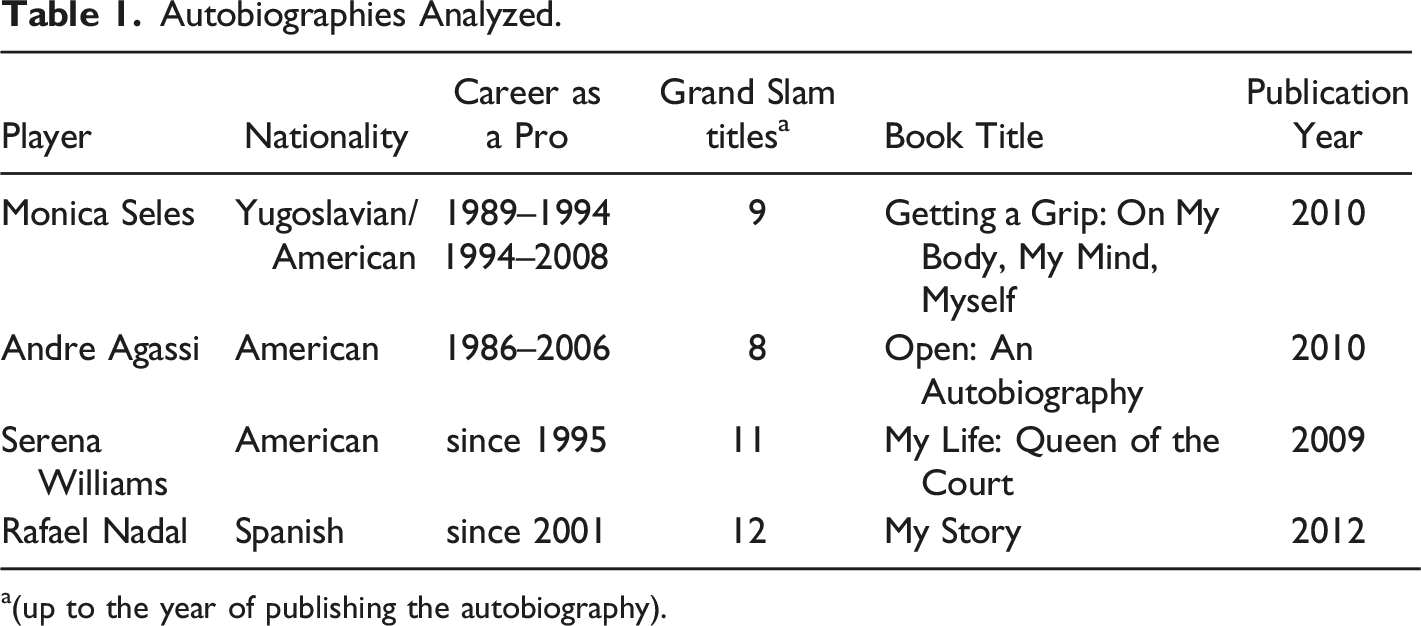
The theoretical framework and the methodology of this study were guided by Birkner and Nölleke (2016). This study is based on the autobiographies of four top international athletes (Serena Williams, Rafael Nadal, Monica Seles, and Andre Agassi). As the autobiographies in our sample cover the time span from the 1980s to the early 2010s, we systematized the athletes’ perceptions of mediatization processes in professional tennis. During that time, traditional mass media dominated sports coverage. With our sample, we develop a historical review and thus establish the basis and an intellectual starting point for further research. Five categories emerged from a qualitative content analysis. They map the different dimensions of mediatization in professional tennis that we elaborated from the athletes’ autobiographies. The paper concludes with a critical classification of the results and suggestions for further research.
Literature Review
Mediatization and Society
The interplay of media and society is often researched in communication studies using the concept of mediatization. Mediatization research forms an interface between media scholars and sociologists that has its origins in studies of political communication: “The essence of mediatization is increasing importance and influence of media” (Strömbäck & Esser, 2014, p. 246). The starting point of mediatization research was the question of whether and how politics is oriented toward the media and how the system changes as a result (e.g., Mazzoleni, 1987). This approach can be applied to almost every social field because the media influence social domains and actors in politics, science, and sports at the micro, meso, and macro levels, changing institutions and behaviors. Within mediatization research, two main directions exist: One sheds light on the integration of media into everyday life and the other focuses on changes because of orientation toward media. Depending on the research interest, an institutional-systemic or a technological-cultural approach to mediatization can be applied (Couldry & Hepp, 2013). In any case, mediatization is considered a dynamic process (Hjarvard, 2008; Livingston & Lunt, 2014; Lundby, 2009).
Researchers draw on this concept not only to describe the relationship between media and other areas of society. It is also understood as a “broader theory of modernity” (Hjarvard, 2008, p. 108) or “meta-process” (Krotz, 2009, p. 24). In this context, mediatization does not refer to a specific theory that stands on its own but rather to an overarching concept for examining the relationship between media and society that can be analyzed both quantitatively and qualitatively. Quantitatively, mediatization research captures, for example, the spread of media and the intensity of media use. Qualitatively, concrete media such as television or social media and specific subsystems are investigated, and changes in the relationship between media and society are at the center of research interest (Couldry & Hepp, 2013). Based on this understanding of mediatization as an overarching, multilayered process “for a range of media-embedded processes of social transformation” (Ekström et al., 2016, p. 1097), the empirical practice in turn always requires further specifications.
We focus on the aspect that “actors and organizations of all sectors of society accommodate to the media logic” (Schulz, 2004, p. 98). Individual and collective actors take action to gain media exposure and thus social attention based on their perception of the influence and logic of various media (Nölleke et al., 2021). The term media logic was developed by Altheide and Snow (1979) and is nowadays defined as follows: Media logic is defined as a form of communication, and the process through which media transmit and communicate information . . . . A basic principle of media logic is that events, action, and actors’ performances reflect information technologies, specific media, and formats that govern communication. A related principle is that communication guidelines become institutionalized and taken for granted, serve as an interpretive schema, and guide routine social interaction, and thereby become integral in creating, maintaining, and changing culture. (Altheide, 2016, p. 1)
Despite the pronounced media orientation and the benefit of media attention for actors of other social systems, defensive mediatization strategies are also evident in various contexts. Both individuals and organizations use shielding from the media and immunization against media effects (Nölleke et al., 2021). At this point, it is particularly important to emphasize that the concept of mediatization underlying this research by no means proclaims a real-life, universally valid media logic. Rather, it focuses on the perception and “anticipation of media logic” (Birkner & Nölleke, 2016, p. 370) assumed by the actors of other systems.
Mediatization and Sport
As a scientific topic, sports communication is of interest not only because of the space it occupies in society and in the media but also because of its potential for attention and identification (Whannel, 2012). Media and sports have been intensely intertwined. For 50 years, broadcasting rights for sporting events represented a core element in the relationship between sports and media (Hutchins & Rowe, 2009). Sports associations and individual players benefit from media attention, which increases their market value and enables sponsorship (Bertling & Schierl, 2020). With the triumph of digital media, the relationship between the two systems is changing, especially due to lower access barriers to content on the (social) web (Hutchins & Rowe, 2009). At the same time, sports are registering a “new wave of mediatization” (Frandsen, 2016, p. 297) in the sense of an orientation toward media logic and an infiltration into everyday life for sports organizations and players.
Empirical findings confirm strong mediatization tendencies in sports. The anthology by Wenner and Billings (2017) shows an increasing media orientation in major events across all sports, from classics such as basketball to golf and the so-called X-Games. Frandsen (2016) compared Danish sports organizations. Although she noted that social media is playing an increasingly important role in the day-to-day work of sports organizations, the Danish Football Association takes a special role in its media orientation and professionalization. In terms of the state of research on sports and mediatization, an overall concentration on soccer is observable: For Germany, Meyen (2014) provided a comprehensive overview on the mediatization of soccer at the micro, meso, and macro levels. Among other things, he referred to media trainings and camera-oriented behavior of players on the pitch, media-friendly stadiums, and public relations strategies of clubs, as well as kickoff times that fit into television schedules and rule changes in favor of aesthetic images, like the prohibition to continue playing with an open wound. Skey et al. (2018) examined soccer in the United Kingdom from a grassroots perspective. They concluded that young football fans become “increasingly orientated toward mediated forms of knowledge and practice” (Skey et al., 2018, p. 601). Finally, Birkner and Nölleke (2016) analyzed the autobiographies of German and British professional soccer players. This study reveals that the athletes are aware of the relevance of the media for their professional life, though it has to be mentioned that most of them worked with ghostwriters who are mostly sports journalists. They perceive a media logic and adapt their behavior to it to profit from the attention. At the same time, they criticize journalists for their ways of working, especially in the tabloid media. In addition, there are major differences between the genders in the soccer system, as women tend to see themselves as underrepresented, whereas male athletes complain about nonstop observation. Consequently, they also use defensive strategies and thus show a certain “ambiguity” (Birkner & Nölleke, 2016, p. 380) regarding the media orientation.
Mediatization and Tennis
Studies on tennis and media often spotlight the athletes’ representation. For example, Cooky et al. (2021); Quayle et al., (2019) researched such representation in television. Domeneghetti (2018); Vincent (2014) studied the British print press, and Kian and Clavio (2011) analyzed the American press in print and online. There are also studies on the digital world; for instance, Yip (2018) studied online reporting. Finally, Lebel and Danylchuk (2012) and Litchfield et al. (2018) examined (self-)representation in social media.
Researchers have focused on gender comparison: Women’s tennis is still relatively prevalent compared with other women’s leagues and competitions (Cooky et al., 2021), yet the screen time for women is noticeably lower than that of their male colleagues. The studies note that professional tennis is a male domain, and female athletes have been measured for decades according to the beauty standards of heterosexual White men (Bernstein, 2002; Vincent, 2004). Although recent studies offer slight hope for change (Yip [2018] found, for example, that the online coverage of ESPN during the Australian Open 2015 discussed family roles and mental strength less stereotyped than older investigations indicated), female athletes have often been sexualized and infantilized in the media, which diminishes their sporting success. Moreover, racist stereotypes are reproduced, especially about Serena and Venus Williams (Domeneghetti, 2018).
The abovementioned anthology by Wenner and Billings (2017) also includes a study (a participant observation) of the mediatization of the tournament at Wimbledon from a spectator’s perspective (Kennedy et al., 2017). They noted the mediatization of the championship at the All England Club in various places, including extensive advertising and sponsoring, multiscreen viewing, and the introduction of the Hawk-Eye. In summary, “the Wimbledon experience—either live or mediated—is an experience of mediatization” (Kennedy et al., 2017, p. 140), without the tournament and its organizers losing sight of Wimbledon’s own logic and maxim of exclusivity and tradition. However, research on the athletes’ perspective on media and mediatization in professional tennis is hard to find (the only exception seems to be Röhr, [2015], but her study addresses the small German market and not the international elite). In our study, we aimed to close this research gap.
Focus of the Study
Ekström et al. (2016) emphasized the relevance of “large-scale historical studies to analyze the role of changing media environments in long-term processes of social change” (p. 1094) in the context of mediatization. We followed this recommendation and clarified the prehistory of today’s development in the system of professional tennis. This is because we analyzed a period in which social media was still a rather marginal phenomenon (before the initial public offering of Facebook and the founding of Instagram), but television was the dominant mass medium of the time. Consequently, the research question is as follows: What did the mediatization process look like in professional tennis from the 1980s to the early 2010s from the athletes’ perspective?
Method
We follow the approach of Birkner and Nölleke (2016) and analyze autobiographies of top international tennis players. From a media researcher’s point of view, these books provide insights into the thoughts and experiences of sports professionals. They are “authentic, as aspects are emphasized by the respective athlete and not by the researcher” and reduce “the problem of reactivity” (Birkner & Nölleke, 2016, p. 373). However, most autobiographies of prominent sport stars are written in cooperation with a co-author or even ghostwriter, usually from within sports media. It is conceivable that these journalists formulate criticism more diplomatically and distort the actual views of the athletes. Williams and Nadal disclosed that they collaborated with journalists who are officially listed as authors, whereas in the case of Agassi, his co-author is named in the acknowledgements. There is no information on this topic in Seles’ book.
The fact that the respective autobiographies were not written to present the perceived mediatization of the authors is, of course, a limitation of our research design. However, these texts as sources have two sides. On the one hand, as providing information for communication scholars is not the main goal of publishing an autobiography, one must search intensively for such information. On the other hand, these texts can reveal a predominantly unfiltered description of the perceived mediatization. Of course, one could address this topic more directly with interview questions, but with an appropriate research design, the books can be consulted to identify the relationship between sports and media that seemed relevant to the athletes during their careers.
In other fields of research, such as (historical) journalism research, autobiographies have been used for some time (Wilke, 2011). Whenever field access proves difficult to impossible, researchers must rely on other sources, such as (auto)biographies (Williams, 2012). Sparkes and Stewart (2016) suggested that in several respects, social science work with autobiographies has no greater or different problems than, for example, qualitative research with interviews. They argued that transcribing interviews is ultimately a form of ghostwriting as well because information is purposefully elicited and transcribed. Furthermore, the material is not shaped from the outset by the researcher’s investigative interests (Birkner & Nölleke, 2016). After all, such writings are even used in (sports) psychological studies, for example, to examine resilience (Morgan et al., 2015) or analyze symptoms of mental illness and correlating life events from the material (Newman et al., 2016).
Sample
Autobiographies Analyzed.
a(up to the year of publishing the autobiography).
Qualitative Content Analysis
Categories to Classify Media-Related Text Passages in the Autobiographies.
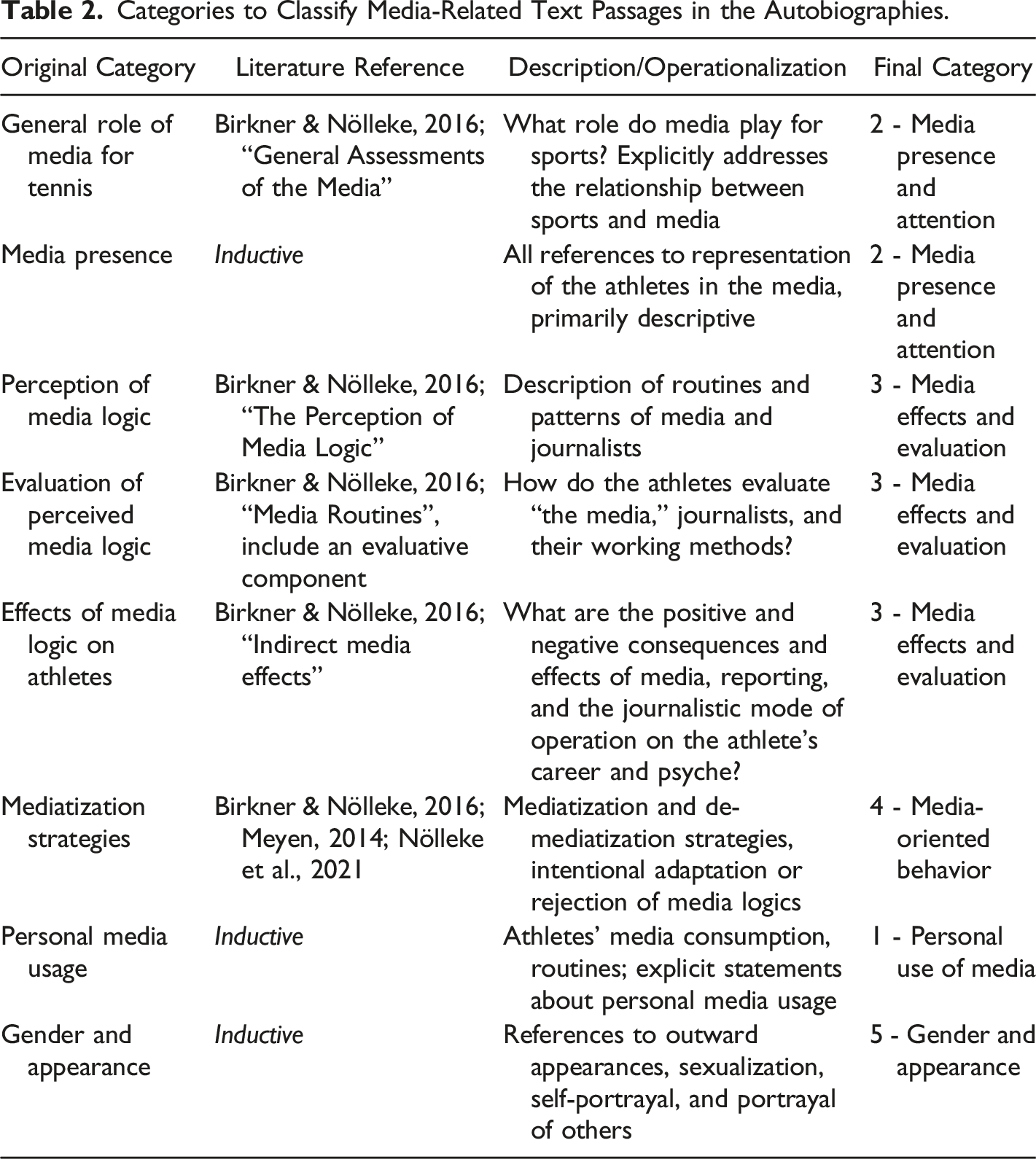
This step was followed by paraphrasing and reduction. Some categories could be summarized then because the coded passages often fulfilled several functions at the same time. For example, the perceived media logic and its effects were always provided with an evaluation component. Whenever attributions, interpretations, and labels were ambiguous, these passages were discussed among the coders until the issue was resolved. This process led to a refinement of categories and operationalizations and ensured intercoder reliability. In the end, there were (again) five main categories (Table 2).
Results
The analysis of tennis autobiographies shows that, like soccer, this sport is closely intertwined with mass media. Mediatization processes have strong effects on the players, which can be either positive or negative—and sometimes even both.
Personal Use of Media
The first category, “personal use of media”, does not directly contribute to the understanding of mediatization as an accommodation to a perceived media logic but corresponds with other aspects of mediatization: People gain a certain impression of media logic through the consumption of news coverage that is independent of direct contact with media workers (Birkner & Nölleke, 2016; Nölleke & Birkner, 2019).
The authors of the autobiographies use media, especially television, to analyze their own game and that of opponents (“I watched myself often enough on video”; Nadal & Carlin, 2012, p. 20). Among the younger generation of players, entertainment media are mentioned for relaxation (“Relaxing in my hotel room, taking it easy, eating this heavenly burger, watching these old Superman cartoons to get me motivated for the tournament”; Williams & Paisner, 2009, p. 240). There are also references to specific newspaper and magazine articles, but rarely references to usage habits (“While I was waiting for my flight, I was browsing through an international paper at the newsstand”; Seles, 2010, p. 116). Most of the references give a hint that the athletes do consume (sports) media, but not in a manner of daily routine. Instead, the authors of the autobiographies zoom in on individual aspects of content (“That is, until I see what Lendl has to say about me in the newspapers”; Agassi, 2010, p. 111), which are examined in more detail in the following categories.
Media Presence and Attention
The autobiographies make it clear that press and television have a great interest in the professionals, their (private) lives, and the sport (“On the tour, they’re always sticking a microphone in your face”; Williams & Paisner, 2009, p. 68). Sporting topics that the press writes about are, for example, previews of upcoming matches. All four professionals addressed the issue of trampling on sporting successes and failures by the print media. Closely linked to this are financial aspects and the attribution of favorite roles by the press.
Overall, “the press” in general is written about, but specific media representatives and the British and Australian press are explicitly mentioned (“The Australian press can be so mean, so petty. And so loud! The British press, too”; Williams & Paisner, 2009, p. 204). In addition, there are many general references to “newspapers” that report on the players. References are made to specific articles that had a remarkable impact on the tennis professionals.
Regarding television, the players are aware of the presence of cameras, and the way television journalists work is known or perceived. Reference is also made to television audiences (“For years afterward, people who’d seen that match on television or read about it in the papers would ask me how I managed to lift myself”; Williams & Paisner, 2009, p. 90). Furthermore, the women in particular reflected on the importance of the role of television for the sport: Tennis becomes more popular and better known through the medium (e.g., Seles, 2010, p. 148).
Due to media attention, there are many opportunities for lucrative advertising deals for the professionals. Nadal is the only one who does not explicitly mention advertising campaigns in his biography. Specifically, the other three often discuss the relationship between performance and advertising deals/sponsorship. On the one hand, good performance brings attention and advertising deals (“When I hit number one, I landed my first big endorsement contract with Matrix, the hair company”; Seles, 2010, p. 70). On the other hand, Williams observed regarding her sister, Venus, that being at the top of the world rankings is not necessary for public attention: “And Venus really was a star by then. She hadn’t played a single point as a professional, but everyone knew who she was. She’d been written up in all the tennis magazines and in a lot of major newspapers” (Williams & Agassi, 2009, p. 112). In addition, Agassi described that a player does not have to be loved by the press or win everything to be interesting to magazines and sponsors.
Media Effects and Evaluation
In the course of the (often immense) media attention, media effects on the psyche as well as on the players’ performance are described, and they are predominantly negative. On the one hand, praise can be seen as an incentive and motivation as well as criticism, to prove the journalists wrong. On the other hand, criticism can also be unsettling and distracting and can inhibit performance enormously (“Critics can kill your spirit if you let them”; Seles, 2010, p. 84). Impairment of performance includes too much media attention and pressure built up by the media. The female athletes also wrote that the media influences their self-perception (“I mean, it only follows that if you want to be at your best you have to look your best, right? How the world looks back at you has everything to do with how you look out at the world, and here I didn’t like how I looked”; Williams & Paisner, 2009, p. 115). These media effects sometimes result in profligate criticism of the media and the perceived media logic.
The professionals criticize articles that polarize, distort, and overinterpret facts: And the media–ah, my fair-weather friends. Just weeks before I’d been labelled as a has-been and ‘past my expiration date’, but now they were running headlines like Monica’s Magic and referring to my wins as a ‘return to former glory’. (Seles, 2010, p. 186) I’ve seen reports in the news media saying that Toni forced me to play left-handed, and that he did this because it would make me harder to play against. Well, it’s not true. It’s a story the newspapers have made up. (Nadal & Carlin, 2012, p. 36)
The players also criticize the superficiality of some publications and their tone. Another point of criticism is the media’s choice of topics, especially when irrelevant sporting aspects are blown up, such as the on-court grunting of female players (Seles, 2010, p. 244) or private relationships and friendships (e.g., the one between Agassi and Barbara Streisand; Agassi, 2010, p. 172).
Furthermore, the athletes accuse journalists of not being interested in the truth and not asking for background information. For example, Agassi (2010) wrote the following about wearing denim shorts: Now I wear them at all my matches, as do countless fans. Sportswriters murder me for it. They say I’m trying to stand out. In fact—as with my mohawk—I’m trying to hide. They say I’m trying to change the game. In fact, I’m trying to prevent the game from changing me. (p. 115)
The male athletes in particular report negatively about the large amount of media attention off the field, especially in relation to their partners (Nadal & Carlin, 2012, p. 273). In addition to the perceived media effects and their evaluation, in their autobiographies, the athletes are aware that a certain amount of media attention is part and parcel of life as a professional athlete.
Media-Oriented Behavior
In dealing with the media, on the one hand, the athletes try to influence the reporting with various strategies, but on the other hand, they also deliberately shield themselves from media contact. Attempts to influence mean that the players acquire skills in dealing with the media and their representatives (“Kids are much more media savvy now. Sports academies have media training classes for players before they hit their teens”; Seles, 2010, p. 52) and hire professionals such as press officers and managers. For example, Benito Pérez Barbadillo deals with media communications for Nadal. Attempts to influence could be understood as offensive processes of adaptation to the media logic. Efforts to influence the media, however, often fail, and the players experience a high degree of powerlessness. This is especially perceived in defamatory stories.
In dealing with the media, for example, participation in press conferences is, on the one hand, partly an unpleasant duty, but on the other hand, it is also an opportunity to present one’s own position. However, here, too, the possibility of exerting influence is perceived as limited, as players often make statements that they think the press wants to hear. This can also be seen as an adaptation strategy, as players try to conform to the perceived expectations of the media. Agassi emphasized that he often lies to journalists for this reason: “The next person who phones is a reporter. I tell him that I’m happy about the ranking, that it feels good to be the best that I can be. It’s a lie. This isn’t at all what I feel. It’s what I want to feel” (2010, p. 203).
In addition to the players’ abovementioned progressive strategies of adaptation to the media, defensive strategies were also identified in the material, according to Nölleke et al. (2021). The media hype is regularly too much of a burden for professional tennis players, and they actively shield themselves from it. To protect himself (and reduce the negative media effects described above), Agassi, for example, skips the obligatory press conferences and willingly pays the fine (“Money well spent”; Agassi, 2010, p. 229). Nadal also emphasized that times without the hustle and bustle of the press are relaxing for him (“It was a relief, for a while at least, not to be constantly besieged by journalists, or to appear in the newspapers every day”; Nadal & Carlin, 2012, p. 258), and he tries to keep his family out of the media, even if that results in (even) more media attention.
Appearance and Gender
The topic of self-portrayal and the portrayal of others in relation to appearance plays a major role in the autobiographies of Williams, Seles, and Agassi. It is striking that the focus on appearance is emphasized and strongly criticized not only by the ladies but also by Agassi. Negative comments and portrayals by the press include weight gain by all three players and special styles of dress. All three are labelled or called names that go as far as insults. For example, Seles wrote that the “newspapers had a field day and said that I looked like a sumo wrestler” (Seles, 2010, p. 109). Williams had a similar experience: The general consensus was that I was a big fat cow. That was what I kept hearing—in just those terms, too . . . . My first thought was, ‘Moo’. I just had to laugh. It was either that or cry, and I wasn’t about to let these people get to me, so I tried to smile and press on. (Williams & Paisner, 2009, p. 204)
For Agassi in particular, appearance is an issue that has long accompanied his tennis career. With him, appearance often comes before his sporting performance, and he is criticized for distracting from his failures. The press does not ask about the reason for his appearance: Of course I could play without my hairpiece. But after months and months of derision, criticism, mockery, I’m too self-conscious. Image is Everything? What would they say if they knew I’ve been wearing a hairpiece all this time? Win or lose, they wouldn’t talk about my game. (Agassi, 2010, p. 152)
The analysis of the autobiographies also makes it clear that the focus on appearance and the sexualization of tennis players changes over time. Regarding appearance, Seles initially perceived a difference between the sexes, at least at the beginning of her professional career. As the sport became more sexualized, the spotlight was on evaluating athletes’ sex appeal. During this time, tennis was increasingly perceived as a “sexpot sport” (Seles, 2010, p. 151), that is eroticized: Not just in the way tennis was being played, but more dramatically in the way it was being presented to the public. The Express stated that ‘tennis knickers promise to be the smash hut of Wimbledon, while the Daily Mail asked the burning question: ‘This year, will all the talk be about sex and the single girls?’ (Seles, 2010, p. 147)
This development is also visible in the birth of (Anna) “Kournikova Syndrome” (Bertling & Schierl, 2020, p. 36), which Seles herself witnessed: While the press was foaming at the mouth over Anna and a couple of younger ones, I faced endless postgame questions about my thirty-pound weight gain. One article compared my look to the court to ‘a hag with a frying pan’. Ouch. (Seles, 2010, p. 148)
Discussion and Conclusion
The analysis of the autobiographies reveals that tennis is a media sport in the perceptions of Seles, Agassi, Williams, and Nadal. There is a high degree of media attention for the professionals but also a strong tendency toward entertaining topics away from the sporting performance. In this context, tennis professionals, in their own words, are aware of the importance of public attention for tennis, and they actively adapt to the perceived media logic to gain media exposure. These strategies include targeted interactions with journalists, professional media relations, strategic self-promotion, and entering into promotional collaborations.
On the other hand, professional players often feel inhibited by the press in their work and reject adaptations to the perceived media logic, especially when the focus is not on athletic performance. In the case of individual players, willingness to engage with the media seems to decline if the media does not pay enough attention to them as athletes and seek their own stories. In this case, Agassi, Williams, Seles, and Nadal use defensive strategies (Nölleke et al., 2021) to shield and immunize themselves from the press. These include, for example, not giving interviews, skipping press conferences, or keeping their families away from the press whenever possible.
In mediatization research, the focus is still, with a few exceptions, on the mutual advantages for sports and media. Using a pragmatic method, analyzing autobiographies provides a broad overview of many critical interfaces between sports and media. Although interviews might have provided even deeper insights (or perhaps not, considering possible obligations of anonymity, social desirability, etc.), the selected method convinces with practicability and genuineness. The fact that at least some of the results seem trivial can be justified by the pioneering nature of the study: Until now, the athletes’ perspectives on mediatization in professional tennis have not been presented in a scientifically intersubjectively comprehensible way.
Because this study was conducted following the methodology of the study by Birkner and Nölleke (2016), a brief comparison of the results is provided here. Some overlaps in content can be identified between the tennis autobiographies and the findings of the soccer study: Media represent an essential part of life as a professional athlete, and both offensive and defensive strategies of adaptation to perceived media logic are employed. Both analyses show that the athletes clearly criticize the working methods of media professionals and the perceived media logic.
Differences in the results seem to exist primarily with regard to gender equality, because Williams and Seles do not address a lack of attention, and regarding media content, Agassi in particular reports very similar problems to those of the female players. However, the autobiography of Nadal does not tell of scathing coverage on his appearance, so the question is whether gender differences in tennis have actually been reduced, not only on paper but also in practice, or whether Agassi’s history and personality make him an exception. Other studies provide clues to this question: Several studies show gender differences in professional tennis regarding media presentation (e.g., Bernstein, 2002; Quayle et al., 2019).
Meyen’s (2014) findings for soccer also show parallels with the findings presented here, for example, with regard to the professionalization of media relations and media training for professionals. The obligatory press conferences in tennis show an orientation of sports organizations and leagues toward the interests of the media, as Meyen (2014) also noted, although the author largely disregarded the aforementioned compartmentalization on the part of the sport or the athletes here.
When comparing soccer and tennis, structural differences between the two sports must be considered, for example, the differences between individual and team sports and the orientation toward national leagues with a season lasting just under a year versus the international tournament business with weekly finals. Nevertheless, it is worth taking a comparative look at these sports against the background of the media attention they generate and the fact that even in soccer, as the biographies Birkner and Nölleke (2016) studied vividly show, individual players are certainly under media scrutiny—even without much consideration of the team for which they are currently active.
Of course, one of the limitations of this study is its small sample of only four autobiographies. Accordingly, the results of this study should be reexamined with a larger sample. This study also opens the path for further research, for example, regarding gender representation. As mentioned earlier, there are studies in this regard that suggest inequality and that also suggest looking at tennis professionals who are not among the top-ranking athletes. Methodologically, the subject of autobiographies could also be criticized for the mentioned co-authoring, and for the fact that the authors’ views and perceptions are not necessarily objective, compete, or factually correct. However, at least regarding media criticism, this does not seem to represent a limitation, because in all four autobiographies there is clear criticism. Another limitation is the close proximity of the autobiographies’ publication years. On the one hand, this provides a basis for meaningful comparability, but on the other hand, this research can therefore only be understood as an inventory of the mediatization processes in professional tennis up to the early 2010s. It could further be discussed whether the athletes’ engagement in such book projects could be considered a sign of mediatization itself. This question arises in particular because we investigated a time period in which it was not yet possible to actively influence the public (media) image via social media. The official collaboration with a professional co-author in three out of four cases could be a strong indicator for how these professional athletes deal with mediatization and how the athletes want to shape their public image. In the coming years and decades, we will see whether the spread of social networks will overtake the medium of autobiography. In the future, earlier and more recent autobiographies should be considered and the results could be combined with findings on “new media” such as social media (Lebel & Danylchuk, 2012). In this way, interactions and adaptation processes between media and sports could be mapped in the long term.
The fact that the findings for the media sports of tennis and soccer are similar in some respects and differ in others underpins the need for further cross-sport comparisons. Of particular interest should be sports away from the major media presence. At the same time, the comparability of the categories suggests that autobiographies can cover different sports fields—if there are autobiographers from these disciplines available.
Returning to the negative impact of mediatization, recent developments suggest that even today, the psychological impact on professionals is enormous. For example, multiple Grand Slam winner Naomi Osaka decided that she would not participate in the 2021 Wimbledon tournament after a press boycott because the psychological strain was immense. Newman et al. (2016) also identified evidence of symptoms of depressive illness in the biographies of Williams and Agassi. Combined with the negative if not dangerous influences of the media on athletes’ lives identified in this study, the relevance of this aspect becomes clear. Accordingly, “the other side of mediatization” (Nölleke et al., 2021) should be examined even more closely, and a focus should be placed on defensive strategies, including shielding from the press. Additionally, the social media factor is of great interest; among other things, it allows the public to be reached without an intermediary journalistic system, and the athletes can easily present themselves (Horky et al., 2021; Nölleke & Birkner, 2019; for the case of Osaka, see Razack & Joseph, 2020).
This development has already been examined in initial mediatization studies (e.g., Frandsen, 2016; Skey et al., 2018), yet further empirical research on the media orientation of athletes is needed. Moreover, the phenomenon of social media must be contextualized more precisely into the theoretical concept of mediatization. In any case, comparing the results of the present study (data up to 2012) with the current discussion on professionals’ mental health, the relevance of long-term studies of mediatization and its effects on elite athletes is obvious. The mapping of mediatization processes in earlier times in combination with the illumination of current developments is necessary to draw a complete picture of the mediatization of social systems such as professional sports.
Footnotes
Declaration of Conflicting Interests
The author(s) declared no potential conflicts of interest with respect to the research, authorship, and/or publication of this article.
Funding
The author(s) received no financial support for the research, authorship, and/or publication of this article.
