




Abstract
Participation in leisure sports is undergoing a transformation that is guided by societal and cultural changes as well as recent developments in, and the use of, digital sports media and technologies. This paper discusses how changes in leisure sports participation can be understood using mediatization as a theoretical framework. This theoretically informed analysis of change is contextualized within Finnish climbing and trail running subcultures. The paper proposes that mediatization contributes to the diversification of the sporting landscape, enables fluidity in sports communities, and strengthens commercialization of leisure sports. Additionally, the paper outlines how the dynamics of de- and reinstitutionalization of leisure sports are connected to the rise of digital media and communication.
Keywords
The past decades have witnessed a growing interest in leisure sports in Northern Europe. In Finland, the amount of 20–64 year olds who engage in leisure sports activities has increased from 70 to 80% in 20 years (Official Statistics of Finland, 2018). This means that today, there are approximately 2.7 million adult leisure sports participants in Finland. The most popular leisure sports activities among Finnish adults are walking, gym training, cycling, swimming, cross-country skiing, and running (Mononen et al., 2019). Participation in individual leisure sports (as opposed to team sports) is a growing trend that has been observed also in other European countries (see e.g., Harris et al., 2017; Pilgaard, 2009; Scheerder & Vos, 2011).
As recreational health-enhancing physical exercise is becoming more widespread, many Northern Europeans prefer to engage in sports activities outside a formal sports club setting (see European Commission, 2018). This trend is further accelerated by digital media that provide new affordances for social interaction and allow for the formation of interest-based networks and communities (see Baym, 2015; Rainie & Wellman, 2012). Leisure sports participation is undergoing a transformation that is “not just a linear result of societal processes of change, but should be perceived as a complex interplay between societal processes, organisational cultures and traditions and individual action” (Borgers et al., 2018, p. 86). Frandsen (2020, p. 113) argues that understanding this kind of interplay and “to grasp the full picture of the forces that are currently at work in a Northern European context, it is absolutely critical to integrate the dynamics that arise from the digital, mobile communication technologies.”
This paper discusses how changes in Finnish leisure sports participation can be understood using mediatization as a theoretical framework. Specifically, three aspects of change, namely, differentiated leisure sports cultures, shifting configurations of light sports communities, and commercialized practices, are under scrutiny in this paper. Furthermore, the paper outlines how the dynamics of de- and reinstitutionalization of leisure sports (see Borgers et al., 2018) are connected to the rise of digital media and communication.
The paper consists of four parts. First, I introduce the synchronous approach on mediatization and explain the rationale for using the approach. Second, I provide an overview of the methods used. Third, using empirical data, I show how the advent of digital media has impacted leisure sports cultures and participation in Finland. In this section, I contextualize and illustrate my theoretically informed analysis of change using Finnish climbing and trail running 1 subcultures as examples. Finally, I close the paper with a discussion of the extent to which changes in leisure sports participation foster an institutional change in sports.
The Synchronous Approach on Mediatization
Over the past two decades, mediatization has emerged in the field of media and communication studies as a key theoretical and analytical concept, albeit highly debated, for structuring social and cultural transformation (see Lunt & Livingstone, 2016). Mediatization is a broad concept that seeks to explain social and cultural changes, changes in the media environment, and the interrelationships between these changes (Couldry & Hepp, 2013).
Before discussing the different approaches to mediatization, it is important to make a distinction between the concepts of mediation and mediatization. Mediation, in general, refers to the understanding that communication always and inherently mediates how meaning is constructed (Couldry & Hepp, 2013). Therefore, both face-to-face and digital communication mediate how individuals, groups, and institutions interpret and negotiate life events and objects. The choice of communication channel has “a direct impact on the form and the content of a message, as well as on who is capable of taking part in the act of communication” (Hjarvard, 2018, p. 65). Moreover, because “culture is mediated and enacted through communication,” changes in the modes and technologies of communication also have profound implications for whole cultures (Castells, 2010, p. 357).
The technological developments that have taken place over the past two decades have given impetus to digitally and, more recently, mobile-mediated communication. Whereas mediation is the process of communication, mediatization, on the other hand, refers to a larger change in communication; it “reflects how the overall consequences of multiple processes of mediation have changed with the emergence of different kinds of media” (Couldry & Hepp, 2013, p. 197). In explaining the reciprocal relationship between mediatization and mediation, Hjarvard (2018, p. 66) summarizes it as follows: The conditions for communication and interaction change as media become integrated into more and more areas of culture and society. The media become therefore an important resource, and the steering logics of the media are both influenced by the media themselves and by the institutional logics in the area concerned (e.g., politics or sport). This, in turn, changes the conditions for how messages are mediated in this particular context.
For this reason, mediatization scholars largely subscribe to Hjarvard’s (2018, p. 65) statement that “if the objective is to understand the influence of media on modern society, it is not enough to focus on mediation alone – processes of mediatization also need to be analyzed.”
Analyzing processes of mediatization can be done using a diachronous or a synchronous approach. Whereas diachronous perspective makes comparisons over time, synchronous perspective studies how media during a single time period contributes to processes of change (Hepp, 2013). Using a synchronous approach is reasonable when examining a “mediatization wave,” that is a certain time period or a development that more fundamentally renews media and its role in society (Hepp, 2013). Digitalization can be understood as such wave because media scholars generally agree that “many, even all, dimensions of society are now mediated by digital networked technologies in ways that matter and, many would concur, that matter increasingly” (Lunt & Livingstone, 2016, p. 463). Frandsen (2020) notes that the growing interest in leisure sports has taken place parallel with developments in digital media and technologies, and argues that integrating leisure sports practitioners’ perspective into the mediatization discussion advances the understanding of the complex institutional change in sports.
Using a synchronous approach, this paper outlines how the current wave of mediatization, led by digitalization, contributes to participatory changes in leisure sports cultures in Finland. The paper seeks to advance the discussion of the larger institutional change and to illustrate it through a bottom-up approach to digital media use from the perspective of recreational climbing and trail running. The adapted synchronous approach broadens the understanding of the mechanisms through which media contributes to the ongoing institutional change in sports. The paper addresses the following research questions: (1) How has the advent of digital media impacted leisure sports cultures and participation in Finland? (2) How do digitally mediated leisure sports practices advance de- and reinstitutionalization of sports?
Methods
The present qualitative study was conducted with 15 Finnish leisure sports participants, of whom eight practiced climbing and seven practiced trail running as their main sports activity. The participants’ age range was 24–52 years. Nine participants were male and six were female. The participants were recruited through an online survey that had been used for another case study in 2016 (Ehrlén, 2017). The aim was to collect a varied sample with regard to age, gender, perceived sports competence, and the use of digital media platforms.
Semi-structured interviews were carried out in February–April 2017. The purpose of the interviews was to obtain recreational sport practitioners’ perspectives regarding their physical activity-related digital media use and community formation. Interview questions included items on exercise background, sports contacts and communities, digital media use and digital communication, and sports in relation to lifestyle, individuality, and communality.
Each interview lasted between 45 and 100 minutes. All interviews were recorded and later transcribed using intelligent verbatim transcription. Data saturation was reached after 12 interviews. This means that the last three interviewees provided no new dimensions or insights into the topics discussed.
After anonymization of the interviews, the data was organized into themes that were both derived from the interview topics and emerged from the interview data. Subsequently, each thematic section was analyzed using a combination of the inductive and deductive approaches of qualitative content analysis, in accordance with Schreier’s (2014) model. The aim of the content analysis was to identify meanings and mindsets embedded in the interviews.
The research was conducted according to the guidelines of the Finnish National Board on Research Integrity (TENK). Prior to data collection, the participants were asked to read and sign a consent form concerning the interview guidelines. The consent guaranteed anonymity and stated that participation was voluntary and could be terminated at any point in time. The interview extracts that are presented in this article were translated from Finnish to English by the author. To protect the participants’ privacy, pseudonyms are used when presenting examples from the interview data.
Differentiated Leisure Sports Cultures
In the sports context, differentiation refers to the increasing diversification of sports organizations’ and individual practitioners’ goals, motivations, and actions (Pfister, 2006). Differentiation is also seen in new performance styles and activities that lead to a variety of practitioner groups and subcultures within each sport (van Bottenburg & Salome, 2010). In this section, I portray how digital media have impacted organizing of and participation in leisure sports in Finland and contributed to differentiated leisure sports cultures.
Digitalization and Participatory Changes in Finnish Leisure Sports
In Finland, sports is primarily organized in non-profit sports clubs 2 that rely on voluntary work (Vehmas et al., 2018). Many of the long-established Finnish sports clubs were originally formed around a social class or an ideology at the turn of the 20th century (Research Institute for Olympic Sports, 2021; Sarje, 2011). Organizing based on social categories was a consequence of the industrial revolution, and especially the development of print media. Printed language helped people to develop a stronger national, class, or ideology-based identity (Meyrowitz, 1997).
The organization of sports in Finland has undergone many changes in the past decades as Finland has become a more urbanized, pluralistic, individualized, and market-driven society (Koski, 2012). Sports organizations have been compelled to change their orientation from demand to supply and at the same time, sports disciplines are having to compete more aggressively for media attention (Koski, 2012). Digitalization has reinforced this trend, forcing sports organizations to diversify and dissolving long-established distinctions between the organizations (Frandsen, 2020; see also Borgers et al., 2018; Koski, 2012). Sports organizations have responded to the changes and new challenges in the communication and media environment in different ways (Frandsen, 2020). Attitudes, which are influenced by the size, resources, and priorities of organizations, as well as by external actors, have shaped the internal structures of sports organizations and have thus led organizations in different directions (Frandsen, 2020).
Differentiation can be observed in the number of new sports clubs in Finland. In the past 30 years, the number of sports clubs that are registered under Finnish sports federations has doubled, reaching almost 8000 in 2020 (Figure 1). The great majority, 96%, of those sports clubs that have been registered after the year 2010 are specialized in one sports discipline (Research Institute for Olympic Sports, 2021). These numbers indicate that the sporting landscape is becoming more diversified and that there is more internal differentiation within sports subcultures. Number of registered sports clubs under Finnish sports federations in 1990–2020.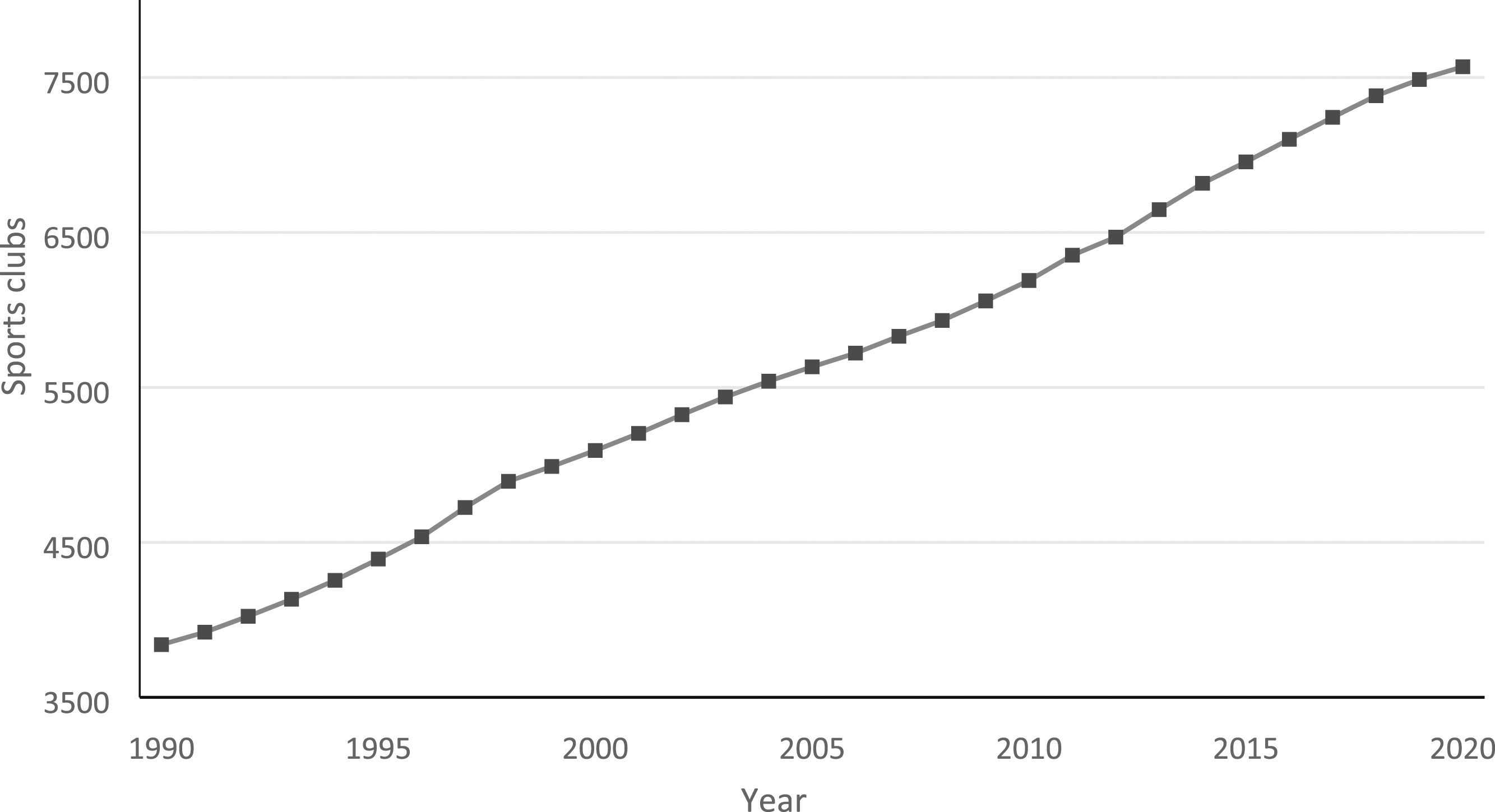
Even though there has been a steady growth in the number of sports clubs, the share of adults who practice sports in sports clubs has not increased. Figure 2 shows that only 13% of adults who engaged in leisure sports in 2018 did this at sports clubs. The share of those who used the services of private (for-profit) companies was 15%. The majority of those who engaged in leisure sports did so unaffiliated with any sports organization and either on their own (66%) or with a group of friends (34%). Eurobarometer reports from the past decade (European Commission, 2010, 2014, 2018) show comparable findings about the context of leisure sports participation in Finland. Context of leisure sports participation among 19–65 year olds (2002 and 2010) and 15–74 year olds (2018).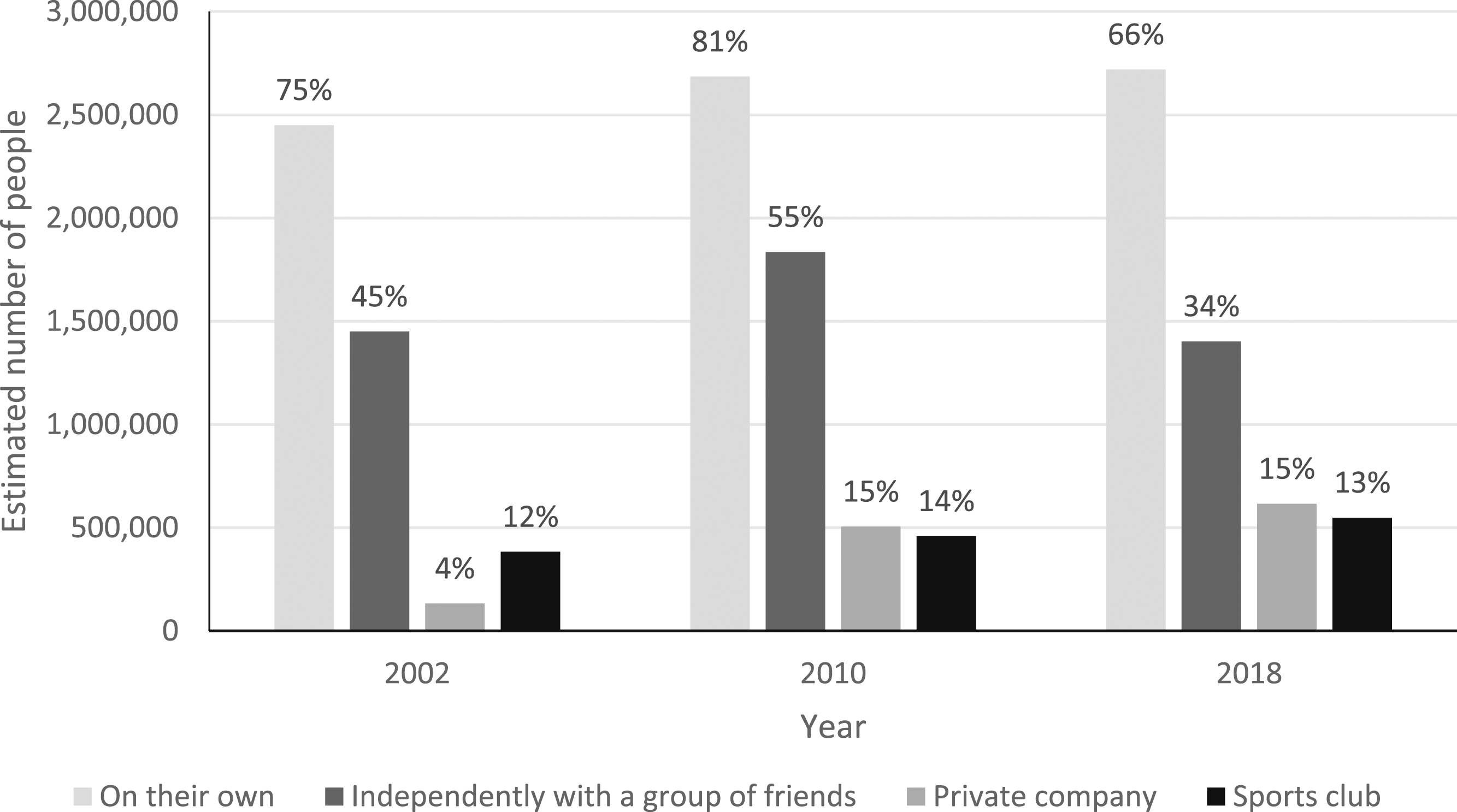
As Figure 2 shows, a large number of leisure sports practitioners in Finland are seemingly not drawn to sports clubs but opt for lighter forms of organizing. Borgers and colleagues (2018, p. 87) call this kind of “weakening or disappearance of the logics related to traditional participation styles” the deinstitutionalization of sports. I argue that mediatization is a key driver behind deinstitutionalization. Before the advent of digital media, sports practitioners engaged in subcultural activities within the possibilities and limitations of the surrounding environment and cultural norms. Today, leisure sports practitioners consume, produce, and share sports-related information, entertainment, and experiences using a multitude of media and technologies (see Thorpe, 2017). Digital media platforms facilitate global means of communication, allowing people to connect with distant others without boundaries of space and time (Rainie & Wellman, 2012). Leisure sports practitioners are to a great extent influenced by global sports media content that they may apply locally in their everyday sports practice (see e.g., Enright & Gard, 2016). At the same time, they often share local examples and variations of a practice on global platforms and thereby contribute to differentiation of sports (see e.g., Gilchrist & Wheaton, 2013).
Organizing in Climbing and Trail Running Subcultures
The trends described above can also be observed in the two sports disciplines that are under examination in this paper. According to the Finnish Climbing Association, the number of climbing clubs in Finland has increased from 14 to 41 between 1995 and 2020 (J. Koski, personal communication, August 30, 2021). Still, as Figure 3 shows, the number of climbing club members has not significantly increased in comparison to the overall popularity of the sport. There are now an estimated over 40,000 climbers in Finland, yet only 10% of them are members of climbing clubs (J. Koski, personal communication, August 30, 2021; see also Mononen et al., 2019). Climbers and climbing club members in Finland 1995–2020.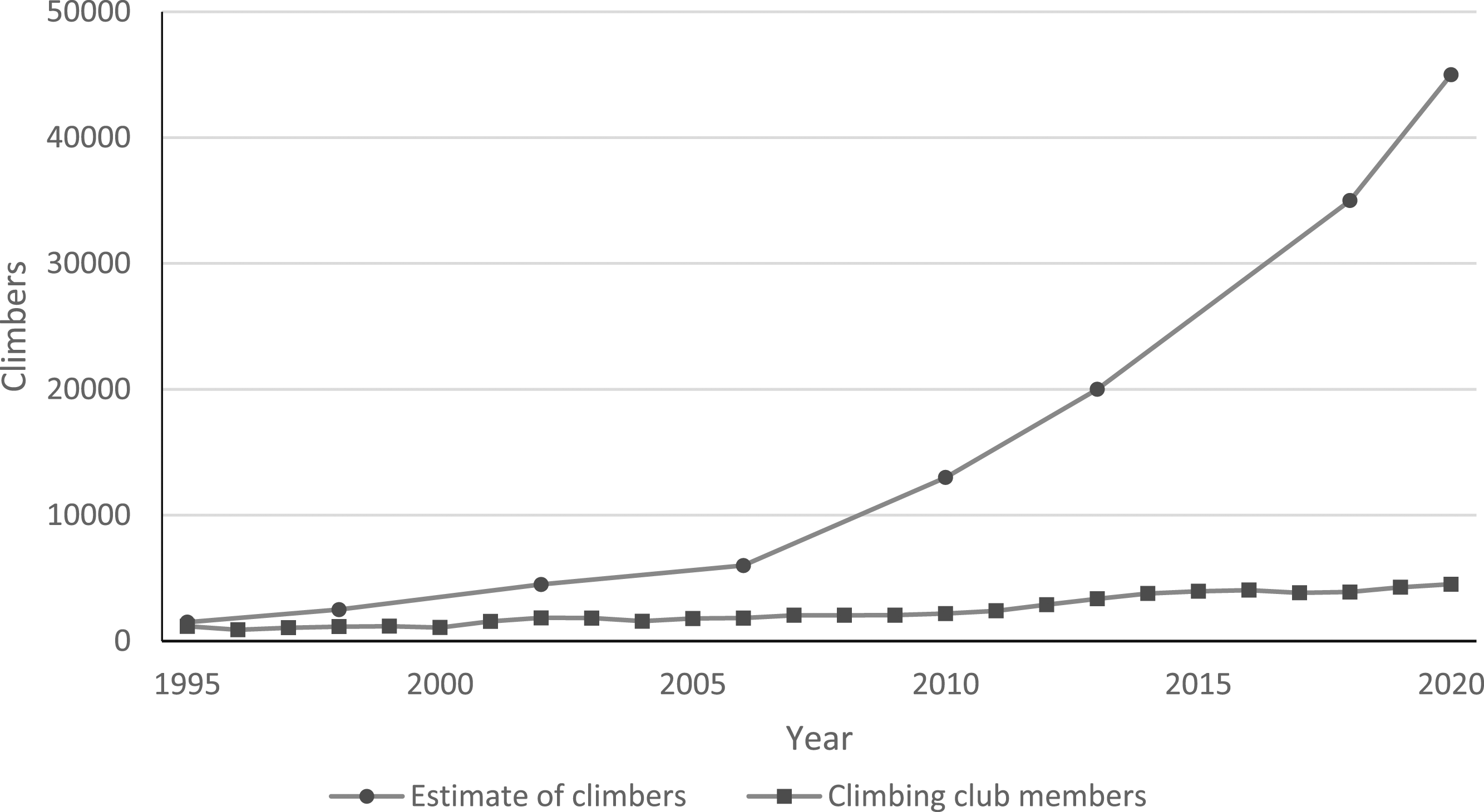
The popularity of trail running in Finland has not been monitored in the longer term for two reasons. First, trail running is considered a relatively new sport even though outdoor recreation and the public’s right to access nature are an integral part of the Finnish culture and history (see Hamunen & Airila, 2018). Second, the first trail running clubs were established in 2014 and to date there are only a handful of trail running clubs in Finland (Trailrunning Finland, n.d.). A recent survey indicates that as many as 700,000 people in Finland have practiced trail or cross-country running over the past year (Natural Resources Institute Finland, 2021). This means that, as with climbing, the great majority of trail runners practice the sport unaffiliated, on their own or with a group of friends, and organize themselves informally.
Shifting Configurations of Light Sports Communities
As shown above, many Finnish adults prefer to engage in sports activities outside a formal sports club setting and organize themselves in more informal groupings. This trend is strengthened by digital media, which have opened up new opportunities for community building. In this section, I use Borgers and colleagues’ (2018) concept of light sports communities to discuss late modern, loosely structured informal sports entities that include location-based meetups and online groups that take place on diverse digital media platforms.
Digitalization and Late Modern Communities
Late modern communities can be described as tribal (Maffesoli, 1995) or liquid (Bauman, 2012). The focal idea in late modern communities is that they are temporary, loosely organized entities based on shared emotions, lifestyles, or consumption practices (Blackshaw, 2010; Cova, 1997). An individual may belong to several communities without being particularly attached to any of them (Wellman, 2001). Attachment to multiple, even conflicting communities is possible through different roles; in forming communal connections with others, people often bring out a specific value, ability, or part of themselves, but not the whole person (Wellman, 2001). Late modern communities enable an individual to construct a temporary identity that may dissolve once they leave the community (Bauman, 2004; Maffesoli, 1995).
Digital media provide new affordances of persistent contact and pervasive social awareness which further alter community formation (Hampton, 2016). These affordances enable individuals to develop stronger community ties through more frequent interaction and to stay connected to multiple different communities over time (Hampton, 2016). van Dijck (2009, p. 45) points out that the term community on digital media platforms “refers to a large range of user groups, some of which resemble grassroots movements, but the overwhelming majority coincide with consumer groups or entertainment platforms.” Late modern light sports communities are thus here understood to include this whole spectrum and combinations of commercial and grassroots communities.
Borgers and colleagues (2018, p. 92) argue that “the recognition of sport light as an institution is not new, but its popularity has risen over the past decades alongside and within traditional ‘heavy’ organisational settings.” In contrast to heavy sports organizations that value rules and commitment, light sports communities are flexible in their nature (Borgers et al., 2018). Participation in light communities does not mean that a person could not at the same time be involved with more traditional communities, such as sports clubs. Within this framework, it is important to underline that an individual can experience all forms of social interaction, from traditional to light communities; they are not mutually exclusive (Cova, 1997).
Light Sports Communities in the Studied Context
In the context of this study, the participants were involved in diverse light sports communities such as interest-based online groups, workplace sports groups, brand communities, climbing gyms, recurring running meetups, or sports event organizing committees. The participants described equality and decision-making power of individuals as the upsides, and non-commitment of individuals as the main downside of these kinds of communities. At the same time, most practitioners were not willing to commit long-term to any community, but they underlined their individual freedom of being able to choose on what level they wanted to be involved in each community at any given time.
Light sports communities may not always be strongly communal, but they help people to meet and communicate, stay connected, and actively manage “the social fabrics of their everyday lives” (Wang et al., 2018, p. 683). Light sports communities may also introduce “heavy” logics in their activities, and thus, become to a varying degree reinstitutionalized (Borgers et al., 2018). In the following, I draw two examples from the data to show how self-organized sports groups can go through different processes of reinstitutionalization. These cases illustrate how configurations of participation in light sports communities are shifting over time and renew traditional models of sports participation.
The first case is a Facebook climbing group that Eva (33 years) and a few of her close friends set up 7 years back to organize their climbing practice. Since then, the group has grown and become more established. According to Eva, the community brings climbers together and “is just an easy way to say that we belong to the same bunch.” To “say” has a special connotation in this context because the group has its own logo. Eva described the meaning of the logo: I might go climbing wearing the logo on my shirt and someone may take a photo of it. Sharing [the photograph online] is an inside thing for the community. It’s like a small-scale brand, a way of showing belonging. … It’s a big part of my identity that I belong to the community. I don’t feel that I’m a climber with a capital C, but I definitely belong to the community and within it I climb actively.
The logo can be seen as an “embodiment of ‘heavy’ logics” in Eva’s climbing community (see Borgers et al., 2018, p. 92). Through sharing photographs with the logo in them, the community members construct a common understanding and an identity of what it means to belong to the community, and they communicate their personal sporting identity (see Gilchrist & Wheaton, 2013). Also, “loyalty and mutual expectations” and a “lack of explicit entrance possibilities” are more unintentional mechanisms of reinstitutionalization (Borgers et al., 2018, 92). Eva depicted the feeling of closeness in her community: Climbing is the reason why we, a vague group of 20 people, are together. But it is so much more nowadays. We do all kinds of things: spend evenings together, help each other in home renovations and removals, in everything. We’re a close-knit group and we might be somewhat clannish. It is not easy to get involved in, or at least outsiders may experience it like that.
Even though the community has over the years developed elements and mechanisms of reinstitutionalization, Eva explained that the members have consciously decided against formalizing as a club: We’ve had this discussion but then the question is why. Now, this works independently without anyone having to pay anything, and no one needs to take responsibility for anything because there is nothing to take responsibility for. There is no point in making it hierarchical.
Because of the lack of binding elements Eva presumed that her climbing community “will most likely gradually wither away.” She did not see it as a source of sorrow but as a natural developmental pattern. For her, the original community was fading in importance because its members had formed smaller closed networks and moved their communication over to other media.
The second case is a trail running club that Annika (36 years) co-founded some years back. Before the club was established, it was “a loose bunch of people” with informal activities. One reason to formalize the group was to better organize trail running activities; there was an intentional effort of reinstitutionalization. Still, Annika emphasized the informality of the club: Our aim is that there is nothing really official about it. We have, of course, the board and the committee and all such formal necessary organizational structures, but our chairman and vice-chairman train as hard as everyone else … Our main idea is to have fun. There are no nitpickers among us.
Another reason for formalizing the club was to put a conscious effort into promoting competitive trail running in Finland. Annika elaborated the purpose of this: Some of our runners aim at making results. Their workouts are rigorous and for some, goals are big. Now we are setting up a racing team too. It’s for that if you want to train harder and more purposefully. There are runners who could gain ground internationally.
Even though the club has an aim to promote competitive trail running, Annika told that club welcomes new members on all levels. She emphasized that the club is comprised of individuals who “attract like-minded people” and “make up the idea of who we are.” She explained how all club members have their individual training goals, how “everyone can find the right guy to keep up the pace,” and how individuals are seen “not just as runners, but as persons.” Annika’s descriptions show that the community is determined to bring late modern values such as self-development and flexibility into their formal club activities. This is a case in point of how “new communities drive institutional change in a process where practices and values from the new and old settings of sport are intertwined” (Frandsen, 2020, 113).
Commercialized Practices
The ongoing differentiation of sports cultures and the emergence of light sports communities are closely connected to consumerism and commercialization. In this section, I describe how digital media have impacted commercialized leisure sports practices.
Digitalization and Commercialization of Leisure Sports
All popular digital media platforms are commercial enterprises. They follow the logic of connectivity, which refers to their affordances to connect users with each other and with personalized advertising (van Dijck & Poell, 2013). According to Frandsen (2020, p. 109), connectivity “reflects aspects of mediatization that have extensive implications for sport as an institution.” On the one hand, connectivity supports the formation of light sports communities, and on the other hand it increasingly connects recreational sports practitioners with commercial interests (Frandsen, 2020).
The commercialization of sports is a complex process because sports practitioners themselves are involved in commercial activities on many levels (see Edwards & Corte, 2010). For example, some local grassroots communities have been established in collaboration with global sports brands (see Kornum et al., 2017). Also, through digital media, some practitioners are able to commercialize their self-produced content and transform a leisure interest into a subcultural career (see Snyder, 2011). Sports and commercial activities are intertwined to the extent that “the project of the self as such may become heavily commodified … [as] not just lifestyles, but self-actualisation is packaged and distributed according to market criteria” (Giddens, 1991, p. 198).
The many aspects of commercialization can be more profoundly understood when viewed from the perspective of individualization. In late modern societies, “new demands, controls and constraints are being imposed on individuals” (Beck & Beck-Gernsheim, 2009, p. 14), and consequently, human identity is being transformed “from a ‘given’ into a ‘task’” (Bauman, 2012, p. 31). Individuals are urged to take responsibility for this task and to engage in “life politics” through “day-to-day decisions on how to live” (Giddens, 1991, p. 14). In the sports context, commercial digital media platforms and technologies help individual practitioners to structure and organize their everyday exercise routines according to their individual needs and desires (Frandsen, 2020). By combining different leisure-time activities and services, individuals can create their personal lifestyle of sports practice that they, in turn, may share with others online.
Commercialized Practices in the Studied Context
In the context in which this research was carried out, many digital media platforms function simultaneously as both service and community; that is, they follow the logic of connectivity (see van Dijck & Poell, 2013). The participants in this study did not generally regard these two aspects as contradictory, but rather as complementary. For most of the interviewed trail runners and climbers, commercial media platforms and technologies were an integral part of the sports practice. The practitioners were ready to consume sporting goods and services that met their specific needs. Commercial media helped practitioners to keep track of what is going on in the sport and to maintain connections with their peers.
Many of the interviewees were following sports brands through digital media platforms, they took part in location-based brand activities, and they used several commercial services to record and share their physical performance. For example, Eva (33) followed climbing brands on Instagram because “they have interesting stories, beautiful photos, and new products.” Additionally, she followed the brand ambassadors, that is influential athletes who represent and market the brands, because they “share the outdoorsy lifestyle that I like and want.”
Tom, a 31-year-old trail runner, is in turn a member of a brand community that organizes joint running sessions. According to him, trail running in its current form is grounded on digital media and running brands: I don’t think that the hype around trail running would have been possible without social media and without the brands that put so much money to marketing their products there. Because of social media running gear has developed incredibly during the past ten years.
Similarly, Mika, a 45-year-old trail runner, explained that “being a fan of a brand” means that consumers “are not just randomly choosing products but they really like the brand and want to be in touch with it” by “giving feedback and participating in brand events.”
These examples show how the use of digital media platforms both increases individual practitioners’ connections to commercial interests and strengthens the commercialization of leisure sports in general. The involvement of commercial media and consumerism in leisure sports participation is also seen in practitioners’ attitudes towards traditional sports clubs. Most of the interviewed practitioners considered traditional sports clubs not as communities but as service providers. Especially many climbers said that they had become members in climbing clubs because of an insurance benefit that they could gain though the membership. Lisa, a 33-year-old climber, explained: The club provides me with certain services. For example, they organize trips on my behalf. All I have to do is to sign up and go. This also applies to the courses they organize. They are the kind of services I pay for and then I just show up there.
Some sports clubs have begun to take advantage of this change of attitude and started organizing so called drive-in programs that enable lighter forms of participation (see Bennike et al., 2014; Stenling, 2013). According to Borgers et al. (2018, p. 94), this is another mechanism of reinstitutionalization that takes place in “tradition-bound organisations, when they adopt new (light) institutional paradigms in order to facilitate flexible sports participation.”
Discussion
Participation in leisure sports is undergoing a transformation that is guided by societal, cultural, and technological changes, as well as individual and subcultural responses to these changes. Sports communication is increasingly digital, and the ways of organizing leisure time are more varied than before. This paper has shown that digital media has impacted leisure sports cultures and participation by contributing to differentiation in leisure sports, by supporting the formation of light sports communities, and by reinforcing commercialized sports practices.
Using a synchronous approach, this study has exemplified that mediatization drives both de- and reinstitutionalization of sports. Leisure sports practitioners with specific sports interests use digital media to connect with those who share their passion and form communities in which participation is based on personal preferences. When more people become involved in light sports communities, it changes the norms and logics of leisure sports participation and contributes to deinstitutionalization of sports (see Borgers et al., 2018). The lightness of organizing on digital media is inherently connected to the wide range of sports forms and practices today; a “pick and mix” mentality enables everyone to create their own personal sporting identity, and individual freedom allows for more individualized ways of expressing oneself through physical activity.
Digital media operate predominantly on commercial terms and serve for individual needs. This kind of service-oriented flexible participation model is reflected on how new sports communities function and forces traditional sports clubs to adjust their supply accordingly, hence contributing to the reinstitutionalization of sports (see Borgers et al., 2018). If members in light sports communities, in turn, are willing to commit to their communities, then over time these communities may benefit from becoming more formalized. As this study shows, reinstitutionalization can happen through conscious decision or through more unintentional processes that are often supported by digital media (such as through sharing content with meanings that are understood only by insiders of a community).
The impact of digital media on leisure sports is not one-directional. Media seldom influence in isolation but rather operate in interaction with other global and local institutions, and therefore they also “become influenced by the particular inter-institutional context in question” (Hjarvard, 2018, p. 81). This means that the logics of leisure sports participation change in interplay with the media logics. For example, if digital media platforms do not meet the needs of individual users or sporting networks, they may quickly be abandoned. Consequently, whereas sports disciplines today need to compete for mass media attention (Koski, 2012), digital sports media need to compete more vigorously for the attention of sports subcultures and individual users. This, in turn, affects digital sports media, forcing them to create more personalized conditions for interaction. Commercial platforms are in the position of needing to provide affordable services that meet the needs of individualized practitioners and diverse sporting cultures. This, again, strengthens their logic of connectivity (see van Dijck & Poell, 2013) and contributes to the mediatization of sports.
As a final remark, this paper underlines that sports in Finland, the organization of which has traditionally relied on voluntary participation, is now more than ever compelled to acknowledge the role of informal sports participation. Individuals are looking for participation models that fit their social and economic realities and their perceptions of meaningful leisure time (McGrath, 2019). If traditional sports organizations aim to gain leisure sports participants’ interest, they need to open to alternative models of participation. In practice, this could mean lighter sports programs, non-binding membership options, and different expectations regarding voluntary work.
Limitations
The first limitation concerns the scope and the sample of this study. All the leisure sports practitioners who participated in the study used digital media as a part of their practice. The results therefore cannot be generalized to include all sports practitioners in the selected sports disciplines. In addition, the study was limited to only two sports disciplines. It is therefore unclear to what extent the results can be generalized to the general population and across different types of sports. Lastly, the results cannot be generalized to other countries, apart from those that share similar values, the same principles of a democratic welfare society, or similar cultural dimensions, such as individualism and indulgence (see Hofstede Insights, n.d.); they would also need to have similarly high internet usage rates to Finland (see Eurostat, 2021).
Footnotes
Declaration of Conflicting Interests
The author(s) declared no potential conflicts of interest with respect to the research, authorship, and/or publication of this article.
Funding
The author(s) received no financial support for the research, authorship, and/or publication of this article.
