




Abstract
Rugby union, alongside other collision and contact sports, faces ever mounting pressure from increased recognition of concussive injuries and the risks they present to athletes, both in the short-term and long-term. Here, the media is a central component of increasing pressure for cultural change. This research analysed data from 524 self-selected survey respondents to examine rugby union fans’ and stakeholders’ perceptions of media portrayal of concussion and how it might influence their own perceptions. We found evidence of a complex and heterogenous relationship between perceptions of masculinity, views and attitudes toward mass media, and degree of involvement in rugby union. Specifically, partisans of the sport generally saw mass media as hostile, with coverage biased against rugby, allowing them to manufacture doubt regarding risk information, as well as maintaining involvement in the sport. We conclude that critical commentaries from the media have the ability to challenge masculinities around concussion.
In December 2020, it was revealed that former international rugby union players were suffering from early-onset dementia, with a large number poised to take legal action against their former employers and the governing bodies of the sport (Anderson et al., 2020). This revelation brought the dangers involved with playing rugby into “the public eye” and drew criticism of the governing bodies of rugby for allegedly denying the growing evidence that the sport has injury rates that are higher than other sports (Piggin, 2020). At the same time, there has been increased sociological focus on sporting injury. Here, athletes are often culturally expected to sacrifice their bodies in the pursuit of success, an act that may be seen as deviant in broader society, but normative in sport, and especially rugby (Anderson & White, 2017; Coupland, 2014; Hughes & Coakley, 1991).
Developed in the British Public-School system, rugby union has an enduring link to the formation of traditional masculinity in the United Kingdom (UK), and the sport has long prized the endurance of pain (Light & Kirk, 2000; Proctor, 2011; White & Anderson, 2017). Indeed, rugby union maintains strong associations with aggression and physicality, and it has long been associated with violence (Collins et al., 2008). For example, Dunning (1986, p. 81) identified rugby union as a contact sport that has traditionally embodied: “the expression of macho values in a relatively unbridled form.” Even in the 21st century, the school system continues to play a central role in pushing boys towards hegemonically masculine sports, such as rugby union (Whigham et al., 2019), reinforcing the pressure for boys to be tough and strong “men” who ignore injury and sacrifice their bodies for the good of the team (Light & Kirk, 2000; White & Hobson, 2017).
In line with this contention, Liston et al. (2018) found that amateur rugby union players underplayed and ignored the importance of concussion in an effort to be “headstrong” and assimilate with the sporting culture. As a consequence, there continues to be under-reporting of concussion, with many parents, coaches, and young athletes believing that athletes are indestructible, while accepting that injury and concussion are just part of the game (Sanderson & Cassilo, 2019). Malcolm (2017, p.135) attributes the under-reporting of concussion symptoms to: “(a) perceptions that their condition is not serious enough; (b) reluctance to leave the game and/or let down teammates; or (c) disbelief that a concussion has occurred.”
Compared to most other sports, rugby union has a relatively high injury rate (Griffin et al., 2020), including at school level in the UK (Pollock et al., 2017). For instance, Abernethy and MacAuley (2003) found that rugby union was responsible for 45% of school-sport injuries that required Accident and Emergency department attendance—more than three times higher than any other sport. As a result, a variety of safety measures have recently been introduced in rugby union with the aim to make it safer. Measures have included voluntary concussion training, post-concussion return-to-play protocols, as well as a pre-activity exercise movement control programme (Batten et al., 2016; White et al., 2018). Others have called for further action, including the removal of collision elements from compulsory lessons of school rugby union physical education to protect children from injuries (Pollock et al., 2017; Sport Collision Injury Collective, 2016; White, 2020).
There are many stakeholders involved in the concussion debate (players, coaches, parents, medical professionals, sport governing bodies, and public health organisations) and hence the socio-cultural context is complex. Nevertheless, concussion has become a serious sporting and public health issue (Anderson & White, 2017; Benson, 2017), one in which the media plays an active role in influencing the opinions of fans and wider stakeholders involved in sport (White et al., 2020). However, understanding the influence on attitude formation of story frames in sports media coverage of athletes and teams remains under-researched (Lewis & Weaver, 2015). In addressing this gap in knowledge, this research examines two key questions: (1) what are rugby fans and stakeholders’ views on the potential risks of concussion in rugby union? and (2) what are rugby fans and stakeholders’ perceptions of media coverage of concussion in rugby union? To do so, we analyse responses via an online survey of 524 self-selected participants, examining the relationship between rugby union, the media, and masculine-influenced views about injury and concussion.
Masculinity and Sport
Organised team sport provides an avenue for displays of patriarchal structure, physical prowess, and heterosexual domination (Adams, 2011; Hargreaves, 1986; Murray & White, 2017; Pronger, 1990; Pringle, 2005). As a result, many note how it provides a vehicle that reinforces an orthodox or hegemonic form of 20th century masculinity (Anderson & White, 2017). Connell’s Hegemonic Masculinity Theory (1987) contends that multiple types of masculinities exist within a hierarchal structure, with one holding dominance over others. Connell (2005, p. 77) defined hegemonic masculinity as the “configuration of gender practice which embodies the currently accepted answer to the problem of the legitimacy of patriarchy, which guarantees…the dominant positions of men and the subordination of women.” Commenting on the structure and process of organised team sports, Connell suggests sport “embeds definite social relations” (1995, p. 54).
Under this practice, and despite the increased awareness of the severity of the injuries that are a part of playing rugby union, there is often an expectation that athletes are able to withstand and play sport despite their pain and injuries (Hughes & Coakley, 1991). Pierre Bourdieu (1993) states that physical sports (such as rugby union) require not just investment of effort, but also the acceptance of pain, suffering, and risk to the body itself. Indeed, Coakley et al. (2011) claim that a strong, muscular, athletic body can be a source of social status as it is an indicator of self-control and discipline, while the ability to ignore pain is seen as a gauge of physical strength and is valued in (many) sports.
More so, it has been suggested that some seek to enhance their masculine and athletic identities by engaging in injurious and risky behaviours, particularly as they are often praised for doing so by fans and the media (Anderson & White, 2017; Sanderson et al., 2014). As such, sport becomes a symbolic enactment and representation of warfare, reproduced via “warrior narratives” (Adams et al., 2010; Anderson & Kian, 2012). Adams et al., (2010, p. 281) assert that: “…players who do not live up to the expected orthodox scripts of masculinity are often subordinated through physical dominance and ridicule.”
However, masculinity is not fixed and there are often multiple, intersecting versions that compete with the dominant, previously accepted hegemonic masculinity that will come into existence at particular times and places (Connell & Messerschmidt, 2005). There is also evidence that boys and young men are today moving away from orthodox versions of masculinity that have been based on tenets such as violence, aggression, and misogyny (Light, 2007). In line with this, Anderson (2009, p. 13) developed Inclusive Masculinity Theory to explain the changing nature of masculinities which he had witnessed, claiming this to be the norm for “White, middle class men; both inside and outside of sport.” Given this shift away from hegemonic masculinity, it may be expected that there will be an associated move away from aggressive competitiveness, toughness (Wright & Clarke, 1999) and, most significantly in this paper, risking the body (Bowley, 2013; Griffin et al., 2020). Indeed, this has been the case in American Football with a year-on-year reduction in participation attributed to health concerns with the sport (Cantu & Hyman, 2012).
The Media and Concussion Discourse
Media coverage of concussion has been investigated in several sports, including boxing (DeKosky et al., 2013), Association football (White et al., 2020), rugby union (McLellan & McKinlay, 2011), ice hockey (Kuhn et al., 2016; McGannon et al., 2013), and American football (NFL) (Anderson & Kian, 2012; Cassilo & Sanderson, 2016; Sanderson & Cassilo, 2019), where concussion incidence rates are high and worldwide visibility tends to be greater than other sports. Specifically, Ahmed and Hall (2017) explored the description of sports concussion in online sports news articles on ice hockey, American football, Association football, and rugby union. They found that mainstream media articles have the potential to widely influence public perceptions of concussion, to mediate misconceptions, and to increase knowledge.
It is not only the sporting press that is reporting on concussion in sport, but now these stories also feature in mainstream press reporting (Cassilo & Sanderson, 2016). This reporting is typically influenced by the values of the media organisation and/or the writers who frame stories by selecting which elements in a certain news story are presented (Lewis & Weaver, 2015). In this manner, the selection of certain aspects of reality to focus on makes them more salient, more noticeable, and more meaningful in any communication (Entman, 1993). Significantly, Sanderson et al. (2014) argue that media attitudes can be reflected at lower levels of the sport and can influence the decisions of youth coaches, parents, and children.
Therefore, the media can define a problem and shape public perceptions, and is particularly persuasive with public health issues (Cassilo & Sanderson, 2016; Sanderson & Cassilo, 2019). However, treading the line between sensationalising and minimising the risks and long-term implications of injury and concussion in sport is an ongoing challenge for the media. Nevertheless, Ventresca (2019) suggests that attention-grabbing headlines may serve to support efforts to influence stakeholders to make changes. There have also been some high-profile documentaries and films such as Head Games, League of Denial, and Concussion (White & Franks, 2019), which have brought public attention to the issue of chronic traumatic encephalopathy (CTE), a disease associated with repetitive brain trauma. As such, Anderson and Kian (2012) suggest that media coverage is now reducing the emphasis on the warrior narrative.
Opinions can also be perpetuated on social media sites, such as Twitter and Facebook, without regulation. Workewych et al. (2017) conducted a Twitter analysis to try to gauge the culture of concussion in sports, hypothesising that the data might aid understanding of public perceptions and misperceptions. They found that, while the scientific and medical communities consider concussion to be a form of traumatic brain injury, there is a misunderstanding of that among the public. Sullivan et al. (2012) also investigated opinions on Twitter, arguing that its use for education on concussion is a powerful one. It can heighten the impact of the issue and increase the number of people that could benefit from accurate reporting. In addition, Williams et al. (2014) recommend YouTube as an appropriate way of disseminating quality-controlled information on concussion in sport due to its global popularity and reach. However, debate in the area of social media suggests that there may not be enough regulation of online e-Health information (Ahmed & Hall, 2017). As such, the public has no way of knowing if it is accurate, misleading, or for commercial gain, and sources of concussion information may also have biases (Partridge, 2013).
Cleland (2011) argues that the relationship between consumers (fans and stakeholders) and the media has evolved since the advent of “new” media due to its interactive nature. Media coverage (of many topics) is increasingly challenged and rejected as either biased or “fake,” inspired by political leaders globally (Nelson & Taneja, 2018). Furthermore, as most sporting clubs and governing bodies have direct access to consumers via institutional websites and social media channels (and their own television channel in some cases), they are now able to counter unfavourable media coverage and to influence public discourse directly. As Cleland (2011) notes, sport consumers may not be passive audiences, who accept and absorb media information without question, while stakeholders that are already invested in the sport may challenge media information. Gunther and Liebhart (2006) highlight that “partisans” (such as stakeholders and fans of a sport) tend to view news coverage of controversial issues in the mass media as biased against them—the hostile media effect. However, as noted at the start of this paper, the influence of sport media on attitudes towards concussion remains relatively unknown (Lewis & Weaver, 2015).
With disagreements between research, science, sport, and stakeholders, it is unsurprising that there are disconnects in the information provided by science and the media. Kuhn et al. (2016) discuss the case of Todd Ewen, a National Hockey League (NHL) player who committed suicide believing that he had CTE, yet no evidence of it was found post-mortem. They recognise the importance of the intermediary role the media plays in providing information to the public and recommend that researchers spend more time educating the media. Ahmed and Hall (2017) agree that the process of engagement between researchers, clinicians, and the media needs to be more extensive and consistent internationally. Provvidenza et al. (2013) also reviewed knowledge transfer and concussion education literature, finding that using the media is a valuable way to draw attention to concussion and educate the public, while emphasising the importance of accurate information.
Given the historic (and current) overemphasis on men’s sport in the media, it should not be surprising that sport media has been described as “a glorified package of what masculinity is and should be” (Messner, 2012, p. 115). However, this depiction of masculinity has typically been relatively narrow, linked with nationalism, the glorification of warfare (Messner, 2012) and an associated acceptance of pain (Cranmer & Sanderson, 2018) and toughness, particularly in sports where there has been an overrepresentation of “toxic masculinity” (Bowman, 2020). Therefore, the media has been complicit in constructing and maintaining hegemonic masculinity (Park, 2015). Although media representation of masculinities in rugby union remains underexamined, in a rugby league context, an orthodox form of masculinity has been reinforced in media coverage against wider social trends towards inclusive masculinities (Murray et al., 2016). Thus, we examined responses to media coverage from stakeholders to consider how masculinity is framed in relation to rugby, providing a vital comparative to Cranmer and Sanderson’s (2018) examination of American football.
Method
An anonymous online survey was developed to collect stakeholder opinions on the media’s reporting of concussion in rugby union. The survey instrument consisted of standard demographic questions and a series of open-ended and closed-ended questions asking opinions on media reporting of concussion and brain injury in rugby. An example of the questions asked included: There has been an increasing amount of media attention focusing on head trauma in rugby. What are your views on this increasing media attention? Overall, we received a substantial response to the open-ended questions (∼15,000 words for each question) and so it is the results from the questions related to media reporting of concussion (questions 1-3 in the Appendix) that we present here.
As part of the survey, participants identified their involvement with rugby, selecting multiple options from a list including: player, coach, spectator, and parent of players. “Other” responses included former players and a sports therapist. The responses are provided in Table 1.
Involvement With Rugby Union.
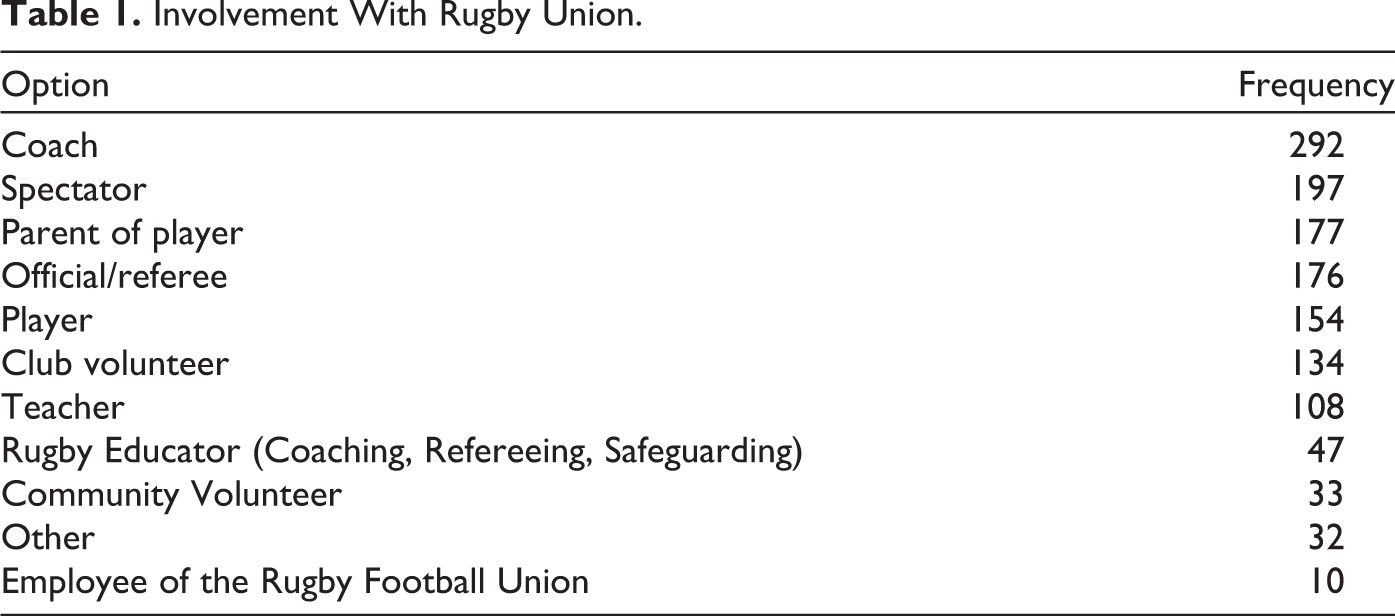
The total sample included 524 self-selected participants accessed via social media platforms and rugby union message boards in the UK between March and September 2016. The mean age of participants was 43.9 years (SD = 12.83 years). The gender breakdown was 481 males (91.8%) and 43 females (8.2%). Given that the survey was available online, there was an in-built bias as only those with access to the internet were able to complete it. However, with the popularity of internet-enabled smartphones and the availability of the internet in public places, we believe that this bias is acceptable. Furthermore, as participants took part voluntarily and anonymously by self-selecting to take the survey, more-traditional sampling errors were avoided (Cleland & Cashmore, 2014). University ethical approval for the study was granted in January 2016. Following the Association of Internet Researchers guidance (Internet Research Ethics 3.0, 2019), a participant information sheet was provided for all participants to explain the study and allow participants to make an informed choice over whether to participate or not. Following data collection one participant withdrew their data from the study.
Data Analysis
Our approach to data analysis was based on subjective interpretation. Here, authors one, two and four independently analysed the survey answers manually (rather than via computer-assisted software) to allow a focus on meaning rather than quantity (St John & Johnson, 2000), an approach still favored by many social scientists (Davis & Meyer, 2009). Thematic analysis was used to summarise the data set (Sparkes & Smith, 2014), with each response coded. This involved giving meaning to responses that had relevance to the research question. Here, the researchers discussed each code and meaning before grouping it with similar words or phrases. During the coding process, common themes arose and were noted down. Each code was placed into a provisional category and reviewed once completed. Next, themes and codes were challenged by two additional “critical friends” (Smith & McGannon, 2018), who questioned their relevance. This helped to ensure rigour in the analysis, with critical friends used to highlight different interpretations, as well as facilitating reflection through the challenging of beliefs (Cowan & Taylor, 2016). In terms of naturalistic generalizability (Smith, 2018), which refers to findings that correspond with the experiences of others, it is also likely that the reader will be able to recognise similarities and differences with their own perceptions of the relationship between rugby union, the media, and injuries and concussion. Overall, this process resulted in the emergence of three broad themes, namely: positivity toward increased awareness of concussion from the media, acceptance of the risk involved in sport, and us (rugby) versus them (media).
Discussion of Results
Awareness of Concussion
Participants displayed an awareness of concussion, largely due to media coverage. However, they frequently attempted to mitigate the impact on rugby union as a sport by scapegoating and, for example, attributing blame for an increase in injuries to those running the sport or to processes involved with the modernisation of rugby union. Rugby union itself was identified as having a higher potential for injury due to its physical nature. One participant stated that, “Playing rugby infinitely increases your risk of a potential concussion. The media is not over reacting” (48 year old, male, Coach, Official/Referee, Parent, Spectator), whilst others likened it to American football, claiming that rugby union was benefitting from the increased understanding of concussion: The professionalism of the game has led to bigger “hits” from bigger players and at the same time has brought more science into the game from other sports, such as American football, who have studied such trauma and recovery for many years. It is vital that all participants realise that head trauma is not limited to the elite level but extends down to all levels where contact occurs, and may be even more important for young players whose physiology is still developing. (51 year old, male, Coach, Club volunteer, Parent)
This sentiment was echoed in a number of responses with the implication that the governing bodies of rugby union needed to be pressurised to act on concussion. These views are indicative of a perceived lack of preventative action by sporting bodies to remove dangers from sport (Anderson et al., 2020). As one participant stated, “Whilst I like to think that the rugby authorities would look at this issue in the absence of media attention, I have greater faith in them doing so when put under the microscope” (40 year old, male, spectator), whilst another participant outlined: With the increasing research into the effects of concussion. More awareness of the risks, will allow for more informed decisions on whether to play and what to look out for when playing. (26 year old, male, player, spectator)
Despite this increased awareness, many participants believed there still to be insufficient knowledge about concussion in both society, and sport more generally. The following responses highlighted the difficulties that are posed with concussion and head trauma due to their relatively unseen nature: In the past, it has always been an injury that people ignore or don’t take as seriously as they should, so increasing awareness is a very good thing. (40 year old, male, Player, Coach, Official/Referee, Club volunteer, Parent, Spectator)
Rugby union became a professional sport in 1995, and players have become bigger and stronger since that time, alongside a higher level of player injury since professionalisation (Malcolm & Sheard, 2002). Addressing this physical change, one particular response claimed that in the intervening time the players’ “bodies have grown and even backs [traditionally the smallest players on a team] in junior teams can be 17+ stone. 14 stone was heavy in my day” (60 year old, male, Official/Referee). The size of the modern players means that the collisions involved were equivalent to “a head on car crash at 30mph” (46 year old, male, player, coach, official/referee, parent, spectator) or getting “hit by about 50 buses over the game” (24 year old, male, player, coach, spectator). Nevertheless, this greater risk was believed to be only relevant for the elite players and not youth or amateur players as, in the views of one respondent, the elite game involves “significantly higher speed collisions between significantly heavier individuals, but with good technique vs lower speed collisions between typically lighter people versus the youth game” (48 year old, male, coach, parent).
In other cases, the increased awareness of concussion in rugby union and the greater media coverage were put forward as contributing factors in the rise in incidents of concussion. Here, it was argued that increased awareness meant players and officials were now able to identify cases of concussion, resulting in a greater prevalence of injury reporting in rugby and, in turn, the media, rather than increased rates of concussion resulting from changes in the physical nature of the sport. However, this increased knowledge was framed in a positive manner as it was believed to have resulted in improved player safety. One participant stated, “More awareness = better safety” (57 year old, male, Coach, Official/Referee, Spectator), whilst another participant noted “…due to the excellent work of the RFU to educate players and coaches I believe that the increased numbers are mainly due to players, coaches and parents being better educated and reporting concussion more often” (26 year old, male, Player, Coach, Official/Referee).
Other responses drew from personal involvement in rugby union and highlighted an increased awareness of the issues, particularly from parents. It was argued that the risks were acceptable if they were managed or by ensuring that participants, or their parents in the case of children, were aware of the risks: Risk is inherent to all aspects of daily life. Entering into a sport assumes that the individual weighs that risk. For children, the parent makes that choice. The sport should not change because of the risk. Risks should be mitigated as much as possible however they can never be removed. (49 year old, male, Coach, Parent, Spectator) If you are better informed you can weigh up the risks. Rugby is a risky sport and I have talked this through with both sons. As a coach I am fully aware of what I have to do to minimise the possible dangers. (48 year old, male, Coach)
Acceptance of the Risk Involved in Sport
In light of the responses to this study, and contrary to the findings of Sanderson et al. (2014), the media may not be able to change the hyper-masculine culture of some sports (Ventresca, 2019). Indeed, rugby was identified by one participant as having a “culture of bravado that shrugs off injury and will play on, often to their longer-term detriment” (51 year old, male, Coach, Player). It was also evident across the data that some participants believed that the risk of injury and concussion were part of the game, reflective of traditional notions of masculinity (Messner, 2012; Park, 2015). The fact that rugby union is a contact sport was a prominent feature, but the dangers involved were seen to be outweighed by the benefits of playing. For example, rugby union was believed to develop a number of beneficial skills and characteristics, often associated with typical masculine values in addition to providing aesthetic qualities. By way of illustration was this response, “rugby is a great sport for many reasons, I have seen young lads develop into sociable responsible and ‘all rounders' as a direct result of playing rugby” (56 year old, male, Coach, Club volunteer), whilst another participant concurred: I played rugby, as did (and still do as adults) both my sons. One has had a number of concussions. I am clear that the benefits to them (in terms of social development, character development, moral education, physical fitness and sheer pleasure) has greatly outweighed the risks. (61 year old, male, Parent, Spectator)
In other responses, there was a tendency to blame injuries on poor technique, suggesting that the laws of the game had been modified to minimise injury risk. Therefore, injuries were the fault of individuals. Poor technique was cited as being an issue with the “modern” game as exemplified by one participant who claimed: [there] seem to have been less incidents of head injuries previously when players avoided contact and had better tackling techniques. Hopefully the media focus can reduce this and make rugby the game it was. (57 year old, male, Official/Referee)
As is apparent above, the risk of injury in rugby was often linked back to those inherent in everyday life. Activities such as walking down the street, motorcycle riding, and driving a car were put forward as more dangerous than playing rugby. In many comments, there was a pervading sense that the media had a disproportionate focus on risk and injury in rugby. For example, this participant stated: The first thing we teach kids is how to fall, how to take a tackle safely, and also correct head position. All sports involve risk, rugby is just fronting up to it. (47 year old, male, Coach, Official/Referee, Parent)
It should be noted that many people are willing to accept a degree of risk in everyday life (Adams, 1995). Fuller (2007, p. 185) stated that “a high level of risk does not make a risk unacceptable per se; people will accept risks that are taken on a voluntary basis that are up to 1,000 times higher than risks taken on a non-voluntary basis.” These comments also reflect a critique on the lack of risk in everyday life and a fear of risks. It was claimed that “Generally as a society we are getting too risk averse” (45 year old, male, Coach, Official/Referee, Spectator) and “We do not and cannot live wrapped up in cotton wool” (56 year old, male, Coach, Club volunteer). Sport has been regarded as one of the last bastions of male hegemony, and a defence against a perceived “effeminising” of society (Clayton & Harris, 2009). Indeed, the civilising of society has reduced the avenues for men to display their manliness and to demonstrate physical superiority over others (Muir et al., 2020).
Yet, it is worth noting that stronger in-group identities have been found to influence perceptions of and attitudes toward risk information. In a study on parental attitudes towards children playing contact American football, Boneau et al. (2020, p.44) drew attention to the “different football identities” that families may possess, as well as differences in approaches to child involvement in the sport. They argue that those more invested in American football are less likely to heed risk information that highlights dangers associated with participation; a finding which may explain the different attitudes present within rugby stakeholders. Boneau et al. (2020) do, however, note that increased awareness of the risks involved with playing American football were causing tensions in families, suggesting a shift in attitudes in some areas of this sporting culture.
Us (rugby) Versus Them (Media)
When risk information is presented via mass media, the hostile media effect suggests that partisans of the sport, as we have in this study, are more likely to view it as biased against them (Gunther & Liebhart, 2006). Across our data, and in line with this contention, the media was widely recognised as playing a key role in shaping public views, but the validity and accuracy of reporting were frequently questioned by a number of participants. Indeed, there was a deep reluctance from some respondents, typically those actively involved in the sport (such as players, coaches and teachers) to acknowledge the potential dangers involved in rugby union. For many, media coverage of injuries was believed to be sensationalism and inaccurate. The motivations of the media and the perceived “sensationalising” and “scaremongering” (both terms were frequently used) were attributed to a desire to “sell a story” by “using the increased number in concussions to their advantage” (26 year old, male, Player, Coach, Official/Referee). Another participant claimed that “Headlines sell papers, so it is an attractive story with some shock value. Most people I know involved in the game are not influenced by the media” (22 year old, male, Coach, Teacher). These comments downplayed concussion in rugby, claiming that the media was over-reporting a small number of negative events and creating the perception that concussion was rife within the sport, as shown here: It can seem from the way things are reported that no one cares about player welfare. You can be left with a perception that all players are suffering from regular concussions at all levels of the sport. (38 year old, male, Player, Coach, Club volunteer) Scare-mongering and unsupported theorisation help no-one. Those who have been involved in rugby for upwards of 50 years do not take kindly to one-off “statements”—actual, objective research will be recognised, ideally by people who understand and have been involved in the game. “Statements” by “doctors” never aware of the reality of rugby are disingenuous. (64 year old, male, Coach, Official/Referee, Spectator, Community volunteer, Rugby Educator) Obviously rugby is a collision sport and maintaining safety of players is crucial but there is a risk of media attention causing rugby to change as a sport in terms of safety and regulations. Also, players may be more inclined to lie about their welfare in order to be allowed to play (21 year old, male, Player, Coach, Club volunteer)
On the other hand, several responses emphasised a perceived safety-first attitude and inbuilt trustworthiness that would help to ensure the safety of players. One participant stated that “Even when I was playing several years ago, if the captain thought a player had concussion he would substitute that player. I feel the sport always has protected the player” (45 year old, male, Parent, Spectator).
Overall, it was argued that the governing bodies of the sport needed to do more to present positive messages and attitudes toward player safety that would counter the negative messages in the media. In the words of one respondent, it was claimed that “the RFU must do more to manage the media” (52 year old, male, Coach); suggesting that negative images relating to concussion can be minimised through better media coverage. Interestingly, one participant indicated that supposedly biased media reporting was because: The media over hype everything. There is potential risk in rugby as it is a contact sport. Those involved should be educated through rugby channels. (35 year old, male, Coach, Official/Referee, Club volunteer, Parent, Spectator), Awareness is key. Media attention helps this. If a player is seriously injured or dies on the field due to a lack of awareness that would be far worse for everyone involved and have a hugely damaging affect [sic] on the game. The game needs to do more to use the media to positively show how rugby is dealing with this and how rare serious injury is in comparison to other sports or pastimes. (45 year old, male, Coach)
Conclusion
Recent changes to media reporting of injuries and concussion, along with changes to the sport of rugby union, indicate that it has become a more health-conscious game. Such a change is reflective of shifts in societal views of masculinity and the acceptance of risk and injury. In this paper, we sought to explore two questions; what are rugby fans’ and stakeholders’ views on the potential risks of concussion in rugby union? and what are rugby fans’ and stakeholders’ perceptions of media coverage of concussion in rugby union? Here, we found evidence of a complex and heterogenous relationship between perceptions of masculinity, views and attitudes toward mass media, and degree of involvement in rugby union. Nevertheless, and far from being a reinforcer of orthodox masculinity as Murray et al. (2016) reported in rugby league, the media was found to play an important role in highlighting the dangers involved in sport, as well as challenging these interpretations.
In addition, this study has revealed that historical notions of masculinity still resonate with many rugby union fans and stakeholders, making them more likely to accept pain and injury within the sport. These individuals believed that injuries and concussion are not only acceptable in sport, but should also be seen as part of everyday life. Such beliefs are contrary to a documented softening in masculinities within Western societies and, significantly, mean that these fans and stakeholders are resistant to changes within rugby union. At the same time, our participants frequently engaged in scapegoating, via nostalgic sentiments, as well as attributing blame to those running the sport, or the modernisation of rugby union, as they attempted to shift away blame for increased injury incidence from rugby union itself.
Although there have been changes in the media reporting of concussion in sport, this study demonstrated that many participants are resistant to the representation of concussion and injury from the media, particularly those who are currently more invested in rugby union via involvement as players, coaches, or teachers. These partisans of the sport see the mass media as hostile and their coverage as biased against rugby union, allowing them to manufacture doubt regarding risk information and maintain their involvement in the sport. As shown, some respondents either remain unaware of the seriousness of concussion or refuse to accept the evidence that has been presented to document the dangers involved. Indeed, in a number of instances, media reporting was viewed as an attack on rugby union and a threat to its existence, reminiscent of fears that have been shown to exist in American football.
Concerningly, the perceived threat to the sport is likely to result in considerable entrenchment by fans and stakeholders and by challenging evidence relating to the consequences of concussion, they are creating an environment in which the health and wellbeing of players are put at risk. These views can, at times, be subtlety presented, with individuals arguing that rugby union protects players via rule changes. However, when these stakeholders hold official roles within rugby union, their challenge of risk information and ability to shape organisational communication presents a potentially dangerous climate. As such, the media has to retain a critical commentary, whilst offering gradual changes and education to consumers. Commentaries which are seen as attacks on the status quo risk being dismissed, instead of being recognised.
Footnotes
Appendix
Declaration of Conflicting Interests
The author(s) declared no potential conflicts of interest with respect to the research, authorship, and/or publication of this article.
Funding
The author(s) received no financial support for the research, authorship, and/or publication of this article.
