




Abstract
Previous research has shown that governments have often used mega sport events to convey a positive image of their nation to a global audience, whereas Western-based non-governmental organizations use these events to criticize social ills in the host countries. Research presented here asks to what extent attempts at politicization have prevailed with regard to the 2018 FIFA World Cup in Russia. The question is addressed with a quantitative content analysis of English Twitter messages (N = 14,366,447) surrounding the Russian World Cup. The analysis points to several attempts to politicize the event, however with limited resonance. Among political tweets, those that criticize the suppression of homosexuals in Russia gained most but only short-lived attention. Sentiment analyses further indicate that negative messages declined in the course of the World Cup; hence, the event might have distracted audiences from political issues and created a “feel-good effect.” The 2018 World Cup appeared as a “normal” mega sport event on Twitter.
Mega sport events, like Olympic Games or FIFA World Cups, have been used by host countries to showcase themselves to the world and thereby create and convey positive national images for domestic and global audiences (Alekseyeva, 2014; Haut, Grix, Brannagan, & van Hilvoorde, 2018). These images are able to transport meanings and values concerning what a nation might stand for and thus add normativity and positive appeal to the concept of the nation (Mutz & Gerke, 2018). It is exactly because of this creation of public meanings and values, that hosting mega sport events has been related to strategies of “soft power” (Grix & Brannagan, 2016; Grix & Houlihan, 2014; Manzenreiter, 2010). Moreover, they are supposed to strengthen attachments to the nation among a country’s population as well as bolster the legitimacy of its political elite (Elling, van Hilvoorde, & van den Dool, 2014; Meier & Mutz, 2018). However, in the last decades, public discourses accompanying these events, driven by Western non-governmental organizations (NGOs) and civil society, have been increasingly focused on issues of good governance, democracy, human rights, or civil liberties in host countries and usually demand political reforms and accountability from the host nation’s political elites and public authorities (Brownell, 2012). Particularly in the case of non-Western host nations, Western and non-Western perspectives and readings on what a mega sport event stands for often seem to conflict and the prerogative of interpretation is at stake. In this regard, mega sport events have become increasingly contested (Grix & Kramareva, 2017; Manzenreiter, 2010).
A textbook example of such a contested event was the 2018 FIFA World Cup. The World Cup, staged in Russia, was indeed one controversial mega event for a number of reasons. Particularly, the Russian annexation of Crimea in March 2014 and the subsequent escalation of a military conflict in Eastern Ukraine between Ukrainian nationalists and pro-Russian separatists (supported by Russia) have had a lasting impact on Russia’s international relations (Von Steinsdorff, 2015). Russia’s actions in Ukraine have been considered a serious violation of the European and international security order by the European Union (EU) and called into question essential principles of international relations, such as respect for territorial integrity (Rácz & Raik, 2018). The military intervention provoked sanctions by the United States and the EU, among others, which included travel bans against individuals and legal entities and bans against business transactions as well as an arms trade embargo (Wohlmann, 2015). Apart from the political reactions of the EU, the annexation of Crimea has reinforced negative and stereotypical representations of Russia in the West and eventually even reactivated Russia’s Cold War enemy image (Von Steinsdorff, 2015). Moreover, Russia started a military intervention in Syria in September 2015 after an official request by the Syrian government for military aid. While Western countries have tried to support factions of the anti-government opposition, the Russian intervention resulted in significant gains for the Syrian government but was accompanied by accusation of civil casualties and war crimes. This conflict served to increase the tensions between Russia and the West.
Against the backdrop of these events, several Western politicians, NGOs, and a group of 60 members of the European parliament had called for a boycott of the World Cup. However, no national team eventually boycotted the tournament, and some Western politicians visited Russia. Only few governments, including Iceland and Great Britain, officially announced that no government or state representatives would take part in the World Cup (Banks, 2018). Nevertheless, the boycott demands indicate that mega sport events might not only serve as potential occasion for image effects or nation branding. Rather, they can attract the attention of a global public to contested foreign or domestic issues as well.
In view of intense political controversies surrounding the 2018 World Cup, the current piece of research raises the question of whether Russia was able to use the event to boost its image among Western audiences and strengthen its symbolic power vis-á-vis the West or if, on the contrary, critical voices espousing a Russia-skeptical stance of Western political and civil society actors dominated the discourse. Conceptually, this research combines literature on mega sport events and their legacies with the concepts of soft power and nation branding. In the empirical part, the article examines to what extent the 2018 World Cup was politicized and resonated positively or negatively among the English-speaking Twitter community.
Situating the Research Within a Complex Field
Mega Sport Events, Soft Power, and Nation Branding
Although there is a comprehensive body of literature on the legacies of mega sport events (Koenigstorfer et al., 2019; Zimbalist, 2016), one insufficiently addressed question concerns intangible legacies and soft power effects. Soft power (Nye, 1990) represents an inherently vague concept, referring to means of power beyond military and economic force, as for instance, attractive culture, efficient institutions, persuasive political values, or popular channels of communication. These means of soft power can secure attention and attraction, influence, compliance, and support from other political actors. In the realm of international sports, soft power has been often understood as the use of sport events for attracting international prestige, to open doors to new political and diplomatic relations and to create better business opportunities (Grix & Brannagan, 2016; Grix & Houlihan, 2014; Rein & Shields, 2007; Xifra, 2009). Most importantly, a soft power approach assumes that governments benefit from hosting mega sport events by improving the image of their country. Thus, scholars have pointed out that soft power strategies include nation branding, that is, attempts to favorably change the perceptions of a country and the values associated with it (Fan, 2008; Ginesta & de San Eugenio, 2014; Rein & Shields, 2007). Following Xifra (2009) as well as Ginesta and San Eugenio (2014), such attempts of nation or place branding can be described as public diplomacy, more precisely as government relations with international publics. Sport has been characterized as a prime venue for creating and inventing a unique place identity (Ginesta & San Eugenio, 2014). Rein and Shields (2007) even claim that hosting a mega sport event is the best opportunity for nation branding, in particular for countries trying to change perceptions (Rein & Shields, 2007). Such effects are supposed to be the result of mega events in the realm of sport reaching out to an audience of billions and transporting (mostly) positive images and narratives to a truly global public.
A variety of case studies on mega sport events highlight how governments try to exploit image effects from these events. For instance, the 1994 Rugby World Cup hosted by South Africa under its newly elected president Nelson Mandela served to embed the idea of a multi-ethnical rainbow nation in the country (Farquharson & Marjoribanks, 2003). Under the slogan “A time to make friends,” Germany showed the world its vibrant, modern, and tolerant facets, while hosting the 2006 FIFA World Cup, thereby overcoming negative stereotypes remaining from the Nazi period (Grix & Houlihan, 2014). And with the 2008 Beijing Olympics, China highlighted the country’s ambition to be a global economic and political leader and maneuvered itself onto the top of the sporting world order (Giulianotti, 2015). Moreover, the case of China shows how the sporting spectacle eclipsed occasional Western criticism (Fernández Peña, de Moragas, Lallana, & Rezende, 2010). Future events will surely follow the same logic: Qatar will likely use the FIFA World Cup in 2022 to emphasize its technological progress, affluence, and modernity and to convey its core values of security, stability, and integrity (in order to stand out from its Arabic neighbors widely perceived as unstable and unsafe; Brannagan & Giulianotti, 2015; Reiche, 2015). It should be noted, however, that attempts at nation branding are not necessarily successful. The case of Brazil shows that hosting increases visibility but might also reinforce strong unfavorable stereotypes (Buarque, 2015). Notwithstanding the peculiarities of each of these cases, it becomes clear that political elites in hosting countries are frequently attempting to create or change national images and gain international reputation, thereby making the country more appealing for international cooperation, business investments, and international tourism alike.
These arguments mostly hold in the case of Russia, a country which recently hosted two sporting mega events—the 2014 Winter Olympics and the 2018 FIFA World Cup—in the shortest time and spent a sum of approximately 65 billion US dollar for both. 1 However, scholars have claimed that Russia adopted a “unique soft power strategy” (Grix & Kramareva, 2017) and pointed to idiosyncrasies of the Russian case. For instance, a key motive for Russia to host both events was the country’s ambition to be (again) fully recognized as a superpower in global politics (Alekseyeva, 2014; Persson & Petersson, 2014). This ambition must be regarded against the background of the Soviet Union’s defeat in the Cold War, resulting in a desire to regain its former strength and to reaffirm national confidence. In the case of the Olympics, the production of images of greatness and superiority already started with the torch relay, where the Olympic torch, amongst others, was brought to the North Pole, underwater into the depths of Lake Baikal and even to the International Space Station. The Olympics as well as the World Cup underscored Russia’s intent to renew its international standing and geopolitical power and to signal economic and sporting viability to the world.
Moreover, both mega events also served to create images of national unity and national pride for Russia’s domestic population. Mega sport events are cultural symbols that convey narratives of success useful for national cohesion and consolidation and add normativity and affectivity to the concept of nation (Mutz & Gerke, 2018). In terms of the Sochi Olympics, Russia formally embraced and communicated Olympic values, like excellence, inclusivity, or volunteerism (Alekseyeva, 2014). Moreover, with 29 medal victories, the Russian athletes performed successfully, and this has certainly helped to create national success stories. Massive doping accusations put forward in the aftermath of the event by some Western-based media and the World Anti-Doping Agency were framed in the Russian discourse as a Western plot to discredit Russia’s outstanding sporting achievements. However, previous doping revelations had already provoked a suspension of Russia by the International Association of Athletics Federations in 2015 and the International Olympic Committee (IOC) in 2017. 2 Finally, the Russian government seems to have used mega events to follow and communicate a domestic development strategy for underdeveloped regions (Orttung & Zhemukhov, 2014). For instance, the region of Sochi was marketed as one transforming from an outdated Soviet holiday region into an international tourism hot spot with highly developed infrastructure. These issues—sporting success, Olympic values, and regional development—were present in Russia and may have influenced domestic audiences. Grix and Kramareva (2017) cited Russian public opinion polls from 2014, which show an unprecedented rate of support for Russian president Vladimir Putin shortly after the Sochi Olympics of almost 86%. Roughly, half of Russia’s population believed that the Winter Games improved Russia’s international prestige. On the bottom line, mega events may thus generate legitimacy for political elites.
The Politicization of Mega Sport Events From a Western Liberal Perspective
Although governments of the hosting nations are trying to exploit soft power effects in terms of positive images and international reputation from mega sport events, these attempts increasingly receive counterreactions from (mostly) Western-based civil society actors and movements. The politicization of mega sport events by Western NGOs and activist groups is in a chronological sequence with the arrival of newly industrialized Asian and Latin American countries—China, South Korea, India, Brazil, or Qatar—on the sporting landscape (Manzenreiter, 2010). Scholars thus see herein a conflict between new, non-Western rising economic and political powers and Western liberalism with its strong emphasis on economic openness, individual freedom, and cultural pluralism (Brownell, 2012; Gamble, 2009).
The 2008 Beijing Summer Olympics can be seen as a textbook example for this (new) power of activist groups. While Chinese elites were eager to convey their vision of “One World, One Dream” —an imagery of a peaceful global community and a blending of Chinese and Western traditions for their mutual benefit—to the world (Manzenreiter, 2010), Western-based NGOs, for instance, Amnesty International, Human Rights Watch, or Reporters without Borders criticized China for its poor record in terms of human rights, freedom of press, and due process. Moreover, several NGOs and activist groups became engaged with the Free Tibet campaign, organized protests, and disrupted the Olympic torch relay (Brownell, 2012). These campaigns found a broad echo in leading Western media and have reinforced negative stereotypes about China (Manzenreiter, 2010). Moreover, since then immense pressure has been exerted on the IOC to urge (future) hosting countries to strictly adhere to human rights. As of late, the most important sports organizations (e.g., FIFA, IOC) have inserted human rights protection clauses into the bidding process or into their host city contracts (Heerdt, 2018).
However, mega sport events following the Beijing Olympics often had to face similar contestations put forward by Western politicians or activist groups. In 2012, EU representatives urged for a boycott of the Union of European Football Association’s (UEFA) Euro (which was hosted partly in the Ukraine) due to the imprisonment of opposition leader Yulia Tymoshenko. Brazil had to face severe accusations for its decision to displace more than 60,000 people in and around Rio de Janeiro for the 2014 World Cup and the 2016 Summer Olympics, among them particularly the most disadvantaged inhabitants of several favelas (Talbot & Carter, 2018). 3 The 2022 FIFA World Cup in Qatar filled newspaper headlines years before its opening with reports of exploited, injured, and killed workers on the stadium and infrastructure construction sites (Heerdt, 2018).
In case of Russia’s 2018 World Cup, protests and criticism of Western politicians were fueled by the events mentioned in the beginning: Russia’s annexation of Crimea, its support of pro-Russian separatists in Ukraine and the military intervention in Syria. Apart from Russia’s foreign policy, relations with the West were further strained by authoritarian domestic policies. In particular, human rights violations and repressive laws that deny the rights of Lesbian Gay Bisexual Transgender (LGBT) communities, NGOs, journalists, and political dissidents have caused furor in the West, with Russia rejecting criticism by international institutions as encroaching on its own sovereignty (David, 2014). The sheer number of political and social controversies led to highly critical reporting in leading Western media in the time preceding the event (with regard to the annexation of Crimea, see Smirnova, Laranetto, & Kolenda, 2017). Hence, Russia’s intentions to use the World Cup to upgrade its international reputation found a huge counterreaction in the West. Therefore, the World Cup is a paramount example for a contested event, where different and opposing interpretations are grappling for ascendancy.
The Race for the Prerogative of Interpretation: Whose Issues Resonate?
Sporting mega events, almost without exceptions, produce some negative side effects—social frictions, ecological damage, and the waste of public funds. However, several scholars argue that negative side effects receive more attention and resonance in Western media, when the hosting country is non-Western. The Western discourse then seems often to pick on the negative: “irrespective of the hosts’ best effort, a critical Western media framing often prevails, unearthing all the deficiencies of the hosts’ political system and social order, epitomized in the event preparation process” (Grix & Kramareva, 2017, p. 463). Consequently, these scholars conclude that soft power campaigns of hosting countries are less successful when the hosting country’s modernity is inconsistent with Western liberalism.
In case of Russia, this race for the prerogative of interpretation did obviously take place, as Russia, in its current political constitution, conflicts with Western liberal standards in terms of democracy, economic openness, and individual freedoms. Neither the country’s repressive policy against opposition members, critics, and minorities nor its state-controlled oil and gas strategy for geopolitical influence is in line with liberal orthodoxy (Domjan & Stone, 2010). Hence, Russia’s ambition to reenter the circle of superpowers is viewed with suspicion in the West, mainly because Russia refuses to fully adapt to Western liberalism but attempts to reemerge on the international political stage on its own terms (Grix & Kramareva, 2017).
The road to Russia’s World Cup was thus paved with ongoing controversies between Russia’s own communication surrounding the World Cup and its Western critics. In these “media wars” (Manzenreiter, 2010), interpretational sovereignty is at stake. Many Western media thus focused on the immense costs of the World Cup, Russia’s autocratic regime, state-led doping, and football hooliganism, thereby drawing an image of a crooked and cruel country. In Russia, however, the coverage concentrated on positive stories, including the timely and proper organization, while Western criticism, including calls for boycott, was framed as a belligerent, arrogant, and undue attempt from Western politicians to deny Russia its World Cup.
Against the background of this highly controversial media coverage, the question arises which of these lines of interpretation resonated in the public sphere: Was the World Cup the hoped-for image booster for Russia or did audiences resemble behind the Kremlin’s critics? To answer this question, the article will focus on the English-speaking communication on Twitter. The article’s key construct of “image gains” is operationalized in a very simple way: First, we analyze which political tweets found resonance among the Twitter community, that is, were extensively retweeted. We will then look at the most popular political tweets to see whether they convey anti- or pro-Russian viewpoints. To assess whether positive or negative perceptions of the Russian World Cup resonated among Twitter users, we finally conduct a sentiment analysis. The emergence of increasingly positive sentiments in political tweets over the course of the World Cup could then be interpreted as an image gain for Russia.
Research Design
Twitter as Global Political Forum
Social media have profoundly changed how information is disseminated and how people engage in politics. Previous research has emphasized that social media have heavily affected social movements, social mobilization, and collective action by providing convenient and cost-efficient alternatives to traditional forms of mobilizing, channeling protest identities, and reaching transnational constituencies (Bennett & Segerberg, 2013; Bruns, Highfield, & Burgess, 2013; Gerbaudo & Treré, 2015; Poell, 2019). Moreover, politicians and parties employ social media for interacting with citizens and campaigning (Jungherr, 2016).
Twitter qualifies as a political forum due to its popularity and specific architecture (Bennett & Segerberg, 2013). With its current 330 million monthly active users (approximate), Twitter has evolved into one of the biggest social media providers and one of the most popular websites worldwide (Twitter, 2019). In addition, the platform has experienced substantial changes since its launch in 2006, characterized as a “debanalization” of Twitter (Rogers, 2014). By shifting towards rapid news spreading, Twitter has become an integral online service in personal and public settings. Thereby, Twitter has evolved into an important global political forum, where people are “talking and fighting about politics, organizing collective action, showing support for or critique of politicians and political issues” (Jungherr, 2014, p. 16). Moreover, Twitter messages reflect “personal perspective, social information, conversational aspects, emotional reactions, and controversial opinions” (Atefeh & Khreich, 2015). They happen “at the ‘speed of thought’ and are available for consumption as they happen in near real time” (Russell, 2013, p. 5).
Research presented here capitalizes on the fact that social media enables unprecedented, borderless, transnational communicative and interactive patterns for actors within sports contexts (e.g., Brown, Brown, & Billings, 2015). Hence, examining transnational communications of Twitter users allows addressing the question whether Russia reaped any image gains by hosting the 2018 World Cup.
Data Sampling
A particular advantage of digital trace data derived from Twitter or other social media is that they are event-based and longitudinal (Howison, Wiggins, & Crowston, 2011). Moreover, the specific architecture of Twitter allows data sampling and analyses at different levels. Gaining access to digital trace data is challenging due to privacy issues, platform politics, and commercial interest (Gillespie, 2010; Puschmann & Burgess, 2014). Concerning access, Twitter policies are still more liberal than the ones of other platforms. Moreover, since almost all content and the majority of accounts on Twitter are public (Marwick & Boyd, 2011), using the data for research purposes is less problematic compared to other social media platforms.
The data analyzed here were manually collected and processed. The software R was employed for data retrieval, filtering, and analysis. In order to collect Twitter data related to the World Cup, the focus was placed on hashtag conversations. For most (major) sport events, (official) topical hashtags are appropriated to gather and coordinate evolving conversations. As mega sport events-related hashtags usually follow a simple standardized and recurring structure, this sampling process is highly adequate. However, since not every user may include a hashtag or competing hashtags develop, it is impossible to collect all tweets referring to a specific event (Highfield, Harrington, & Bruns, 2013). Nevertheless, it can be reasonably expected that most conversation regarding a match establishes around the dominant topical hashtags. Accordingly, the raw data set analyzed here consists of all tweets of the English hashtags “#worldcup,” “#fifaworldcup,” “#wc,” “#wc2018,” “#2018worldcup,” “#fifaworldcup2018,” “#russia2018,” “#russia2018worldcup,” “#2018fifaworldcup,” “#2018fifaworldcuprussia,” “#worldcup2018,” and “#russiaworldcup.” Thus, all public contributions including a World Cup-specific hashtag were streamed and collected in real time via Twitter’s Application Programming Interfaces over the period lasting from the beginning of the tournament on June 14, 2018 to July 16, 2018, that is, 1 day after the final. Accordingly, the raw data included every publication, such as original tweets, retweets, quoted tweets, or replies, that were identified via exact matching of the specific hashtags. Next to the tweet texts, various metadata, such as the time of publication, ID of contributor, and many more, are stored in JavaScript Object Notation format and processed as data frames. After collecting and storing the tweets, the raw data were mined.
The entire data set conducted consists of 14,366,447 tweets of which were 3,536,798 original tweets and 10,829,649 retweets. 88,430 unique users twittered during the World Cup under the above-mentioned hashtags.
Identifying Popular Themes in Twitter Communication
In order to address the question of image gains, the most popular themes in the English Twitter communication about the World Cup 2018 are examined. The number of “retweets” serves as metric for the popularity of hashtags and tweets. “Tweeting” reflects the subjective volition of Twitter users to make content, that is, a “tweet” visible to followers. Tweeting is often triggered by an event. “Retweeting” refers to the practice that the original tweets can then be forwarded by followers to further distribute the content. Retweeting is not an arbitrary way of spreading content, rather it is a purposeful action validating the content of a tweet, disseminating subjectively important information, participating in conversation, and engaging with others (Boyd, Golder, & Lotan, 2010). Retweets are one of the key mechanisms of information diffusion within the Twitter community, so that the number of retweets can be used as popularity indicator. Moreover, communication on Twitter can be coordinated through hashtags (Rambukkana, 2015). Hashtags usually refer to a specific event, topic, or theme (Bruns & Burgess, 2011). Including a hashtag in a tweet implies that a sender intends “to take part in a wider communicative process” (Bruns & Moe, 2014, p. 18). As elaborated below, political tweets were identified based on certain hashtags.
In order to trace potential gains for Russia during the World Cup, the analyses focus first on the most popular tweets and hashtags. Using basic techniques of content analysis (Braun & Clarke, 2006, p. 87), the most popular tweets and hashtags have been coded as relevant for image gains if they referred to Russia’s domestic or foreign policy in a critical or affirmative way. After relevant tweets and hashtags were identified, the development of their popularity over the course of the tournament was traced.
Tracing Sentiments
In a second step, sentiment analyses were performed. This method measures the sentiment of tweets ranging from positive to negative valence by using a dictionary approach, which treats tweets as separate sentences. Research presented here employs the package “syuzhet,” which implements four distinct dictionaries for measuring sentiments (for details, Jockers, 2017). We calculated sentiments scores for the entire corpus employing each of the four distinct methods. Then, we performed an exploratory factor analyses using principal components in order to determine whether the results converged. The analysis suggested the existence of one single factor. As Cronbach’s α was sufficiently high (0.894), a single sentiment indicator based on the z-scores of the distinct measures was created and served as dependent variable in ordinary least square (OLS) regressions. These OLS regressions trace the development of the sentiments of all original tweets and all retweeted tweets over the course of the tournament.
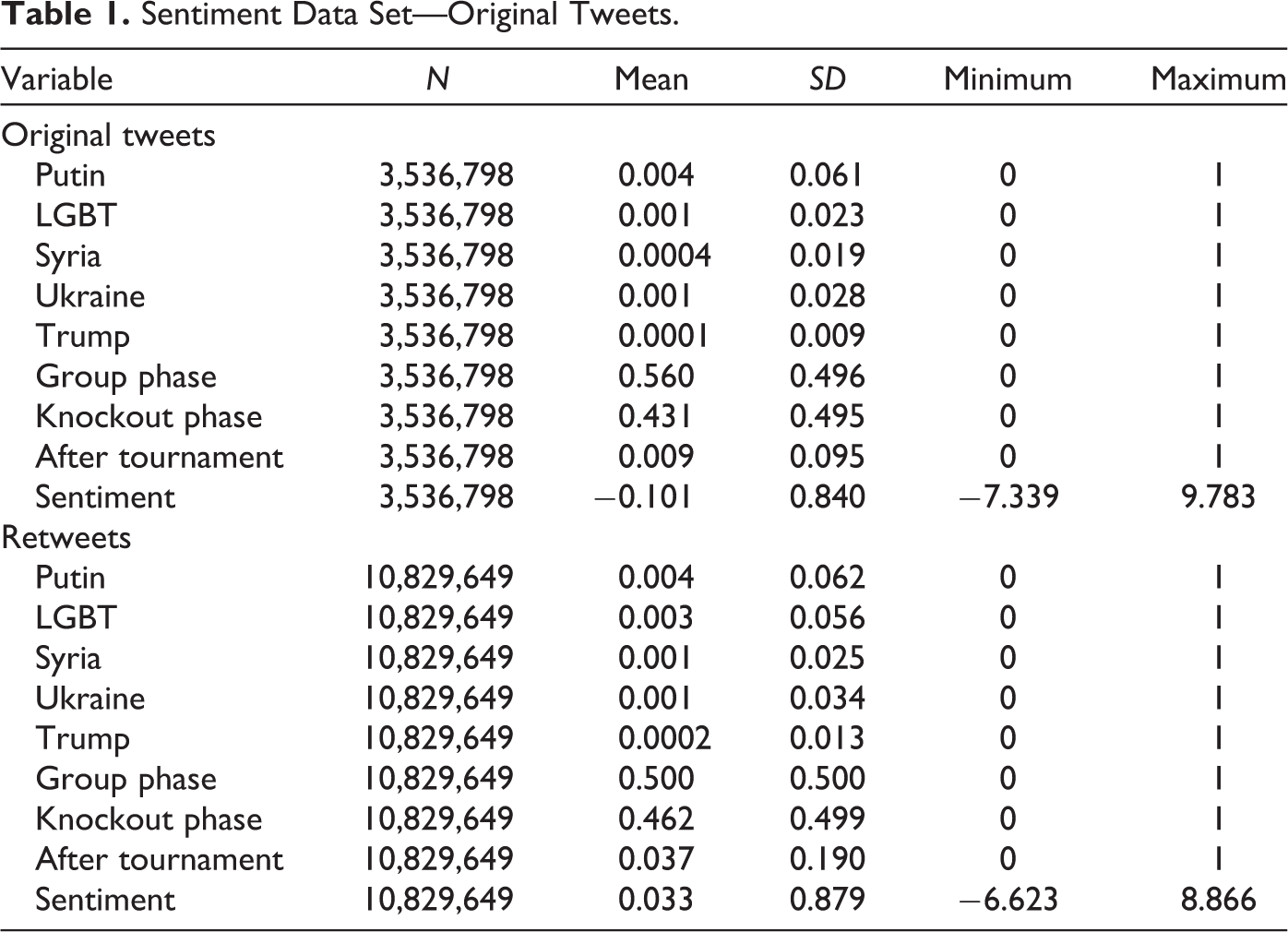
The analyses differentiate (un)political tweets, that is, those (not) including a political hashtag. Moreover, in addition to the quantitative analysis, the authors read a sample of about 1,000 tweets (e.g., the most positive and most negative political tweets), which proved that tweets with a negative sentiment score overwhelmingly expressed a Russia-skeptical stance, whereas tweets with a positive sentiment score mainly expressed views in favor of Russia. Hence, the sentiment analysis allows for conclusions with regard to pro-/anti-Russian attitudes within the Twitter community. Table 1 provides an overview over the two sentiment data sets.
Sentiment Data Set—Original Tweets.
Results
The (Un)Importance of Political Issues
The development of Twitter activity during the 2018 World Cup shows a typical pattern according to which social media activity is driven by single events. In our case, peaks in Twitter activity correspond visibly with decisive sporting events during the tournament, for instance, with opening matches and (quarter- and semi-) finals (Figure 1).
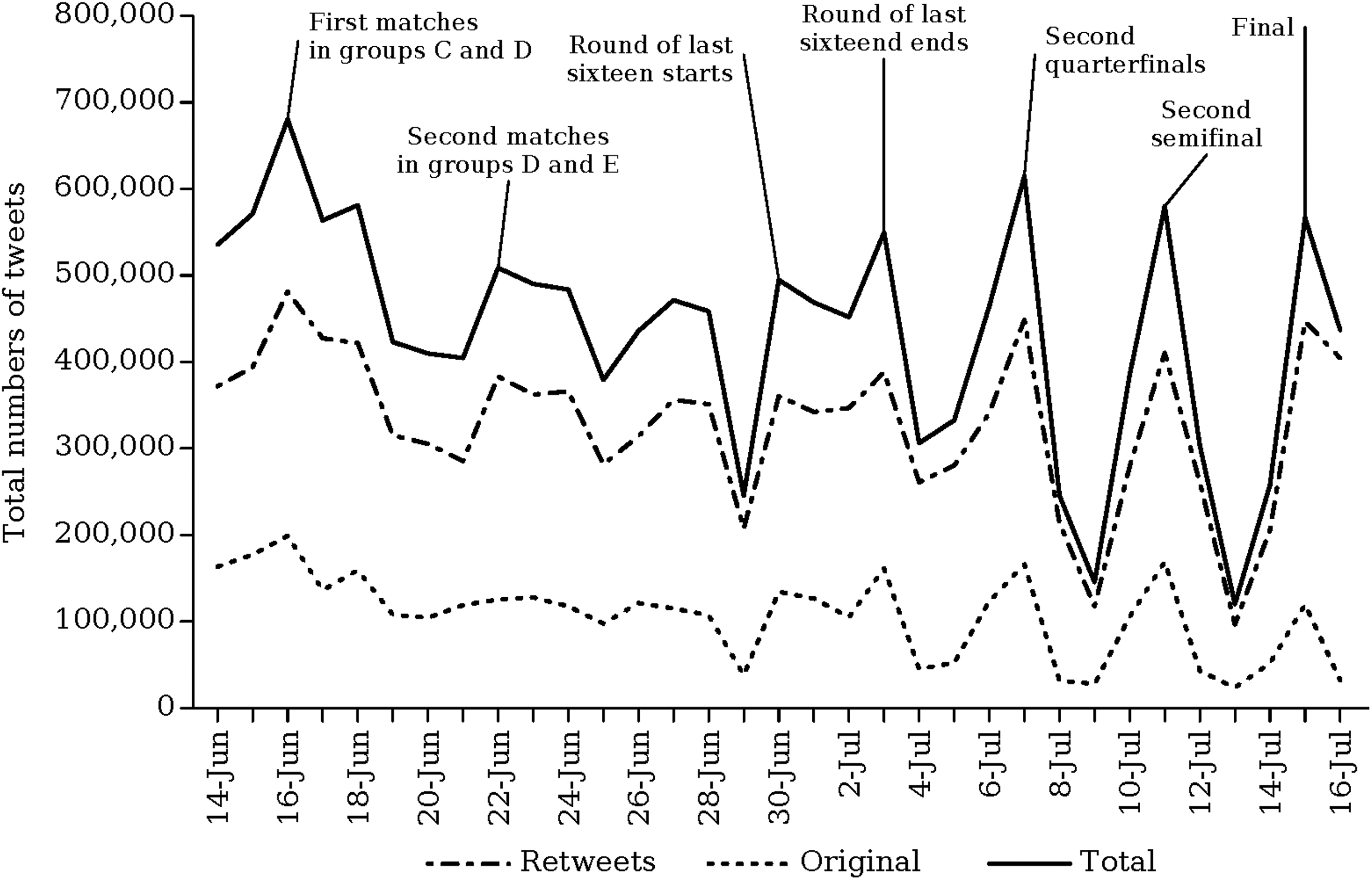
Twitter activity during the 2018 World Cup.
A thematic coding of the most popular tweets on Twitter as measured by the number of retweets reveals that of the 1,000 most popular tweets, only 7 fulfill the criteria of referring to Russian domestic or foreign politics. The low share of relevant tweets is in itself an important finding as it demonstrates that debates about Russian politics did hardly dominate the World Cup–related communication on Twitter.
Four of the relevant political tweets emphasize the suppression of homosexuality in Russia. The most popular tweet published on July 9, 2018, refers to a protest by LGBT activists wearing different colored soccer jerseys in order to resemble a rainbow flag (Figure 2). As becomes evident from the project’s website ( thehiddenflag.org ), the campaign of the LGBT activists was well prepared and designed. It was targeted for an international audience; a Russian version of the website does not exist. The Website reads: “Six brave LGBT activists, that together, form the flag that toured around iconic sites in Russia, traveling to every corner for a fight that will never be silenced.” The hidden flag tweet was the most popular political tweet. Moreover, with 22,982 retweets, it placed seventh in popularity among all tweets in the entire English Twitter corpus. This immense popularity supposedly resulted from international news coverage, for instance, in The New York Times or The Guardian.
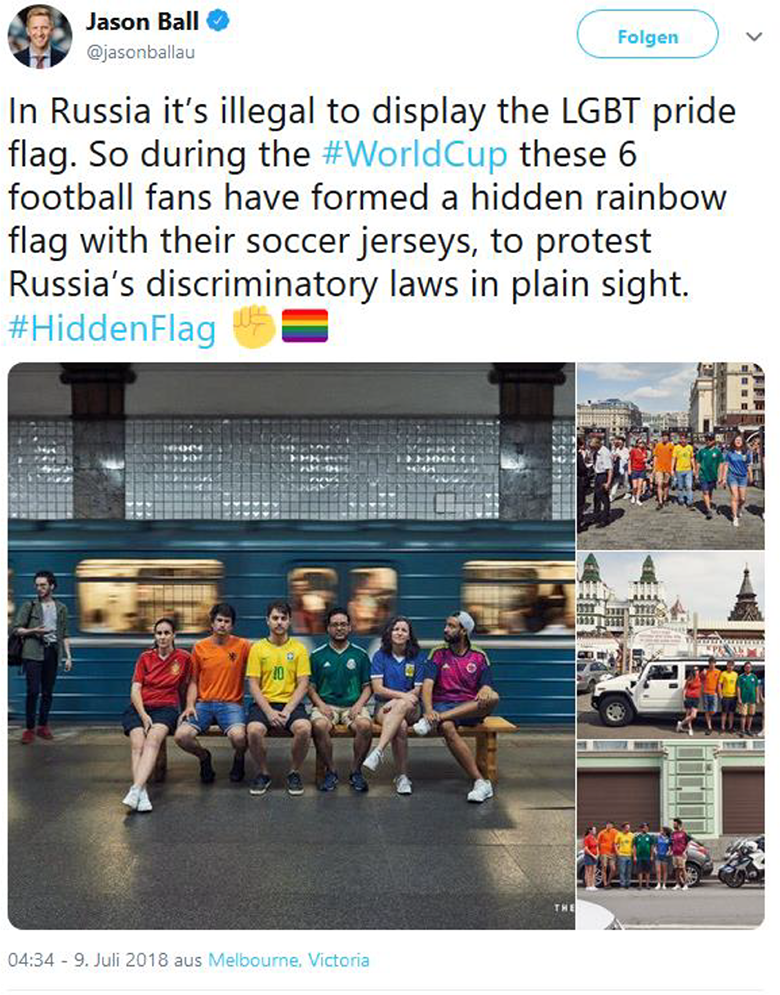
The hidden flag tweet.
Two other political tweets point to Russia’s doping practices but were substantially less popular (1,901 or 1,736 retweets). One of them reads: REVEALED: FIFA have had irrefutable documentary evidence for 18 months that footballers from #WorldCup hosts Russia have benefited from doping scandal…and have done nothing. #EXCLUSIVE #BREAKING Qatar’s lawyers tried a desperation move to keep their secret #TrumpRussia communications out of federal court. It exposed the Royal Family’s spy operations, run out of their deadly #WorldCup infrastructure agency.
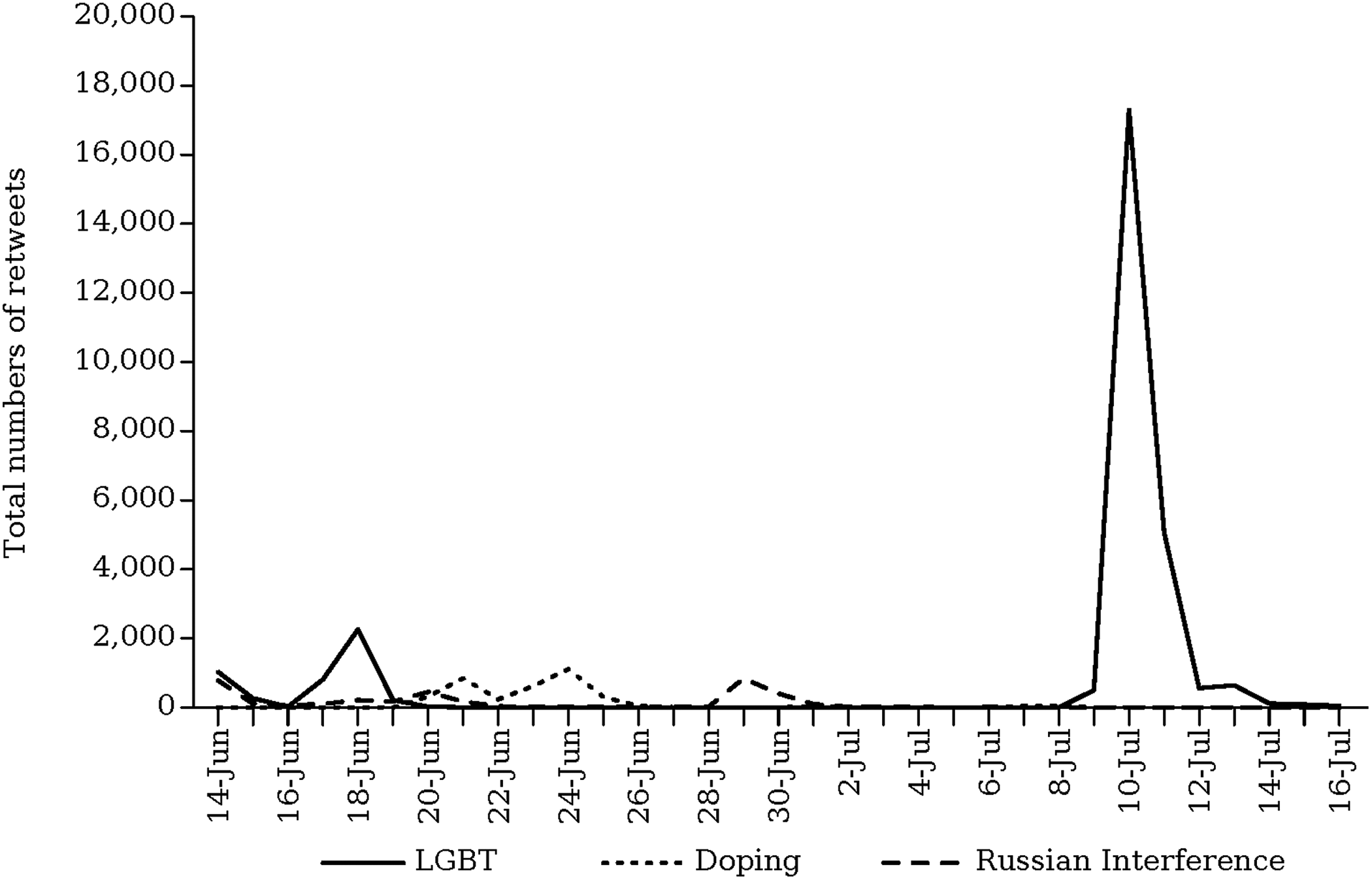
The popularity of political tweets during the 2018 World Cup. Figure shows retweeting activity for those tweets among the 1,000 most popular tweets, which addressed Russian foreign or domestic policy-making.
Investigating the thematic analysis of the 5,000 most popular hashtags demonstrates again that politics did not dominate in the Twitter activity relating to the 2018 World Cup in Russia. Only 10 hashtags could be linked to criticism against Russian domestic and foreign politics. These hashtags account for only 0.2% of the 5,000 most popular hashtags or 0.9% of all 10,829,649 retweets using these hashtags. Thus, it becomes again clear that Russian politics constituted only a marginal subject in the Twitter communication.
Concerning the political issues touched upon in these hashtags, three hashtags (#hiddenflag, #lgbt, and #rainbowrussians) can be related to the suppression of homosexuals in Russia, one to Syria (#syria), four to the Russian intervention in Ukraine (#ukraine, #freesentsov, #saveolegsentsov, and #mh17), and one to Trump’s relation to Russia (#trumprussia). According to the total number of retweets, the suppression of homosexuality dominated the political communication (68.2%), followed by the intervention in the Ukraine (25.3%). The other political issues account for around 7% or 6% of the political retweets, Trump figured lowest (3.7%). Figure 4 displays the development of the tweet volume in these hashtags over the course of the tournament.
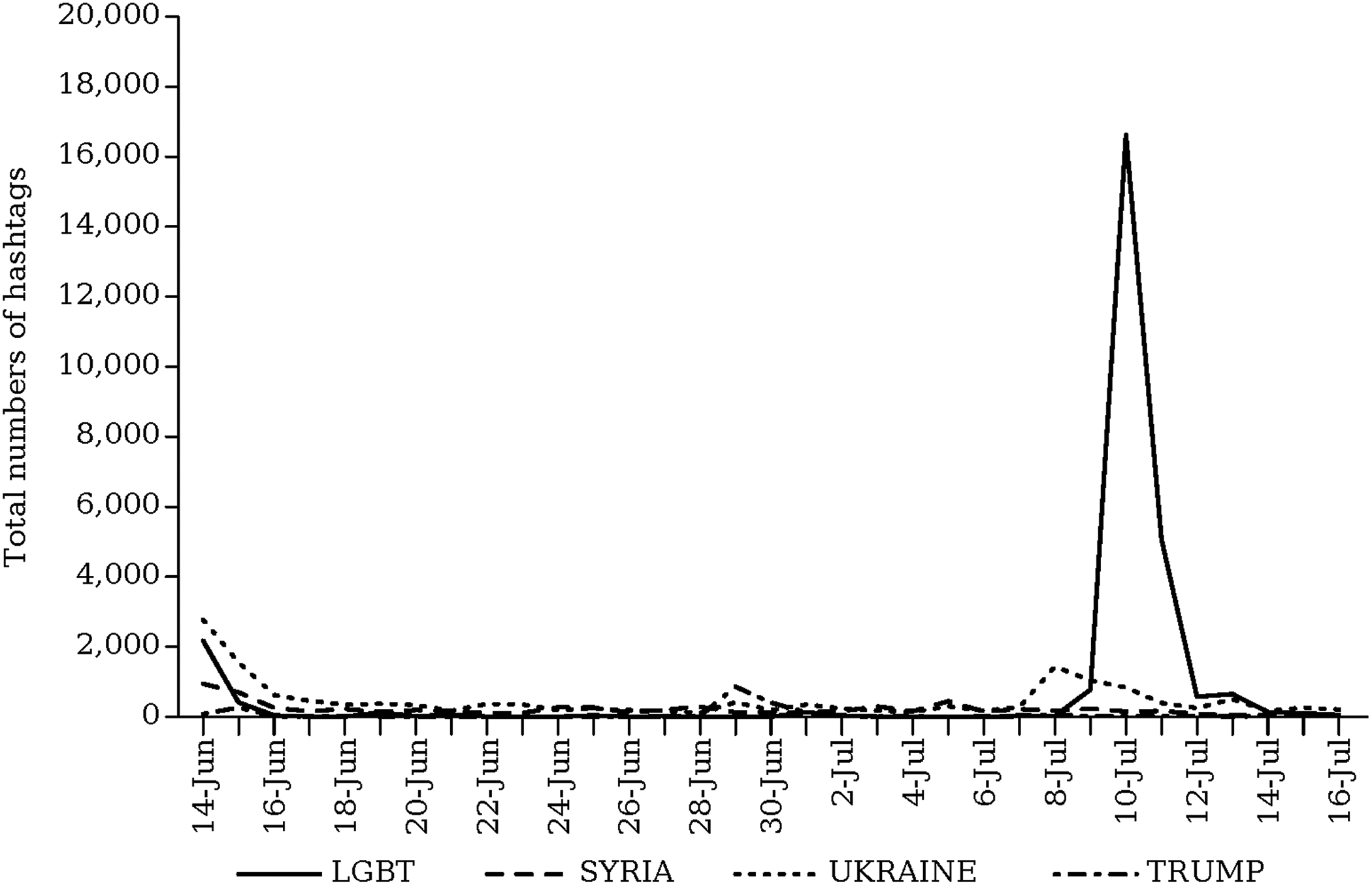
The popularity of political hashtags during the 2018 World Cup.
The descriptive analyses suggest so far that tweets about the 2018 World Cup were primarily focused on sporting aspects. Politics did not figure much in English Twitter messages, with the exception of LGBT activists and their criticism of the suppression of homosexuality in Russia. The finding that political issues did not resonate much in the English Twitter communication about the World Cup applies also to possible pro-Russia or pro-Putin contributions. The most popular political tweets and hashtags solely espoused a Russia-skeptical stance. Political statements in favor of Russia are lacking, that is, there are either no pro-Russian political tweets in the corpus or these tweets received no substantial retweet activity.
The Development of Sentiments During the 2018 World Cup
Besides the (un)political content of a tweet, another important aspect is its affective valence, that is, its inherent (negative or positive) sentiment. Figure 5 displays average scores for sentiments per tweet over the entire tournament. The analyses suggest that on average, tweets were characterized with neutral or slightly negative sentiments. Moreover, retweet activity seems to have been characterized by more positive sentiments. However, both, original and retweeted tweets, show a visible tendency towards more positive sentiments at the end of the tournament. A comparison of political and nonpolitical tweets shows that political tweets are characterized by more negative sentiments, which apply in particular to retweet activity.
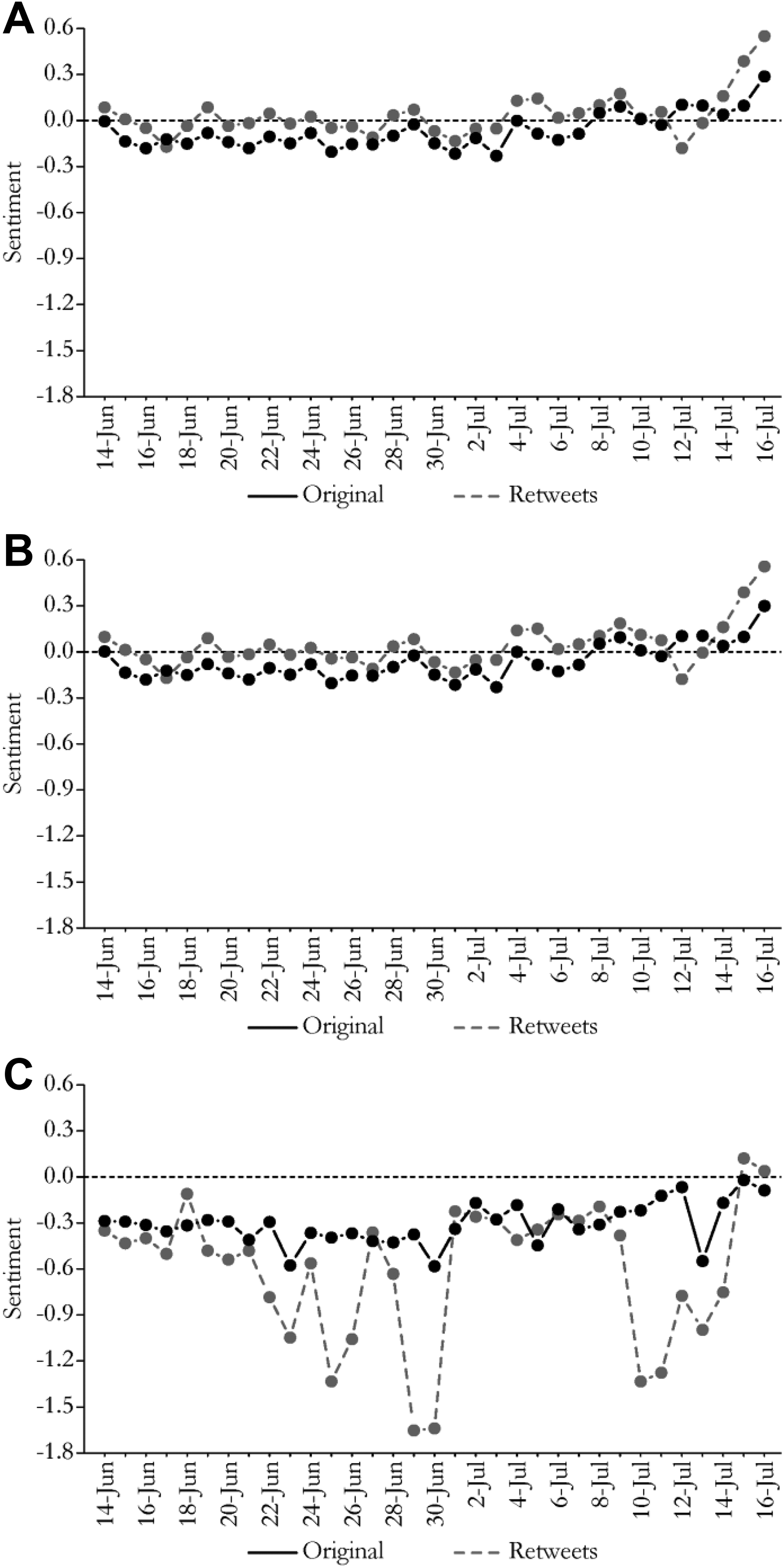
Tweet sentiments during the 2018 World Cup. (A) All tweets, (B) unpolitical tweets, and (C) political tweets. The figures display the average sentiment per tweet per day for the original tweet corpus and the retweet corpus. Political tweets are tweets/retweets that include a political hashtag, that is, referring to LGBT rights, the war in Syria, Ukraine/Crimea or Russia’s relationship to U.S. president (cf. Figure 4).
The development of sentiments during the World Cup is further analyzed with several regression models. We conduct separate analyses for the original tweets (Models 1, 2, and 3) and the retweets (Models 4, 5, and 6). The analyses proceed as follows: First, we examine the sentiments in distinct sub-discourses by employing a number of dummy variables for several hashtags (#putin, #LGBT, #Syria, #Ukraine, and #Trump; Models 1 and 4). In order to trace how sentiments evolved over time, we then include dummies for tournament stages: the knockout stage and the time after the final (Models 2 and 5). Finally, we examine sentiment trends in the distinct sub-discourses by including interaction effects with hashtag dummies and tournament phase dummies (Models 3 and 6; Table 2).
Sentiment Analyses for the English Twitter Discourse During the 2018 World Cup.
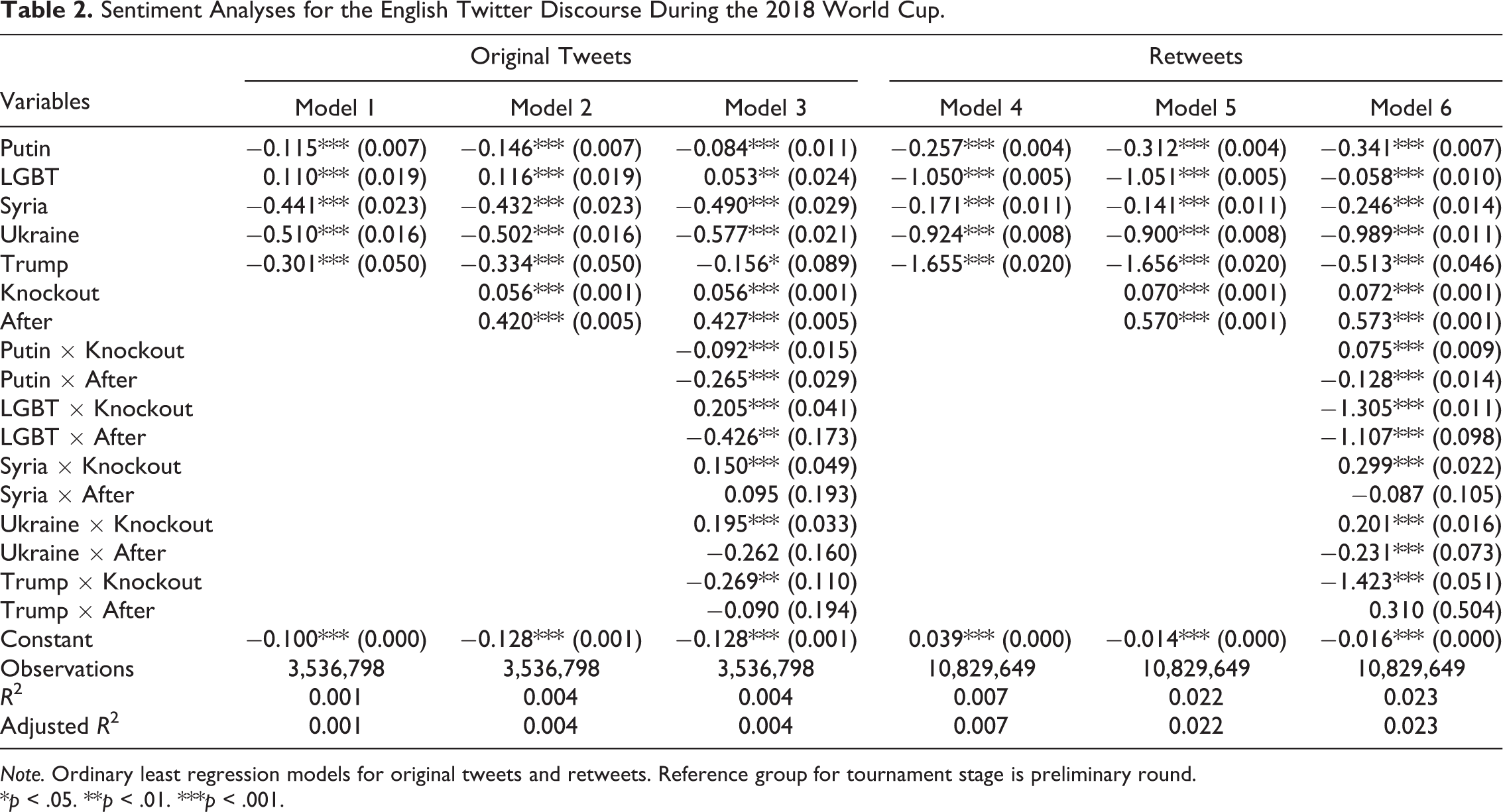
Note. Ordinary least regression models for original tweets and retweets. Reference group for tournament stage is preliminary round.
*p < .05. **p < .01. ***p < .001.
As becomes evident from the intercepts, the sentiments expressed in Twitter messages are, in general, slightly negative with Model 4 as an exception. Moreover, the multivariate analyses support the impression that the sentiments become significantly more positive over the course of the tournament. The coefficients for the knockout phase and the period after the tournament are positive and significant (Models 2, 3, 5, and 6). Hence, the World Cup seems to have created a feel-good effect since sentiments became significantly more positive over time.
Concerning sub-discourses within the entire Twitter corpus, sentiments expressed in tweets associated with Vladimir Putin are significantly more negative as the sentiments of the other tweets. Moreover, the negative interaction effects indicate that sentiments in Putin-related (re)tweets became more negative after the World Cup (Model 3). The most negative tweet in terms of sentiments includes a number of insults and vulgar language: Fuck this balled motherfucker Putin and his tacky shit. Tiny fool shouldn’t even had the cup because England should’ve. And the FIFA President can suck my dick, too. This isn’t the #WorldCup in being balled so step aside ugly ass shits.
An interesting difference in the sentiments between the original tweets and the retweets is also found for the LGBT-related tweets. The second most negative tweet relates the suppression of homosexuals in Russia to broader political criticism: Gay Rights Abuses, War Crimes and #WorldCup Fever: It’s an Ugly Mix. I’m in Moscow trying to lie low and evade the Russian security service. I’m exhausted from stress. It’s my sixth time in the country; each time, I’ve visited in order…LGBT Russia That’s cool! LGBTQIA LGBT LGBTPROUD LGBTExcellence: I so happy to see their spirits high and proud. I hope their safe and have a great time. Russia2018WorldCup WorldCup
The sentiments in tweets related to Syria are consistently more negative. The most negative one points to war crimes and the most positive one refers to possible improvements regarding security in the Middle East. Among Putin’s egregious crimes in Syria—Russia’s airforce mercilessly bombing WhiteHelmets in “double tap” attacks coming back after first strike to bomb them digging people out of the rubble Shame Putin allowed use WorldCup as cover for these horrific war crimes Marian responds:1st, congrats n successful WorldCup.2nd, thanx for invitation to see the game &; the opportunity on May 9. Every meeting b/n us is chance to act together to increase ME security &; regional trust. Our focus 2day is Syria, Iran’s presence there….
Tweets relating the Russian–Ukrainian conflict show even more negative sentiments. The most negative tweet refers to Ukrainian filmmaker Oleg Sentsov, who was arrested in Crimea after the Russian annexation and sentenced to 20 years’ imprisonment by a Russian court on charges of plotting terrorism acts. Ukrainian filmmaker Oleg Sentsov on 37th day of hunger in Russia/n prison—guilty of NO crime except peacefully resisting repression—don’t let Putin watch him die using worldcup as cover—demand he FreeOlegSentsov Ukraine CROvENG EnglandvsCroatia Dear CRO Croatia, This final WorldCup18 Russia2018 france was my favorite until now when Croatia beat england! Please win the CUP and give SlavaUkraini GloryToUkraine salute! The people of ukraine Ukrainian Ukrainians deserve it PutinsUmbrella TotalDiva sad weak WorldCup2018 punkassbitch bbcworldcup Worldcup2018Russia Russians pussyriot France TrumpRussia PUTIN YOU ARE A WEAK BITCH, GO LET DONNIE SUCK YOUR DICK Brilliant news—well done President Trump. We are all looking forward to Russia2018WorldCup rus Nothing else can bring the world together like the Russia Putin putin TrumpRussia Russia2018WorldCup peace WORLDCUP
Discussion and Conclusions
Starting from the insight that mega sport events have become increasingly politicized in particular when the event is hosted by a non-Western country, research presented here has addressed the question of whether such attempts can be traced in Twitter messages surrounding the 2018 Russian World Cup. Given that substantial political tensions exist between Russia and the West, it is relevant to assess whether Russia has reaped image gains from hosting the World Cup or if, in contrast, Western liberal actors succeeded in using the event to direct attention to Russia’s social and political wrongs. English Twitter messages were analyzed in order to find proper indications of which messages resonated within a broader public sphere.
The analyses provide numerous examples for attempts to politicize the event from a Western liberal perspective—a perspective that insists on universal human rights, self-determination, and market liberalization (Gamble, 2009). In particular, these attempts at politicization focused on minority rights and state-led doping practices in Russia. Findings show, however, that these attempts have received only limited resonance. The analyses of more than 14 million tweets and retweets highlight that any attempts to politicize the Russian World Cup were overshadowed by sports-related issues. The present study thus confirms previous findings according to which soccer fans are hardly interested in political issues (Hölzen & Meier, 2018). The political ignorance of soccer fans implies also that blatant attempts to exploit these events for propagandist purposes are likely to fail. Pro-Russian propaganda did likewise not figure among the English-speaking Twitter audience. The 2018 World Cup appeared as a “normal” mega event on Twitter, which fans seem to have perceived as a sport event in the first place.
In view of the finding that political themes played only a marginal role in the entire English Twitter corpus, it is still worth noting that the suppression of homosexuals in Russia was the only issue that gained at least some attention among Twitter users. This attention was mainly generated by well-prepared actions of a group of LGBT activists, which targeted an international audience and which was taken up by leading newspapers throughout the world. This finding illustrates the key role of social media for the mobilization and organization of protest movements (Bennett & Segerberg, 2013) but also shows the amplification of outreach and visibility when traditional, offline media take up a social media-based campaign. However, attention for Russia’s restrictive policy towards homosexuals was short-lived. Other topics, the conflict with Ukraine, Russia’s intervention in Syria, or its (alleged) interference in the U.S. election, gained hardly any attention during the World Cup.
The political ignorance of Twitter users is also reflected in the fact that pro-Russia or pro-Putin tweets played no visible role. Hence, the material gives almost no cues for suggesting that the 2018 World Cup had an impact with regard to Russia’s image building or nation branding attempts. Tweets that praise Russia, its government, or its president hardly occured, and the same is true of tweets that relate specific ideals and values, for example, of greatness, superiority, or viability, to the Russian nation. The sentiment analyses performed for original tweets and retweets indicated, however, that messages became more positive in the course of the World Cup; hence, the event might have created a “feel-good effect.” Initial concerns about security issues and hooliganism did not come true and the organization of the World Cup gave hardly any reasons for continuing critique, so that soccer euphoria could spread out unabatedly. However, the increase in positivity in Twitter messages was more pronounced in unpolitical tweets compared to the majority of political tweets. Hence, findings do not suggest image gains for Vladimir Putin or greater acceptance of Russian politics but indicate that Russia succeeded in inducing a sense of normality and (soccer-related) positivity during the event.
Despite these relevant findings, the study also raises questions for further research, partly because it has some limitations that need to be discussed. Firstly, the conclusion that political statements, neither those with anti-Russian nor those with pro-Russian viewpoints, did not find substantial resonance among Twitter users only pertains to the English-speaking Twitter community. However, the World Cup may well have succeeded with regard to its domestic public, that is, with changing the meanings and the significance of the nation within Russia and with strengthening support and legitimacy of the Russian government. Yet, it seems highly likely that the surprisingly successful performance of the Russian national soccer team helped to create national pride and happiness within Russia. Studies from several countries have pointed to sport-related increases in national pride and national levels of happiness shortly after successful sporting events (Elling et al., 2014; Kavetsos & Szymanski, 2010; Mutz, 2019). Domestic impacts, however, were not within the scope of this article.
Secondly, the focus of this study was on Twitter activity in the course of the 2018 World Cup, thereby ignoring the months before its opening. Several scholars (e.g., Brownell, 2012; Manzenreiter, 2010) argue that Western critique of the political situations within hosting countries receives the most public interest shortly before the beginning of the event and that NGOs purposely use this period to attract attention and direct public opinion, for instance, with progress reports, press releases, and protest campaigns. Although critical voices are marginalized from the moment the first whistle for kick-off is blown (Mittag, 2017; Rowe, 2012), it is still possible that a negative image of Russia has unfurled among Western audiences, but in the months before the World Cup and not during the event. In any case, the study has employed a rather short-term perspective, and findings are inconclusive with regard to long-term image and soft power effects. Thirdly, although Twitter is a highly popular forum for communication in many Western countries, its users are still not representative for “Western society.” For instance, people of younger age and from higher social classes are overrepresented (Sloan, Morgan, Burnap, & Williams, 2015; Yates & Lockley, 2018). Despite this objection, one could still argue that Twitter users are opinion leaders in their private sphere and thus form an important and potentially influential group within society. Moreover, tweets of 280 characters are not ideal for lengthy discussions and carefully considered political views, but may rather invite for short, expressive messages. To assess whether Twitter as a medium or the composition of its users generate any bias, future analyses are needed, which allow for comparing different types of traditional (offline) media and social media with regard to topics and viewpoints expressed. Finally, it has to be mentioned that attempts at politicization are not solely found when mega sport events are hosted in non-Western nations. Hosting and bidding countries or cities in “the West” also have to cope with critique, as for instance, with regard to ecological problems, economic and security issues, or corruption (Armstrong, Giulianotti, & Hobbs, 2016; Kassens-Noor & Lauermann, 2018). However, attempts at politicization appear to be more massive when hosting countries are non-Western, and in those cases, they are often fueled by political frictions.
To conclude, the 2018 FIFA World Cup triggered millions of tweets, but only very few political tweets resonated among English-speaking Twitter users. Despite the fact that the event was embedded in severe political tensions between Russia and the West, neither anti-Russian viewpoints nor a pro-Russian attitude received substantial resonance, since unpolitical, sports-related topics dominated. Athletic performances come to the fore once the event started. This case thus highlights that Russia’s desire for international reputation and image building found little resonance in the English-speaking Twitter community and neither did Western liberal criticism of the host’s social and political conditions.
Footnotes
Declaration of Conflicting Interests
The author(s) declared no potential conflicts of interest with respect to the research, authorship, and/or publication of this article.
Funding
The author(s) received no financial support for the research, authorship, and/or publication of this article.
