




Abstract
Recent research indicates that sports fanship decreases with age. Socioemotional selectivity theory (SST) posits that older adults, with time limited, shift their focus on positive experiences. Entertainment media choices reflect this proactive emotion regulation strategy. This study applied that perspective to mediated sports content, itself characterized by emotional intensity and unknown outcomes. Using an online survey containing an experimental condition (N = 433), the current study investigated whether the unpredictability and emotional intensity of sports contribute to older people disengaging from viewing it. The results are mixed: Older adults consume less sports media than younger adults and value the outcome less but are equally likely to be sports fans or watch highly exciting sports contests. It seems that fanship may contribute to happiness for some and thus reflect an active choice. Future research should investigate individual differences among older sports fans and nonfans to expand knowledge on their (emotional) viewing experiences.
Media preferences and selections change across the life span. Older adults are more likely to select media content they know will make them feel good and avoid programming that may have negative outcomes (Mares, Bartsch, & Bonus, 2016). Such changes can be explained by socioemotional selectivity theory (SST; Carstensen, 1995). With age, awareness arises that one has limited time ahead. This perspective stimulates a stronger focus on well-being and positive life experiences. More than younger adults, older adults are likely to interpret any given situation more positively and make active choices, including the people they hang out with and the media content they select, that further stimulate that same positive outlook (Mares et al., 2016; Urry & Gross, 2010).
Although research on media preferences across the life span is gaining momentum, not much is known about how SST relates to mediated sports. Sports are known for the intense emotional experiences they evoke, particularly when much is at stake and when those competing are rivals. The live and unscripted nature of sports makes the outcomes impossible to predict. At the same time, outcomes matter to many viewers, particularly those who are emotionally (or financially) invested in those who are competing.
Research indicates that sports media use (Brown, Billings, & Ruihley, 2012) as well as sports fanship may decrease with age (ESPN, 2009; Gantz & Lewis, 2016). The current study aims to investigate whether the emotional intensity of viewing sports and the unpredictability of outcomes might lead older adults to engage with mediated sports content differently than younger adults. Research on emotion regulation strategies and aging demonstrates that older adults tend to make use of active regulation strategies, whereas younger adults regulate emotions reactively—that is, after exposure. This could mean that older adults who choose to view sports may actively avoid contests that may trigger strong emotional responses—or that they apply emotion regulation strategies during viewing such emotionally intense content to limit their impact. Younger adults may deal with the emotional consequences afterward.
Age and General Media Preferences
Compared to young adults, older people are more likely to have negative life experiences including those related to physical and cognitive problems and the loss of loved ones (Urry & Gross, 2010). Nonetheless, scholars have consistently documented increases in positive affect and decreases in negative feelings with age that cannot be fully explained by biological maturation, changes in cognitive processes, or general life and emotional experience (Charles & Carstensen, 2010). Carstensen’s SST connects these accounts by positioning older adults as actively seeking happiness. With age, awareness arises that the time one has left is limited. This perspective stimulates a stronger focus on well-being and positive life experiences. Older adults consciously select situations that will maximize positive emotions (e.g., love, enjoyment, contentment, affection) and minimize negative ones (e.g., anger, stress, anxiety, and sadness) in order to make optimal use of time (Charles & Carstensen, 2010; Isaacowitz & Ossenfort, 2017).
This change in one’s approach to life affects emotional experiences, directs cognitions and behavior such as what older adults pay attention to and the people they choose to be with and befriend, and helps shape the media content they select (Charles & Carstensen, 2007; Mares et al., 2016; Urry & Gross, 2010). Life experience matters. Older adults have had the time to explore highs and lows and have learned what makes them feel good as well as how to achieve positive or resolve negative situations. Older adults aim for stability and meaningfulness in their experiences. In contrast, young adults are more interested in gaining knowledge and learn about themselves (Charles & Carstensen, 2007; Mares & Sun, 2010). Their preference for emotionally intense experiences, including negative ones, is a means of exploring their emotional identity (Charles & Carstensen, 2007).
Gross’s initial emotion regulation model (1998) offers an explanation for the different emotion regulatory strategies employed by older and younger people. Older adults tend to employ antecedent-focused strategies, whereas younger adults tend to employ response-focused emotion regulation (Droulers, Lacoste-Badie, & Malek, 2015; Urry & Gross, 2010). Antecedent regulation refers to employing strategies that prevent emotions from (fully) arising. Older people may avoid situations with expected negative outcomes, actively seek out situations that contribute to their happiness, and invest more in stable, meaningful social relationships (Charles & Carstensen, 2010). Response-focused strategies on the other hand refer to regulating emotions after they arise.
Antecedent regulation may also apply to changes in media content selection. Older adults make different media choices than younger adults. Some shifts can be attributed to life changes such as retirement and the onset of age-related health issues (van der Goot, Beentjes, & Selm, 2012). Yet changes in media preferences extend beyond that. Older people are more likely to select media content they expect is meaningful and will make them feel good (Bartsch, 2012; Droulers et al., 2015; Mares et al., 2016; Mares & Sun, 2010). Bartsch (2012) explained that “older adults become less interested in emotionally intense entertainment experiences, such as thrilling and tear-jerking experiences," and instead "become more interested in entertainment experiences that are heartwarming, contemplative, and socially meaningful (p. 589).”
Age, Emotion Regulation, and Sports Media Viewing
Unlike most entertainment content, sports are characterized by truly unknown outcomes. Unless a contest is rigged, no one knows with certainty who will come out ahead. Moreover, sports are known for the intense emotionally arousing responses they stimulate, from nervousness and worry to pleasure and elation or sadness, loss, and despondency. As noted earlier, research indicates that sports fanship and mediated sports consumption may decrease with age (Brown et al., 2012; ESPN, 2009; Gantz & Lewis, 2016). Older adults may actively avoid sports viewing because of the potential emotional intensity associated with viewing sports and the unpredictability of contest outcomes.
As noted earlier, one study found an opposite trend—that older people watch more games compared to young adults and become more avid fans with age (Toder-Alon, Icekson, & Shuv-Ami, 2019). These findings suggest that age does not negatively affect sports interest for all adults and may result in stronger fanship for some.
Gross’s emotion regulation model (1998, 2015) may account for the apparent discrepancy between Carstensen’s theory and interest among some older adults in sports viewing. The original model distinguishes five emotion regulation processes, ordered to reflect the temporal stage in which each could be employed. Gross later adapted the model to account for the dynamic nature of the regulation process. This extended process model (EPM) holds that people first detect a discrepancy between actual and target emotional state, subsequently decide whether regulation is needed, and finally select the appropriate course of action (Gross, 2015). During this cyclical process, people continuously monitor the effectiveness of the selected strategy. In the current article, we present watching sports media as a situation that older (U.S.-based) adults have previous experience with, and, at this point in life, have a routine in place for how to approach (or avoid) it.
The first four strategies of the process model are considered to be antecedent-focused; the final stage is seen as response-focused (Gross, 1998). The five stages are (1) situation selection, (2) situation modification, (3) attentional deployment, (4) cognitive change, and (5) response modulation.
In situation selection, people can choose to avoid a potential emotional situation altogether or purposefully select a situation to experience certain emotions. In circumstances where anticipated negative emotions are unavoidable, older people are more likely than younger people to prepare (situation modification) for what is coming by making changes to the situation (Urry & Gross, 2010)—for example, by taking a different route to avoid a difficult neighbor (Gross, 1998) or, with sports, potentially avoid watching games that might be intense. In line with that supposition is the rising trend that younger viewers shift to the action sports genre such as snowboarding and windsurfing (Wheaton & Thorpe, 2019). When actively consuming and considering information, older people are more likely to attend to the positive elements of that information (attentional deployment), also referred to as positivity bias (Isaacowitz & Ossenfort, 2017; Reed, Chan, & Mikels, 2014). When older people view negative media content such as a sad TV show, they are more likely to report a more positive and less negative experience than younger people (Droulers et al., 2015; LaCoste-Badie, Malek, & Droulers, 2013). Or, they may seek out distractions or simply ruminate about something unrelated to the content (Gross, 1998). Older adults are more likely to reappraise (cognitive change) negative events into a positive frame although not always successfully (Urry & Gross, 2010). In contrast, younger adults are not only more likely to feel sad after watching a sad commercial but also to take a negative attitude toward that brand (LaCoste-Badie et al., 2013). Older adults choose to regulate negative emotions as quickly as the situation allows. With those expectations in mind, Scheibe, Sheppes, and Staudinger (2015) demonstrated that older adults chose disengagement strategies over reappraisal strategies when viewing negative images, meaning that they preferred to deal with the negative emotions earlier in the process than younger adults did.
Once the emotional processes have been induced, younger adults are more likely to modulate these experiences in terms of emotions or behavior (response modulation; Gross & John, 2003). For example, younger adults may fully let out their emotions while watching a nail-biting sports contest and afterwards find ways to calm down. Older adults do not rely on this emotion regulation strategy as much since they prefer to, according to Gross’s model, control their emotions during the earlier stages of the process. Indeed, Toder-Alon, Icekson, and Shuv-Ami (2019) found that older sports fans show less aggression during and after a sports game.
The model would predict that older people choose to watch contests of which they can foresee the outcome, so they can prepare. They prefer contests in which their favorite teams are fairly certain to win (situation selection/modification). Differences in sports viewing may also play out in the preparation for or context of sports viewing (situation modification) or with the emotion regulation strategies used during sports viewing (attentional deployment and cognitive change).
With this in mind, we hypothesize the following:
Since older adults are likely to employ antecedent emotion regulation strategies before and during viewing, older adults are likely to have less negative emotional responses after viewing:
It should be noted that each regulation strategy in fact consists of a wide variety of subtactics (Gross, 2015; Webb, Miles, & Sheeran, 2012). For this study, however, our aim is to assess how the gist of the model fits with the temporal stages of sports viewing (pre-, concomitant, and postviewing behaviors). We do this by assessing day-to-day situations, allowing participants to think of their own favorite sports, team, or athlete to control for generational differences in sports genre preferences (Wheaton & Thorpe, 2019). In addition, we incorporated an experimental component with preselected sports.
Method
Participants
This study was part of a larger data collection effort using Amazon Mechanical Turk (MTurk) participants (N = 1,142) designed to assess age differences in sports fanship. MTurk was set so that only those 18 and older who lived in the United States and were experienced and reliable MTurk users (those who had successfully completed at least 90% of their previous surveys, with a minimum of 50 completes) could participate, see also the study of Myrick and Wojdynski (2016). We excluded 21 participants from the study because of incomplete data or the time they took to complete the study suggested they did not carefully read the questions or attend to the manipulation. Based on their unique MTurk worker numbers and location data, we identified 24 older adults who took the survey twice and included only their first responses in the database. We performed one other quality check by examining responses to an open-ended question, which were filled out by all but seven respondents. We kept the seven who did not offer an open-ended response because their responses throughout the questionnaire appeared internally consistent.
We initially selected two age-groups (18–25 and 55+) based on research regarding entertainment media preferences across the life span (e.g., Bartsch, 2012; Mares et al., 2016; Mares & Sun, 2010) and experimental research on aging and emotion regulation (e.g., Scheibe, Sheppes, & Staudinger, 2015). The age range of our youngest age-group was established to include young adults of a similar socioemotional developmental stage. Research comparing age-groups on emotion regulation are limited and age ranges vary. Our rationale was further based on findings that life satisfaction peaks at and negative affect declines at least until people reach their 60s (Charles & Carstensen, 2007; Mares, Oliver, & Cantor, 2008), suggesting that the emotion regulation strategies around that age differ from younger people (Charles & Carstensen, 2007).
The older group in our study included those who were at least 55 (N = 202, M = 62.90, SD = 5.33, range = 55–80). As it turned out, no 18 year olds participated. To ensure that both age-groups contained roughly similar numbers of participants, we set the final age range for the younger group at 19–27 (N = 230, M = 24.59, SD = 2.00). There were no gender (48% women in the younger age-group, 55% in the older age-group, χ 2 (2, N = 433) = 3.59 p = .17, or sports avidity differences between these age-groups (M younger = 5.82, SD = 2.98; M older = 6.03, SD = 2.58, p = .42). In all, a total of 433 adults participated in our study.
Procedure
Participants were recruited via MTurk through two data collection efforts. In the first wave of data collection, everyone over 18 was allowed to participate. The second wave of data collection, less than a month later, was designed to expand the base of older adults: Only those 60 and up were asked to participate.
Participants were first asked to rate their current mood. Then, they were asked to watch a sports clip and answer the same mood questions afterward. They also indicated their level of attention, familiarity, and involvement with the sports clip featured. Subsequently, participants answered a range of questions relating to their level of sports fanship, media preferences, sports viewing behaviors and emotional responses to sports content, and emotion regulation skills and, finally, demographic attributes. On average, participants needed roughly 15 min to complete the study.
Measures
Sports media use
Our 10-item sports media usage scale measured weekly exposure to mediated sports as well as conversations about sports. The items captured exposure to sports on television or online; sports news and sports talk on traditional, online and social media; sports blogs; messaging about sports; engaging in sports leagues; and communication with friends and family about sports. All items used a scale of 0 (0 days a week)–7 (every day). Cronbach’s α = .93; M = 1.98, SD = 1.69.
Motivations for sports media use
Using a 0–10 scale, participants were asked to indicate how much three motivations for sports viewing (Gantz & Wenner, 1995), each emotion-focused, applied to them: to get psyched up (M = 4.20, SD = 3.38), to let off steam (M = 3.62, SD = 3.42), and for the tension and drama involved (M = 4.74, SD = 3.40). These were part of a more comprehensive set of (14) motivation items used for purposes beyond the scope of this article.
Sports viewing: Day-to-day situations
Sports viewing selection
Using a 0–10 scale, participants were asked to indicate how likely they were to watch five competitions with their favorite team that varied in levels of expected excitement, predictability of outcome and valance (win or loss). Two illustrations should suffice. The low emotional excitement, predictable, positive valance competition was: “Your favorite team/athlete is about to compete with a team/athlete that is much lower ranked. An easy win is expected” (M = 5.28, SD = 3.43). The emotionally intense, unpredictable competition was: “Your favorite team/athlete is about to go head to head with its biggest rival; it is THE game of the year. Both teams/athletes seem equally qualified to win. There is a lot at stake; whoever wins will proceed to the finals” (M = 7.11, SD = 3.32).
Previewing
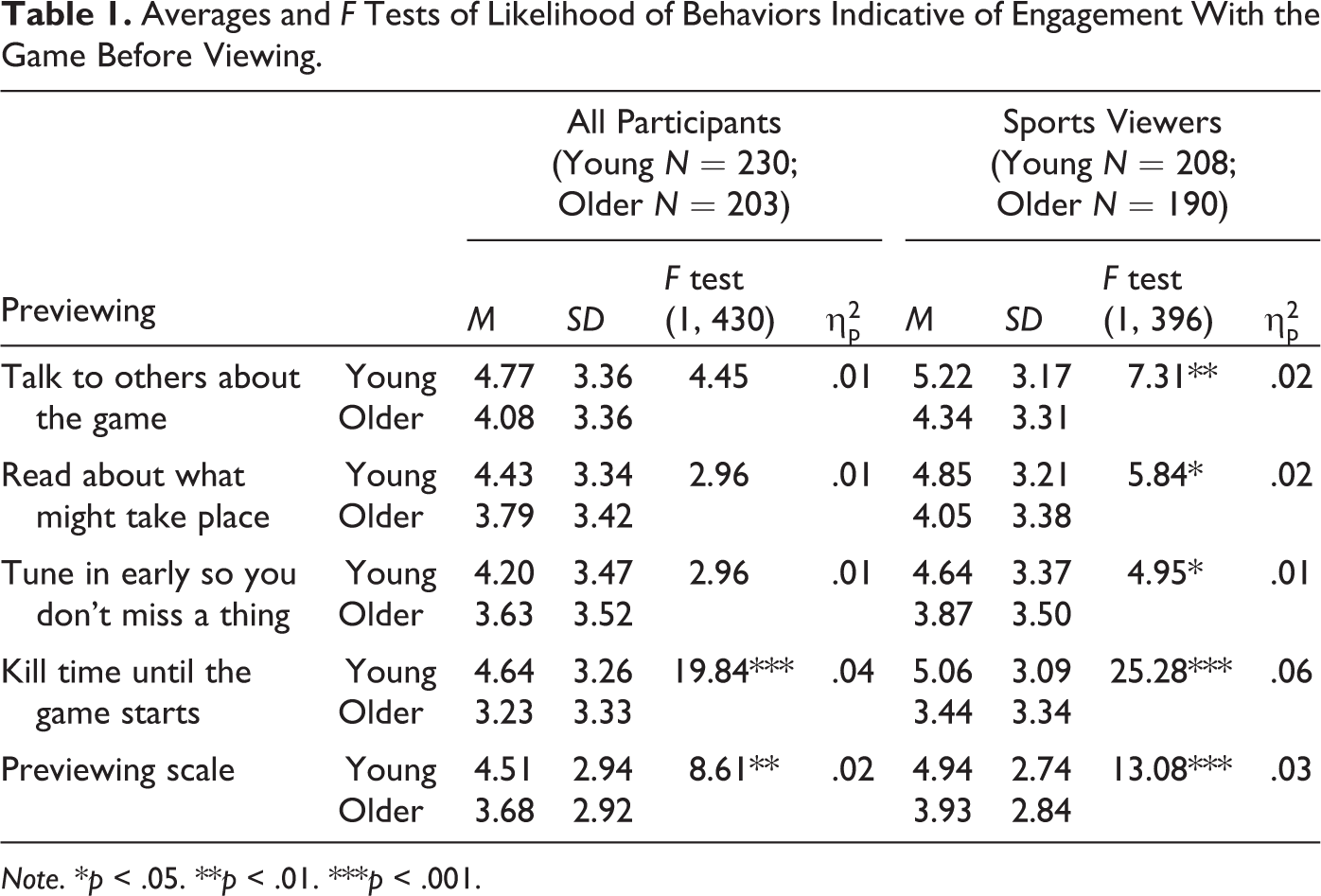
Four items derived from research on previewing behavior (e.g., Gantz & Wenner, 1995; Gantz, Wang, Paul, & Potter, 2006) were used to estimate the amount of anticipation participants built up as they prepared for important matches featuring their favorite athletes or teams. Items were selected based on preparations older and younger people would be equally likely to get into and are an unambiguous sign of game preparation. Items included: “Talk to others about the game,” and “Tune in early so you don’t miss a thing.” Cronbach’s α = .89; M = 4.12, SD = 2.96. All items can be found in Table 1.
Averages and F Tests of Likelihood of Behaviors Indicative of Engagement With the Game Before Viewing.
Note. *p < .05. **p < .01. ***p < .001.
During viewing
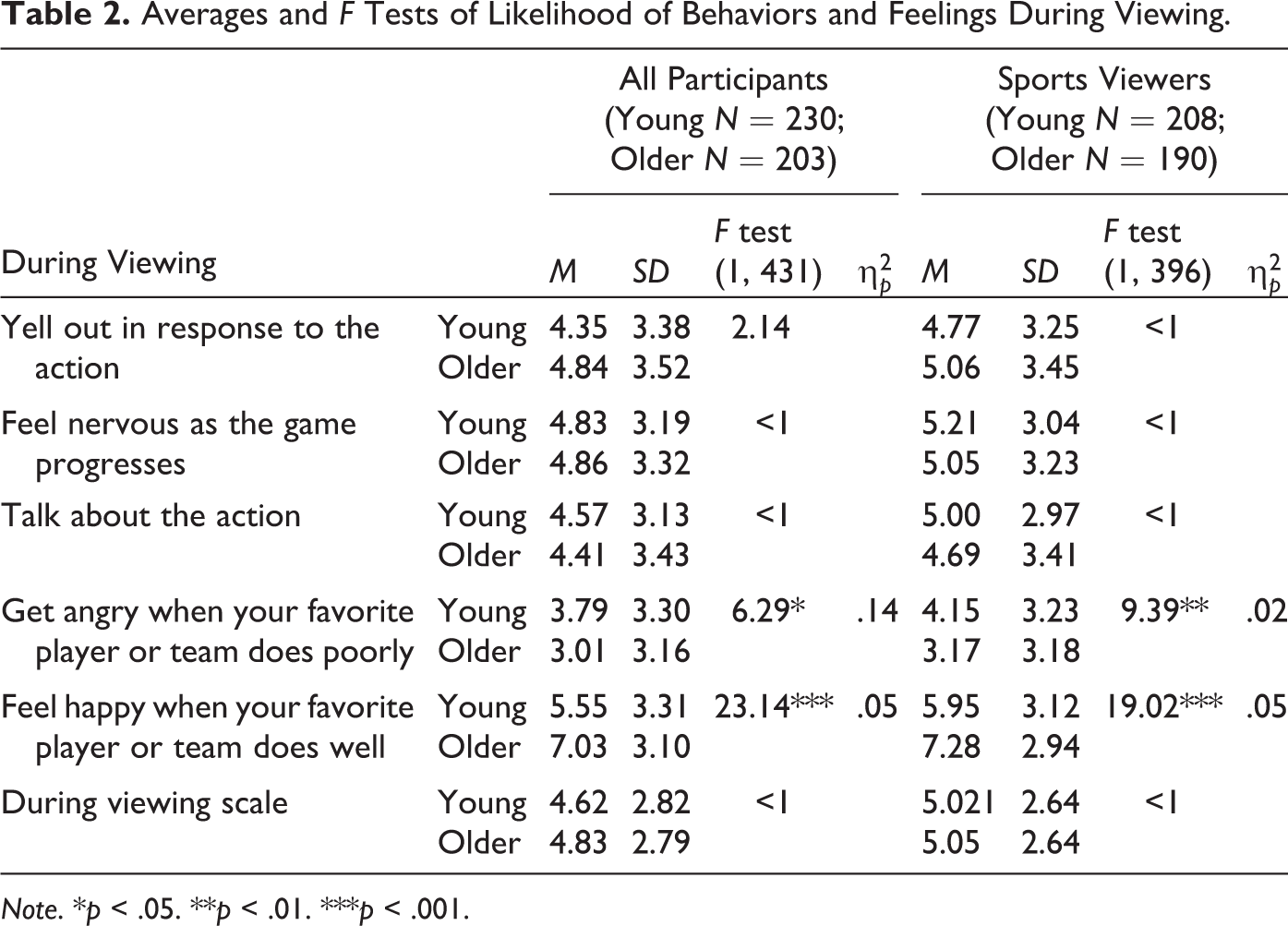
Seven items were derived from research on concomitant emotions and behaviors (e.g., Gantz et al., 2006; Gantz & Wenner, 1995). Using our 0–10 scale, each item measured the extent to which participants would be invested in the game. Items included “Yell out in response to the action,” “Talk about the action,” and “Get angry when your favorite player or team does poorly.” Based on a factor analysis, “Pace the floor” and “Texting or using social media to talk to others about the game” were removed. In addition to loading on a second factor, it made sense that older and younger people might not have equal physical abilities to “pace the floor” or the experience and intent to “text/use social media.” Answers on the remaining 5 items were given on a scale of 0–10. Cronbach’s α = .90; M = 4.72, SD = 2.78. All items can be found in Table 2.
Averages and F Tests of Likelihood of Behaviors and Feelings During Viewing.
Note. *p < .05. **p < .01. ***p < .001.
Postviewing
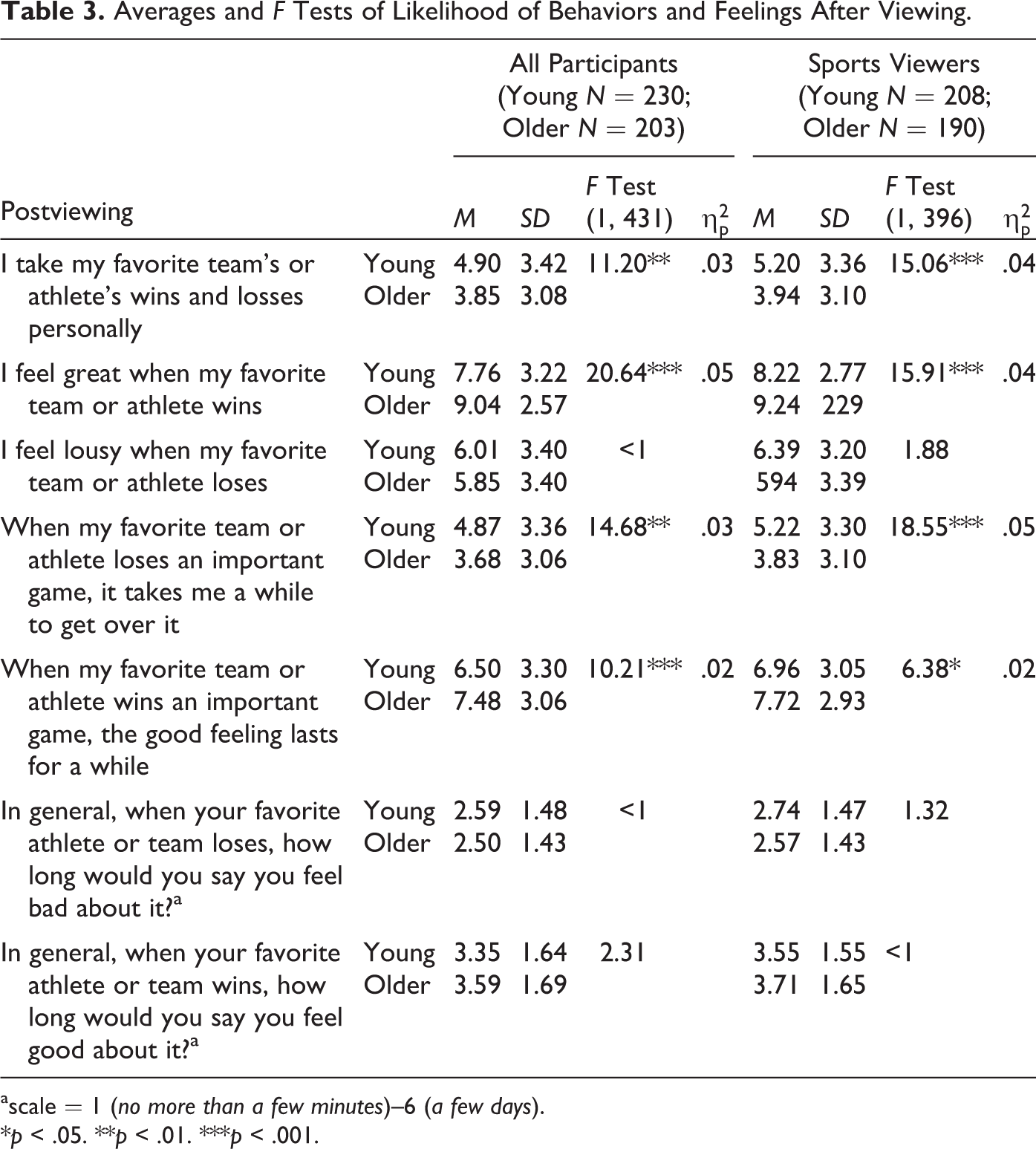
On a 0–10 agreement scale, participants were asked, “I take my favorite team’s or athlete’s wins or losses personally” (M = 4.41, SD = 3.31), thought to be reflective of reappraisal strategy. Next, we had 4 items that assessed feelings following a loss or win (Gantz & Wenner, 1995). These included “When my favorite team or athlete wins an important game the good feeling lasts for a while/it takes me a while to get over it” and “I feel lousy/great when my favorite team/athlete loses/wins.” Participants were also asked, on a scale of 1 (no more than a few minutes) to 6 (more than a few days), how long they felt good after a win (M = 3.46, SD = 1.66) and bad (M = 2.55, SD = 1.45) after their favorite team or athlete lost. All items can be found in Table 3.
Averages and F Tests of Likelihood of Behaviors and Feelings After Viewing.
ascale = 1 (no more than a few minutes)–6 (a few days).
*p < .05. **p < .01. ***p < .001.
Sports viewing: Manipulation
In order to simulate emotionally intense sports viewing situations, participants were asked to watch and respond to a sports video clip. This enabled us to test concomitant and postviewing experiences when confronted with an emotionally intense sports contest.
Video clips
Each participant was randomly assigned to view one of four sports clips. The videos were selected and pretested (N = 250) for level of excitement. All were characterized by close finishes. To maximize the likelihood that participants would be equally committed to the athletes they watched, all videos showcased U.S. athletes competing on international level. Two of the videos displayed a U.S. athlete or team winning (Shani Davis, men’s speed skating 1000-m finals Vancouver Olympics 2010; Men’s running team 4 × 400 finals, IAAF World Relays, Bahamas 2014). The other two videos displayed a U.S. athlete or team not coming in first (Michael Phelps, men’s swimming 200 m Butterfly finals London Olympics 2012; Men’s running team 4 × 400 finals, London Olympics 2012). We refer to these clips as “winning” and “losing” clips, respectively, in the rest of this text.
Control questions
To control for race outcome knowledge differences, participants were asked on a 0–10 scale how familiar they were with the race (M = 2.58, SD = 3.24) and the sport in general (M = 4.00, SD = 2.90). No differences were found on these variables between age-groups.
Concomitant and postviewing behaviors
Participants were asked to rate the extent to which they had paid attention (scale of 0–10) to the sports video clip they watched during the experiment (M = 8.70, SD = 1.91) and how much the outcome mattered to them (M = 5.67, SD = 3.37).
Mood
Using the Self-Assessment Manikin dimensions of pleasure and arousal (Bradley & Lang, 1994), participants were asked at the beginning of the study, directly after watching the sports clip, and at the end of the study to rate their levels of happiness (pleasure) and excitement (arousal) at that moment. The Pleasure scale asked participants to rate current happiness levels on a scale of 1 (sad)–9 (happy), and levels of excitement on a scale of 1 (calm)–9 (excited). Happiness levels at Time 1: M = 6.51, SD = 1.59; Time 2: M = 6.57, SD = 1.92; and Time 3: M = 6.19, SD = 1.68. Only excitement levels at Time 1: M = 3.48, SD = 2.17 were used to control for mood after watching the clip.
Results
In contrast to expectations of the first hypothesis, χ2 analysis revealed that older adults (79%) were equally likely to be sports fans as younger people (74%), p = .26. The extent of their fanship (M = 6.03, SD = 2.56) was also comparable to younger people (M = 5.82, SD = 2.98), t(429.90) = −.81, p = .42. Thus, the first hypothesis was not supported.
As predicted by the second hypothesis, older participants scored significantly lower, M = 2.32; SD = 1.85, F(1, 430) = 21.43, p < .001,
As expected according to the third hypothesis, watching sports to get psyched up (M = 3.72; SD = 3.34) and to let off steam (M = 2.95; SD = 3.29) applied less to older participants than younger participants, respectively, M = 4.62; SD = 3.35, F(1, 430) = 7.83, p = .01,
The results that follow have been analyzed with all participants (N = 433) as well as with all participants excluding those who indicated watching sports 0 days a week and also indicated to “not at all” follow sports (for the viewing group, N = 396). The results that are presented from here on are those with all respondents, unless we found noteworthy differences. For comparison purposes, tables are presented with both groups (all participants vs. sports followers).
Sports Viewing: Day-to-Day Situations
Sports media selection
The fourth hypothesis predicted that older participants regulate emotions by means of situation selection and would avoid intense and unpredictable games (Hypothesis 4a) and prefer games with a positive outcome (Hypothesis 4b). Neither hypothesis received support. Older participants were more likely than their counterparts to watch four of the five competition scenarios provided. Contrary to expectations, older adults (M = 5.53; SD = 3.61) and young adults (M = 5.07; SD = 3.26) were equally likely to watch the least exciting game with a positive outcome “Your favorite team is about to compete with a team/athlete that is much lower ranked, an easy win is expected,” F(1, 430) = 1.92, p = .17, but older adults preferred all other games including the most exciting game with an unpredictable outcome “Your favorite team/athlete is about to go head to head with its biggest rival; it is THE game of the year. Both teams/athletes seem equally qualified to win. There is a lot at stake; whoever wins will proceed to the finals,” older adults: M = 7.76; SD = 3.16; younger adults: M = 6.53; SD = 3.37, F(1, 430) = 15.34, p < .001, ηp 2 = .03.
Previewing
In line with the fifth hypothesis, older adults were less likely to engage in previewing behaviors (e.g., reading up on the game) as much as younger adults, F(1, 430) = 8.60, p < .01, ηp 2 = .02. These, and the averages of the individual items for all participants and separate for those who follow sports at least a little, are found in Table 1.
Hypothesis 6 predicted that older adults would be more likely to disengage during viewing and thus decrease their potential negative experience. In essence, older adults would be less involved and less invested in the contests watched. This was not supported. Older and younger participants were equally likely, F < 1, to engage in behaviors that indicate high levels of attention to and investment in the game (see Table 2). Item-level differences provided insight in this unexpected finding. Older people turned out to be more likely than younger people to feel happy when their favorite player or team does well and less likely to feel bad when they do poorly (see Table 2). This is in fact in line with expectations that older people tend to focus on positive elements of a situation and demonstrates that important item-specific information can get lost when analyzing data on scale level.
Postviewing
Hypothesis 7 predicted that older adults would give less weight to the outcome of sports contests. As expected, older participants indicated to take their favorite team’s or athlete’s wins or losses less personally, F(1, 431) = 11.20, p < .001,
Hypothesis 8a predicted that older adults would report less negative emotions and experience them for a shorter time period after a loss. Older participants were less likely to state it would take them a while to get over a loss, F(1, 431) = 14.68, p < .001,
In contrast, hypothesis 8b was supported: older and younger participants felt that good feelings would last equally long, F(1, 431) = 2.23. When asked how long their emotions lasted after an intense game, older participants reported that the positive feelings after a win lasted “for a while” more so, F(1, 431) = 10.21, p < .01, ηp 2 = .02, than the younger group.
Sports Viewing: The Manipulation
The sixth hypothesis expected older adults to be less invested during viewing and thus would pay less attention to the sports clips and give less meaning to the outcome. Contrary to expectations, older participants (M = 9.28; SD = 1.30) reported paying more attention, F(1, 431) = 40.25, p < .001,
Hypothesis 7 predicted that older participants would give less weight to the outcome of a contest. In contrast, older adults (M = 6.20; SD = 3.37) indicated that the outcome of the races mattered to them more, F(1, 429) = 9.16, p = .003,
Hypothesis 8 predicted that older adults would feel more positive after winning and losing races compared to younger adults. To determine this, we ran a repeated measures analysis of covariance with happiness at two time points (directly after viewing the clip and close to the end of the survey) as the within-subject factor and age (young/old) and outcome (losing/winning) as between-subject factors, while controlling for happiness and excitement levels previous to watching the clip. Yet no interaction effect was found for Age × Happiness, F < 1, or Age ×Happiness × Outcome, F(1, 427) = 1.21, p = .27.
As our preliminary analyses had shown age effects when looking at outcomes separately, we ran post hoc analyses to understand the findings. Those showed that older participants were indeed happier (M = 7.50; SE = .15) than younger participants (M = 6.92; SE = .14) after watching the winning races. This gap just lost significance at the second time point: Older participants reported to be (insignificantly) happier (M = 5.31; SE = .20) than younger participants (M = 5.05; SE = .20, p = .06, ηp 2 = .02).
After viewing the losing races, there were no age-group differences in happiness at either time point (all tests: F < 1). These results provide partial support for our hypothesis. Compared to their counterparts, older adults feel happier after a win, but they do not feel more positive after a loss.
Discussion
This study explored whether older adults are less engaged with sports than their younger counterparts. We expected that, when viewing sports, older adults would apply regulating strategies earlier in the sports viewing process than younger people to minimize potential negative, intense emotions. Our findings suggest that while older people do not avoid sports altogether, they do engage differently with mediated sports. Our results confirmed our prediction that older adults tend to view less mediated sports content than younger adults. Older adults also were less likely to watch sports to experience intense emotions, engage in fewer previewing behaviors, and report being happier when their favorite team won. These findings are in line with proactive emotion regulation: Older adults are likely to maximize positive experience.
Yet conflicting with the proposed model was that older adults showed heightened interest in watching sports contests, regardless of the level of (expected) excitement or outcome valence. During viewing, older adults were at least as (emotionally) involved in the game as younger adults. Yet when examining the individual items, it was clear that older adults displayed greater involvement when it came to experiencing positive emotions—and less so when it concerned negative emotions.
Two alternative applications of SST and EPM may help account for some of our unexpected findings. First, older people who choose to watch sports may differ in important ways from those who do not watch sports. For some older adults, sports viewing adds meaning to their life and contributes to their positive outlook. As such, for those adults, sports are an attractive choice even if it includes unknown outcomes and intense emotional experiences. SST would then predict increased engagement in sports viewing. Some research indeed indicates that sports fanship contributes to life satisfaction and is positively linked with indicators of well-being (Shuv-Ami, 2014).
Second, older adults who view sports may do so with a positivity bias. They do not fully disengage to prevent emotional arousal or negative emotions but instead focus on the positive elements of the viewing process. The surprising results of the experiment in which older adults paid more attention to all races are consistent with this train of thought: It may be their enhanced focus was directed at different, positive elements of each race. For example, older adults were more likely to admire the athletic performances. Yet, this does not explain why older adults were able to prolong their positive emotions but not minimize their negative ones.
A third alternative explanation somewhat separate from the theoretical frameworks may also hold that of generational differences. Older and younger adults may be interested in different types of sports. Instead of avoiding intense contests, older adults may avoid intense sports they did not grow up with whereas younger adults turn to those they have personally experienced. Wheaton and Thorpe (2019) argue the decrease in Olympics viewership among the young is a function of the sports aired. The younger generation is interested in arousing sports such as surfing, skateboarding, and mountain biking, sports the Olympics will now start to cover to attract these younger audiences. A difference in desire to experience intense emotions may thus also play out in the type of sports that one engages in. We asked all participants to imagine their favorite team or athlete when answering the sports questions; however, we did not ask what type of sports these belonged to. It is possible that older people imagined more relaxing sports, whereas younger people imagined more arousing sports. The behavioral display before, during, and after viewing may also depend on the type of sports that is consumed; yelling at the TV may make more sense to support a football team than to support mountain climbers as they face challenging inclines. Emotional display measures should incorporate these differences.
Limitations to our study associated with the experimental context may account for some of our unexpected findings. The first limitation relates to the level of identification with the athletes and the races. It is likely that participants did not feel as affiliated with the athletes and sports picked for this study as with their own favorites. A loss may not have hit the younger age-groups as hard as it might have if their own favorite team had lost. Moreover, the older age-group may have felt more affiliated with the national team compared to the younger participants due to a stronger sense of national identity. Also, because the contests were not live, the context for the races was minimal; because the clips were short, the suspense built-up was limited. The emotional highs and lows associated with sports viewing were likely affected by that.
The second limitation relates to emotion regulation in an experimental context. The older age-group had no choice but to watch the clip and had no time to prepare. The emotional experience was not well regulated. It seems that older adults are able to enhance positive experiences under most circumstances but when forced into a negative experience, they are not able to reduce their negative feelings as much.
A third limitation of this study relates to the sample. Because the title and description made clear for MTurk workers that the study was about sports, it may have resulted in a pro-sport biased sample. Even though the description made clear that we were looking for those who were and were not interested in sports, the former group may have been particularly eager to participate. As older people had two opportunities to sign up, it may have increased the influx of older participants who liked to follow sports. It also seems fair to consider that older participants were more serious and focused in this study and may have felt a stronger moral obligation to take their survey task seriously. Finally, we do not know the extent to which the sample identified with their age which is known to influence media preferences (Harwood, 1999) and thus how much older people perceived time to be limited.
We would like to offer a few suggestions for future studies to account for some of our methodological caveats and to test alternative explanations. Worth investigating is whether the motivations for viewing shift from experiencing emotions to having social and/or meaningful experiences, such as found in previous entertainment media research (e.g., Mares & Sun, 2010). We also wonder about the factors that make the viewing experience positive and meaningful—and how those factors may vary from younger to older viewers. With age, older adults may feel equally connected to their teams, yet value and focus on different aspects of the game, aspects that convey meaning beyond a win or a loss, such as the athletes’ performances.
Future studies should more deeply detail Gross’s five emotion regulation strategies and incorporate a wider range of measures to account for the many substrategies of emotion regulation that may be dissimilar in effectiveness (Urry & Gross, 2010; Webb et al., 2012). In doing so, new scales need to be developed to be able to capture differences in valence in emotional responses. It seems that older adults may report heightened positive responses yet decreased negative emotional engagement during viewing. Averaging those items makes these differences go unnoticed.
A final important future contribution involves incorporating individual differences. The current study purposefully focused on sports viewing interests and experiences of all older versus all younger adults. Toder-Alon et al. (2019) demonstrated the importance of fandom and identification in self-reported aggression during sports viewing and the moderating role of age in this relationship. Although those researchers mainly looked at basketball fans, investigating the level of identification with sports teams/athletes may be particularly important in the context of age and life span research. It is likely that some older adults have grown up with their sports teams and consider those teams as an extension of their identity—and therefore care for their performances more strongly. In that sense, identification may affect viewing sports more strongly than being a general sports fan. However, Toder-Alon et al. did find an increase in basketball fandom but not in team identification among their older participants. Still, our results may have been conflated by those individuals whose identity is connected to their teams and care to follow any and all contests as part of that identity. For them sports may have become more meaningful over the years.
Next to identification, assessing the influence of emotion regulation strategies as a trait would also provide further insight in the explanatory mechanisms behind the path between age, sports viewing, and emotional outcome. We would expect older adults to be better at emotion regulation and more emotionally prepared to watch sports. Yet individual differences within age-groups are likely to exist.
Taking into account viewing motivations and behaviors of older fans and nonfans and the type of sports that older and younger adults prefer also are worthy factors for future investigations. Important as well is to test to the extent to which life satisfaction is related to these individual differences in experiencing sports with age.
This study provides partial support for its initial expectation that older adults are less likely to fully emotionally engage with sports because of its emotionally intense characteristics. This implies that older adults are more proactive in their approach to sports viewing, by means of any or a combination of all antecedent emotion regulation strategies. Yet, this also means that some older adults may actively choose engagement with sports because of the added meaning it brings to their lives. Gaining knowledge on these meaningful aspects would also allow for tailoring of sports media to highlight these components of sports events.
As previous research has suggested that aggression during sports events may be curbed by mixing older and younger sports audiences (Toder-Alon et al., 2019), this mixing may also contribute to a positivity bias during the viewing process and strengthen positive outcomes of sports games at stadia, bars, homes, or on social media. We need to identify and understand how individual factors contribute to the ways in which older adults (choose to) experience sports.
Altogether, these findings suggest that for those interested in aging, emotion regulation and changing media uses across the life span, sports is a fruitful content area for further research.
Footnotes
Declaration of Conflicting Interests
The author(s) declared no potential conflicts of interest with respect to the research, authorship, and/or publication of this article.
Funding
The author(s) received no financial support for the research, authorship, and/or publication of this article.
