




Abstract
Social media have enabled sports fans to interact with their favourite clubs, players, and fellow fans. By using a sample of over 4.5 million tweets, we applied a social networks approach to examine whether and, if so, how different types of users influence online engagement and patterns of information flow of professional football clubs on Twitter. We focus on five types of social mediators (i.e., key users who connect organizations with their publics): (1) organizational (e.g., teams or players), (2) industry (e.g., competitors or associations), (3) media (e.g., journalists), (4) individual (e.g., fans), and (5) celebrities. Our results indicate that the power of media social mediators—the most traditional mediators—has declined over recent years, and they were negatively associated with engagement on Twitter. Instead, relationships between football clubs and publics were primarily mediated by individual social mediators, for top division clubs in particular. Taken together, scholars and practitioners should recognize the potential impact of social mediators, given that even individuals can function as powerful users in the information diffusion process.
For decades, mass media have played a key role in distributing information, with journalists often playing the role of gatekeepers between organizations and their publics (Sallot & Johnson, 2006). This has been particularly true in the world of sports, where mass media had the single most dominant influence on the way sport is experienced (Lever & Wheeler, 1993). Fan communities, for example, were mostly organized around off-line events, hence remained typically close to home (Guschwan, 2011). Social media, however, presents an environment for community building where fans can easily express team support, participate in discussions, and exchange information with fellow fans (Clavio & Kian, 2010). In such online communities, any individual can become a key source of information for many others about a wide variety of issues and potentially become a social mediator (i.e., key actors that bridge users across clusters; Himelboim, Golan, Moon, & Suto, 2014). Social mediators are identifiable and distinct (i.e., organizational, industry, media, individual, and celebrity social mediators; Himelboim, Reber, & Jin, 2016).
While social mediators have been found to be influential for online social movements (Isa & Himelboim, 2018), strategic public diplomacy (Himelboim et al., 2014), and crisis communication (Himelboim et al., 2016), less is known about the emergence of various types of social mediators in strong online communities. This is especially the case in the world of sports, with fans showing high levels of fandom (Williams & Chinn, 2010), team identification, and emotional attachment far stronger than customers of any other type of brand (Watkins, 2017). Social media seem especially relevant in the sports world, where online communities strongly affect the attitudes toward, relationship with, and behavioural responses to fans’ favourite teams and players (Muñiz & Schau, 2007). By playing influential roles in information flow, highly active, loyal social mediators are likely to be involved in community-related behaviours that can benefit sports teams (e.g., enhancing fan engagement, using team-related products, sustaining ties among community members) and fellow fans (e.g., sharing knowledge and new information) through electronic word-of-mouth (Schau, Muñiz, & Arnould, 2009; Yoshida, Gordon, Heere, & James, 2015).
By taking a social networks approach, the present study detects network clusters on Twitter as a way to identify key users (i.e., social mediators) who hold the power to bridge users across clusters. Furthermore, we examine whether and, if so, how various types of social mediators influence fan engagement on Twitter. Specifically, we collected tweets (in the form of mentions, replies, and retweets) of users who publicly tweeted about football clubs in the Dutch top division and first division during a full season. In this way, we are able to compare the influence of social mediators among football clubs with different sizes of supporters’ groups and number of fans. The objectives and scope of this study extend previous research in three ways. First, by examining online sports communities through a network lens, we are able to understand how information diffuses from one individual, group, or organization to another within social networks (Hambrick, 2013). Exploring this topic for both top division and first division clubs does not only extend the scope of sports communication research in general (see, e.g., Clavio, Burch, & Frederick, 2012) but contributes specifically to understanding the dynamics of online sports communities. Second, drawing from mediated public relations literature, we distinguished between five types of social mediators (i.e., organizational, industry, media, individual, and celebrity social mediators). This is important, as it can help in understanding how social media has changed the information diffusion process (e.g., Clavio et al., 2012). Finally, we tested whether certain types of social mediators affect fan engagement on Twitter. This advances earlier findings by testing which key users actually contribute to community-related behaviors (Schau et al., 2009; Yoshida et al., 2015), which might benefit sports teams and fellow fans.
Literature Review
Online Sports Communities
Social media tremendously facilitate and accelerate the creation, consumption, and the dissemination of information (Sohn, 2014). Following, sharing, and retweeting are just a few types of practices of engagement with users and content that define how information flows. Social media have enabled users to be more active and take control of the communication about, and the interaction with, organizations (Kent, 2013). Users are becoming increasingly influential with respect to the organizations they are interacting about (Cova & Dalli, 2009) and are depending more and more on each other than on organizations for information (Westerman, Spence, & van der Heide, 2014).
Social media has also been shown to be important in the diffusion and consumption of information about the sports industry (Pedersen, 2014). Social media give fans the opportunity to be active participants in creating, discussing, and sharing content about sports teams and to enable the creation of online sports communities (Clavio & Kian, 2010).
Online Sports Communities in the Netherlands: Top Division versus First Division
In this study, we explore how online sports communities emerge surrounding football clubs in the top division and the first division in the Netherlands and how they are composed when analysed from a social network perspective. The top and first divisions were selected to allow for a comparison of teams with different sizes of supporters’ groups and number of fans, as shown in earlier research (Cleland, 2010).
Top division
The top division, also known as the Eredivisie (2019), is the highest league of professional football in the Netherlands. The division was founded in 1956, merely a few years after the beginning of professional football in the Netherlands. The Eredivisie consists of 18 clubs. Each club meets every other club twice during the season, once at home and once away. At the end of each season, the club at the bottom is automatically relegated to the first division of the Dutch league system.
First division
The first division, also known as the Keuken Kampioen Divisie (2019) due to sponsorship (until 2018 it was known as the Jupiler League for the same reason), is the second highest league of professional football in the Netherlands. The first division consists of 20 clubs, with each club playing other clubs in home and away games. It is linked with the Eredivisie and the third-level division via promotion and relegation systems.
Social Networks on Twitter
Sports communities are often discussed in terms of participants or comments—content—as units of analysis (see Hambrick, 2013). Nonetheless, this approach leaves various questions about the structure and dynamics of sports communities unexplored. The current study extends earlier research by taking a social networks approach to conceptualize sports communities on Twitter. A social network can be defined as “a set of nodes (e.g., individuals or organizations) linked by a set of social relationships (e.g., friendship or overlapping membership) of a specified type” (Laumann, Galaskiewicz, & Marsden, 1978, p. 458). Network structures emerge through aggregated interconnected social actors. On Twitter, for example, social networks are composed of users and their connections with others when they follow, mention, like, reply, or retweet (Hansen, Shneiderman, & Smith, 2010). By taking a social network perspective, this study is able to shift the focus from individual characteristics to relational ties between multiple social actors (Lin & Himelboim, 2018), and not only identify key actors in such communities but also investigate their influence in information diffusion patterns.
Two concepts are of importance to this study, namely the formation of clusters and the emergence of social mediators. First, network clusters can be identified as the patterns that characterize subgroups (Wasserman & Faust, 1999). Network clusters define the boundaries of interaction and information flow on Twitter. Users within interconnected clusters tend to share similar characteristics (Lin & Himelboim, 2018). Second, conceptualizing online sports communities as network clusters highlights the importance of users in key positions: individuals who are central in the network in ways that allow them to become key content sources within as well as across clusters (Lin & Himelboim, 2018). Drawing from mediated public relations literature, Himelboim, Golan, Moon, and Suto (2014) defined such users as social mediators: “the entities which mediate the relations between an organization and its publics through social media” (p. 367). In other words, a social mediator is considered to be located in a key position in their own subgroup and for users outside that subgroup. Social mediators could be considered not only as key publics to be targeted but also as collaborators for dialogic relationships with publics. Himelboim, Reber, and Jin (2016), for example, found that the success of organizational engagement with publics largely depends on the strategic use of social mediators to spread information.
Social Mediators on Twitter
We adopt the categorization proposed by Himelboim et al. (2016) to distinguish five different types of social mediators, as outlined below.
Organizational social mediators
Organizational social mediators are accounts and affiliated accounts of the organization of conversation (Himelboim et al., 2014), who can play an important role in the information diffusion process—particularly for smaller organizations. In the context of this study, organizational social mediators relate to the football club itself or actors affiliated with the football club of conversation (e.g., youth academies, foundations, football players, and trainers). Bruns, Weller, and Harrington (2014) found that minor clubs generate and maintain more tweets around their accounts, thereby positioning fans as part of an “inner circle” linking them to other fans and encouraging them to attend live sporting events or continue to support the club in other ways. High-profile football clubs, on the other hand, used Twitter almost exclusively as a means to spread information, not to engage with fans through replies or to retweet their messages. This leads to the following hypothesis: The proportion 1 of organizational social mediators is higher for first division football clubs compared to top division football clubs (Hypothesis 1a).
Industry social mediators
Himelboim et al. (2016) argue that larger organizations are dependent on more, and a wide variety of social mediators. Industry social mediators are actors within the same industry as the organization of conversation (Himelboim et al., 2014) and are especially present in networks of larger organizations (Himelboim et al., 2016). In the context of this study, industry social mediators are organizations or institutions within the sports industry, such as sports associations. Sports associations (e.g., KNVB, 2 FBO, 3 and EPFL 4 ) are especially interdependent with top division clubs, as—for example—players of top division clubs are often called up to their national teams. We propose the following hypothesis: The proportion of industry social mediators is higher for top division football clubs compared to first division football clubs (Hypothesis 1b).
Media social mediators
Himelboim et al. (2016) also revealed that the proportion of media social mediators, such as journalists, is higher in networks from larger organizations in comparison to smaller organizations. Media social mediators hold a societal role as information providers (Himelboim et al., 2014). Nonetheless, journalists and other media outlets are increasingly struggling with how and why to reach out to publics, primarily through Facebook and Twitter where readers encounter professionally produced news stories (Ananny, 2014). Since sports news particularly focuses on top division football clubs meeting the criteria of objectivity, interest, and tradition (Knoppers & Elling, 2004), we propose the following hypothesis: The proportion of media social mediators is higher for top division football clubs compared to first division football clubs (Hypothesis 1c).
Individual social mediators
Additionally, Himelboim et al. (2016) found that the proportion of individual social mediators is higher for larger organizations compared to smaller organizations. In the context of this study, individual social mediators are individuals, mainly football fans, or (small) groups of individuals (e.g., supporters’ groups). As fans have an inherent interest in protecting the reputation of their favorite club, clubs should not underestimate them as key mediators for relationship cultivation. When examining season ticket holders, fans of top division clubs are scattered throughout multiple provinces, whereas first division clubs’ fans are located in municipalities nearby (Tubantia, 2014). As top division clubs are presented by a larger (and more spread out) fan base in comparison to first division clubs, we pose the following hypothesis: The proportion of individual social mediators is higher for top division football clubs compared to first division football clubs (Hypothesis 1d).
Celebrity social mediators
Himelboim et al. (2016) argue that the proportion of celebrity social mediators is higher for larger organizations in comparison to smaller organizations. In the football industry, lists of celebrity fans have become a feature of club websites. As top-level football clubs have a reputation as celebrity clubs, it is expected that the proportion of celebrity social mediators (other than football players of the club of conversation) is higher for top division clubs in comparison to first division clubs, resulting in the following hypothesis: The proportion of celebrity social mediators is higher for top division football clubs compared to first division football clubs (Hypothesis 1e).
Highly Influential Social Mediators
The question then becomes what particular type of social mediator has above average influence to stimulate information diffusion through, for example, retweeting (see, e.g., Kwak, Lee, Park, & Moon, 2010). Earlier research on information diffusion indicates that influential users are often public figures (Cha, Haddadi, Benevenuto, & Gummadi, 2010), as they are able to stimulate others to spread organizational content on Twitter (Araujo, Neijens, & Vliegenthart, 2017). This was found for all types of content including replies and original tweets. In the context of this study, Boehmer and Tandoc (2015) explored factors influencing intentions to share sports-related content on Twitter. Findings indicate that several factors interplay, including the characteristics of the source as well as the receiver and the message itself. Perceiving the content as relevant serves as the main motivation for a user to retweet sports-related content. Taken together, Twitter users are sharing content that not only has been provided by an influential source but also meets their specific interests. Since fans have an increased level of interest in messages of their favourite sports teams or players (Frederick, Lim, Clavio, & Walsh, 2012), the role of organizational social mediators can be of particular importance for the spread of organization-related information on Twitter. Drawing from these earlier findings, this results in the following hypothesis: Organizational social mediators receive more mentions, replies, and retweets compared to other types of social mediators in sports-related networks (Hypothesis 2a).
On this basis, Bruns et al. (2014) have compared the interactions between football clubs and their fans in Australia, Germany, and England. They captured tweets from and to (in the form of @replies or retweets) official football clubs’ Twitter accounts. The findings revealed significant differences in how various leagues and clubs approached Twitter as a medium for communication with their fans. Regional clubs, or even globally recognised clubs, receive the most mentions and retweets. By contrast, the accounts of minor clubs based in smaller cities receive comparatively less fan interaction. This results in the following hypothesis: The above hypothesized result (Hypothesis 2a) is stronger for top division football clubs compared to first division football clubs (Hypothesis 2b).
Fan Engagement in Sports-Related Networks on Twitter
As Twitter can bring large numbers of fans together in interactive and engaging environments, the question arises whether and, if so, what factors (e.g., type of social mediators) particularly contribute to fan engagement. According to Bruns et al. (2014), various factors are likely to determine fan engagement on Twitter, such as sporting performances on the field, the size of established fan bases, and social media performance by the club. For example, clubs enjoying the largest audiences, both during games in the stadium and on Twitter, receive the most fan responses through mentions and retweets (Bruns, Weller, & Harrington, 2014). Furthermore, it can be argued that highly active, loyal social mediators are involved in engaging others through, for example, positive word of mouth (Yoshida, Gordon, Nakazwa, & Biscaia, 2014). Until now, however, empirical research has not explored how various types of social mediators influence fan engagement. Considering the lack of earlier literature, the following research question is proposed to explore this topic: What type of social mediators, and other factors (e.g., the number of Twitter followers of a football club, and sporting performance on the field), contribute (most) to fan engagement (the number of mentions, replies and retweets) on Twitter? (Research Question 1)
Method
Sample
As shown in Table 1, we selected 38 football clubs for this study. First, we determined which football clubs were actually present on Twitter. Since Jong Ajax, Jong FC Utrecht, and Jong PSV do not manage a separate Twitter account, we removed these clubs from the sample, resulting in a total of 35 football clubs.
Football Clubs of the Top Division and First Division During the 2016–2017 Season.
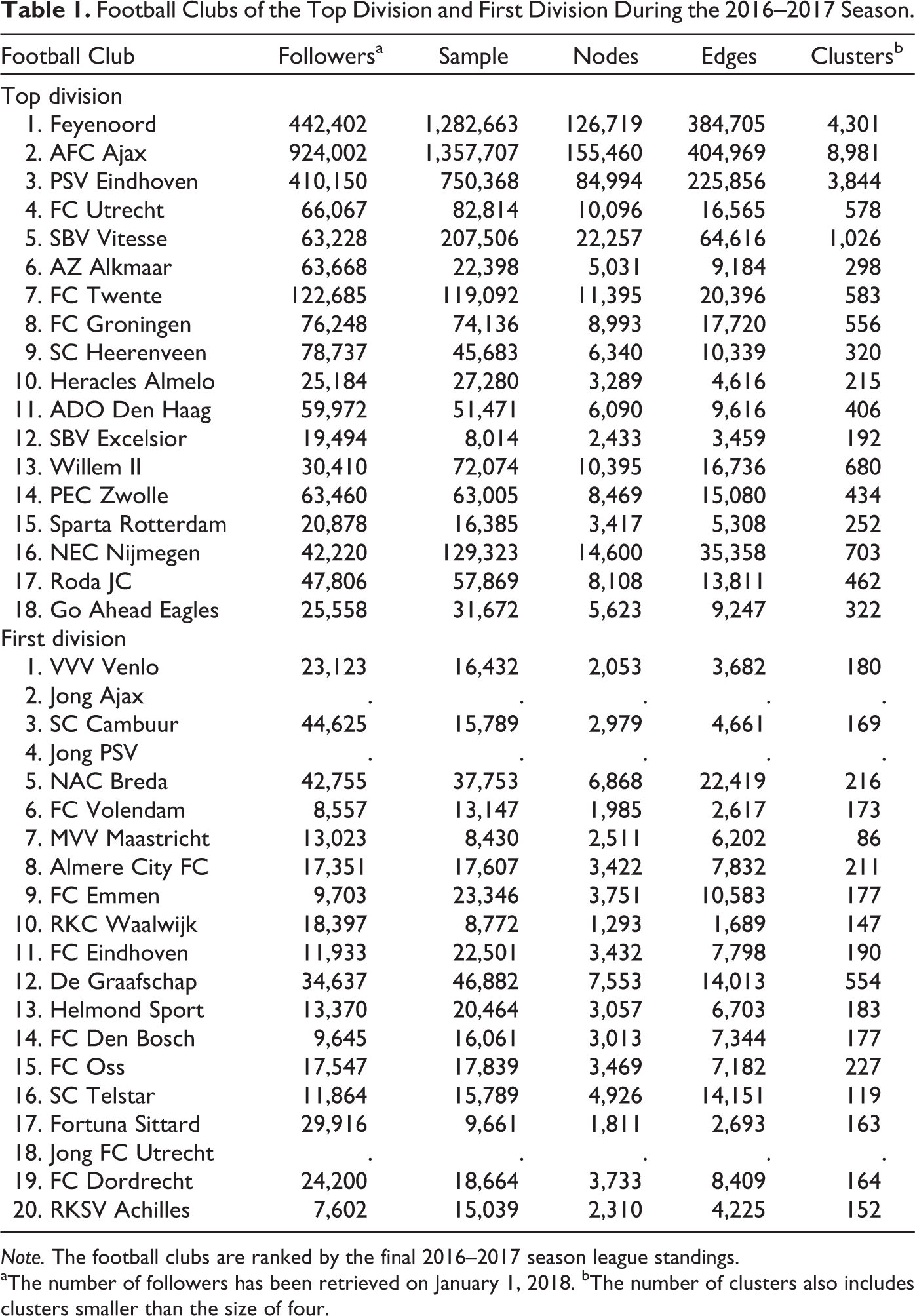
Note. The football clubs are ranked by the final 2016–2017 season league standings.
aThe number of followers has been retrieved on January 1, 2018. bThe number of clusters also includes clusters smaller than the size of four.
We used a social media monitoring service to collect tweets about each of the selected football clubs. We retrieved data in the period July 5, 2016, to June 28, 2017 (i.e., exactly 1 month before and after the 2016–2017 season). We adopted this sampling strategy, across two divisions over one football season, to increase the validity of the results. For each football club, the search query included the club’s name (e.g., “ajax”) and main Twitter handle (e.g., “AFCAjax”), to make our searches more streamlined and cut out many of the extraneous results. Additionally, we removed Twitter users unrelated to the conversation (n = 598), 5 resulting in a total of 335,267 unique users being responsible for 4,690,899 tweets.
Social Network Analysis
We use social network analysis to better understand information diffusion within large sports networks on Twitter. A social network can be defined as “a set of nodes (e.g., individuals or organizations) linked by a set of social relationships (e.g., friendship or overlapping membership) of a specified type” (Laumann et al., 1978, p. 458). Social network analysis examines social networks by observing members, defining their roles within the social network, and analysing their network relationships (Wasserman & Faust, 1999). By doing so, each member is represented by a single node, and a line joining two nodes indicates that the network members share a relationship. Eventually, the collection of nodes and ties becomes a sociogram, and the resulting diagram presents the nodes, their ties, and the entire network (see Figure 1A).
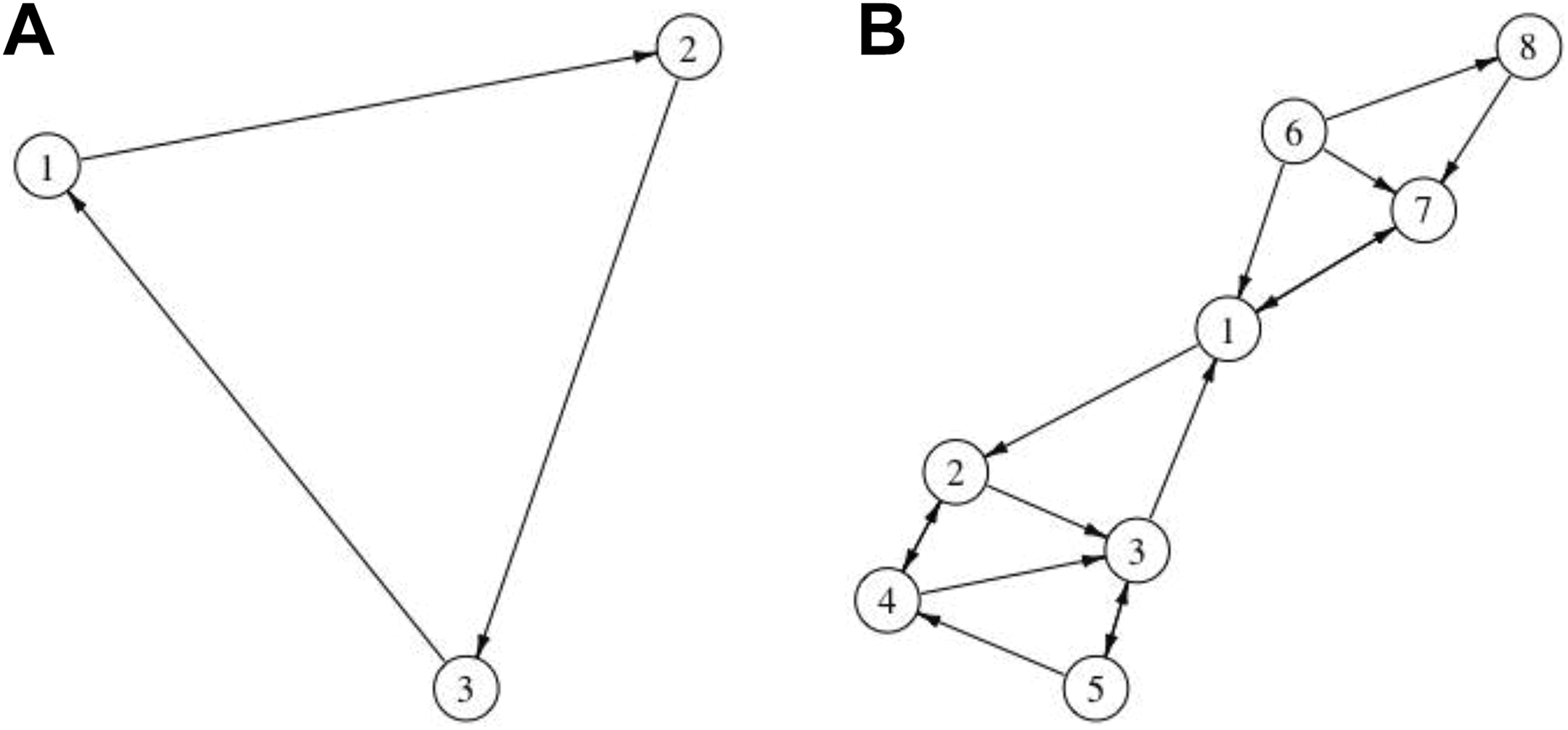
Exemplary social network analysis. (A) (left) with three nodes (1, 2 and 3) and (B) (right) with eight nodes (1–8) with node 1 bridging two clusters.
In this study, nodes are Twitter users who publicly tweeted about top division or first division club, whilst social ties were created when users replied, mentioned, or retweeted one another. We developed a Python script to iterate through each of the 4,690,899 tweets and create edges for each interaction—mention, reply, and retweet—between two users (e.g., Users X and Y). It should be noted that mentions, replies, and retweets, rather than follows, were used as links because they indicate stronger attention giving and information flow—the goals of Twitter participation (Golan & Himelboim, 2016).
We saved the interactions between users for each football club and imported these in R. We used the package igraph (version 1.2.4) within R to conduct social network analysis, as it is capable of handling large graphs efficiently (Csardi & Nepusz, 2006). The ties within these networks formed a directed graph, as edges in the graph have an associated direction (e.g., if User X mentions User Y, user Y does not necessarily mention user X). We created a network for each football club consisting of nodes and directed ties (mentions, replies, and retweets).
Identifying social mediators
Additionally, a social network analysis can help to identify social mediators. We considered a user to be a social mediator if a user (a) follows the football club on Twitter, (b) bridges two clusters (see Figure 1B), and (c) attracts large audiences (Himelboim et al., 2014). Firstly, social mediators have to be subscribed to updates from the football club on Twitter. The Twitter Application Programming Interface was used to collect the followers of each football club, and we used the Twitter IDs to combine these data with the tweet-level information. Secondly, mediators take a unique structural position in the network, as they enable information to flow across clusters (Wasserman & Faust, 1999). We identified the clusters in each network through the Clauset–Newman–Moore algorithm (Clauset, Newman, & Moore, 2004). This algorithm classifies clusters in a large data set by putting users in a subgroup or cluster they best fit in based on the interconnectivity among other users (Isa & Himelboim, 2018). This typically results in a few large clusters and many small ones. Since small clusters consisting of two or three members cannot provide strong team or community feelings (n = 19,149), social mediators have only been identified in clusters of at least four members (Wagenseller & Wang, 2017). If connected nodes are located in different clusters, this indicates a mediated relationship (see Figure 2).
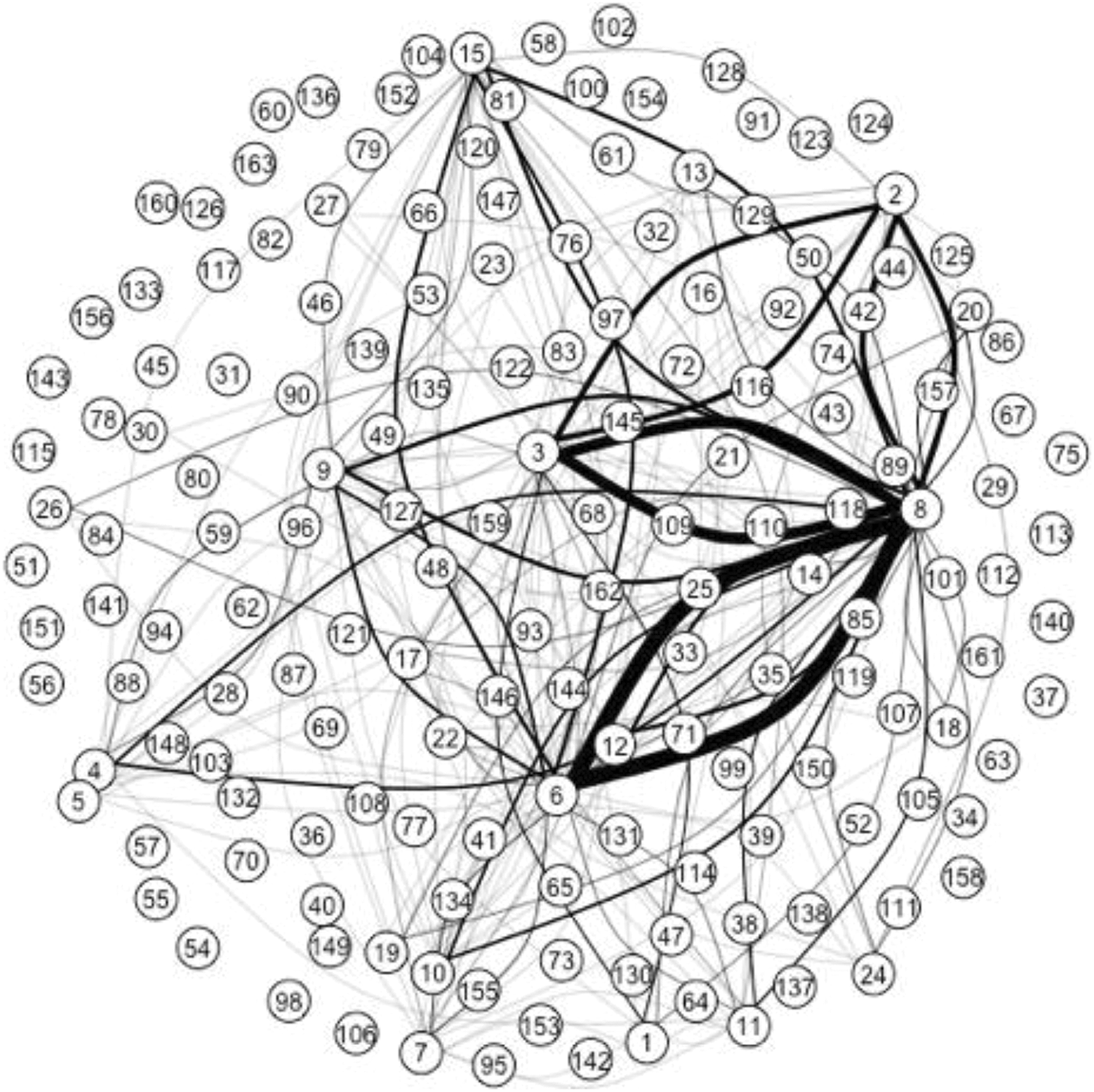
Interactions among Fortuna Sittard clusters (i.e., the weight of an edge is related to the number of ties between two clusters).
Lastly, as directors of information flow among publics in a social network, social mediators should not only connect but also attract large audiences (Himelboim et al., 2014). The third aspect of the operationalization of social mediators therefore concerns a high in-degree, which is measured as the number of ties directed to a user within the network (i.e., the number of mentions, replies, and retweets a user has received). High in-degree Twitter accounts for a significant amount of information flow through Twitter networks (Raban & Rabin, 2009). For every possible mediated relationship between two clusters, we operationalized the node with the highest in-degree as a social mediator. In total, we identified 6,366 social mediators. We present the steps of collecting and handling data in Figure 3.
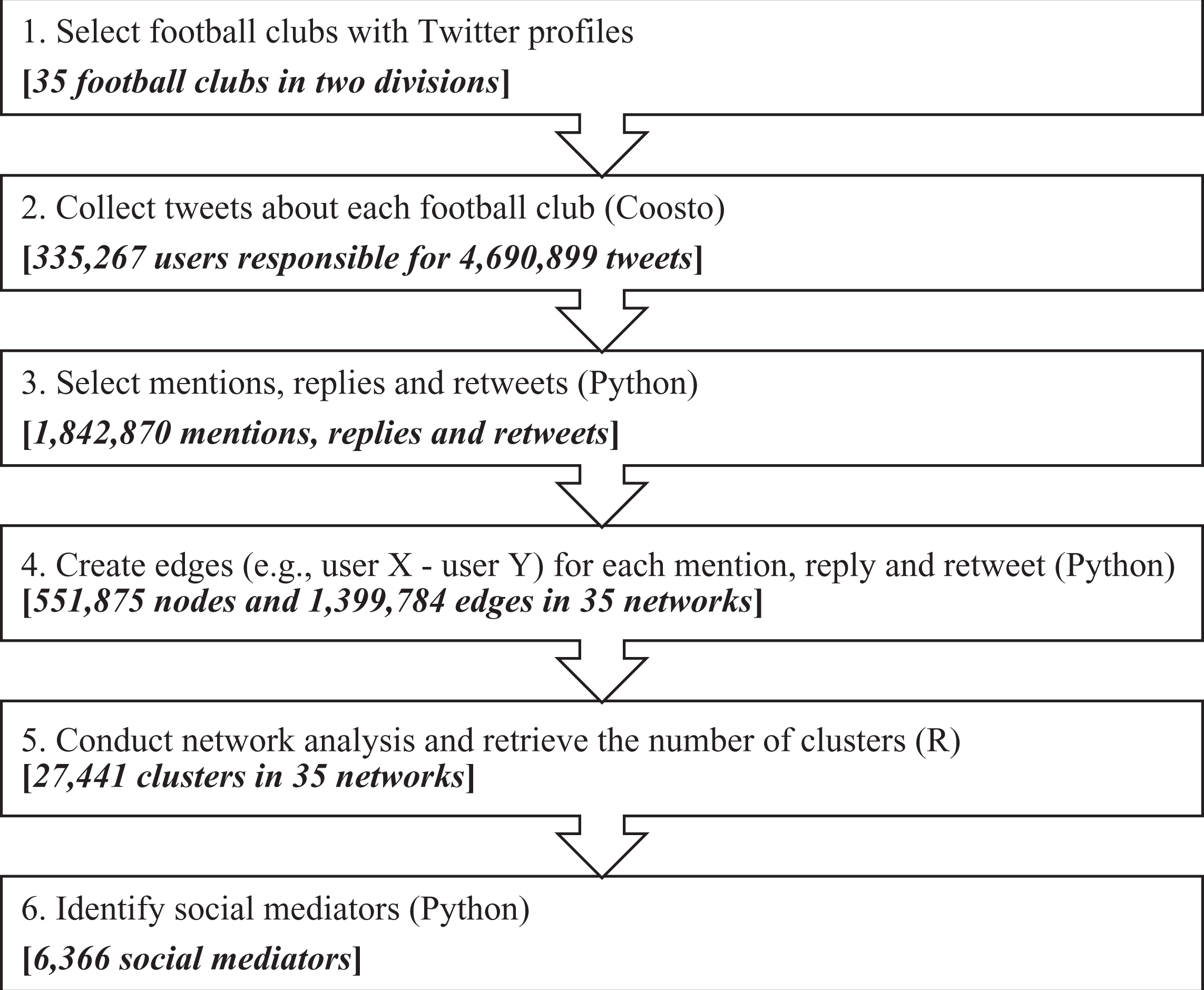
Data collection.
Content Analysis of Users’ Self-Descriptions
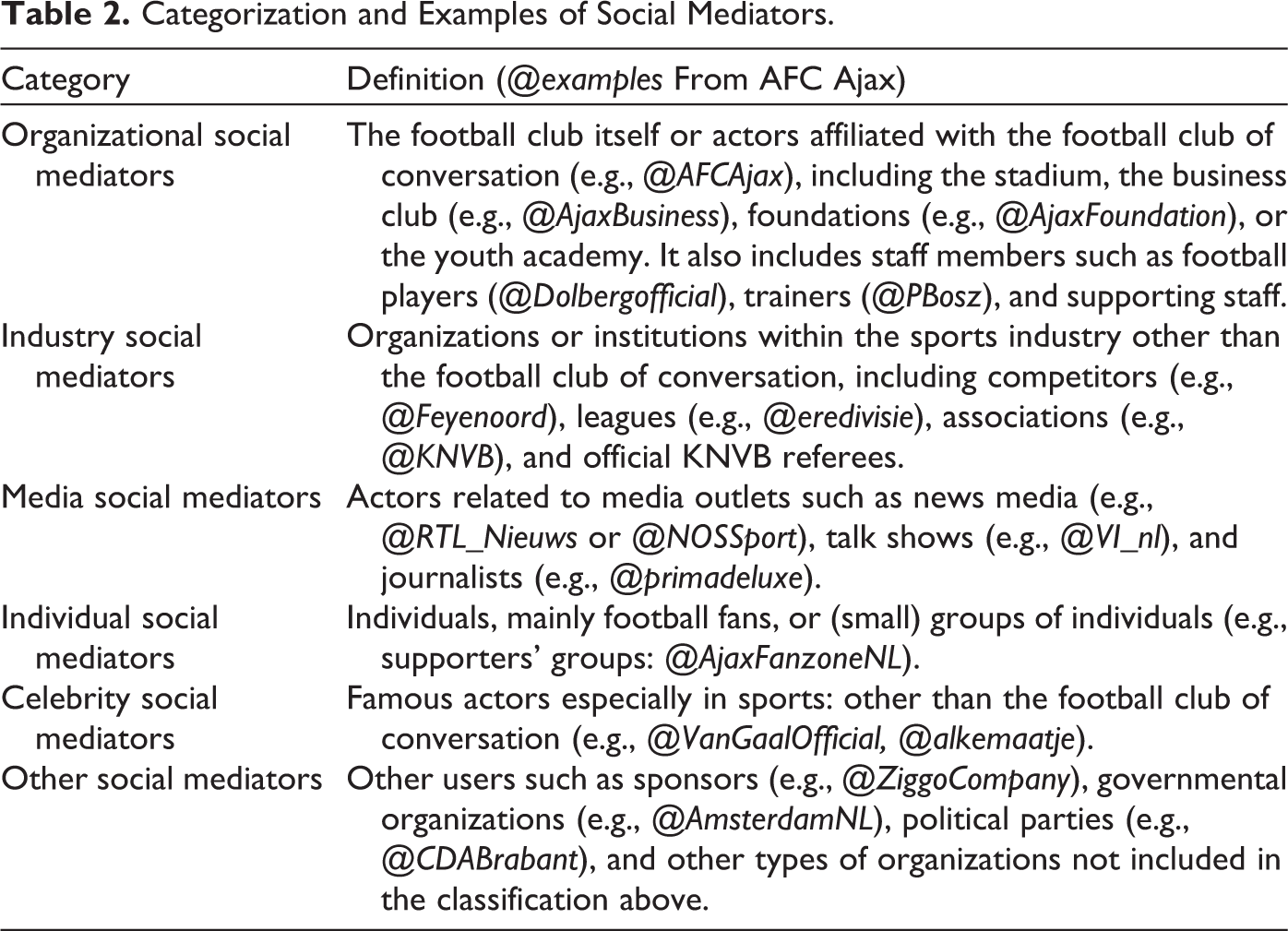
Next, we conducted a manual content analysis of social mediators’ self-descriptions. We classified social mediators into five distinct categories (Himelboim et al., 2016) based on their Twitter self-description (Table 2).
Categorization and Examples of Social Mediators.
Intercoder reliability
To determine the reliability of the coding procedures, two coders manually coded a random subsample of 672 social mediators (approximately 10% of the sample). Cohen’s κ was .96; this agreement can be considered acceptable (Fleiss, Levin, & Paik, 2003). On this basis, one coder categorized the additional 5,694 social mediators. We removed social mediators indicating fake, suspended, private, or deleted Twitter accounts from the sample (n = 402), resulting in a total of 5,964 social mediators.
Analytical Strategy
Lastly, the prepared data sets have been imported in Stata. To test the hypotheses and answer the research question of this study, numerous statistical analyses have been conducted at club level and mediator level.
Mediator level
The unit of analysis for Hypotheses 1 and 2 was the type of social mediator. In order to test Hypotheses 1a–e, a χ2 test and various two-sample z tests for proportions were performed. Two-sample z tests for proportions were able to calculate whether two groups (top division vs. first division) differ significantly on some single categorical characteristic (type of social mediator). In order to test Hypotheses 2a and b, analyses of variance (ANOVAs) were conducted. The reliability of ANOVAs depends on some assumptions (e.g., the homogeneity of variances, the distribution of the dependent variable), which have been checked by using Stata. ANOVAs have been carried out when the assumptions were not violated.
Club level
Next, in order to test Research Question 1, numerous stepwise (forward) multiple regression analyses were performed to examine the combination of independent variable(s) that predict the dependent variable (fan engagement). The reliability of regression analyses depends on several assumptions. The assumptions have been checked for using Stata, such as the existence of a linear relationship (i.e., regression plots), multivariate normality, and homoscedasticity. Regression analyses have been carried out when the assumptions were not violated.
Results
Types of Social Mediators
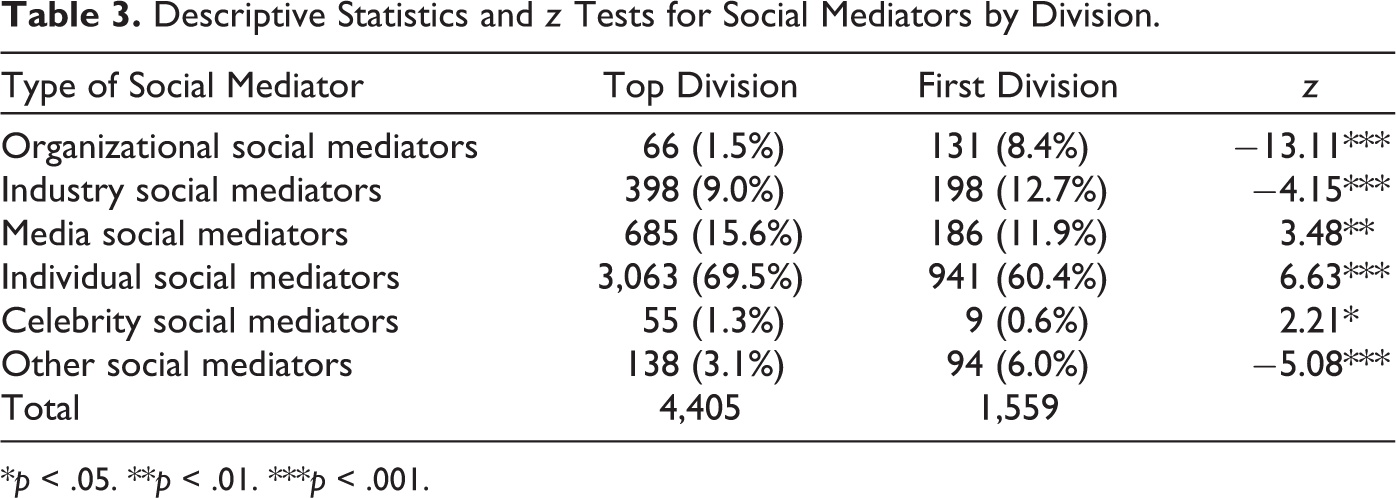
In total, 5,964 social mediators were identified (Figure 4); 4,405 social mediators were related to conversations about top division clubs and 1,559 social mediators were related to first division clubs.
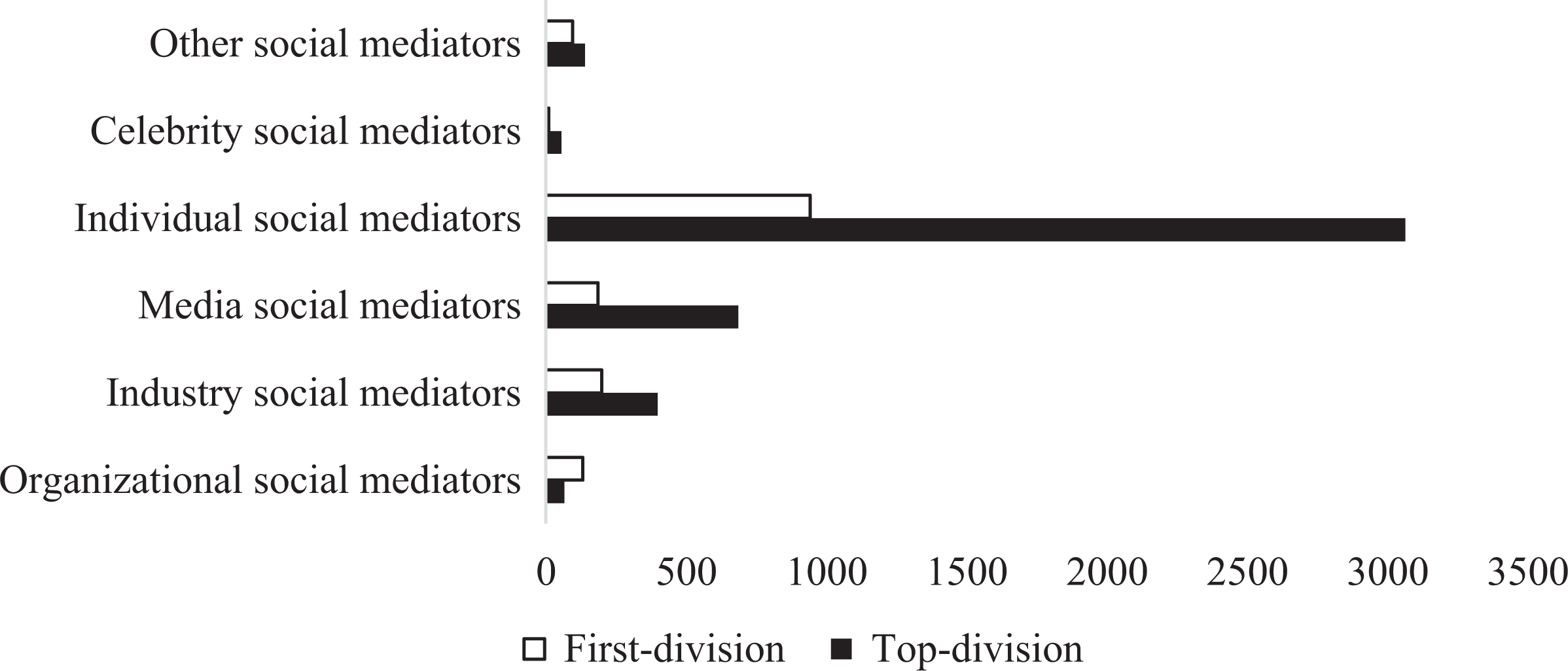
Types of social mediators.
A 6 × 2 Pearson’s χ2 test was conducted to examine whether significant differences exist between types of social mediators in the top division and the first division. The results indicate a significant difference between types of social mediators and division, χ2 (5, N = 5,964) = 236.11, p < .001 (Table 3). Next, various two-sample z tests for proportions have been conducted to retrieve a closer examination of the data (Table 3). The results indicate that the proportion of organizational social mediators was significantly higher for first division clubs compared to top division clubs (z = −13.11, p < .001). Hypothesis 1a was supported by the data. Remarkably, topic networks of first division clubs included significantly more industry social mediators compared to top division clubs (z = −4.15, p < .001). Therefore, Hypothesis 1b—the proportion of industry social mediators is higher for top division football clubs compared to first division football clubs—was not supported by the data. The remaining types of social mediators represent larger proportions for top division clubs compared to first division clubs. Differences were significant for media social mediators (z = 3.48, p < .01), individual social mediators (z = 6.63, p < .001), and celebrity social mediators (z = 2.21, p < .05). Thus, Hypotheses 1c, d, and e were fully supported by the data.
Descriptive Statistics and z Tests for Social Mediators by Division.
*p < .05. **p < .01. ***p < .001.
Highly Influential Social Mediators
Next, the in-degree (the number of received mentions, replies, and retweets) of social mediators has been explored. Organizational social mediators indicated the highest in-degree (M = 448.22, SD = 2,310.70). It has been examined whether the in-degree of organizational social mediators is significantly higher compared to other social mediators. A one-way ANOVA confirmed that the in-degree significantly differs between social mediators, F(5, 5958) = 10.66, p < .001. Next, a Bonferroni post hoc test revealed that the in-degree was significantly higher for organizational social mediators compared to industry social mediators (M difference = 390.49, p < .001), media social mediators (M difference = 383.41, p < .001), and individual social mediators (M difference = 409.28, p < .001). There was no significant difference between organizational social mediators and celebrity social mediators. Thus, Hypothesis 2a was partially supported by the data.
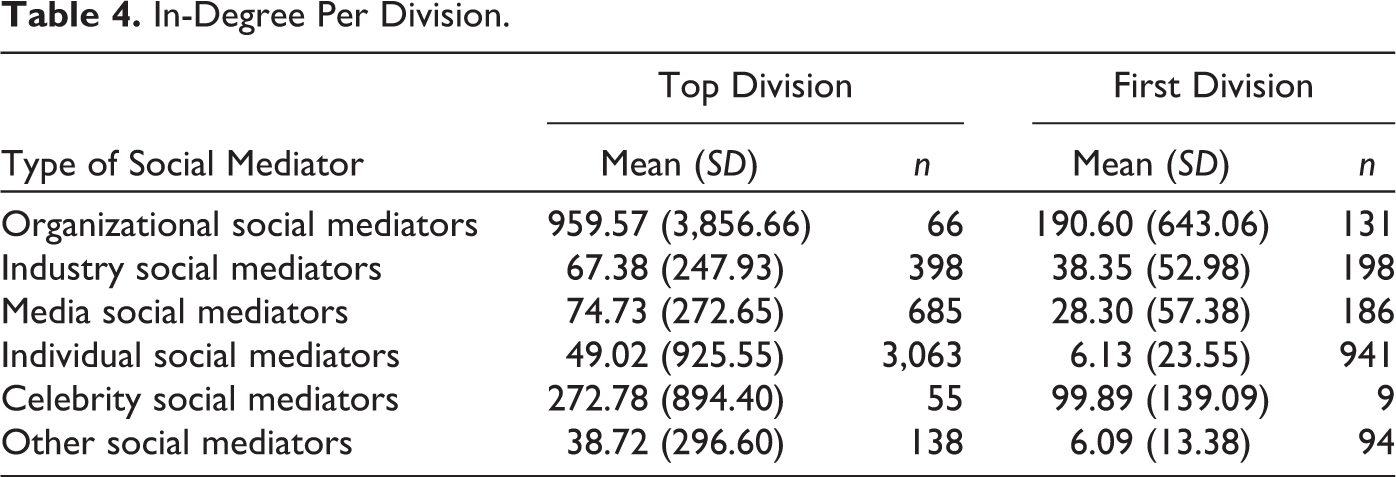
As shown in Table 4, organizational social mediators in the top division indicate the highest in-degree (M = 959.57, SD = 3,856.66). To examine the influence of division and type of social mediator on in-degree, a two-way ANOVA was conducted. The dependent variable was in-degree, whilst the independent variables were division and type of social mediator. The ANOVA results revealed an interaction between the effects of division and type of social mediator on in-degree, F(5, 5952) = 7.07, p < .001. A Bonferroni post hoc test indicated that organizational social mediators have a higher in-degree within the top division compared to the first division (Mdifference = 768.97, p < .001). However, we found an effect size of .0059 indicating that it concerns a small effect. And there were no differences between divisions for the remaining types of social mediators.
In-Degree Per Division.
Fan Engagement of Social Mediators
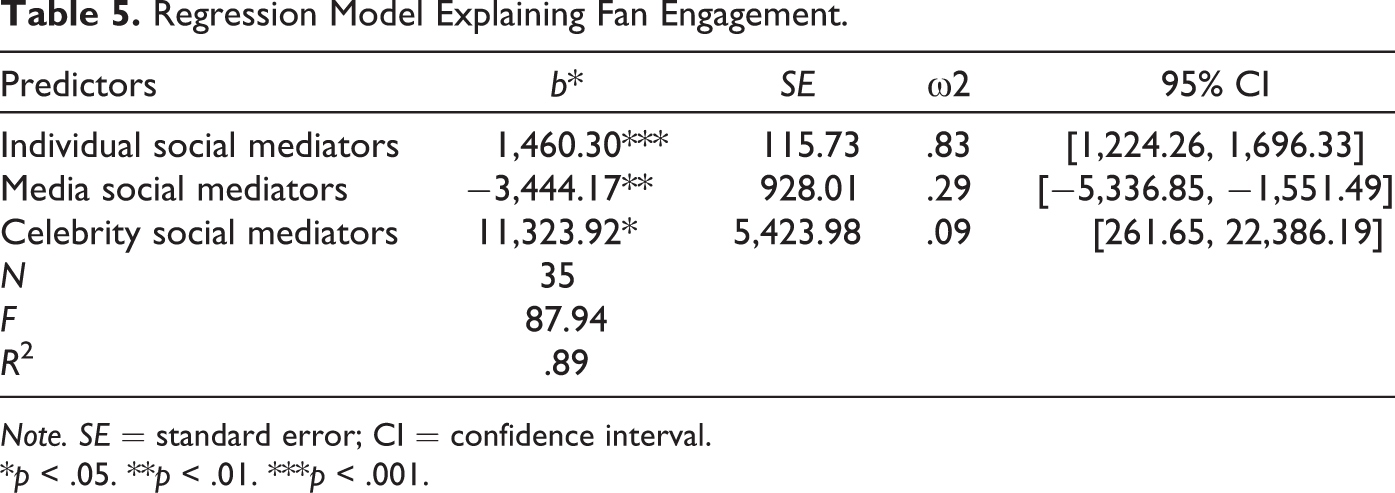
Finally, to answer Research Question 1, we conducted various stepwise multiple regression analyses to find the combination of variable(s) that predict fan engagement (the number of mentions, replies, and retweets; see Table 5). 6 Numerous independent variables 7 were entered into and/or removed from the model—in a stepwise manner—to predict fan engagement. This resulted in a model including the number of individual social mediators, the number of celebrity social mediators, and the number of media social mediators to predict fan engagement, F(3, 31) = 87.94, p < .001, explaining 89% of the variance (R 2 = .89; see Table 5). Fan engagement was primarily predicted by the number of celebrity social mediators (b* = 11,323.92, t = 2.09, p < .05, 95% confidence interval (CI) = [261.65, 22,386.19]), and the number of individual social mediators (b* = 1,460.30, t = 12.62, p < .001, 95% CI [1,224.26, 1,696.34]). Remarkably, the number of media social mediators negatively affects fan engagement on Twitter (b* = –3,444.17, t = −3.71, p < .01, 95% CI [−5,336.85, −1,551.49]). As shown in Table 5, we found effect sizes (varying from .09 to .83) indicating that our various independent variables moderately to strongly affect fan engagement on Twitter.
Regression Model Explaining Fan Engagement.
Note. SE = standard error; CI = confidence interval.
*p < .05. **p < .01. ***p < .001.
Conclusion and Discussion
Our study took a social networks approach to investigate the structure of online sports communities by detecting emerging network clusters as well as social mediators (i.e., key users) who hold the power to connect such clusters. We also examined the extent to which different types of social mediators influence fan engagement on Twitter. By collecting and analyzing 4.5 million tweets about 35 football clubs, and subsequently reviewing the details of about 6,000 key users, this study provides a set of key findings on how sports communication takes place within and across fan communities on Twitter and demonstrates how adopting a social networks approach can be an important methodological framework for examining patterns of sports-related information flow on social media.
The first key finding of this study relates to the notion of a less central role of news media in distributing information among online communities on social media. News media—the most traditional mediators—namely accounted for less than 15% of the social mediators in our sample. Instead, (groups of) individuals were most likely to be found in key positions mediating information diffusion between (1) a football club and (2) the communities that were formed by user interaction surrounding each club. This extends mediated public relations literature (e.g., Himelboim et al., 2014) into the realm of sports and validates the overall trend of social media gradually changing the dynamics of information diffusion, especially on Twitter. Moreover, this finding confirms and extends earlier research on sports communication (see, e.g., Clavio et al., 2012), as, seen from a network perspective, fans are no longer restricted by the information provided by news media that they relied upon for their off-line activities (e.g., Cleland, 2009; Guschwan, 2011).
Furthermore, a second key finding of this study relates to the differences in first and top division clubs when it comes to their network compositions and especially the role and relevance of different types of social mediators. First division clubs, on the one hand, are dominated by social mediators affiliated with football, such as competitors, football associations, and the football club itself. On the other hand, social mediators for top division clubs were more diverse and included (groups) of fans, talk shows, journalists, and celebrities. One potential reason for this might be—validating findings of Bruns et al. (2014)—that online communication strategies of small clubs have a stronger focus on positioning publics as part of their “inner circle,” for example, by generating and maintaining tweets around their own accounts. The findings extend earlier research on information diffusion and sports communication (e.g., Clavio et al., 2012; Cleland, 2010), providing evidence that teams with different sizes of supporters’ groups and number of fans leave the stage to certain types of key users. Although both larger and smaller football clubs need to connect with their fans, in general, large clubs tend to have more available resources and broader goals, whilst small clubs may have fewer available resources and more specific goals (Yang & Taylor, 2015). Therefore, particularly small clubs can benefit from identifying social mediators that provide doorways to new publics.
Our results also indicate that certain types of social mediators are more influential in stimulating others to spread sports-related content on Twitter. In particular, online content of key users affiliated with the football club of conversation (e.g., staff members, football players), and especially public figures, such as famous sports actors, is more likely to receive mentions, retweets, and replies from other users. Drawing from the concept of parasocial interactions (see, e.g., Rubin & McHugh, 1987), one explanation may be that fans have an increased level of interest in messages of their favourite sports teams or players (Frederick et al., 2012), which subsequently elicits online fan engagement. These results add to the existing empirical research on information diffusion on Twitter (see, e.g., in branding; Araujo et al., 2017) by demonstrating that public figures not only are influential because a large number of users might be exposed to their content, but also because they are able to stimulate these users to go a step further and spread sports-related content to their own networks.
A fourth and important key finding is the positive effect of individual social mediators on fan engagement (i.e., mentions, replies, retweets) on Twitter. By playing influential roles in information flow, key individual users are able to stimulate other users to engage on Twitter. Several studies have shown that individuals are able to exert a strong influence on the relationship with, attitudes toward, and behavioral responses to certain sports organizations, teams, and individual players through social interactions and information exchanges (Muñiz & Schau, 2007; Schau et al., 2009; Yoshida et al., 2015). This study, using a social network approach, provides empirical evidence adding to these earlier findings by showing that social media does not only give fans the opportunity to be active participants in creating, discussing, and sharing content about sports teams, and enables the creation of online sports communities (Clavio & Kian, 2010), but also presents an environment where users engage in community-related behaviours that benefit sports teams. By doing so, users are able to encourage online interactions and foster greater fan engagement with football clubs.
From a practical perspective, the findings of this study suggest that football clubs (and other sports organizations) can benefit from using a social network approach to analyzing social media and fan engagement and by potentially identifying and targeting social mediators. Not only is this approach relevant to identifying groups of users—clusters—that may be talking about the club but not with the club, but it is also helpful in detecting unique individuals who exert influence on fan engagement by being located in a unique position connecting clusters—the social mediators. While football clubs have a powerful platform to communicate with their millions of followers on Twitter, they should also consider the potential that social mediators have to extend the reach of the club beyond the limits of this community.
The current study also makes methodological contributions to sports communication research, addressing earlier calls to adopt network analysis in the field (for an overview, see Hambrick, 2013). This study extends earlier case study research by collecting more than 4.5 million tweets of approximately 330,000 users over a 1-year period. Based on users’ patterns of interactions and information flow (e.g., following, mentioning, retweeting, and replying), we show how to identify communities in terms of network clusters and social mediators bridging such clusters. Future studies should consider these capabilities when studying sports communication research.
Limitations and Future Research
Finally, while this study contributes to research with numerous important findings, certain limitations need to be discussed. Firstly, we should consider the operationalization of social mediators. The highest in-degree was one indicator of identifying social mediators. Future studies should also incorporate user–follower relationships, as these also account for a significant amount of information flow throughout Twitter networks (Raban & Rabin, 2009). Besides, social mediators have been identified in clusters of at least four members (Wagenseller & Wang, 2017) without setting a maximum. Dunbar (2016) posits that large communities of size over 150 contain weak connections among their members and therefore are not stable. Examining communities that are limited to 150 members might be imperative when social mediators are targeted to build and maintain relationships.
Furthermore, this study used a social media monitoring service to collect data as it enables users to easily extract large data sets in a short period of time. Although the limitations imposed by Twitter restrict (rapid) data collection, it can be argued that extracting all data directly from Twitter is most fortunate (Kwak et al., 2010). Another possible limitation is that this study focused on mentions, replies, and retweets to explore information diffusion on Twitter. Future studies could be limited to retweets. From a theoretical perspective, it can be argued that replies and mentions imply a conversation between two Twitter users, being less interesting to the general public (Araujo, Neijens, & Vliegenthart, 2015). The final limitation concerns the sample size of the regression analyses, which was somewhat small; this may have reduced the accuracy of the results (Sawyer, 1982). Future studies should therefore expand the sample, for example, by including organizations from different sports disciplines or even other industries. By doing so, it can be examined whether differences exist not only among different types of organizations but also between industries.
Notwithstanding these limitations, this study has provided various findings relevant and specific to sports communication on Twitter. These findings not only update and advance earlier research about the role of social mediators but also provide a further understanding about their specific characteristics that can be used by future sports communication studies to continue investigating the role that social mediators play as collaborators for dialogic relationships with fans.
Footnotes
Declaration of Conflicting Interests
The author(s) declared no potential conflicts of interest with respect to the research, authorship, and/or publication of this article.
Funding
The author(s) received no financial support for the research, authorship, and/or publication of this article.
