




Abstract
When exposed to conflicting arguments, people tend to evaluate the attitude-congruent arguments favorably and the attitude-incongruent arguments unfavorably. This phenomenon is called biased assimilation. Prior research has shown that the biased assimilation of conflicting arguments is robust. Yet, relatively little is known about how conflicting arguments are processed, thereby increasing or decreasing the influence of preexisting attitudes on the argument evaluation. The present study examined relational (vs. separate) processing of conflicting arguments—that is, strategically connecting the arguments with each other—and its effects on biased assimilation. In two online studies, Japanese adults (Study 1: N = 406, Study 2: N = 447) received and evaluated two conflicting arguments concerning the introduction of daylight savings in one of two presentation modes: sequential (one at a time) or simultaneous (at one time). Although, in Studies 1 and 2, presentation mode did not influence relational processing or biased assimilation, quite a few participants reported that they engaged to varying degrees in relational processing while evaluating the arguments. Additionally, results of Study 2 indicated that participants' self-reported relational processing had moderating effects on biased assimilation. The present findings have implications for the further elucidation of the cognitive processes of biased assimilation and the development of debiasing techniques.
Introduction
When exposed to conflicting arguments, individuals often evaluate arguments congruent with their preexisting attitudes (or beliefs) favorably and arguments incongruent with their preexisting attitudes unfavorably. This phenomenon is referred to as biased assimilation (Lord, Ross, & Lepper, 1979). Biased assimilation of conflicting arguments is a psychological mechanism by which the recipients irrationally resist changing their attitudes, including sexual prejudices (Munro & Ditto, 1997), skepticism about climate change (Corner, Whitmarsh, & Xenias, 2012), and political partisanship (Greitemeyer, Fischer, Frey, & Schulz-Hardt, 2009; Munro et al., 2002). Owing to biased assimilation, individuals' attitudes may remain unchanged or become more extreme than before even when they are given an opportunity to closely inspect arguments from both sides (Lord et al., 1979; McHoskey, 1995). Therefore, it is important to understand how conflicting arguments are processed, thereby increasing or reducing biased assimilation.
The primary concern of the present study is relational processing of conflicting arguments and its effects on the biased assimilation of the arguments. Relational processing refers to strategically connecting pieces of information from different sources so that meaningful relations between the pieces of information can be recognized and understood. Although prior research on multiple-argument processing has suggested that skilled processing of conflicting arguments entails relational processing (Afflerbach & Cho, 2009; Bråten & Strømsø, 2011), research on biased assimilation has mainly focused on cases in which the arguments are separately processed and evaluated (see the following section). Little is known about whether and how relational processing of conflicting arguments influences biased assimilation. The present study addressed this issue.
In this article, an argument refers to a statement or a series of statements that basically consists of a claim and one or more reasons for justifying the claim (Toulmin, 1958; Walton, 2006). Conflicting arguments are defined as a set of arguments in which the claims are opposed to each other on an issue. Although it is certainly possible that multiple arguments from the same source are in conflict (e.g., Regan et al., 2014), the focus of the present study is conflicting arguments that come from different sources.
Biased Assimilation of Conflicting Arguments
The first evidence that the biased assimilation of conflicting arguments occurs was reported by Lord et al. (1979). In their pioneering study, individuals with positive and negative attitudes toward capital punishment received two arguments (consisting of research methodology, results, conclusions, and rebuttals to counterarguments) that respectively supported and opposed the deterrent effect of the death penalty. The individuals rated the argument congruent with their preexisting attitudes as more convincing and being better in quality than the argument incongruent with their preexisting attitudes. Since Lord et al. (1979), numerous studies have shown the biased assimilation of conflicting arguments to be robust (Corner et al., 2012; Druckman & Bolsen, 2011; Edwards & Smith, 1996; Greitemeyer, 2014; Greitemeyer et al., 2009; McHoskey, 1995; Miller, McHoskey, Bane, & Dowd, 1993; Munro & Ditto, 1997; Munro et al., 2002; Pyszczynski, Greenberg, & Holt, 1985; Richardson, Huddy, & Morgan, 2008; Taber, Cann, & Kucsova, 2009; Taber & Lodge, 2006).
Prior research has provided two levels of explanation for the biased assimilation of conflicting arguments. One level of explanation focuses on motivational processes that drive recipients to persist in their preexisting attitudes (Kunda, 1990; Lord & Taylor, 2009). Several theories posit that individuals have a basic motivation or tendency to reduce an unpleasant state arising from cognitive dissonance (cognitive dissonance theory; Festinger, 1957), affirm or defend their self-worth (self-affirmation theory; Sherman, 2013), or process information in accordance with their cultural worldviews (cultural cognition thesis; Kahan, Jenkins-Smith, & Braman, 2011). Accordingly, the individuals are thought to produce defensive responses, including biased assimilation, when an argument challenges their preexisting attitudes, thereby causing cognitive dissonance (Aronson, 1992), posing a threat to their self-worth (Correll, Spencer, & Zanna, 2004) or creating the gap between the argument and their cultural worldviews (Kahan, Braman, Cohen, Gastil, & Slovic, 2010). Another level of explanation concerns why the argument evaluation is biased by motivational processes. The typical explanations propose that the asymmetric processing of conflicting arguments leads to the biased assimilation of the arguments (Lord et al., 1979; Munro & Ditto, 1997; Taber et al., 2009; Taber & Lodge, 2006). According to the disconfirmation model proposed by Edwards and Smith (1996), for example, exposure to an argument on an issue triggers an automatic memory search for relevant information, including one's own attitude toward the issue. When the retrieved attitude is incongruent with the argument, a deliberate and time-consuming memory search for information counter to the argument is executed. When congruent, no further efforts are made to process the argument. This means that the attitude-congruent argument tends to evade critical scrutiny. As a result of the asymmetrical processing, the attitude-congruent argument is evaluated more favorably than the attitude-incongruent argument.
Notably, empirical and theoretical research on biased assimilation has assumed that recipients respond to or deal with conflicting arguments individually and judge the quality of each argument. Indeed, in the typical research paradigm developed by Lord et al. (1979), individuals received and evaluated two conflicting arguments one at a time. The individuals process and evaluate the firstly presented argument before the second argument was presented. Moreover, they did not return to the first argument while they processed and evaluated the second argument. This procedure would discourage the individuals from strategically connecting the two conflicting arguments, because doing so required extra efforts and working memory resources (O'Hara, Taylor, Newman, & Sellen, 2002; Richter, 2011). A few studies (Correll et al., 2004; Munro et al., 2002; Richardson et al., 2008) used a videotaped or televised debate as a stimulus material. Although, in these studies, individuals watched the debate and then evaluated arguments from both sides, their opportunities for relational processing were limited. The participants had to follow a series of orally presented arguments in real time; they were not allowed to watch the debate again. Biased assimilation research appears to discount the possibility that recipients strategically connect conflicting arguments, thereby evaluating the arguments.
Relational Processing of Conflicting Arguments
There are two reasons to highlight relational processing of conflicting arguments. First, separate processing of conflicting arguments is by no means normative. On the contrary, evidence suggests that experienced recipients are active in strategically connecting arguments, including conflicting ones, from different sources (Geisler, 1994; Rouet, Favart, Britt, & Perfetti, 1997). For example, Wineburg (1991) found that historians checked what was written in a text against other texts more often than did high school students when they reasoned about a historical event from conflicting texts. In a study by Bernstein (2010), while reading conflicting texts on a political issue, undergraduate students with experience in political science made more connections between arguments in the texts than did undergraduate students with little experience. Of course, as suggested by Wineburg (1991) and Bernstein (2010), it is not easy to strategically connect conflicting arguments. Relational processing requires cognitive capacity and efforts (Richter, 2011; Stadtler & Bromme, 2014). This would be demanding for those who are inexperienced in handling conflicting arguments, particularly when they receive the arguments one at a time and are not allowed to go back and forth between the arguments.
The influence of preexisting attitudes on the evaluation of conflicting arguments may differ according to whether the arguments are processed separately or interrelatedly. When individual recipients separately process and evaluate conflicting arguments on an issue, they cannot help relying on information (e.g., prior knowledge about the issue, inferential rules) stored in long-term memory. Their memory search for relevant information may increase the retrieval and accessibility of their preexisting attitudes toward the issue (Edwards & Smith, 1996; Houston & Fazio, 1989). Additionally, one major function of preexisting attitudes is to efficiently perceive and interpret one's environment, such as information from external sources, ensuring cognitive consistency (Katz, 1960; Maio & Olson, 2000). As Lord and Taylor (2009) argued, it is natural that recipients rely on their retrieved attitudes to evaluate an argument unless they are competent and motivated to use other resources. Thus, separate processing of conflicting arguments is expected to increase the influence of preexisting attitudes on the evaluation of the arguments. In contrast, relational processing enables recipients to weigh arguments from both sides against each other when they evaluate the arguments. By comparing and contrasting the arguments, they can gain information to ascertain the validity of what is said in each argument (Wineburg, 1991) and perceive the difference between the arguments in quality (Geisler, 1994; Kobayashi, 2015). Recipients' relational processing may reduce their reliance on their preexisting attitudes for evaluating conflicting arguments and consequently decrease biased assimilation.
Although there is no definite evidence for the effects of relational processing on biased assimilation, Jonas, Schulz-Hardt, Frey, and Thelen (2001) found that the influence of preexisting attitudes on the processing of conflicting arguments was less conspicuous when the arguments were simultaneously presented than when sequentially presented. This finding suggests that giving recipients an opportunity to strategically connect conflicting arguments reduce the influence of their preexisting attitudes. In addition, evidence suggests that relational processing of conflicting arguments plays a substantial role in the evaluation of each argument (Anmarkrud, Bråten, & Strømsø, 2014; Geisler, 1994; Kobayashi, 2010). Unfortunately, the previous studies did not examine the effects of relational processing on biased assimilation. It remains unclear whether relational processing of conflicting arguments reduces the influence of preexisting attitudes on the evaluation of the arguments.
The Current Study
The current study was designed to investigate relational processing of conflicting arguments and its effects on the biased assimilation of the arguments. In two studies, participants expressed their preexisting attitudes toward an issue and then read two conflicting arguments concerning the issue. Two presentation modes were compared: sequential and simultaneous. As in the typical research paradigm developed by Lord et al. (1979), half of the participants received and evaluated the arguments one at a time (the sequential presentation condition). The other half received and evaluated the two arguments at the same time (the simultaneous presentation condition). Additionally, each participant's engagement in relational processing was assessed using a self-report measure.
Three research questions were addressed. The first research question was whether exposure to conflicting arguments leads to biased assimilation. The extant literature suggests that recipients' evaluation of conflicting arguments is biased in favor of their preexisting attitudes. However, prior research has mainly focused on samples of undergraduate students, limiting the generalizability of the findings. To explore the generalizability of biased assimilation, the present study used a more diverse sample of participants.
The second question concerned whether the simultaneous presentation of conflicting arguments encourages recipients to engage in relational processing. The sequential presentation prevents the recipients from returning to the first argument while they process the second argument. Additionally, relational processing of sequentially presented arguments requires extra efforts and working memory resources. In contrast, the simultaneous presentation would allow the recipients to go back and forth between conflicting arguments and strategically connect the arguments without much effort or posing a heavy burden on their working memory. Therefore, it was hypothesized that participants in the simultaneous presentation condition would engage in relational processing of conflicting arguments more than participants in the sequential presentation condition (Hypothesis 1).
The third research question was whether and how relational processing influences biased assimilation. On the basis of the earlier discussions, recipients' relational processing would reduce their reliance on their preexisting attitudes as a resource for the argument evaluation and therefore decrease biased assimilation. The influence of preexisting attitudes on the evaluation of the conflicting arguments would be weaker for participants in the simultaneous presentation condition than for participants in the sequential presentation condition (Hypothesis 2). Additionally, the influence of preexisting attitudes on the evaluation of the conflicting arguments should be weaker for participants who engaged in relational processing than for those who did not, regardless of presentation condition (Hypothesis 3).
Study 1
Method
Participants
A panel of Japanese members from 18 to 69 years old maintained by Intage Inc., a survey research company, was invited by e-mail to participate in an Internet-based survey experiment. Of the 2,446 invited members, 406 participants completed the study. Although the present study was not a representative sample of the general Japanese population, the sample included a wide range of sociodemographic groups: 46.3% females; 17.0% were 18 to 29 years old, 20.0% 30 to 39 years old, 24.4% 40 to 49 years old, 17.5% 50 to 59 years old, and 21.2% 60 to 69 years old (M = 44.5 years, SD = 14.6); 49.5% were full-time workers, 18.5% full-time wives, 10.3% retired and unemployed persons, and 7.8% students; and 66.5% were from Eastern Japan and 33.5% from Western Japan. Participants were randomly assigned to either the sequential presentation condition or the simultaneous presentation condition.
A power analysis for key significance tests was conducted using G*Power 3.1.3 (Faul, Erdfelder, Buchner, & Lang, 2009). The analysis indicated that a total sample size of 406 participants would provide a power of 0.88 (α = .05) for detecting a small effect size (Cohen's f2 = 0.02) as judged by Cohen's (1988) criteria. Effect sizes (f2) representing the magnitude of biased assimilation, which were calculated from the relevant studies reporting statistical information necessary for the calculation of an effect size (Greitemeyer, 2014; Greitemeyer et al., 2009; Houston & Fazio, 1989; Taber & Lodge, 2006), ranged from 0.18 to 1.36. The present sample size was sufficient to detect this range of effect sizes.
Measures
Preexisting attitudes, familiarity, and personal importance. After receiving a brief explanation of daylight saving time, participants rated the following two statements, using a 7-point Likert-type scale ranging from 1 (Strongly disagree) to 7 (Strongly agree): “Daylight saving time should be introduced into Japan”; and “Daylight saving time is unsuitable for Japan.” The second rating was reverse coded, and then the two ratings were averaged (r = .65, p < .001; Cronbach's α = .78). Higher scores indicated more positive attitudes toward the introduction of daylight saving time into Japan. To control the possible influence of familiarity with and personal importance of the issue on the argument evaluation (Kobayashi, 2010), the present study also included measures of these variables. Participants rated their familiarity toward the controversy over the introduction of daylight saving time into Japan and their personal importance of the issue, using 7-point Likert-type scales ranging from 1 (Extremely unfamiliar) to 7 (Extremely familiar) and 1 (Extremely unimportant) to 7 (Extremely important), respectively.
Arguments. Two sets of short pro and con arguments concerning the introduction of daylight saving time into Japan were written in Japanese. The fictitious author's name was also placed above the body of each argument. The English version of each argument is shown in Appendix. Of the two sets, one set addressed the issue concerning the energy-saving effect of daylight saving time. In the pro-argument (171 characters in Japanese) of this set, the author claimed that daylight saving time would decrease energy consumption. In the con argument (172 characters), another author claimed that daylight saving time would make no substantial contribution to energy savings. The other set focused on the issue concerning the economic impact of daylight saving time. In the pro argument (170 characters) of this set, the author claimed that daylight saving time would revitalize the nation's economy. In the con argument (172 characters), another author claimed that the introduction of daylight saving time would be harmful to the nation's economy. The two arguments of each set did not include any explicit references to each other or a refutation of the other side's argument. Participants received one of the two sets.
Evaluation of arguments. Participants rated the convincingness and validity of each argument, using 7-point Likert-type scales ranging from 1 (Extremely unconvincing) to 7 (Extremely convincing) and from 1 (Extremely invalid) to 7 (Extremely valid), respectively. The two ratings of each argument were highly correlated (rs = .72–.82, p < .001; Cronbach's αs = .83–90) and therefore averaged. Higher scores indicated more positive evaluation of argument quality.
Self-reported processing during evaluation of arguments. Participants were asked whether the following two statements applied and answered with yes or no: “I evaluated the two authors' arguments, carefully considering the current Japanese situation” (self-reported use of prior knowledge) and “I evaluated the second author's argument, recollecting the first author's argument” (self-reported relational processing for the sequential presentation condition) or “I evaluated the two authors' arguments, comparing and contrasting their arguments” (self-reported relational processing for the simultaneous presentation condition).
Procedure
First, participants rated their preexisting attitudes toward the introduction of daylight saving time, their familiarity with controversy over the issue, and the personal importance of the issue. Next, they received the two conflicting arguments on the energy-saving effect or the economic effect of daylight saving time and rated the convincingness and validity of each argument. Participants in the sequential presentation condition were presented the two arguments on separate webpages one at a time. Therefore, they could not reread the first presented argument while they read and evaluated the second argument. Half of the participants in this condition received the pro argument on a web page first and then the con argument on a different web page. The other half did so in reverse order.
Participants in the simultaneous presentation condition were presented the two conflicting arguments on the same webpage. Therefore, they were allowed to go back and forth between the arguments while they read and evaluate each argument. Half of the participants in this condition received a web page where the pro argument was placed above the con argument. The other half received a web page where the con argument was placed above the pro argument. Finally, participants answered the question about their self-reported processing during the argument evaluation.
Results and Discussion
Preliminary analyses
Inspections of quantile-quantile plots against the normal distribution for continuous variables indicated that the distribution of each variable was approximately normal; therefore, the variables were suitable for use in parametric analyses. The mean score for attitude was 3.76 (SD = 1.14). Of the 406 participants, 166 supported the introduction of daylight savings time into Japan (over the score of 4.00), 115 were neutral (4.00), and 125 opposed it (below 4.00). The mean ratings of familiarity and personal importance were 3.63 (SD = 1.36) and 3.78 (SD = 1.44), respectively. There were no significant differences between the sequential and simultaneous presentation conditions in attitude, familiarity, or personal importance: for energy savings, ts < 1.59 and for economy, ts < 1.28.
Self-reported processing during argument evaluation
Number and Percentage of Participants Reporting Strategic Processing During Argument Evaluation as a Function of Issue and Presentation Condition in Experiment 1.

Biased assimilation and moderating effects of relational processing
The mean scores for perceived quality of the pro and con arguments on energy savings were 3.95 (SD = 1.14) and 4.47 (SD = .96), respectively. The mean scores for perceived quality of the pro and con arguments on economy were 3.75 (SD = 1.14) and 4.55 (SD = 1.05), respectively.
To examine the occurrence of biased assimilation and the moderating effects of relational processing, hierarchical regression analyses were conducted separately on the perceived quality of the pro- and antiarguments on energy savings and economy. In Step 1, age, sex (male = 0, female = 1), attitude, familiarity, personal importance, presentation condition (sequential = 0, simultaneous = 1), self-reported use of prior knowledge (no = 0, yes = 1), and self-reported relational processing (no = 0, yes = 1) were entered. In Step 2, Attitude × Presentation Condition interaction and Attitude × Self-Reported Relational Processing interaction were entered. The predictor variables were mean-centered so that the mean of each variable would be zero (Aiken & West, 1991).
Results of Hierarchical Regression Analyses in Experiment 1.
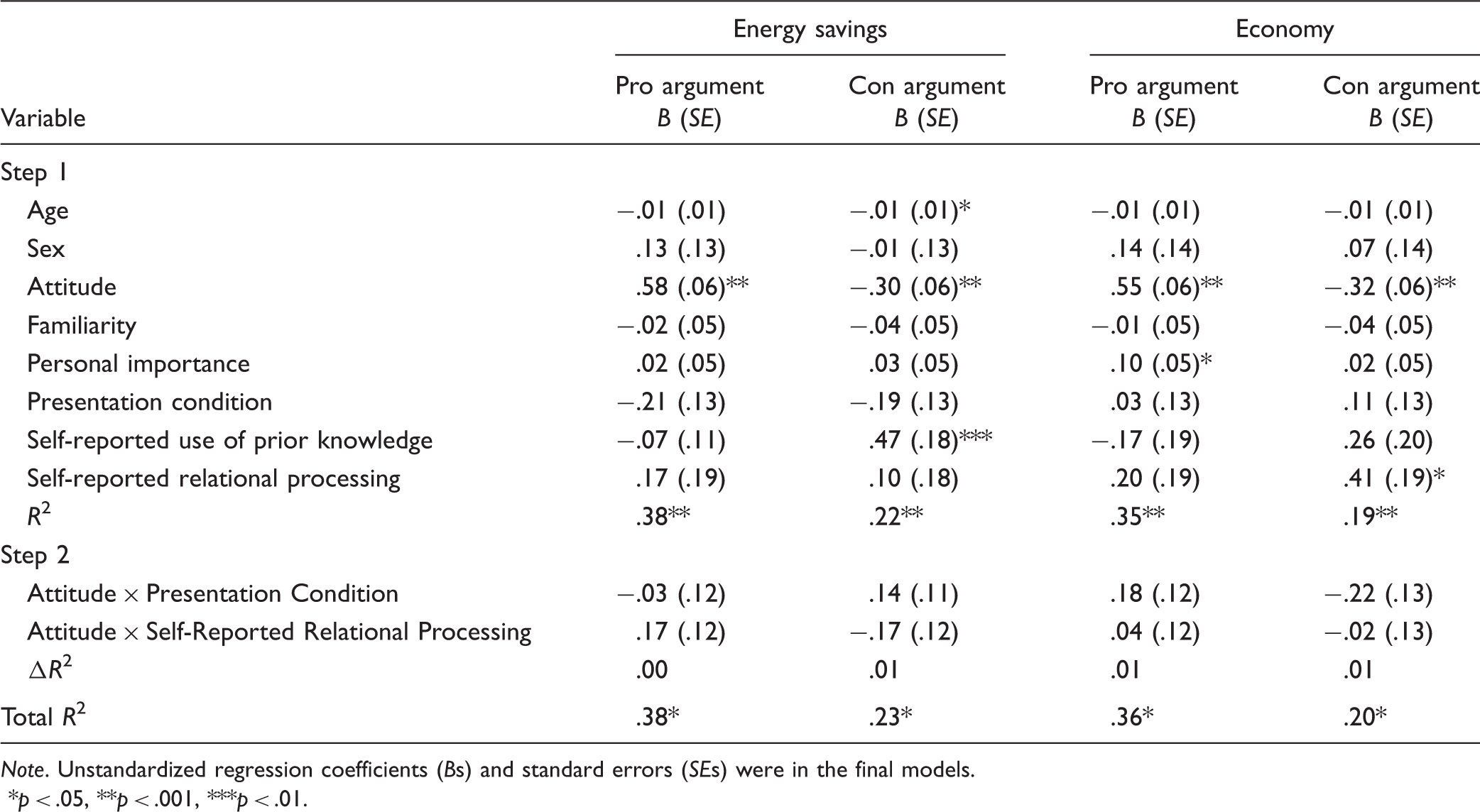
Note. Unstandardized regression coefficients (Bs) and standard errors (SEs) were in the final models.
p < .05,
p < .001,
p < .01.
Study 2
Study 1 found that neither the simultaneous presentation of the conflicting arguments nor the participants' self-reported relational processing had a substantial influence on biased assimilation. However, these findings might be due to two methodological limitations. First, relational processing might not have worked because the conflicting arguments adopted as the stimulus material did not refute the opposing argument or permit direct comparison in terms of evidentiary quality. This seems likely, given that the advantage of relational processing in the context of argument evaluation is to compare and contrast conflicting arguments, thereby gaining information on the quality of each argument (Geisler, 1994; Kobayashi, 2015; Wineburg, 1991). Participants might not have gained sufficient information for the evaluation of each argument by relational processing, and therefore, might have relied on their preexisting attitudes. Second, the measure of self-reported processing used in Study 1 might have been inadequate to assess relational processing. Therefore, the analyses might have failed to detect the effects of presentation mode on participants' self-reported engagement in relational processing and the moderating effects of relational processing on biased assimilation.
To address these methodological limitations, Study 2 was modified in two ways. First, the stimulus material was slightly modified so that participants would take advantage of relational processing. More specifically, critical information enabling the direct comparison was added to the arguments. Second, the measure of relational processing during the argument evaluation was extended. Also, a measure assessing the extent to which participants paid attention to the critical information was added.
Method
Participants
A panel of Japanese members maintained by Intage Inc. was invited by e-mail to participate in an Internet-based survey experiment. Of the 2,319 invited members, 447 participants completed the study (a power of 0.90, at α = .05, for detecting a small effect size). The sample included 48.1% females; 17.2% were 18 to 29 years old, 18.3% 30 to 39 years old, 22.6% 40 to 49 years old, 19.9% 50 to 59 years old, and 21.9% 60 to 69 years old (M = 44.92 years, SD = 14.29); 50.3% were full-time workers, 19.9% full-time wives, 7.4% retired and unemployed persons, and 6.9% students; and 62.4% were from Eastern Japan and 37.6% from Western Japan. None of these individuals participated in Study 1. Participants were randomly assigned to either the sequential presentation condition or the simultaneous presentation condition.
Measures
Preexisting attitudes, familiarity, personal importance, and evaluation of arguments. The same measures as in Study 1 were used. The reliability of the attitude measure (Cronbach's α) was .85 (r = .73, p < .001). The convincingness and validity ratings of each argument were highly correlated (rs = .74–.80, p < .001; Cronbach's αs = .85–89) and were therefore averaged.
Arguments. The same sets of conflicting arguments as in Study 1 were used with a few modifications (see Appendix). For the set of conflicting arguments on energy savings, critical information consisting of a few words and phrases was added to indicate that the estimate of energy savings by daylight saving time (reported in 1998) cited in the pro argument was outdated in comparison with the latest estimate of energy savings (announced in 2014) cited in the con argument. For the set of conflicting arguments on economy, a phrase was added so that the estimated economic benefits of daylight saving time (approximately 970 billion yen) in the pro argument greatly exceeded the estimated costs of introduction (approximately 50 billion yen) in the con argument. The critical information was the amount of money presented as the estimated economic benefits or costs. Participants received one of the two sets.
Self-reported relational processing. Participants rated the extent to which they performed each of the following two acts, using a 7-point Likert-type scale ranging from 1 (Not at all) to 7 (Very much so): for the sequential presentation condition, “I evaluated the second author's argument, comparing and contrasting it with the first author's argument in my memory” and “I weighed the trial calculations cited in the two authors' arguments, relying on memory”; and for the simultaneous presentation condition, “I evaluated the two authors' arguments, comparing and contrasting their arguments” and “I weighed the trial calculations cited in the two authors' arguments.” The two ratings were highly correlated (rs = .67 and .68, ps < .001; Cronbach's αs = .80 and .81) and were therefore averaged.
Memory for critical information. A multiple-choice test was prepared to examine the extent to which participants paid attention to the critical information presented in the arguments of each set. This test consisted of two questions assessing their memory for the critical information. For energy savings, the two questions were as follows: “When, according to Yuki Sakashita, did the Centre for Socio-Economic Development report the trial calculation supporting the energy-saving effect of daylight saving time?” and “When, according to Tomoko Sato, did the Ministry of Environment announce the trial calculation opposing the energy-saving effect of daylight saving time?” Participants chose one from five alternatives: “1998,” “2005,” “2014,” “the author did not mention it,” and “I do not know.” For economy, the two questions were as follows: “What, according to Yuki Sakashita, did the Ministry of Economy, Trade and Industry estimate the economic benefits of daylight saving time at?” and “What, according to Tomoko Sato, did the private think tank estimate the total costs of introducing daylight saving time at?” Participants chose one from five alternatives: “approximately 50 billion yen,” “approximately 400 billion yen,” “approximately 970 billion yen,” “the author did not mention it,” and “I do not know.” Each correct choice scored one point.
Procedure
The same procedure as in Study 1 was used with the following exception. Participants rated their engagement in relational processing and then took the multiple-choice test after their evaluation of the conflicting arguments.
Results and Discussion
Preliminary analyses
Inspections of quantile-quantile plots against the normal distribution for continuous variables indicated that the distribution of each variable was approximately normal. The mean score for attitude was 3.85 (SD = 1.29). Of the 447 participants, 156 supported the introduction of daylight savings time into Japan (over the score of 4.00), 123 were neutral (4.00), and 168 opposed it (below 4.00). The mean ratings of familiarity and personal importance were 3.55 (SD = 1.35) and 3.78 (SD = 1.46), respectively. There were no significant differences between the sequential and simultaneous presentation conditions in attitude, familiarity, or personal importance: for energy savings, ts < 1.45, and for economy, ts < 1.40.
Means and Standard Deviations of Self-Reported Relational Processing and Memory for Critical Information as a Function of Issue and Presentation Condition in Experiment 2.

The mean scores for perceived quality of the pro and con arguments on energy savings were 3.88 (SD = 1.17) and 4.47 (SD = 1.06), respectively. The mean scores for perceived quality of the pro and con arguments on economy were 3.95 (SD = 1.23) and 4.29 (SD = 1.00), respectively.
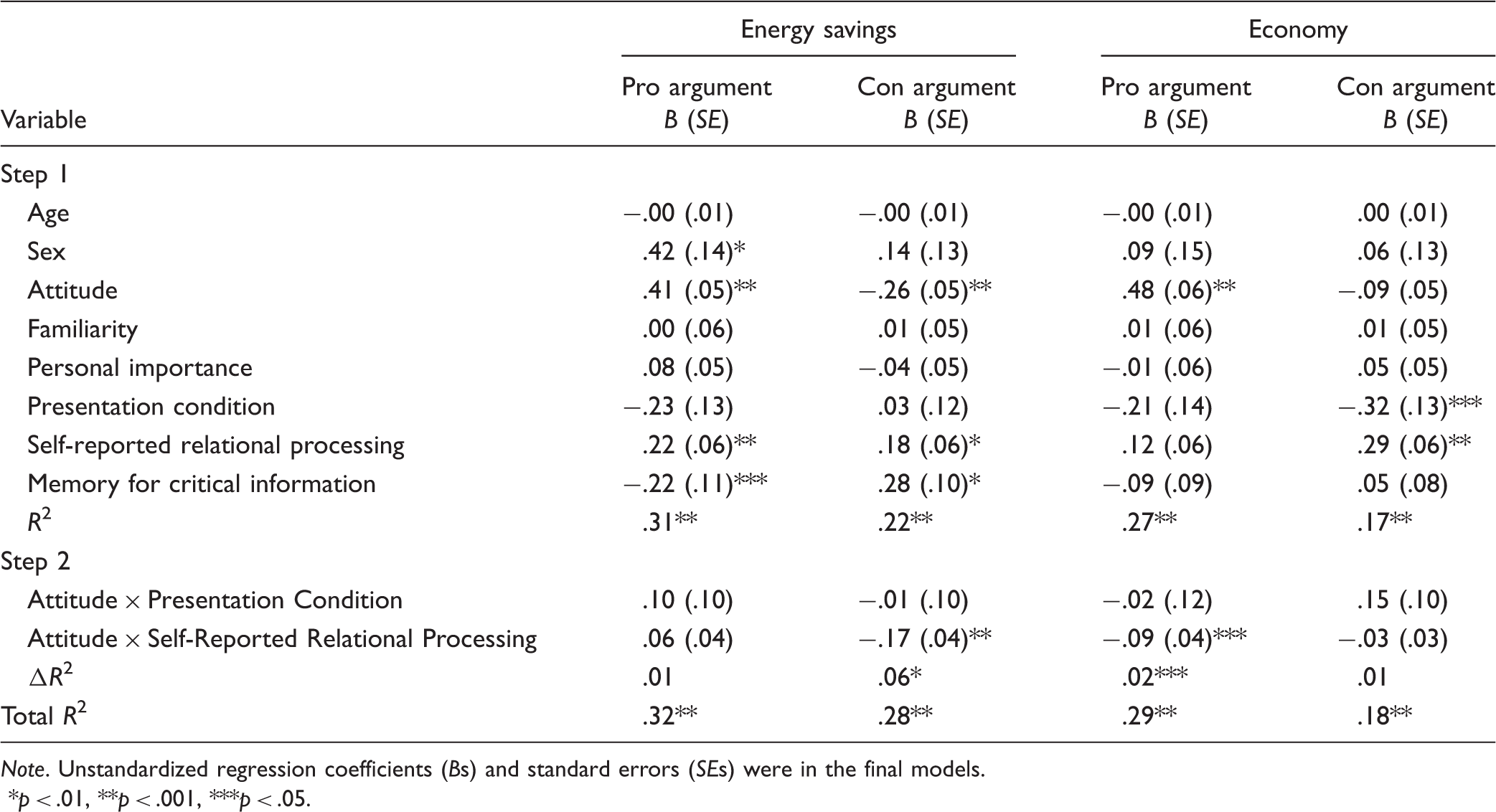
Hierarchical regression analyses were conducted separately on the perceived quality of the pro- and antiarguments on energy savings and economy. In Step 1, age, sex, attitude, familiarity, personal importance, presentation condition, self-reported relational processing, and memory for critical information were entered. In Step 2, Attitude × Presentation Condition interaction and Attitude × Self-Reported Relational Processing interaction were entered. The predictor variables were mean-centered.
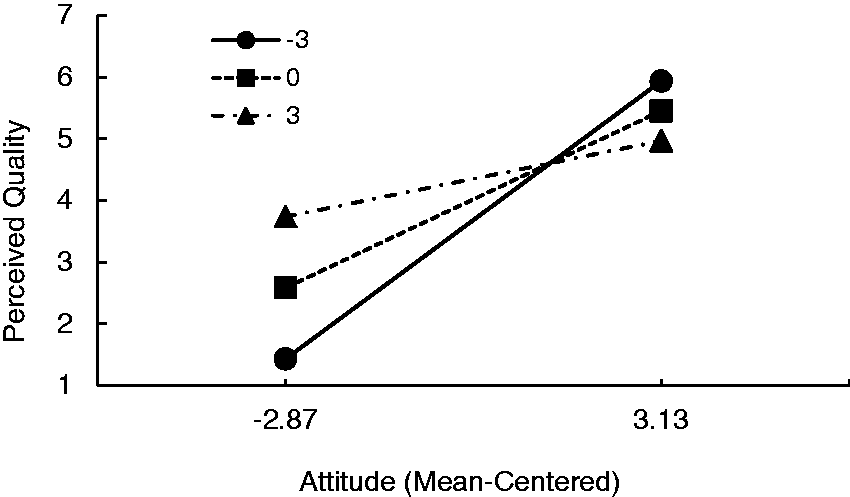
The results of the hierarchical regression analyses are presented in Table 4. Attitude significantly predicted perceived quality of the pro arguments on energy savings (B = .41, SE = .05, p < .001, f2 = 0.23) and on economy (B = .48, SE = .06, p < .001, f2 = 0.31) and the con argument on energy savings (B = −.26, SE = .05, p < .001, f2 = 0.10), except the con argument on economy (B = −.09, SE = .05, f2 = 0.01). With regard to energy savings, Step 2 significantly contributed to the regression models for the antiargument (ΔR2 = .06, p < .001) but not for the pro argument (ΔR2 = .01). Only Attitude × Self-Reported Relational Processing interaction was significant (B = −.17, SE = .04, p < .001, f2 = 0.04). This interaction was probed, using the Johnson–Neyman technique. The simple slopes defining the effect of attitude were significantly smaller than zero when the mean-centered ratings of self-reported relational processing were over .80 SD below the mean (Figure 1). With regard to economy, Step 2 significantly contributed to the regression models for the pro argument (ΔR2 = .02, p < .05) but not for the con argument (ΔR2 = .01). Only Attitude × Self-Reported Relational Processing interaction was significant (B = −.09, SE = .04, p < .05, f2 = 0.02). The decomposition of this interaction revealed that the simple slopes defining the effect of attitude were significantly greater than zero when the mean-centered ratings of self-reported relational processing were under 2.86 SD above the mean (see Figure 2). In summary, the presentation mode of the conflicting arguments had no influence on biased assimilation, regardless of issue and argument type. Thus, Hypothesis 2 was not supported. However, participants' self-reported relational processing moderated the relation between their preexisting attitudes and evaluation of the arguments. Their active engagement in relational processing increased biased assimilation for the con argument on energy savings and decreased it for the pro argument on economy. These results were partly consistent with Hypothesis 3.
Interaction between attitude and self-reported relational processing for perceived quality of antiargument on energy savings in Experiment 2. Each line corresponds to a different mean-centered rating of self-reported relation processing. Interaction between attitude and self-reported relational processing for perceived quality of pro argument on economy in Experiment 2. Each line corresponds to a different mean-centered rating of self-reported relation processing. Results of Hierarchical Regression Analyses in Experiment 2. Note. Unstandardized regression coefficients (Bs) and standard errors (SEs) were in the final models. p < .01, p < .001, p < .05.
General Discussion
The present study addressed three research questions concerning relational processing of conflicting arguments and its effects on biased assimilation. The first research question was whether exposure to conflicting arguments leads to biased assimilation. Although there is much research support for the biased assimilation of conflicting arguments, the findings were mainly based on a sample of undergraduate students (e.g., Corner et al., 2012; Lord et al., 1979; Miller et al., 1993; Taber & Lodge, 2006). As an exceptional case, Druckman and Bolsen (2011) found that biased assimilation occurred, using a sample of voters who were recruited at their polling places. In the present study, participants came from a panel of adults from 18 to 69 years old and across Japan. The results of Studies 1 and 2 are consistent with prior findings, increasing the generalizability of biased assimilation to the general population.
Second, the present study addressed the question of whether recipients engage in relational processing when conflicting arguments are presented simultaneously more than when presented sequentially. Studies 1 and 2 found no evidence that the simultaneous presentation of the conflicting arguments encouraged participants to engage in relational processing.
Unexpectedly, the data concerning self-reported relational processing revealed that participants were not necessarily passive in relational processing, regardless of presentation condition. Quite a few participants reported that they engaged in relational processing to varying degrees. Contrary to the underlying assumption of biased assimilation research that conflicting arguments are separately processed and evaluated, it seems that relational processing is common in the context of argument evaluation. Additionally, the findings suggest that neither the participants' cognitive capacity nor their efforts were major factors determining whether and how they engaged in relational processing, given that connecting conflicting arguments strategically is more cognitively demanding when the arguments are presented sequentially rather than simultaneously. Other cognitive and motivational factors, such as epistemic beliefs (Barzilai & Zohar, 2012; Wineburg, 1991) and need for cognition (Bråten, Anmarkrud, Brandmo, & Strømsø, 2014), might have had a greater influence on their engagement in relational processing. Or alternatively, the sets of conflicting arguments used as the stimulus material in the present study were not so long or complex, and therefore, even participants in the sequential presentation condition might have been able to strategically connect the arguments without much effort or posing a heavy burden on their working memory. To examine these possibilities, further work is needed.
The third and most important research question was whether and how relational processing of conflicting arguments influences the biased assimilation of the arguments. Two studies found that the presentation mode of the conflicting arguments had no influence on biased assimilation. This is unsurprising, considering that the simultaneous presentation did not encourage participants to engage in relational processing. However, results of Study 2 support and extend the idea that relational processing plays a substantial role in the argument evaluation (Anmarkrud et al., 2014; Geisler, 1994; Kobayashi, 2010), suggesting that at least under certain circumstances, recipients' engagement in relational processing increases or decreases the bias in their evaluation of conflicting arguments.
It is important to note that participants in the present study, on the whole, were not skillful in relational processing. Study 2 found that participants' memory for critical information was generally poor: Ms = 0.37 for energy savings and 0.87 for economy, with the possible scores ranging from 0 to 2. Additionally, there were no substantial correlations between self-reported relational processing and memory for critical information, suggesting that participants' relational processing hardly increased their attention to critical information. Prior research has suggested that less experienced recipients are not only passive in relational processing but also have difficulty in recognizing and understanding meaningful relations between arguments (Geisler, 1994; Wineburg, 1991). Consequently, they may interpret the individual arguments and the interargument relations in a biased manner that maintains or strengthens their preexisting attitudes (Kobayashi, 2010). It is likely that, in a similar vein, the present participants failed to take full advantage of relational processing. This provides one potential explanation for why, in Study 2, participants' self-reported relational processing increased or did not influence the biased assimilation of the conflicting arguments on energy savings.
The fact that relational processing can reduce or increase the influence of preexisting attitudes on the evaluation of conflicting arguments would have important implications for biased assimilation research. First of all, whether and how recipients engage in relational processing deserve more attention in future theoretical and empirical investigation of biased assimilation. Given that relational processing is not rare and plays a role in the argument evaluation, it is unreasonable to assume that separate processing and evaluation of arguments are normal and normative. Different mechanisms and factors may contribute to biased assimilation according to whether arguments are dealt with individually or inter-relatedly. To develop a more comprehensive theory of biased assimilation, future research might consider this possibility. Another implication concerns the development of debiasing techniques. In contrast to the robustness of biased assimilation, how to reduce the bias has received relatively little research attention. Only a few studies have explored debiasing techniques for the biased assimilation of conflicting arguments (e.g., Correll et al., 2004; Lord, Lepper, & Preston, 1984). The present findings suggest that, in some cases, recipients' engagement in relational processing reduces the influence of their preexisting attitudes on the argument evaluation. Although, as noted earlier, there may be cases in which inadequate relational processing backfires, one's ability to strategically connect conflicting arguments can be enhanced (Nokes, Dole, & Hacker, 2007; Salmerón, Gil, Bråten, & Strømsø, 2010; Stadtler, Scharrer, Skodzik, & Bromme, 2014). Future research on debiasing techniques may benefit from the investigation of relational processing that works adequately.
Despite these implications, there are some methodological limitations to the present study. First, the simultaneous presentation of the conflicting arguments was unsuccessful at facilitating participants' self-reported engagement in relational processing. This means that how they processed the arguments was not experimentally manipulated. Uncontrolled factors, such as participants' abilities and skills to deal with each argument (Kuhn, 1991) and their defense or accuracy motivation (Bolsen, Druckman, & Cook, 2014; Kunda, 1990), that covaried with their self-reported relational processing might have influenced biased assimilation. Further work needs to establish the causality between relational processing and biased assimilation by controlling for the possible correlates and experimentally manipulating the manner in which conflicting arguments are processed. Second, the present data did not enable a detailed analysis of how participants processed and evaluated conflicting arguments. Although their engagement in relational processing was assessed using self-report measures, more process-based data are needed to provide insight into the psychological mechanisms underlying the moderating effects of relational processing. Prior research has suggested that asymmetric processing of attitude-congruent and- incongruent arguments leads to biased assimilation (Edwards & Smith, 1996; Taber et al., 2009; Taber & Lodge, 2006). By using measures such as thought-listing and reading time (Edwards & Smith, 1996), future research should address whether and how relational processing influences the asymmetry. Finally, the present study used only two sets of conflicting arguments concerning the introduction of daylight saving time as the stimulus material. Therefore, it is possible that the characteristics of these argument sets (e.g., issue, argument length, and complexity) influenced the moderating effects of relational processing as well as the effects of presentation mode. To ensure that the present findings can be generalized to other sets of conflicting arguments, further work is needed.
Footnotes
Appendix
Declaration of Conflicting Interests
The author declared no potential conflicts of interest with respect to the research authorship, and/or publication of this article.
Funding
The author disclosed receipt of the following financial support for the research authorship and/or publication of this article: This research was supported by JSPS [Grant-in-Aid of Scientific Research (C) No. 15K04055].