




Abstract
A series of recent studies in the U.K. and in Australia has drawn attention to the distinctive psychological type profile of churchgoers compared with non-churchgoers or with the general population. This study extends that research to Italy. A sample of 1,155 Italians between the ages of 14 and 80 completed the Italian form of the Francis Psychological Type Scales (translated and tested within the Salesian Pontifical University) together with a measure of their frequency of church attendance. The data demonstrated that intuitive types and thinking types were under-represented in church congregations in Italy. This pattern is broadly consistent with findings from the U.K. and Australia.
Introduction
When Argyle (1958) wrote his pioneering summary of the state of knowledge generated by the empirical psychology of religion up to the mid-1950s, he concluded that there were insufficient robust studies exploring the connections between personality and religion to permit generalisations from their findings. By the time of Argyle’s third review of the field in the mid-1990s, as documented by Beit-Hallahmi and Argyle (1997), he revised his conclusion to affirm that sufficient consistent evidence had been accumulated to establish a secure link between personality and religion based on Eysenck’s three major dimensions of personality (Eysenck & Eysenck, 1975, 1976). In more recent reviews, Saroglou (2002, 2010) has documented the link between personality and religion based on the Big Five factor model of personality (Costa & McCrae, 1985). Alongside these two well-established models of personality (the three major dimensions and the Big Five factors), a third model, psychological type theory, has been playing an increasing role within the empirical psychology of religion and empirical theology (see Francis, 2009; Lewis, 2012, 2015; Ross, 2011; Village, 2011). One specific set of questions to which psychological type theory has made a significant contribution concerns the connection between personality and church attendance. Are some psychological types more inclined to attend church than others? If so, does such a tendency have implications for the psychological profile of local churches and for the comfort or discomfort of other psychological types who may experience difficulty in integrating themselves within such local churches?
Psychological type theory has its roots in the pioneering work of Jung (1971) and differs from the models of personality proposed by the three major dimensions and the Big Five factors in two important aspects of conceptualization. While the three major dimensions model deliberately links individual differences in normal personality with abnormal personality disorders (naming the high scoring ends of two dimensions as neuroticism and psychoticism), psychological type theory restricts discussion to variations in normal personality. While the three major dimensions model and the Big Five factor model locate individuals along personality continua, psychological type theory operates in terms of discrete personality types. Following Jung’s initiative, psychological type theory has been developed and extended in a variety of ways, particularly through the operationalization of psychological type constructs by instruments like the Myers-Briggs Type Indicator (Myers & McCaulley, 1985), the Keirsey Temperament Sorter (Keirsey & Bates, 1978), and the Francis Psychological Type Scales (Francis, 2005). Each of these instruments generates continuous scale scores on the basis of which discrete type categories are calculated. Various studies have examined the correlations between these continuous scale scores and other established models of personality (Francis, Craig, & Robbins, 2007, 2008; Francis & Jones, 2000).
A strength of psychological type theory (and inevitably also a weakness) concerns the way in which it has developed (and relies on) a highly distinctive use of language. This distinctive use of language needs to be clarified at the outset and involves giving close attention to the following constructs: perceiving as expressed through sensing and intuition, judging as expressed through thinking and feeling, orientation concerned with sources of psychological energy as expressed through introversion and extraversion, and attitudes toward the external world as expressed through perceiving and judging. At its heart, psychological type theory distinguishes between two core mental processes: the perceiving process that is concerned with gathering information and the judging process that is concerned with evaluating information. According to psychological type theory each of these two processes is expressed through two contrasting functions. The perceiving process (P) is expressed through sensing (S) or intuition (N). The judging process (J) is expressed through thinking (T) or feeling (F). Psychological type theory also distinguishes between two orientations or sources of psychological energy and between two attitudes or approaches to the external world. The two sources of psychological energy are styled introversion (I) and extraversion (E). The two attitudes toward the external world are styled judging (J) or perceiving (P) reflecting the psychological process directed to the external world.
Psychological type theory suggests that there are innate predispositions within individuals to prefer (and therefore to develop) one of each of the pairs of characteristics: extraversion or introversion, sensing or intuition, thinking or feeling, and judging or perceiving. It is these developed preferences that shape individuals’ habitual approach to life. Introverts, who gain their energy from the inner world, prefer quiet and their own space in which to work. Extraverts, who gain their energy from the outer world, prefer to share their thinking and to collaborate with others. Sensing types prefer to work with data and facts and are cautious of too much change. Intuition types prefer to work with ideas and theories and enjoy innovative change. Thinking types reach their decisions and make their choices on the basis of objective, logic, and analysis. Feeling types reach their decisions and make their choices on the basis of personal values and interpersonal relationships. Judging types prefer to operate in a tightly structured and organized environment. Perceiving types prefer to keep plans and organization to a minimum in order to maintain openness and flexibility.
These basic building blocks of psychological type theory can be applied in a variety of ways. At the simplest level (as discussed so far), the four component constructs can be discussed separately: the two orientations (extraversion and introversion), the two perceiving functions (sensing and intuition), the two judging functions (thinking and feeling), and the two attitudes toward the outer world (judging and perceiving). A second approach deals in terms of “sixteen complete types.” According to this approach, an individual who prefers introversion (I), intuition (N), thinking (T), and judging (J) would be described as INTJ. A third approach deals in terms of identifying an individual’s best developed or strongest function (sensing, intuition, thinking, or feeling). According to this approach, individuals may be characterized as dominant sensing, dominant intuition, dominant thinking, or dominant feeling. Psychological type theory suggests that the dominant function shapes an individual’s profile: dominant sensing is reflected in the practical person; dominant intuition in the imaginative person; dominant feeling in the humane person; and dominant thinking in the logical person (see Myers & Myers, 1980).
One of the implications of psychological type theory is an appreciation of how organizations and groups of people can take on the psychological profile of its members. According to psychological type theory, a church shaped by extraverts would give greater emphasis to social activities than a church shaped by introverts, while a church shaped by introverts would give greater opportunities for quiet and reflection than a church shaped by extraverts. A church shaped by sensing types would hold much more tightly to the traditional than a church shaped by intuitive types, while a church shaped by intuitive types would enjoy innovative teaching and experimental worship more readily than a church shaped by sensing types. A church shaped by feeling types would give prominence to the God of mercy and promote a pastoral ministry, while a church shaped by judging types would give prominence to the God of justice and promote a teaching ministry. A church shaped by judging types would value a consistent pattern and structured programe, while a church shaped by perceiving types would value being responsive to changing situations and emerging opportunities.
In England and Wales, sociological studies of church congregations have routinely noted ways in which church congregations fail to reflect the profile of the wider society on which they draw. The most obvious of these differences concerns the over-representation of women and of older people within church congregations (see, for example, Francis, 1996). Alongside such sociological studies, a series of studies emerged from the late 1980s that reported on the psychological type profile of church congregations, including Gerhardt (1983), Delis-Bulhoes (1990), Ross (1993, 1995), and Rehak (1998).
Building on these earlier studies that explored the psychological type profile of church congregations, more recent studies are beginning to examine how the psychological profile of church congregations map onto the normative data available for the wider population. In an initial pilot study conducted among Anglican churchgoers in Wales, Francis, Robbins, Williams, and Williams (2007) compared their findings with the U.K. population norms published by Kendall (1998). They noted the over-representation in these congregations of introverts, sensing types, feeling types, and judging types (ISFJs). Replicating and extending this study among a larger sample of 3,304 Anglican churchgoers, Francis, Robbins, and Craig (2011) confirmed this basic pattern. In a third study, drawing on data from the Australian National Church Life Survey provided by 1,527 churchgoers across 18 denominations, Robbins and Francis (2011) found similar results in this different cultural context.
In order to test the thesis that individuals who did not conform to the ISFJ profile may feel less comfortable in and less committed to their congregations, Francis and Robbins (2012) designed a scale to assess congregational satisfaction and analyzed the mean scores recorded on this scale alongside the psychological type profiles of 1,867 churchgoers. The data showed that of the 16 complete types, the type reporting the lowest congregational satisfaction were ENTP, the mirror image of the ISFJ majority in churches.
Research Problem
The current state of knowledge about the distinctive psychological type profile of churchgoers has two limitations that the present project seeks to address, at least in part. First, current sources of data on this issue have been drawn exclusively from England, Wales, and Australia. The present study extends the geographical base for this research to include Italy. The research method so far employed has relied on setting two sources of data side-by-side. The psychological type profile of church congregations has been established by inviting churchgoers to take a recognized measure of psychological type in the context of a church service. The type profile of these churchgoers has then been compared with the type profile derived from more general population studies. Not only have the data been collated in different ways for the two profiles being compared, but different measures of psychological type have been employed in the two situations. The present study proposes to conduct a survey among Italians in which frequency of church attendance and psychological type data are collected side-by-side. From these data, comparisons can be drawn between regular attenders (at least monthly) and non-attenders within one database. In view of the known differences in the psychological type profile of men and women (see Kendall, 1998), analyses will be conducted for the two sexes separately.
Method
Procedure
An opportunity sample of participants was drawn from all over Italy (North, Central, and South). As part of a research methods course, trainee psychologists (operating under the supervision of a senior psychologist within the Institute of Psychology at the Salesian University in Rome) were invited to administer a questionnaire to approximately 10 diverse individuals. Participation was anonymous, and no monetary reward was offered or given. The informed consent procedure required written consent prior to participation, as agreed with the Institutional Review Board of the Salesian University. Questionnaires were administered, mainly at home, in the presence of a trainee psychologist. A total of 1,155 individuals submitted thoroughly completed questionnaires.
Measures
Psychological type was assessed by the Francis Psychological Type Scales (Francis, 2005). This 40-item instrument comprises 4 sets of 10 forced-choice items related to each of the four components of psychological type: orientation (extraversion or introversion), perceiving process (sensing or intuition), judging process (thinking or feeling), and attitude toward the outer world (judging or perceiving). A number of studies have demonstrated this instrument to function well in church-related contexts. For example, Francis, Craig, and Hall (2008) reported alpha coefficients of .83 for the EI scale, .76 for the SN scale, .73 for the TF scale, and .79 for the JP scale. Participants were presented each pair of characteristics and asked to “check the box next to that characteristic which is closer to the real you, even if you feel both characteristics apply to you. Tick the characteristics that reflect the real you, even if other people see you differently.” The Italian translation of this instrument originated within the Salesian Pontifical University, employing the conventional practice of translation and back-translation. The translated instrument had lower alpha coefficients than the original English version: .74 for the EI scale, .64 for the SN scale, .56 for the TF scale, and .65 for the JP scale.
Participants
The participants (N = 1,155) comprised 538 men and 617 women ranging in age from 14 to 80 years (M = 30.7, SD = 15.1); 247 were in their teens, 493 in their 20 s, 199 in their 30 s or 40 s, and 216 were aged 50 or over; 878 were from Central Italy, 69 from North Italy, and 208 from South Italy. In terms of religious worship attendance, 366 never attended services, 342 attended services at least once a month (of whom 276 attended weekly), and the remaining 447 attended less frequently than once a month. In terms of personal prayer, 402 never prayed, 311 prayed occasionally, 61 prayed at least once a month, 104 prayed at least once a week, and 277 prayed almost every day.
Analysis
The research literature concerning the empirical investigation of psychological type has developed a highly distinctive method for analyzing, handling, and displaying statistical data in the form of “type tables.” This convention has been adopted in the following presentation in order to integrate these new data within the established literature and to provide all the detail necessary for secondary analysis and further interpretation within the rich theoretical framework afforded by psychological type. Type tables have been designed to provide information about the 16 complete psychological types, about the four dichotomous preferences, about the six sets of pairs and temperaments, about the dominant types, and about the introverted and extraverted Jungian types. Commentary on this table will, however, be restricted to those aspects of the data strictly relevant to the research question.
Results
Type Distribution for Italian Females Who Attend Church at Least Monthly.

Note. E: extraversion; F: feeling; I: introversion; J: judging; N: intuition; P: perceiving; S: sensing; T: thinking. N = 201 (NB: + = 1% of N).
Type Distribution for Italian Females Who Never Attend Church Compared With Those Who Attend at Least Monthly.

Note: E: extraversion; F: feeling; I: introversion; J: judging; N: intuition; P: perceiving; S: sensing; T: thinking. N = 172 (NB: + = 1% of N). *p < .05, **p < .01, ***p < .001.
Type Distribution for Italian Males Who Attend Church at Least Monthly.

Note. E: extraversion; F: feeling; I: introversion; J: judging; N: intuition; P: perceiving; S: sensing; T: thinking. N = 141 (NB: + = 1% of N).
Type Distribution for Italian Males Who Never Attend Church Compared With Those Who Attend at Least Monthly.
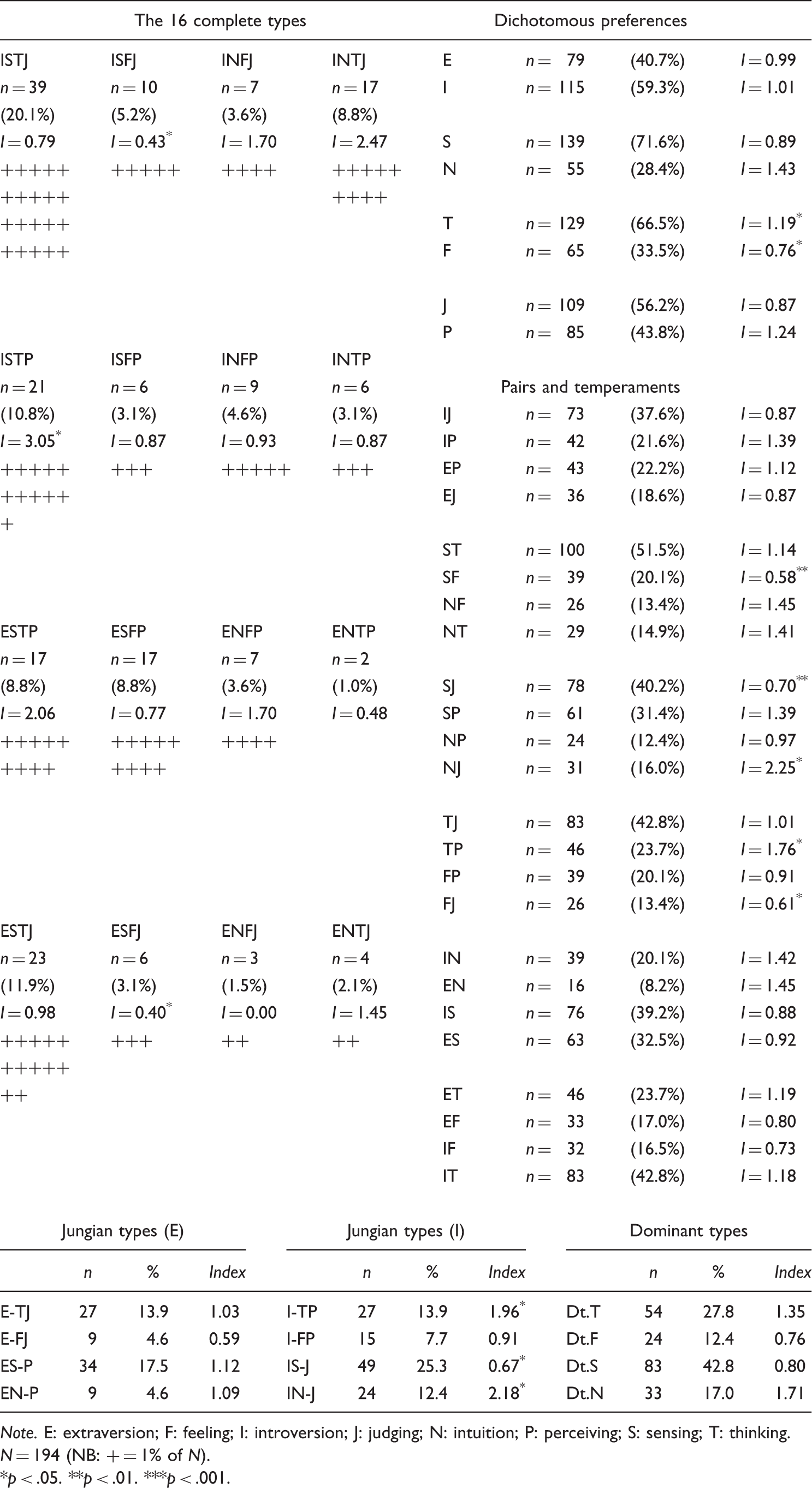
Note. E: extraversion; F: feeling; I: introversion; J: judging; N: intuition; P: perceiving; S: sensing; T: thinking. N = 194 (NB: + = 1% of N).
p < .05. **p < .01. ***p < .001.
Discussion
Four aspects of the data provided in the tables warrant further discussion. The first of these aspects concerns a general overview of the findings, while the other three aspects concern more specific findings.
The present study was designed to extend to Italy a research tradition already established in Wales (Francis et al., 2007), England (Francis et al., 2011), and Australia (Robbins & Francis, 2011). These studies had found that there are significant differences between the psychological-type profiles of churchgoers and those who do not attend church. A general overview of the findings from the present study demonstrates that this solution holds true in Italy as well as in Australia, England, and Wales. Further studies in other cultural contexts are, nonetheless, needed to test the wider generalization of this finding.
The first more specific finding is that, as in the earlier studies, a major component of the difference between the psychological-type profiles of churchgoers and non-churchgoers concerns the higher proportion of feeling types attracted to church attendance. In the present study, among Italian women, 62% of churchgoers preferred feeling, compared with 51% of non-churchgoers; among Italian men, 44% of churchgoers preferred feeling, compared with 34% of non-churchgoers. The higher proportion of feeling types in church congregations is noteworthy for two reasons. The first reason is that the feeling preference is much more strongly represented among women than among men in general population studies. For example, the British norms published by Kendall (1998) show 70% of women prefer feeling compared with 35% of men. Thus, not only do churches attract a higher proportion of women than of men, both the women and the men attracted by churches tend to prefer feeling (a feminine quality) more frequently than in the population as a whole. In this sense, church congregations can be seen as feminized institutions not only in the highly visible sense revealed by the high proportion of women but also in a less visible sense revealed by the higher proportion of feeling types among both men and women. The second reason is that a high proportion of feeling types may shape a distinctive style of community. Here is a community in which peace and harmony are highly prized and in which conflict and opposing opinions are seen as undesirable and dangerous. Such communities thrive in managing compromise and avoiding or side-stepping tough decisions. A community managed by feeling types may accept and tolerate poor leadership and ill-mannered members rather than run the risk of alienating or upsetting them. A community managed by feeling types may prefer not to deal with problems head-on, sometimes to the detriment of the community and to the exclusion of thinking types, who walk away from institutions to which they are permitted to offer little structural critique or practical reformation.
The second more specific finding is that, as in the earlier studies, a second component of the difference between the psychological-type profiles of churchgoers and non-churchgoers concerns the lower proportion of intuitive types attracted to church attendance. In the population as a whole, normative data show the strength of the sensing profile. For example, in Britain, Kendall (1998) found that 79% of women and 73% of men preferred sensing. What is shown by studies of churchgoers is that there is an even higher preference for sensing inside churches than within the population at large. In the present study among Italian women, 82% of churchgoers preferred sensing, compared with 73% of non-churchgoers (a statistically significant difference); among Italian men, 80% of churchgoers preferred sensing, compared with 72% of non-churchgoers (a difference that does not quite reach statistical significance). The higher proportion of sensing types in church congregations is noteworthy for the following reason. Sensing types have a profound commitment to protecting and preserving institutions as they have inherited them. They are unlikely to wish to experiment unnecessarily with change or to embrace novelty with enthusiasm. The stronger the presence of a sensing culture within local churches, the less likely it is that intuitive types will be able to affect those churches with their visions for future development and transformation. Intuitive types tend to become restless and uncomfortable in institutions that are resistant to their ideas and may choose to walk away from those institutions.
The third more specific finding is that, as in earlier studies, the SFJ profile is particularly prominent among churchgoers. In the present study, among Italian women, 10% of churchgoers reported ISFJ, compared with the 5% of non-churchgoers; among Italian men, 12% of churchgoers reported ISFJ, compared with 5% of non-churchgoers (both statistically significant differences). In the present study, among Italian women, 15% reported ESFJ, compared with 8% of non-churchgoers; among Italian men, 8% reported ESFJ, compared with 3% of non-churchgoers (both statistically significant differences). Thus, when the introverted orientation and extraverted orientation are considered together, the SFJ profile account for 25% of Italian female churchgoers and 20% of Italian male churchgoers. This concentration of SFJ characteristics may have a strong influence on the personality profile of church congregations as a whole. Here are practical, warm, and well-structured communities able to close ranks to exclude unwelcome disruptive influences threatening change and offering critique.
Conclusion
Several previous studies examining the psychological-type profiles of male and female churchgoers have found that some types are more likely than others to attend church (Francis et al., 2011; Francis et al., 2007; Robbins & Francis, 2011). Just as disproportionate numbers of women (compared with the population as a whole) have been found in church congregations, so are disproportionate numbers of some psychological types (particularly ISFJ). The aim of the present study was to build on these previous studies and to extend previous research in two ways. First, previous research had been confined to England, Wales, and Australia; the present study was conducted in Italy. Second, previous research had relied on comparing data collected from churchgoers during services in local churches with population norms; the present study gathered information about church attendance and psychological-type profile at the same time in a survey involving an opportunity sample of 1,155 participants.
The data generated by the present study has made two original contributions to knowledge. The first original contribution to knowledge concerns the way in which these new data have confirmed the conclusion drawn by Francis et al. (2007, 2011) in England and by Robbins and Francis (2011) in Australia that church congregations attract and retain some psychological types more than others. The crucial point is that this conclusion has been generated by a different method. While the three studies in Wales, England, and Australia all compared the psychological profile generated by people sitting in church congregations with the available population norms (that inevitably included churchgoers and non-churchgoers), the present study employed self-report data on frequency of church attendance gathered from an opportunity sample. That the same conclusion emerged from different methodological approaches adds security to the conclusion.
The second original contribution to knowledge concerns the way in which these new data have tested the association between psychological type and church attendance within a very different sociological context. Compared with Wales, England, and Australia, Italy remains a puzzle within the sociology of religion, as a country in which about 90% of the people still define themselves as Catholic (Vezzoni & Biolcati-Rinaldi, 2015) and in which the presence of the Catholic Church remains highly visible, while at the same time mass attendance is declining and traditional religiosity is being supplemented by other expressions of spirituality (Giordan, 2007, 2010; Palmisano, 2010).
As the first study exploring the connection between psychological type and churchgoing in Italy, this study has generated findings worthy of further investigation. The main weakness with the study concerns the nature of the sampling and the limited number of participants. While the original database included 1,155 participants, the exclusion of those who attended church sometimes but less than monthly reduced the effective number of participants to 708 and to group sizes varying from 141 for churchgoing males to 201 for churchgoing females. The convention of type tables to present data on the 16 complete types inevitably results in small cell sizes. Future research in Italy could replicate the present study among a larger group of participants. Then, the next step after that could be the careful surveying of whole church congregations in Italy as undertaken by the foundation studies reported in England and Wales and in Australia.
Footnotes
Declaration of Conflicting Interests
The authors declared no potential conflicts of interest with respect to the research, authorship, and/or publication of this article.
Funding
The authors received no financial support for the research, authorship, and/or publication of this article.