




Abstract
In this study, we present research intended to establish the predictive variables related to satisfaction among different members of the educational community when including students with Asperger syndrome (AS) in the university system. This international study takes into account the opinions of students with AS who are at university as well as their families and the teaching staff directly involved in their learning process (N = 83). The results obtained through an ad hoc questionnaire indicate that both curricular and organizational pedagogical factors were predictive of the satisfaction of the students with AS in higher education.
Keywords
Introduction
According to their psychosocial and pedagogical features, people with an autistic spectrum disorder of Level 1, and specifically a diagnosis of Asperger syndrome (AS), are characterized by a lack of the capacity to associate stimuli to meaningful or global entities. That is, in their specific way of processing information related to perceptual and cognitive variables, people with AS typically exhibit literality in perception, deficits in inductive thinking, and also deficits in establishing connections between external inputs and intrinsic information. This particular processing (reception, encoding, and response) of information makes it completely necessary to inform an educational process adapted to their needs and to ease access for these people to general studies and university studies, in particular (Alquraini & Gut, 2012; Gobbo & Shmulsky, 2012, 2014; Kite, Tyson, & Gullifer, 2011; McCrimmon, Schwean, Saklofske, Montgomery, & Brady, 2012; Minihan, Kinsella, & Honan, 2011; Ojea, 2008; Price, Shiffran, & Kerns, 2012; Stephenson, O’Neill, & Carter, 2012; Werner & Grayzman, 2011; Whitburn, 2013). With the intention of facilitating an adapted educational process, policy is needed for an inclusive education. This policy would require that universities meet the needs of all students, whatever their personal, psychological, or social characteristics. Construction of an innovative formative system for inclusion is possible; it must be bound to access, participation, and achievement of all students. But to create such a system, it is important that all stakeholders in the education system (students, teachers, and families) have an overall attitude and vision that facilitates the necessary approach. With this perspective, inclusive education will demand development and global changes involving the whole education system (Alzugaray, Mederos, & Sutz, 2011; Fernández, Álvarez, & Malvar, 2012; García & Cotrina, 2011; Slee, 2011; Smith, 2010; Soresi, Nota, & Wehmeyer, 2011; Styslinger, 2012; Yeo, Neihart, Tang, Chong, & Huan, 2011).
The prescribed action established by the United Nations Organization and changes promoted by the European Higher Education Area (European Commission, 2011; United Nations Organization, 1966, 2006; United Nations Organization for Education, Science and Culture, 1994) have offered an opportunity to reflect on the university system and with special emphasis on the needs of students (Vieira & Vidal, 2006). University education must guarantee a continuity of development and all-round training to the student, both at the academic level and the sociopersonal level. In the case of students with AS, this development must involve socioeducational adaptation and access to the curriculum, so the specific needs and particular interests are met (Luque & Rodríguez, 2008). As Alfonso and Díez (2008) emphasized, the creation of the European Higher Education Area demands that universities fulfill quality standards, attention to disabled students being one of the standards. In practice, this means a systemic plan must be implemented to guarantee an equal access for students with AS, as well as an equitable action and appropriate practices that lead to quality higher education (Álvarez, Alegre, & López, 2012; Bartolo, 2010; Sepúlveda, 2008; Sepúlveda, Medrano, & Martin, 2010). European universities have made great efforts to create programs and services oriented to support diverse students. In an international context, we can find experience in meeting the individual needs of university students with AS (Nielsen, 2011; Osborne & Reed, 2011; Pillay & Bhat, 2012; Robinson, Curwen, & Ryan, 2012). In that respect, in 2011, the European Commission, the Academic Network of European Disability Experts, the Eurostat, the World Health Organization, and the Council of Europe worked together on the design and implementation of the Indicators of Disability Equality in Europe, providing facilities for research on the creation of indicators and criteria that allow adapted responses to the needs of university students. The development of indicators is related to the implementation of the Convention on the Rights of Persons with Disabilities following the new strategies for people with AS (European Commission, 2010). This effort examines indicators related to numbers of students with AS who successfully complete their higher education and identify three types of quantitative and qualitative indicators or criteria for educational centers (European Commission, 2011; Jallade, 2011; McAndrew, Farrow, & Cooper, 2012; Priestly & Lawson, 2009): (a) students’ rights according to current regulation and policies, (b) accessibility and barriers in the environment, and (c) equal participation for persons with disabilities.
In Spain, the implementation of global measures of attention to diversity started around 2000, and it is been heterogeneous and unequal at the different universities where it is been carried out (60% of the public universities). This means that many universities are not ready yet for integration of students with AS, not only because of architectural access issues but also because of their current regulations and curricular and educational organization. Although great efforts are being made to continue with the required measures to support and advise students with AS, the consolidation of the principles of equality of opportunities and nondiscrimination in the university system is still far from meeting current regulations (Fleischer, 2012; Flood, Hare, & Wallis, 2011; Griffith, Totsika, Nash, & Hastings, 2012a; Griffith, Totsika, Nash, Jones, & Hastings, 2012b; Hughes, 2012; Ruiz, Pistrang, & Mandy, 2012; Sawyer, Williamson, & Young, 2012; Sciutto, Richwine, Mentrikoski, & Niedzwiecki, 2012; Shady, Luther, & Richman, 2013; Sharma, Woolfson, & Hunter, 2012; Swain, Nordness, & Leader-Janssen, 2012; Tolrá, 1998; Voss & Bufkin, 2011). To resolve these problems, it is necessary to move forward on the design, approval, and application of regulations, which assure an appropriate attention and support to students with AS, specifying quality standards and good practice indicators for an efficient functioning of support services to students in all different contexts and, by doing so, building continuity into academic and professional training (Alcantud, Ávila, & Asensi, 2000; Forteza & Ortego, 2003; Luque & Rodríguez, 2008) over the students’ development. From this point of view, guidance and tutoring programs at universities are a basic element favoring quality and inclusion of students with different abilities, as they promote a model of integration in higher education (Álvarez, 2012; Bayot, del Rincón, & Hernández, 2002; Luque & Rodríguez, 2005).
According to Fernández et al. (2012), there is a lack of a clear, stable, and suitable policy informing teachers about students with AS. A consequence of this, as the research carried out by Castellana and Sala (2005) shows, is that there is a high percentage of teachers (72%) who are unaware of students with AS in their classes. Therefore, it would be difficult for them to offer the appropriate specific attention that will allow them to track all of these students’ progress (Castellana & Sala, 2005; Ferraz, 2002). As Ainscow (2001) emphasized, commitment from teachers is fundamental. When teachers are well informed and given suitable plans, they show neither lack of self-confidence nor discomfort in the presence of students with different abilities in their lecture rooms (Fernández et al., 2012). That is the reason why it is important to keep in contact with education professionals in the in initial stages of designing adaptive programs—to know their individualistic characteristics and the most effective resources to meet their needs, understanding they deal with different educational levels. The university teacher must have at their fingertips information about the psychosocial and educational characteristics of their students with AS.
In recent years, there has been a considerable increase in policies in favor of equality and disability, both at the legislative and action levels, which have led to a considerable increase in the number of students with AS accessing university studies, though the percentage of those who complete their degree is still very low. There are still many difficulties that students with disabilities must tackle if they decide to start university studies. Such difficulties explain why only 1% of the university students are classed as disabled and just 3% of people with AS hold a university degree. Universities have been steadily making changes and adjustments to ease physical access for people with AS and guarantee their participation under the same conditions as the rest of university students, to ensure normalization of university life. The university, as a public institution, is obliged to guarantee the right to education for everybody, with collaboration of all public administrations involved as well as social agents and organizations (Méndez, 2009; Trujillo & Cayo, 2006). In a legal context, the Constitutional Law 6/2001 of 21 December on universities, modified by the Constitutional Law 4/2007 of 12 April, establishes in Article 46.2b “equality of opportunities and no discrimination based on sex, race, religion or disability …” for students. The University Students’ Statue, passed by Royal Decree 1791/2010 on 30 December, states in Article 4 that “all university students, regardless racial or ethnic origin, religion, disability … have the right not to be discriminated against …” and continues in Article 12 by determining that “resources and necessary adaptations should be considered for students with AS to be able to exercise their rights on an equal basis …” This way, in the formerly mentioned Royal Decree, in Article 65, it has been established that “from each university the creation of … services to people with disabilities must be encouraged …”
Taking this context into account, it seems necessary to create a systematic plan of action, which enables monitoring and evaluation of the support of students with AS and the awareness of the needs themselves (Castro & Abad, 2009; Tinklin, Riddell, & Wilson, 2004; Vieira, 2008; Villa, Thousand, & Nevin, 2013; Villeneuve et al., 2013). This study had the following general objectives: (a) to analyze organizational and curricular explanatory variables in relation to the satisfaction of students diagnosed with AS; (b) to specify possible differences in satisfaction according to group of stakeholders (students with AS, their parents, and teachers); and (c) to present outlines of a general psycho-socio-educational action plan tailored to students with AS in higher education. Hypothesis 1. Organizational and methodological variables grouped into subgroups or dimensions will be explanatory of the satisfaction of the stakeholders surveyed. Hypothesis 2. There will be differences in satisfaction by group of stakeholders.
Method
Participants
This study involved 83 participants, of whom 32 were students diagnosed with AS studying for different university degrees, 24 teachers of students with AS, and 27 family members of these students (parents). Of the 32 students, 26 were men and 6 women; 18 were studying at universities in Spain, 6 in Italy, 4 in Mexico, and the other 4 in Chile. Likewise, 9 students were in the range of age 17 to 22 years, 10 between 23 and 28 years, and 3 were older than 29 years. As for the teachers instructing students with AS, 14 were men and 10 were women; 16 were taught at Spanish universities and 8 at Italian universities. Regarding the 27 family members who were surveyed, 12 lived in Spain, 7 in Italy, 4 in Mexico, and 4 in Chile. Of these, 8 were fathers and 19 were mothers of students with AS.
Design and Measure
Variables and Descriptions.
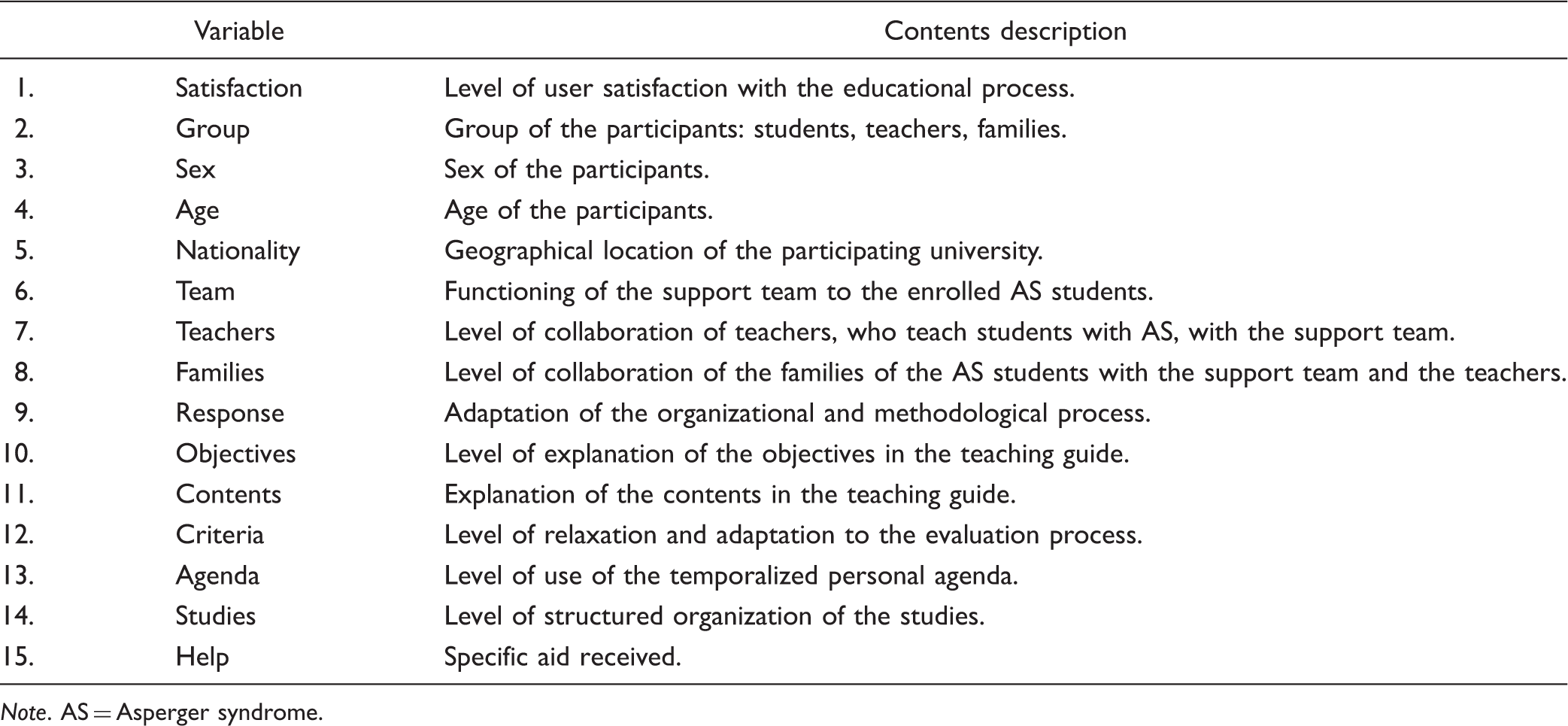
Note. AS = Asperger syndrome.
The questionnaire applied was based on the preparation of an ad hoc Likert-type questionnaire, using graded responses with anchors, 1: Strongly agree and 7: Completely disagree. Overall internal consistency reliability (Cronbach’s α) was α = .82 (N = 83).
Procedure
Based on the data from several students with AS who had completed their university studies at the University of Vigo, following specific programs coordinated by support teams, the questionnaire was tailored to the objectives of this research. The questionnaire was administered to the different groups of participants where enrollment processes for students with AS were carried out at the different universities. The resulting data were analyzed using the SPSS statistical package.
Results
Descriptive Statistics by Group: Students (n = 32), Parents (n = 27), and Teachers (n = 24; Total N = 83).

Hierarchical Regression (Dependent Variable: Satisfaction).

The first step of the analysis explained meaningful variance in Satisfaction (R2 = .22; corrected R2 = .18; p = .001). The second step significantly increased the variance explained (R2 = .40; corrected R2 = .34; p = .001). Finally, the third step showed an even greater increase in variance explained (R2 = .61; corrected R2 = .53; p = .001), which is a 20.7% increase compared with Step 1.
Games-Howell Multiple Comparisons Post Hoc Analysis.

Note. Dependent variable: Satisfaction. Differences in means are significant at p < .05.
The teachers’ responses substantially differed from those of the students and their families. These differences show a more objective assessment by the teachers, in relation to the development of the educational and organizational process and to the implementation of the measures adopted to ensure the adaptation to the needs of such students. On the other hand, students and their families have a more subjective perception of the process, more related to obtaining positive results regarding the acquisition of the competences of the university degree.
Discussion
The satisfaction of participants in the different groups of stakeholders surveyed with the perceived effectiveness of the specific educational activities was well explained by the selected dimensions. Educational factors, either organizational or curricular, explained the most variance in Satisfaction and therefore are excellent predictors of an effective educational process adapted to these students with AS, who followed their undergraduate studies at different universities.
The factors comprising the operation of the support team, collaboration of teachers, and the collaboration of families with the team greatly contributed to explain Satisfaction ratings. However, the educational response, clarification of objectives, definition of the contents, relaxation of the criteria of evaluation, temporalized use of the personal agenda, structured organization of the study, and use of immediate assistance constituted the major explanatory variables. Actually, the factors listed, as demonstrated in this research, had important predictive power relevant to setting quality standards for adaptation of schooling processes for AS students in higher education. Abad, Álvarez, and Castro (2008) stated that quality assurance systems of universities, currently included in the protocols of evaluation of degrees, have to consider various actions to encourage the adaptation of students with AS to university life by developing a system of coaching and mentoring tailored to their specific needs. Plans or programs of action must comprise a response process, properly sequenced and organized, affecting the whole schooling process in a comprehensive way, from the reception plan or tutorial action plan to processing specific individualized support programs for the development of basic skills consistent with prior needs assessments (Harpur, Lawlor, & Fitzgerald, 2004; Kaland, Mortensen, & Smith, 2011; Klin, Pauls, Schultz, & Volkmar, 2005; Maheady, Harper, & Mallette, 2001; Minne & Semrud-Clikeman, 2012; Nyden, Myren, & Gillberg, 2008).
Program Elements.

Note. AS = Asperger syndrome.
The organization and location of the classroom must meet a set of requirements. Among them, we would highlight the following: (a) trying to ensure a predictable environment in the classroom, which anticipates any changes, both in relation to the structure of the contents and to the duration or type of activities to be developed; (b) reserving a stable and permanent seat in the classroom for students with AS; (c) trying to avoid places with an excess of stimuli that may distract their attention, staying away from noisy environments that can affect the hypersensitivity of people with AS; (d) providing clear operating rules in the classroom and developing guidelines properly organized; (e) establishing clear guidelines for academic organization: how to send materials and give documents or reports; (f) determining in advance the contents, activities, and individual or group papers that must be properly specified in the paper or the digital platforms used; (g) properly anticipate the contents of lessons, informing the support team to progress in the process of understanding contents; (h) encouraging participation of students with AS in group activities, as well as allowing them to work individually, if desired; (i) specifying specific tutoring hours, both face-to-face and online, to ensure that they follow the activities planned properly, and they correctly understand the contents of the class; (j) providing in advance the material to be used in class or providing it on an accessible platform; and (k) specifying, meeting the support team, the type of evaluation best suited to the characteristics of students with AS, thus adjusting its format or relaxing the timing of the objectives assessments.
The specific individualized support plan must also include the following general objectives: (a) collaborating with teachers and families in the design of the specific support process for students with AS; (b) promoting collaboration of teachers and families in monitoring the support process; (c) collaborating in the initial assessment of needs of students with AS; (d) reporting on the choice of subjects per period, regulating the types and amount of contents, according to the needs assessment; (e) arranging and temporalizing content specifically; (f) establishing and monitoring the use of a personal agenda, both for planned activities and for the schedule of study, considering time and type of study, at the center and at home; (g) providing role-playing tests, using scripts listed in the personal agenda, in relation to the presentation of papers or public speeches; (h) establishing specific plans for the development of social and communication skills; and (i) designing specific support plans aiming to ease the acquisition of academic skills. Among the latter support skills are sequencing analysis of the information perceived; building information in a gestalt manner; developing progressive semantics of the processes perceived; enabling the creation of links related to the acquisition of information, to facilitate its recovery; developing capacities that enable analysis, synthesis, and criticism, along with the actual curricular practice; developing the ability to establish relationships, comparisons, similarities, and differences between the information received; developing capacities for personal inquiry and investigation; carrying out tests and mock situations before the real research process with other students; and developing levels of assessment and evaluation processes.
To ensure social and work integration, practice sessions should bring together the theory previously learnt and its application. Situations from an internship related to the degree should be simulated. Finally, guidelines for mediation and support in the workplace must be developed.
Footnotes
Declaration of Conflicting Interests
The author(s) declared no potential conflicts of interest with respect to the research, authorship, and/or publication of this article.
Funding
The author(s) received no financial support for the research, authorship, and/or publication of this article.