




Abstract
The ways in which high schools in rural U.S. communities allocate their staffing and assign roles related to career development impact the preparation of students with disabilities for future employment pursuits. This mixed methods study explored (a) the roles of 291 school staff and administrators in supporting the career development of students with disabilities, (b) how they came to assume these roles, and (c) how they viewed their roles. Findings indicated that special educators self-decided an overwhelming majority of roles in this area and could benefit from increased contributions from school staff in other positions to support the work preparation of students with disabilities. We offer recommendations for extending and clarifying the roles of staff in these rural districts.
Preparing students for the workforce is a primary purpose of secondary and special education. The reauthorized Individuals with Disabilities Education Improvement Act (IDEA) of 2004 mandates that schools provide students with disabilities with transition services supporting their postsecondary goals, including employment. Several components of career development in high school (e.g., work-based learning; paid jobs; participation in vocational courses; career counseling; learning self-determination, socialization, and self-care skills) are associated with successful employment outcomes for students with disabilities (Mazzotti et al., 2021).
Best practices promote integration of career development experiences for students with disabilities within the continuum of initiatives for all students. Morningstar and colleagues (2012) proposed a transition-focused multi-tiered systems of support (MTSS) framework for delivering varying levels of support to prepare students for the future. All students receive broad supports in career-focused assessment and curricula, and students needing more support receive supplemental assessment, ancillary curricula, and small-group instruction. Those requiring the most intense services receive customized transition assessment, person-centered planning, and individualized community-based instruction. Furthermore, Morningstar et al. (2018) argued that incorporating college and career readiness approaches within school MTSS efforts could leverage existing systems and practices to ensure that students with disabilities develop college and career competencies. Employing a transition-focused MTSS framework necessitates collaboration amongst special education staff, general education staff, and stakeholders beyond the school (Morningstar et al., 2018), as reflected in IDEA (2004) and predictors of postsecondary employment outcomes for students with disabilities (Mazzotti et al., 2021).
Several school staffing positions are guided by professional standards and literature that address their roles in career development for students with disabilities. Special educators and paraprofessionals—who often know students with disabilities and their support needs better than anyone else in their districts—provide career-related planning, instruction, and experiences. In some districts, special educators or other staff are designated as transition specialists with focused responsibilities for conducting assessments, coordinating community-based experiences, and building capacity among other educators to facilitate career development for students with disabilities (Lillis & Kutscher, 2022). Nonetheless, general education staff should support special education staff in this work. Career and technical educators (CTEs) are charged with teaching job skills, coordinating work-based learning with businesses, and ensuring equity for marginalized populations, including students with disabilities (Association for Career and Technical Education, 2018). School counselors can help students identify career prerequisites and relevant courses, teach skills that promote work success, and advocate for students to postsecondary personnel (American School Counselor Association, 2020; Milsom, 2007). Related service providers should support skill development (e.g., communication and motor skills), consult on workplace supports, and teach students to advocate for accommodations in postsecondary settings (e.g., American Occupational Therapy Association, 2018; National Association of School Psychologists, 2020; Perryman et al., 2020). Finally, administrators are responsible for ensuring that staff adopt evidence-based practices and include students with disabilities in CTE, allotting funding to career-related experiences, and coordinating staff collaboration (Test et al., 2015).
Although collaboration among these staff is advocated as a best practice, there is a dearth of empirical literature examining the specific roles staff play in career development for students with disabilities. A few studies have described special educator roles in teaching vocational skills and job awareness, sharing information with businesses, communicating with general educators and administrators, and collaborating with agencies (e.g., Carter et al., 2021; Eisenman et al., 2011). Most recently, Lillis and Kutscher (2022) highlighted several dispersed tasks of transition specialists in Individualized Education Program (IEP) development and building capacity among others. Yet, the limited research characterizing roles of CTE educators suggests that they may be underutilized in students with disabilities’ career development (e.g., Schmalzried & Harvey, 2014). Similarly, Milsom (2002, 2007) suggested that school counselors rarely participate and often feel ill-prepared to do so for students with significant disabilities. In addition, Ducharme and colleagues (2020) found that school psychologists reported having skills to contribute to employment planning for students with disabilities but were unsure of how to help. Finally, Lehman (2020) suggested that principals could play more active roles in preparing students with disabilities for adulthood. Yet, questions remain on (a) how staff have come to assume their roles, (b) the assistance they receive from others, and (c) the extent to which they view their roles to be effective. Research is needed to examine staff perceptions on role allocation and explore how multiple other staff presently contribute—or could contribute—to career development for students with disabilities.
Staff role allocation is particularly critical in rural districts. In the limited literature on career development for rural students with disabilities, practitioners have reported limitations in local job availability, transportation, internet or cellular service, and nearby disability agencies, all of which may further exasperate the challenges faced by staff in preparing their students with disabilities for work (Anderson, 2012; Mahiko, 2017). Yet, rural staff also possess unique assets for collaboration, such as tightly knit personal networks in their small communities (Rowe et al., 2020; Test & Fowler, 2018) and have even characterized their collaborations for supporting employment as more extensive and effective than their nonrural counterparts (Carter et al., 2021). Cultivating expertise and connections is key to assisting students with disabilities in obtaining work in the evolving labor markets of their rural communities, but previous studies have not examined specific rural staff roles in career development for students with disabilities.
The purpose of this study was to investigate the roles that various rural school staff play to support career development for students with disabilities. We used a multiphased mixed methods design: a combination of convergent and sequential design strands over multiple phases (Creswell, 2015). In the initial convergent design phase, we merged qualitative data from interviews with district-level administrators and quantitative data from staff and administrator surveys to identify roles played in career development by various staff members across rural districts. Next, in the explanatory sequential design phase, we gathered qualitative data from interviews with staff and school-level administrators that explained how staff came to assume roles identified in the initial phase and how they viewed such roles. This study sought to answer the following questions:
Method
In the following sections, we describe the participants, data collection measures, and data analysis procedures used within our mixed methods design.
Participants
We recruited 291 participants (56 administrators and 235 staff) from 10 rural districts in one Southeastern U.S. state. To participate, administrators had to self-identify as having leadership responsibilities and knowledge of transition programming. School staff had to self-identify as having supported at least one student with disabilities age 14 or older in preparing for work. Table 1 includes characteristics of participants who completed each study measure. The 10 districts in which participants worked varied in number of students served (M = 3,604, range 976 to 7,301) and number of high schools (M = 1.8, range 1–5). The mean percentage of low-income students was 35.3% (SD = 7.3), and most students served were White (M = 89.0%, SD = 5.9).
Demographic Information of Participants Completing Each Study Measure.
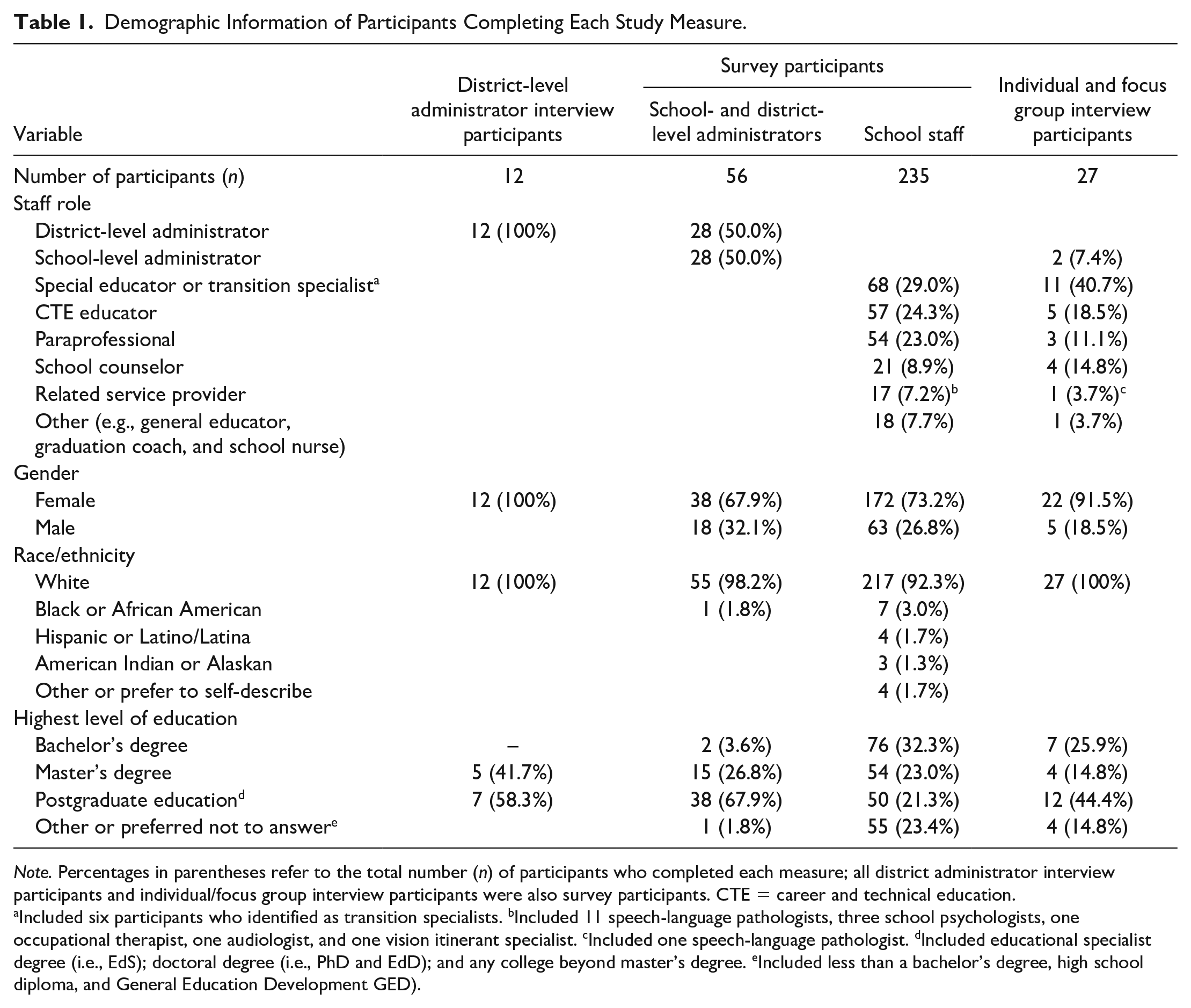
Note. Percentages in parentheses refer to the total number (n) of participants who completed each measure; all district administrator interview participants and individual/focus group interview participants were also survey participants. CTE = career and technical education.
Included six participants who identified as transition specialists. bIncluded 11 speech-language pathologists, three school psychologists, one occupational therapist, one audiologist, and one vision itinerant specialist. cIncluded one speech-language pathologist. dIncluded educational specialist degree (i.e., EdS); doctoral degree (i.e., PhD and EdD); and any college beyond master’s degree. eIncluded less than a bachelor’s degree, high school diploma, and General Education Development GED).
Recruitment and Data Collection
District Administrator Interviews
In July and August of 2021, we purposively sampled rural districts that varied on characteristics expected to impact role allocation (e.g., number of high schools and staff with specialized positions for career development). First, we identified all rural districts in our state using information from the National Rural Education Association. Next, we emailed district-level special education administrators, beginning with districts at which we had previous contacts from other projects before contacting districts who differed from these in aforementioned characteristics. We then held an interview with at least one district-level administrator from each interested district (n = 10) using a semi-structured interview protocol (see Appendix A in supplemental materials) to identify (a) the constellation of roles played across districts to support career development for students with disabilities, as well as (b) the staff members who were perceived to play such roles. Interviews ranged from 45 to 59 min (M = 48 min) and were audio-recorded, transcribed, and de-identified.
Surveys of Administrators and School Staff
We developed two versions of an electronic survey focused on identifying roles in career development for students with disabilities based on best practices in career development (e.g., Carter et al., 2010; Mazzotti et al., 2021; Morningstar et al., 2017) and incorporated aforementioned professional standards for school counseling, CTE, school psychology, and related service areas. When developing surveys, we used multiple rounds of revision to incorporate feedback from university faculty and staff with expertise in special education, vocational rehabilitation (VR), and disability advocacy. Surveys were piloted with two graduate students who were former special educators, and minor suggested revisions on clarity of language was incorporated into the final iteration approved by the Institutional Review Board.
The two survey versions (see Appendices B1 and B2 in the online supplemental materials) were similar in structure but written for either (a) an administrator to describe staff members’ roles or (b) a staff member to report their own roles. All participants were presented with 48 tasks spanning six areas of career development (see Table 2 for all tasks). Administrators used a 4-point Likert-type scale (1 = strongly disagree to 4 = strongly agree) to describe their agreement that each task was performed sufficiently in their district for students with disabilities and noted the staff position(s) who performed the task. In the other version, staff described the frequency with which they performed each of these tasks for a student with disabilities in the last year (1 = never, 2 = rarely, 3 = monthly, 4 = weekly, 5 = daily) and selected a reason for performing each task (see Table 3 for all response options). Finally, all participants used the 4-point Likert-type scale to indicate agreement that staff roles were clear and effective. We collected survey responses from September to December 2021 using the online survey platform REDCap (Harris et al., 2009). The response rate of special educators, school counselors, CTE educators, paraprofessionals, and related service providers who met the inclusion criteria was 67.6% across districts. Yet, given that administrators also disseminated the survey to other staff who met the inclusion criteria (e.g., an English teacher providing career exploration), we cannot report an overall response rate.
Staff Reporting of Their Performance of Career Development Tasks.
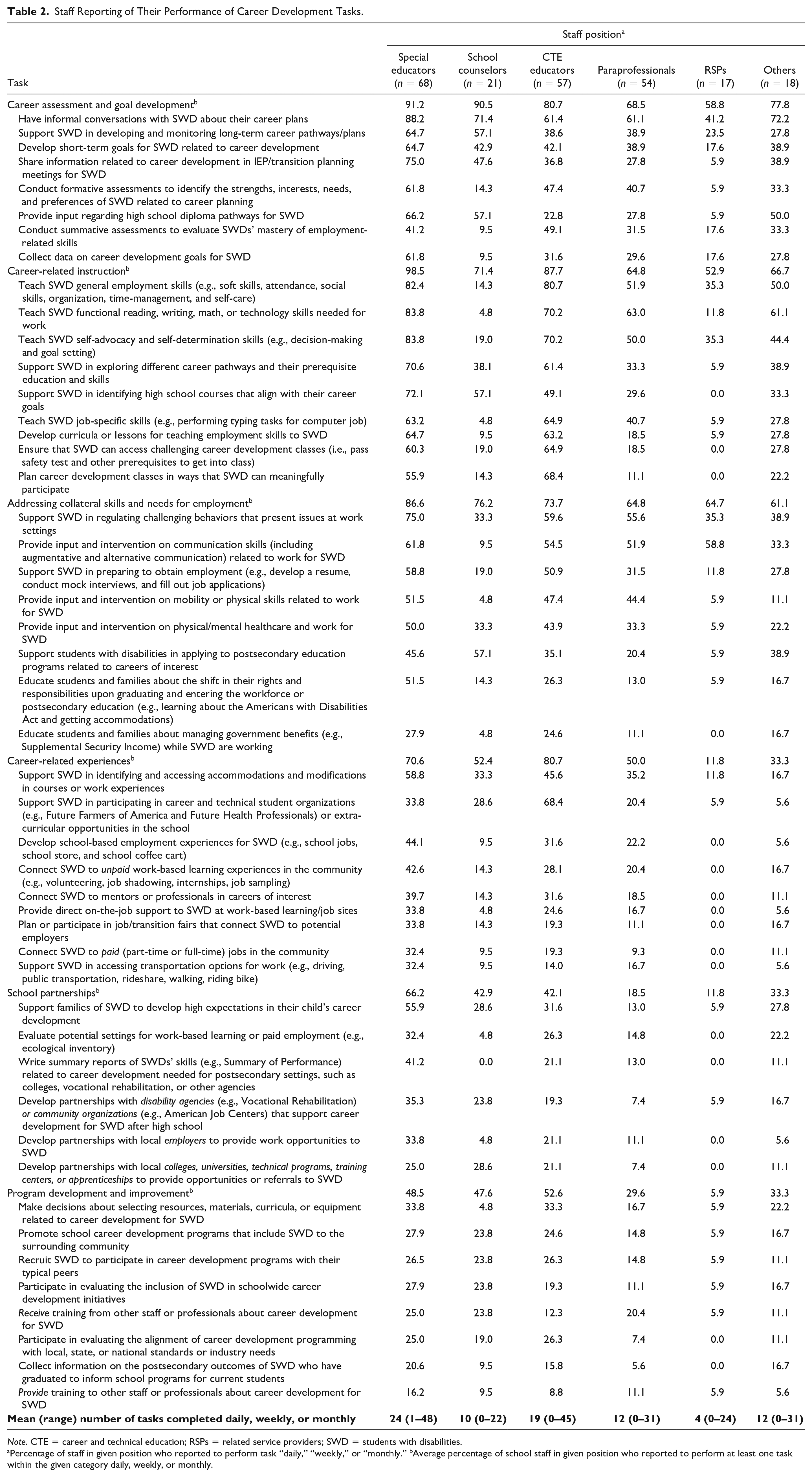
Note. CTE = career and technical education; RSPs = related service providers; SWD = students with disabilities.
Percentage of staff in given position who reported to perform task “daily,” “weekly,” or “monthly.” bAverage percentage of school staff in given position who reported to perform at least one task within the given category daily, weekly, or monthly.
Joint Display of How Staff Came to Assume Career Development Tasks.
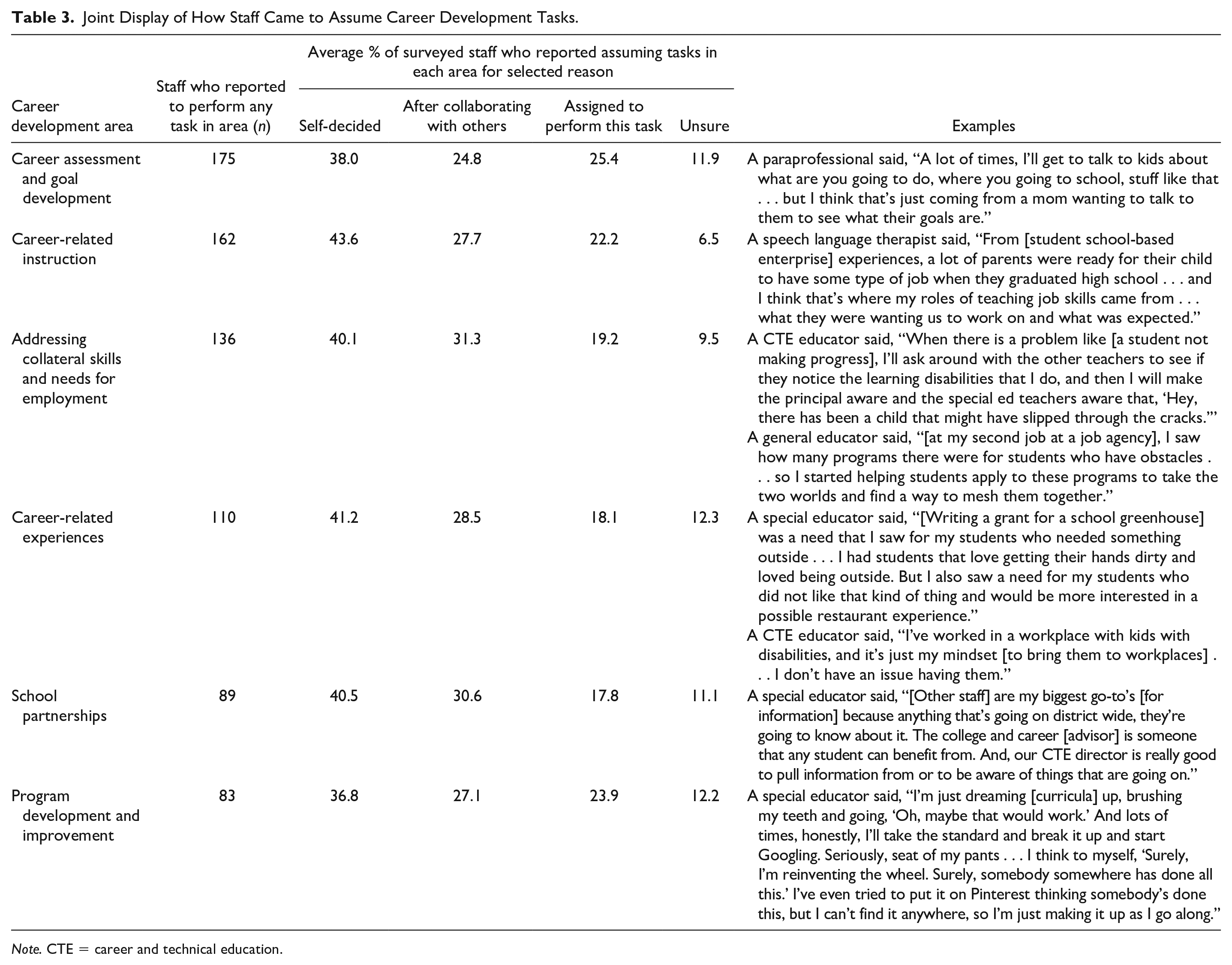
Note. CTE = career and technical education.
To recruit administrators for the survey, we emailed a link to administrators (e.g., principals and CTE supervisors). To recruit staff, we asked administrators to email a link to special educators, transition specialists, CTE educators, school counselors, related service providers, paraprofessionals, and others that met eligibility criteria and distribute flyers in their schools but clarify that they would not have access to individual responses. We emailed up to three reminder emails. Each participant who completed a survey was offered a US$10 gift card.
Interviews With Staff and School-Level Administrators
To recruit participants for subsequent interviews, we contacted staff and school-level administrators from various positions and districts who indicated interest on surveys or were identified by other participants to have knowledge that could explain roles. We continued recruitment from November 2021 until February 2022, when we reached saturation (i.e., analyses solely provided repetition of previous themes; Creswell, 2015). Each participant was offered a US$25 gift card. We attempted to organize in-person focus groups but resorted to using Zoom to host two focus groups (with three and two participants, respectively) and 22 individual interviews to accommodate pandemic-related needs. We used semi-structured interview protocols (see Appendix C1 and C2 in supplemental materials) to gain a deeper understanding of how participants assumed and viewed their roles, customizing probes to explain roles.
Data Analysis
During the convergent design phase, the first author merged administrator interview data with survey data and used a general inductive approach (Thomas, 2006) to develop an initial coding framework describing roles in career development (e.g., partnering with disability agencies) and contributions of staff (e.g., special educators inviting VR counselors to schools). We sent summaries of the coding framework back to interviewed district-level administrators for member checking; every administrator responded. Some provided clarity, such as saying, “I do not believe that related service providers are supporting students in career development, but I would love for them to do so if we had the staffing needed to fulfill these positions consistently.” I incorporated feedback by clarifying language in the coding framework and findings. Descriptive statistics (i.e., means and percentages) were used to summarize tasks by staff position and reasons for assuming roles. The first author compared administrator survey data (e.g., reporting of staff positions responsible for career development tasks) with staff survey responses (e.g., self-reporting of tasks) and refined interview questions based on these data (Creswell, 2015). For example, given that more than one quarter of surveyed school counselors reported that they partner with postsecondary education institutions to support students with disabilities, a question was refined to ask interviewed counselors how this participation came to be.
During the explanatory sequential design phase, we analyzed data from individual and focus group interviews to explain staff roles. The first author applied the coding framework from the initial phase and added codes as necessary to explain how staff came to assume roles and viewed such roles. The first and third authors engaged in multiple rounds of independent coding using this framework, meeting regularly to refine, collapse, and add codes and definitions until consensus was reached on applying a final coding framework for half of interviews (Saldana, 2016). The first author then independently applied this framework to code the remaining half of interviews. The second author acted as a peer auditor, providing feedback on the framework during the convergent phase and, later, the final codebook that emerged from the first half of interviews. We kept an audit trail of procedures and sought out disconfirming evidence to identify outlying data (Brantlinger et al., 2005). We addressed potential biases through researcher reflexivity during coding meetings, acknowledging how our previous experiences as special educators providing career development services could influence our interpretations of the data, questioning such interpretations, and discussing alternative explanations.
Results
RQ1. What Are the Roles of School Staff in Career Development for Students With Disabilities in Rural Districts?
Participants reported performing numerous career development tasks, with substantial variations based on their staff position (see Table 2). The average number of tasks completed by a staff member was 16, with participants explaining that this “happens in small rural districts where you don’t have so many people to do so many specific jobs” and “every student is different, and their needs are different.” The following sections illustrate trends by staff position.
Special Educators
Special educators reported greater involvement than any other group. Of the total surveyed, 51.5% indicated that supporting students with disabilities to prepare for future employment was a primary role. Some were designated as classroom teachers solely teaching classes on transition and work-related skills, while others were case managers who wrote IEP transition plans for all students with disabilities in their districts. One special educator said: My primary role is to help the students be ready for life after high school. And part of that is that career exploration and job attainment. I want them, when they leave high school, to have the skills necessary to hold either a part-time or full-time job, or at least have an idea of what their area of interest is or what their abilities and their interests will allow them to do even in our own small community.
In contrast, 42.6% of special educators identified career development to be a secondary role of theirs, citing instruction of academic content, preparing for testing, teaching “life skills,” IEP paperwork, and simply “getting students through their classes” to “make sure they graduate” as more important. One special educator explained that “special educators are a combination of a teacher, counselor, psychiatrist, drill sergeant . . . all things wrapped into one”; another defined their role as serving as “a mentor . . . a real one, not just what all teachers say they are.”
Multiple special educators teaching students with high-incidence disabilities felt that an overemphasis on college preparation limited their abilities to provide students with career-related experiences. Four interviewed special educators mentioned contacting VR counselors or arranging pre-employment transition services (pre-ETS) but also cited student schedules and inconsistent agency staffing as barriers to participation in employment activities. In contrast, special educators teaching students with intellectual and developmental disabilities (IDD) often discussed roles for partnering with agencies, such as “rely[ing] pretty heavily on VR,” but admitted to rarely collaborating with these individuals, and instead “reiterating” skills that providers taught after the fact. Nonetheless, special educators and transition specialists sometimes described feeling unaware of opportunities available to their students. One transition specialist admitted: I struggle with, “Do I spend time with a student, or do I spend time in preparation?” And I feel like it’s going to have to be a balance because I need to spend time with the students to even know what they’re needing, but I also have to stop and say, “I’m going to take a day or two and not see a lot of students so that I can . . . give myself enough time to get those things organized and learn what all we have here and how I can use it.”
Most surveyed administrators also reported that special educators established paid jobs (80.4%) or partnered with employers (69.6%), but only 32.4% and 33.8% of special educators, respectively, reported performing these tasks. Only 48.5% of special educators reported performing any tasks related to program development and improvement.
CTE Educators
CTE educators also reported being fairly involved. Of all surveyed CTE educators, 31.6% indicated that supporting students with disabilities in preparing for future employment was a primary role of their job. A majority self-reported tasks in career-related instruction (87.7%), career assessment and goal development (80.7%), and career-related experiences (80.7%). In interviews, they frequently cited teaching general employment skills and job-specific skills to students with high-incidence disabilities who found success in “more hands on” classes than academic courses. Yet, various CTE educators described their roles to be fundamentally different for students with IDD: supporting them in “getting loved on by regular students” and developing “life skills,” but “not necessarily to prepare them for the workforce” because “this will likely not be a career for those students.” Four of five interviewed CTE educators described safety preparation as a prerequisite of students even enrolling in their courses, with one declaring “safety should trump special ed [inclusion in CTE courses].”
CTE educators varied in whether they viewed providing accommodations as their own role or that of special education staff. Only one expressed that “if I end up with a major issue of trying to get a point across to a student, then it’s my role to get the special ed teacher or seek out somebody else who can help me.” Less than a quarter (21.1%) reported forming partnerships with postsecondary institutions or employers for students with disabilities. In contrast, 53.6% of surveyed administrators reported that CTE educators partnered with employers, and 39.3% of administrators reported that CTE educators partnered with colleges for these purposes. Multiple CTE educators described feeling uncertain of students’ postsecondary success or reported inaccurate perceptions. CTE educators described feeling uncertain of students’ postsecondary success or reported inaccurate perceptions, such as claiming “[students] get to keep their IEPs when they go to college.” Yet, one CTE educator described successfully working with a technical school on behalf of students: I had made mention of a couple students [with disabilities] who were planning to go there and about issues that I knew they were going to have, so that there was an awareness of the students coming . . . I think having the connection between high school and the instructors for the [technical school] made a world of difference for those two particular boys because they were given the extra time.
CTE educators mentioned preparing content aligned with standards, teaching academic skills, caring for equipment, and preparing for extra-curricular activities as competing priorities. Although 51.8% of surveyed administrators reported that CTE educators recruited students with disabilities to participate in their programs, only 26.3% of CTE educators themselves reported doing so. Those who had students with IDD in their classes tended to describe this inclusion to happen arbitrarily, based on requests from special educators or paraprofessionals.
Paraprofessionals
Paraprofessionals reported considerable involvement in career development. Of those surveyed, 40.7% identified supporting students with disabilities in preparing for future employment as a primary role. They discussed consulting other staff (e.g., school counselor for addressing student mental health) and fellow paraprofessionals when determining roles in work preparation. Their tasks tended to vary by the setting in which they supported students. Those in general education discussed providing accommodations in CTE courses and having informal conversations with students about careers. They advocated for student accommodations, despite being “the lowest paid in the building,” feeling that they were considered to be “always wrong,” and “never wanting to step on anybody’s toes.” Alternatively, paraprofessionals working in self-contained classes tended to emphasize teaching self-care skills, such as “brushing teeth” or other daily living skills, like “eating properly with a fork,” much more extensively than work-related skills. Two of three interviewed paraprofessionals did not expect students with significant disabilities to obtain a job or were unsure of available future supports. They characterized their roles as limited, saying “I wonder where [my students] are going to go when they’re 22 and they leave me” and “I don’t know what kind of career I would steer them towards having.”
Administrators seemed to be generally unaware of paraprofessionals’ efforts in career development. For example, only few administrators reported in surveys that paraprofessionals partnered with employers (5.4%) or connected students to paid jobs (8.9%). Yet, all three interviewed paraprofessionals described self-initiated efforts to expand work opportunities for students, such as reaching out to personal contacts to develop job opportunities, requesting to go to community events to increase local awareness, and applying for small grants to fund community-based instruction. One paraprofessional working in a transition program for students with disabilities (ages 18–21) described spending most of her time transporting students to jobs in the community, communicating with employers, and providing on-the-job supports. She even reported initially “shadowing” students in paid job settings to “make sure they can do it.”
School Counselors
School counselors tended to report less involvement with students with disabilities. In surveys, 81.0% identified preparation of these students for employment as a secondary role. Two of four interviewed counselors said they provided direct services to students to address “issues that hinder educational and life situations.” Others deemed large caseloads to “pull [them] in many diverse directions” and cited students with disabilities having case managers to limit the need for their own involvement, admitting that they themselves “don’t have eyes on IEPs.” Counselors described dispersed roles. One shared, “I probably spend 60% of my time doing logistical things, 25% of my time with students, and then the rest of the time doing other duties.” Multiple counselors cited scheduling and testing to take priority over career development.
School counselors consistently described ensuring that all students completed coursework in selected career pathways. They often shared that students with high-incidence disabilities were included in district-wide efforts for developing plans of study, but those with IDD were not. Nonetheless, counselors often characterized their roles to emphasize earning graduation credits—and sometimes completing requirements for postsecondary education—with little reference to employment. Alternatively, one counselor assumed direct roles for work-based learning: My role as school counselor has been to work with the special education teacher to understand what students need to be successful at their work sites and basically supporting them with anything they need. If they need clothing to wear to their job sites, I have resources to help get them appropriate clothing. And setting up their schedule to allow for their work-based learning to fit in . . . however I can help them.
Although the majority (76.8%) of administrators reported in surveys that counselors had informal conversations with students with disabilities about their career plans, multiple counselors reported that they do not have the time to meet individually with every student on their caseload. They described collaborations with special educators that addressed the specific needs of students with disabilities for college and career. For example, one counselor described her efforts in supporting students with IDD in applying for financial aid: The first couple of years we did FAFSAs [i.e., Free Application for Federal Student Aid], I did not seek out the students [with IDD], but [a special educator], thankful to him, said, “Oh no, there’s opportunities that they could have that the state could possibly fund.” So now I make sure every single student has filed a FAFSA.
Fewer school counselors reported in surveys to perform tasks related to program development and improvement (47.6%) or school partnerships (42.9%), with some noting in interviews that they had limited or no training for supporting students with disabilities in career development. The exceptions were specialized college-career advisors in two districts who supported all students in preparing for college programs aligned with career goals, including supporting students with IDD and their families in applying to nearby inclusive postsecondary education programs. School counselors identified these advisors as particularly beneficial to students, saying “if any [of the roles each of us perform] is ever redundant, it’s helpful.”
Related Service Providers
Related service providers reported the least involvement, with only 23.5% reporting in surveys that supporting students with disabilities in preparing for future employment was a primary role of their job. Providers mentioned evaluating students for services, supporting them in achieving academic success, and “consulting with teachers and parents” to take priority. One speech pathologist pointed out that “working in a rural school district requires each person to wear many hats,” particularly for staff who were the sole providers of their services for entire districts. An occupational therapist reported that, although skills they taught students “may or may not benefit them in employment,” this was “not my direct goal.” Providers most often reported performing tasks in addressing collateral skills and needs for work, explaining that such roles were almost solely driven by the opportunities students received in their classes or in the community (e.g., work-based learning experiences) and the expectations of educators and families for their future. When these experiences were absent, however, providers felt uncertain. A speech pathologist reflected on a student on her caseload in his final year of school, wondering “What is his next step? What is there for him? Are there programs that he can go to?”
Providers minimally reported performing tasks in any other areas of career development. They described contributing to IEP paperwork by “just putting goals in” or giving input on “how often we see [the student],” but only one surveyed provider reported ever sharing information related to career development. All 12 interviewed district administrators affirmed the limited involvement of related service providers, with multiple describing uncertainty on how these professionals could be involved in career development. All administrators also shared that students were often dismissed from related services by high school due to “a lack of progress.” One said she “would love for related service providers to be more involved in preparing students to transition to work after high school” but lacked staffing in these positions. All interviewed administrators reported that some providers in their districts were contracted and seldom worked in school buildings. Nonetheless, one transition specialist described how the audiologist and vision itinerant in her district began “tying in transition better” within their services only after sharing an office with her and “learning about transition through osmosis.” She insisted that, otherwise, “they wouldn’t know much [about career development] at all.”
Others
Eighteen other staff (i.e., general educators teaching academics, graduation coaches, and school health staff) participated in the study. Some described playing roles when other staff could not perform them to the extent necessary. For example, an English teacher who recognized the importance of “fixing for the future” embedded career exploration in her ACT preparation course after recognizing that the school counselor “has so many hats to wear” and “not enough hours in the day” to meet with all students about career plans. Moreover, a principal discussed training general educators and other staff (e.g., school nurse) with interests or experiences related to various career pathways to act as mentors to students with employment goals in these pathways.
RQ2. How Do Staff and Administrators Explain Staff Assumption of Their Roles?
Participants assumed roles related to career development for students with disabilities for a variety of reasons. Table 3 provides a joint display of data from both surveys and interviews.
Self-Deciding Roles
Across all areas, more staff reported self-deciding tasks than for any other reason. Per surveys, they were most likely to self-decide having informal conversations with students with disabilities about their career plans (56.3%), teaching general employment skills (48.7%), and connecting students to mentors or professionals in careers of interest (47.9%). In interviews, staff said they assumed roles after recognizing an unaddressed need in their district, like scheduling times for students to meet with VR counselors at the school. Several administrators affirmed that special educators and paraprofessionals were “a huge asset” for “reaching out to local businesses and creating plans for work-based learning.” Staff often described initiatives in reaching out to colleagues or others without having formal mechanisms to meet or work together.
Sometimes, staff assumed roles to fulfill broader community needs. A general educator explained why she decided to incorporate career exploration into her ACT preparation course: I don’t do it because it’s my job or because somebody is expecting it or to one-up someone else. I’m doing it because we live in a community that is dying . . . I want us to have a society of working productive adults who pay taxes, who build our community. If every one of them leave because there is no job opportunity or they have nothing to come for, our county [will die]. . . So, anything that I can do to help make a child have the living that they want, as well as to give back to the community and hopefully water us to keep us from completely drying up . . . that pushes me at the end of the day.
Staff also assumed roles based on prior job experiences or professional development they sought on their own and cited experiences with family members with disabilities to prompt their roles “in understanding the IEP” for their students. Finally, two staff described assuming roles they perceived to be their ethical “responsibility,” with one stating “if [a student is] in my classroom, then I feel that’s my role as the teacher to make sure the student’s getting what they need.”
Determining Roles After Collaborating With Others
Staff also reported assuming roles across various areas of career development after collaborating with others. In surveys, they reported developing school partnerships with employers (33.7%), disability agencies (32.9%), and local postsecondary education institutions (31.6%). In interviews, participants described developing school-based work experiences or teaching job-specific skills upon speaking with an employer or technical school instructor about valued skills. They cited this collaboration as crucial for students to access jobs, programs, and other opportunities that were “few and far between” in their rural areas. When developing jobs, two special educators described “tapping into the guidance department and CTE director” to learn about opportunities and “identify local industry needs and employer expectations.” One special educator described how, after learning that a local store needed to organize inventory to improve sales, she taught her students to create labels and reorganize products, leading the employer to hire those students. She persisted, “we have to help the employer as much as the employer’s helping us. It isn’t all just warm and fuzzy . . . it has to actually help them at that time.”
Delegated Roles by Others
Although less often, some staff described being delegated roles by others. Those from outside of special education often explained that they only shared information at IEP meetings after being asked to by an administrator. For example, CTE educators shared that they were sometimes asked to attend meetings for students not in their classes “simply to serve as the general education representative.” Two paraprofessionals reported that they were asked by case managers to “gather data” on career-related IEP transition goals, but “would like to be more involved with how [these goals] were written.” Staff also discussed inheriting roles (e.g., going to particular job sites) “based on how things have always been done” by predecessors.
RQ3. How Do Staff and Administrators Explain Their Views of Their Roles?
Data suggested that rural staff roles in career development for students with disabilities were shaped collectively through the interaction of staff-level, district-level, and community-level factors. Staff perceptions of roles being clear, feasible, or manageable were quite mixed.
Clarity of Roles
Most surveyed staff (82.1% of administrators and 74.0% of staff) agreed or strongly agreed that roles were clear for preparing students with disabilities for employment. In interviews, they explained “there’s just not a lot of overlap [in roles] because . . . we’re all wearing many hats.” Yet, both of the two interviewed transition specialists— in particular—expressed a lack of clarity in their perceptions of their roles or the discernments of colleagues. One explained: I had this CTE educator saying, “You’re doing some of the stuff I’m doing, so why are you here?” But, I’m doing it with a select population [of students] to reinforce because they’re going to need more than what you’re able to give in their senior year.
Furthermore, three special educators expressed a lack of clarity about their own roles versus those of agency providers, saying “[agency providers] are doing a lot of what I’m doing across the board at different times,” and “I get confused between the two programs a bit. Who is doing what?”
Feasibility of Roles
During interviews, staff overwhelmingly described altruistic intentions of administrators and willingness of colleagues to collaborate within “a family atmosphere where everyone cares” to foster their own confidence in performing roles well in their rural communities. Nonetheless, all interviewed participants expressed confidence in some of their roles and skepticism in others given limited time, resources, or training. For instance, CTE educators and paraprofessionals described feeling unconfident in supporting students’ emotional and behavioral challenges or providing accommodations and modifications, with one CTE educator questioning, “How much leeway do I get? What if a student is just acting lazy?” Moreover, special educators and administrators expressed difficulty in developing partnerships or identifying postsecondary opportunities. A transition specialist said: As far as training [students] to do things and finding stuff for them to do physically and hands on . . . I feel pretty confident with that . . . [But] when that student graduates on Friday night, what are they doing Monday morning is what I would love to come up with.
Sometimes, staff described their roles to be feasible but not comprehensive or effective enough to adequately prepare students with disabilities to obtain jobs, desiring “more time to meet with individual students.” Special education staff, in particular, discussed feeling limited by the low expectations of families and colleagues or poor-quality instructional materials.
Manageability of Roles
Finally, staff described feeling overwhelmed by the breadth of effort it took them to ensure their students were sufficiently prepared to work. One special educator shared: I wish there was a curriculum. I wish somebody would say, “Here, this is what you need to teach for work-based learning. This is what they need to be able to do this.” But it’s, I guess, too encompassing because there’s so many things . . . so what’s the most important? I guess sometimes, [it would help] just knowing that I’m on the right track.
Three staff even expressed concern for retaining their positions due to challenges in addressing student needs and developing experiences from the few opportunities available in their communities. These sentiments were primarily voiced by staff who had been in their positions for less than 1 year, describing their roles as “just keeping your head above water and staying a day ahead.”
Discussion
Understanding individual roles in career development is essential for appraising the collective delivery of services within rural school districts. Findings from this study extend the literature by identifying and explaining the roles that various rural school staff play to support career development for students with disabilities. In subsequent sections, we discuss key study findings, address salient limitations, and offer implications for research and practice.
Collectively, participants shared a wide variety of staff roles played. They often performed tasks in career-related assessment, goal development, and career-related instruction, but reported more limited involvement in program development and improvement. Overall, only 19.0% of staff participated in evaluating the inclusion of students with disabilities in career development programs, and multiple staff remarked that they had never even considered various career pathways for students with disabilities. Rural districts should integrate disability-specific and generically available career development services by building staff capacity, developing common understanding and commitment, and adopting a team structure with communication procedures that promote accountability to inclusion and program evaluation (Agran et al., 2020). Furthermore, it is especially important in rural districts for administrators and staff to ensure that career development initiatives align with local industry needs (Mahiko, 2017).
Rural special educators played dispersed roles and could benefit from increased contributions from others. On average, surveyed special educators reported performing 24 different career development tasks, with four performing all 48 presented tasks. They described feeling overwhelmed by too many duties, as suggested in previous studies (e.g., Eisenman et al., 2011). Limited staffing in rural districts likely exasperated this struggle. Special educators who did report connecting students to jobs cited the efforts of CTE educators, counselors, paraprofessionals, and administrators, suggesting that other staff may be lacking these key collaborations. Related service providers described being left out of transition planning and suggested they could perform more targeted roles when educators designed work experiences that facilitated their involvement. Special educators should tap into the expertise, skills, and networks of their colleagues, including those without obvious responsibilities for career development who could address the limited availability of qualified individuals in their rural communities. Some participants highlighted creative solutions to staffing gaps, such as general educators serving as career mentors. As suggested by Rowe et al. (2020), staff should utilize their personal relationships to access supports that could enable and sustain work for students. Finally, administrators and staff should consider ways in which other school personnel (e.g., general educators, administrative staff, and athletic coaches) and community members could contribute to career development and elicit the contributions of these individuals in systematic ways, such as community conversation events that gather multiple local perspectives (Schutz et al., 2021).
Staff primarily reported self-deciding their roles related to career development, rather than being delegated tasks from an administrator. Given that staff can vary widely in their prior knowledge or training, perceived responsibilities, and abilities to recognize district needs for career development (e.g., Milsom, 2002; Schmalzried & Harvey, 2014), they may self-decide vastly different roles without explicit guidance from administrators. For instance, few staff reported being involved in developing career-related experiences or partnerships that supported students with disabilities; those who did so indicated that their work was heavily informed by their own relationships. Others may struggle to collaborate to provide their students with work opportunities due to a lack of training or professional development on potential partners, their offerings, or preferred modes of communication (Awsumb et al., 2022; Bumble et al., 2021). Staff also described assuming several roles after collaborating with others but reported few formal mechanisms to collaborate. These collaborations are vital for students to access limited job opportunities and postsecondary programs available in their rural communities but generally occurred only when staff developed close relationships. Cross-departmental training and common meeting times could intentionally facilitate these collaborations (e.g., Schmalzried & Harvey, 2014; Schutz et al., 2021).
Although staff generally characterized roles to be clear, transition specialists expressed much unclarity. They often felt uncertain of how their roles related to those of others, and colleagues reported difficulty discerning these positions from other special educators or counselors. These depictions align with a study by Lillis and Kutscher (2022), in which transition specialists characterized their roles as ambiguous and called for more clearly defined responsibilities. Ironically, several participants from districts without transition specialists persisted that staffing this very position would supplement existing services in clear ways. If districts develop transition or career-focused positions, they must ensure roles are clear (Morningstar et al., 2017).
Limitations and Future Research
Limitations to this study suggest areas for future research. First, although we collected perspectives from staff with varying vantage points, all data were gathered through self-report. Staff perceptions may not fully reflect actual practices or factors to which they attributed roles. Future research is needed to fully characterize the extent to which students with disabilities participate in career development, and studies that identify specific barriers (e.g., Awsumb et al., 2022) and potential solutions (e.g., Schutz et al., 2023) are warranted. Second, although administrator data were used to inform purposive sampling of staff, there may have been others who played roles of which administrators were unaware. The inclusion of students with disabilities in CTE interventions has been studied (see Lombardi et al., 2018), but a review of the literature that examines the extent to which the career development of students with disabilities has been addressed in other disciplines (e.g., related services, school counseling, and school administration) could provide further understanding of how employment preparation for these students is considered in these areas. Third, although our study included participants from 10 districts differing in size, staffing, and surrounding communities, this sample from one state cannot represent all rural districts across the country. This line of inquiry should be extended to other geographic regions. Fourth, the COVID-19 pandemic limited roles that some staff were able to play (e.g., taking students out in the community for work-based learning) due to school policies at the time of this study. Subsequent studies are important for characterizing how staff roles may change as school procedures are updated in light of the COVID-pandemic.
Implications for Practice
Our findings have important implications for career development practices in rural school districts. Identifying staff roles in preparing students with disabilities is an initial step toward developing strategic role allocation that addresses the unique needs of rural districts. Few staff in this study reported receiving any professional development on work preparation for students with disabilities, echoing prior literature (e.g., Schmalzried & Harvey, 2014). Furthermore, staff facilitating work experiences or developing partnerships often self-decided their roles. Administrators should develop opportunities that support special educators in training CTE educators, counselors, and related service providers on contributing to postsecondary goals. In exchange, CTE educators and school counselors could train special educators on opportunities available in their rural communities that could support student goals. This work could serve as a starting point for ensuring that all students with disabilities receive career-related supports that align with the industry demands of the very communities in which they plan to work after graduation.
Second, administrators should provide staff with opportunities to collaborate across departments and within the community to facilitate roles that lead to jobs for students with disabilities. Staff in this study reported having close networks in their rural school communities and tended to cite partnerships to prompt many of the important roles they played in preparing students for work. Yet, they were rarely, if ever, provided with time for cross-departmental collaboration and often lacked knowledge on policies, programs, and practices beyond their areas of expertise, affirming prior studies (e.g., Schmalzried & Harvey, 2014). Districts should provide cross-departmental collaboration time during professional development days or planning periods to ensure that students with disabilities can meaningfully access career development initiatives available to all students (Carter et al., 2021; Morningstar et al., 2018).
Conclusion
Understanding staff roles in rural schools is essential to ensure that all students access career development services for future employment. Special education staff perform many tasks within this area, and CTE educators, school counselors, related service providers, administrators, and others may be underutilized for these purposes. Training and time allotment for cross-departmental collaboration and community partnership could increase staff capacities. Future research is needed to examine the extent to which students with disabilities participate in career development activities and the ways in which staff from various disciplines can contribute.
Supplemental Material
sj-docx-1-cde-10.1177_21651434231152822 – Supplemental material for Rural School Staff Roles in Career Development for Students With Disabilities: A Mixed Methods Study
Supplemental material, sj-docx-1-cde-10.1177_21651434231152822 for Rural School Staff Roles in Career Development for Students With Disabilities: A Mixed Methods Study by Michele A. Schutz, Erik W. Carter and Hilary E. Travers in Career Development and Transition for Exceptional Individuals
Footnotes
Declaration of Conflicting Interests
The author(s) declared no potential conflicts of interest with respect to the research, authorship, and/or publication of this article.
Funding
This research was conducted as part of a dissertation study and was partially funded through a contract with the Tennessee Department of Education. The content of this manuscript does not necessarily reflect the views of the funding agency.

References
Supplementary Material
Please find the following supplemental material available below.
For Open Access articles published under a Creative Commons License, all supplemental material carries the same license as the article it is associated with.
For non-Open Access articles published, all supplemental material carries a non-exclusive license, and permission requests for re-use of supplemental material or any part of supplemental material shall be sent directly to the copyright owner as specified in the copyright notice associated with the article.
