




Abstract
Transition education should be grounded in quality research. To do so, educators need information on which practices are effective for teaching students with disabilities transition-related skills. The purpose of this systematic literature review was to identify evidence-based and research-based practices in secondary special education and transition for students with disabilities. This systematic review resulted in the identification of nine secondary transition evidence-based practices and 22 research-based practices across more than 45 different transition-related skills. The range of effects for each of the secondary transition evidence-based and research-based practices identified are also included. Limitations and implications for future research, policy, and practice are discussed.
Keywords
Transition education should be grounded in quality research. To do so, educators need information on which practices are effective for teaching students with disabilities transition-related skills. Nearly two decades ago, the reauthorization of the Individuals with Disabilities Education Improvement Act (IDEA, 2004) and the Elementary and Secondary Education Act (i.e., No Child Left Behind [NCLB], 2001) required schools to use programs, curricula, and practices grounded in scientifically based research. In alignment with previous mandates, legislation continues to emphasize the use of evidence-based practices (EBPs). The Workforce Innovation and Opportunity Act of 2014 included a new focus on implementation of EBPs in the workplace. In addition, the Every Student Succeeds Act (ESSA, 2015) strengthened the focus on EBPs by developing a continuous monitoring system that included guidance for selecting relevant EBPs. In 2016, the U.S. Department of Education (U.S. DOE) published Non-Regulatory Guidance: Using Evidence to Strengthen Education Investments to assist state and local education agencies with selecting and using EBPs (U.S. DOE, 2016). This guidance defined EBPs for education agencies as an intervention that “demonstrates a statistically significant effect on improving student outcomes” or “demonstrates a rationale based on high quality research findings” which may improve student outcomes [section 8101(21)(A) of ESSA, 2015]. Researchers continue to identify EBPs across content areas, grade levels, and for specific populations (e.g., What Works Clearinghouse, National Autism Center).
In their systematic review of the literature, Test et al. (2009) identified 32 EBPs to teach transition-related skills to youth with disabilities. Transition-related skills are defined as academic (e.g., math, reading) and functional (e.g., social-emotional, organizational, self-determination, employment) skills needed to support students in moving from school to adult life (Morningstar & Clavenna-Deane, 2018; Wehman, 2011). In 2012, Test et al., provided an update to the Test et al. (2009) review. Although Test et al. (2012) identified effective practices, they did not examine the overall effects of the practices in their analysis.
Since the Test et al. (2012) review, numerous other systematic literature reviews have examined the effects of interventions on transition-related skills for specific populations of youth with disabilities. For example, Westbrook et al. (2015) conducted a systematic review of strategies to support youth with autism in obtaining postschool employment. However, they were unable to draw conclusions on which practices reliably predicted positive employment outcomes for youth with autism. Furthermore, Cannella-Malone and Schaefer (2017) conducted a review of the research on teaching vocational skills to students with significant disabilities. Although the majority of participants included in this study were older (i.e., >23), a small number were transition aged. The focus of the Cannella-Malone and Schaefer review was on what was taught versus how it was taught. A major finding was the decreased number of studies published on this topic over time. Likewise, Gilson et al. (2017) reviewed the literature to identify effective strategies to teach employment skills to students with intellectual and developmental disabilities (IDDs). This review provided insight into effective interventions for teaching certain employment-related skills (e.g., social interactions with customers, cleaning tasks) for students with IDD. This study was one of the first to summarize intervention effects on employment outcomes for youth with IDD.
Systematic reviews published since Test et al. (2009, 2012) focused on specific subpopulations of students (e.g., more complex support needs), and very few have summarized intervention effects. Therefore, the purpose of this review was to identify effective practices (i.e., EBPs, research-based practices [RBPs]) in secondary transition for students with disabilities and to provide an overall summary of where the secondary transition literature currently stands. This review provides the field of secondary special education and transition with information about remaining research gaps and addresses findings from research published prior to 2019. Although our larger systematic literature review (National Technical Assistance Center on Transition [NTACT], 2020) focused on identifying practices effective in teaching all transition-related skills (i.e., academic and functional skills), results presented here include EBPs and RBPs to teach functional skills (e.g., social-emotional, organizational, self-determination, employment) to secondary students. Two research questions guided this review: What was the level of evidence (i.e., EBP and RBP) for practices identified to support transition skill development for secondary students with disabilities? What were the range of effects for each of the secondary transition EBPs and RBPs identified?
Method
Selection Procedures
We followed guidelines presented by Shea et al. (2017) to ensure the methodological rigor of this systematic literature review. We conducted an electronic search, as well as a hand-search, from January 2010 to December 2018 of peer-reviewed journals in special education and rehabilitation (e.g., American Journal on Intellectual and Developmental Disabilities, Career Development and Transition for Exceptional Individuals, Education and Treatment of Children, Exceptional Children, Focus on Autism and Other Development Disabilities, Intellectual and Developmental Disabilities, Journal of Applied Behavior Analysis, Journal of Behavioral Education, Journal of Learning Disabilities, Journal of Rehabilitation, The Journal of Special Education, Journal of Vocational Rehabilitation, Rehabilitation Counseling Bulletin, Remedial and Special Education). The current review updates the findings from Test et al. (2012). The search dates were consistent with dates reported in Test et al. (2012), ensuring a thorough review of the literature relevant to secondary transition to date.
We electronically searched the following databases: Academic Search Premier, Academic One-File, ERIC, Masterfile Premier, Middle Search Plus, Health Source: Nursing/Academic Edition, PsycINFO, CINAHL with Full Text, PsychARTICLES, Education Research Complete, Education Abstracts, Educational Administration Abstracts, and Vocational and Career Collection. We used full and truncated versions and combinations of 78 search terms (e.g., transition, transition education, transition service, work-based learning, competitive integrated employment, customized employment, career technical education, community integration, life skills instruction, self-determination instruction), and 51 limiting terms (e.g., students, youth, adolescents, autism, behavior disorder, blind, deaf, emotional disorder, health impairment, hearing impairment, learning disability, orthopedic impairment, significant disability, speech language impairment, traumatic brain injury). This resulted in more than 5,000 different combinations of search terms (see Figure S1 in Supplemental Materials for a full list of search terms). In addition, we checked reference lists of meta-analyses and systematic reviews of the literature (e.g., academic, life skills, vocational rehabilitation [VR]).
Inclusion/Exclusion Criteria
We used a two-phase process to determine inclusion or exclusion of studies. Phase 1 included a review of titles and abstracts. Phase 2 included full-text review.
Phase 1: Title and abstract review
Initial inclusion criteria were (a) participants with disabilities between the age of 11 and 22, receiving special education services under IDEA (2004) in secondary settings (i.e., middle or high school); (b) dependent variables (DVs) that were a transition-related skill (e.g., life skill, employment skill, self-determination skills); and (c) an experimental design (i.e., group experimental and single-case). We excluded studies describing strategies for primary students or adult populations. These inclusion criteria are consistent with previous reviews (i.e., Test et al., 2009, 2012) and reflect recommendations that transition skills instruction occurs prior to the required age set forth by IDEA (2004; Papay et al., 2015; Palmer & Wehmeyer, 2003).
The initial search of key terms through an electronic search of databases and hand-search of key journals yielded 28,918 studies. Two researchers from two separate institutions reviewed each title and abstract to determine if each article met the initial inclusion criteria. If there was disagreement among the two researchers on whether or not a study should be included, they met to discuss the title and abstract and came to consensus on whether the article met initial inclusion criteria. If the inclusion/exclusion criteria were not clear from the title or abstract, the full text was retrieved and moved into Phase 2 of the coding process (i.e., full-text coding).
After titles and abstracts were scanned, 1,418 articles met the initial inclusion criteria. Articles excluded in this phase were (a) nonexperimental (e.g., descriptive, qualitative, literature review/meta-analysis, practitioner-focused); (b) conducted internationally (i.e., students not served under IDEA); and/or (c) focused on transition in health care, rather than school-related transition.
Phase 2: Full-text review
The 1,418 remaining studies were reviewed in their entirety (see Figure 1, Literature Review Flowchart). Due to the scope of this systematic literature review, the first author trained 15 reviewers to review and code articles. The 1-hour training included a review of inclusion/exclusion criteria, coding forms, and accompanying guidance documents. After the training, the first author assigned reviewers one common study to review independently. If a reviewer’s coding form and the first author’s coding form reflected agreement below 90% in an item-by-item analysis, another article was assigned, and the same procedure was followed until high reliability (at least 90%) was achieved. Once 90% reliability was achieved by a reviewer, the first author assigned the reviewer additional articles to code.
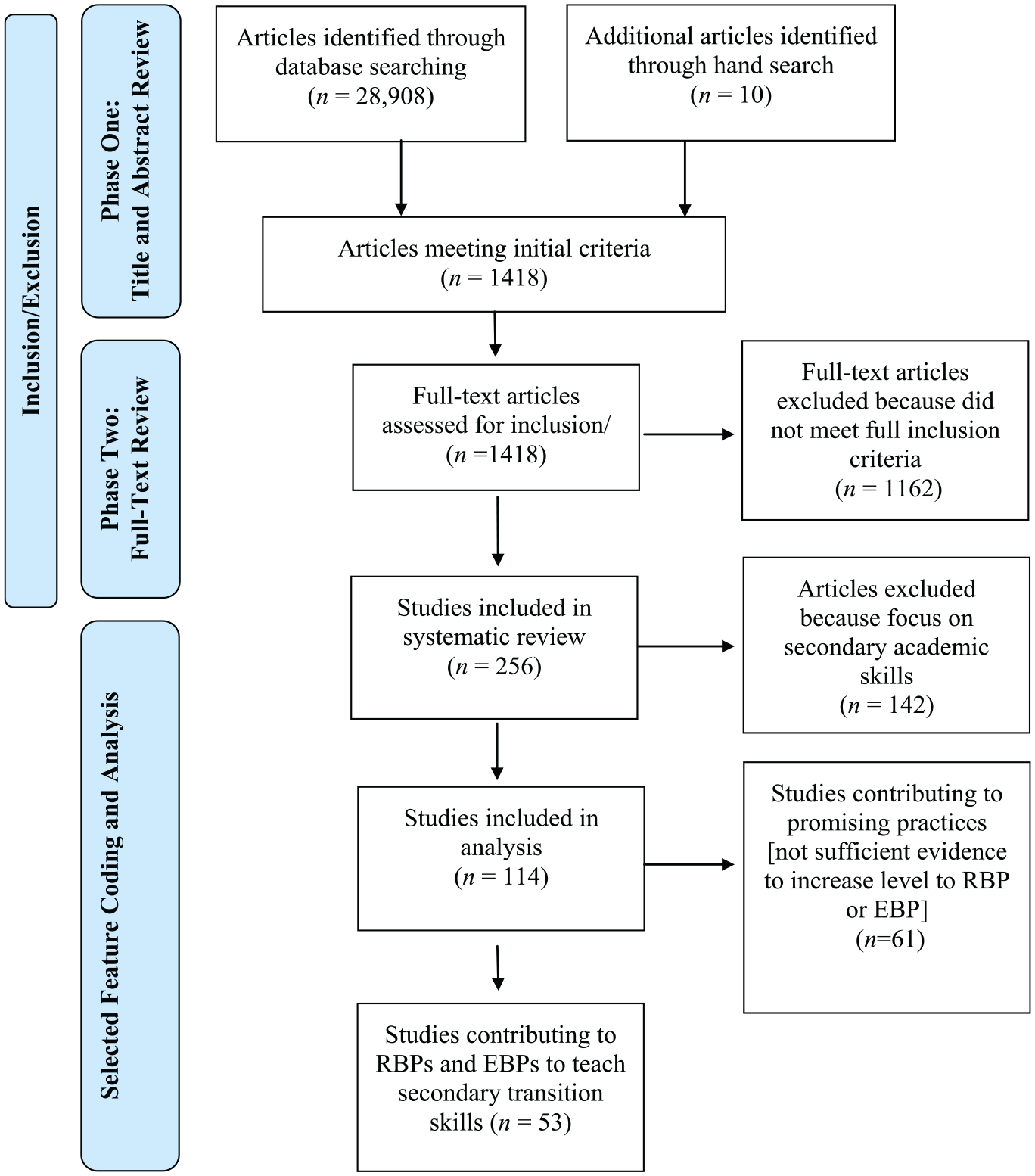
Literature review flow chart.
The first author instructed reviewers to review the full text of each article to ensure the article met inclusion criteria prior to coding for selected features. If reviewers found the article did not meet inclusion criteria, they met with the lead researcher (i.e., first author) and determined inclusion by consensus. Of the 1,418 studies that underwent full-text review, we excluded 1,162 articles because the article (a) was nonexperimental; (b) was conducted internationally; (c) did not disaggregate data for students with disabilities; (d) did not include participants who met age requirements; (e) focused on employer or teacher skills versus student skills; (f) did not include a minimum of one DV focused on secondary transition skill development; and/or (g) was not published in a peer-reviewed journal. This resulted in a total of 256 studies to be coded for selected features.
Interrater reliability on full text inclusion/exclusion criteria
Two reviewers were assigned to each study. In the case where reliability was not achieved between two reviewers, the first author facilitated a meeting to come to consensus on final codes. We collected and reported interrater reliability (IRR) on a minimum 30% of studies reviewed (Shea et al., 2017).
Of the 1,418 studies identified for full review, IRR was conducted on all studies to verify inclusion criteria were met. If IRR was below 90% for inclusion criteria, the first author and coders met to discuss the article to establish consensus on whether or not the article should be included in the current review. IRR for inclusion criteria, based on full-text review, was 100%.
Selected Feature Coding
Of the 256 studies identified for selected feature coding, 142 focused specifically on secondary academic skill interventions. These studies will be summarized in separate reviews, leaving 114 studies focused on secondary transition functional skills for full analysis (i.e., quality, level of evidence, and effect size) in the current review. Coding procedures included coding for the following: (a) setting of research and intervention; (b) participants, including identifying demographics of the study population; (c) method and design, including reporting the type of study design used; (d) independent variable (IV), including fully describing the intervention along with the cost and barriers related to implementation; (e) DVs, including listing and operationally defining each DV; and (f) results, including entering a description of results, maintenance, and generalization data.
IRR of selected feature codes
IRR was conducted on 61% (n = 70) of the 114 studies. IRR ranged from 71% to 100% with a mean of 87%. When IRR was below 80%, reviewers met with the first author to come to consensus on final codes. We used consensus codes for analysis. An analysis of the disagreements did not indicate any patterns where any one area proved to have less agreement than another area. Areas of disagreement among reviewers ranged from demographic information, such as setting of research (i.e., school and community type), age range of students, number of participants, household income range, operational definition of DV, and identification of maintenance and generalization data collected.
Evaluation of Methodological Quality
We used the quality indicators (QIs; Gersten et al., 2005; Horner et al., 2005; Kratochwill et al., 2013) to determine the methodological soundness of each study reviewed. The goal for this systematic review was to report on research that allowed for identification of effective practices in secondary transition. We interpreted studies meeting most or all of the QIs as being methodologically sound with moderate to high causal inference; therefore, increasing our confidence the practice was effective.
We coded all studies (n = 114) that met inclusion criteria using QI checklists developed by the NTACT (see Supplemental Material). NTACT developed these checklists based on QIs identified by Horner et al. (2005) and Kratochwill et al. (2013) for single-case design studies and Gersten et al. (2005) for group experimental studies. A methodologically sound single-case design study must meet (a) all QIs related to participants and setting, IV(s), DVs and measures, baseline procedures, internal validity, and external validity (i.e., items 1–16) and (b) at least one of the four social validity QIs (i.e., items 17–20; see Figure S2 in Supplemental Materials). A methodologically sound group experimental study must meet all essential QIs (i.e., items 1, 2, 3, 5, 6, 9, 10, 12, 16, 17; see Figure S3 in Supplemental Materials). For both QI checklists, a binary scale (i.e., yes, no) was used to determine if a study met each individual QI.
QI IRR
We conducted IRR for methodological quality on 57% (n = 65) of the 114 studies. IRR ranged from 74% to 100%, with a mean of 90%. In the case where IRR was below 80%, reviewers met with first author to come to consensus on quality codes. We used consensus codes in the analysis.
Levels of Evidence
We used two basic considerations for determining levels of evidence: (a) the methodological quality of the research and (b) the amount of research identified to support each practice. Our decisions regarding levels of evidence for research were guided by EBP guidelines from the 2005 special issue of Exceptional Children, Kratochwill et al. (2013), and Council for Exceptional Children’s (CEC, 2014) levels of evidence. To determine the level of evidence (i.e., EBP and RBP) for each practice, we used NTACT’s criteria for level of evidence which align with CEC’s evidence-based classifications (i.e., NTACT’s EBPs = CEC’s EBPs; NTACT’s RBPs = CEC’s Potentially EBP). An EBP is the highest level, indicating a practice has a sufficient number of methodologically sound studies to support the effectiveness of the practice and is based on scientific evidence (CEC, 2014). An RBP is the second highest level, indicating that a practice has some scientific evidence but does not include a sufficient number of studies that meet methodological standards to be identified as an EBP. Other considerations when identifying EBPs and RBPs included the total number of participants included across studies, number of research teams, and calculation of effect size or reporting data that allowed for effect size calculation. See NTACT criteria for levels of evidence (Figure S4 in Supplemental Materials) for distinguishing factors of EBP versus RBP.
Range of Effects
To determine the range of effects for single-case and group experimental studies, we recorded effect sizes based on study findings and/or calculated for each study identified in this review (n = 86). If not reported by authors, we calculated effect sizes for each study using Tau-U for single-case design (Parker et al., 2011) and Cohen’s d (Cohen, 1977) for group experimental designs. Effect sizes were reported for 86 studies contributing to the secondary transition EBPs or RBPs. In addition to Cohens d and Tau-U, there were several different types of effect sizes recorded from original study findings, including Z-scores, standardized mean difference, Pearson r, Hedges g, and partial eta squared. Due to this reason, the range of effects and means are not included in text but can be found in Table S1 (see Table S1 Magnitude of Effect in supplemental materials). Effect sizes could not be reported for four studies (i.e., two studies included more advanced analytic approaches not allowing for the calculation of Cohen’s d [Lee et al., 2008; Shogren et al., 2018]; in one study, the graphed data were not available to calculate Tau-U [Snyder & Shapiro, 1997]; one study lacked sufficient data points to calculate Tau-U [Schelling & Rao, 2013]).
Single-case design studies
Tau-U is a nonparametric, nonoverlap statistical method that controls for positive data trends in baseline phases and level changes across phases (Parker et al., 2011). In the case where a study did not report an effect size, we calculated individual A-B phase comparisons and an overall omnibus estimate of the effect of the intervention. We used a web-based calculator (see singlecaseresearch.org; Vannest et al., 2016) to calculate Tau-U. If a significant positive data trend existed in baseline phase or trend, we used baseline trend correction procedure prior to computing Tau-U estimates. Omnibus Tau-U estimates for effect were (a) less than 66% = ineffective, (b) between 66% and 92% = effective, and (c) equal to or greater than 93% = very effective (Rakap, 2015).
Although recommended to use a between-case effect size when a systematic review includes between-group methods (Shadish et al., 2015), we selected Tau-U (i.e., within-case effect size) over other between-case effect sizes (e.g., Hedges g; Hedges et al., 2013; Pustejovsky et al., 2014) due to many studies including fewer than five data points per phase (e.g., three data points in baseline). Although between-case effect size procedures can be conducted with as few as three data points per phase, five data points per phase are preferred. The effectiveness of the between-case effect size procedures is also affected by the stability of the data (Shadish et al., 2015). It was difficult to assess the stability of the data in some studies due to fewer than five data points and variability of the data. Therefore, we selected Tau-U to calculate the effects for single-case design studies to report the range of effects. It is important to note that we are not proposing comparisons of results between single-case and group experimental studies. The Tau-U calculations for the single-case design studies allow conclusions to be drawn about each case separately (Shadish et al., 2015).
Group experimental studies
When reported, we included the effect size calculations used in the original studies (e.g., partial eta squared, Cohen’s d). When studies did not report effect sizes and sufficient information was provided to calculate Cohen’s d (e.g., F statistic, sample size), we used a web-based calculator (https://www.campbellcollaboration.org/research-resources/research-for-resources/effect-size-calculator.html; Wilson, n.d.) to calculate effect size. Cohen’s d produces a standardized measure of mean difference (Durlak, 2009). Cohen’s d effect size estimates were (a) small (d = 0.20), (b) medium (d = 0.50), and (c) large (d = 0.80; Coe, 2002). In some instances, studies used more advanced analytic approaches that did not allow for the calculation of Cohen’s d (e.g., Shogren et al., 2018). In these cases, attempts were made to contact the authors to determine appropriate effect size calculations. If attempts were not successful, we indicated effect size results were not available.
IRR for effect size analysis
We conducted IRR on 52% (n = 45) of the 86 studies for which effects were reported or calculated. As initial IRR was below 85.0% for two studies (i.e., 66.0% and 70.5%), we used consensus coding between the two coders. We determined the low IRR was due to (a) failure to consider data for all DVs and/or (b) inconsistent data calculations for participant order. Following a discussion to reach consensus about the coding process, IRR on the remaining studies reviewed ranged from 76.0% to 100.0% with a mean of 93.6% across studies.
Results
This systematic review identified nine EBPs and 22 RBPs across more than 45 different transition-related skills. The Test et al. (2012) review broadly defined some practices (e.g., using published curricula to teach student involvement in the Indivudualized Education Program [IEP]). In this review, we examined broadly defined practices to identify the specific intervention used to teach a specific skill. Determining levels of evidence for a specific practice was determined by first examining the methodological quality; then by identifying the number of methodologically sound studies to support a specific practice to determine the level of evidence.
Methodological Quality of Studies
Of the 114 studies reviewed for quality, 93 (82%) were deemed methodologically sound, while 21 (18%) did not meet quality standards. Table 1 notes the extent to which each of the 53 studies contributing to EBPs or RBPs in this review was deemed methodologically sound. Commonly missed QIs for group experimental studies included (a) description of fidelity of implementation (e.g., adherence, quality, exposure); (b) description of comparison conditions; (c) documentation of IRR of outcome measures; and (d) reporting of effect size calculations or providing sufficient information to allow for calculation. For single-case design studies, the most commonly missed QIs included lack of description of treatment fidelity (e.g., adherence, quality, exposure) and lack of measures of social validity (e.g., DV was socially important, magnitude of change was socially important, described as practical and cost-effective, implemented over extended periods by typical intervention agents in typical contexts).
Evidence- and Research-Based Practices to Teach Secondary Transition Skills (i.e., Functional Skills).
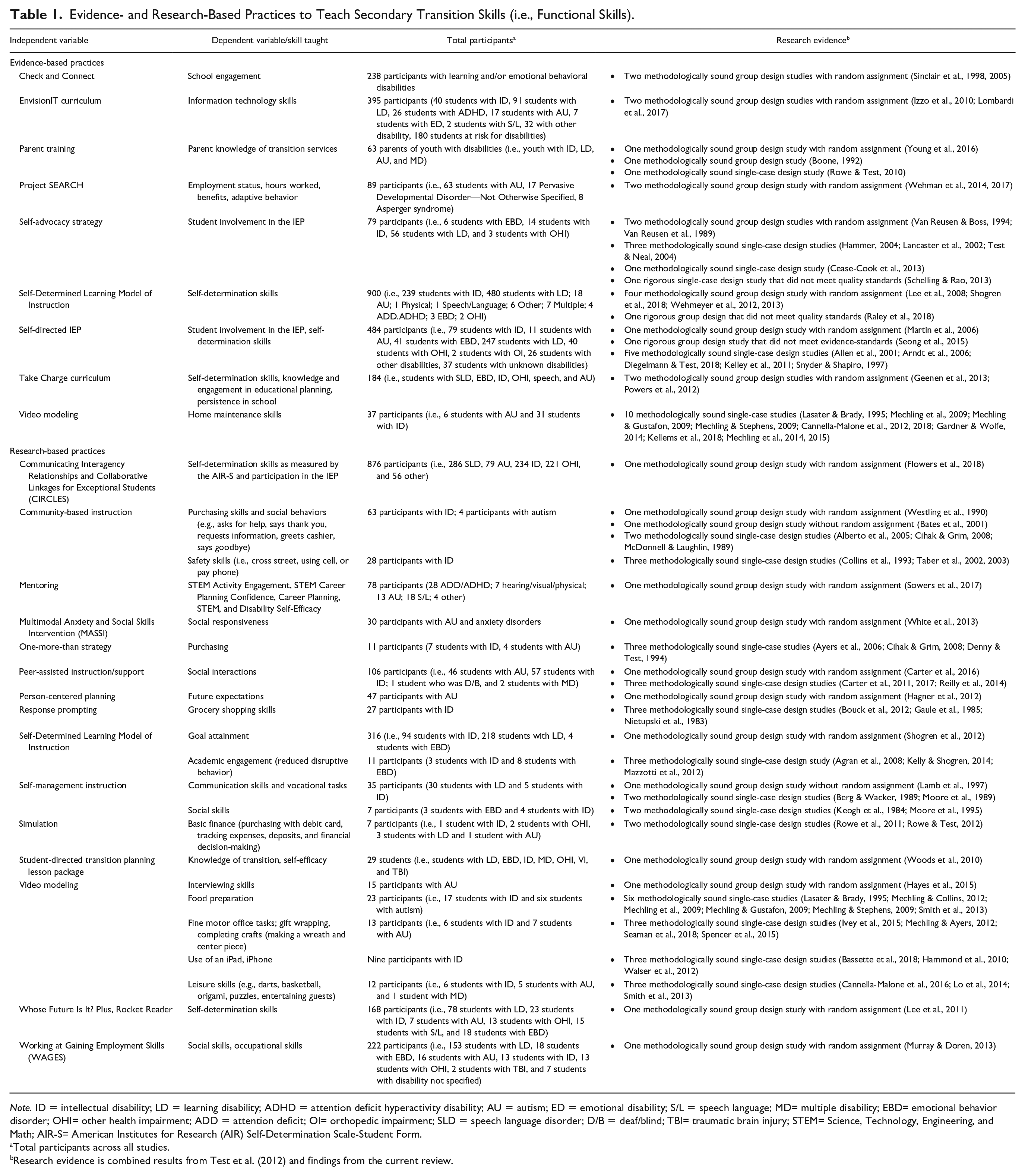
Note. ID = intellectual disability; LD = learning disability; ADHD = attention deficit hyperactivity disability; AU = autism; ED = emotional disability; S/L = speech language; MD= multiple disability; EBD= emotional behavior disorder; OHI= other health impairment; ADD = attention deficit; OI= orthopedic impairment; SLD = speech language disorder; D/B = deaf/blind; TBI= traumatic brain injury; STEM= Science, Technology, Engineering, and Math; AIR-S= American Institutes for Research (AIR) Self-Determination Scale-Student Form.
Total participants across all studies.
Research evidence is combined results from Test et al. (2012) and findings from the current review.
Levels of Evidence and Range of Effects
Table 1 provides a summary of research evidence for each secondary transition EBP and RBP identified, including IV/practice, DV/skills taught, total participants included across studies, and research evidence. Table S1 (see Supplemental Materials) includes effect sizes for each EBP and RBP across skills and provides the magnitude and range of effects across studies.
Of the initial 114 studies, we excluded 61 (54%) because studies did not provide enough evidence to support an EBP or RBP secondary transition practice. For example, only one single-case design study was identified that used peer-assisted instruction/supports plus simultaneous prompting to teach recreation and leisure skills (i.e., playing UNO; Fetko et al., 2013). Therefore, this study was excluded because there were no additional studies to support this as an EBP or RBP. Another study used a group experimental design without random assignment to examine Post-School Achievement Through Higher Learning Skills (PATHS) to increase self-awareness, advocacy, and career and college preparation (Lindstrom et al., 2013). This study was excluded because there were no additional studies to support PATHS as an EBP or RBP. These studies provided a promising level of evidence for a practice. However, there were no additional studies identified through this review to identify these practices as an EBP or RBP. Finally, a total of 53 (46%) studies that supported secondary transition EBPs or RBPs were included. Next, we include a description of each of the EBPs, followed by each RBP.
EBPs
Check & Connect to increase student engagement and IEP participation
Check & Connect is defined as an intervention that uses data to identify students at risk of dropping out and pairs the students with a mentor to address each student’s individual needs and help them progress toward school completion (Rowe et al., 2019). Two methodologically sound group experimental studies with random assignment (Sinclair et al., 1998, 2005) were identified. There is sufficient evidence to support Check & Connect as an EBP to increase student engagement in school and increase participation in IEP meetings. Effects ranged from small to large.
EnvisionIT to teach technology skills
EnvisionIT is an online curriculum focused on informational technology that integrates instruction in reading, writing, and technology content for students at risk for and with disabilities (Rowe et al., 2019). This review identified two methodologically sound group experimental studies with random assignment (Izzo et al., 2010; Lombardi et al., 2017) examining the effects of the EnvisionIT curriculum to teach information technology skills. Based on this review, there is evidence to support the EnvisionIT curriculum as an EBP to teach information technology skills. Effects ranged from small to medium.
Parent training to teach knowledge of transition services
Parent training is instruction that occurs between educators or service providers and parents where parents study about a single topic or a small section of a broad topic for a given period of time (Rowe et al., 2019). This review identified one methodologically sound group experimental study with random assignment to groups (Young et al., 2016), one methodologically sound group design study without random assignment (Boone, 1992), and one methodologically sound single-case design study (Rowe & Test, 2010) examining the effects of parent training on parent knowledge of transition services. Based on this review, the additional studies published since the Boone (1992) study increased the level of evidence for parent engagement from an RBP to an EBP. For the group experimental studies, effects ranged from small to large. For the single-case design study, effects ranged from effective to very effective.
Project SEARCH to teach vocational skills
Project SEARCH is a school-to-work transition model with rotating internships for a school year (Rowe et al., 2019). This review resulted in two methodologically sound group experimental studies with random assignment (Wehman et al., 2014, 2017) examining the impact of Project SEARCH on future expectations and vocational decision making. Based on this review, there is evidence to support Project Search as an EBP to improve future expectations and vocational decision making for students with disabilities. Effects for Project SEARCH were large.
Self-Advocacy Strategy to teach student involvement in the IEP
Self-advocacy strategy (SAS) is a published self-determination curriculum (Van Reusen et al., 1994) designed to prepare students to participate in education or transition planning conferences (Rowe et al., 2019). Results of this review identified one methodologically sound single-case design study (Cease-Cook et al., 2013) that used the SAS to teach student involvement in the IEP and one single-case design study that did not meet quality standards (Schelling & Rao, 2013). Although the new findings did not change the level of evidence (i.e., EBP), these studies add support. For group experimental studies, effects ranged from small to large. For single-case design studies, effects ranged from ineffective to very effective.
Self-Determined Learning Model of Instruction to teach self-determination skills
The Self-Determined Learning Model of Instruction (SDLMI) is an instructional framework that teaches students to set goals, make a plan to achieve those goals, and monitor progress toward goals (i.e., engage in self-directed and self-regulated learning; Rowe et al., 2019). Results of this review identified three methodologically sound group experimental study with random assignment (Shogren et al., 2018; Wehmeyer et al., 2013, 2012) and one rigorous group experimental study that did not meet quality standards (Raley et al., 2018) to teach self-determination skills. These studies added to the one group experimental study identified by the previous review (Test et al., 2012) and increased the level of evidence for the SDLMI to teach self-determination skills from an RBP to an EBP. Effects for group experimental studies were small and effects for single-case design studies ranged from effective to very effective.
Self-Directed IEP to teach self-determination skills and involvement in the IEP
The self-directed (SD) IEP lesson package includes four instructional units that focus on teaching students with disabilities to lead a meeting, report interests, report skills, and report options (Rowe et al., 2019). Results of this review identified two methodologically sound single-case design studies (Diegelmann & Test, 2018; Kelley et al., 2011) that used SD IEP to teach students self-determination skills and involvement in the IEP and one rigorous group experimental study that did not meet quality standards (Seong et al., 2015). Although the new findings of this review did not result in a change in level of evidence (i.e., EBP), these studies add additional research support for the impact the SD IEP has on self-determination skill development for students with disabilities. For group experimental studies, effects ranged from small to large. For single-case design studies, effects ranged from effective to very effective.
Take Charge curriculum to teach self-determination skills
The Take Charge curriculum is a published curriculum that includes student coaching, mentorship, peer support, and parent support (Rowe et al., 2019). Results of this review identified two methodologically sound group experimental studies with random assignment (Geenen et al., 2013; Powers et al., 2012) examining the effects of Take Charge on self-determination skills and increased engagement in educational planning and persistence in school for secondary students with disabilities. Based on this review, there is evidence to support the Take Charge curriculum as an EBP. Effect sizes ranged from small to large.
Video modeling to teach food preparation and home maintenance skills
Video modeling is a form of response prompting (i.e., a stimuli that later functions as extra cue; Rowe et al., 2019). Video modeling involves a video recording of a multistep task in which an individual will watch and will then be allowed an opportunity to imitate the steps in the task. This review identified two methodologically sound single-case design studies focused on teaching food preparation (Mechling & Collins, 2012; Smith et al., 2013), as well as six methodologically sound single-case design studies focused on teaching home maintenance skills (Cannella-Malone et al., 2012, 2018; Gardner & Wolfe, 2014; Kellems et al., 2018; Mechling et al., 2014, 2015). While these new findings did not change the level of evidence (i.e., RBP), results add to the evidence that video modeling can lead to improved outcomes in food preparation and home maintenance skills for students with disabilities. Effects ranged from effective to very effective.
RBPs
Communicating Interagency Relationships and Collaborative Linkages for Exceptional Students (CIRCLES) to increase self-determination
CIRCLES is a multilevel intervention that includes interagency collaboration and teaming as a key component to ensure positive postschool outcomes for students with disabilities (Rowe et al., 2019). Results of this review identified one methodologically sound group experimental study with random assignment (Flowers et al., 2018) examining the effects of CIRCLES on students’ levels of self-determination and participation in their IEP. Based on this review, there is evidence to support CIRCLES as an RBP. Effect sizes ranged from small to large.
Mentoring to increase STEM knowledge, engagement, and self-efficacy
Mentoring is defined as a relationship between an experienced adult and/or an unrelated peer who provides ongoing guidance, support, and instruction, aimed at building a student’s self-efficacy and character (Rowe et al., 2019). Results of this review identified one methodologically sound group experimental study with random assignment (Sowers et al., 2017) examining the effects of mentoring on STEM-related knowledge, engagement, self-efficacy, and career planning. Effects ranged from medium to large.
Multimodal Anxiety and Social Skills Intervention (MASSI to increase social skills and reduce anxiety)
Multimodal Anxiety and Social Skills Intervention (MASSI) is a curriculum that incorporates traditional verbal explanation and examples, visual supports, writing and drawing activities, among other approaches (e.g., drama, tactile reminders) to address anxiety symptoms and social skill deficits (Rowe et al., 2019). Results of this review identified one methodologically sound group experimental study with random assignment examining the effects of MASSI on social deficits and anxiety (White et al., 2013). Effects ranged from small to medium.
Peer-assisted instruction/supports to teach social interactions
Peer-assisted instruction and support (e.g., peer tutoring, peer-mediated instruction) is defined as same-aged students delivering academic or functional skills instruction to each other or working in pairs or small groups to complete assignments (Rowe et al., 2019). This review identified one methodologically sound group experimental study with random assignment (Carter et al., 2016) and three methodologically sound single-case design studies (Carter et al., 2011, 2016; Reilly et al., 2014) examining the effects of peer-assisted instruction/supports to teach social interactions. Results of this review indicate there is evidence to support peer-assisted instruction/supports as an RBP to teach social interactions to transition-aged students with disabilities. For the group experimental study, effects ranged from small to large. For single-case design studies, effects ranged from effective to very effective.
Person-centered planning to teach employment skills
Person-centered planning includes facilitated meetings and group training sessions for families with follow-up assistance for career exploration and plan implementation (Rowe et al., 2019). This review identified one methodologically sound group experimental study with random assignment (Hagner et al., 2012) examining the effects of person-centered planning on employment skills. Based on this review, there is evidence to support person-centered planning as an RBP to improve employment and employment support needs for transition-aged students with disabilities. Effect sizes ranged from medium to large.
Response prompting to teach grocery shopping skills
Response prompting is defined as a visual, auditory, textual, or symbolic stimuli that later functions as an extra cue and reminder for desired behavior (Rowe et al., 2019). This review identified one methodologically sound single-case design study (Bouck et al., 2012). Findings did not change the level of evidence (i.e., RBP); however, this study adds additional research support for the effectiveness of using response prompting to teach grocery shopping skills. Effects ranged from ineffective to somewhat effective.
SDLMI to teach on-task behavior
Results of this review identified two methodologically sound single-case design studies to increase on-task behavior (Kelly & Shogren, 2014; Mazzotti et al., 2012). Combined with the one methodologically sound single-case design study identified from the previous review (Test et al., 2012), there is sufficient evidence to move this practice from a promising level of evidence to an RBP. Effects for single-case design studies ranged from effective to very effective.
Simulation to teach basic finance skills
Simulation is defined as “using materials and situations in the classroom that approximate the natural stimulus conditions and response topographies associated with the performance of functional skills in community settings” (Rowe et al., 2019, p. 12). Results of this review identified two methodologically sound single-case design studies (Rowe et al., 2011; Rowe & Test, 2012) examining the effects of simulation on basic finance skills. Based on this review, there is evidence to support simulation as an RBP to teach basic finance skills to secondary students with disabilities. Effects ranged from effective to very effective.
Student-Directed Transition Planning lesson package to teach self-determination skills
The Student-Directed Transition Planning (SDTP) includes eight lessons that use the summary of performance to teach students to learn how to organize and present information during their transition planning process (Rowe et al., 2019). Results of this review identified one methodologically sound group design study with random assignment (Woods et al., 2010) examining the effects of the SDTP on self-efficacy and knowledge of transition. Based on this review, there is evidence to support SDTP as an RBP to improve secondary students’ with disabilities self-efficacy and knowledge of transition. Effects were medium.
Whose Future Is It? Plus Rocket Reader to teach self-determination skills
Whose Future Is It? is a published curriculum that teaches students how to be involved in their IEP process (Rowe et al., 2019). Rocket Reader is a computer software program that allowed students to navigate through the Whose Future is It? book with read aloud and a playback option (Lee et al., 2011). This review resulted in one methodologically sound group experimental study with random assignment focused on teaching self-determination skills (Lee et al., 2011). Based on this review, there is evidence to support Whose Future Is It? plus Rocket Reader as an RBP to teach self-determination skills to secondary students with disabilities. Effects were small.
Working at Gaining Employment Skills to teach social and occupational skills
Working at Gaining Employment Skills (WAGES) is a job-related social skills curriculum focused on teaching self-regulation, teamwork, communication, and problem solving (Rowe et al., 2019). Results of this review identified one methodologically sound group experimental study with random assignment focused on teaching social and occupational skills (Murray & Doren, 2013). Based on this review, there is evidence to support WAGES as an RBP to teach social and occupational skills to secondary students with disabilities. Effects ranged from small to medium.
Video modeling to teach technology skills
Results of this review identified one methodologically sound group experimental study focused on teaching interviewing skills (Hayes et al., 2015), three methodologically sound single-case design studies using video modeling to teach office tasks (Ivey et al., 2015; Mechling & Ayers, 2012; Spencer et al., 2015), three methodologically sound single-case design studies using video modeling to teach the use of an iPad/Phone (Bassette et al., 2018; Hammond et al., 2010; Walser et al., 2012), and three methodologically sound single-case design studies using video modeling to teach leisure skills (Cannella-Malone et al., 2016; Lo et al., 2014; Smith et al., 2013). Based on this review, there is evidence to support video modeling as an RBP to teach office skills, an RBP to teach the use of iPad/Phone, and an RBP to teach leisure skills to secondary students with disabilities. Effect sizes for the group experimental study was large, while effect sizes for single-case design studies were very effective.
Discussion
We reviewed the literature to identify published research focused on practices to teach secondary transition skills (i.e., functional skills) to (a) describe the current levels of evidence, (b) provide an overall summary of where the secondary transition literature currently stands, and (c) determine the range of effects across studies for each practice identified. This systematic review identified additional evidence expanding the literature base to support nine EBPs and 22 RBPs across more than 45 secondary transition-related skills.
As noted by Cook and Odom (2013) in the introduction to the Exceptional Children special issue on EBPs, “no practice will work for every single student; this is a reality of education” (p. 137). However, providing as much specificity as possible when reporting on EBPs increases the likelihood of implementation and adoption (Cook & Odom). By examining the specific skills taught through the use of the effective practices, we found that the majority of practices addressed areas in the broad family of life skills, including social and communication, purchasing, cooking, and technology skills. Eleven practices were effective for teaching self-determination or its component skills, including specific skills for student involvement in the IEP process. The remaining practices focused on vocational or occupational skills, with one practice focused on parent knowledge of transition services. Including the populations with whom the practice was effective in the description of a practice (i.e., See Table 1) also informs the field about which populations of students may be underrepresented or overrepresented in the research and for whom the identified EBPs and RBPs may, or may not, be effective.
Implications for Researchers
Future researchers should continue to attend to methodological rigor to promote confidence in findings and replicability. Based on the guidelines outlined in Horner et al. (2005) and Kratochwill et al. (2013) for single-case design studies and Gersten et al. (2005) for group experimental studies, some reviewed studies did not contribute to the level of evidence in this review. The lack of EBPs to teach skills needed across various transition domains (e.g., financial literacy, sex education, benefits planning) indicates secondary teachers of students with disabilities have a limited number of EBPs to fully support transition skill development. As has been mentioned continuously through research in our field (e.g., Mazzotti et al., 2013; Trainor et al., 2020), it is imperative researchers adhere to the QIs in order to establish EBPs in secondary transition.
Future researchers should follow the recommended Preferred Reporting Items for Systematic Reviews and Meta-Analyses (PRISMA) guidelines to assist in the evaluation of validity of results as well as to enhance replicability of the review. This study followed recommendations of Shea et al. (2017) for conducting systematic reviews. However, the methods for conducting systematic literature reviews continue to evolve (e.g., Living Systematic Reviews; Millard et al., 2018). The PRISMA has developed a revised checklist providing specific guidance for reporting of systematic reviews (Mcinnes et al., 2018).
Future researchers should also conduct a meta-analysis to examine effects across studies and on students individually to assess the impact of the intervention on participant’s performance. Whereas this systematic literature review is primarily descriptive, a meta-analysis would combine results of comparable studies and better estimate the effects of a particular intervention to teach a specific set of skills. It may also be useful in identifying potential mediating and moderating variables (e.g., disability type, race, gender, socio-economic status; Lipsey & Wilson, 2001). In addition, future researchers should either calculate effect size by hand and/or use the most current calculators for which they can verify the mathematical procedures behind the calculations. Using de-graphing software to extract the precise numbers or request the original data from authors of single-case design research would also increase confidence in effect size reporting in future reviews.
Future researchers must continue to examine the effects of interventions on specific subpopulations of students (i.e., disability category, service continuum, gender, race, ethnicity, geographic context, and grade). Researchers must provide information that practitioners can rely on for applicability within the contexts in which they educate and provide services. Researchers should also include students receiving services under section 504 of the Rehabilitation Act, in addition to students identified with disabilities under the IDEA.
Due to the complexity of secondary transition education and services, future reviews should focus on other aspects of transition (e.g., secondary academics, VR, inclusive postsecondary education), as well as examine transition practices in authentic contexts over time. Although this review identified new practices focused on such skills as technology, specific components of self-determination, and social skills in the workplace, this review did not include findings regarding interventions to teach academic skills or interventions by providers, such as VR. Researchers must move the field forward by examining the effect of practices on the myriad of skills necessary for success in and beyond high school.
Identifying the current state of evidence to teach transition-related skills is critical, but this is only an initial step in improving practice. The field must also understand the context in which the practices were effective and continue to attend to the specific populations of students, educational and community environments, and implementers to affect practice and increase the likelihood of student acquisition of skills. It is critical that researchers understand the context of school populations across the United States when conducting research, including the fact that the majority of research in secondary transition does not take into account the national school population, which includes a large number of children of color and children with disabilities living in low socio-economic environments (American Psychological Association [APA], 2020a; APA, 2020b).
Understanding the factors and nuances that influence outcomes across communities and families is critical. It is also important to recognize that one EBP or RBP, unless tested longitudinally, will not necessarily show improvement in outcomes for youth (Mazzotti et al., 2013; Trainor et al., 2020). Recommendations included in the CEC’s Division of Career Development and Transition (DCDT) position paper on identifying and promoting transition EBPs, and predictors of success should guide the field in (a) conducting research that meets QI guidelines; (b) focusing research efforts on skill areas that have little to no evidence to support improved outcomes; (c) including research that includes diverse students [e.g., disability, ethnicity]; (d) conducting longitudinal studies to examine the effects of practices over time; (e) conducting studies that examine complex transition issues; and (f) following recommendations of implementation science to support bridging the research-to-practice gap (Mazzotti et al., 2013).
Implications for Professional Organizations and Higher Education
It is imperative that professional organizations and personnel preparation programs equip practitioners to implement EBPs that facilitate the development of transition-related skills among students with disabilities (Morningstar & Mazzotti, 2014). Since special education and related services should be based on “peer-reviewed research to the extent practicable” (IDEA, 20 U.S.C.§ 1414[d][1][A][i][IV]), these practices should be highlighted during preservice coursework focused on secondary transition and during in-service professional development for practitioners (e.g., teachers, transition specialists, related service providers, VR, or other service providers). The practices identified in this review cover 45+ skills that are addressed in many students’ IEPs. Training, coaching, and implementing EBPs and RBPs to teach secondary transition skills is a logical step to support improving student outcomes.
In addition, these practices could inform federal and state policies and funding. IDEA and ESSA have legislated expectations for practitioners to implement EBPs. Policymakers may use the current results to prioritize and incentivize new and refined programs in local communities. Educators of future practitioners and those who encourage and fund research have a role in moving implementation and knowledge forward to improve services to, and outcomes for, secondary students with disabilities.
Implications for Practitioners
Over the years, the field of special education has been criticized for the lack of empirically based research methods used to teach students with disabilities (Carter et al., 2013). In recent years, there have been considerable efforts (time and resources) for developing criteria and identifying EBPs, yet many practitioners continue to use practices shown to have little to no effect on outcomes of students with disabilities, rather than available EBPs (Cook et al., 2009; Mazzotti & Plotner, 2016). The use of EBPs and RBPs has become a key expectation when providing educational interventions to students (e.g., Cook & Cook, 2011; Gersten et al., 2005; Horner et al., 2005). When determining how to teach a specific skill to students, practitioners should select practices with the best available evidence (i.e., EBPs and RBPs).
Results of this review may be used to support practitioners as they identify strategies for effective instruction. Consulting these practices can inform the work of IEP teams regarding inclusion of effective instructional practices reflected in a student’s IEP (Rowe, 2020a). Each identified practice provides a practitioner with information about the (a) intervention, (b) skill taught, and (c) level of confidence regarding the degree of its effectiveness.
In the absence of more than one, or a few EBPs, to teach a specific skill, practitioners should consult RBPs and/or promising practices to support their decisions. In any case, it is important practitioners collect data to determine the effects of the intervention for the specific student(s). Although a practice has been identified as an EBP or RBP, it does not guarantee effectiveness for an individual student or when applied in a different context (e.g., classroom structure, community setting) due to the diverse needs in the population (Rowe, 2020b). Data collection regarding delivery of the intervention (e.g., frequency, time of day, setting) and student response are important to effective implementation, as well as developing the field’s knowledge of future practices.
Limitations
This review is not without limitations. One limitation is the methods used to calculate effect sizes for variables in each study. For the single-case design studies, we relied on visual analysis to identify each of the data points rather than using a de-graphing software. Although the IRR for the effect size calculations for the single-case design studies was within a reasonable range, it is possible the data points entered into the Tau-U calculator were not exact. Concerns have been noted about the use of the Tau-U calculator (Brossart et al., 2018). As indicated in Table S1 (see Supplemental Material), effect sizes varied widely across practices. Future research might examine effect size in defining levels of evidence.
A second limitation is that we do not report on academic interventions, behavioral interventions, or other interventions students need to be successful to persist through high school to graduation. We also do not report on EBPs or RBPs in VR or other adult services which are necessary to increase the likelihood of positive outcomes, such as employment and quality of life beyond high school. These topics must be addressed in separate papers. As mentioned by Trainor et al. (2020), transition is complex and multidimensional. As students move into adulthood, their goals evolve, and their services and supports change and adapt with them. Transition is a broad term that includes both academic and functional supports provided over time by multiple service providers (e.g., educators and counselors) through many different service systems (e.g., school, VR, and adult service systems). It is difficult to capture all the nuances of transition in one review.
Finally, this review provides a “birds-eye view” of the populations with whom practices were effective and also informs the field about which populations of students may be underrepresented or overrepresented in the research. For example, there were greater numbers of youth with learning disabilities represented in studies than some other disability categories (e.g., vision impairment, deaf, deaf/blind, traumatic brain injury, and intellectual disability). Just as IEP teams must plan for how a youth’s disability impacts their performance in general education, IEP teams must plan for how a youth’s disability will impact performance in postschool environments. There is a need for further exploration of what works for whom and under what conditions. Results of this review reflect the need for researchers to better understand gaps in the literature as it relates to the context of the interventions (e.g., Who is teaching the skills? Under what conditions are the skills being taught?). This review is a starting place.
Supplemental Material
Figure_S1_NTACT_Systematic_Review_Search_terms – Supplemental material for Updating the Secondary Transition Research Base: Evidence- and Research-Based Practices in Functional Skills
Supplemental material, Figure_S1_NTACT_Systematic_Review_Search_terms for Updating the Secondary Transition Research Base: Evidence- and Research-Based Practices in Functional Skills by Dawn A. Rowe, Valerie L. Mazzotti, Catherine H. Fowler, David W. Test, Vickie J. Mitchell, Kelly A. Clark, Debra Holzberg, Tosha L. Owens, Dana Rusher, Rachel L. Seaman-Tullis, Christina M. Gushanas, Hannah Castle, Wen-Hsuan Chang, Ashley Voggt, Stephen Kwiatek and Catie Dean in Career Development and Transition for Exceptional Individuals
Supplemental Material
Figure_S2_Quality_Indicator_Checklist_Single_Case_11-04-16 – Supplemental material for Updating the Secondary Transition Research Base: Evidence- and Research-Based Practices in Functional Skills
Supplemental material, Figure_S2_Quality_Indicator_Checklist_Single_Case_11-04-16 for Updating the Secondary Transition Research Base: Evidence- and Research-Based Practices in Functional Skills by Dawn A. Rowe, Valerie L. Mazzotti, Catherine H. Fowler, David W. Test, Vickie J. Mitchell, Kelly A. Clark, Debra Holzberg, Tosha L. Owens, Dana Rusher, Rachel L. Seaman-Tullis, Christina M. Gushanas, Hannah Castle, Wen-Hsuan Chang, Ashley Voggt, Stephen Kwiatek and Catie Dean in Career Development and Transition for Exceptional Individuals
Supplemental Material
Figure_S3_Quality_Indicator_Checklist_Group_11-04-16 – Supplemental material for Updating the Secondary Transition Research Base: Evidence- and Research-Based Practices in Functional Skills
Supplemental material, Figure_S3_Quality_Indicator_Checklist_Group_11-04-16 for Updating the Secondary Transition Research Base: Evidence- and Research-Based Practices in Functional Skills by Dawn A. Rowe, Valerie L. Mazzotti, Catherine H. Fowler, David W. Test, Vickie J. Mitchell, Kelly A. Clark, Debra Holzberg, Tosha L. Owens, Dana Rusher, Rachel L. Seaman-Tullis, Christina M. Gushanas, Hannah Castle, Wen-Hsuan Chang, Ashley Voggt, Stephen Kwiatek and Catie Dean in Career Development and Transition for Exceptional Individuals
Supplemental Material
Figure_S4_LOE_Criteria_for_CDTEI_2020_NTACT-2 – Supplemental material for Updating the Secondary Transition Research Base: Evidence- and Research-Based Practices in Functional Skills
Supplemental material, Figure_S4_LOE_Criteria_for_CDTEI_2020_NTACT-2 for Updating the Secondary Transition Research Base: Evidence- and Research-Based Practices in Functional Skills by Dawn A. Rowe, Valerie L. Mazzotti, Catherine H. Fowler, David W. Test, Vickie J. Mitchell, Kelly A. Clark, Debra Holzberg, Tosha L. Owens, Dana Rusher, Rachel L. Seaman-Tullis, Christina M. Gushanas, Hannah Castle, Wen-Hsuan Chang, Ashley Voggt, Stephen Kwiatek and Catie Dean in Career Development and Transition for Exceptional Individuals
Supplemental Material
Table_S1_Magnitude_of_Effect_08-24-2020 – Supplemental material for Updating the Secondary Transition Research Base: Evidence- and Research-Based Practices in Functional Skills
Supplemental material, Table_S1_Magnitude_of_Effect_08-24-2020 for Updating the Secondary Transition Research Base: Evidence- and Research-Based Practices in Functional Skills by Dawn A. Rowe, Valerie L. Mazzotti, Catherine H. Fowler, David W. Test, Vickie J. Mitchell, Kelly A. Clark, Debra Holzberg, Tosha L. Owens, Dana Rusher, Rachel L. Seaman-Tullis, Christina M. Gushanas, Hannah Castle, Wen-Hsuan Chang, Ashley Voggt, Stephen Kwiatek and Catie Dean in Career Development and Transition for Exceptional Individuals
Footnotes
Declaration of Conflicting Interests
The author(s) declared no potential conflicts of interest with respect to the research, authorship, and/or publication of this article.
Funding
The author(s) disclosed receipt of the following financial support for the research, authorship, and/or publication of this article: This document was developed by The National Technical Assistance Center on Transition (NTACT), Charlotte, NC, funded by Cooperative Agreement Number H326E140004 with the U.S. Department of Education, Office of Special Education Programs and the Rehabilitation Services Administration. Opinions expressed herein do not necessarily reflect the position or policy of the U.S. Department of Education nor does mention of trade names, commercial products, or organizations imply endorsement by the U.S. Department of Education.

References
Supplementary Material
Please find the following supplemental material available below.
For Open Access articles published under a Creative Commons License, all supplemental material carries the same license as the article it is associated with.
For non-Open Access articles published, all supplemental material carries a non-exclusive license, and permission requests for re-use of supplemental material or any part of supplemental material shall be sent directly to the copyright owner as specified in the copyright notice associated with the article.
