




Abstract
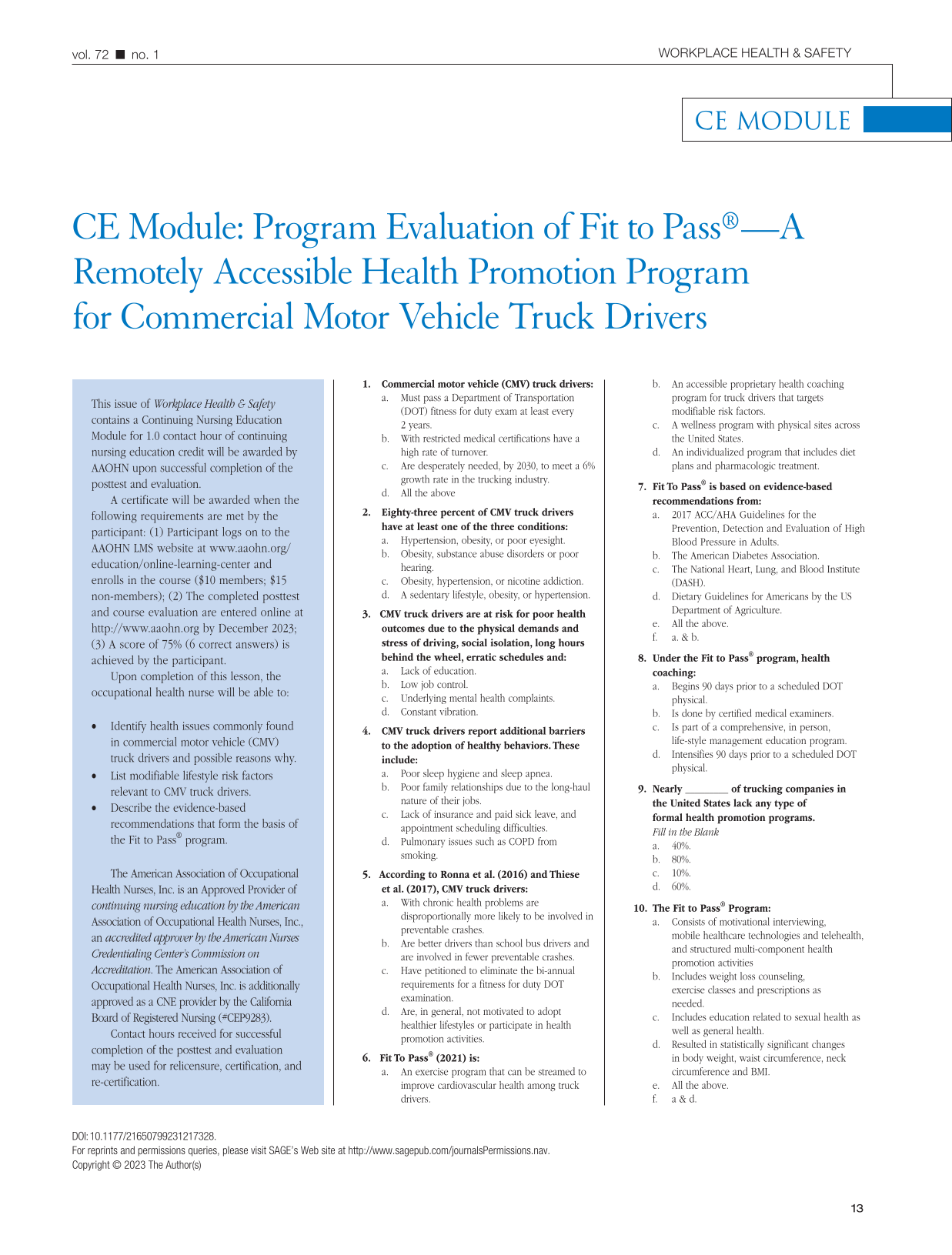
This issue of Workplace Health & Safety contains a Continuing Nursing Education Module for 1.0 contact hour of continuing nursing education credit will be awarded by AAOHN upon successful completion of the posttest and evaluation.
A certificate will be awarded when the following requirements are met by the participant: (1) Participant logs on to the AAOHN LMS website at www.aaohn.org/education/online-learning-center and enrolls in the course ($10 members; $15 non-members); (2) The completed posttest and course evaluation are entered online at http://www.aaohn.org by December 2023; (3) A score of 75% (6 correct answers) is achieved by the participant.
Upon completion of this lesson, the occupational health nurse will be able to:
Identify health issues commonly found in commercial motor vehicle (CMV) truck drivers and possible reasons why.
List modifiable lifestyle risk factors relevant to CMV truck drivers.
Describe the evidence-based recommendations that form the basis of the Fit to Pass® program.
The American Association of Occupational Health Nurses, Inc. is an Approved Provider of continuing nursing education by the American Association of Occupational Health Nurses, Inc., an accredited approver by the American Nurses Credentialing Center’s Commission on Accreditation. The American Association of Occupational Health Nurses, Inc. is additionally approved as a CNE provider by the California Board of Registered Nursing (#CEP9283).
Contact hours received for successful completion of the posttest and evaluation may be used for relicensure, certification, and re-certification.
a. Must pass a Department of Transportation (DOT) fitness for duty exam at least every 2 years. b. With restricted medical certifications have a high rate of turnover. c. Are desperately needed, by 2030, to meet a 6% growth rate in the trucking industry. d. All the above
a. Hypertension, obesity, or poor eyesight. b. Obesity, substance abuse disorders or poor hearing. c. Obesity, hypertension, or nicotine addiction. d. A sedentary lifestyle, obesity, or hypertension.
a. Lack of education. b. Low job control. c. Underlying mental health complaints. d. Constant vibration.
a. Poor sleep hygiene and sleep apnea. b. Poor family relationships due to the long-haul nature of their jobs. c. Lack of insurance and paid sick leave, and appointment scheduling difficulties. d. Pulmonary issues such as COPD from smoking.
a. With chronic health problems are disproportionally more likely to be involved in preventable crashes. b. Are better drivers than school bus drivers and are involved in fewer preventable crashes. c. Have petitioned to eliminate the bi-annual requirements for a fitness for duty DOT examination. d. Are, in general, not motivated to adopt healthier lifestyles or participate in health promotion activities.
a. An exercise program that can be streamed to improve cardiovascular health among truck drivers. b. An accessible proprietary health coaching program for truck drivers that targets modifiable risk factors. c. A wellness program with physical sites across the United States. d. An individualized program that includes diet plans and pharmacologic treatment.
a. 2017 ACC/AHA Guidelines for the Prevention, Detection and Evaluation of High Blood Pressure in Adults. b. The American Diabetes Association. c. The National Heart, Lung, and Blood Institute (DASH). d. Dietary Guidelines for Americans by the US Department of Agriculture. e. All the above. f. a. & b.
a. Begins 90 days prior to a scheduled DOT physical. b. Is done by certified medical examiners. c. Is part of a comprehensive, in person, life-style management education program. d. Intensifies 90 days prior to a scheduled DOT physical.
a. 40%. b. 80%. c. 10%. d. 60%.
a. Consists of motivational interviewing, mobile healthcare technologies and telehealth, and structured multi-component health promotion activities b. Includes weight loss counseling, exercise classes and prescriptions as needed. c. Includes education related to sexual health as well as general health. d. Resulted in statistically significant changes in body weight, waist circumference, neck circumference and BMI. e. All the above. f. a & d.