




Abstract
Background:
Healthcare providers putting their patient’s health before their own has negative consequences. Utilizing evidence-based research, nurse leaders can implement practices to positively affect employee health. This project assessed the utilization of a workplace relaxation room to reduce occupational stress.
Method:
Multiple methods were used to recruit participants. Participants completed pre/post surveys (demographic, PSS-10, GallupQ12, and open-ended questions) via email. The relaxation room contained stress reducing items for staff to utilize while at work. Data was collected using Qualtrics Survey software.
Findings:
Data from the PSS-10 and GallupQ12 did not reveal statistically significant results. The participants responses to the open-ended questions did indicate a positive impact.
Conclusions/Application to Practice:
While the aims of the project were not met during the intervention, the open-ended responses indicated that for the employees who participated in the project, the intervention was a positive addition to the workplace.
Background
Data from a recent survey by Gould et al. (2019) revealed 64% of nurses surveyed put the health, safety, and wellness of their patients above their own. This same survey also revealed 52% of nurses surveyed work through their breaks, and 60% experience workplace stress (Gould, et al., 2019). Workplace stress negatively affects nurses’ mental, physical, and social well-being (Rajabi et al., 2018). This leads to depression, missed shifts, and lower quality of patient care (Rajabi et al., 2018). Nurse occupational stress can also cause sleep disturbances, mental health disorders, and family/marital problems (Accardi et al., 2020). The American Nurses Association (ANA, 2020) notes that nurses are at higher risks of suicide than the general population. A study that examined suicide prevention among nurses found that common work stressors such as lateral violence, understaffing, inadequate resources, and feeling underappreciated in their workplace increases a nurse’s risk for suicide (Accardi et al., 2020). Jacques et al. (2018) supports that nurse leaders are in a unique position to implement interventions to decrease stress in the workplace. The ANA (2017) reiterates the belief that, “nurse well-being must be safeguarded, and that ill-health should not be an inevitable by-product of dedicated nursing practice.”
The use of a wellness room or relaxation room may decrease the perception of psychological stress at work (Jacques et al., 2018). Being able to engage in more social support at work, nursing staff may forge a greater bond in working together. Resources such as this stress management effort may be an opportunity for nursing staff to actively work together to reduce their stress by sharing similar experiences in real-time (Jacques et al., 2018).
Nejati et al. (2016) highlighted that a relaxation room would allow nurses the opportunity to step away from the chaos alone or with a fellow co-worker to help alleviate the feeling of burnout that plagues the nursing profession. Often, nurses fail to recognize when to step away, but peers may be able to readily identify this need (Nejati et al., 2016). Dapcic and Figueroa (2019) found that in facilities with a designated relaxation room, nursing staff who recognized a peer in distress would suggest they take some time in the room to decompress. In the same study, there was an increase in staff being able to assist their peers de-stress (Dapcic & Figueroa, 2019). Nursing staff also demonstrated feelings of happiness, relaxation, and positivity, while showing a decrease in frustration, tiredness, and anger (Dapcic & Figueroa, 2019).
Multiple relaxation methods were used in various studies, including deep breathing, combined body awareness, muscle tone regulation, massage chairs, meditation music, essential oil diffusion, mindfulness, snacks, and journaling (Dapcic & Figueroa, 2019; Montanari, et al., 2019; Veiga et al., 2019). Montanari et al. (2019) revealed that using relaxation methods reduced the perception of burnout in areas of emotional exhaustion and depersonalization of patients. This study was based on the premise of relaxation, nourishment, and refocus which led to 75% of participants perceiving these practices as effective/very effective in reducing their stress at work (Montanari et al., 2019). In two 20-minute sessions a week of psychomotor relaxation practices (deep breathing, progressive relaxation, stretching, meditation), over an 8-week period, nurses’ feelings of emotional exhaustion and depression were reduced (Veiga et al., 2019). The American Holistic Nurses Association (AHNA, 2023) states journaling is an effective stress reduction method as it allows people to reflect and explore thoughts/feelings and gain a sense of clarity for oneself.
Another key point to consider is the definition of “rest.” Rest is not just the cessation of physical activity, but an opportunity to relax by taking on a different mind-set (Nejati et al., 2016). This concept must be considered to understand the value of restorative breaks in the workplace (Nejati et al., 2016). For instance, taking a walk outside during work is an effective method to change scenery and nurture the body through gentle exercise (AHNA, 2017). All of these resources work together to promote stress reduction among nurses in the healthcare setting. The purpose of this project was to assess the impact of utilizing a relaxation room within the work environment to reduce occupational stress.
Method
For this 8-week quality improvement project, a relaxation room was created within the work setting. Relaxation items were selected based on evidence gleaned from previous research targeting occupational stress reduction.
Staff were defined as medical doctors, nurse practitioners, medical assistants, registered nurses, phlebotomist, and front office members. The inclusion criteria for project participants included being employed by the organization, working at the designated project site, and being 18 years or older. The recruitment emails contained a link to the pre-survey. Interested participants clicked on a link to access the informed consent, questions to de-identify themselves 2-digit birth month and first 3 letters of mother’s name, a demographic survey, Perceived Stress Scale (PSS-10), and Gallup Q12 survey. The PSS-10 is a 10-question survey created by Cohen, Kamarack, and Mermelstein in 1988. This survey evaluated staff perception of stress pre–post-intervention. The Gallup Q12 survey was created in the mid-1990s to survey employee engagement and their enthusiasm for their jobs (Gallup, 2023). The PSS-10 and Q12 survey tools are available in the public domain and do not require permission for use.
Demographic data collected included age, gender, years working in healthcare, and years working for this organization. Participants then completed the PSS-10 which includes questions related to feelings from the past month such as, “How often have you felt nervous or stressed?” The Gallup Q12 survey has 12 questions which assess employee engagement; one example is, “I know what is expected of me at work.” Both surveys use Likert-type scale responses.
Data were analyzed using descriptive statistics and identifying qualitative themes revealed in the data collected. Descriptive results concluded that the participants averaged 48 years of age, 9 years working for the organization, and 19 years working in healthcare. Qualitative themes identified included perception of stress, lack of time to utilize space, and appreciation of relaxation room for staff.
Staff were encouraged to utilize the room at their leisure before, during, or after work at any time. The room contained a wall of blue lights, two yoga mats, one exercise ball, relaxation coloring books, a gratitude wall, an essential oil diffuser, a desk water fountain, snacks, and a changing light projector. Flyers posted throughout the room displayed how each item in the room could be used for relaxation purposes along with a QR code that had a link to further information/resources for staff use. QR codes were added to the flyers for staff education. Education for the intervention was provided through QR codes and a presentation from Tip It Forward (TIF). The TIF is a local non-profit organization dedicated to providing education about holistic health to the community (TIF, n.d.). QR codes were added to each flyer in the Relaxation Room that provided more in-depth education on the purpose of each relaxation practice. This also allowed staff to access the education on their own time, at their own pace. The TIF made a presentation to three nursing staff and gave each of them a relaxation kit containing essential oils, massage ball, stretch band, and relaxation tip cards.
Data were collected using Qualtrics Survey software.
Findings
Results of both the PSS-10 Survey and the Gallup Q12 did not reveal statistically significant evidence that participants would score differently on pre- and posts-surveys. The sample surveyed was too small (N = 5) to draw any statistically significant conclusions.
The post-survey contained three optional open-ended questions including “How has the relaxation space been beneficial to you?” “What suggestions do you have for improving the space?” and “other comments.” Participants had a positive view of the relaxation space. Some of the comments included, “a Godsend,” “a place to take a breather on a stressful day,” and “an oasis in the desert.” These responses are summarized in Table 1.
Employee Open-Ended Responses to Survey
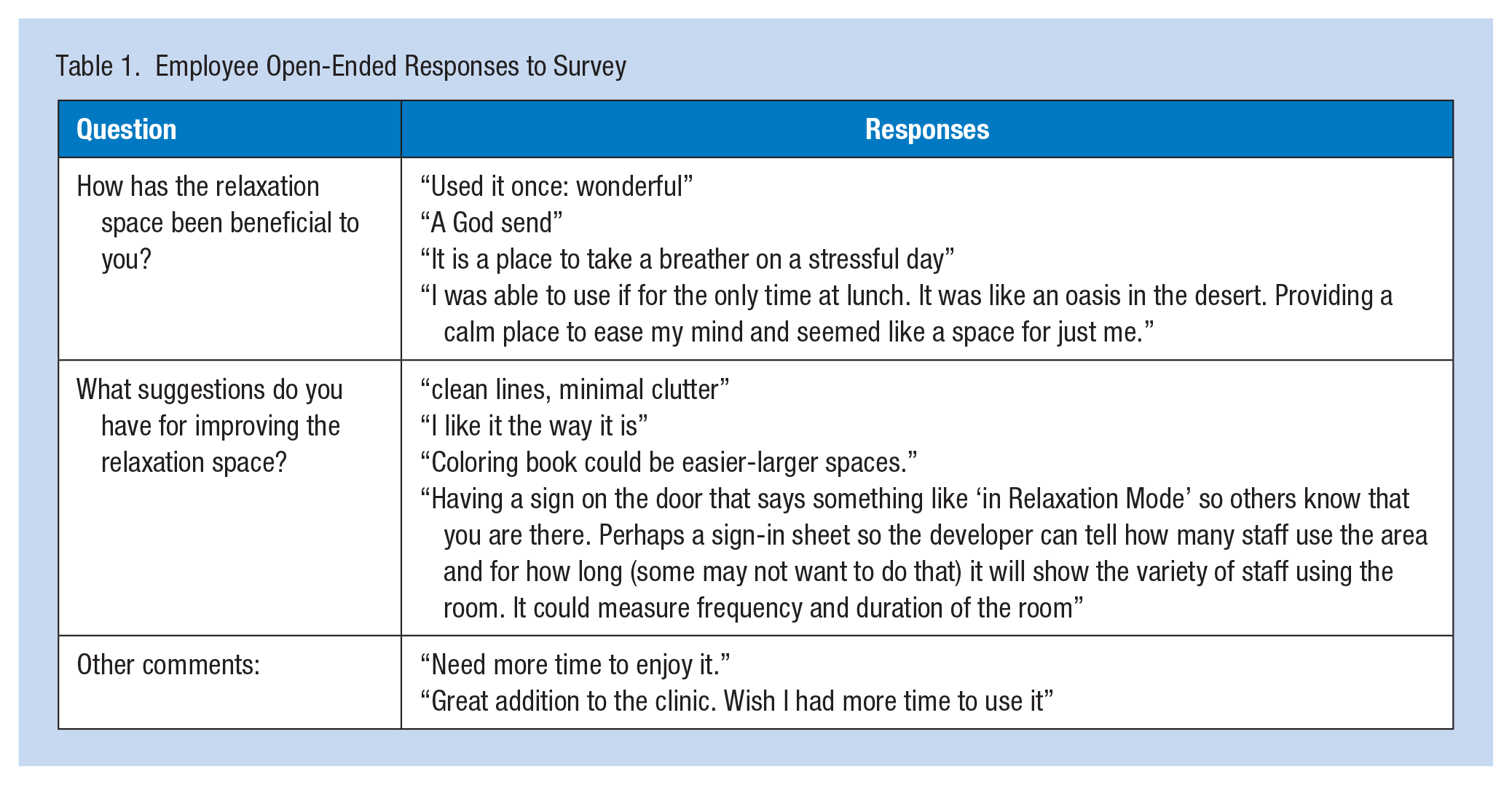
The aims and objectives of this project were to decrease staff perception of stress and increase staff satisfaction. While these aims were not met during this intervention, the open-ended responses indicate that for the employees who participated in the project, the intervention was a positive addition to the workplace. This intervention was an encouraging introductory experience for staff and created a positive perception of self-care in the workplace.
Discussion
Strengths of this project included the quality of the relaxation room, positive perception by staff, and an innovative effort to increase self-care within the workplace. Staff were encouraged to add items to the relaxation room to make it their own. A staff member stated, [this room provided] “a calm place to ease my mind and seemed like a space just for me.” COVID-19 brought many challenges in health care and has revealed a significant gap in the overall care and well-being of staff (U.S. Department of Veterans Affairs, 2020). This relaxation room provided a physical demonstration of support and encouragement of self-care and well-being. Furthermore, it highlighted the need for more interventions that are staff-focused, consistent, accessible, and sustainable.
Limitations of this project included timeframe, small sample size, low staffing levels, and lack of a self-care culture. This project was conducted over an 8-week period and only had five full-survey participants. Due to the short timeframe and small sample size, it is unlikely to identify any statistically significant results. In addition, low staffing negatively affected the staff’s ability to utilize this space as much as they would have liked to. Within healthcare organizations universally, workplace culture supports overexertion of oneself to achieve organizational goals which results in self-neglect and negative outcomes overtime for employees and the organization (Veiga et al., 2019). With more time, funding, and leadership buy-in, results of a project like this one would likely yield similar results to previous research which revealed statistically significant changes based on interventions conducted.
Applications to Professional Practice
Occupational stress negatively affects the well-being of healthcare workers. Intentional implementation of evidence-based research targeting reduction of workplace stress could lead to better outcomes for healthcare workers, patients, and the healthcare environment. One such innovative method is utilizing a dedicated Relaxation Room for staff as a method to reduce occupational stress. The relaxation room for this project included blue lights, yoga mats, exercise ball, relaxation coloring books, a gratitude wall, an essential oil diffuser, a desk water fountain, snacks, and a changing light projector. In addition to these items, relaxation training and educational tips were provided to staff to assist in improving their self-care. Staff who participated in this project found it to be a positive addition to their work environment. It would be beneficial to incorporate self-care in healthcare degree education and workplace as a part of preventative care and preservation of the workforce for future generations.
Footnotes
Declaration of Conflicting Interests
The author(s) declared no potential conflicts of interest with respect to the research, authorship, and/or publication of this article.
Funding
The author(s) received no financial support for the research, authorship, and/or publication of this article.
Human Subjects Review
Human subjects were utilized as research participants. Approval was granted through a university institutional review board (IRB) and deemed exempt.
