




Abstract
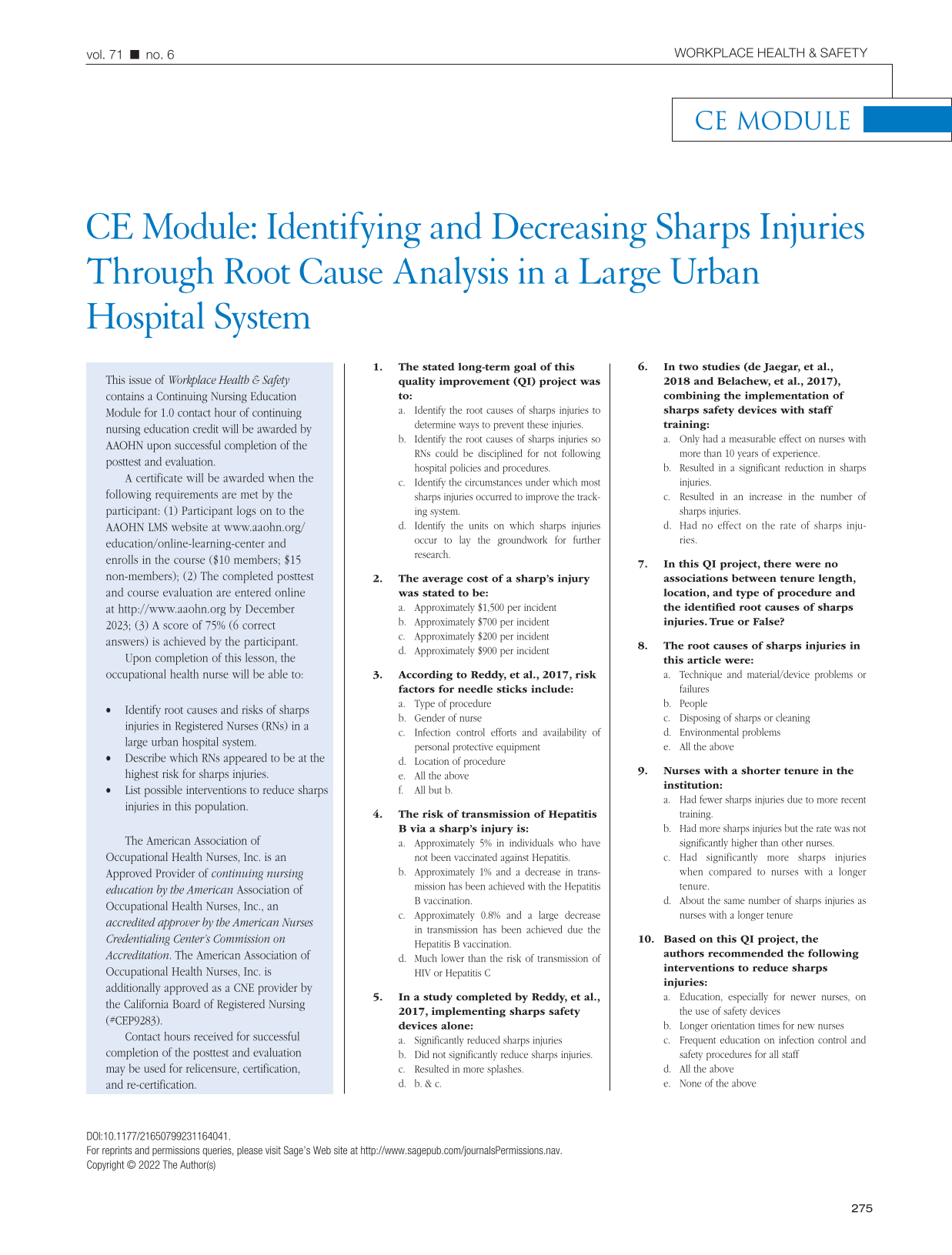
This issue of Workplace Health & Safety contains a Continuing Nursing Education Module for 1.0 contact hour of continuing nursing education credit will be awarded by AAOHN upon successful completion of the posttest and evaluation.
A certificate will be awarded when the following requirements are met by the participant: (1) Participant logs on to the AAOHN LMS website at www.aaohn.org/education/online-learning-center and enrolls in the course ($10 members; $15 non-members); (2) The completed posttest and course evaluation are entered online at http://www.aaohn.org by December 2023; (3) A score of 75% (6 correct answers) is achieved by the participant.
Upon completion of this lesson, the occupational health nurse will be able to:
Identify root causes and risks of sharps injuries in Registered Nurses (RNs) in a large urban hospital system.
Describe which RNs appeared to be at the highest risk for sharps injuries.
List possible interventions to reduce sharps injuries in this population.
The American Association of Occupational Health Nurses, Inc. is an Approved Provider of continuing nursing education by the American Association of Occupational Health Nurses, Inc., an accredited approver by the American Nurses Credentialing Center’s Commission on Accreditation. The American Association of Occupational Health Nurses, Inc. is additionally approved as a CNE provider by the California Board of Registered Nursing (#CEP9283).
Contact hours received for successful completion of the posttest and evaluation may be used for relicensure, certification, and re-certification.
The stated long-term goal of this quality improvement (QI) project was to: Identify the root causes of sharps injuries to determine ways to prevent these injuries. Identify the root causes of sharps injuries so RNs could be disciplined for not following hospital policies and procedures. Identify the circumstances under which most sharps injuries occurred to improve the tracking system. Identify the units on which sharps injuries occur to lay the groundwork for further research.
The average cost of a sharp’s injury was stated to be: Approximately $1,500 per incident Approximately $700 per incident Approximately $200 per incident Approximately $900 per incident
According to Reddy, et al., 2017, risk factors for needle sticks include: Type of procedure Gender of nurse Infection control efforts and availability of personal protective equipment Location of procedure All the above f. All but b.
The risk of transmission of Hepatitis B via a sharp’s injury is: Approximately 5% in individuals who have not been vaccinated against Hepatitis. Approximately 1% and a decrease in transmission has been achieved with the Hepatitis B vaccination. Approximately 0.8% and a large decrease in transmission has been achieved due the Hepatitis B vaccination. Much lower than the risk of transmission of HIV or Hepatitis C
In a study completed by Reddy, et al., 2017, implementing sharps safety devices alone: Significantly reduced sharps injuries Did not significantly reduce sharps injuries. Resulted in more splashes. b. & c.
In two studies (de Jaegar, et al., 2018 and Belachew, et al., 2017), combining the implementation of sharps safety devices with staff training: Only had a measurable effect on nurses with more than 10 years of experience. Resulted in a significant reduction in sharps injuries. Resulted in an increase in the number of sharps injuries. Had no effect on the rate of sharps injuries.
In this QI project, there were no associations between tenure length, location, and type of procedure and the identified root causes of sharps injuries. True or False?
The root causes of sharps injuries in this article were: Technique and material/device problems or failures People Disposing of sharps or cleaning Environmental problems All the above
Nurses with a shorter tenure in the institution: Had fewer sharps injuries due to more recent training. Had more sharps injuries but the rate was not significantly higher than other nurses. Had significantly more sharps injuries when compared to nurses with a longer tenure. About the same number of sharps injuries as nurses with a longer tenure
Based on this QI project, the authors recommended the following interventions to reduce sharps injuries: Education, especially for newer nurses, on the use of safety devices Longer orientation times for new nurses Frequent education on infection control and safety procedures for all staff All the above None of the above