




Abstract
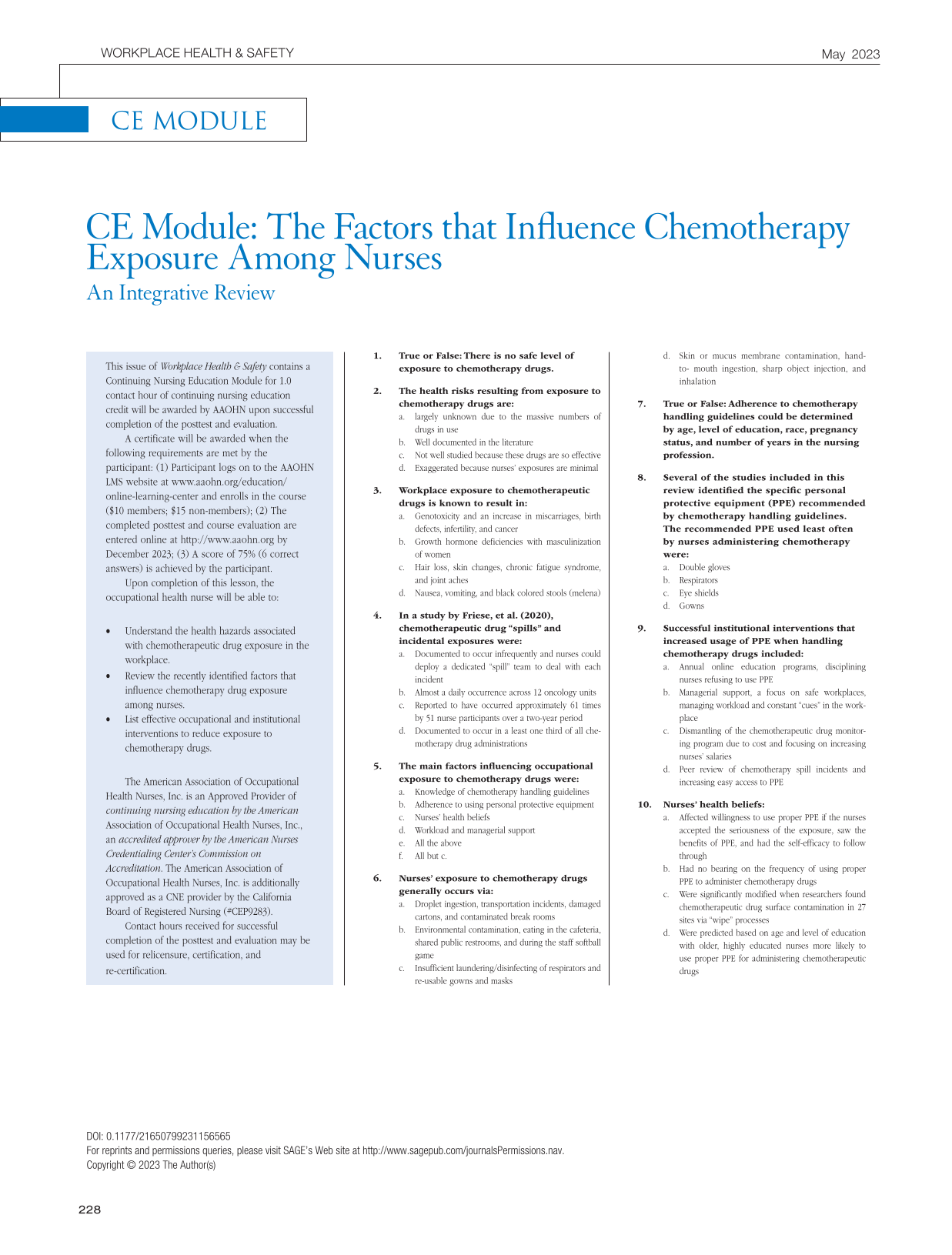
This issue of Workplace Health & Safety contains a Continuing Nursing Education Module for 1.0 contact hour of continuing nursing education credit will be awarded by AAOHN upon successful completion of the posttest and evaluation.
A certificate will be awarded when the following requirements are met by the participant: (1) Participant logs on to the AAOHN LMS website at www.aaohn.org/education/online-learning-center and enrolls in the course ($10 members; $15 non-members); (2) The completed posttest and course evaluation are entered online at http://www.aaohn.org by December 2023; (3) A score of 75% (6 correct answers) is achieved by the participant.
Upon completion of this lesson, the occupational health nurse will be able to:
Understand the health hazards associated with chemotherapeutic drug exposure in the workplace.
Review the recently identified factors that influence chemotherapy drug exposure among nurses.
List effective occupational and institutional interventions to reduce exposure to chemotherapy drugs.
The American Association of Occupational Health Nurses, Inc. is an Approved Provider of continuing nursing education by the American Association of Occupational Health Nurses, Inc., an accredited approver by the American Nurses Credentialing Center’s Commission on Accreditation. The American Association of Occupational Health Nurses, Inc. is additionally approved as a CNE provider by the California Board of Registered Nursing (#CEP9283).
Contact hours received for successful completion of the posttest and evaluation may be used for relicensure, certification, and re-certification.
True or False: There is no safe level of exposure to chemotherapy drugs.
The health risks resulting from exposure to chemotherapy drugs are: largely unknown due to the massive numbers of drugs in use Well documented in the literature Not well studied because these drugs are so effective Exaggerated because nurses’ exposures are minimal
Workplace exposure to chemotherapeutic drugs is known to result in: Genotoxicity and an increase in miscarriages, birth defects, infertility, and cancer Growth hormone deficiencies with masculinization of women Hair loss, skin changes, chronic fatigue syndrome, and joint aches Nausea, vomiting, and black colored stools (melena)
In a study by Friese, et al. (2020), chemotherapeutic drug “spills” and incidental exposures were: Documented to occur infrequently and nurses could deploy a dedicated “spill” team to deal with each incident Almost a daily occurrence across 12 oncology units Reported to have occurred approximately 61 times by 51 nurse participants over a two-year period Documented to occur in a least one third of all chemotherapy drug administrations
The main factors influencing occupational exposure to chemotherapy drugs were: Knowledge of chemotherapy handling guidelines Adherence to using personal protective equipment Nurses’ health beliefs Workload and managerial support All the above All but c.
Nurses’ exposure to chemotherapy drugs generally occurs via: Droplet ingestion, transportation incidents, damaged cartons, and contaminated break rooms Environmental contamination, eating in the cafeteria, shared public restrooms, and during the staff softball game Insufficient laundering/disinfecting of respirators and re-usable gowns and masks Skin or mucus membrane contamination, hand-to- mouth ingestion, sharp object injection, and inhalation
True or False: Adherence to chemotherapy handling guidelines could be determined by age, level of education, race, pregnancy status, and number of years in the nursing profession.
Several of the studies included in this review identified the specific personal protective equipment (PPE) recommended by chemotherapy handling guidelines. The Double gloves Respirators Eye shields Gowns
Successful institutional interventions that increased usage of PPE when handling chemotherapy drugs included: Annual online education programs, disciplining nurses refusing to use PPE Managerial support, a focus on safe workplaces, managing workload and constant “cues” in the workplace Dismantling of the chemotherapeutic drug monitoring program due to cost and focusing on increasing nurses’ salaries Peer review of chemotherapy spill incidents and increasing easy access to PPE
Nurses’ health beliefs: Affected willingness to use proper PPE if the nurses accepted the seriousness of the exposure, saw the benefits of PPE, and had the self-efficacy to follow through Had no bearing on the frequency of using proper PPE to administer chemotherapy drugs Were significantly modified when researchers found chemotherapeutic drug surface contamination in 27 sites via “wipe” processes Were predicted based on age and level of education with older, highly educated nurses more likely to use proper PPE for administering chemotherapeutic drugs