



Abstract
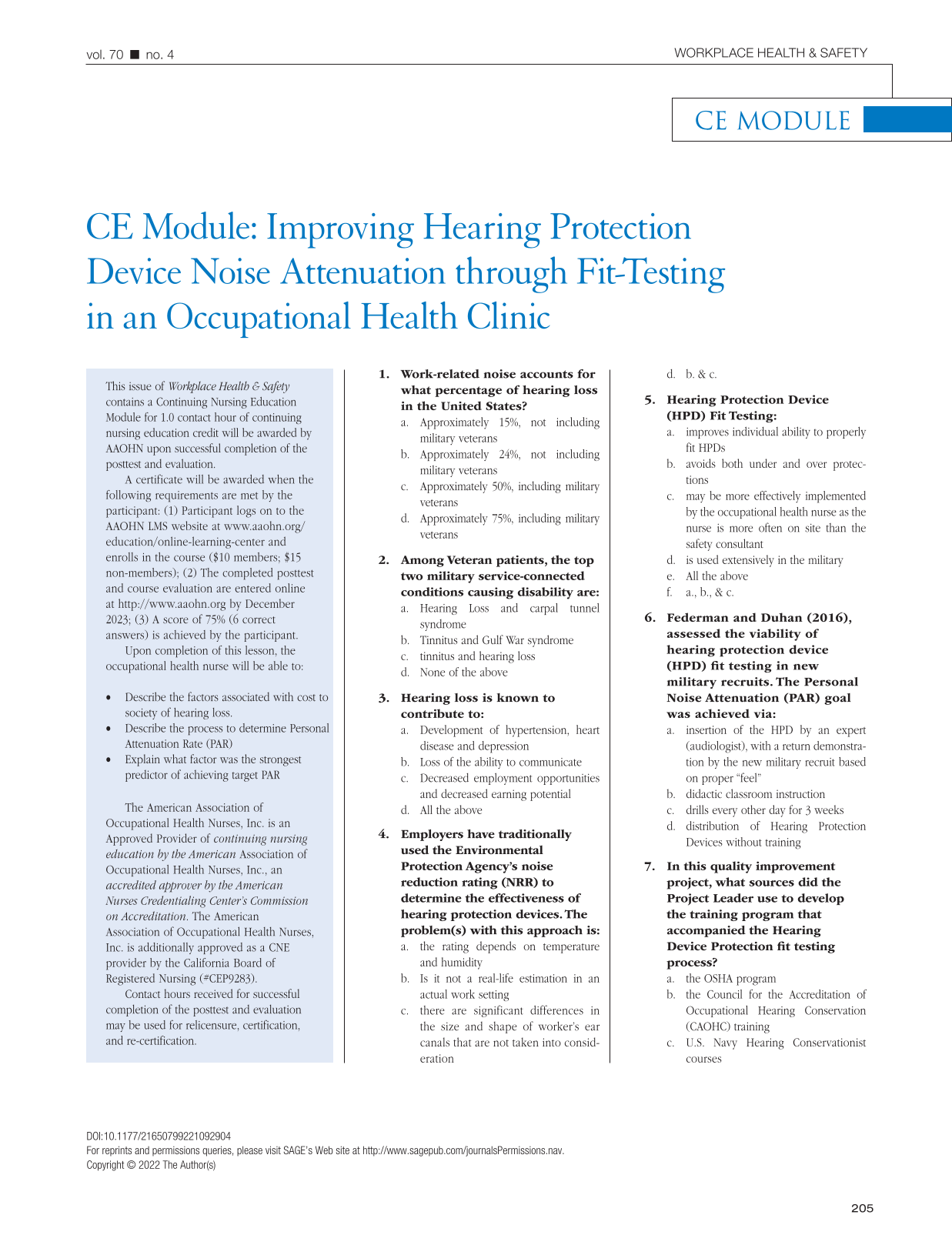
This issue of Workplace Health & Safety contains a Continuing Nursing Education Module for 1.0 contact hour of continuing nursing education credit will be awarded by AAOHN upon successful completion of the posttest and evaluation.
A certificate will be awarded when the following requirements are met by the participant: (1) Participant logs on to the AAOHN LMS website at www.aaohn.org/education/online-learning-center and enrolls in the course ($10 members; $15 non-members); (2) The completed posttest and course evaluation are entered online at http://www.aaohn.org by December 2023; (3) A score of 75% (6 correct answers) is achieved by the participant.
Upon completion of this lesson, the occupational health nurse will be able to:
Describe the factors associated with cost to society of hearing loss.
Describe the process to determine Personal Attenuation Rate (PAR)
Explain what factor was the strongest predictor of achieving target PAR
The American Association of Occupational Health Nurses, Inc. is an Approved Provider of continuing nursing education by the American Association of Occupational Health Nurses, Inc., an accredited approver by the American Nurses Credentialing Center’s Commission on Accreditation. The American Association of Occupational Health Nurses, Inc. is additionally approved as a CNE provider by the California Board of Registered Nursing (#CEP9283).
Contact hours received for successful completion of the posttest and evaluation may be used for relicensure, certification, and re-certification.
Approximately 15%, not including military veterans Approximately 24%, not including military veterans Approximately 50%, including military veterans Approximately 75%, including military veterans
Hearing Loss and carpal tunnel syndrome Tinnitus and Gulf War syndrome tinnitus and hearing loss None of the above
Development of hypertension, heart disease and depression Loss of the ability to communicate Decreased employment opportunities and decreased earning potential All the above
the rating depends on temperature and humidity Is it not a real-life estimation in an actual work setting there are significant differences in the size and shape of worker’s ear canals that are not taken into consideration b. & c.
improves individual ability to properly fit HPDs avoids both under and over protections may be more effectively implemented by the occupational health nurse as the nurse is more often on site than the safety consultant is used extensively in the military All the above a., b., & c.
insertion of the HPD by an expert (audiologist), with a return demonstration by the new military recruit based on proper “feel” didactic classroom instruction drills every other day for 3 weeks distribution of Hearing Protection Devices without training
the OSHA program the Council for the Accreditation of Occupational Hearing Conservation (CAOHC) training U.S. Navy Hearing Conservationist courses written instructions from the Centers for Disease Control and Protection All the above All but a. above
these are the only frequencies that really matter several researchers agree testing more than these three frequencies would not impact PARs the new military recruits had already lost hearing in the upper frequencies None of the above
achieved better attenuation rates with HPDs than older individuals suggesting early training was more likely to result in better hearing protection were less likely to find a good fit for their “hearing protection devices” achieved lower attenuation rates with HPDs than older individuals suggesting experience resulted in better hearing protection had more ear wax that interfered with baseline hearing levels
a small sample size the actual hearing protection devices used in the workplace were not available the optimal interval between Hearing Device Protection (HPD) training sessions was not evaluated the project precluded individuals with pre-existing hearing loss all the above