



Abstract
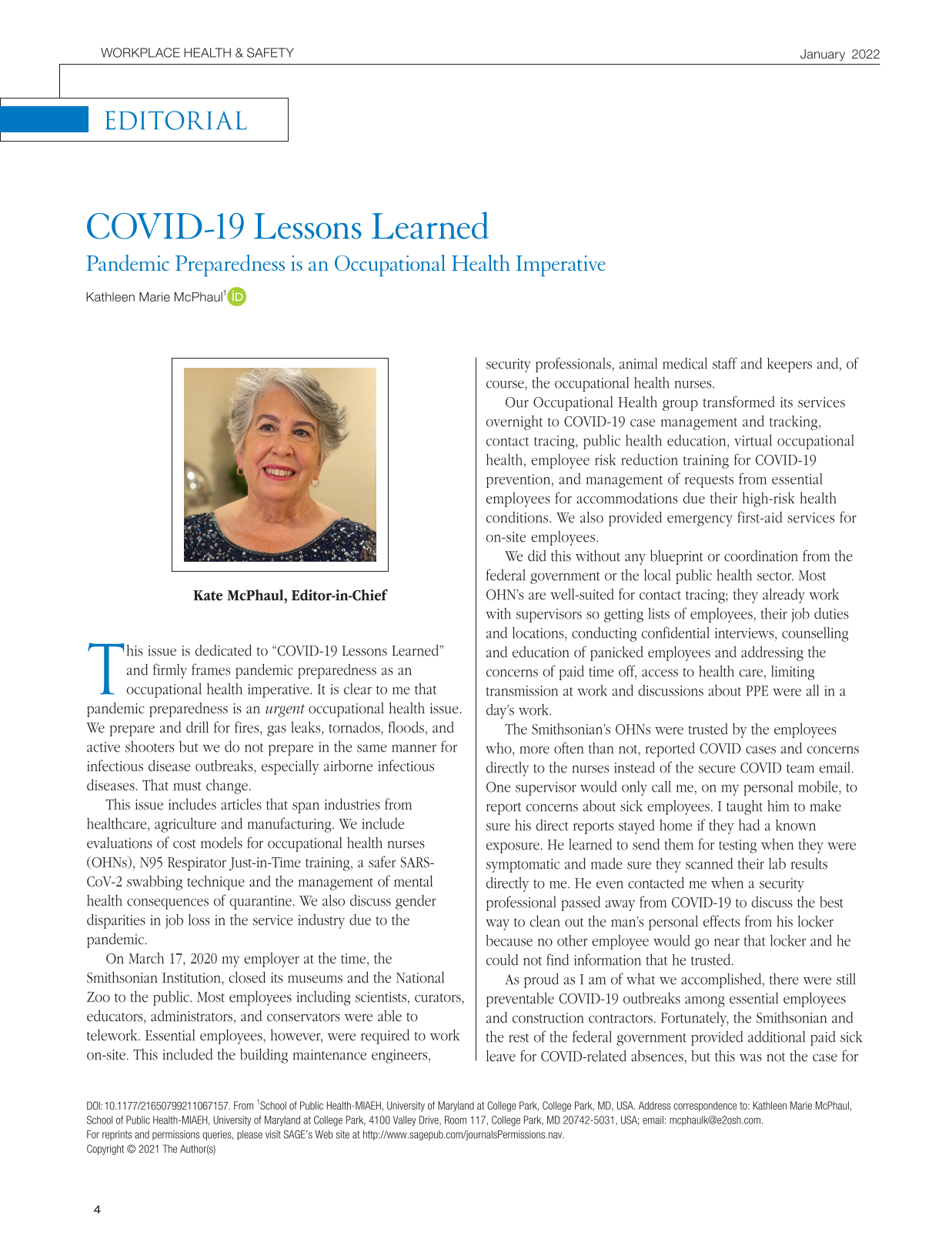
Kate McPhaul, Editor-in-Chief

This issue is dedicated to “COVID-19 Lessons Learned” and firmly frames pandemic preparedness as an occupational health imperative. It is clear to me that pandemic preparedness is an urgent occupational health issue. We prepare and drill for fires, gas leaks, tornados, floods, and active shooters but we do not prepare in the same manner for infectious disease outbreaks, especially airborne infectious diseases. That must change.
This issue includes articles that span industries from healthcare, agriculture and manufacturing. We include evaluations of cost models for occupational health nurses (OHNs), N95 Respirator Just-in-Time training, a safer SARS-CoV-2 swabbing technique and the management of mental health consequences of quarantine. We also discuss gender disparities in job loss in the service industry due to the pandemic.
On March 17, 2020 my employer at the time, the Smithsonian Institution, closed its museums and the National Zoo to the public. Most employees including scientists, curators, educators, administrators, and conservators were able to telework. Essential employees, however, were required to work on-site. This included the building maintenance engineers, security professionals, animal medical staff and keepers and, of course, the occupational health nurses.
Our Occupational Health group transformed its services overnight to COVID-19 case management and tracking, contact tracing, public health education, virtual occupational health, employee risk reduction training for COVID-19 prevention, and management of requests from essential employees for accommodations due their high-risk health conditions. We also provided emergency first-aid services for on-site employees.
We did this without any blueprint or coordination from the federal government or the local public health sector. Most OHN’s are well-suited for contact tracing; they already work with supervisors so getting lists of employees, their job duties and locations, conducting confidential interviews, counselling and education of panicked employees and addressing the concerns of paid time off, access to health care, limiting transmission at work and discussions about PPE were all in a day’s work.
The Smithsonian’s OHNs were trusted by the employees who, more often than not, reported COVID cases and concerns directly to the nurses instead of the secure COVID team email. One supervisor would only call me, on my personal mobile, to report concerns about sick employees. I taught him to make sure his direct reports stayed home if they had a known exposure. He learned to send them for testing when they were symptomatic and made sure they scanned their lab results directly to me. He even contacted me when a security professional passed away from COVID-19 to discuss the best way to clean out the man’s personal effects from his locker because no other employee would go near that locker and he could not find information that he trusted.
As proud as I am of what we accomplished, there were still preventable COVID-19 outbreaks among essential employees and construction contractors. Fortunately, the Smithsonian and the rest of the federal government provided additional paid sick leave for COVID-related absences, but this was not the case for security and construction contractors. Those who worked on-site often worked long days. Our occupational health unit lost several experienced nurses to retirement, to other employers and to off-site telework accommodation due to their high-risk health status. I retired from federal service and became the Editor-in-Chief of this journal and part-time faculty at the Public Health Aero-Biology Lab (PHABLab) at University of Maryland.
In retrospect, we wasted precious time building our own contact tracing and high-risk employee tracking tools that could have been provided by an integrated public health system. The lack of on-site rapid testing meant that many employees stayed home on quarantine far longer than necessary while the on-site employees worked extra hours. We hoarded old N-95’s left over from the 2009 H1N1 epidemic and spent countless hours trying to find appropriate PPE; then we paid much more than usual when we did find suppliers with PPE. We used manual non-secure means for transmitting protected health information such as phone screen shots and photos of lab results.
The articles in this and future issues of WH&S demonstrate that access to Occupational and Public Health services provided by nurses and other qualified professionals saves lives. The U.S. government was under-prepared, without authority and powerless to prevent the catastrophic loss of life and economic hardship of COVID-19. This is a call for a legally binding national pandemic preparedness plan with a designated federal leadership structure that has the authority to work across and between the public and private sectors, the State and local governments and that addresses safety and health in all workplaces for all workers. This is also a salute to the tireless occupational health professionals who protected and continue to protect workers’ health during the pandemic.
