



Abstract
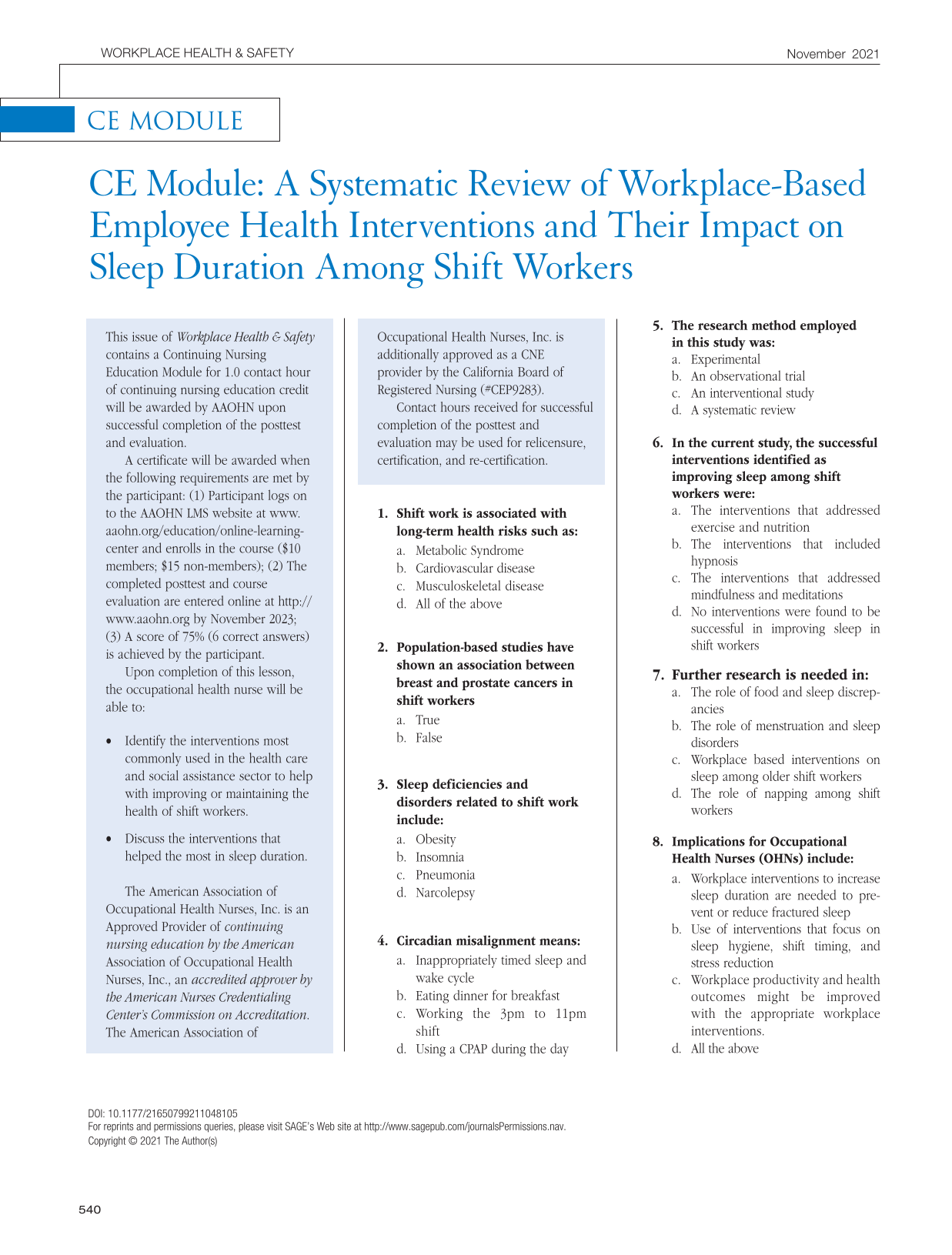
This issue of Workplace Health & Safety contains a Continuing Nursing Education Module for 1.0 contact hour of continuing nursing education credit will be awarded by AAOHN upon successful completion of the posttest and evaluation.
A certificate will be awarded when the following requirements are met by the participant: (1) Participant logs on to the AAOHN LMS website at www.aaohn.org/education/online-learning-center and enrolls in the course ($10 members; $15 non-members); (2) The completed posttest and course evaluation are entered online at http://www.aaohn.org by November 2023; (3) A score of 75% (6 correct answers) is achieved by the participant.
Upon completion of this lesson, the occupational health nurse will be able to:
Identify the interventions most commonly used in the health care and social assistance sector to help with improving or maintaining the health of shift workers.
Discuss the interventions that helped the most in sleep duration.
The American Association of Occupational Health Nurses, Inc. is an Approved Provider of continuing nursing education by the American Association of Occupational Health Nurses, Inc., an accredited approver by the American Nurses Credentialing Center’s Commission on Accreditation. The American Association of Occupational Health Nurses, Inc. is additionally approved as a CNE provider by the California Board of Registered Nursing (#CEP9283).
Contact hours received for successful completion of the posttest and evaluation may be used for relicensure, certification, and re-certification.
Metabolic Syndrome Cardiovascular disease Musculoskeletal disease All of the above
True False
Obesity Insomnia Pneumonia Narcolepsy
Inappropriately timed sleep and wake cycle Eating dinner for breakfast Working the 3pm to 11pm shift Using a CPAP during the day
Experimental An observational trial An interventional study A systematic review
The interventions that addressed exercise and nutrition The interventions that included hypnosis The interventions that addressed mindfulness and meditationsd No interventions were found to be successful in improving sleep in shift workers
The role of food and sleep discrepancies The role of menstruation and sleep disorders Workplace based interventions on sleep among older shift workers The role of napping among shift workers
Workplace interventions to increase sleep duration are needed to prevent or reduce fractured sleep Use of interventions that focus on sleep hygiene, shift timing, and stress reduction Workplace productivity and health outcomes might be improved with the appropriate workplace interventions. All the above