




Abstract
Background:
Restorative sleep is essential for the level of cognitive performance required of truckers to drive safely. The purpose of this qualitative descriptive study was to describe and explore sleep-related and safety decision-making among truck drivers.
Methods:
Flyers and snowball sampling were used to recruit truck drivers into the study. Semi-structured interviews were conducted to determine personal and professional influences on sleep and safety decision-making and preferences for receiving health information. Thematic analysis was conducted to generate descriptions of participants’ experiences.
Findings:
The sample consisted of 10 White males with a mean of 22 years of truck-driving experience. Weather conditions and drowsiness were the most commonly described conditions that required sleep decision-making by the participants. Four themes impacting sleep- and safety-related decision-making emerged including sentinel events, evolving driver characteristics, relationships, and company-level factors.
Conclusion/Application to Practice:
Findings from this study suggest that there are both internal and external factors influencing sleep and safety decision-making among truck drivers. Personal relationships with important others, such as family members, and professional relationships with company dispatchers were important influences among participants. During encounters with truck drivers, occupational health nurses should assess sleep quality and quantity and review healthy sleep hygiene strategies with them and their family members, if they are available. Future larger studies are necessary to inform the development of interventions and company policies to promote healthy sleep among truck drivers.
Background
The sleep of truck drivers is a highly significant occupational and public health and safety concern. There are almost two million heavy and tractor-trailer truck drivers in the United States (U.S. Bureau of Labor Statistics, 2017). They are a remote and highly mobile group of workers who experience many job-related factors that may contribute to sleep disruption. These factors include excessive nighttime driving, inconsistent and variable schedules, “just-in-time” customer delivery expectations, and sometimes unpredictable delays due to road and weather conditions, traffic, and availability of warehouse staff to unload freight (Chen et al., 2015; Lemke et al., 2015). In addition to these factors, truck drivers have a higher prevalence of obstructive sleep apnea (OSA) compared with the public (Colvin & Collop, 2016). Because OSA involves a cycle of repeated upper airway obstruction, oxygen desaturation, and arousal, the person with OSA experiences fragmented and nonrestful sleep (Franklin & Lindberg, 2015).
Drivers experiencing sleep disruption or fragmentation experience a higher risk for motor vehicle crash compared with drivers who do not experience these conditions because of commonly associated cognitive impairments. Vigilance or sustained attention to the driving task, executive function, and processing speed are among the cognitive impairments associated with sleep disruption and fragmentation that negatively affect safe driving skills, such as speed, lane position maintenance, and reaction time (Lees et al., 2012). Therefore, the sleep-deprived truck driver is at increased risk for motor vehicle crash, compared with the truck driver who is not sleep-deprived. Not only does the increased risk of sleep deprivation in this group heighten the likelihood of fatal and nonfatal motor vehicle crash (MVC)-related injuries, it also increases the risk of fatal and nonfatal MVC-related risk in other drivers with whom they share the roadways (Duffy et al., 2015).
Applying Research to Occupational Health Practice
This study, pertaining to sleep among truck drivers, will inform the development of interventions to positively influence those relationships and promote healthy sleep- and safety-related decision-making of truck drivers. Interventions may target less experienced truck drivers so that they feel empowered to self-advocate for sleep and safety earlier in their careers. Owners and managers of trucking companies and industry leaders must be made aware of these findings so that consistent messaging, policies, and procedures that promote healthy sleep and safety decision-making are top priorities.
Although a great deal of research involving the sleep of truck drivers has been published, there is a significant gap in the literature related to how truck drivers make decisions about their sleep while they are working. In fact, we could find no other study focusing on this topic. Therefore, the purpose of this qualitative descriptive study was to describe and explore sleep-related and safety decision-making among truck drivers.
Methods
The researchers employed qualitative description as the research design. This is a formative method of qualitative research that uses the common language of participants (Sandelowski, 2000) and is used when little is known about the research topic. It was appropriate and logical to use this method as we could find no other documentation of the sleep and safety decision-making experience among truck drivers in the research literature.
Drivers were recruited from the southern U.S. region using convenience (volunteer) sampling—primarily from truck stops, truck maintenance shops, and via word of mouth (snowball sampling). Flyers were also placed in areas commonly frequented by truck drivers. Interested drivers contacted the Principal Investigator (PI) via telephone for eligibility screening and to setup an interview appointment. Truck drivers who slept at least three nights per week in their trucks and who did not use alcohol or illegal drugs while on duty, who spoke and wrote English, and who had not been diagnosed with a sleep disorder (e.g., sleep apnea, insomnia, and narcolepsy) were deemed eligible for inclusion into the study. We excluded participants with sleep disorders and substance use because of the known negative effects of both on sleep. This study specifically targeted truck drivers who might have experienced poor sleep purely because of job-related issues such as irregular scheduling, short sleep duration, or sleep disruptions, and without the confounding effects of substance use or sleep disorders. Once eligibility was confirmed, 10 drivers completed written informed consent and were enrolled into the study. Recruitment ended after we reached data saturation with 10 participants. That is, after completing and analyzing the 10th interview, it became clear that we had reached saturation and were hearing no new information from the participants (Lincoln & Guba, 1985).
Data Collection
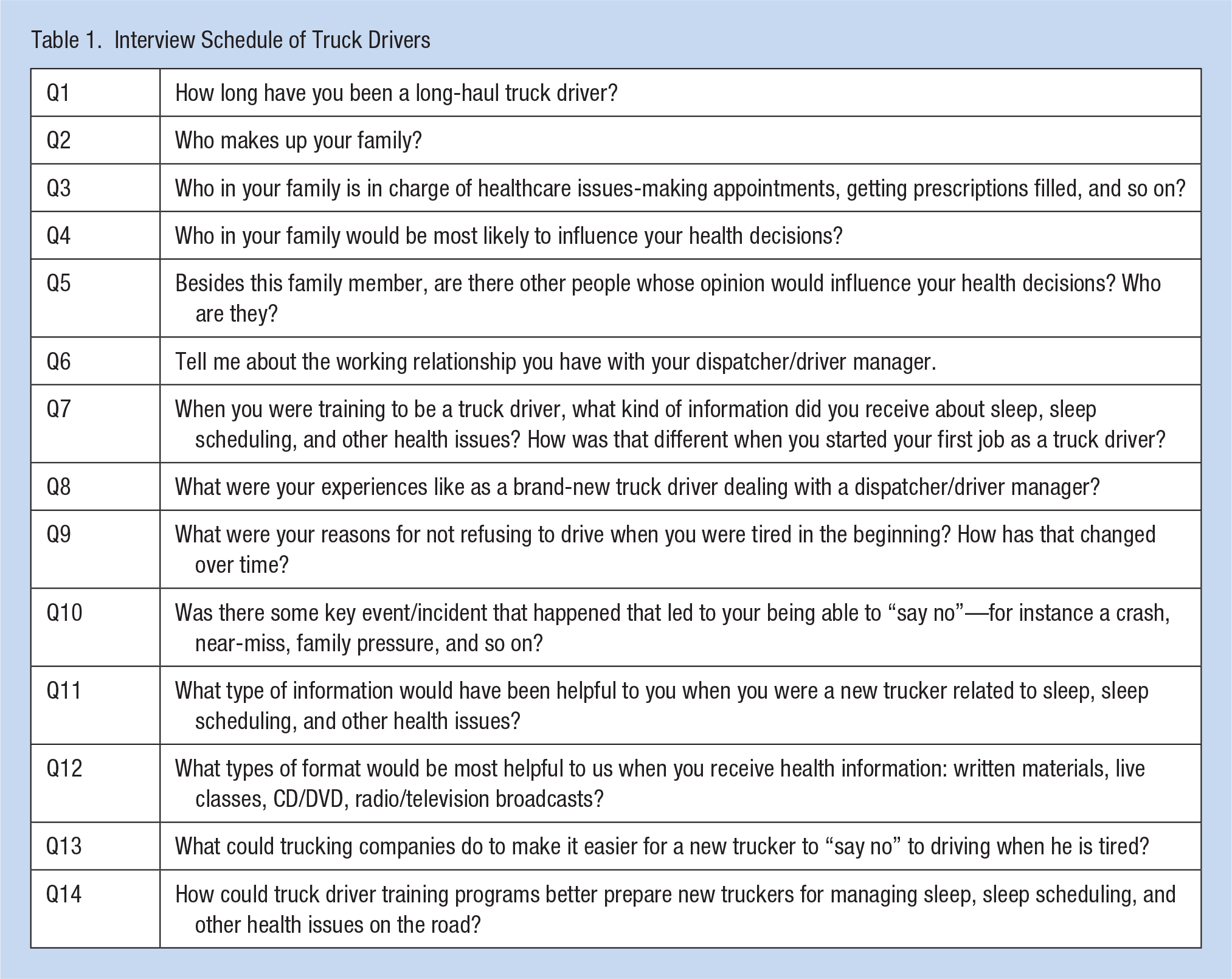
Semi-structured interviews took place in private areas of truck stop restaurants, truck maintenance shops, and community restaurants. The researchers developed an interview guide (Table 1) that was used for each interview to make sure that all participants were asked the same questions. Existing literature about sleep of truck drivers (Heaton et al., 2017; Heaton & Griffin, 2015; Wise et al., 2019) informed the development of the interview guide. The questions focused on identifying important others (e.g., family, friends, and coworkers) who influenced health and safety decisions, experiences with critical events such as crashes or near-misses that influenced decisions about sleep, and the truckers’ relationships with their dispatchers. The interviews were conducted by the study PI, ranged in length from 30 to 60 minutes, and were recorded and transcribed verbatim.
Interview Schedule of Truck Drivers
The University of Alabama at Birmingham Medical Institutional Review Board approved this study prior to enrollment of participants in the study and any data collection.
Data Analysis
NVivo™ software was used to facilitate content and thematic analysis of the interview transcripts. Thematic analysis was appropriate for identification of concepts within individual interviews and across the entire group to generate descriptions of a phenomenon, such as health- and safety-related decision-making in this study (Vasmoradi et al., 2013). To protect the anonymity of the drivers, all identifying information was removed from the interview transcripts. Each author reviewed the transcripts. The first cycle of coding yielded a tentative codebook, while second cycle coding resulted in codebook revisions. Repeated cyclical processes of coding and memo writing were conducted until interview themes emerged. Many strategies were used by the researchers to ensure the validity, credibility, and trustworthiness of the study. First, the researchers employed reflexivity to distance themselves from the data by acknowledging any possible biases that might influence data analysis. Specifically, notes and memos regarding potential areas of bias were documented concurrently with analysis. Second, a detailed audit trail, which documented all the study procedures, decisions, and their rationale in real time, was kept. The purpose of the audit trail was to document that study findings came from participant interviews and to provide a transparent record of all study procedures and decisions. Finally, interpretive convergence was reached by having all three researchers review the data analysis and come to a consensus on meaning and themes identified in the analysis (Lincoln & Guba, 1986).
Results
The sample consisted of 10 Caucasian males, with a mean of 22 years of experience (SD = 11.70; M = 19, range = 35) working as truck drivers. Four of the drivers identified themselves as owner–operators of trucks leased to a trucking company, and the remaining six drivers stated that they were employees of trucking companies.
Generally, the most commonly described conditions requiring sleep decision-making were road or driver conditions, such as inclement weather and drowsiness, respectively. Overall, four main influencing themes impacting sleep- and safety-related decision-making emerged from the analysis of the data: (a) sentinel events, (b) evolving driver characteristics, (c) relationships, and (d) company-level factors.
Sentinel Events
Drivers described key or sentinel events as crashes, near-misses, running off the road, or other experiences that allowed them to recognize their personal limits and prevent them from entry into what they described as the “danger zone.” They either described their own experiences of key events or described exposure to or witnessing another driver’s experience(s). “Wakeup calls” were sometimes literal references to hitting guardrails or waking up at the wheel of a truck. For instance, one participant indicated, “you are going down the road late at night and then all of a sudden you get this adrenaline rush and you wonder how long your eyes have been shut.”
Another driver described, trying to run a little harder than I should have . . . and you feel yourself going over on the shoulder . . . or sleeping literally around the clock. And that was a wakeup call for me, you know this is ridiculous . . . and it is too hard on your body.
Other key events involved deaths or severe injury to truck drivers and/or other drivers on the roadways, as one participant stated, I’ve probably seen 50 to 60 truck roll overs or truckers plowing through fields just driving off the road . . . I seen him fall asleep, go into the median, cross over to the other side, take out a car killing everyone inside including three children and they were on their way to a vacation down in Florida.
One of the other drivers shared a similar story, “saw it happen; bursting into flames. I had to dodge pieces of flaming debris and I was on the phone with 911 and everything . . . that woke me up because I knew he had fell asleep.”
Drivers described key events as helpful in recognizing personal health and safety limits, such as when to pull over and get rest or when to turn down a load based on road conditions. For example, one stated, “When I am seeing double vision, I get myself off the road.” Another driver described, a point where you have to tell yourself, you know your body tells you things and you have to listen to your body, it is as simple as that, um you can go to the bank so many times and get a loan but there is a point where the bank is going to say no, you can’t do this anymore, you know.
Drivers described exposures to key events leading to development of an awareness of potential consequences, highlighting the significance of sleep and safety decision-making and the risks at stake when driving “an 80,000-pound bullet”: I am not hurting anyone but myself . . . how would you feel . . . if through your own negligence or through neglect to other people, you know, how you explain to them . . . you have run off the other side of the road and you have hurt or killed someone because you’re not getting enough rest, not getting enough sleep?
This sentiment was shared by many of the drivers who expressed concern with either killing someone or being killed while driving their vehicles without adequate sleep or rushing to make a deadline. “Think, you know, if you would run over and kill somebody . . . a human life . . . ” One driver stated that truck drivers were “putting your life and everyone else’s life around you” at risk and because of this he was motivated to make better sleep decisions and not “put them all on the line.” One driver described his takeaway from key events during his early years: “You know, it is kind of like baseball, the runs don’t count unless you make it home safe.”
Evolving Driver Characteristics
Experience
Many drivers discussed experience by comparing “younger” versus “older” drivers and revealed that poor decision-making was common in younger drivers, not only due to a lack of health knowledge, but also naivety in working with companies and dispatch personnel (i.e., employees of trucking company who plan trucker workloads): “I didn’t realize, because of being new, how dangerous it was to drive when you were really tired.” “When I was new in the trucking business . . . I was forced to continue driving when I was exhausted . . . ”
However, the ability to discern and make appropriate sleep and safety decisions was enhanced with years of experience: As I became more experienced in my driving, more confident in my driving, I realized, no, I don’t have to continue to drive when I am tired. And no, I’m not going to drive in hazardous conditions when every other truck is pulled off the road.
Persona
Drivers described the development of a “tough guy” persona that enabled them to resist pressure to make poor decisions and establish boundaries to protect their health or safety. They described this persona as being “hard-headed” and learning “it’s okay to say no.” However, drivers also mentioned an additional persona, sometimes referred to as “super driver,” that was common among ambitious drivers who were “making a name” for themselves by pushing for as many miles and deliveries as possible. These super drivers, as described by participants, wished to be known as the “go to guy” for dispatchers to contact with confidence, knowing the load would be delivered as fast as possible: “one of our super drivers, dispatchers loved him cause he would do run and run and run.” However, the drivers also described super drivers as dangerous and reckless “fools . . . drivers that will end up hurting someone or go to jail.” While both the tough guy and super driver personas were described in detail, most drivers identified themselves as the tough guy driver.
Persona was an evolving, individual driver characteristic. Drivers described a transition in decision-making that occurred over time with increased experience and exposure to sentinel events (e.g., crashes, near-misses). This led to their greater understanding of risks associated with sleep and safety decisions while driving.
Relationships With Others
Family and Friends
Along with individual driver characteristics, drivers’ relationships with others were described as influential on their sleep and safety decision-making. Influential relationships included individuals and family outside of work, and the individuals inside their work environment, particularly the dispatcher or “trip planner” who assigned driver loads. Family members and friends were often cited as primary influencers of driver health care, most often a spouse or member of immediate family (e.g., sister, mother, brother, father) who was always “nagging to do the right thing.” While most drivers cited positive influences of family and friends on their health decision-making, one driver noted his father’s negative example and stated that he strove not to participate in the behaviors his father did.
Dispatcher
Drivers described their relationships with a work dispatcher as the primary relationship influence on decision-making for sleep and safety, surpassing the influence of family and friends. Boundaries, communication, and dispatcher characteristics all played a part in what drivers described as the driver–dispatcher relationship. Some truckers experienced work with dispatchers who overstepped boundaries, a commonly described negative impact on decision-making for drivers: I felt uncomfortable and he told me to just keep going . . . on the radio they said unless it is an emergency get off the road. He said it’s not an emergency . . . no you just keep right on going . . . so I felt very uncomfortable and very forced; I was forced at that time to continue driving when I was exhausted.
When asked to describe what they meant by “forced,” drivers stated that although their job was not threatened, the dispatchers might display vindictive behavior such as making them feel guilty by making subtle comments and passing them over when loads were assigned, “making me sit for a few days” and therefore impacting the driver’s personal income. One driver described an attempt toward reciprocity in the driver–dispatcher relationship but “it didn’t always seem to work.” Another driver stated that even after developing a tough guy persona, he still anticipated “the blow torch in your face” for stopping to sleep or refusing a load. Some drivers described learning “to say this is enough” and to think in terms of their own liability, remembering to “tell yourself it’s not worth you taking the heat” and “I’m sticking my neck out there.”
Drivers described both good and bad driver–dispatcher relationships but all noted that, good or bad, the relationship impacted both sleep and safety due to work load, stress, and safety concerns. Drivers who reported good relationships with their dispatchers described a mutual understanding of roles and use of compromise when necessary. Some drivers reported that building their tough guy persona was partly to change communication with their dispatcher and to protect personal boundaries. One driver described taking a defensive position in the relationship, stating “throwing it back in their court helps your position tremendously.”
Drivers also described a “super dispatcher” persona, a parallel person with “super drivers”; a dispatcher who receives a financial incentive for facilitating the most loads by pushing drivers to deliver more, faster: “their motivation is to move freight . . . to get their job done regardless of what.” Because of financial incentives, drivers often described the dispatchers as hard to trust. When probed regarding this view of dispatchers, drivers suggested that the physical disconnect between the drivers and dispatchers promoted hostility and frustration, because, “they don’t see, they are on the telephone, they can’t see you standing there sweating and wore out, ’cause they are sitting in an air-conditioned office and at 5 o’clock they are going to the house.”
Company-Level Factors
Company factors, in addition to individual driver characteristics and relationships, impacted driver sleep and safety decisions. Some company factors include company culture, pay, and the use of forced dispatch.
Company Culture and Pay
Drivers describe an ideal company culture as “honest,” “proactive,” and one that provides adequate training on health and safety, which “gets you in the mindset of what you’re supposed to be doing.” Alternatively, company culture can negatively impact driver decisions about sleep and safety when the company communicates a lack of respect for drivers, such as when profit is valued more highly than safety. One driver joked that their company was “all about safety until it costs money.” Drivers also mentioned that value of cost over safety was frustrating, considering it “less costly to keep truckers safe, to keep from killing people.” Sleep decisions were also influenced by the driver’s employment status and method of payment. It was suggested that the choice of pay over sleep might be worse in independent owner operators, because “if you are getting paid per load or percentage of that load you really tend to push yourself because you are getting paid this whether it takes you 2 days or 3 days.” For drivers who were paid per mile, making good decisions about their sleep was easier because they were able to take breaks without concern about financial repercussions: “if you’re being paid by the mile you can take a deep breath . . . I can relax.” These drivers did sometimes push their sleep limits and acknowledged that although missing sleep didn’t have a direct financial impact, “it hurts your health dramatically.”
Forced Dispatch
Several drivers described a negative influence on sleep and safety decisions by forced dispatch. Forced dispatch refers to the strict, non-negotiable assignment of a load and destination to a driver. Drivers described forced dispatch as “This is your load. Don’t say you aren’t going to take it, this is your load, and this is forced dispatch. No negotiation.” One driver even suggested that forced dispatch was the most important aspect to consider when choosing a company, because of the influence of forced dispatch on the driver–dispatcher relationship.
Discussion
This study suggests that both internal and external dynamics influence sleep- and safety-related decision-making among truck drivers. As the drivers gained more driving experience, survived near-misses and sleeping at the wheel, and witnessed or heard of other drivers’ sentinel events, they critically appraised risks to themselves and others. Subsequently, they were empowered to self-advocate for their own sleep and safety by declining loads or stopping to sleep rather than continuing to drive.
Relationships with others and the culture of the trucking companies were primary external influencers of sleep and safety decision-making among this group. Although drivers identified friends and family members as influential, the relationship with the dispatcher emerged as most influential on sleep and safety decision-making. The relationship with the dispatcher was identified as having the potential to positively influence health and safety decisions when negotiation and compromise took place between driver and dispatcher. However, most drivers felt that pressure from the dispatchers to keep driving and their fear of punitive actions directed toward them by dispatchers were negative influences on sleep and safety decision-making.
During the discussion of the relationships between dispatchers and drivers, a driver again described the evolution of his “tough guy” persona, which emboldened him to stop to sleep or decline loads. Still, he anticipated negative responses from his dispatcher. Other drivers described thinking of their liability and risk as motivators to say “enough” to dispatchers. Along with relationships with others, company cultures were important external influences on sleep and safety decision-making.
Two primary features of company culture that were identified as negative influences on sleep and safety decision-making by drivers were the focus on financial gain or loss avoidance over safety and forced dispatch policies. In both of these areas, drivers described having knowledge of best practices for safety and health, but they found themselves at odds with the push to move freight to make money for themselves or the company, and in conflict with dispatchers who told them that there was no negotiation allowed regarding assigned loads.
Findings from this study make a unique and important contribution to the body of knowledge concerning truck drivers’ sleep and safety decision-making. To the best of our knowledge, this is the first qualitative study of its kind. One other study, regarding truck driver decision-making related to distracted driving (Swedler et al., 2015) suggested that the most important influence was the drivers’ supervisor(s). In this study, the relationship with the dispatcher was the most influential. Although the dispatcher is usually not the truck driver’s supervisor, that role was the one which assigns work and evaluates, in real time, the achievement of goals (e.g., on-time deliveries). In this regard, findings from this study are related to those of Swedler et al. (2015).
This study is not without limitations. The sample is small and limited to White males who volunteered to participate. It is unclear whether the experiences of a more racially, ethnically, and gender diverse sample would be like those described in this article. Also, this sample of drivers had many years of driving experience. Therefore, they had likely experienced evolution in their decision-making, compared with truck drivers with fewer years of experience who were not represented in this study. Another limitation is that although the role of the dispatcher is discussed thoroughly, the voice of the dispatcher is missing. That is, the perspectives of dispatchers regarding sleep and safety decision-making among truck drivers are critical to a comprehensive understanding of the sleep and safety decision-making experience of truck drivers.
Larger quantitative studies involving not only truck drivers, but dispatchers and family members as well will be important to gain a more complete understanding of the dynamics of their relationships related to truck driver’s sleep and safety decision-making. Recruitment and retention of this population are difficult. Innovative methods of recruiting truck drivers using targeted placement of research recruitment advertising on social media sites frequently accessed by truckers casts a very large net and may yield larger numbers of participants who are racially and ethnically diverse and represent broader areas of the United States. Using this recruitment effort would potentially improve generalizability of future quantitative research focusing on this population.
Despite the limitations of the study, this article brings to light the experience of sleep- and safety-related decision-making of truck drivers in their own words. Given the safety-sensitive nature of their jobs, and the numbers of truck drivers on U.S. highways, it is important to use findings from this study to inform future research and education.
Implications for Occupational Health Nursing Practice
Because truck drivers are so mobile and isolated, occupational health nurses must familiarize themselves with the unique job and lifestyle issues faced by truck drivers “on the road.” A better understanding of some of the challenges experienced by the drivers will allow nurses to tailor information and advice that is practical and timely to this unique and high-risk population. Discussions with drivers about sleep hygiene at every visit are important. Findings from this study also suggest that it may be especially important to stress sleep hygiene and self-advocacy for healthy sleep among less-experienced truck drivers, who may feel pressured to work when they are too tired to safely do so.
Footnotes
Declaration of Conflicting Interests
The author(s) declared no potential conflicts of interest with respect to the research, authorship, and/or publication of this article.
Funding
The author(s) received no financial support for the research, authorship, and/or publication of this article.

Author Biographies
Karen Heaton is a recognized expert in occupational health and safety. Her research focus includes the cognitive effects of sleep deprivation and disorders on performance, health, and safety among remote workers-specifically long-haul truck drivers and farmers.
Rachael Mumbower, PhD, RN, is an Assistant Professor at the Capstone College of Nursing at the University of Alabama.
Gwendolyn Childs, PhD, RN, FAAN is an Associate Professor and Associate Dean for Undergraduate and Prelicensure Programs at the University of Alabama at Birmingham School of Nursing.