




Abstract
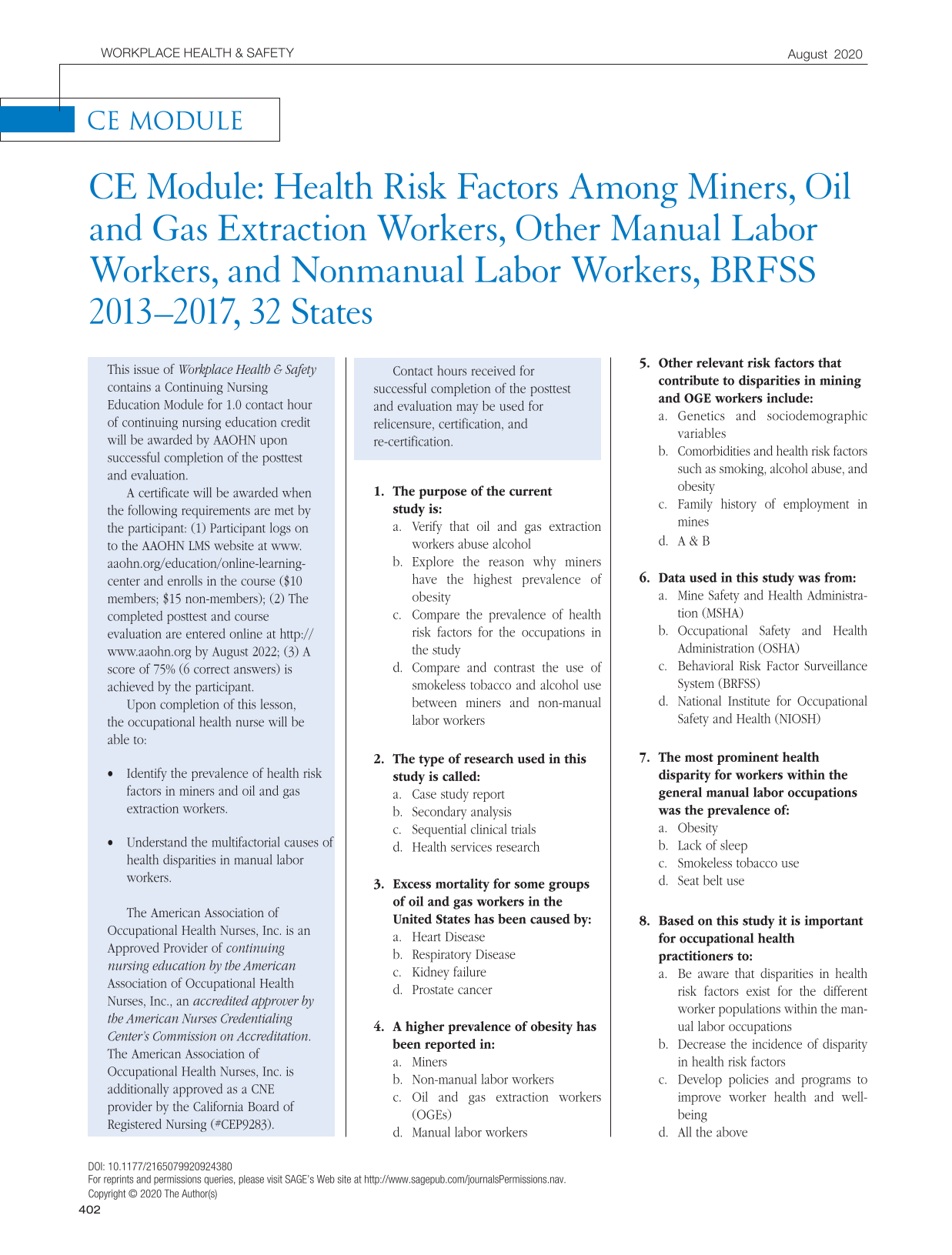
This issue of Workplace Health & Safety contains a Continuing Nursing Education Module for 1.0 contact hour of continuing nursing education credit will be awarded by AAOHN upon successful completion of the posttest and evaluation.
A certificate will be awarded when the following requirements are met by the participant: (1) Participant logs on to the AAOHN LMS website at www.aaohn.org/education/online-learning-center and enrolls in the course ($10 members; $15 non-members); (2) The completed posttest and course evaluation are entered online at http://www.aaohn.org by August 2022; (3) A score of 75% (6 correct answers) is achieved by the participant.
Upon completion of this lesson, the occupational health nurse will be able to:
Identify the prevalence of health risk factors in miners and oil and gas extraction workers.
Understand the multifactorial causes of health disparities in manual labor workers.
The American Association of Occupational Health Nurses, Inc. is an Approved Provider of continuing nursing education by the American Association of Occupational Health Nurses, Inc., an accredited approver by the American Nurses Credentialing Center’s Commission on Accreditation. The American Association of Occupational Health Nurses, Inc. is additionally approved as a CNE provider by the California Board of Registered Nursing (#CEP9283).
Contact hours received for successful completion of the posttest and evaluation may be used for relicensure, certification, and re-certification.
Verify that oil and gas extraction workers abuse alcohol Explore the reason why miners have the highest prevalence of obesity Compare the prevalence of health risk factors for the occupations in the study Compare and contrast the use of smokeless tobacco and alcohol use between miners and non-manual labor workers
Case study report Secondary analysis Sequential clinical trials Health services research
Heart Disease Respiratory Disease Kidney failure Prostate cancer
Miners Non-manual labor workers Oil and gas extraction workers (OGEs) Manual labor workers
Genetics and sociodemographic variables Comorbidities and health risk factors such as smoking, alcohol abuse, and obesity Family history of employment in mines A & B
Mine Safety and Health Administra-tion (MSHA) Occupational Safety and Health Administration (OSHA) Behavioral Risk Factor Surveillance System (BRFSS) National Institute for Occupational Safety and Health (NIOSH)
Obesity Lack of sleep Smokeless tobacco use Seat belt use
Be aware that disparities in health risk factors exist for the different worker populations within the manual labor occupations Decrease the incidence of disparity in health risk factors Develop policies and programs to improve worker health and well-being All the above