




Abstract
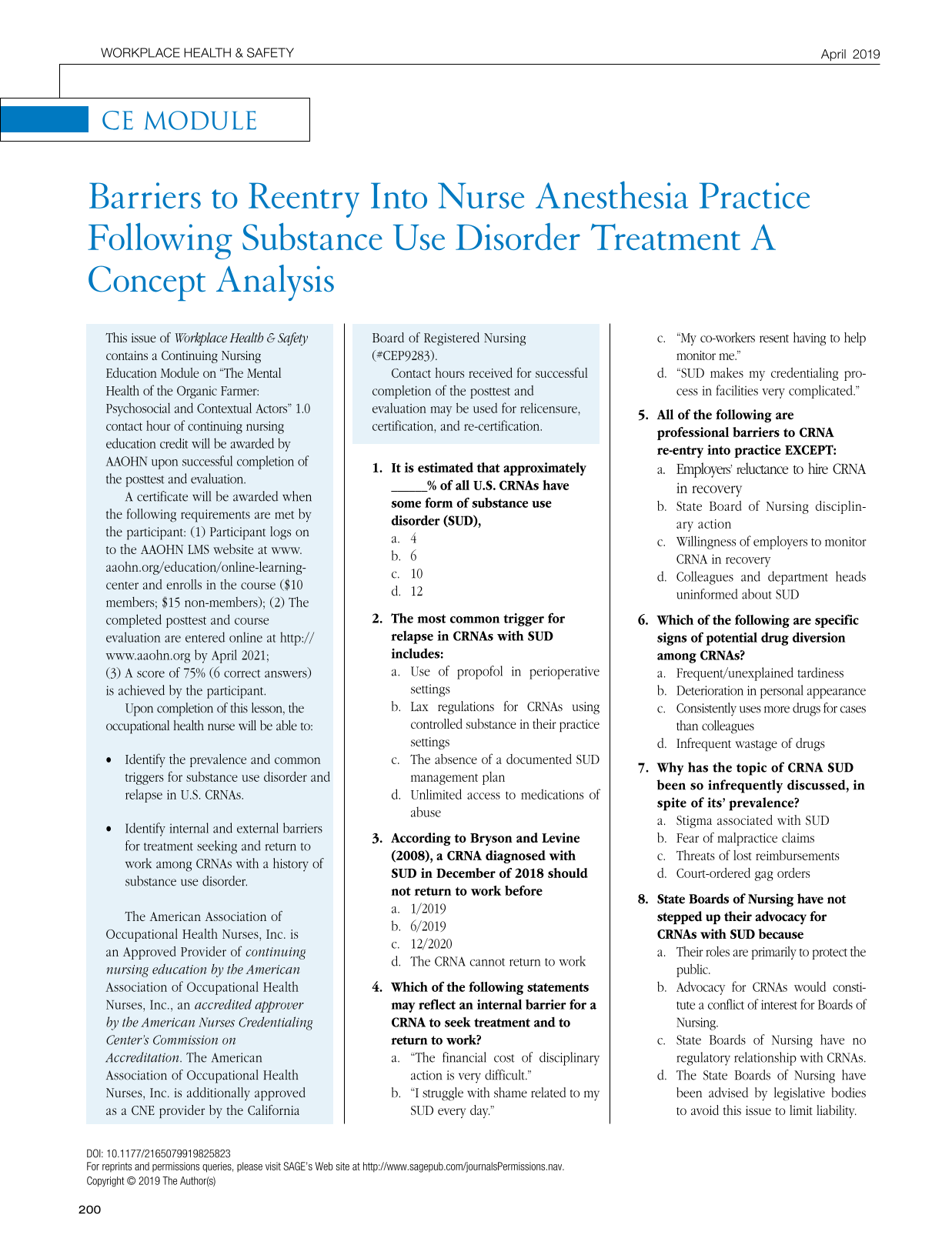
This issue of Workplace Health & Safety contains a Continuing Nursing Education Module on “The Mental Health of the Organic Farmer: Psychosocial and Contextual Actors” 1.0 contact hour of continuing nursing education credit will be awarded by AAOHN upon successful completion of the posttest and evaluation.
A certificate will be awarded when the following requirements are met by the participant: (1) Participant logs on to the AAOHN LMS website at www.aaohn.org/education/online-learning-center and enrolls in the course ($10 members; $15 non-members); (2) The completed posttest and course evaluation are entered online at http://www.aaohn.org by April 2021; (3) A score of 75% (6 correct answers) is achieved by the participant.
Upon completion of this lesson, the occupational health nurse will be able to:
Identify the prevalence and common triggers for substance use disorder and relapse in U.S. CRNAs.
Identify internal and external barriers for treatment seeking and return to work among CRNAs with a history of substance use disorder.
The American Association of Occupational Health Nurses, Inc. is an Approved Provider of continuing nursing education by the American Association of Occupational Health Nurses, Inc., an accredited approver by the American Nurses Credentialing Center’s Commission on Accreditation. The American Association of Occupational Health Nurses, Inc. is additionally approved as a CNE provider by the California Board of Registered Nursing (#CEP9283).
Contact hours received for successful completion of the posttest and evaluation may be used for relicensure, certification, and re-certification.
4 6 10 12
Use of propofol in perioperative settings Lax regulations for CRNAs using controlled substance in their practice settings The absence of a documented SUD management plan Unlimited access to medications of abuse
1/2019 6/2019 12/2020 The CRNA cannot return to work
“The financial cost of disciplinary action is very difficult.” “I struggle with shame related to my SUD every day.” “My co-workers resent having to help monitor me.” “SUD makes my credentialing process in facilities very complicated.”
Employers’ reluctance to hire CRNA in recovery State Board of Nursing disciplinary action Willingness of employers to monitor CRNA in recovery Colleagues and department heads uninformed about SUD
Frequent/unexplained tardiness Deterioration in personal appearance Consistently uses more drugs for cases than colleagues Infrequent wastage of drugs
Stigma associated with SUD Fear of malpractice claims Threats of lost reimbursements Court-ordered gag orders
Their roles are primarily to protect the public. Advocacy for CRNAs would constitute a conflict of interest for Boards of Nursing. State Boards of Nursing have no regulatory relationship with CRNAs. The State Boards of Nursing have been advised by legislative bodies to avoid this issue to limit liability.