



Abstract
The purpose of this study was to identify variables—that is, demographic factors (age, history of back pain, body mass index [BMI], and waist circumference), occupational stress, job satisfaction, perceived supervisor support, and physical fitness—that predict back pain in firefighters. Firefighters, an occupational group at high risk for back injury, perform many job tasks under hazardous work conditions. A nonexperimental, correlational design was used to study a convenience sample of 298 male firefighters who completed study questionnaires. Almost one third (30.20%) of the firefighters reported current back pain. The set of factors that predicted current back pain in firefighters included occupational stress, age, history of back pain, and BMI—pseudo R2 = .351. Further studies should validate the model and explore relationships among perceived supervisor support, occupational stress, and job satisfaction in other occupational groups, including nurses and police officers.
Occupational back pain is a significant health and safety problem in many industrialized countries for individuals who perform work-related forceful movement and lifting (World Health Organization, 2017). Estimated costs for low back pain are at least US$50 billion per year (National Institute of Neurological Disorders and Stroke, National Institutes of Health, 2008). In 2014, the U.S. Department of Labor (2014) reported a comparison of 12 injuries and illnesses and found that back pain caused the most days away from work. Almost one fifth (20%) of nonfatal occupational injuries with days away from work were back injuries (U.S. Department of Labor, 2014). When considering the events leading to an occupational injury, 57% of cases involved worker overexertion, specifically from lifting, with 10 days away from work (U.S. Department of Labor, 2014).
Firefighters, an occupational group at high risk for back injury, perform many hazardous job tasks at the scene of a fire (Karter, 2013). Firefighters are required to lift and carry victims, wear heavy protective gear, connect hose lines to hydrants, and secure their equipment after responding to a fire (Karter, 2013). Moreover, their duties may result in unexpected encounters during a variety of emergencies (U.S. Department of Labor, 2004). In all, 40% of total injuries in firefighters are sprains or strains resulting in pain; 43% of those firefighters who report sprains or strains experience moderate and severe sprains or strain (Karter, 2013). The U.S. Department of Homeland Security, U.S. Fire Administration, National Fire Data Center (2014) reported that 27% of firefighters experienced back pain due to overexertion. Back pain was reported to be the reason for early retirement because about one fifth of “dropouts” and early retirees reported low back pain when they were still active firefighters (Lusa, Miranda, Luukkonen, & Punakallio, 2015). Most studies of occupational back pain have examined factors influencing this problem among other groups of workers, especially nurses and hospital workers, but few studies have investigated municipal workers such as firefighters. Little is known about factors that influence back pain among firefighters.
The impact of musculoskeletal disorders on individuals and society is expected to increase dramatically (Karter, 2013; Moore, 2013). Many of these conditions are more prevalent among or may have a greater impact on older adults, and the predicted aging of the world’s population, predominantly in less-developed countries, will probably increase the number of individuals affected by musculoskeletal conditions (Briggs et al., 2016). In addition, changes in lifestyle may lead to increased obesity and less physical activity due to urbanization and motorization of the developing world, with more individuals experiencing back pain (Kirchengast, 2014). Because of conflicting results reported in the literature, more studies are needed examining the relationship between age and back pain (McGorry, Shaw, & Lin, 2010; Rafeemanesh, Kashani, Parvaneh, & Ahmadi, 2017).
Researchers have reported that physical fitness can increase the body’s resistance to low back pain and provide long-term protective effects (Rafeemanesh et al., 2017). Physical fitness can improve back strength and increase blood supply to the muscle and joints, minimizing the risk of injury; the risk of back pain can be reduced by increasing muscle strength and flexibility (Moore, 2013). The Moore (2013) study also found that the least-fit firefighters were 10 times more likely to be injured than the most-fit firefighters. These results have been reported among other occupational groups (e.g., nurses and construction workers) as well; however, additional research is needed on firefighters (White et al., 2016). Moon et al. (2015) found that the role of physical fitness is critical to improving muscle strength and minimizing lower back pain in firefighters. Because work-related back pain is the leading cause of early retirement among firefighters, research on physical fitness and back pain in firefighters is needed (Lusa et al., 2015).
Regarding the influence of stressors on back pain, de Freitas-Swerts and do Carmo Cruz Robazzi (2014) examined the relationship of psychological stress and incidence of low back pain and found that stress was associated with back pain incidence. The authors focused on only one general measure of psychological stress and did not measure occupational stress.
Some studies have reported that limited social support is associated with back pain (Masters, Stillman, & Spielmans, 2007; Melloh et al., 2013; Yilmaz & Dedeli, 2012). Conversely, another study that examined the relationship between social support and low back pain found that social support had no association with low back pain (Hartvigsen, Lings, Leboeuf-Yde, & Bakketeig, 2004). Because of conflicting results reported in the literature, more studies are needed to examine the relationship between social support and back pain. In addition, further study is needed to understand the particular influence of both occupational stress and supervisor support on low back pain in firefighters.
The effect of job satisfaction, a psychosocial variable, on back pain should also be studied. For example, some investigators have concluded that low job satisfaction was associated with an increased risk of back pain (Dick, Lowe, Lu, & Krieg, 2015; Urquhart et al., 2013). Another study reported no influence of job satisfaction on low back pain in nurses, postal workers, and patients being treated for pain (Feyer, Williamson, Mandryk, de Silva, & Healy, 1992). Because the relationship between job satisfaction and back pain has not been established, and because no studies have been reported on job satisfaction and low back pain in firefighters, future studies are needed to examine this relationship.
The aims of this research were to (a) identify the best subset of predictors—that is, occupational stress and demographic factors (age, history of back pain, body mass index [BMI], and waist circumference)—for work-related back pain in firefighters; (b) test whether adding job satisfaction and perceived supervisor support to the best predictive model increases predictive ability; and (c) test whether adding physical fitness to the model identified in the second research question increases predictive ability.
The research questions for this study were as follows:
Method
A nonexperimental, correlational design was used to study firefighters employed by a large city in the southeastern United States. The convenience sample included firefighters who volunteered to participate in the study and met the following criteria for inclusion in the study: (a) full-time firefighters employed by a municipality, (b) willing to participate in the study, (c) aged 20 years to 60 years, and (d) male gender. Exclusion criteria included history of vertebral fracture or malignant spine diseases such as primary tumor, metastases, and myeloma. A total of 393 male firefighters participated in the health screening at this worksite and were eligible to participate in the study. Of the 311 firefighters who volunteered to participate, a total of 298 (95.8%) participants submitted completed questionnaires and physical fitness evaluations. In all, 13 (4.2%) incomplete questionnaires were submitted and excluded from analysis. Therefore, the response rate in this study was 75.8%. Power and sample size for binomial logistic regression analysis showed that with a probability of back pain P0 (a priori) = 0.34, intra-predictor R2 = .1, odds ratio of 1.5, 80% power at the α = .05 significance level (two-sided test), the required sample size for this study was 240 participants.
Instruments and Data Collection
Data from the worksite annual health risk appraisal screening and physical fitness evaluation of firefighters were provided to the investigators in a limited data set. The investigators collected job stress, job satisfaction, and perceived supervisor support data on-site at the time of the same health screening.
Health Risk Appraisal Questionnaire
Personal factors collected via the health risk appraisal questionnaire included age, history of back pain, and report of current back pain. History of back pain was self-reported as yes or no to the question “have you ever had pain in your lower back?”
Physical Measures
Physical components measured during the health screening included height, weight, and waist circumference; physical fitness data were collected from the standard annual fitness evaluation of firefighters and incorporated into the database.
BMI
BMI, an evaluation of body fat, used the health screening height and weight data and was calculated as weight in kilograms (kg) divided by the square of height in meters (m2; Centers for Disease Control and Prevention, 2015). The participants’ height (without shoes) was measured in inches with a metal tape ruler mounted on a wall, and weight (without shoes, keys, heavy objects) was measured on a calibrated digital scale.
Waist circumference
Using the Gulick II tape measure placed around the abdomen on the umbilicus line, waist circumference was recorded in inches (Centers for Disease Control and Prevention, 2015).
Physical fitness
Using the standard annual fitness evaluation of firefighters in this municipality, the participants’ physical fitness was determined from a cumulative summated total of performance scores on the four measures of cardiorespiratory performance, body flexibility, abdominal strength, and upper body strength and endurance. The total performance score was divided by 4 (four types of physical measures) to calculate a percentage score (highest percentage score possible = 100%). Cardiorespiratory performance was measured as the amount of time required to run 1.5 miles or to walk 3 miles and was adjusted for age and gender. Body flexibility was assessed by participants performing a sit-and-reach test. The results were compared with the standard flexibility table adjusted for age and gender (Pescatello & American College of Sports Medicine, 2014). Abdominal strength was assessed by number of sit-ups performed in 1 minute and compared with a standard chart adjusted for age and gender. Upper body strength and endurance were evaluated by performing a 1-repetition bench press. The results were compared with the standard bench press chart adjusted for age and gender (Pescatello & American College of Sport Medicine, 2014).
The Job Stress Survey (JSS)
The JSS, a 30-item self-administered questionnaire developed by Vagg and Spielberger (1998), was designed to assess occupational stress in men and women employed in a wide variety of work settings. Four major domains were assessed, including stress frequency, stress severity, job pressure, and lack of organizational support. The 9-point scale ranged from low (1) to high (9). The total job stress score ranged from 30 to 270, with higher scores indicating higher perceived job stress.
Internal consistency for the JSS has been reported as Cronbach’s alpha coefficients ranging from .76 to .90 in a sample of 176 case managers (Gellis, Kim, & Hwang, 2004). Factor analyses in the study identified two major components of occupational stress: job pressure and lack of organizational support. Spielberger and Reheiser (1994) also assessed the validity of the JSS in a sample of 1,791 university and corporate employees. The 30 JSS items were tested in principal components factor analyses, and strong relative factors were identified.
The Job Satisfaction Survey (JOBSAT)
The JOBSAT, developed by Spector (1997), was used to assess how workers feel about their jobs in general and various aspects of their jobs specifically. This instrument is composed of nine subscales; each subscale was composed of four items, for a total of 36 items. The 6-point Likert-type scale includes 1 = disagree very much, 2 = disagree moderately, 3 = disagree slightly, 4 = agree slightly, 5 = agree moderately, and 6 = agree very much. Some of the items are scored in a positive direction, and some are scored in a negative direction. Therefore, the negatively worded items were reverse-scored from 6 to 1 rather than 1 to 6. Individual subscale scores could range from 4 to 24. The total score for job satisfaction was the sum of all 36 items; the total score could range from 36 to 216.
Reliability of the JOBSAT has been favorably reported in studies. Spector (1997) assessed a sample of 3,067 individuals and found coefficient alphas of .75 for Pay, .73 for Promotion, .82 for Supervisor, .73 for Benefits, .76 for Contingent Rewards, .62 for Operating Procedures, .60 for Coworker, .78 for Nature of Work, and .71 for Communication. The coefficient alpha for the total survey was .91. Gellis et al. (2004) assessed the internal consistency of JOBSAT in a sample of 176 case managers. The Cronbach’s alpha for job satisfaction was .93. The coefficient alphas for the subscales (i.e., Pay, Promotion, Supervisor, Benefits, Contingent Rewards, Operating Procedures, Coworker, Nature of Work, and Communication) were .80, .74, .86, .77, .75, .67, .74, .82, and .71, respectively. Convergent validity was found to range from 0.61 to 0.80 for the Job Descriptive Index (JDI) subscale (Spector, 1997; van Saane, Sluiter, Verbeek, & Frings-Dresen, 2003).
The Contents of Communication Scale (COCS)
The COCS, developed by Beehr, King, and King (1990), is a 12-item self-administered questionnaire used to assess perceived supervisor support at the workplace. The COCS was used to assess positive, negative, and nonwork-related perceptions of supervisor support (Beehr, Jex, Stacy, & Murray, 2000). The 5-point Likert-type scale included 1 = never, 2 = seldom, 3 = occasionally, 4 = often, and 5 = always. The total COCS score could range from 12 to 60.
Reliability was assessed for the 12-item COCS in a sample of 112 temporary employees (Chen, Popovich, & Kogan, 1999). The Cronbach’s alphas for supervisor’s positive, negative, and nonwork-related communication were .86, .81, and .81, respectively. In a study by Beehr et al. (2000), social support was investigated using the COCS with 198 university students. The Cronbach’s alphas for positive, negative, and nonwork-related communication were .74, .75, and .72, respectively. Fenlason and Beehr (1994) assessed the reliability of the COCS for a sample of 173 professional secretaries. The Cronbach’s alphas for supervisor’s positive, negative, and nonwork-related communication were .87, .81, and .93, respectively. Construct validity for the COCS was assessed using factor analysis and was reported to be between .01 and .88 for positive, .15 and .87 for negative, and .10 and .92 for nonwork-related communication.
Ethical Considerations
After institutional review board approval, a limited data set was provided for this research from the health risk appraisal and physical fitness database. Data remained both confidential and anonymous. Identifiers were deleted to prevent linking the data to particular individuals. Results of the study are reported in the aggregate only.
Data Analysis
The data were verified by reviewing every section of the questionnaire. Coding and review by the investigator was completed for every item. Incomplete questionnaires were accepted if the number of missing items was less than or equal to 20%. The data were analyzed using SAS (Version 9.1). Distributions for each variable were examined using descriptive statistics appropriate to measurement level (e.g., frequencies, percents, means, and standard deviations). Reliability was assessed by computing Cronbach’s alpha for the JSS, JOBSAT, and the COCS. The research questions were tested using a .05 significance level.
This exploratory examination used an all subsets multiple logistic regression approach. Independent contribution to predicting occurrence of back pain and to adding the predictive power to the set of all predictors was examined using the Score χ2 test. In addition, model goodness-of-fit was tested using the Hosmer–Lemeshow goodness-of-fit test.
Results
The participants’ ages ranged from 20 years to 63 years, with an average age of 39.6 years (SD = 9.8 years). Most participants (70.8%) were married, White (53.7%), and had completed some college (54.92%). Work experience as a firefighter ranged from 8 months to 40 years, with a mean of 12.5 years (SD = 8.8 years). The job position title with the highest frequency was firefighter (53.33%), followed by apparatus operator (22.2%).
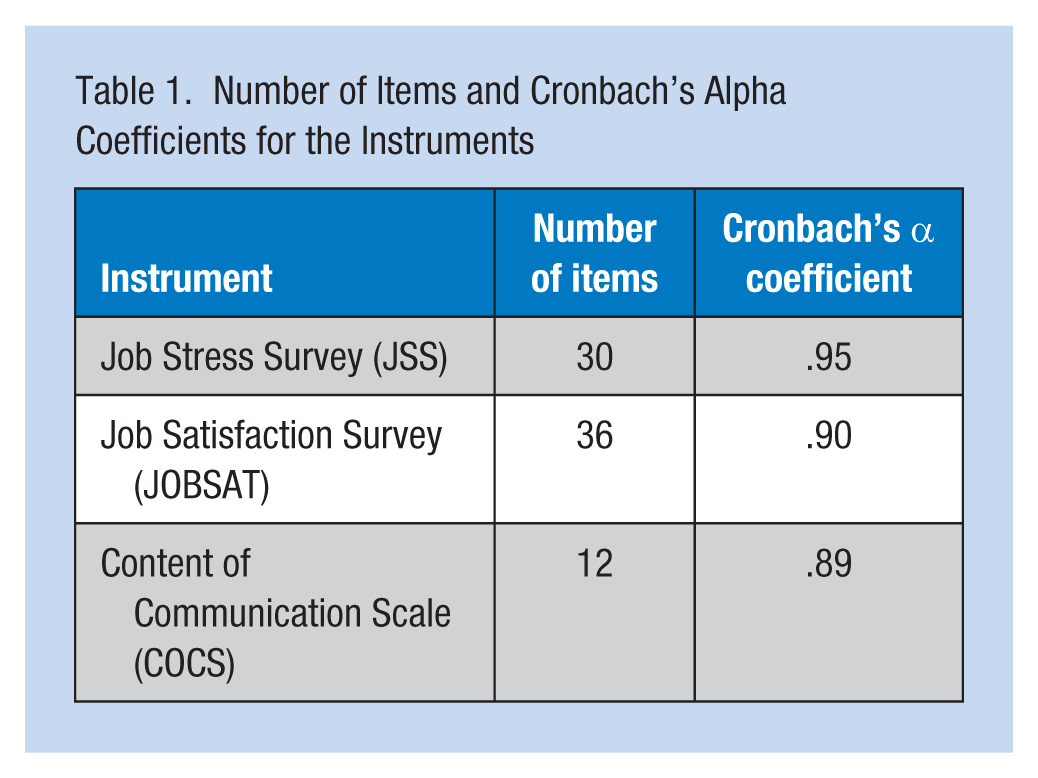
The internal consistencies for the JSS, JOBSAT, and COCS were assessed using Cronbach’s alpha coefficients. Reliability estimates were acceptable for all scales, ranging from .89 for the COCS to .95 for the JSS (Table 1).
Number of Items and Cronbach’s Alpha Coefficients for the Instruments
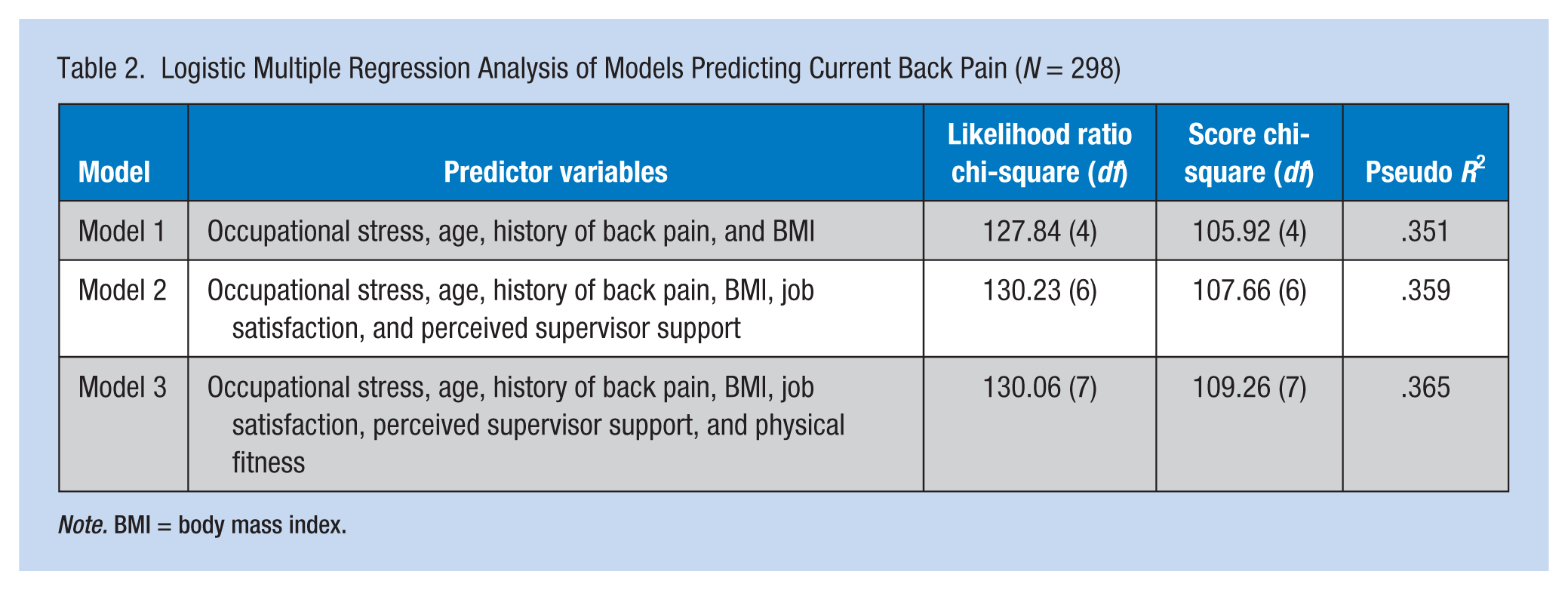
The initial analysis found collinearity between BMI and waist circumference; therefore, separate analyses were conducted using two models, one that included BMI and another model that included waist circumference. The model with BMI had more predictive ability than the model with waist circumference. Table 2 summarizes all variable results, presenting the best predictive model of each size. The four-predictor model—consisting of occupational stress, age, history of back pain, and BMI (Table 2)—was selected as the best model, based on the Score statistic, pseudo R2, and parsimony. The Hosmer–Lemeshow goodness-of-fit test demonstrated the model fit was adequate (p = .466). Score χ2 test of H0: β = 0 was used to test for relationships between current back pain and the set of predictors contained in the logistic model.
Logistic Multiple Regression Analysis of Models Predicting Current Back Pain (N = 298)
Note. BMI = body mass index.
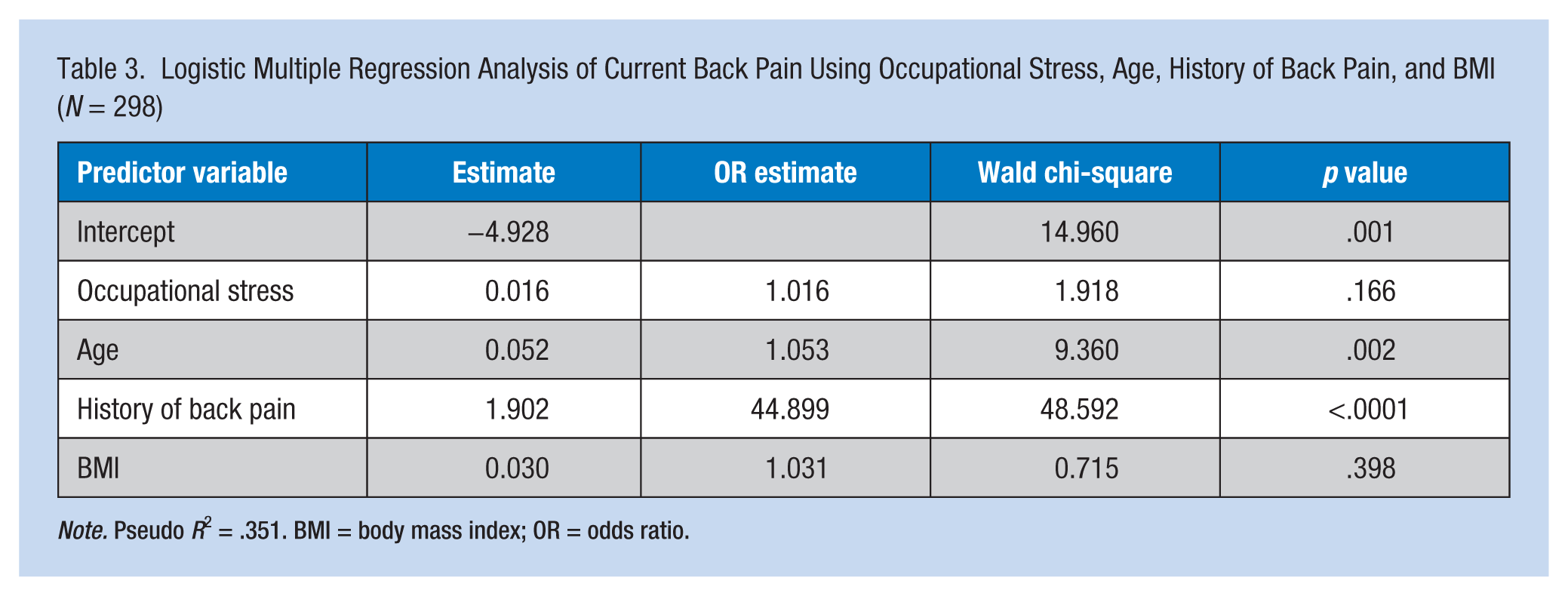
The results demonstrated a significant relationship between current back pain and occupational stress, age, history of back pain, and BMI (χ2 = 127.84, df = 4, p < .0001). The individual independent variables of age and history of back pain were significantly associated with current back pain (p = .002 and p < .0001; Table 3). The odds ratio for history of back pain was 44.90, meaning that the predicted odds of current back pain were about 45 times higher when firefighters have a history of back pain. The findings also showed that a 1 unit increase in years of age was associated with a 5.3% increase in predicted odds of current back pain.
Logistic Multiple Regression Analysis of Current Back Pain Using Occupational Stress, Age, History of Back Pain, and BMI (N = 298)
Note. Pseudo R2 = .351. BMI = body mass index; OR = odds ratio.
To test whether adding the variables of job satisfaction and perceived supervisor support to the first model would increase prediction of current back pain, it was necessary to examine change in the χ2 statistic when job satisfaction and perceived supervisor support were added to the initial model that included occupational stress, age, history of back pain, and BMI. The Hosmer–Lemeshow goodness-of-fit test (χ2 = 9.36, df = 8, p = .32) supported adequate fit for the full model (i.e., job satisfaction, perceived supervisor support, occupational stress, age, history of back pain, and BMI). The null hypothesis of no relationship between the full model set of predictors and current back pain was rejected (χ2 = 130.23, df = 6, p < .0001). Multiple logistic regression results for the full model are presented in Table 2. The χ2 change was not statistically significant (
To test whether adding physical fitness to the second model, Research Question 2, improved prediction of current back pain, it was necessary to examine change in the χ2 statistic when physical fitness was added to the model that included occupational stress, age, history of back pain, BMI, job satisfaction, and perceived supervisor support. The Hosmer–Lemeshow goodness-of-fit test (χ2 = 3.949, df = 7, p = .862) indicated adequate fit for the full model (i.e., physical fitness, occupational stress, age, history of back pain, BMI, job satisfaction, and perceived supervisor support). The null hypothesis of no relationship between the full model set of predictors and current back pain was rejected (χ2 = 130.06, df = 7, p < .0001). Multiple logistic regression results for the full model are presented in Table 3. The χ2 change was not statistically significant (
Discussion
In this study, one third of the participants reported current back pain. This result is similar to the results of a study conducted in the Netherlands that found the prevalence of back complaints in firefighters was 32% (Bos, Mol, Visser, & Frings-Dresen, 2004). Moreover, Spyropoulos et al. (2007) found that 33% of office workers had current back pain. Possible reasons for this prevalence of current back pain among firefighters may be related to firefighters’ work, which involves strenuous physical demands, including pulling, pushing, twisting, lifting, and bending. In addition, firefighters are required to rapidly respond in emergency situations while wearing heavy gear and protective clothing (Boorady et al., 2013). The more quickly firefighters perform their tasks, the more likely lives will be saved. High energy physical demands during emergency calls may contribute to fatigue, exhaustion, and musculoskeletal complaints. Similarly, Parker (2011) studied the physical tasks and activities of rural firefighters and found that the complex interactions among work practices, work environment, and clothing resulted in high individual physical loads and excessive fatigue.
Predictors of Back Pain
This study found that select factors, including occupational stress, age, history of back pain, and BMI, could predict the probability of current back pain among firefighters. When adding perceived supervisor support and job satisfaction to the model, the results of this study found no statistically significant improvement compared with the initial model.
The addition of physical fitness also did not contribute to the prediction of back pain in firefighters above the contribution of occupational stress, age, history of back pain, BMI, perceived supervisor support, and job satisfaction, and interaction terms. Other variables (i.e., perceived job demands and work experience) were not examined but may have influenced back pain (Katsavouni, Bebetsos, Antoniou, Malliou, & Beneka, 2014; Kim, Kim, Ryoo, & Yoo, 2013). Because the addition of supervisor support, job satisfaction, and physical fitness did not improve the model, the first model containing the fewest variables provided the most parsimonious model to predict current back pain.
The findings that age and history of back pain were significant independent predictors of back pain are consistent with most previous research that reported age was positively associated with current back pain (Jensen et al., 2012; Katsavouni et al., 2014; Studnek, Crawford, Wilkins, & Pennell, 2010), and history of back pain was related to current back pain (Matsudaira et al., 2012; Studnek et al., 2010). The findings of this study indicated that the older the firefighter, the more likely the firefighter would report current back pain. The average age of firefighters in this study was 40 years old, and the age range between 30 years and 39 years was the group most frequently reporting current back pain. Firefighters with a history of back pain were more likely to report current back pain.
No significant association between BMI and back pain was found. This result was similar to findings in other studies in which no relationship was found between BMI and back pain (Brooks, Siegler, Cheema, & Marshall, 2013). Although this study found that firefighters had good to excellent physical fitness, the average BMI was 29, which indicates overweight. One possible explanation for this finding may be that BMI, a measure of body fat based on height and weight, does not distinguish between fat mass and fat-free mass. Therefore, firefighters with significant amounts of lean tissue may have a high BMI but their body fat percentage is in the healthy range. In addition, the relationship between waist circumference and back pain was examined, and no significant association was found.
Occupational stress was not significantly associated with current back pain. The average stress score for the firefighters was 15.91 of a possible 81, which is indicative of low occupational stress. One possible reason for this finding could be that firefighters work in crisis situations and become accustomed to responding to those situations. Another explanation for this finding may be that the item with the highest occupational stress level was inadequate salary, over which firefighters have little control, because their salaries are dependent on city council approval. A study by Oberlinner, Yong, Nasterlack, Pluto, and Lang (2015) reported similar results: no association between occupational stress and back pain.
Although some studies have reported that limited social support is associated with back pain (Masters et al., 2007; Melloh et al., 2013), Bergstrom, Hagberg, Busch, Jensen, and Bjorklund (2014) reported that when age and gender were controlled, supervisor support was not significantly associated with back pain among employees. These findings were similar to a study of both blue- and white-collar workers in which social support was found to have no association with low back pain (Hartvigsen et al., 2004). Similarly, Yip (2004) found no statistically significant relationship between supervisor support and low back pain. A potential reason for this lack of association may be that firefighters in this study perceived moderate supervisor support (M = 36.35), and the sample had little variation in this perception. Moreover, firefighters accomplish their work as a team, depending on each other, and may perceive that they receive adequate encouragement and support from their supervisors during crisis situations, as well as during routine work.
The lack of a statistically significant relationship between current back pain and job satisfaction was unexpected because previous research has indicated that job satisfaction was a key factor in reported back pain (Hoogendoorn et al., 2002; Johnston, Landsittel, Nelson, Gradner, & Wassell, 2003; Studnek, Crawford, Wilkins, & Pennell, 2010; Urquhart et al., 2013). One possible explanation for this finding may be that the level of job satisfaction among this group of firefighters was high (M = 133.31) with little variation (SD = 24.2). However, a cross-sectional study conducted by Van Nieuwenhuyse et al. (2004) also found that job satisfaction was not significantly associated with back pain.
Another variable, physical fitness, was also not associated with current back pain. In this study, 90.9% of the firefighters perceived that they were in good to excellent general health. In addition, 94.7% of firefighters engaged in physical activity 1 or 2 times or more per week, with 95.3% of the respondents reporting medium to high levels of activity. Physical fitness training is expected to maintain job performance. Moon et al. (2015) investigated physical fitness and back pain between experimental and control groups of firefighters for 8 weeks and found that pain could be reduced in participants with chronic lower back pain after they participated in the intervention. The possible explanation for differences in findings on this variable could be that physical fitness in Moon et al.’s study measured fitness and strength using stronger measures (i.e., sit-ups holding and sit-arch back holding compared with this study, which used running or walking, bench press, sit-up, and sit and reach) as measures of physical fitness. Another possible explanation could be related to the mandatory requirement for firefighters to pass the physical fitness test so they focus on meeting the minimum level to pass for age and gender rather than performing at their maximum levels. The physical fitness measures used in this study were collected as part of firefighters’ annual fitness evaluations; more sensitive measures of fitness may have yielded a statistically significant correlation between physical fitness and back pain.
Limitations of the Study
This study could not draw any cause-and-effect relationships between the independent variables and the dependent variable, back pain, because the study design was predictive correlational. Predictive correlational research designs explore the association between two or more variables. This study aimed to examine the relationship between all independent variables and back pain.
Second, a self-report bias could have occurred because participants may have answered questions with socially desirable answers. Respondents may present their knowledge, attitudes, and behaviors in a more positive light when information is provided by self-report.
Third, because the study group was all male, the generalizability of results to female firefighters is limited. In addition, because firefighters work in dangerous situations and must meet occupational physical performance requirements, the generalizability of results from this group to other populations is limited.
Finally, secondary data is another limitation in that some data were collected for annual health risk assessment and physical fitness performance evaluations and not for purposes of answering study questions.
Implications
Nursing Education
Undergraduate and graduate nursing curricula should include content related to back injury prevention. The findings of this study support the need for nursing students to understand that risk factors, such as occupational stress, age, history of back pain, and overweight/obesity, can be linked to back pain. To promote and prevent back pain among employees such as firefighters, nursing students should have the knowledge and skills to teach employees that these risk factors (i.e., history of back pain, age, stress, and overweight) can contribute to chronic back pain.
Nursing Practice
Because age, history of back pain, occupational stress, and BMI are factors that influence back pain in firefighters, occupational health nurses should assess these factors at the workplace and when these employees visit clinics. The one in three prevalence of back pain among firefighters in this study is consistent with the early retirement rates of firefighters across the nation. This finding reinforces the need to assess function and performance of active-duty firefighters and the potential for continued disability retirements. These findings could alert occupational health nurses to develop targeted programs to prevent initial or recurrent back pain in this occupational group and communicate with fire department administrators regarding how occupational stress (e.g., inadequate salary, excessive paperwork, and noisy work areas) are related to job satisfaction.
Nursing Research
The model, including occupational stress, age, history of back pain, and BMI, should be tested with independent groups of firefighters and other occupational groups, such as nurses and police officers. Additional predictive studies are needed to test the model when the dependent variable, back pain, is refined to indicate location of the back pain. Work experience and perceived job demands for each type of firefighter position should be examined as possible influences on current back pain.
Conclusion
The four-predictor model consisting of occupational stress, age, history of back pain, and BMI was the best model to predict current back pain. Moreover, the variables of age and history of back pain were found to be significant independent predictors of current back pain. Results of this study provide a new parsimonious model that occupational health nurses and primary care providers can efficiently use to predict and prevent back pain in firefighters.
Applying Research to Practice
The study found that age, history of back pain, occupational stress, and BMI are key contributing factors for back pain in firefighters. Because one third of firefighters experience back pain which leads to early retirement, occupational health nurses and primary care providers should assess active duty firefighters for the presence of these factors and encourage participation in targeted back injury prevention programs. The need for change should be communicated to leadership so that a worksite culture is developed which promotes back injury prevention awareness and quality improvement to reduce occupational stress.
Footnotes
Declaration of Conflicting Interests
The author(s) declared no potential conflicts of interest with respect to the research, authorship, and/or publication of this article.
Funding
The author(s) received no financial support for the research, authorship, and/or publication of this article.
Author Biographies
Mantana Damrongsak is a project manager at the University of Alabama at Birmingham School of Nursing. Her research examines individual and occupational factors that influence work-related injuries.
Aoyjai Prapanjaroensin is a PhD student at the University of Alabama at Birmingham School of Nursing. Her research primarily focuses on worker burnout, shift work, and circadian misalignment.
Kathleen C. Brown is a retired professor and chair of Community Health, Outcomes and Systems at the University of Alabama at Birmingham School of Nursing. At the time of this study, she directed a NIOSH-funded graduate program in occupational health nursing.