




Abstract
The purpose of this integrative review was to evaluate the use of text message (TM) reminders to promote timely medical surveillance examinations (MSEs). Notifying employees of scheduled MSE appointments is challenging. Text messaging can be used by occupational health nurses to remind employees of needed examinations. SCOPUS was searched for relevant studies between 2005 and 2015, resulting in nine articles meeting inclusion criteria. Seven of the nine articles reported significant improvement in attendance rates, with one study demonstrating no-show rates could be reduced by 51% using TM reminders. This integrative review demonstrated that text messaging appointment reminders for MSEs could be effective.
The Occupational Safety and Health Administration (OSHA) requires employers to provide periodic medical surveillance examinations (MSEs) for employees exposed to chemical-specific and situational workplace hazards. Medical surveillance examinations are a core component of occupational health services “that impacts individuals and groups whose occupation places them at significantly increased risk of a controllable disease” (Craner, 2014, p. 693). Timely MSEs are imperative not only for optimizing employee health and well-being but also to ensure compliance with regulatory standards. However, for some on-site occupational health clinics, scheduling and notifying employees when these examinations are due can be challenging and can affect compliance. The purpose of this article was to evaluate the literature regarding the use of text message (TM) reminders to increase compliance with required MSEs.
Problem
In the workplace, MSEs are an essential strategy for the early detection of adverse health effects from exposure to workplace hazards. “Early-stage disease identified through medical surveillance allows intervention through proper treatment to lessen the overall effect on the employee” (Amacher, 2007, para. 10). These annual examinations usually include documentation of health history, physical examination findings, and laboratory test results specific to target organ toxicity.
Medical surveillance examinations are usually scheduled by occupational health clinic staff weeks to months, even a year, in advance. The main challenges to effective scheduling and examination adherence are the “hard-to-reach” employees who provide limited or no contact information, lack of occupational health personnel access to corporate infrastructure such as e-mail systems, and employee forgetfulness or confusion about scheduled appointment dates, times, and locations (DeKoekkoek et al., 2015). Missed MSE appointments can not only have a detrimental effect on employee health and clinic compliance, but also negatively affect clinic efficiency and productivity. This challenge results in a cycle of attempting to contact employees and supervisors about missed appointments, re-scheduling missed appointments, and again attempting to notify employees about the new appointment date and time.
In 2013, the Department of Veterans Affairs, Office of the Inspector General estimated the cost of a missed appointment was US$198 (McInnes et al., 2014). This cost may not seem significant in the short term; however, most companies have more than one MSE program, and the possibility of having several missed examinations in 1 day can dramatically escalate the costs. According to Moore, Wilson-Witherspoon, and Probst (2001), a daily loss of US$323.52, which in a working calendar year totals US$80,880, could result if a clinic that is typically scheduled to see 155 patients has 48 no-shows, demonstrating how missed appointments can negatively affect the clinic budget over the long term.
Background
The use of cell phones, coupled with the rapid emergence of smartphones, represents a widespread technology infrastructure that is inexpensive, convenient, accessible, and easy to use. By the end of 2012, 326 million active wireless subscriptions had been activated in the United States, with 2.2 trillion messages sent (U.S. Department of Health & Human Services [HHS], 2014). In 2013, 91% of the U.S. population aged 18 years and older owned a cell phone, and ownership of smartphones increased from 35% in 2011 to 56% in 2013 (HHS, 2014). Text messaging is a preferred method of communication in modern society. In 2013, the most common use of cell phones among adults was text messaging with 81% of adult cell phone owners sending or receiving TM, the most used communication method on the planet.
Mobile health (mHealth) is an area of rapid expansion in health care and uses mobile computing and communication technology “for a range of functions from clinical decision support systems and data collection for healthcare professionals, to supporting health behavior change and chronic disease management” (Free et al., 2010, p. 1). An expansion of mHealth into the occupational health setting through TM reminder systems provides an opportunity to improve MSE compliance, employee accountability and participation, and clinical outcomes and goals, particularly among hard-to-reach employee populations. Text messaging is a more cost-effective, rapid, and readily responsive system than a letter and less invasive than a telephone call. Multiple messages may be dispatched simultaneously which in turn decreases labor cost and increases staff efficiency. Text messaging appointment reminders (TMARs) have been successfully used in many health care settings, not only to improve appointment compliance but also to improve vaccine adherence, health-related communication, and clinical outcomes for a wide range of chronic health-related conditions (Car, Ng, Atun, & Card, 2008; DeKoekkoek et al., 2015; Kannisto, Koivunen, & Valimaki, 2014; HHS, 2014).
Method
The integrative review process (Whittemore & Knafl, 2005) was used for this literature review. Articles identified for use in this review were chosen from a peer-reviewed, online database, SCOPUS, which compiles millions of peer-reviewed articles from health care and scientific journals and includes abstracts from Medline and CINAHL. Keywords used in the search for relevant articles included “text message” and “appointment reminders.” Only articles published in English from 2005 to 2015 were included.
The initial search produced 122 articles (Figure 1). Titles and abstracts of the articles were reviewed for relevance (i.e., the use of text messaging for appointment reminders). Excluded articles focused on text messaging for vaccine or immunization reminders; disease management including hypertension, diabetes, and HIV; wellness-related services; and treatment or medication adherence. Articles focused exclusively on pediatric or adolescent clinics also were excluded. Using these criteria, 36 articles about the use and effects of TM as appointment reminders in outpatient or primary care clinics were further reviewed. Articles about TM reminders for physical therapy, dental, ophthalmology, and psychiatric or mental health appointments were excluded, which resulted in the elimination of 29 additional articles. Due to the hierarchy of evidence, systematic and Cochrane reviews were included. Nine articles that met the inclusion and exclusion criteria were included in this review.
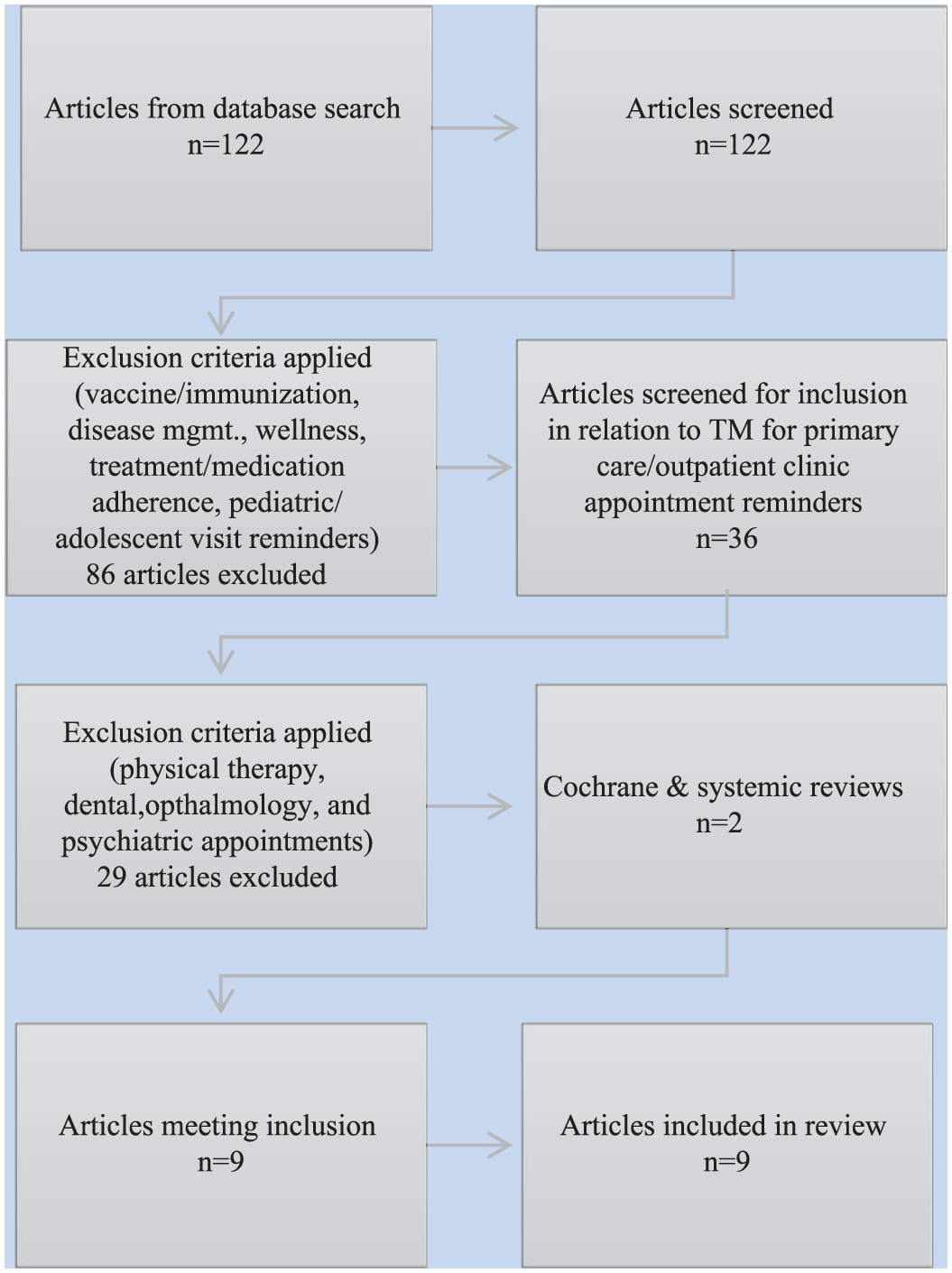
Search strategy using inclusion and exclusion criteria for articles included in this review.
Each article included in the review was critiqued. Study characteristics, purpose, intervention, timing, and key findings regarding the use of TMARs in outpatient or primary care clinics were extracted from the articles to describe the effect of TM reminders on individuals who had scheduled appointments. Pertinent data including name of first author, year of publication, sample size, study design, intervention, and findings were compiled (see Table 1).
Findings of TM Appointment Reminders to Improve Attendance
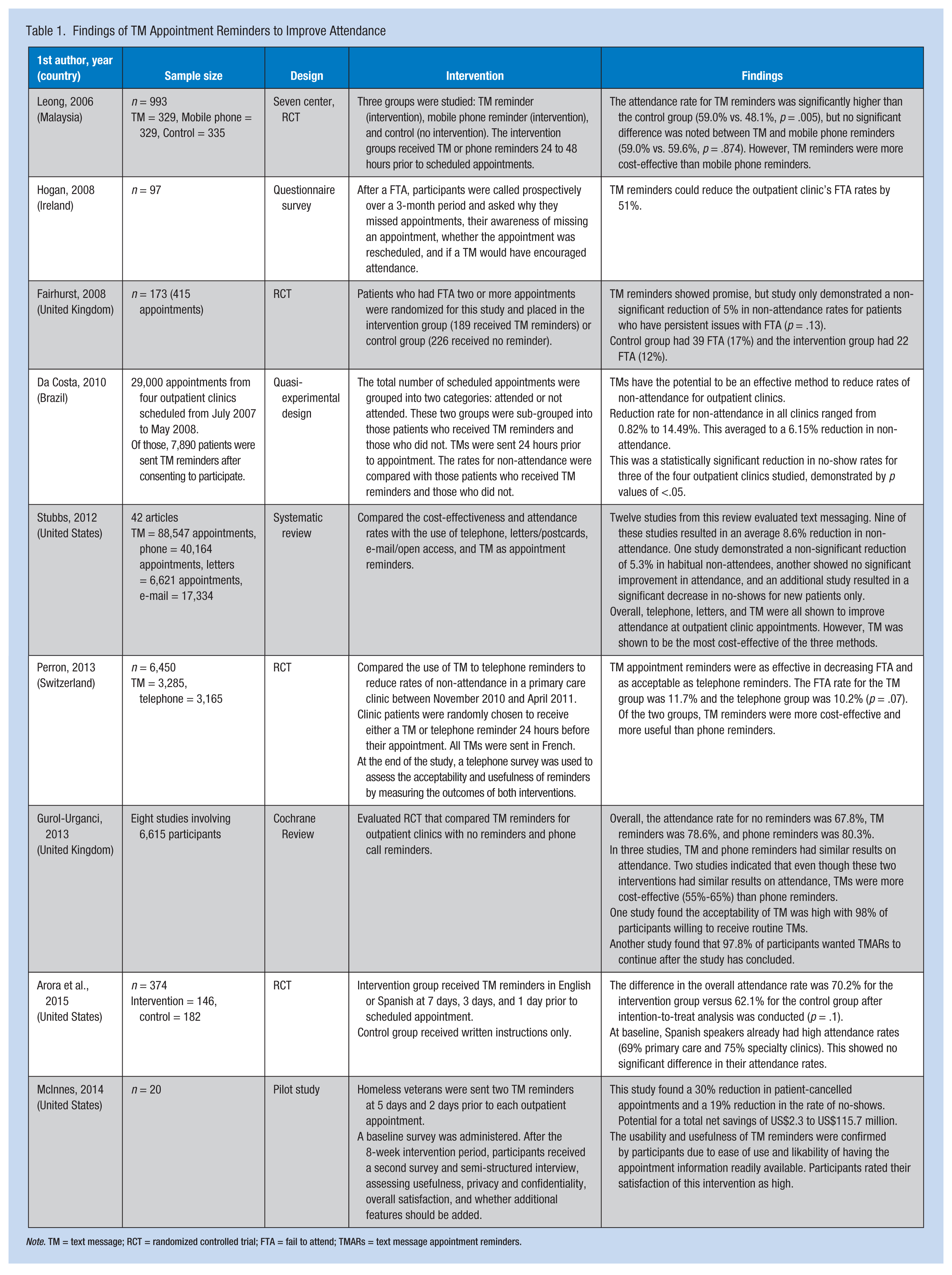
Note. TM = text message; RCT = randomized controlled trial; FTA = fail to attend; TMARs = text message appointment reminders.
Results
All studies used descriptive or quantitative designs; randomized control trials (RCT) were the most common type of study. The studies in this review were conducted in many countries (Table 1). The target population in each study was adults ranging in age from 18 years to 59 years. One study included a hard-to-reach population of homeless veterans (McInnes et al., 2014), and another study offered TM to its participants in English or Spanish (Arora et al., 2015). The study by Perron et al. (2013) sent all TMARs in French only.
For the included studies, TMARs were delivered using a variety of platforms. Arora et al. (2015), Fairhurst and Sheikh (2008), McInnes et al. (2014), and Perron et al. (2013) delivered TM via a web-based platform. Da Costa, Salomao, Martha, Pisa, and Sigulem (2010) sent TM automatically after an appointment was scheduled. The average timing for TMARs ranged from 1 day to 2 days before the scheduled appointment. McInnes et al. (2014) sent staggered TMARs at 5 days and 2 days before scheduled appointments. Arora et al. (2015) sent TMARs at 7 days, 3 days, and 1 day before scheduled appointments.
The number of appointments using TM as reminders ranged from 20 to 7,890. Text message appointment reminders contained the following content: name, appointment date, appointment time, and location. Arora et al. (2015) provided patients an opt-out option, and Perron et al. (2013) allowed patients to cancel their appointment by replying no. Text messages sent by McInnes et al. (2014) and Fairhurst and Sheikh (2008) provided patients a call back number to reschedule.
The primary outcome for each study was appointment compliance measured by assessing the impact of TMARs on attendance. Other outcomes measured were cost-effectiveness, acceptability, satisfaction, usefulness, and usability. Text message appointment reminders were compared with other reminder methods (e.g., phone calls, letters, e-mails, and open scheduling). For a few studies (Hogan, McCormack, Traynor, & Winter, 2008; McInnes et al., 2014; Perron et al., 2013), outcome data were collected using surveys; the other studies used computer-based clinic software to track attendance.
Discussion
This is the first and only identified literature review to assess TMAR feasibility in occupational health for MSEs. All studies, except two (Fairhurst & Sheikh, 2008; Perron et al., 2013), found that sending Text message appointment reminders were an effective method of ensuring attendance at scheduled appointments. TMARs also were shown to be more cost-effective, acceptable, and user-friendly than other reminder methods. Compared with no reminders, “text message reminder(s) . . . encourage(d) 51% of those surveyed to attend or cancel in advance” (Hogan et al., 2008, p. 355). Attendance rates for the TM intervention ranged from 59% to 70.2% (median = 64.5%) compared with 48% to 62.1% (median = 54%) for no intervention (reminders) in this review. These results demonstrate how beneficial the use of TMARs for MSEs could be in occupational health clinics.
Besides improving attendance rates, TMARs are more cost-effective than other reminder methods. The acceptability of TMARs could increase employee involvement, resulting in better compliance and early identification of work-related exposure risks. Respondents also noted that TMARs had demonstrated their usability and usefulness, and participants rated TMARs high for likability and satisfaction. These factors support TMARs as the preferred choice for occupational health clinics even though TMARs were shown to be only as effective as phone calls at eliminating no-show appointments.
Appointments are missed for many reasons; the most commonly cited reason is forgetfulness. All studies reviewed sent TMARs within 1 week of the scheduled appointment time which should reduce missed appointments due to forgetfulness. A TM reminder system provides a low-cost method of just-in-time reminders. According to Arora et al. (2015), TMs were superior to mail or written reminders and less intrusive than phone calls. This benefit influences the acceptance of TMs as appointment reminders in the MSE process.
Limitations
A limitation of this review was the lack of published studies testing TMARs for MSEs. Without these studies, the generalizability of TMAR use in occupational health clinics cannot be predicted. Second, the review only included studies in adult primary care or outpatient clinics, not community or on-site occupational health clinics. Finally, no study addressed limitations of TM intervention (e.g., confidentiality, data usage, and outdated cell number information).
Conclusion
The results of this review indicate use of TMARs could be advantageous in ensuring timely MSE attendance. Text message appointment reminders could increase employee participation in the MSE process resulting in better compliance with regulatory standards. Future studies about the use of TMARs in occupational health clinics are warranted.
In Summary
The purpose of this study was to determine the effectiveness of TM reminders in promoting timely attendance at MSE appointments, to protect employee health and well-being, and ensure compliance with regulatory standards.
Because notifying employees of their scheduled MSE appointments can be challenging, text message reminders may be the preferred method of communication as 81% of adult cell phone owners send or receive TM.
An integrative literature review was initiated resulting in nine articles meeting inclusion and exclusion criteria; these studies demonstrated a median attendance rate of 64.5% using TMARs compared with a 54% rate with no reminders.
Results of this review indicate that TMARs could be a cost-effective strategy for occupational health clinics that provide MSEs.
Footnotes
Conflict of Interest
The author(s) declared no potential conflicts of interest with respect to the research, authorship, and/or publication of this article.
Funding
The author(s) received no financial support for the research, authorship, and/or publication of this article.
Author Biographies
Tammy Lockhart recently earned her master’s degree with a focus in occupational health nursing from the University of Cincinnati. She is currently employed as the employee health nurse specialist at CareSource, a non-profit public sector–managed care company, in Dayton, Ohio.
Gordon Lee Gillespie is an associate professor and deputy director of the occupational health nursing program at the University of Cincinnati College of Nursing. His research focuses on the prevention and mitigation of workplace aggression.
Valorie Grant is an assistant professor at the University of Cincinnati College of Nursing. Her nursing career started in 1984 and she has experience in spinal cord injury, cardiac and community population–based health care, and inter-professional health education.