




Abstract
The purpose of this study was to determine the prevalence and characteristics of tinnitus and assess the relationship between tinnitus and hearing loss among firefighters and operating engineers, who are exposed to noise on-the-job. The study analyzed existing data from two different populations (154 firefighters and 769 operating engineers) who completed a survey and audiometric tests as part of a hearing loss prevention intervention study. Approximately 40% of both groups reported tinnitus; 34% of firefighters and 59% of operating engineers showed hearing loss at noise-sensitive frequencies (4 kHz and 6 kHz). Firefighters with high frequency hearing loss (odds ratio [OR] = 2.31; 95% confidence interval [CI] = [1.05, 5.11]) and those with perceived impaired hearing status (OR = 3.53; 95% CI = [1.27, 9.80]) were significantly more likely to report tinnitus. Similarly, operating engineers who had hearing loss at both low (OR = 2.10; 95% CI = [1.40, 3.15]) and high frequencies (OR = 2.00; 95% CI = [1.37, 2.90]), and perceived impaired hearing status (OR = 2.17; 95% CI = [1.55, 3.05]) were twice as likely to report tinnitus. This study demonstrated that tinnitus is a considerable problem for noise-exposed workers. Workers with hearing loss demonstrated significantly higher rates of tinnitus. Comprehensive workplace hearing conservation programs should include tinnitus management for noise-exposed workers, along with other key elements such as noise control and hearing protection.
Tinnitus, defined as the perception of phantom sound (i.e., ringing, buzzing, hissing, or roaring) in the ears or head without any acoustic external source (Henry, Dennis, & Schechter, 2005), is a commonly reported health issue among noise-exposed workers. Furthermore, tinnitus affects about 12% to 15% of the general population in the United States and Europe (Allman, Baizer, Salvi, & Lobarinas, 2013). In an analysis of data from the 1999 to 2004 U.S. National Health and Nutrition Examination Surveys (NHANES; N = 14,178), 25.3% (approximately 50 million) of U.S. adults reported tinnitus, and 7.9% (approximately 16 million) of U.S. adults reported experiencing tinnitus daily within the past year (Shargorodsky, Curhan, & Farwell, 2010).
Tinnitus has been reported to be associated with both loud noise exposure and low hearing thresholds or hearing loss (Chung, Gannon, & Mason, 1984; Phoon, Lee, & Chia, 1993; Rubak et al., 2008; Shargorodsky et al., 2010; Sindhusake et al., 2003). A history of leisure-time, occupational, and firearm noise exposure were all associated with increased odds of tinnitus (Shargorodsky et al., 2010). Among participants (n = 5,414) who completed an audiogram in the NHANES study, tinnitus was associated with low to mid frequency (defined as a pure-tone mean of ≥25 decibels [dB] at 0.5, 1, or 2 kHz in either ear) and high frequency (defined as a pure-tone mean of ≥25 dB at 3, 4, 6, or 8 kHz in either ear) hearing impairment (Shargorodsky et al., 2010). Furthermore, in a recent study of 752 workers employed at 91 workplaces, increases in the noise level and the duration of noise exposure contributed to an increased risk of both tinnitus and concomitant hearing loss (Rubak et al., 2008).
Firefighters are routinely exposed to occupational noise from a variety of firefighting tasks and equipment, such as the use of saws and pneumatic chisels (Neitzel, Hong, Quinlan, & Hulea, 2013). Construction workers in the operating engineer trade are also exposed to a noise level above 85 dB (loud enough to cause hearing loss) when they operate heavy equipment (e.g., bulldozers, graders, backhoes, asphalt road rollers, asphalt spreaders, and wheel loaders; Kerr, Brosseau, & Johnson, 2002; Legris & Poulin, 1998). Exposures to loud noise can cause tinnitus and noise-induced hearing loss (NIHL) among firefighters and operating engineers. Thus, it is important to assess the relationship between tinnitus and hearing loss in workers exposed to loud noise.
The purpose of this study was to determine the prevalence and characteristics of tinnitus and assess the relationship between tinnitus and hearing loss among two groups of noise-exposed workers: firefighters and construction operating engineers.
Method
Study Design and Participants
This study used a secondary cross-sectional design, which included two different data sets: 154 firefighters from three states (California, Illinois, and Indiana) and 769 operating engineers in a single Midwestern state, all who completed audiometric tests and a computer-based survey as part of a hearing protection intervention study.
Firefighters
Firefighters were recruited from occupational health clinics, fire departments, and audiologists’ clinics. The original study used multimedia Internet technology to collect the survey data and developed and tested a tailored hearing protection intervention to increase firefighters’ use of hearing protective devices (HPDs) to prevent NIHL. Details on the development process for the Internet-based survey and tailored intervention programs are published elsewhere (Hong, Eakin, Chin, Feld, & Vogel, 2013).
The research protocol was approved by the Committee of Human Research, University of California at San Francisco and the Institutional Review Board of North Shore University Health System in Evanston, Illinois. Participation was voluntary. Informed consent was secured prior to participants completing the pre-intervention survey and retrieving their audiometric test results. All participants received a US$25 gift card honorarium for their participation.
Operating engineers
This study also used the survey and audiometric tests as part of the pre-intervention data for a randomized, controlled trial of a hearing protection intervention for construction workers in the operating engineer trade. The original study involved audiometric testing and the development of a computer-based hearing protection training intervention to reduce NIHL among construction workers (Hong & Csaszar, 2005). Participants were recruited from an operating engineer trade union training center in the Midwest during the workers’ annual Hazardous Materials (HAZMAT) refresher course, optional construction skill upgrade, or apprentice certification course. Details on the development of the computer-based program and the results of the intervention can be found in Hong and Csaszar (2005) and Hong, Ronis, Lusk, and Kee (2006), respectively.
Participation was voluntary, and informed consent was secured from all participants before completing the survey and obtaining audiometric test results. All participants were given a free otological examination, audiometric test, and samples of hearing protection devices as part of the study; no other financial incentives were provided for participation. The University of Michigan Health Sciences Institutional Review Board approved the study.
Measures
Demographics and work-related characteristics
The study collected demographic data such as age, gender, ethnicity, and years of service in their respective fields (e.g., firefighting or construction).
Noise exposure at work
Noise exposure at work was measured by a single question: “How often are you exposed to loud noise when working as a firefighter?” using “daily, weekly, monthly, yearly, and rarely or never” response categories for firefighters, or “hours of exposure to high noise at work per day” for operating engineers. Loud noise exposure was defined as a noise level that requires you to raise your voice to be heard by someone 3 feet away.
Tinnitus status
Tinnitus status was assessed by asking a single question: “Have you experienced tinnitus (noises or sounds in your ears or head)?” for firefighters, or “Do you ever have ringing or buzzing in your ear(s)?” for operating engineers. Response options were yes and no.
Hearing ability
Hearing ability was measured by standard audiometric tests conducted using a microprocessor pure-tone audiometer in both ears at frequencies of 0.5, 1, 2, 3, 4, 6, and 8 kHz. The audiometer was calibrated according to the American National Standards Institute (ANSI, 1969-2004) S3.6- 1996-2004 standard. Hearing threshold levels (HTLs) were measured in dB. Higher HTL indicated more impaired hearing status. Hearing loss was defined as an HTL of 25 dB or greater in the worst ear (i.e., the ear with the higher HTLs). Hearing losses at speech frequencies (0.5, 1, 2, and 3 kHz) and noise-sensitive frequencies (4 and 6 kHz) were calculated.
Use of HPDs
Self-reported HPD use was calculated by taking the mean scores of two questions regarding workers’ reported use of HPDs measured in percentage of time (0%-100%) they used HPDs when exposed to high noise (i.e., for firefighters, measured HPD use during their most recent emergency situation/run and in the past 3 months; for operating engineers, measured during loud noise at their job site within the past 12 months and most recently).
Perceived hearing
Perceived hearing was measured by a single question: “How good is your hearing?” Responses were measured on a 5-point Likert-type scale (1 = excellent to 5 = poor).
Data Analyses
Data were analyzed using SPSS Version 20. Descriptive statistics were calculated for all study variables using means and standard deviations for continuous variables and frequencies and percentages for categorical variables. T tests for continuous variables and chi-squares for categorical variables were used to compare characteristics for each noise-exposed worker.
Because age and years in service were highly correlated, age for firefighters and years worked in construction for operating engineers were included in the multivariable logistic regression models based on significant associations with tinnitus status in bivariate analyses. Self-reported perceived hearing status and measured hearing ability were highly correlated among the two groups. Therefore, perceived hearing ability and measured hearing ability were separately chosen as the indicator for participant’s tinnitus symptoms.
Odds ratios (ORs) with 95% confidence intervals (CIs) and p values were calculated to determine the association between hearing ability and tinnitus using logistic regression analyses. The level of statistical significance was set at a p value of <.05.
Results
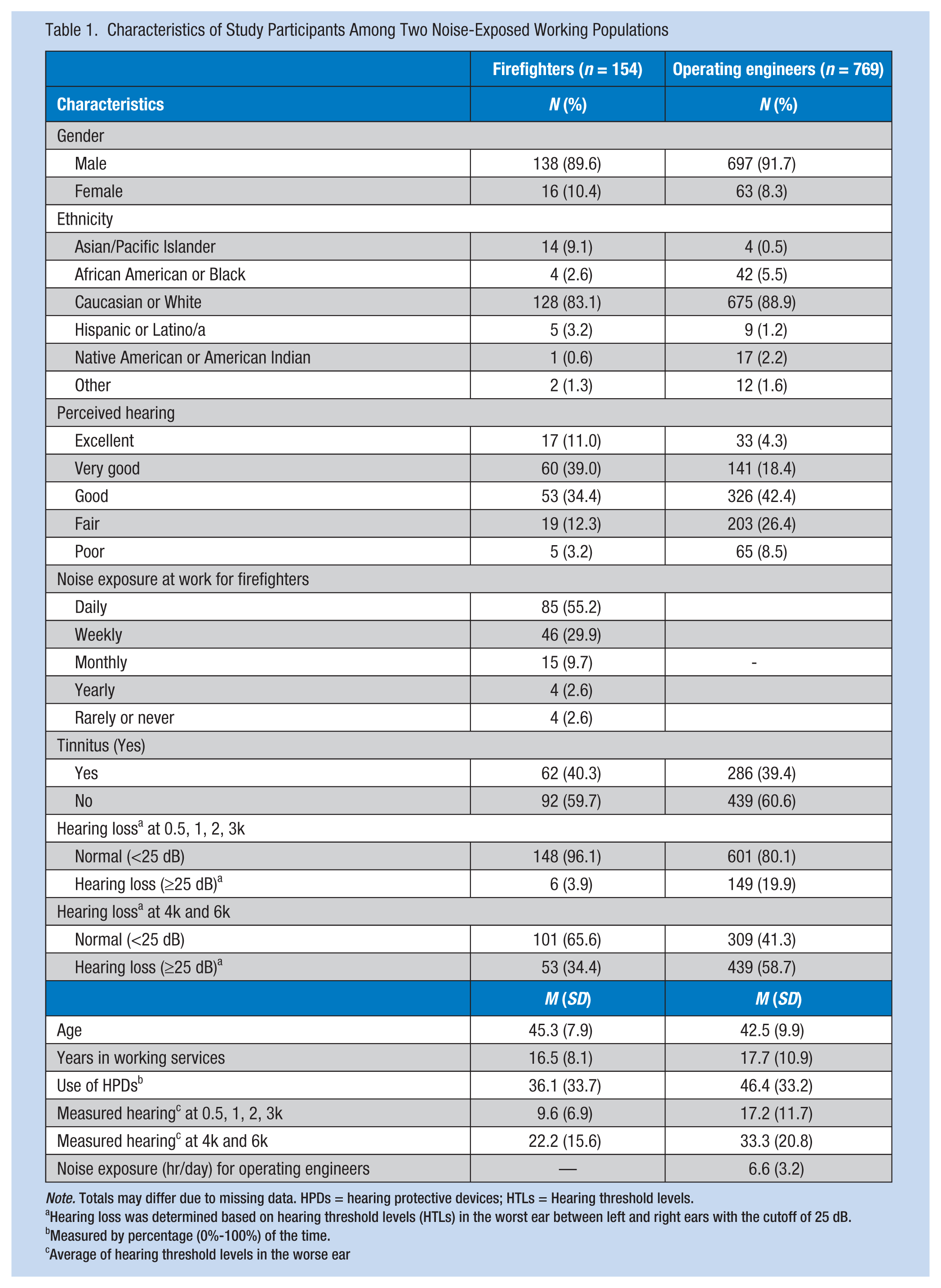
Characteristics of the Study Participants (Table 1)
Firefighters
The participants were predominately middle-aged (M age = 45.3 years), White (83.1%), and male (89.6%) with an average of 16.5 years of work in fire services. The reported mean use of HPDs was only 36.1% when necessary. The majority (84%) of participants perceived their hearing to be good to excellent. About 85% of participants reported that they were exposed to loud noise daily or weekly at their job sites.
Approximately 40% of the participants reported experiencing tinnitus. The means of HTLs at low frequencies (0.5 to 3 kHz) and high frequencies (4 and 6 kHz) were 9.6 and 22.2 dB, respectively. About 34% of firefighters demonstrated high frequency hearing loss, whereas only 4% showed low frequency hearing loss.
Characteristics of Study Participants Among Two Noise-Exposed Working Populations
Note. Totals may differ due to missing data. HPDs = hearing protective devices; HTLs = Hearing threshold levels.
Hearing loss was determined based on hearing threshold levels (HTLs) in the worst ear between left and right ears with the cutoff of 25 dB.
Measured by percentage (0%-100%) of the time.
Average of hearing threshold levels in the worse ear
Operating engineers
The operating engineers were also predominantly middle-aged (M age = 42.5 years), male (91.7%), and White (88.9%). They had worked in construction for an extended period of time (M years = 17.7) and reported using HPDs 46.4% of the time during loud noise exposure. The operating engineers reported high noise exposures of about 7 hours per day at their job sites.
Approximately 35% of operating engineers perceived their hearing to be poor to fair. The means of HTLs at low and high frequencies were 17.2 and 33.3 dB, respectively. Approximately 40% of operating engineers experienced tinnitus, and 58.7% had high frequency hearing loss; only 19.9% had low frequency hearing loss.
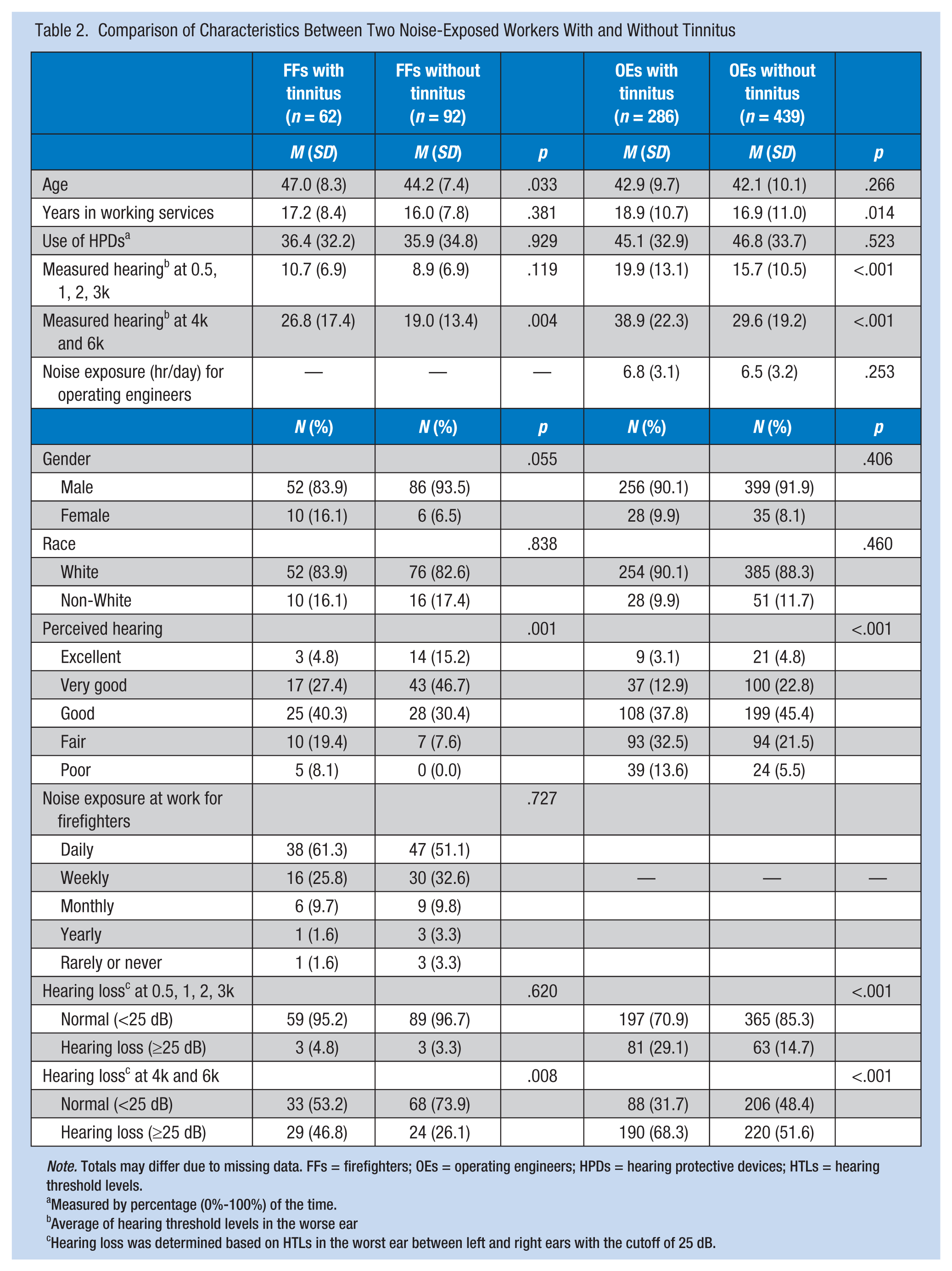
Comparison of Workers With and Without Tinnitus (Table 2)
Firefighters
Firefighters with tinnitus were significantly older (47.0 years vs. 44.2 years, p = .033), were less likely to report their hearing as excellent (4.8% vs. 15.2%, p = .001), and demonstrated more impaired hearing at noise-sensitive frequencies (4 kHz and 6 kHz; 26.8 dB vs. 19.0 dB, p = .004) compared with those without tinnitus. Firefighters with tinnitus showed a significantly higher prevalence of hearing loss in noise-sensitive frequencies (4 kHz and 6 kHz; 46.8% vs. 26.1%, p = .008).
Comparison of Characteristics Between Two Noise-Exposed Workers With and Without Tinnitus
Note. Totals may differ due to missing data. FFs = firefighters; OEs = operating engineers; HPDs = hearing protective devices; HTLs = hearing threshold levels.
Measured by percentage (0%-100%) of the time.
Average of hearing threshold levels in the worse ear
Hearing loss was determined based on HTLs in the worst ear between left and right ears with the cutoff of 25 dB.
Operating engineers
Operating engineers with tinnitus had worse hearing ability, as indicated by higher mean HTLs at low frequencies (19.9 dB vs. 15.7 dB, p < .001) and high frequencies (38.9 dB vs. 29.6 dB, p < .001) and a higher percentage of hearing loss at both low frequencies (29.1% vs. 14.7%, p < .001) and high frequencies (68.3% vs. 51.6%, p < .001), than those who did not experience tinnitus. Compared with those without tinnitus, operating engineers with tinnitus were significantly more likely to perceive their hearing as poor (13.6% vs. 5.5%, p < .001). Finally, operating engineers with tinnitus had worked in construction for a significantly longer period of time (18.9 years vs. 16.9 years, p = .014), than those without tinnitus.
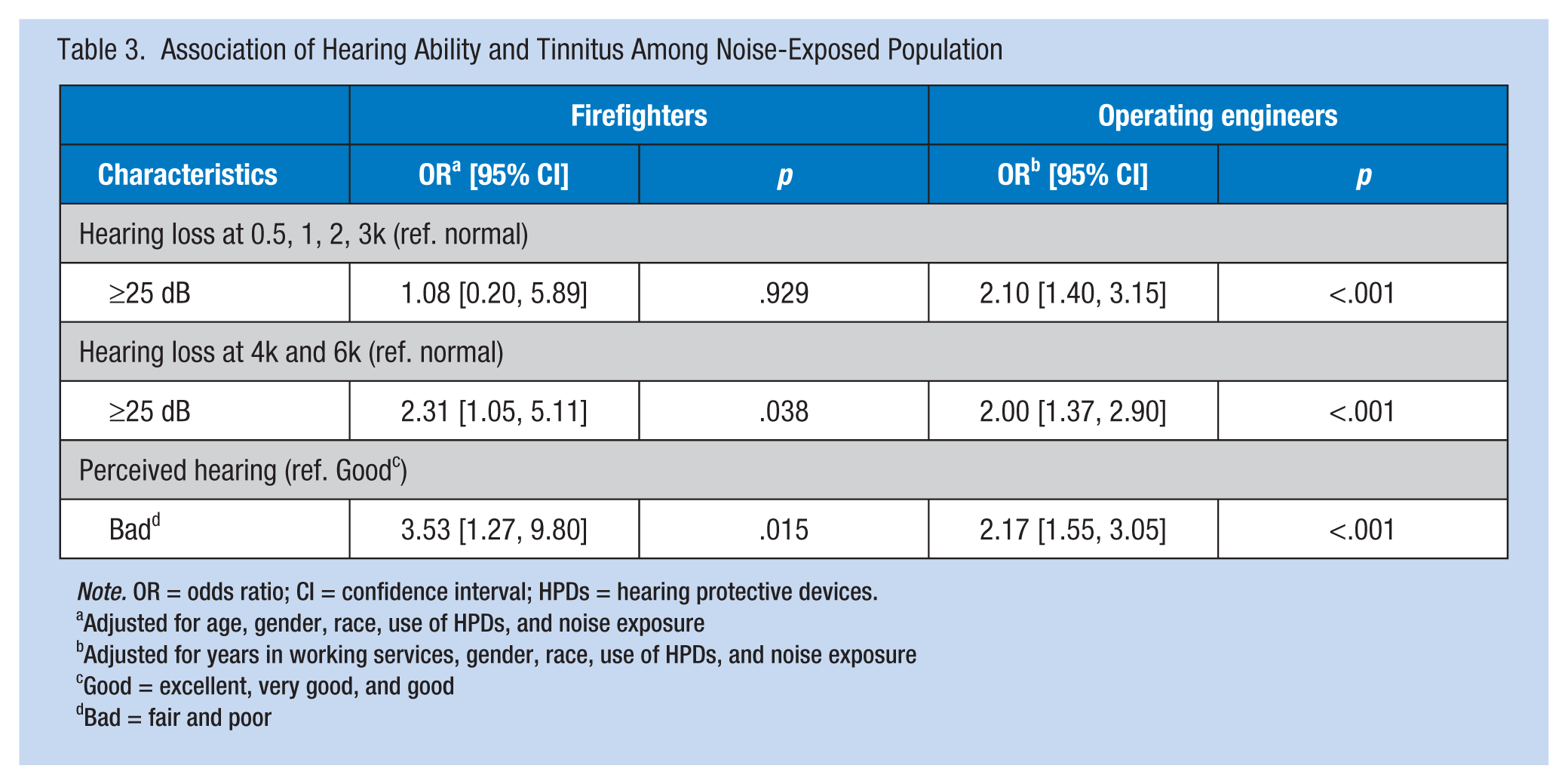
Association Between Hearing Ability and Tinnitus Among Noise-Exposed Workers (Table 3)
Firefighters
Firefighters with hearing loss at high frequencies were twice as likely to report tinnitus as those without hearing loss (OR = 2.31; 95% CI = [1.05, 5.11]). Compared with those who perceived their hearing as good or better, firefighters who perceived poor hearing status were 4 times more likely to report tinnitus (OR = 3.53; 95% CI = [1.27, 9.80]).
Association of Hearing Ability and Tinnitus Among Noise-Exposed Population
Note. OR = odds ratio; CI = confidence interval; HPDs = hearing protective devices.
Adjusted for age, gender, race, use of HPDs, and noise exposure
Adjusted for years in working services, gender, race, use of HPDs, and noise exposure
Good = excellent, very good, and good
Bad = fair and poor
Operating engineers
Operating engineers with hearing loss at both low (OR = 2.10; 95% CI = [1.40, 3.15]) and high frequencies (OR = 2.00; 95% CI = [1.37, 2.90]) were twice as likely to report tinnitus as those without hearing loss. Those who perceived their hearing as poor were also twice as likely to report tinnitus compared with those who perceived their hearing to be good (OR = 2.17; 95% CI = [1.55, 3.05]).
Discussion
The findings of this study indicate that firefighters and operating engineers are at considerable risk of tinnitus and NIHL. Forty percent of firefighters and operating engineers reported experiencing tinnitus. According to the National Institute on Deafness and Other Communication Disorders (NIDCD; 2015), approximately 10% of the U.S. adult population (25 million people) experienced tinnitus (lasting at least 5 minutes) in the past year; therefore, firefighters and operating engineers are at a fourfold risk of tinnitus compared with the U.S. adult population. Literature examining the prevalence of tinnitus among firefighters and operating engineers is scarce. Pross, Allen, Hong, and Cheung (2014) reported that tinnitus was a problem for 52% of the firefighters in their study. To the authors’ knowledge, this study is the first to examine the prevalence of tinnitus among operating engineers.
This study also showed that 34% of firefighters and 59% of operating engineers exhibited high frequency (4 kHz and 6 kHz) hearing loss, typically due to loud noise exposure. According to the NIDCD (2015), approximately 15% of Americans between the ages of 20 and 69 (26 million) have high frequency hearing loss that may have been caused by loud noise exposures at work or during leisure activities. In comparing the NIDCD statistics with the findings in this study, firefighters are twice as likely to develop high frequency hearing loss compared with the general adult American population, and operating engineers are almost 4 times as likely to develop high frequency hearing loss.
Approximately 85% of firefighters reported loud noise exposure daily or weekly, in contrast to operating engineers who reported loud noise exposures 7 days a week. These self-reported noise exposures are congruent with the literature. Neitzel et al. (2013) reported that firefighter task-based noise levels ranged from 82 dBA to 109 dBA, and the majority of estimated 8-hour and 24-hour noise exposures exceeded recommended exposure limits. Root et al. (2013) also found that commonly used fire station equipment (i.e., lawn maintenance equipment, snow blowers, compressors, and emergency alarms) and equipment on the fire engines (i.e., fans, saws, alarms, and extrication equipment) emitted noise equal to or greater than 85 dBA. However, personal dosimetry samples from firefighter training activities revealed an average noise exposure of 78 dBA during activities that lasted approximately 70 minutes (Root et al., 2013). Studies have evaluated workers’ perceptions of loud noise exposures (Lusk, Kerr, & Kauffman, 1998) and confirmed loud noise exposure in the operating engineer trade (Hong, 2005; Neitzel, Stover, & Seixas, 2011). According to Neitzel et al. (2011), more than one-third (39.1%) of the noise measurements from the worksites of operating engineers were above 85 dBA full-shift average exposure levels according to measurement parameters specified by the U.S. Occupational Safety and Health Administration (OSHA), and over three-quarter (77.4%) were above 85 dBA full-shift average exposure levels according to measurement parameters specified by the U.S. National Institute for Occupaitonal Safety and Health (NIOSH).
Tinnitus has been shown to occur among individuals with and without hearing loss. However, this study demonstrated that both firefighters and operating engineers with high frequency (4 kHz and 6 kHz) hearing loss were significantly more likely to report tinnitus, compared with those without hearing loss, therefore placing the worker in double jeopardy—the worse their hearing ability, the more likely the workers were to report tinnitus. Firefighters and operating engineers are at risk of chronic tinnitus because of their exposure to loud noise from a variety of sources. As the prevalence of tinnitus increases with hearing loss and age (Shargorodsky et al., 2010), this high rate of tinnitus among firefighters and operating engineers is unfortunately expected to continue. Although no data on health care costs associated with chronic tinnitus for firefighters and operating engineers exist, auditory impairments, such as hearing loss and tinnitus, are the most common service-related disability claim in the U.S. Department of Veterans Affairs, with disability compensation payments exceeding $1.1 billion in 2009 (National Center for Rehabilitative Auditory Research, 2010; Veterans Benefits Administration, 2010).
Furthermore, noise exposure and hearing loss have been reported as risk factors for occupational injuries among blue-collar workers (Amjad-Sardrudi, Dormohammadi, Golmohammadi, & Poorolajal, 2012; Cantley et al., 2015; Girard et al., 2009), agricultural workers (Choi et al., 2005; Hwang et al., 2001; Sprince et al., 2007; Sprince et al., 2003), and older workers with disabilities (Zwerling et al., 1998). Although it is clear that hearing loss is a risk factor for occupational injuries in the above workers, a paucity of research has examined hearing loss as a risk factor for occupational injury among firefighters and operating engineers. Tinnitus itself can be a significant factor directly affecting occupational safety with the production of frequent or ongoing phantom sounds making it difficult for workers to concentrate or hear warnings (Hallam, McKenna, & Shurlock, 2004). Therefore, future studies should assess the impact of hearing loss and tinnitus on occupational injury among firefighters and operating engineers.
The study findings have major implications for occupational health policy and interventions for workers at risk of both noise-induced auditory damage and tinnitus. The knowledge gained from this study provides a foundation for developing and implementing worksite health policy changes and interventions (e.g., requiring noise control and establishing effective hearing conservation programs to prevent hearing loss and tinnitus) for firefighters and operating engineers at risk of noise exposure, hearing loss, and tinnitus.
Although this study is the first study to examine predictors of tinnitus among firefighters and operating engineers, it has some limitations. First, the study used convenience samples of firefighters and operating engineers. Therefore, the findings may not be generalizable beyond the study participants. Second, the number of female and non-White racial minority workers was small in both occupational groups, which was expected because historically both occupations are Caucasian and male-dominate. Third, a cross-sectional study does not provide evidence as to whether tinnitus preceded hearing loss or vice versa. The authors have no information regarding the degree or severity of tinnitus for workers in either occupation. However, this information could provide additional insight into the association between high frequency hearing loss and tinnitus among firefighters and operating engineers. Finally, this study did not consider comorbid conditions, which might be related to participants’ tinnitus or hearing ability, increasing potential confounding effects. More research is needed to better understand the relationship between tinnitus and hearing loss.
Applying Research to Practice
Noise-exposed workers, such as firefighters and operating engineers, are at considerable risk of tinnitus and noise-induced hearing loss. Firefighters and operating engineers with hearing loss demonstrated significantly higher rates of tinnitus, compared to their coworkers without hearing loss. More comprehensive workplace hearing conservation programs should include tinnitus management for noise-exposed workers, along with other key elements such as noise control and hearing protection.
Footnotes
Acknowledgements
The authors would like to acknowledge all study participants; firefighter union leaders and fire chiefs for their support; the staff at OMEGA for their collaboration with data collection; and Dr. Steven Vogel, Ms. Jamie Feld, and Ms. Marjorie De Groot for their contribution to data collection; and union leaders at the Local 324 Training Center of the International Union of Operating Engineers for their collaboration.
Authors’ Note
The contents are solely the responsibility of the authors and do not necessarily represent the official views of the U.S. Department of Homeland Security, FEMA, or the CDC-NIOSH.
Conflict of Interest
The author(s) declared no potential conflicts of interest with respect to the research, authorship, and/or publication of this article.
Funding
The author(s) disclosed receipt of the following financial support for the research, authorship, and/or publication of this article: This research was partially funded by the U.S. Department of Homeland Security, Federal Emergency Management Administration (FEMA) Assistance to Firefighters Grant (Grant EMW-2007-FP-00785, PI: Hong), and Centers of Disease Control and Prevention–National Institute for Occupational Safety and Health (CDC-NIOSH; Grant 5R01 OH04034-01A1, PI: Hong).
Author Biographies
OiSaeng Hong, RN, PhD, FAAN, FAAOHN, is a professor and director of Occupational and Environmental Health Nursing Graduate Program, School of Nursing, University of California, San Francisco.
Dal Lae Chin, RN, PhD, is a postdoctoral scholar and junior specialist, School of Nursing, University of California, San Francisco.
Stephanie Phelps, RN, MS, is a doctoral student, School of Nursing, University of California, San Francisco.
Yoonmee Joo, RN, PhD, is a recent graduate from the School of Nursing, University of California, San Francisco.