



Abstract
This case study focuses on the application of Artificial Intelligence (AI) in the advertisements of Online Travel Agency (OTA). With the development of AI, companies have more tools to create advertising. Deepfake, as a technology powered by Artificial Intelligence, could be used to manipulate the content in advertising. As a result, it is important to review the effect and users’ attitudes toward AI-advertising. This case study reviews the Trivago AI advertising and discusses the associated theory in the AI-human reaction. The possible solutions are also discussed in the case study.
Keywords
Introduction
Technology companies are increasing their investment in Artificial Intelligence (AI). According to McKinsey’s annual global AI report (Chui et al., 2023), interest in AI technology has shifted from tech professionals to business executives. This means that exploring how to use AI to upgrade traditional services and marketing has become an important topic. This case study focuses on the AI-enhanced advertisement of Trivago, an online travel agency (OTA).
Before the pandemic, Trivago had an effective advertising strategy (Avildsen, 2019). They launched localized live-action advertising tailored to different regional markets, attracting many users’ attention. In the North American market (U.S. and Canada), they also created the famous “Trivago guy.” After the pandemic, Trivago boldly announced the use of AI-assisted advertising to replace the original ones. However, the newly introduced AI ads received mixed reviews. Many viewers criticized them for being unrealistic and uncomfortable.
With the rapid development of AI technology, more and more companies in hospitality and tourism industries are beginning to think about using this new technology to promote their advertisings. However, the audience’s attitude toward it and how to use it correctly are still questions. This case study discusses the AI application in Trivago’s advertisement. It also introduces concepts and theories related to AI applications, providing insights for teaching purposes.
Background
Trivago
Trivago is an online travel company founded in Germany, specializing in hotel and accommodation bookings. Founded in 2005 (Vervelogic, 2023), its founding team developed Germany’s first hotel search engine (Gruenderszene, 2016). And then they developed the metasearch engine which can compare different prices and offers between different platforms. Trivago gradually expanded its business to the international market. In 2012, the American company Expedia acquired a stake in the company for $632 million (Jacobs, 2012). The company continued to grow, with revenues surpassing $500 million by 2015 (Bartlett, 2016) and employing 1,000 staff by 2016 (Scherer, 2016). However, according to the report (Terpitz, 2020), Trivago’s business was severely impacted during the COVID-19 pandemic, with sales in March 2020 being just 5% of the previous year.
As an online travel-related booking platform focused on marketing, Trivago has a unique business model. It primarily uses a Cost Per Click (CPC) model (Gruenderszene, 2016). Partner platforms or hotels list their prices on Trivago, paying for advertising based on the number of user clicks. This means the more users click on Trivago, the higher its revenue. Using the CPC model means that the more people click on their websites, the more money Trivago will earn. Therefore, advertising is key for Trivago to attract users.
Pre-Pandemic Trivago Advertising Campaign
According to ABC News (Anonymous 2015), in 2012, when Trivago released its first advertisement targeting the North American market, the public noticed the spokesperson featured in the advertisement, leading to the hashtag #trivagoguy trending on Twitter. The advertisement featured Tim Williams, an actor from Houston, Texas, who was not well-known. In the advertisement, he became famous for wearing a casual outfit without a belt, which caught attention and sparked discussions on brand identity and gender norms. With the help of the campaign, the actor also stepped into the limelight.
As the attention and discussion around the Trivago Guy increased, Trivago even launched a contest inviting people to dress up as the Trivago Guy (Krashinsky, 2014). Tim Williams gradually became an internet meme—a widely spread cultural symbol (Graham 2002). This phenomenon helped Trivago use the trend to increase its brand visibility and appeal. As more people imitated and shared the “Trivago Guy” image, Trivago’s recognition in the market greatly improved.
The image of the Trivago guy has become a focal point of public attention (Overton, 2014; Pavone, 2019). In the advertisements, the first button of his shirt is undone, and he is not wearing a belt. Additionally, he has stubble. This slightly casual and unconventional outfit breaks the stereotype of professional men. As Overton (2014) commented,
“The magic of the Trivago guy is that he is somehow so creepy, it’s kind of hot. Where did he come from? Is he a laid-back billionaire, or homeless? Let him buy you a few drinks (or let him let you buy him a few drinks) and you may find out.”
While it intrigues the audience, it also sparks discussions about gender equality (Montgomery, 2018).
This strange combination of appearance and mystery has inspired derivative works by internet users. In 2014, a fake Trivago guy account appeared on Twitter, fabricating various tweets in his tone (Montgomery, 2018). After this, many internet users began to imitate or pay tribute to this image. It can be said that the impressive and memorable image, along with online derivative works and viral spread, has made the Trivago guy deeply ingrained in people’s minds.
Learning from the success in the North American market, Trivago started introducing different Trivago guys in various regional markets, including France, Germany, and India. These eye-catching advertisements and spokesperson strategies successfully helped boost and expand Trivago’s business.
Trivago’s New AI Advertising Campaign in Post-Pandemic Era
As Tim Williams started playing the Trivago Guy in the North American market in 2014, it was considered to have successfully helped Trivago enhance its visibility in North America. However, the Trivago Guy’s advertising disappeared before 2020. At the end of 2023, Trivago returned to the public eye. In an interview with Skift, Trivago’s CEO Johannes Thomas stated (Schaal, 2023):
Our mission is to reinvigorate Trivago’s growth by enhancing our brand presence. We’re taking a more experimental approach to our TV commercials, seeking improved traveler engagement the ‘Mr. Trivago’ concept, a powerful TV campaign, was aired with different actors globally. Its revival acts as a litmus test for our ongoing advertising strategy, shaping our upcoming marketing initiatives. Tim’s participation in future campaigns is yet uncertain.
Schaal (2023) also analyzed how changes in Trivago’s leadership and the company’s declining stock price posed risks to Trivago Guy advertising. And after the pandemic, more and more companies released their AI tools, such as ChatGPT, Copilot, and Gemini, which made AI become a popular topic. In December 2023, Trivago announced a new marketing and brand strategy (Mnyamana, 2023). In its advertising, Trivago introduced a new Trivago Guy. Unlike the previous strategy of having different Trivago Guys for each regional market, this time Trivago replaced it with one actor using AI for voice-over in different languages. Trivago claims that such AI technology can not only reduce time and production costs but also be more customizable and responsive. When interviewed about this new incorporation of AI, Johannes Thomas, CEO of Trivago mentioned (Mnyamana, 2023):
Incorporating AI is a leap into a new era of innovation at Trivago. AI enables us to produce and trial a variety of advertising strategies, allowing us to experiment more extensively than ever before. This aligns with our company’s principle of rapid testing and learning, which is ingrained in our DNA. This is just the beginning of our journey in harnessing AI for creative production. Our AI-driven campaigns are a testament to our commitment to consistently lead with cutting-edge technology across all facets of our organization.
The Issues
In December 2023, Trivago (2023a, b) released its new English and French advertisements on YouTube. However, the new advertisements received criticism. According to the comments in Table 1, many viewers pointed out the noticeable artificiality of the AI-generated content, which they could easily identify. For example, the lip movements of the actor did not sync with the voiceovers, creating an unnatural effect that made some viewers uncomfortable. Moreover, compared to the previous Trivago spokesperson, this AI-controlled spokesperson could not establish an emotional connection between the audience and the brand, leading to disappointment for some viewers. Overall, the AI advertisements did not achieve the expected results.
The User Comments on Advertisements on YouTube.
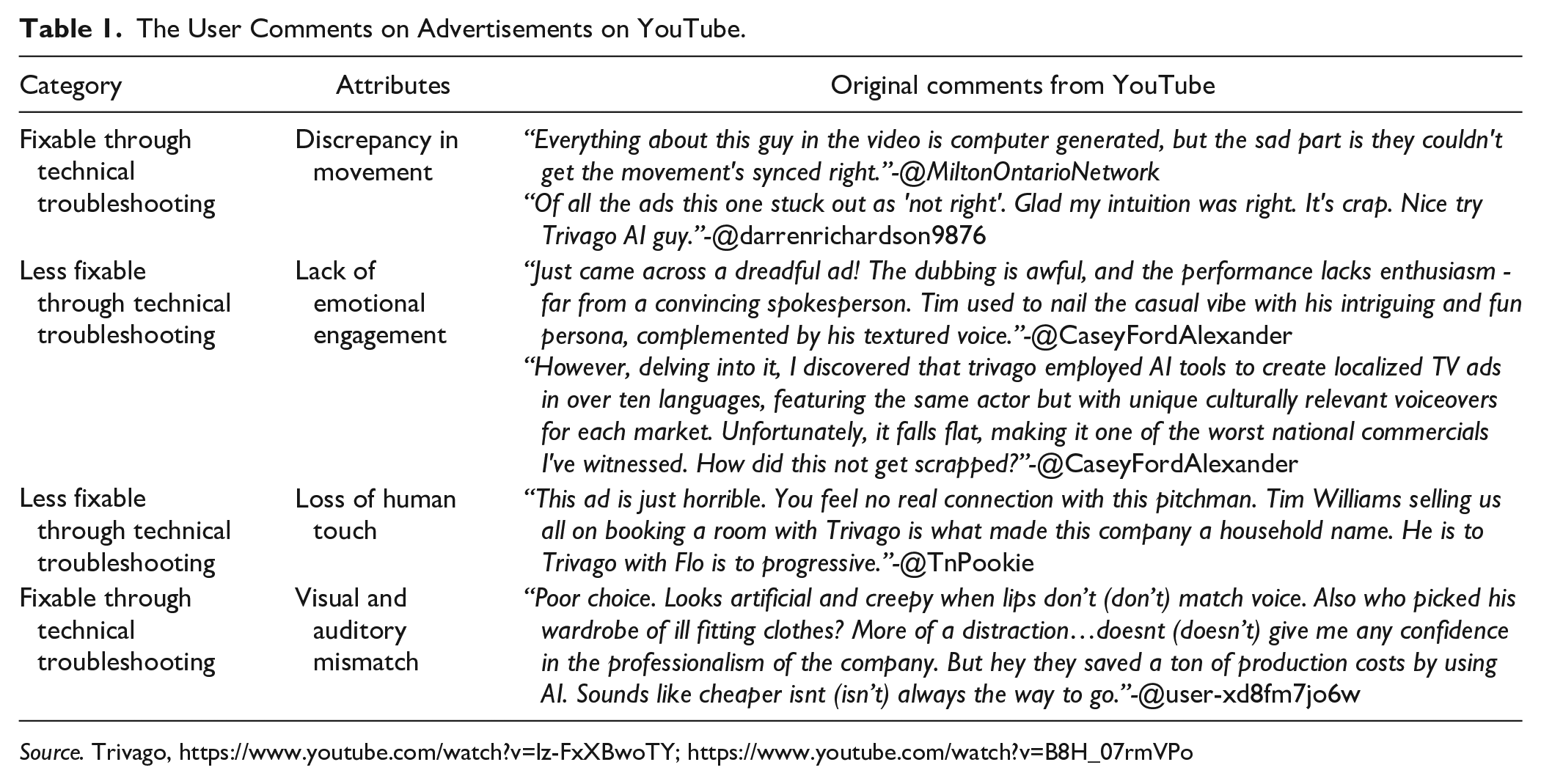
Summarizing representative comments, we find that the challenges of AI advertising can be divided into those that are technically solvable and those that are not. Firstly, uncoordinated movements and expressions can be improved through technological advancements in the future, as this depends on the progress of machine learning algorithms and an increase in training data. Technological advancements can reduce user discomfort. However, there are also some challenges that technological progress cannot solve. AI struggles to genuinely convey human emotions. Even if AI technology can simulate human actions and expressions to a high degree, it cannot replace the emotional connection that human actors establish with the audience. This can affect the acceptance and effectiveness of the advertisement.
Dilemma
Should Trivago Continue Using AI-based Advertising Strategies?
Trivago has shifted from using traditional spokesperson to new artificial-intelligence-enhanced advertising. There are compelling reasons for Trivago to use AI in advertising. First, AI technology reduces the cost of creating advertising and shortens the production cycle. Previously, creating advertisements required actors from different regions. However, with AI, Trivago can hire a single actor to produce advertising for various markets. Second, compared to traditional tools, AI can provide more personalized content. AI can more easily create content based on customers’ language, region, or preferences. This enables more effective targeting of different market segments and improves marketing outcomes. Third, as an OTA platform, Trivago can use AI advertising to help establish a high-tech brand image, which can attract users who are keen on technology and highlight product features such as hotel price comparison and intelligent recommendations.
How Should Trivago’s AI-based Advertising Strategies be Improved?
The audience’s acceptance of artificial intelligence advertising varies. The skepticism toward AI advertising among the audience stems from several aspects. First, AI dubbing in advertising cannot prevent people from noticing its artificial nature. Many viewers still notice the presence of AI technology and feel a sense of unreality. Second, the current use of AI technology in Trivago focuses more on benefiting the company (by reducing costs) but doesn’t enrich the content and quality of the advertising for the audience. This means that the advertisements are not presented creatively. At the same time, many viewers still have an emotional connection to the previous Trivago guy, and this connection leads to dissatisfaction with the new spokesperson who is “not entirely real.”
Although current AI technology can simulate human expressions and voices, we should not expect it to completely replace the emotional connection formed between real human actors and the audience. Besides improving the realism of AI from a technical perspective, it is more important to find new ways for AI to collaborate with human actors. For example, real human actors could convey emotions, while AI could assist in creating visual effects and personalized content. Additionally, AI advertisements should also protect users’ right to be informed and establish reasonable expectations.
Therefore, the dilemma in this case is that Trivago is motivated to use AI to create new advertisements. This will undoubtedly help reduce advertising production costs. However, this kind of advertisement has not been received or accepted by the audience as expected. On the contrary, many viewers have raised criticisms.
In its advertising strategy, Trivago should employ a balanced approach by gradually introducing and testing AI technology, thus reconciling user acceptance with cost control. Trivago could conduct small-scale tests targeted at specific market segments to gather user feedback. This would allow for timely adjustments to advertising content. Based on the feedback, Trivago could gradually expand the scope of AI advertising. This approach helps find a balance between cost and user acceptance.
To address this dilemma, Trivago can consider several solutions. First, the most direct method is to improve AI technology by enhancing video manipulation and expression generation techniques. This can alleviate user discomfort, making the advertisements more natural and appealing. Second, considering emotional connections, since AI-generated characters cannot connect with users as effectively as real actors, it might be better to utilize AI to enhance narrative storytelling or creative content. AI can meet users’ personalized needs more accurately, creating more precise advertisements that may resonate better with viewers. Third, from an ethical standpoint, AI advertisements should proactively inform users. This helps users distinguish ad content, reducing confusion and misunderstanding. It also ensures users have the right to know about the ad production process. Lastly, Trivago should actively collect user feedback. On the YouTube platform, despite many comments from users, Trivago has not responded, which undoubtedly lowers the effectiveness of the advertising.
Theoretical Framework
In Trivago’s new advertisements, AI technology is used to change the voices and lips movements of characters. With this technology, Trivago can generate advertisements in different languages for different markets, using only one real actor. However, currently, AI cannot create videos that are 100% realistic. Especially, when a highly realistic spokesperson is combined with unrealistic manipulation, it will easily cause discomfort to the audience. To explain this phenomenon, the case study will explore the concept of advertising manipulation and the Uncanny Valley Theory.
Advertising Manipulation
In marketing, brands could be considered as:
a psychological phenomenon which stems from the perceptions of individual consumers. But what makes a brand powerful is the collective nature of these perceptions; the stories have become conventional and so are continually reinforced because they are treated as truths in everyday interactions (Holt, 2004, p. 3)
What consumers purchase is not just the product itself, but also the material and psychological benefits brought by the brand (He et al., 2022). For example, personalized experiences, security, etc. This suggests that every advertisement is a long-term investment in the brand. In this case, Trivago’s advertisement can be a good example to show its ambition and motivation in new technology, which will help the user to relate their brand to high technology.
To enhance brand image, advertisers use various methods to change the content of advertising. Through advertising manipulation techniques, advertisers can alter characters’ attire, accessories, lighting, and scene setups in the early stages of ad creation. They can also change the content and sound of videos through post-production (Rust & Oliver, 1994). Advertising manipulation techniques have almost as long a history as advertising itself (Campbell et al., 2022). With the development of AI technology, AI-driven manipulation techniques have provided new tools for advertising production. Through AI algorithms, deepfake technology can replace original attributes in advertising, such as expressions, attire, facial features, and voices. With its help, advertisers can create more humorous and creative advertising.
Deepfake
Although Trivago has not disclosed which AI technology they have used, based on examples of manipulation described by Somers (2020), it is likely that they employed Deepfake technology.
Deepfake is a combination of “Deep learning” and “fake” (Mitra, 2020). Based on deep learning, Deepfake can perform highly realistic manipulations of videos, images, or audio by replacing actors’ faces and voices (Kietzmann et al., 2020). Therefore, Deepfake is increasingly used in advertisement manipulation. Sivathanu and Pillai (2022) did empirical research on the effect of the deepfake video advertisements on customers’ hotel booking intentions. They found that “these deepfakes are appealing and stimulating and provide information about the hotels with some fake manipulation” (p.1679). However, the manipulation of human likenesses still requires further research.
To be more specific, AI lip synchronization is an example of the application of deepfake (Suwajanakorn et al., 2017). In this case, Trivago can change the original voice and match their lip movements. However, due to the complexity of lip synchronization technology, the actor’s lip may not always appear natural. Therefore, this mismatch leads to discomfort among the audience and resulted in negative comments about Trivago’s AI advertisement involving voice-overs and lip movements.
Uncanny Valley Theory
The manipulation of Trivago’s advertisements is based on a real actor. In this situation, the dilemma can be explained by the Uncanny Valley Theory. It is a hypothesis used to describe the level of human acceptance of humanoid robots or objects (Mori et al., 2012). This hypothesis posits that as robots or humanoid objects become more human-like, human acceptance of them will increase. However, when these objects reach a certain point, acceptance significantly drops. At this stage, humans become highly sensitive to the abnormal aspects of the robots. However, as the level of human likeness in these objects continues to increase, human acceptance grows once more. Eventually, the acceptance will reach its peak. The AI-enhanced Trivago Guy is highly realistic, but the audience can still distinguish him by his lip movements. This indicates that the advertisement is currently in the “uncanny valley.” Please refer to Figure 1. Uncanny Valley Theory (Source: Mori et al., 2012).
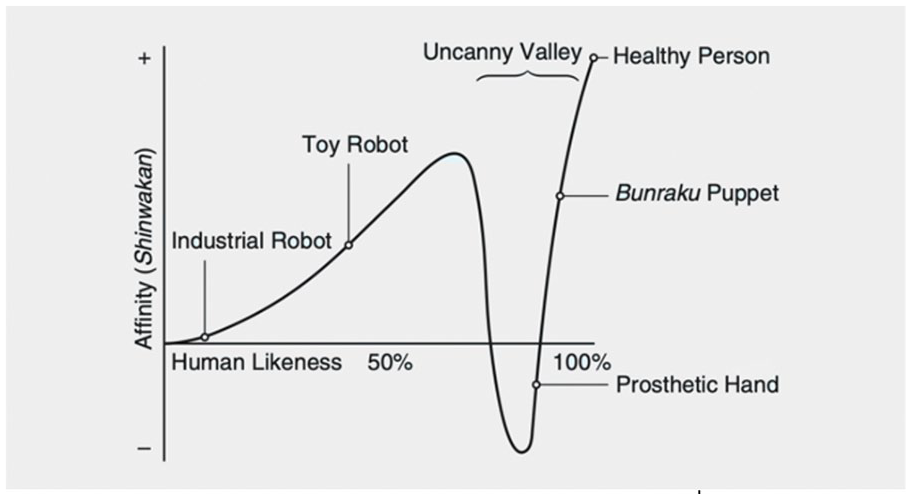
Uncanny valley theory (Source: Mori et al., 2012).
According to Uncanny Valley Theory, appropriately reducing the degree of human likeness could avoid users’ discomfort. This is because highly human-like features often lead to cognitive dissonance, resulting in discomfort due to violated expectations (Saygin et al., 2012). Therefore, Trivago could introduce some cartoonish-styled designs in its advertisements, which can reduce the discomfort felt by the audience. Moreover, from another perspective, adopting a more advanced AI can also help overcome the Uncanny Valley.
Discussion Questions
What are the potential benefits of Artificial Intelligence (AI) advertising for Trivago? Is this an effective strategy?
Why does AI advertising receive mixed reviews? What impact does this have on its brand image?
Learning from the Trivago Advertisements, is it a good idea for Trivago to continue to use AI advertising? Why?
What ethical issues should be considered when implementing AI advertising across different cultural groups?
Based on the Uncanny Valley Theory, discuss whether deepfake technology in advertising will become popular in marketing. How can marketers address potential challenges associated with it in the future?
If you are an ICHRIE member, you can access the Teaching Notes for this case study here: https://ichrie.memberclicks.net/jhtc. If you are not an ICHRIE member, the Teaching Notes will be published in a future Sage Business Cases (SBC) annual collection: https://sk.sagepub.com/cases. For more information, please contact
Footnotes
Appendix
The Rubric for Roleplay.
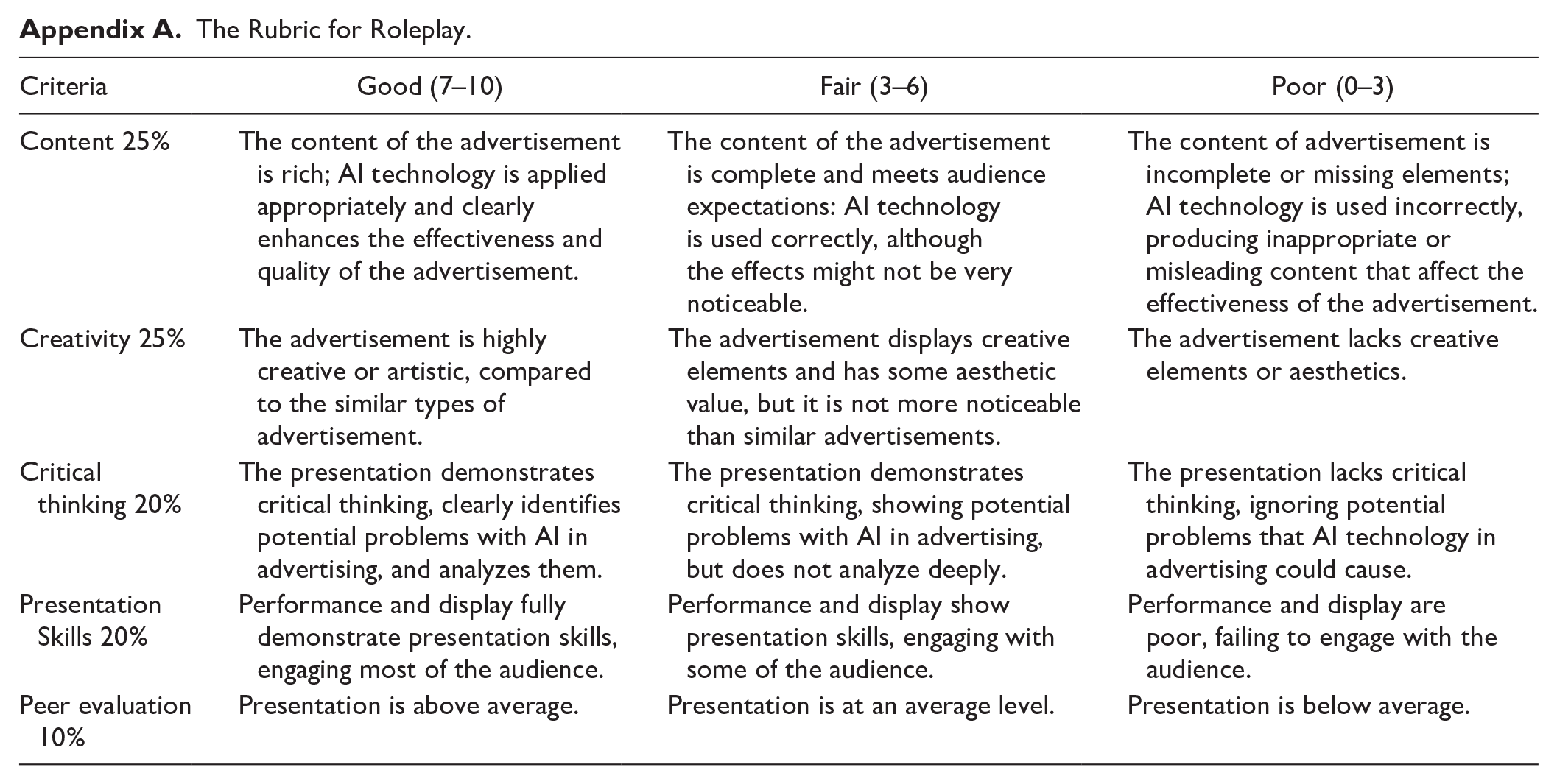
| Criteria | Good (7–10) | Fair (3–6) | Poor (0–3) |
|---|---|---|---|
| Content 25% | The content of the advertisement is rich; AI technology is applied appropriately and clearly enhances the effectiveness and quality of the advertisement. | The content of the advertisement is complete and meets audience expectations: AI technology is used correctly, although the effects might not be very noticeable. | The content of advertisement is incomplete or missing elements; AI technology is used incorrectly, producing inappropriate or misleading content that affect the effectiveness of the advertisement. |
| Creativity 25% | The advertisement is highly creative or artistic, compared to the similar types of advertisement. | The advertisement displays creative elements and has some aesthetic value, but it is not more noticeable than similar advertisements. | The advertisement lacks creative elements or aesthetics. |
| Critical thinking 20% | The presentation demonstrates critical thinking, clearly identifies potential problems with AI in advertising, and analyzes them. | The presentation demonstrates critical thinking, showing potential problems with AI in advertising, but does not analyze deeply. | The presentation lacks critical thinking, ignoring potential problems that AI technology in advertising could cause. |
| Presentation Skills 20% | Performance and display fully demonstrate presentation skills, engaging most of the audience. | Performance and display show presentation skills, engaging with some of the audience. | Performance and display are poor, failing to engage with the audience. |
| Peer evaluation 10% | Presentation is above average. | Presentation is at an average level. | Presentation is below average. |
Declaration of Conflicting Interests
The author(s) declared no potential conflicts of interest with respect to the research, authorship, and/or publication of this article.
Funding
The author(s) received no financial support for the research, authorship, and/or publication of this article.
