




Abstract
This case describes the employment situation at an inn in the mountains of North Carolina in the United States. The inn used to do well at recruiting and retaining employees, but recently it has had issues regarding the recruitment, training and development, satisfaction, and retention of its labor force, particularly with the onset of the COVID-19 pandemic. The dilemma is that while the inn needs to recruit and retain employees to keep operating effectively, no one on the staff has the time or ability to address the labor issues and therefore, a consultant has been invited to address the issues to try to identify possible solutions to the current and persistent challenge of attracting and retaining qualified people to work at the inn.
Introduction
The Hazel Hollow Lodge is an independently owned and operated 40-room, full-service inn located between the Great Smoky Mountains National Park and the Blue Ridge Parkway in western North Carolina in the United States (U.S.). It is located approximately 50 miles west of Asheville, North Carolina and 150 miles north of Atlanta, Georgia. Its customers consist primarily of upper middle-class couples, professional people, and some younger, single people who expect excellent service; safe, quiet, attractive surroundings; and access to scenic beauty and outdoor activities. The lobby of the inn welcomes people with its large stone fireplace, comfortable furniture, and local artwork. The Hemlock Creek Lounge, located off the lobby, offers guests a view of the mountains and an assortment of liquid refreshments, light meals, and snacks. Breakfast is served daily in the Rhododendron Room across from the lounge; lunch and dinner are offered there as well and often are served on the patio adjacent to the inn where guests can enjoy the sunshine and fresh air. The Mountain Laurel Room, an additional space off the lobby, is decorated with fresh flowers and provides a comfortable area for small group conversations. The inn can seat 80 guests for meals. The inn itself is a historic building constructed in 1905. It has been operated by its current owners for 16 years, and it has recently been renovated, invested in state-of-the-art technology, and built a small event venue on-site to capture the small meetings and events market in the area. The patio and event venue areas are nice for weddings and other special events and the inn markets itself to couples, for weekend getaways, and families, for reunions and other get-togethers.
The inn employs a management team that includes a general manager, assistant general manager, front desk manager, food and beverage manager, head chef, assistant (sous) chef, executive housekeeper, events/sales manager, accountant/financial manager, and a facilities manager. It also employs four kitchen staff members, ten servers, four-room attendants, four assistant desk clerks, two event planners, two staff members to help with the upkeep of the buildings and the grounds, and four part-time employees who work as servers or room attendants or in other areas, as needed. Many of the employees are seasonal and often the staff members are college students. The management staff experienced little to no turnover prior to the last 6 years, but they, along with other permanent staff members, have begun to express increased dissatisfaction with their jobs at the inn, especially with regard to their benefits, well-being, wants and needs that are connected with their jobs, and job opportunities. Furthermore, the seasonal staff has approximately a 70% turnover rate each season. The employees’ dissatisfaction started to be noticeable prior to the COVID-19 pandemic, and once the pandemic occurred it became a central issue for the property.
The inn is owned by a small enterprise out of Atlanta, Georgia that wants to ensure that the inn keeps running smoothly and continues to offer a great guest experience. When the inn first opened (16 years ago), they gave little thought to employee recruitment and retention. They did not worry about these issues because for many years they had no problems regarding hiring and retaining personnel. However, they do now; for the COVID-19 pandemic impacted the hospitality industry dramatically in a number of negative ways, and the inn was not immune to these issues. Many hospitality employees were laid off due to a loss of revenue or left their jobs for a variety of reasons and, as the industry rebounds there have been difficulties regarding hiring and retaining employees. These kinds of issues negatively impacted the inn as it operated at a limited capacity and did not hire seasonal employees as the pandemic grew in 2020, and experienced difficulty hiring and retaining employees in 2021 and 2022. Therefore, the inn’s operators are interested in effectively recruiting and retaining competent employees so that they can continue to provide exceptional guest service.
Background
Labor and related costs are the largest single expense items for lodging operations, with the combined salaries, wages, and benefits paid to employees accounting for close to 50% of total operating expenses (Jaddoud, 2018). Given the labor-intensive nature of the lodging industry, labor shortage, skills shortage, and employee turnover are among the biggest challenges facing almost every segment of the hospitality industry. Prior to the COVID-19 pandemic, turnover was perhaps the most critical concern in the hospitality sector; for example, there was a 74.8% annual turnover rate for the restaurants and accommodations sector in 2019 (National Restaurant Association, 2019). With the onset of the pandemic, additional significant issues developed such as employee layoffs and terminations due to losses in revenues. COVID-19 also had a negative psychological impact on employees’ mental health and they indicated higher turnover intention during the pandemic (Khawaja et al., 2022). As the COVID-19 pandemic impacted the world, the hospitality industry was the first to decrease its workforce in response to operations being shut down by governments and the decrease in demand, and as some note, it may lag behind other industries in its recruitment as the world moves forward beyond the pandemic (Flaming & Burns, 2020).
To address the issues of recruitment and retention, hospitality businesses need to think about the matters involved with hiring diverse employees, including those from different generations and cultural backgrounds. Hospitality companies, including those operating lodging properties, may have several generations of employees working at a property and their employees may want different attributes from their jobs, including benefits and other elements (Walsh & Taylor, 2007), and may be in need of different kinds of training. These generations typically include employees that are members of the Baby Boomers generation (born between 1946 and 1964), Generation X (born between 1965 and 1979), Generation Y (or Millennials) (born between 1980 and 1995), and Generation Z (born in 1996 or after that year), and may even include much older employees from the Silent or Traditionalist Generation (born between 1928 and 1945), who return to work even part-time after retirement to help make ends meet in the U.S. (Bursch, 2014; Stewart et al., 2016. Generations share important social events and experiences and tend to have preferences regarding work and what they hope to acquire from their work experiences (Jurkiewicz, 2000; Kupperschmidt, 2000; White, 2009). In addition to generational differences, researchers have identified differences by culture (Park & Min, 2020) and found that co-worker support makes a difference (Self et al., 2022). However, regardless of the generations that employees belong to, or their cultural backgrounds, understanding more about what employees’ desire from their work, including their benefits and other attributes connected to their jobs, could be useful for industry leaders and managers, for all employees may not desire the same features (Maioli, 2017; Nelson, 2007), in business in general, and within the hospitality industry, including the lodging sector.
In a study conducted over 20 years ago, Qu et al. (2001) found that pay was ranked as the most important job attribute, followed by benefits, advancement, and promotion, respectively, in the foodservice industry. Yet in more recent studies, specifically about the lodging industry, Frye et al. (2020) and Moncarz et al. (2018) found that the culture at work, including interpersonal relationships, work tasks, compensation, training, rewards and recognition, and performance appraisals, played significant roles in employee retention. Furthermore, Varga et al. (2021) found that wellness programs helped to increase satisfaction and mitigate employee turnover. Additional matters also may influence employee satisfaction; for example, issues related to work-home/life balance (e.g., Farrell, 2012), the implementation of “green” practices (e.g. Jelica et al., 2015), and communication strategies (Lee & Ok, 2016). Work-home/life balance issues have become an important challenge for the hospitality industry, especially with the onset of the coronavirus pandemic, and it is imperative for the industry to come to terms with issues such as long working hours and other related matters (Lytle, 2020).
Interestingly, in a fairly recent study, Goh and Lee (2018) found that Generation Z held more positive attitudes than negative ones toward the hospitality industry. This finding differed from some those of previous hospitality workforce studies (e.g. Barron et al., 2014; Richardson, 2009; Qu et al., 2001; Solnet et al., 2012) where hospitality employees possessed negative attitudes about the hospitality industry because they perceived it as being a low paying industry. In terms of hotel employees’ job and compensation satisfaction and intention to leave, interestingly, the largest gap between the perceived importance of and satisfaction with a factor related to job satisfaction was found for the benefits package (Su et al., 2014). When designing a benefits package, hospitality executives make decisions that will ultimately impact a company’s recruitment and retention efforts. In general, typical benefits received by employees include insurance plans and retirement accounts and may include additional items such as educational and wellness opportunities (e.g. Dishman, 2016; Howe, 2014; Needham, 2018; Rook, 2017a, 2017b; Sheridan, 1992; Spacey, 2015; Talent Sorter, 2017). In the lodging sector specifically, industry executives have identified several core attributes for benefit packages such as health insurance, paid time off, and retirement benefits. In addition, hourly employees are often offered employee meals and employee discounts, whereas managerial employees are frequently offered performance bonuses (Torres & Adler, 2012).
The Issues
Prior to the COVID-19 pandemic, the hospitality industry struggled with finding and keeping employees, and the industry continues to struggle with these issues now, and as businesses try to hire more employees, job candidates want more in terms of job attributes that suit them (Maurer, 2021). Plus, as employees want more from their jobs in terms of working conditions and benefits, the “great resignation” or” turnover tsunami” has greatly impacted the industry (Maurer & Mirza, 2021). However, as Baum et al. (2020) noted in a fairly recent paper, did the COVID-19 pandemic’s impact on the hospitality workforce become a new crisis or was it just an amplification of the norm?
Surprisingly, little is known about benefits and job attributes in terms of the types of benefits and job characteristics that hospitality employees desire, and which ones would truly have an influence on recruitment and retention. Moreover, one size does not fit all in terms of employees’ job satisfaction and the benefits and job attributes that they desire, especially given the increasing diversity of employees in the hospitality industry. For example, hospitality companies have made substantial progress in finding additional sources of staffing, such as veterans, disabled people, and senior citizens, instead of just hiring those in the 16- to 24-year-old age group who have historically been relied upon for entry-level positions in the industry (Jaddoud, 2018). However, even though the hospitality industry has found additional staffing sources, it faces major issues with recruiting and retaining employees, especially as the world moves forward beyond the coronavirus pandemic.
As Whitlow (2019, p. 25), noted, “The future of benefits lies in hyper-personalization. It may also drive demand for an increase in the variety of benefit options that are offered.” Thus, to determine what benefits and job attributes employees want and need, the lodging industry needs to study its employees, comprehend their wants and needs, and develop and offer benefit packages to meet their ever-changing wants and needs. Personalized benefits can be viewed as being connected to well-being and learning more about the benefits desired by employees could be a helpful step toward understanding more about this issue. One thoughtful and long-standing way to identify and determine employees’ needs can be to determine their hierarchy of needs, which includes basic psychological needs such as food and shelter, safety and security needs, needs connected with belonging and love, esteem needs, and needs connected to self-actualization (Maslow, 1943).
The Dilemma
Historically, the Hazel Hollow Lodge had no trouble finding and keeping employees, but lately the establishment has struggled to find, train, and retain employees, particularly as the COVID-19 pandemic impacted the hospitality industry around the globe. As noted, the lodge, in its current form, has been open for 16 years and has primarily relied on current employees to find, train, and retain employees. The inn remained open as the COVID-19 pandemic surged, primarily due to its rural location and access to the outdoors. However, the property operated at a limited capacity, only allowing half of the rooms to be rented and requiring social distancing in all of its dining operations, event spaces, and public areas. The inn kept its management staff and other permanent employees, but did not hire seasonal employees for the summer season of 2020. However, in 2021, as they returned to their full operations, they struggled to hire seasonal staff members and continue to do so. Plus, they now struggle to keep the permanent employees and management staff that they already have due to employees’ dissatisfaction and the availability of other job opportunities, especially given the low unemployment rate nationally in the U.S. in 2022 (U.S. Bureau of Labor Statistics, 2022). While the owners think that they can increase wages by 5%, they believe that they need more effective employee recruitment and retention strategies to be able to continue to operate.
In general, via a survey of the inn’s employees conducted in 2021, and through various informal conversations that employees have had with each other and the owners, the inn’s employees have indicated that they are generally somewhat dissatisfied with their work. They tend to feel stressed and have indicated that they lack work-holife balance. They also feel rather under-valued by the owners and have expressed difficulty working as a team with fellow staff members. Moreover, many of them believe that they lack the training needed to provide their guests with an outstanding experience. In addition, they feel that their employment does not offer value in terms of opportunities for advancement, or competitive benefits, and they have expressed strong dissatisfaction regarding these issues. Plus, the younger, and primarily seasonal, employees have complained that they are not allowed to be innovative and have no flexibility in their jobs. As noted, the inn employs a leadership team and it also has employees who are kitchen staff members, servers, room attendants, assistant desk clerks, and grounds and maintenance staff members. Many of these employees are seasonal and are frequently college students. The employees who comprise the leadership team at the inn include 10 people (see Figure 1).
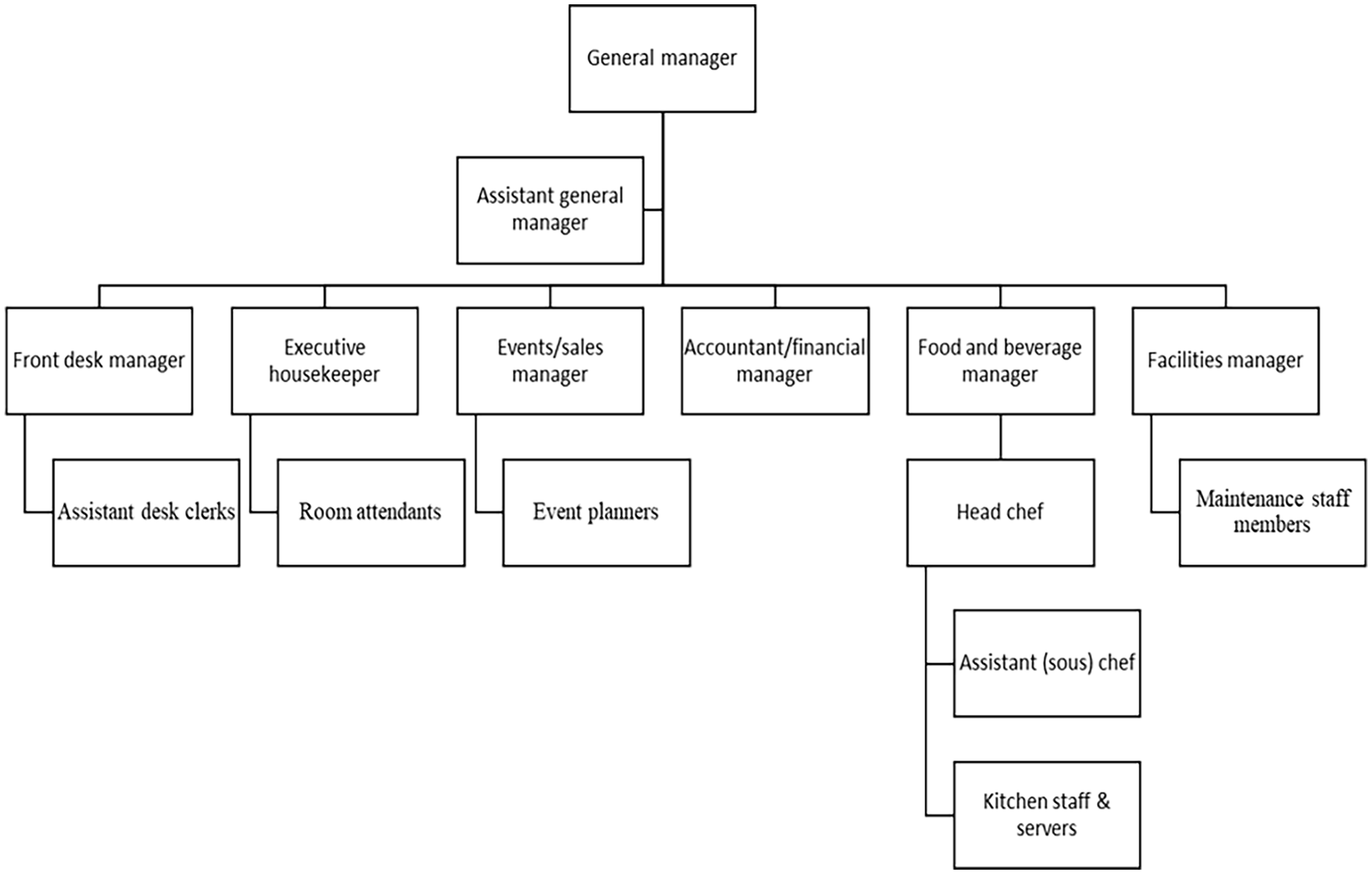
Organizational chart for the Hazel Hollow Lodge.
Unfortunately, no one on the leadership staff has the expertise or time to devote to the issues related to employee recruitment, training, and retention, and this is where you enter the picture. You have been hired as a consultant to provide ideas for recruitment and retention, including innovative benefit options. The hope is that your plan for the inn will be of value to current and future employees, to help them grow professionally, so as to make positive contributions to the workplace, and to help the inn continue to perform as a successful hospitality business.
Theoretical Implications
This case has theoretical implications regarding classic, well-known, motivational theories (e.g., Alderfer,1969; Herzberg, 1966; Maslow, 1943; McClellan, 1961). As noted above, this case asks the reader to apply Maslow’s hierarchy of needs (Maslow, 1943). The hierarchy of needs motivational theory often uses a pyramid to identify five levels of people’s needs, in the following order from the bottom to the top of a pyramid: psychological, safety, love and belonging, esteem, self-actualization (Maslow, 1943). When Maslow first proposed the theory, he posited that a need that was lower on the pyramid had to be totally satisfied before the next level could be acquired, but he later explained that the fulfillment of a need is not an “all-or-none” occurrence and that the hierarchy can be flexible (Maslow, 1987). Alderfer (1969) suggested an alternative to Maslow’s theory, based upon the three human needs of existence, relatedness, and growth (E.R.G.), while McClellan’s (1961) model conceptualized the three human needs as achievement (getting things done), power (having influence over others), and affiliation (having good relationships), noting that all people have a combination of the three, although one is usually dominant. Alternatively, Herzberg’s motivation-hygiene theory postulated that there are two separate sets of mutually exclusive factors, specifically applied in the workplace, which produce either job satisfaction or dissatisfaction (Herzberg, 1966). However, while Maslow’s hierarchy has been used and criticized extensively, recent updates to the theory consider additional features such as the ongoing, dynamic relationships between internal motives and their connections to ongoing environmental threats and opportunities, including those presented by the COVID-19 pandemic (Cerbara et al., 2020).
Discussion Questions
What are the main issues presented in the case?
What additional information do you need to have to complete the tasks asked of you and why?
What suggestions do you have for recruiting new employees?
What suggestions do you have regarding benefits?
What suggestions do you have for retaining employees, and thus reducing the turnover rate?
What general suggestions do you have for employee development and training?
How would you go about meeting the individual needs of the employees identified? Give specific ideas for each employee.
What specific ideas do you have for enhancing the employment offerings at the inn? Please describe your ideas and justify your answer.
What specific ideas do you have for employee development and training opportunities for non-management and/or seasonal employees? Please describe your ideas and justify your answer.
What specific ideas do you have for employee development and training programs for all of the employees at the inn, including the management team and the other employees? Please describe and justify your answer.
If you are an ICHRIE member, you can access the Teaching Notes for this case study here: https://ichrie.memberclicks.net/jhtc. If you are not an ICHRIE member, the Teaching Notes will be published in a future Sage Business Cases (SBC) annual collection: https://sk.sagepub.com/cases. For more information, please contact
Footnotes
Declaration of Conflicting Interests
The author(s) declared no potential conflicts of interest with respect to the research, authorship, and/or publication of this article.
Funding
The author(s) received no financial support for the research, authorship, and/or publication of this article.