




Abstract
Background
Human flourishing is a long sought-after aspiration historically considered and espoused through religious, philosophical, and creative avenues. Only recently has western science began to investigate the meaning, underlying foundations of, and effective strategies for promoting flourishing in life.
Objective
Here, we present a framework for teaching the science and practice of human flourishing grounded in connection, positivity, and resilience (CPR) based on a synthesis of theoretical frameworks and observations and input from a global sample of learners enrolled in an online course.
Methods
The CPR framework is distilled from empirical research in psychology and neuroscience and an applied pedagogy of flourishing delivered through a massive open online course (MOOC) that has reached over 650,000 people worldwide.
Results
Building knowledge and skills tied to three pillars of CPR: connection, positivity, and resilience intrinsically and measurably reinforces the experiences and behaviors that foster flourishing, mainly through prosocial human connection.
Conclusion
Human flourishing is malleable and the CPR framework is a promising method for teaching people the key ideas, spaces of opportunity for change, and behaviors, activities, exercises, and practices that strengthen flourishing in life.
Introduction
A key directive of our work at the Greater Good Science Center (GGSC) is to create practically applicable bridges from rigorous empirical research to insights and educational tools that people can incorporate into everyday life to promote flourishing in their own lives as well as in people they interact with. To advance this goal, the GGSC developed a massive open online course (MOOC) titled: The Science of Happiness to appeal broadly to people seeking to improve their lives. While the course title does not include the term flourishing, happiness in the context of this course is conceptually equivalent to flourishing. It is an overarching quality of life, “the good life”, grounded in everyday connection, positivity, and resilience: CPR, and it is key to lifelong health and well-being. For the purposes of this article, we will use the term flourishing instead of and interchangeably with happiness, with all due acknowledgement of the conceptual overlap amongst these terms. Importantly, we do not define happiness as a momentary pleasurable emotional experience, but like flourishing, as a broad quality of life.
In this article, we begin by tracing the intellectual tapestry of research and theory that gave rise to the curriculum of the Science of Happiness and from which we draw our CPR framework. Then, we explore how teaching principles and practices that enhance CPR can benefit human flourishing on a massive scale. Specifically, we share aggregate insights from the MOOC Science of Happiness participants’ input on their experience in the course. This online approach to teaching the principles of human flourishing is especially relevant given global scalability and accessibility of internet-based learning and training programs; how to enhance the prosocial experiences and behaviors that strengthen interpersonal ease, meaningful connections, and social support, even remotely, is the core deliverable of this framework.
We conclude by presenting how the CPR framework can be broken down into trainable skills and characteristics like mindfulness and gratitude that, with practice, enhance prosociality, genuine connection, and meaningful belonging. Before we begin it is important to consider two fundamental questions: 1) Why should humans flourish and not just survive, i.e. Are there actual advantages to flourishing? and 2) Why do relationships with others matter to one’s own flourishing? Not only does ample evidence converge to justify the claim that people who score high in measures of (or closely related to) flourishing enjoy better health, well-being, and longevity across the lifespan, but multiple accounts now implicate the neurobiology of prosociality in human flourishing, which highlights the essential role of supporting others well-being in the potential to flourish oneself.
“The best predictor of health and well-being is the quality of our relationships and the depth and extent of our attachments to others.” -Robert Waldinger, Harvard Study of Adult Development
Complementary Theoretical Frameworks of Flourishing
Theoretical frameworks for human flourishing can be found in academic fields like positive psychology and developmental psychology, as well as earlier, humanistic approaches. Among these theories, some of which have been explored in empirical research and others examined through a philosophical lens, there emerges a meaningful pattern of constituent factors that define and shape human flourishing.
We will begin exploring theoretical frameworks with a developmental and evolutionary approach put forth by the pediatrician researcher Thomas Boyce and colleagues Bruce Ellis and Jay Belsky. 1 Boyce and Ellis’s theoretical frameworks emerge from a biological lens of early childhood environmental factors that influence physical health and flourishing. The heterogeneity of outcomes amongst people who experience childhood adversity is a complex puzzle that considers both person-level factors (e.g. genetic predisposition) and environmental context. Boyce and Ellis coined the “dandelion and orchid children'' model to explain how some children are resilient like dandelions. Whether conditions are difficult or supportive, the dandelions push through, whereas “orchid” children are far more sensitive to circumstances. And as the metaphor suggests, the gain to flourishing from safe, supportive surroundings is both more essential and more pronounced for “orchid” than “dandelion” children. A valuable addition to this model is the evolutionary perspective which, instead of considering “orchid” sensitivity as a ‘risk’ or ‘fault’ it is considered an adaptive variation which enables children to optimize the benefits of an enriched environment when that is available. This perspective reminds us that biology and early life experiences are key contributors to one’s potential to flourish.
Another core idea from developmental psychology that influences flourishing is the science of attachment - the relationship between children and their primary caregiver(s). From John Bowlby’s early observational work with primates and infants to rigorous and predictive family-based laboratory studies by Mary Main to more recent epigenetic studies documenting how transmission of maternal stress can vary with attachment behaviors pioneered by Michael Meany,2–4 the earliest parental and caregiver attachment exerts an undeniable influence on individual flourishing. Altogether, there is very strong evidence that secure attachment with a primary caregiver predicts adaptive social functioning over the life course. Although long-term close bonds are not the only aspect of human flourishing, it does not appear to occur without them - in fact, several clinical therapeutic approaches involve efforts to re-establish the emotional and cognitive characteristics of secure attachment status to forge relational capacity. 5
A second influential perspective on human flourishing is connected to the construct of eudaimonia, which is often described in contrast to hedonia, i.e. pleasure and gratified desire. 6 Aristotle defined eudaimonia as the highest human good, or a life lived according to ethics and virtue, irrespective of enjoyment - posited as synonymous with flourishing. The study of flourishing in psychology, however, has also emphasized hedonic experiences, that is, greater frequency and intensity of enjoyment of pleasant stimuli and the absence of unpleasantness, or suffering in response to threatening or painful stimuli. An early self-report measure of positive psychological states, the subjective well-being scale, captures this hedonic level. 7 Without denying the value and impact of the hedonic experiences that motivate and reinforce the pursuit of basic needs, eudaimonia pertains to a more elevated, aspirational human potential, above the everyday hedonic mire. Eudaimonia reflects meaningful calling and sense of purpose, which may or may not overlap with immediate desires or sensory pleasure. This idea that meaning and purpose comprise a true form of flourishing is also evident in the works of humanistic psychology from scholars like Erich Fromm and Viktor Frankl. 8 Frankl advocated for the discovery of deep meaning amid, or possibly as a result of, great challenge and difficulty - and even acute suffering where sensory pleasure is absent - as a core facet of human flourishing. According to Frankl’s logotherapy approach to bringing human beings to their fullest potential and flourishing, the presence of hedonic pleasures cannot transform suffering into meaning, but a eudaimonic attitude can.
Several theoretical approaches to flourishing from positive psychology integrate the eudaimonic and hedonic aspects of well-being. For example, Ryff and Singer took opposition to the purely hedonic approach and added their own model of human highest potential. Their measure: Psychological Well Being (PWB), encompasses emotional and physical health and assesses the domains of autonomy, personal growth, self-acceptance, life purpose, mastery, and positive relatedness. 9 Ryan and Deci also situate well-being as the result of ‘self-actualization’ as described in their Self Determination Theory (SDT) model, which emphasizes the importance of autonomy, competence, and relatedness as core contributors to flourishing. 10 Thirdly, the PERMA model, developed by Martin Seligman, presents five aspects of flourishing: Positive emotions, Engagement, Relationships, Meaning, and Accomplishment, which presume to capture both individual and collective origins, and measurement of flourishing. 11 Across these models, social relationships are highlighted, suggesting that prosocial experiences and behaviors are fundamental to human flourishing.
While well-being is often assessed individually, it is also relational. One’s own sense of flourishing may be necessary, but it is not sufficient; people need a sense of belonging, connection, and meaningful contribution to something beyond the self to flourish. Some, in fact, argue that the PERMA model is considered a meaningful alternative to gross domestic product (GDP) as an index for evaluating the health and success of a nation. 12 With the PERMA model in mind, public policy could reflect a different set of values and goals to prioritize and fund. An interesting feature of the global measurement of well-being highlights a difference between experienced and evaluative well-being. Experienced well-being aligns closer to the daily hedonic experience of feeling good or not feeling good whereas evaluative well-being is a global assessment of well-being which people assess the overall quality of their life. Evaluative well-being has been more highly associated with overall health for aging populations. 13 Whether primarily experienced or evaluative, bringing human flourishing into the shared, common, civic evaluation of a society and country is an invaluable criterion for collective well-being.
A related, though narrower in scope theoretical framework clarifies the connection between flourishing and positive emotional functioning. Barbara Fredrickson’s “Broaden and Build” theory posits an evolutionary psychological explanation for ‘why’ positive emotions exist. Specifically, her work documents the advantages and benefits of positive emotions. 14 Prior to Fredrickson’s groundbreaking work, positive emotions were largely viewed as self-serving for pleasure. Now, positive emotions are tied to the generation and discovery of new knowledge, forging new alliances, and developing new skills. Positive emotions broaden the scope of awareness, which heightens creativity and innovation, directs resources to learning and acquiring new skills, promotes social attunement, and engenders cooperative alliances with others. These processes, Fredrickson suggests, are critical to problem-solving and collective progress - beyond the survivalist advantages of the fight, flight, freeze, harm avoidance maneuvers. In the Broaden and Build model, positive emotions produce an upward spiral, feed-forward benefit of the novel, rewarding, and prosocial affordances that are central to human flourishing.
The last outlook on human flourishing that we will discuss here comes from centuries-old traditional eastern philosophical views - specifically Buddhism. Buddhist scriptures and texts offer many teachings that aspire towards a simple, yet not easy to attain, version of human flourishing that does not involve striving for joy and pleasure or trying to escape inevitable sorrows but instead, learning to find ease and confidence in the inevitability of change and interdependence. This anti-materialistic worldview was just as much in contradiction to the ethos of culture in ancient India as it is today, and yet the resonance of these teachings is evident by its thousand-year legacy and its adaptation and incorporation into the modern mindfulness movement. According to Buddhist psychology, human flourishing is not something a person can earn, but a quality that can emerge from dedicated practice. 15 Each person’s buddha nature is innate and can be revealed by disavowing the competing human fixation on hedonic joys and disappointments.
The difference between this philosophy and many of the western psychological approaches to human flourishing is that the traditional Buddhist approach does not emphasize the unique, individual ‘self’ as the target for trying to actualize or hedonically please. Instead, by disassembling one’s unique, fixed sense of self or personal identity, and instead, embracing a collective sense of shared identity and perspective that everything is constantly changing, flourishing can arise. 16 Importantly the practices of inner awareness, meditation, and contemplation from this tradition emphasize that true flourishing occurs in connection to a mindset of wanting that flourishing for all sentient beings. Flourishing, according to the Dalai Lama among other contemplative leaders, comes from being compassionate towards others. 17 This does not mean that people must deprive themselves of basic care and ease, in fact, a first step is often to offer support and care towards one’s own flourishing - and then to extend this care and kindness towards others. Again, from the Buddhist perspective, human flourishing is based on the compassionate, altruistic, motivation found not in self-focus, but emergent from the balance and strength to help and support others.
Unique amongst the great spiritual and religious traditions of the world, Buddhist scholars began partnering with scientists several decades ago to spawn the entire research field called contemplative science which examine the characteristics, origins, and impact of all kinds of contemplative practice. A sub-discipline of this field emphasizes the nature and impact of contemplative practices for training compassion. For example, research at the Max Planck Institute in Berlin, Center for Contemplative Science and Compassion-Based Ethics at Emory University, the Center for Compassion and Altruism Research and Education at Stanford, and the Center for Healthy Minds at the University of Wisconsin among others have endeavored to document the biological systems involved and that change with contemplative practices of compassion. Generally, compassion meditation practices purport to increase investment in supporting one’s own flourishing in the face of struggles and challenges, largely as a springboard for concerning oneself with the welfare of all beings. One rigorous, five-year study, the ReSource project led by Tania Singer, cataloged unique patterns of neural activation tied to the impact of two kinds of meditation: compassion-focused and mindful awareness, as well as interpersonal practices designed to promote connection and vulnerability. 18 While not directly assessing flourishing, these practices reduced stress measured both subjectively and physiologically, and increased neural reward signals tied to generosity and kindness. The key takeaway? Strengthening connections with others through closer, more accurate affect sharing, perspective-taking, and intention to support or help reduces stress, increases compassionate behavior, and enhances meaningful belonging.
Teaching Flourishing Online
Theoretical frameworks informed by science are immensely useful for furthering our understanding, or declarative and descriptive knowledge, yet their potential to actually change flourishing at individual, or collective levels may be limited. To increase everyday human flourishing involves developing procedural knowledge, or knowing how to apply these ideas into everyday experiences, including how to perceive and process information, and make everyday decisions. Practices, activities, and exercises to promote flourishing have long been taught through religious and spiritual institutions and philosophical scriptures, but have largely been absent from mainstream secular learning for children and adults in modern western societies. More recently scientific examination of flourishing, its origins, and drivers, has opened the door to teach, train, and examine the impact of evidence-based approaches to flourishing.
In 2014 the Greater Good Science Center launched a massive open online course (MOOC), The Science of Happiness, to offer this transformative knowledge and array of practical exercises in everyday life at a global scale. Over 650K people have enrolled in the course, and student feedback and input provided the applied insight that led to the CPR framework. Below we share highlights from some of the voluntary, self-report course evaluation input from the global cohort of learners who have participated in the course between September 2014 and now.
The Science of Happiness MOOC is a ten module online course that teaches the roots of and practical strategies for flourishing in life. The course includes eight 2-to-4 hour modules that feature sequences of short videos and articles that describe key study approaches, analyses, and results interspersed with practical lessons for applying insights in day-to-day life. Each module also includes interactive exercises and assessments, and is designed to be completed over the course of one week. Two remaining modules contain a midterm and final exam, which learners can opt to complete to earn credit towards a certificate of completion. Overall, the course zeroes in on the fundamental themes highlighted in this article: that flourishing in life is inextricably linked to having strong social ties (Connection), generally feeling good (Positivity), and gracefully managing setbacks (Resilience), and that these three domains represent tangible areas of opportunity to foster the skills that foment flourishing in life. As an overlying theme, the course reminds learners that CPR capacities can be strengthened by contributing in ways that transcend self-interest—extending attention, energy, and resources towards the greater good.
As one element of the course, learners are invited to engage in a weekly (i.e. once per module) self-evaluation; they “Check In” to report how they have been feeling over the past few days. For each “Check In”, learners are presented with a series of six cartoon sketches of facial expressions that depict: 1) fear/anxiety, 3) enthusiasm/interest, 3) anger/frustration, 4) affection/tenderness, 5) sadness/grief, and 6) amusement/joy in random order. Beneath each sketch, learners are asked to rate, on a scale of 1 to 10, how much each expression matched how they’d been feeling lately. “Check In” ratings from each week were transformed into a happiness score (pleasant emotions – unpleasant emotions) that was plotted on each learner’s progress dashboard in an effort to provide personalized feedback that might support continued engagement. Though not intended for scientific reporting, we plotted aggregate happiness scores across cohorts of learners from several iterations of the course to evaluate course effectiveness (Figure 1(A) and (B)).
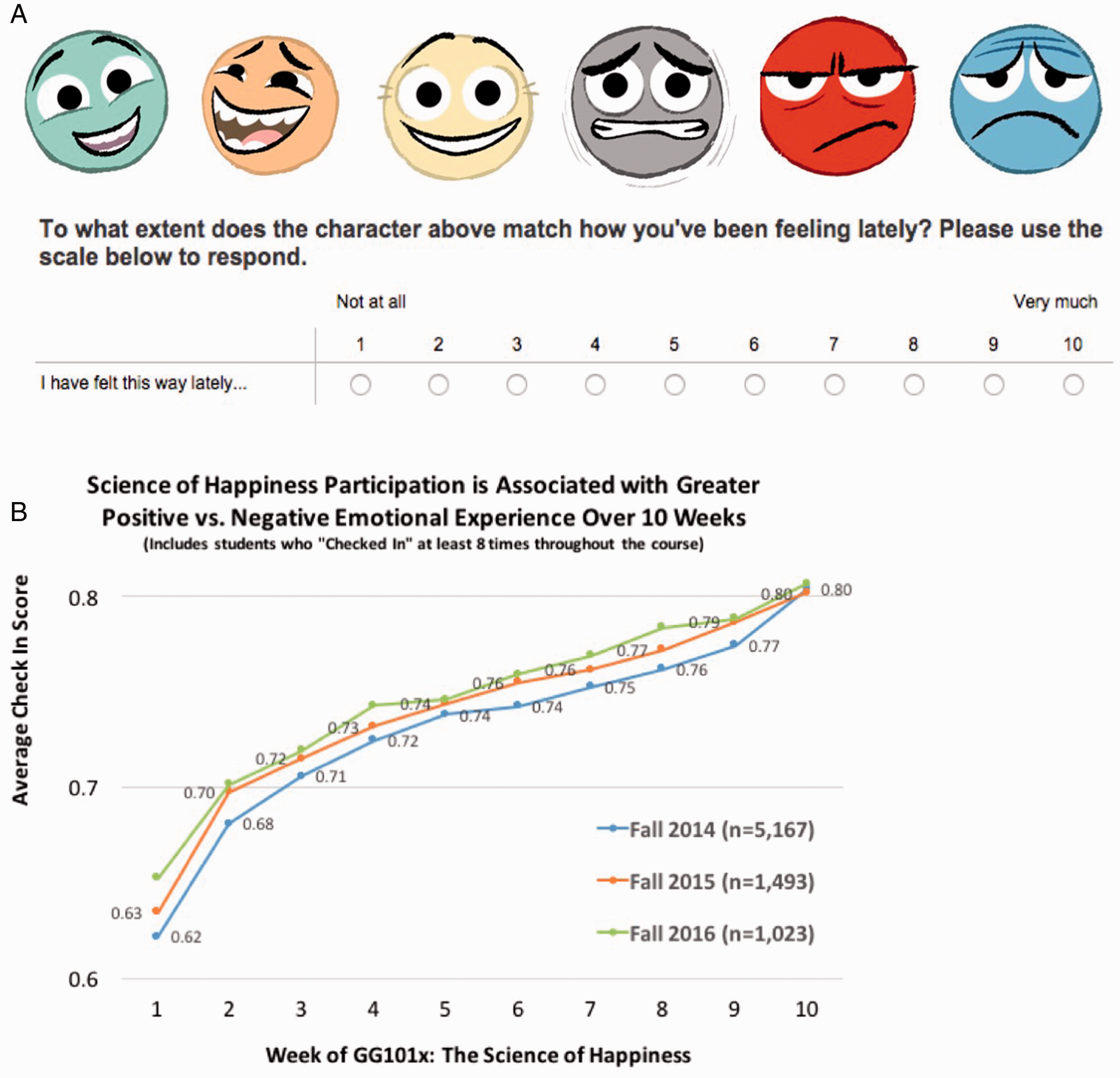
(A) Check In interface. (B) Science of Happiness Flourishing Scores.
For learners who responded to at least 80% of the “Check Ins”—suggesting that they were fully participating in the course— “Check In” scores showed systematically increasing happiness over the course of 10 modules, suggesting that learners felt progressively less sadness, anger, and fear, while at the same time experiencing more amusement, enthusiasm, and affection. While these patterns of self-report are susceptible to demand characteristics and can only reveal correlation between course participation and ratings, the consistency of the pattern suggests that future rigorous data collection might reveal a causal benefit of learning the principles and practices of flourishing on experiential and evaluative facets of flourishing.
Learners were also invited to fill out an informal battery of questionnaires related to human flourishing before and after completing the course to support program evaluation, not as a scientific endeavor (e.g. not a randomized controlled trial that assigned people to different interventions to investigate impact). Course enrollees were invited to complete this battery on three occasions, just before, upon completion, and three-to-four months after completing the course. In aggregate, questionnaire scores suggest again that participating in the Science of Happiness course can measurably benefit flourishing. Specifically, from before to after the course scores for subjective happiness, life satisfaction, and flourishing increased, and learners reported less stress and loneliness in their lives, as well as routine physical discomforts like muscle aches, stomach pains, or skin rash. These changes, consistent with improved flourishing, sustained three-to-four months after the course ended, suggesting that the beneficial impact of the course is lasting.
As one person wrote, “Happiness is a skill is a chief outcome that I have realized in the class. The fact that we are not passive and have some leverage at increasing the positive emotions we experience and enhance the meaning we are involved with our communities is very helpful.” (Figure 2)

Changes in Learners' Self-Reported Indices Related to Flourishing From Before to After the Course (Red), and From Before the 3-to-4 Months After the Course (Orange).
Finally, to explore the possibility that the Science of Happiness course influences interpersonal dynamics – how people see themselves in relationship to others and how others see them, several cohorts of learners were asked to 1) rate their sense of common humanity with other people in general and 2) nominate a peer, not enrolled in the course, who would be willing to rate the learners on a number of characteristics before and after the course. Nominated peer were invited, again informally via email, to complete a brief survey about the learner who nominated them near the beginning of, and after closure of the course.
Learners themselves reported a greater sense of common humanity – or inclusion of other in the self - after completing, compared to before starting the course. This more trusting, shared humanity perspective towards others may be a key to flourishing on wider, more collective levels. Comparing responses gathered within the first week of the course to responses gathered after the course ended (approximately 15 weeks, given extra time allotted for completion), nominated peers rated learners slightly higher on Likert scale items for desirable characteristics like “Content/Satisfied” and “Cooperative/Harmonious”, and lower on less appealing characteristics like “Self-Critical/Hopeless” and “Irritable/Agitated.” (Figure 3(A) and (B))

Peer Report Well-Being.
Regarding shifts in interpersonal experience one learner shared “[The course] reinforced the good that I can do for others, made me feel confident that my tendency to help people is not detrimental to my life,” and another posted, “In my personal relationships I put more emphasis on constructive and respectful open communication, and often I have able to recognize that things that may cause me to be unhappy at times in a relationship, were by-products of my own rumination about issues, real, imagined or projected…”
Though not scientific evidence from a rigorous experimental design, the large samples included in these evaluative analyses suggests that learning about the scientific principles and practicing everyday behaviors that predict flourishing can measurably increase flourishing. A more rigorous examination of this online curriculum in comparison to an active control would be necessary to make any causal conclusions, but again, these exploratory analyses of evaluation data show a promising area for further investigation.
While the principles and practices shared in the Science of Happiness MOOC are backed up by rigorous and comprehensive laboratory-based research, study of the application of these practices in larger global samples is still humble. Two of the evidenced-based writing exercises that learners were invited to try within the course were the “Self-Compassion Letter” and “Three Good Things”. Both of these practices have been shown to support different aspects of flourishing: self-compassion reduces excessive self-criticism and promotes coping, learning, and growth, and the Three Good Things practice promotes optimism, gratitude, elevation, and generosity. While learners’ voluntary free-text responses to these course units have not been analyzed for scientific purposes, select examples are shared below as descriptive anecdotes.
The self-compassion letter activity includes the following instructions:
First, identify something about yourself that makes you feel ashamed, insecure, or inadequate. It could be something related to your personality, behavior, abilities, relationships, or any other part of your life. Once you identify something, write it down and describe how it makes you feel. Sad? Embarrassed? Angry? Try to be as honest as possible, keeping in mind that no one but you will see what you write.
The next step is to write a letter to yourself expressing compassion, understanding, and acceptance for the part of yourself that you dislike.
As you write, follow these guidelines:
Imagine that there is someone who loves and accepts you unconditionally for who you are. What would that person say to you about this part of yourself? Remind yourself that everyone has things about themselves that they don’t like, and that no one is without flaws. Think about how many other people in the world are struggling with the same thing that you’re struggling with. Consider the ways in which events that have happened in your life, the family environment you grew up in, or even your genes may have contributed to this negative aspect of yourself. In a compassionate way, ask yourself whether there are things that you could do to improve or better cope with this negative aspect. Focus on how constructive changes could make you feel happier, healthier, or more fulfilled, and avoid judging yourself.
Learner A. 1) I am always struggling with my weight and feel that I am less worthy of love because I am overweight and because I lack the strength of character to exercise as much as I should and to watch what I eat as much as I should. I feel like I'm unattractive and unworthy of attention. 2) Millions of people are like myself and struggle with their weight. People should not be made to feel worthless due to their weight and likewise I shouldn't consider myself to be worthless. 3) In my household as a child, food was the way you proved you loved someone. Heap up the plate with good food. My mother suffered with weight and yet I loved her and saw her as being beautiful and wonderful. 4) I need to see myself through the eyes of my daughter who tells me on a daily basis that I am beautiful. I am worthwhile and I try my hardest to be a good person. I need to look into the practice of lovingkindness more thoroughly. I need to start talking to myself in a more compassionate way.
Learner B. 1) Fear. Afraid to learn to ride my motorcycle. Panic attacks when driving on the freeway. It makes me feel like a fraud, a poser. I know I can hurt myself but that should not keep me from trying. 2) You have every reason to be afraid. I would be concerned if you weren't. It is a large powerful machine and it commands respect. 4) Maybe you will be able to move past the fear far enough to give it a fair try. You have fallen down before, but you got back up! As far as those panic attacks too. I know you are working on lessening their effects if not stopping them altogether. I think you have made progress. Practice mindfulness, I really think it will help you put things in perspective.
Learner C. 1) I hate on myself a lot when I feel overly emotional. I am a cryer and I cry often and usually without much control. I view it as a sign of weakness. 4) You are a kind and wonderful person despite your flaws. Your tears are an honest expression and outlet for your emotions and frustrations and they are nothing you should feel ashamed of. No one is without flaws and there are many people who struggle with this same over-emotionalism. You will feel much better in general if you stop feeling bad about yourself every time you get emotional. Please stop self-judging!
For the Three Good Things exercise learners were invited to recall, and post a description 3 good things in their day at first within the course platform, and then to continue on their own in a notebook or other word processing program. Below is a selection of the “Three Good Things” that learners posted into the course.
I took a shower which made me feel good because I was taking care of myself. I knew by taking care of my hair sooner rather than later that this would lead to less frustration and annoyance for me in the future. I thought I was being responsible and forward-thinking by doing this. This thus went well for me today.
I felt appreciated.
Ella gave me a hug. As I was leaving for work, Ella grabbed me around the leg and hugged and kissed me. She told me to have a good day. This made me feel loved and appreciated. It makes me smile to think of her sweet face.
I had a good cup of coffee. It was nice.
A friend checked in on me. L sent me a text to let me know that they were thinking of me and gave me words of wisdom to focus on rather than the confused emotions I had been feeling about C.
My new boss told me I was very smart and I'll have no problem learning this new program. It was totally off guard and he doesn't really know my work yet, since 8 just recently moved to his team. It makes me happy they are confident in my ability.
I got to pick up my kids from daycare, which was a surprise since mom usually picks them up
Today is the first day in a long time that the sun is out:) It's -12C outside but the sun makes a huge difference. My office at work gets sunshine the whole day, so I am really happy to sit here and work today. When I got up this morning and realized the thick clouds had shifted, I almost felt a weight off my shoulders immediately. Still happy about it now!
These reflections seem to highlight the simplicity and courage involved in practicing the P and R in CPR, the positivity and resilience skills that promote flourishing. In the case of the self-compassion letter, the exercise requires forging a meaningful connection to difficult aspects of our own self-judgment, and tapping into deeper inner resilience resources to face issues associated with the unpleasantness of feeling unattractive, disliked, or inadequate. The themes of insecurity, insufficiency, and negative self-judgment are prevalent in learner’s responses; turning towards these troubling inner experiences with openness is part of the transformation towards flourishing which occurs in the course. Through the Three Good Things exercise, the simple, sometimes mundane, activities of day-to-day life can become seeds of well-being and flourishing. A good cup of coffee, being seen, taking care of oneself, these are the humble and profound activities of daily flourishing that can so easily be ignored or taken for granted amidst “more important” goals or daily hassles. Capitalizing on these small areas of positivity, and resilience helps incline the mind towards these pathways forging the inner structures of deep flourishing.
These personal, common, human responses provide the most tangible way for us to conclude this article. We moved from the summit of the mountain to the base where the true weight of this model of connection, positivity, and resilience (CPR) is down on the ground through the applications in our lives.
The Science of Training CPR
In an effort make the pursuit of flourishing simple and applicable, the CPR model of flourishing hinges on strengthening skills that are malleable; skills that can be learned and developed with regular, intentional practice. Like other common skills people can improve upon with exercise and practice like dancing or playing chess, the CPR model provides accessible and practical guidance people for improved flourishing in life through simple, dedicated effort.
The C in CPR: connection, refers to believing that there are other people in the world that you can count on, and who count on you, for meaningful support. Whether affirming joyful moments or assisting each other during difficult times, people who are connected, report having social support, or feeling a sense of belonging in community are substantially more likely to fall into the category of “Very Happy” in life. 19 The P if CPR: positivity means being able to experience pleasant emotions when things are going well, or even under ordinary or mundane circumstances. Many studies document the advantages of positive emotional experiences like shared amusement, pride, enthusiasm, affection, and gratitude in shifting one’s perspective towards information that helps secure resources, approach others to form meaningful, cooperative social bonds, and connect with core values and life goals that transcend self-interest. The R in CPR: resilience, refers to handling setbacks, failure, and loss - the difficult experiences that cause pain and suffering that are inevitable in life, in ways that channel learning and growth.
For each of these domains, there is an increasingly long list of behaviors, activities, exercises, and practices that, with repetition, can shift day-to-day experiences in ways that promote flourishing.
Connection, for example, can be bolstered with activities that increase interdependence and psychological safety in social contexts, presumed trust towards others coupled with egalitarian and humanistic beliefs about humanity, empathic accuracy and active perspective taking, and innate tendencies towards care, nurturance, cooperation, and generosity.
Positivity can be bolstered by shifting priorities towards experiences and activities that reliably increase the frequency, duration, and robustness of pleasant, uplifting, and affiliative emotions in a sustained way, and exercises for reshaping learned habits of expectation, interpretation, and judgement to be more accepting, optimistic, and savoring of available or imagined goodness.
Resilience is best strengthened through activities and practices that increase personal meta-awareness and intentional revisioning of unpleasant, difficult, and hostile emotional experiences, including sensations, expressions, and thoughts, both immediate and long term. Efforts to strengthen connection, positivity, and resilience are not necessarily independent, e.g. engaging in an exercise to improve resilience may also benefit connection in a synergistic, complementary way. Also, given that flourishing via upskilling CPR for a meaningful, happy life occurs through both direct experience and learned beliefs and expectations, there are several channels and modes for intervention.
There are several robust examples of activities, practices, and exercises that studies suggest can strengthen CPR, and in turn, flourishing in life. Earlier, we discussed the indisputable literature on the benefits and promise of mindfulness-based practices. Spanning across CPR, exercises for mindfulness, awareness, centering, contemplation, or meditation (a non-exhaustive list which we will refer to as mindfulness moving forward) that enable greater awareness of inner sensations and both reflexive and intentional thoughts and feelings, outer experiences, and behavioral urges as they are occurring in real time, provide measurable benefits. People who score high on measures of mindfulness or increase mindfulness through training or practice get better at connecting with people, can savor joy and maintain a hopeful outlook, and cope with stress and setbacks more gracefully - all which raise their potential for flourishing. 20
A second example of a practical construct that spans CPR is gratitude, the feeling of reverence or warmth that occurs when we consider a positive outcome that we enjoy that is not tied to our own effort, but comes from the efforts of another person or another source outside of oneself. Three decades of research on gratitude highlights the myriad benefits of being a more grateful person or strengthening gratitude through practice on flourishing. 21 More gratitude is tied to greater social appeal and more satisfying relationships, to more positive emotions in general, to healthier coping, and even to sustained effort towards meaningful life goals. Gratitude enhances our sensitivity to positive events, ties those feelings to other people, and serves both a protective and a buffering role against traumatic experiences.
Some examples of practices that serve each domain of CPR more specifically and which are included in the MOOC above. For connection, deliberately noting similarities between oneself and others in writing, and in a particularly challenging vein, doing so with someone distasteful in mind, is a way of softening resistance towards interpersonal experiences. Simply attuning to our similarities with others, even disliked others, shifts habits of judgement and information processing in ways that reduce physiological responses that signal social threat and restore the possibility of coordinated outlook and shared goals. In the realm of positivity, an emerging science of awe, the experience that occurs when we encounter a setting or context that challenges our ordinary expectations for what is possible, and infuses us with humility and warmth, is providing an increasingly rich case for spending time outdoors in nature as a way to experience the kind of genuine uplift, inspiration, and friendliness (not to mention biomarkers of physical health) that fuels flourishing in life. Finally, a key idea for resilience is self-compassion, which means adopting an internal voice that is friendly and caring towards our own insecurities and deficiencies in place of the more common highly self-critical tone. Amongst a long list of benefits, the caring stance of self-compassion is crucial to recovering from failures, setbacks and losses and leveraging life’s difficult moments to inspire purpose and growth. 22
Because we know that the human brain continues to change over the lifespan as a result of day-to-day behaviors and experiences, we can expect that the activities, exercises, and practices that build skills of CPR to also influence patterns of activation in brain regions and pathways and other physiological systems known to support connection, positivity, and resilience. While not every practice has been studied using neuroscience methods, mindfulness, gratitude, compassion, and kindness have. Mindfulness has been associated with greater density of cortex in brain regions involved in learning and memory (e.g. hippocampus), in lesser engagement of brain regions that drive ruminative self-focused thinking (e.g. medial prefrontal cortex, insula, amygdala), greater influence of higher order executive regions (e.g. dorsolateral prefrontal cortex) on vigilance-to-threat/stress signaling systems (amygdala), among other salubrious influences. 23
Evoking gratitude in a functional magnetic resonance scanner, researchers have shown greater co-activation of pathways that process social information (e.g. superior temporal sulcus, temporal parietal junction) and regions that signal memorable reward (e.g nucleus accumbens, ventral medial prefrontal cortex), suggesting a strengthening of associations between socially relevant and intrinsically rewarding information. Empathy and compassion are tied to distributed systems, those that serve simulating other’s states and expressions (e.g. insula, amygdala), understanding others expressions (e.g. temporal parietal junction), and in the case of perceived suffering, judging oneself as safe (e.g. dorsolateral prefrontal cortex) while adopting a caring stance towards the victim (hypothalamic, medial preoptic pathway), and anticipating the warm glow pleasure of shared relief (e.g. nucleus accumbens). 24 Finally, for kindness and generosity, studies report increased engagement of intrinsic reward pathways (e.g. nucleus accumbens) tied to greater tendency to contribute one’s own resources to benefit another. Considering all of these neurobiological systems, and their amenability to change with repeated experience and practice, sheds increasing promise on the possibility of employing trainable skills for CPR for happiness, or flourishing in life.
Since 2001, The Greater Good Science Center has endeavored to provide resources, both knowledge-based and practically applicable, for as many people as possible to incorporate into their daily lives in the service of building a kinder, more compassionate society. By putting actionable insights from the cutting edge science of human flourishing from multiple disciplines into the hands of individuals from all walks of life, we aim to enable flourishing in life from grassroots and leadership levels, by giving accessible, science-backed strategies for strengthening connection, positivity, and resilience to all.
Footnotes
Declaration of Conflicting Interests
The author(s) declared no potential conflicts of interest with respect to the research, authorship, and/or publication of this article.
Funding
The author(s) received no financial support for the research, authorship, and/or publication of this article.
