




Abstract
Since Jon Kabat-Zinn first introduced a contemporary, secularized application of mindfulness for the relief of pain and stress in physical health-care settings, there has been a significant and rapid expansion of the range of mindfulness-based programs (MBPs) designed for various health care, education, workplace, and other settings. As is common with developing programs, these often run ahead of carefully considered and researched effectiveness evaluations. This raises questions of how to best train mindfulness teachers to skillfully facilitate such interventions while minimizing the potential for harm. In this article, we describe the work of an international group of senior teacher trainers who met to develop guidelines on the ethics and standards for teacher trainers and their training pathways. In this article, we will define MBPs; describe the process by which these international guidelines were developed; and share details of the collaborative team who made up the international network that worked on them. We offer these guidelines as “living documents” that specifically set out: (1) ethical standards for mindfulness teachers and trainers; (2) criteria and standards for teacher trainers; and (3) criteria and standards for training pathways. As “living documents,” these will continue to be commented on and refined over time. Given that MBPs offered within secular settings in most countries currently have limited oversight or accreditation processes, we hope these guidelines will provide support and clarity to the teachers of all established and emerging MBPs, and their trainers and supervisors.
Keywords
Introduction
We are at a critical moment in the development of mindfulness-based programs (MBPs) 1 and indeed the role of mindfulness in wider society. Since the first Western applications of mindfulness in medicine and health care offered in the format of Mindfulness-Based Stress Reduction, 2 there has been an exponential rise in the number of trainings, programs, and adaptations in what was once a rather sparse field. This is very good news: providing more innovative and evidenced-based programs by trained teachers that contribute to a deeper understanding of mindfulness in the public domain. However, we are also seeing the influence of the marketplace on this field, giving rise to a proliferation of quick-fix courses and techniques offered by often minimally trained teachers. Furthermore, recent research findings are demonstrating that there can be unwanted effects from meditation practice that require both skillful handling 3 , 4 and further investigation. 5
At this critical juncture in the teaching and training of MBPs, we are faced with the need for careful and caring scrutiny of the quality of all existing and newer mindfulness-based programs, the training and preparation of the teachers, and the impact of the many and varied mindfulness courses being offered. The intention of these guidelines is to ensure that teachers are consistent across all MBPs in offering their participants mindfully embodied presence along with appropriate skills and frameworks that support human growth and flourishing with the potential for healing and transformation. We also wish to guide the ways in which teachers advertise, offer, and fund their programs to ensure they are grounded in ethical considerations that are committed to integrity, transparency, openness, relational responsibility, and clarity around limitations, while recognizing the needs we have for viable livelihoods. The thoroughness and robustness of mindfulness-based program teacher training demand a unique commitment and cost. Like other professions, there are skills and competencies that are taught and evaluated. However, one of the central requirements of teacher training integrity is having a personal meditation practice, which is a much more difficult element to assess. It is especially hard to assess how this practice translates into an individual’s embodied expression within the teaching, although much work has been done to develop tools that can evaluate this for the purposes of training and research fidelity.6–8
There is now a range of published articles on mindfulness teacher training pathways9–14 as well as preliminary attempts to correlate teacher training pathways with MBP outcomes. 15 , 16 This body of literature needs to be widened to include evolving mindfulness-based courses and will be usefully informed by articles which lay out principles for assessing intervention integrity such as those by Crane and Hecht, 7 and Crane. 10
Therefore, with this rush of emergent programs and training pathways, it is timely to formally articulate and disseminate the training standards and criteria that have been developed over the past forty years for the most researched programs, namely, Mindfulness-Based Stress Reduction (MBSR) and Mindfulness-Based Cognitive Therapy (MBCT). These standards and criteria will be articulated in this article to provide a foundation for ongoing dialogue and to offer a potential framework for all trainings in all MBPs. We will also describe what we mean by mindfulness-based programs; the process by which these international guidelines were developed; and who made up the international network of senior international teacher trainers who worked on them. We offer the guidelines as “living documents” that specifically set out (1) ethical standards for MBP teachers and trainers, (2) criteria and standards for teacher trainers, and (3) criteria and standards for training pathways.
As the MBPs currently offered in secular settings in most countries have limited oversight and/or accreditation, we hope these guidelines will provide guidance and clarity for all current and emergent programs and teachers. Aspiring to best practices, and committing to a sense of integrity and quality, will assist a cooperative effort toward disciplined growth and healthy maturation of this nascent field.
Defining Our Terms: Mindfulness and Mindfulness-Based Programs
For the definition of mindfulness, the authors refer to Kabat-Zinn’s operational definition 1 of mindfulness as “… the awareness arising through paying attention on purpose in the present moment ...non-judgmentally … in the service … of self-understanding, wisdom, and compassion.” 17
We see the evidenced-based MBPs, specifically MBSR and MBCT, as the application and recontexualization of the concept of mindfulness found in the teachings and practices from Buddhist traditions as a “lived universal dharma” 18 within a secular framework of experiential education which involves and also goes beyond the meditative practices, both in and out of the classroom. This secular application of mindfulness is interwoven with theoretical rationales drawn from such fields as science, medicine, psychology, and education and attempts to address the causal and maintaining factors of human distress and suffering as they manifest in a range of modern-day contexts. It includes a significant immersion in daily formal and informal mindfulness meditation practice supported by inquiry and class discussion led by the teacher; it is a lively investigation of what occurs when we change our relationship to the present moment, and to that of our physical, cognitive, and affective processes with an attitude of curiosity, interest, kindness, and acceptance. The content, process, and teacher requirements for MBPs have been laid out in a seminal article by Crane et al. 19
The following table lays out the essential and flexible elements of MBPs, which will greatly inform our capacity to evaluate various offerings and their related training pathways.
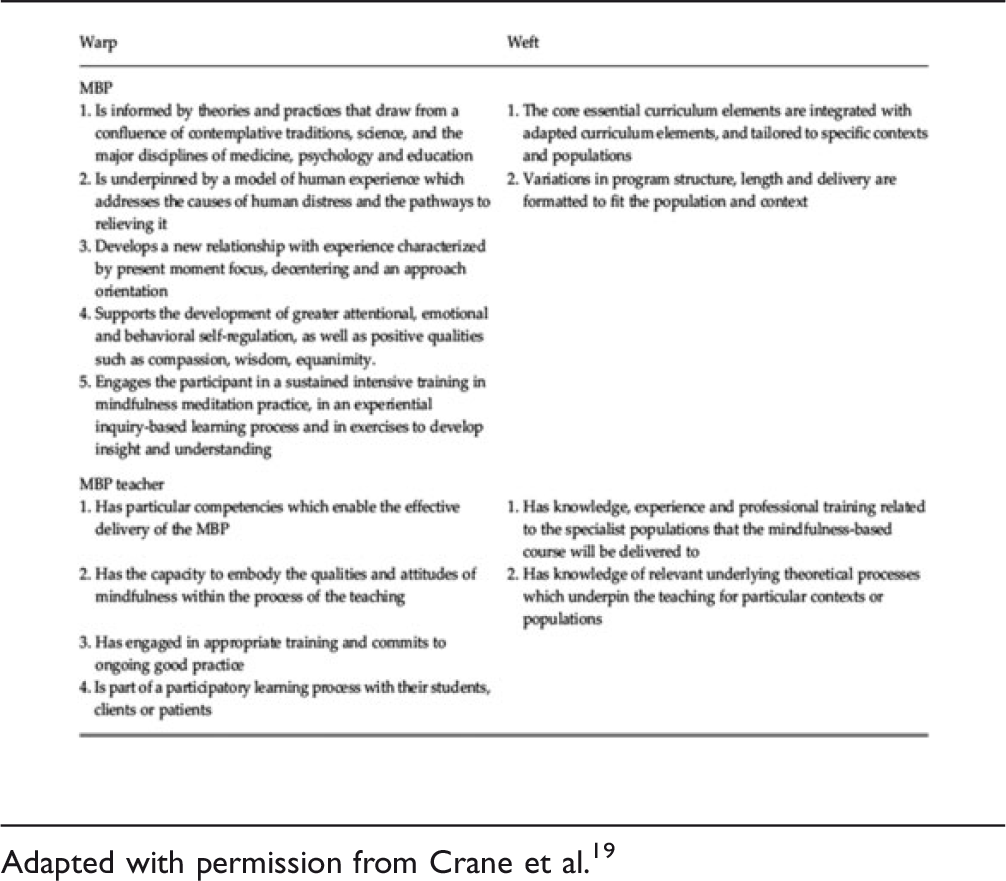

Adapted with permission from Crane et al. 19
How These Guidelines Were Developed and by Whom
The intention to create guidelines for teachers and teacher training pathways that would support the ongoing integrity of MBP teacher training was formed following 5 separate international meetings held in the United States and Europe, attended by recognized leaders and teachers in the field, all engaged in the teaching and training of teachers in evidence-based 8-week MBPs, most typically, MBSR and MBCT.
Such representation from various established Mindfulness-Based Teacher Training Organizations (MTTOs) and/or regional Teachers’ Associations around the globe allowed a compelling inquiry into creating coherence in this field, especially given the various practical, contextual, and logistical realities faced in different countries and regions. This inquiry was informed by the attendees’ long and rich experiences of teaching, training, and supervising others in MBSR and MBCT, as well as their long-term personal meditation and retreat experiences, and provided much of the groundwork for developing the guidelines described later in this article.
This led to a multinational meeting in 2015 in the United Kingdom, now also including the Asia Pacific and South African networks, that reached a clear consensus that the development of a collaborative international network was needed by grassroots teacher and trainers alike to ensure the ongoing integrity of MBP teacher training.
From this 2015 international meeting, the vision and mission for this initiative was developed. These were preliminarily agreed to, as described as follows: Vision Our vision is to support teachers and trainers in maintaining the integrity of mindfulness-based programs that are grounded in awareness, compassion and wisdom upheld by an interconnected, diverse and global network dedicated to promoting health, well-being and ease for the benefit of all beings. Mission An international collaborative network of mindfulness-based teacher training organizations committed to maintaining integrity and upholding training standards of mindfulness-based programs supporting transformative inner work that allows all beings to flourish in our diverse world through the practice of mindfulness.
The Steering Group then established a second group, the Transitional Working Party (TWP), to begin the work of (1) collating, articulating, and disseminating the guidelines for ethical standards and criteria for MBP teachers, teacher trainers, and training pathways; and (2) considering guidelines on structure and governance for such an international grouping.
The TWP members were nominated by the Steering Group based on the criteria below and were drawn from representatives of MTTOs and regional Teachers’ Associations from around the world representing most, but not all, geographical regions. It comprised 2 co-chairs, Günter Hudasch (Germany) and Maura Kenny (Asia Pacific), plus Allan Goldstein (USA, West Coast), Lot Heijke (Holland), Lynn Koerbel (USA, East Coast), Patricia Lück (South Africa), Catherine Phillips (Canada), and Taravajra (UK).
Eligibility Criteria for the TWP
Seniority of at least 5 years’ experience as a teacher trainer within an established MTTO or other closely related MBP teacher training organization. Representation of both their own training organization and the region within which they worked and were well respected, well networked, and well trusted within their wider community. Knowledge of local and regional training organizations—to ensure geographical, cultural, and organizational considerations were covered.
Despite the recognition and acknowledgement that there were still many regions underrepresented at this time, the geographical spread of the teacher training organizations was felt to be broad enough to begin the work.
The Work Completed to Date
Beginning in February 2016, the TWP met regularly, producing 4 sets of guidelines on:
Ethical Standards for Mindfulness Teachers and Teacher Trainers. Criteria and Minimum Standards for Teacher Trainers. Criteria and Minimum Standards for Teacher Training Pathways and Guidelines for Levels of MBP Teacher Experience. Structure and Governance for an International Integrity Network for the MBPs.
The resulting documents were sent to the Steering Group in December 2016 for further review. These were then disseminated through the regional networks represented in the TWP and an overview of the work was presented at the Centre for Mindfulness, Research and Practice Mindfulness Conference in Chester, UK, in 2017.
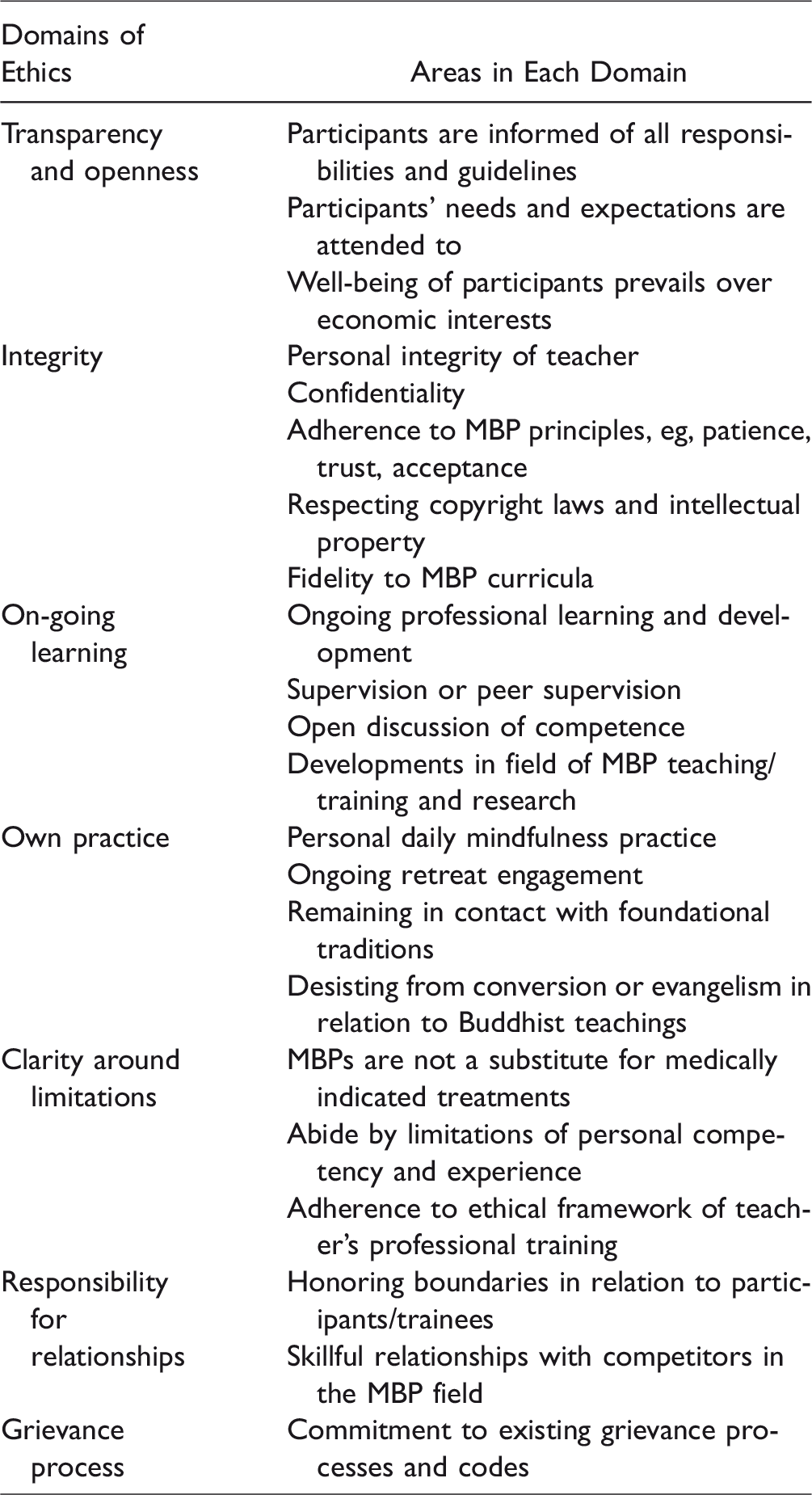
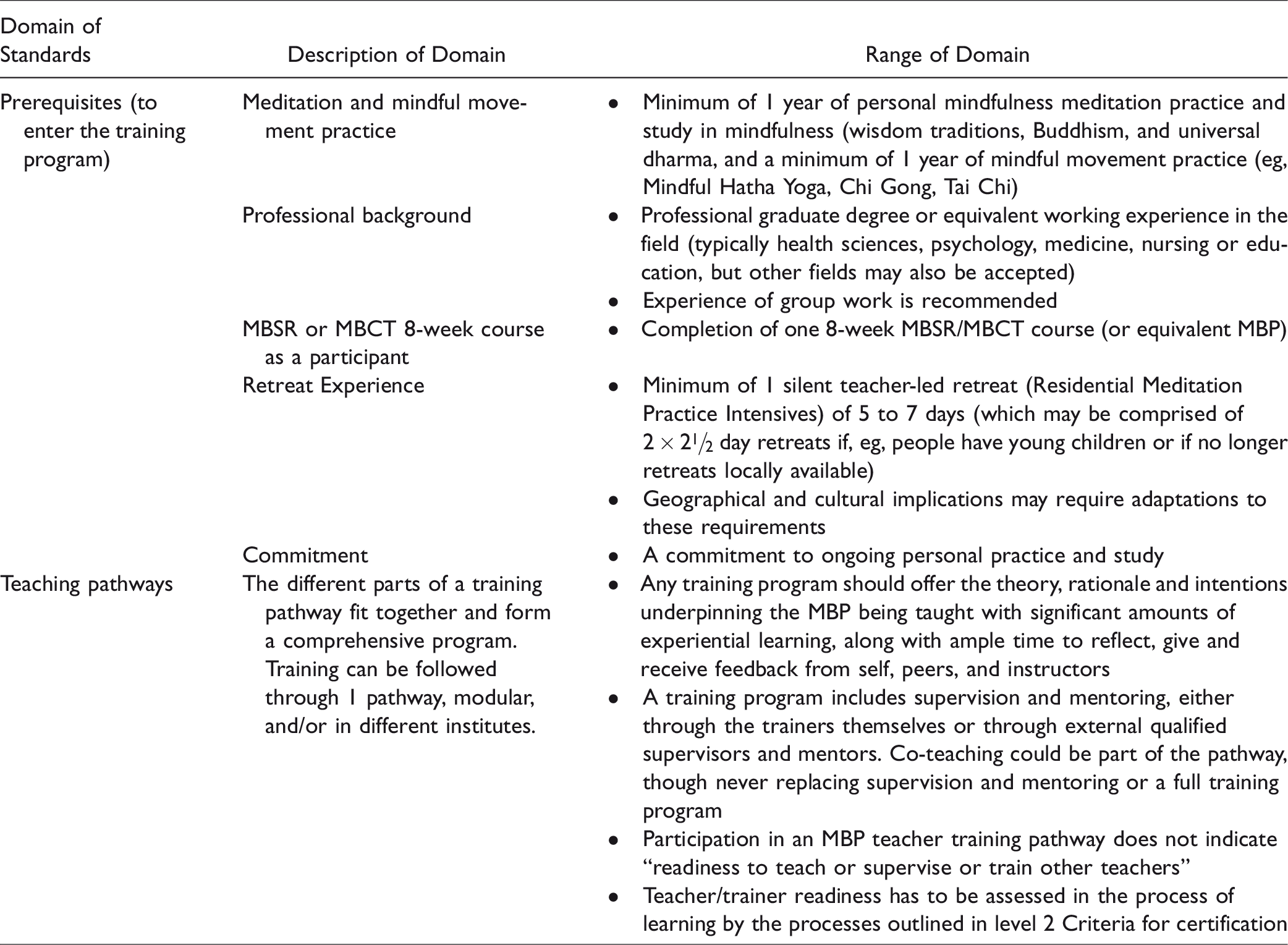
Summaries of these guidelines and standards are presented in the following tables, and full copies can be obtained from the authors or any of the named TWP members until such time that a dedicated website is established.
Ethical Standards for Mindfulness Teachers and Trainers
Criteria and Standards for Teacher Trainers

Criteria and Standards for Teacher Training Pathways
Guidelines for Levels of MBP Teacher Experience

As work on the structure and governance document is still in progress, it was felt that these initial documents would be released as a more immediate and relevant contribution to the field. These “living documents” are offered as best practice guidelines to be utilized by MTTOs as they develop and review their teacher training pathways and by MBP teachers as they reflect on the ethical principles that guide their work. We fully appreciate these guidelines may remain aspirational for some time as the length and cost of MBP teacher training may create unrealistic barriers for some communities, or where geographically isolated teachers are trying to establish evidence-based MBPs. Ethically balancing practical and economic realities while holding true to the integrity of the work is a mindfulness practice in itself. To be both rigorous and flexible requires spaciousness and careful consideration.
The TWP acknowledged early on in its work that a priority was to remain true to the vision described above, which highlights both integrity and inclusivity. To wisely progress this work within the many and varied communities we work and live in, relationships need to be tended to with mutual respect, healthy inquiry, and a nuanced understanding of global realities.
Future Directions
As we go forward, ongoing challenges are inevitable and will require a mixture of patience, care, wisdom, and steadiness as we meet them.
These challenges include the following:
Maintaining MBP teacher and training program integrity while working on increasing the accessibility and dissemination of evidence-based courses. Particular attention is needed where there are regional, cultural, and population differences. Finding ways to initiate or maintain ongoing accessible and affordable training, supervision, mentoring, and course outcome evaluation. Preventing fidelity drift which refers to the often-observed phenomenon where teachers (or therapists) tend to drift away from offering the original model they were trained in, introducing their own ideas without always realizing they have done so, leaving out core components or not evaluating the outcomes for their participants/clients even if they have made any changes carefully. Clarifying which new programs fit the current definitions of MBPs, identifying the standards of evidence needed to justify their inclusion, and evaluating the particular training pathways developed to prepare the teachers. This requires ongoing research (especially more effectiveness trials in different settings), judicious use of research funding to fine tune existing MBPs for some populations, and collaborations between scientists, trainers and teachers that would assist with this more targeted endeavor, rather than trying to meaningfully scope and evaluate the iterations of MBPs that are now appearing. Developing a standardized certification process of both MBPs and MTTOs while paying attention to the implications for different professions, cultures, academic, and nonacademic settings. This would go some way toward safeguarding the offerings so that the public had some way of assessing the integrity of courses on offer. Transitioning from the international group involved in developing these guidelines to the growing generation of leaders who will support the next steps of this work. Some plans for this are coming into focus and involve website creation, biannual meetings for further discussion, and publication of relevant articles. The structure and governance of such a leadership group needs more reflection, especially as the complexities involved in creating a global body that has a meaningful role are not insignificant. For example, the need for support of both participants and teachers in settings where there is systematized discrimination and abuse, and/or increasing social ecology threats is a pressing challenge for the mindfulness community.
Conclusions
By June 2018, these ethical standard and teacher training guidelines had been presented and circulated with the MBP teacher training networks and organizations, but wider dissemination is still needed along with wider ranging discussions, panels, conversations, and investigations. Over time, the TWP has transitioned with some members stepping back after the initial work was completed and as new representatives joined the group. A series of biannual meetings are being planned to further clarify and discuss components of the documents and the direction of the field, with the possibility of a collaborative website being developed with an international reach for all teachers and trainers.
In the meantime, we hope that the summary tables of the documents become a valuable and practical resource to the MBP teacher trainer community that will guide best practices through minimum standards for teacher development and training that can be appropriately adapted to local contexts. The relevance and value of this work and its related documents is now for the community of MBP teachers and trainers to explore, study, and debate as we collectively and individually offer mindfulness-based programs to those who may benefit, and as we train the next generation of teachers. This is all the more crucial as MBPs move into populations, regions, cultures, and domains where classes look nothing like the generally white, relatively wealthy, heteronormative, gender-conforming populations found in the original programs. In fact, this progress is seen as timely and critical in the development of MBPs and is a welcome movement in the field, speaking deeply to the roots of contemplative practice and ethical frameworks of inclusion and equity.
Creating an environment that cultivates deep listening, openness, and respect for what is possible in diverse and underrepresented regions is critical to realizing the full potential of human flourishing through mindfulness practices. We have endeavored to do so in the development of these guidelines.
Footnotes
Acknowledgments
These standards and guidelines were formulated out of the deeply considered and dedicated work of many teachers and trainers, and we express gratitude to the TWP members, the Midwives, and all who commented on these “living documents” along the way.
Declaration of Conflicting Interests
The author(s) declared following potential conflicts of interest with respect to the research, authorship, and/or publication of this article: Lynn Koerbel is the Assistant Director of MBSR Teacher Education and Curricula Development at the Mindfulness Center, Brown University School of Public Health.
The Center takes fee-paying students who are training to become mindfulness teachers. The course was developed with a length and depth that is in accordance with the standards set out in the article. Prior to submitting this article for publication, these standards have been widely held to be the international gold standard for mindfulness teacher training. Moreover, the standards originally emerged from the inaugural Center for Mindfulness at Umass which have been taken up by all reputable Mindfulness Centres around the world, including at Brown where Lynn works. While it could be viewed that the rigour of the proposed standards makes for a longer course at Brown with higher fees, there are many alternative and briefer trainings increasingly available that give potential students plenty of choice. The evidence base for mindfulness interventions has emerged from courses provided by teachers who have been trained to the standards described in the article.
Funding
The author(s) received no financial support for the research, authorship, and/or publication of this article.
