




Abstract
Background
Healthcare professional burnout has reached epidemic proportions, with downstream effects on personal and patient health and on our institutions. Solutions lie in the domains of work culture, operational efforts, and personal strategies.
Objectives
To evaluate the impact of a 5-day mind–body medicine professional training program on burnout and quality of life.
Methods
We conducted pre- and postevaluation of a mind–body medicine skills training for healthcare professionals on 6 wellness domains using 2 validated instruments: the Maslach Burnout Inventory and the Professional Quality of Life Survey.
Results
There was a statistically significant improvement in changes in emotional exhaustion, depersonalization, personal accomplishment, compassion satisfaction, burnout, and secondary traumatic stress which was sustained at 12 months. Largest relative improvements occurred in emotional exhaustion and depersonalization, 22% and 21%, respectively.
Conclusion
In addition to providing an important patient care skill set, mind–body medicine training may be an effective way to mitigate burnout and improve healthcare professional well-being.
Introduction
Healthcare professional burnout has reached epidemic proportions. Physicians, nurses, trainees, and many other healthcare professionals are increasingly facing emotional exhaustion, depersonalization, and a sense of low personal accomplishment.1,2 There are self-reported consequences to burnout that affect patient outcomes, including suboptimal care and medical errors. 3 Unhappy healthcare workers are more likely to decrease work effort or leave the workforce, impacting continuity of care, healthcare practice, institutional recruitment, and hiring costs. 4
Solutions to prevent or mitigate healthcare professional burnout and enhance professional well-being include increased control of the work environment, administrative and staffing resources, team-based care, electronic health record (EHR) redesign, improved leadership communication and values alignment, mentorship, community and connection. 5 , 6 Shanafelt and Noseworthy identified “providing resources to promote resiliency and self-care” as 1 of 9 effective organizational strategies for executive leadership to improve physician well-being, promote engagement, and reduce burnout. 7 With respect to physician-directed interventions (eg, cognitive behavioral therapies, mindfulness-based stress reduction, improving communication skills, stress management), two systematic reviews and meta-analyses identified some that showed benefit, although few looked at outcomes 1 year after the intervention. 8 , 9
Mind–body techniques emphasize the connections between our thoughts, feelings, behaviors, and physiology, and their corresponding effect on overall health. These techniques promote self-awareness, self-care, and resiliency, factors essential to emotional well-being and that may also mitigate burnout. The Center for Mind-Body Medicine (CMBM; www.cmbm.com) has been offering mind–body medicine skills training for healthcare professionals since 1993. This specific model has been taught in a reproducible and experiential manner across the globe, in a variety of settings, including medical schools and hospitals. Target audiences include medical students, physicians, nurses, social workers, psychologists, and others caring for patients; victims of cultural collapse (Pine Ridge Indian Reserve, SD) and environmental disasters (Sonoma County, CA); mass shootings (Broward County, FLA); and war-torn nations (Kosovo, Gaza).
The purpose of this study was to evaluate the impact of CMBM’s mind–body medicine skills training program on 6 validated domains of wellness in healthcare professionals at 3 and 12 months after completing the program, in 3 independent cohorts.
Methods
Participants included healthcare workers (ie, physicians, nurses, social workers, and psychologists) who participated in 5-day mind–body skills professional training programs advertised by the CMBM between 2014 and 2016. Eligible registrants were asked to complete electronic versions of the Maslach Burnout Inventory (MBI; Healthcare version; https://www.mindgarden.com/117-maslach-burnout-inventory) and the Professional Quality of Life (ProQOL) Survey (Professional Quality of Life; https://proqol.org/) just prior to the training, and 3 and 12 months posttraining. Possible scores for each domain ranged from 0 to 54 (Emotional Exhaustion: EE), 30 (Depersonalization: DP), 48 (Personal Accomplishment: PA), or 50 (Compassion Satisfaction: CS, Burnout: BO, Secondary Traumatic Stress: STS).
All sessions were led by senior CMBM faculty and incorporated experiential activities. Interactive large group lectures on the biological underpinning of mind–body techniques, the use of imagery, meditation (concentrative, mindfulness, active), genograms (exploring perpetuation of family of origin beliefs/behaviors/attitudes via family trees), mindful eating, trauma and transformation, movement and physiology, were delivered to the entire group. In addition, each participant took part in eight 2-hour breakout sessions of 8 to 10 people. Sessions started with concentrative meditation and check-in followed by a practice of one of the mind–body techniques (thermal biofeedback and autogenics, ie repetitions of physiologically relevant relaxing body visualizations, safe-place and wise-guide imagery, genograms—moving beyond inherited beliefs/behaviors/attitudes that no longer serve, written dialogues—with a symptom/illness/problem, and drawings—you now, with biggest problem, with biggest problem solved). Sharing of experiences occurred in the safe, supportive, and confidential small group environment which ended with a check-out and final concentrative meditation.
Statistical Analysis
The outcome was defined as the change in the sum of scores from baseline for each of the 3 MBI and the 3 ProQOL domains at each of the 3- and 12-month time points. For each respondent, the unadjusted sum of scores was calculated at baseline, 3 months, and 12 months. For each domain, a generalized estimating equation analysis with unstructured working correlation was used to estimate the mean change in sum of scores from baseline at 3 and 12 months, adjusted for physician status (medical doctors/doctors of osteopathy [MD/DO] vs other) and respondent age. The sample size used for each model was 252 patients. Statistical hypothesis tests were conducted at the .05 significance level and corresponding 95% confidence intervals (CIs) were reported. All analyses were performed in R version 3.3.1.
This study was reviewed and approved by the Institution Review Board of Stanford University School of Medicine.
Results
A total of 281 healthcare workers currently seeing patients registered and were given the survey at baseline; 256 (91%) completed the initial survey. Of these, 104 (41%) completed the 3-month survey, 83 (32%) completed the 12-month survey, and 47 (18%) completed all 3. Also, 81 (32%) were MD/DOs. Most frequent types of other professionals were social workers (44), nurses (33), and psychologists (25); 80% were women and 20% were men.
The results are listed in Table 1. All domains showed statistically significant improvement from baseline at 12 months. The largest proportional changes were in emotional exhaustion and depersonalization, 22% (95% CI: 13% to 30%) and 21% (95% CI: 3% to 40%) improvement, respectively, at 12 months. The smallest proportional change at 12 months was in personal accomplishment, 3% (95% CI: 1% to 3%) improvement from baseline.
Estimates of mean sums of scores and their changes at 3 and 12 months.
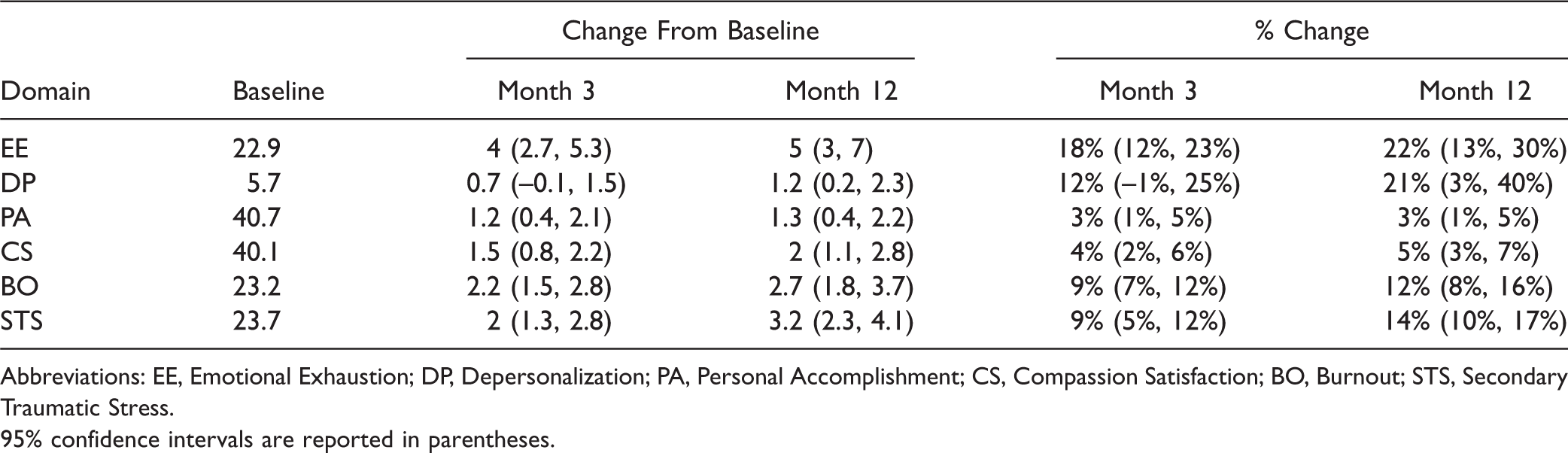
Abbreviations: EE, Emotional Exhaustion; DP, Depersonalization; PA, Personal Accomplishment; CS, Compassion Satisfaction; BO, Burnout; STS, Secondary Traumatic Stress.
95% confidence intervals are reported in parentheses.
Discussion
We found that self-referred participation in a 5-day mind–body medicine skills training program for healthcare professionals was associated with yearlong decreases in emotional exhaustion, depersonalization, burnout, and secondary traumatic stress, and improvements in compassion satisfaction and sense of personal accomplishment 12 months after completing the program. Mind–body medicine techniques use the power of self-awareness, self-expression, and self-exploration, to positively influence our thoughts and emotions as well as physical and emotional health. Meditation, breathing exercises, and other mind–body interventions are thought to increase parasympathetic activity, reduce over-activity of the sympathetic nervous system, promote relaxation, ease tension, lessen pain, increase coping-skill repertoires, offer up new ways to evaluate and approach stressful situation, and decrease the need for medication. 10 , 11 The supportive nature of the group is considered a significant component of the center’s approach and likely contributes to the positive outcomes.
This is the first study, to our knowledge, to suggest that mind–body medicine skills training, in addition to providing an important patient care management tool, has long-lasting beneficial effects on symptoms of burnout and improved wellness for a variety of healthcare professionals.
There are a few limitations. We did not have a control group, so we do not know if improvements were due to the training alone. We have limited demographic and practice data on these national participants, so we do not know if they are comparable to other providers. Mind–body medicine training may be more effective for those who chose to participate than those who did not. Total program length of 5 days might itself be a limitation of participating; shorter interventions are being piloted, and an online version is now available (https://cmbm.org/onlinegroup/). A qualitative study might further inform course content by identifying components most helpful for participants.
There is an urgent need and a shared responsibility to maximize the well-being of our healthcare workforce, our patients, and the institutions that serve them both. This pilot study suggests that mind–body medicine training, in addition to providing an important patient care management tool, may be an effective way to mitigate burnout and to improve and maintain wellness of many healthcare professionals.
Footnotes
Declaration of Conflicting Interests
The author(s) declared no potential conflicts of interest with respect to the research, authorship, and/or publication of this article.
Funding
The author(s) received no financial support for the research, authorship, and/or publication of this article.
