




Abstract
Background
While recent health-care trends rely on activated patients, few studies report direct observations of how to engage and activate patients to be full participants in their own health care. The interpersonal processes and communication strategies used in integrative health coaching (IHC) may offer important insight into how clinicians can help patients step into a more active learning model rather than more typical passive roles.
Objective
This study uses verbatim transcripts of medical patients’ first few IHC sessions to identify the actual processes used to help patients embrace this more active learning role.
Methods
A thematic analysis was conducted of 72 verbatim transcripts from IHC sessions of 26 patients with severe dysfunction from tinnitus. The patients participated in 6 months of IHC as part of a larger integrative intervention in a randomized, controlled pilot designed to assess feasibility for a larger randomized, controlled trial on the clinical effectiveness of an integrative intervention.
Results
Four themes emerged: (1) Describing the Health Coaching Process to patients; (2) Using Key Procedures for Action Planning—optimal health future self-visualization, Wheel of Health, and exploration of the gap between current and desired states to help patients set goals for themselves; (3) Supporting Action and Building Momentum—the creation and support of action steps with frequent reinforcement of self-efficacy; and (4) Active Listening and Inviting the Patient to Articulate Learning—coaches’ active listening process included reflection, clarifying questions, turning patient questions back to the patients, highlighting values, identifying potential barriers and resources, and inviting patients to articulate what they were learning.
Conclusion
The processes identified in IHC incorporate key principles of adult learning theory and engage patients’ innate resources of goal orientation, self-direction, and intrinsic motivation. These interpersonal processes help patients embrace a more active learning role, with implications for patient engagement in other clinical contexts.
Keywords
The term “health coaching” has been applied to a range of interventions designed to improve health outcomes. 1 Integrative health coaching (IHC) is distinct from some other forms of health coaching in that the approach aligns with Integrative Medicine values of care for the whole person, patient-centeredness, mindfulness, and healthy lifestyles. 2 IHC draws from theories of humanistic psychology and self-determination theory so that patients are considered lifelong learners with values and a sense of purpose that facilitate the potential for change. 3 This implies a model of communication in which there is concordance between the care provider and patient with mutually shared responsibility and a negotiation of a course of action. 4 This is in contrast to the biomedical model in which patients are to be compliant with provider-directed and provider-controlled health care. 4
As IHC amplifies the importance of concordance between provider and patient as part of activating the patient to be a full partner in their health care, so do a number of other health-care trends. The chronic care model,5–7 for example, relies on informed and activated patients, as do the patient-centered medical home8,9 and prospective, personalized health models.10,11 Nonetheless, few studies have reported on direct observation of what coaches do in practice to engage and activate patients to be full participants. 12 The interpersonal processes and communication strategies used in health coaching may offer important insight into how to help patients step into a more active learning model rather than the more typical patient role of receiving information, advice, or treatment in a passive manner. This study uses verbatim transcripts of medical patients’ first few IHC sessions to identify the actual processes that coaches use to help patients fully embrace this more active learning role to become full participants in their health care.
Methods
Participants
Participants (n = 26) were those who completed 6 months of health coaching as part of the intervention arm of a randomized, controlled pilot study (R21-DC011643 to Drs. Tucci and Wolever, ClinicalTrials.gov Identifier: NCT01480193) designed to assess feasibility for a larger randomized, controlled trial on the clinical effectiveness of an integrative medicine intervention for those with severe dysfunction from tinnitus. 13 Participants had received a score of 38 or above out of a possible 100 on the Tinnitus Handicap Inventory, indicative of moderate to severe handicap from tinnitus that had to be present for at least 3 months. 14 Participants had undergone audiological and medical evaluations to ensure adequate hearing to participate in the intervention and to rule out systemic illness or easily treated causes of tinnitus (eg, cerumen).
The 6-month integrative suite of therapies included 2 education and sound-based therapy sessions with an audiologist, an 8-week Mindfulness-Based Stress Reduction course, 3 cognitive–behavioral therapy sessions, 5 acupuncture treatments, and 6 months of telephonic health coaching. The coaching served to support participants in applying what they learned in the other aspects of treatment into their daily lives. Because participants were required to be naive to all treatments provided, they had no context for what health coaching is.
Participants in the intervention arm of the parent trial (intention-to-treat sample n = 34) were 41% women, 88% white, with a mean (standard deviation) age of 54.2 years (8.90). Six percent were single, 71% were married, 21% separated or divorced, and 3% widowed. Nine percent had completed high school, 38% had some college education, 35% had completed college, and 18% had graduate degrees. Fifty-three percent were working full time, 9% were employed part time, 15% were retired, 9% were home makers, and 12% were on disability. Finally, the sample covered a wide range of annual household income from 6% making less than 20k to 24% reporting greater than 150k.
Screening and recruitment
As part of the pilot trial, 203 subjects were screened by phone using an institutional review board (IRB) approved waiver of consent and Health Insurance Portability and Accountability Act (HIPAA) authorization. They were identified from clinical practices of otolaryngology faculty at Duke University Medical Center, through flyers, advertisements, and from 2 Internet sites: www.clinicaltrials.gov and www.clinicalconnection.com. All provided written informed consent that allowed for the recording and verbatim transcription of their health coaching calls.
Ethical approval
The Duke University Health System IRB approved the parent study protocol and informed consent documents. A routine internal audit of the trial also ensured adherence to study protocol, Good Clinical Practices Guidelines, and State and Federal Regulations. Through Data Transfer Agreement, the deidentified transcriptions of the health coaching calls were transferred to Vanderbilt, whose IRB provided an exemption for the current study.
Data Analysis
The team analyzed 72 verbatim transcripts of the first few health coaching calls (range 1–6) from each participant using a grounded theory approach 15 to answer the question, “How do health coaches contextualize coaching for patients?” To ensure quality in the assessment process, the team operated out of a position of “intense methodological awareness,” 16 maintaining written memos and records of our decisions about coding process. The team engaged several strategies for establishing credibility, transferability, and dependability. 17 Because we were a team of 4 members with varied perspectives, we engaged the transcripts and coding from different points of view and made decisions about coding and thematic analysis through consensus. We also maintained an audit trail of memos on our team process. With regard to authenticity, 17 we operated from a position of social constructivism, acknowledging that there were a range of different realities and that there could be other ways of presenting the process of contextualizing health coaching for medical patients.
The lead authors (KLC and RQW) began the data analysis by reading transcripts from 3 cases to develop an overall impression of processes used by the coaches to help patients understand what health coaching is. Coding began with development of an open coding scheme by the first author (KLC) through review of half of the transcripts, resulting in 48 codes. As the coding scheme was developed, the first (KLC) and senior (RQW) authors reviewed progress through the creation of memos that refined concepts conveyed in the developing coding system. The first author (KLC) wrote brief summaries of the codes with examples and presented the more refined coding scheme to 2 masters in counseling graduate students (DV and RW) who served as 2 additional coders. They were trained to use the coding scheme until they established consistent agreement over 85% of the time. Transcripts were then divided among the 3 coders (KLC, DV, and RW) who applied the coding scheme to the second half of the transcripts and wrote memos to describe their process. In addition, because the guiding research question was, “How do health coaches contextualize coaching for patients?” coding focused on both the health coaches’ comments and the patients’ responses. As each case and attendant transcript was reviewed and coded, brief descriptions of each participant were created as a way of contextualizing the codes. The 3 coders met together to create interconnected and overlapping themes from the codes and locate “sparkling” exemplar quotes using standard procedures for coding qualitative data.15,18 Codes were reviewed for prevalence of use and prevalence across cases. The coding scheme for the first half of the transcripts fit well with the second half. Data management and the thematic coding process were supported by the use of NVivo10 computer program. 19 For a member check, the integrative health coaches that provided the coaching sessions that were transcribed were provided with a draft of the thematic analysis and gave feedback on the analysis.
Results
The themes (and their descriptions) that emerged from the coding included the following: (1) Describing the Health Coaching Process—coaches initially described the coaching process to their patients; (2) Using Key Procedures for Action Planning—coaches used an optimal health future self-visualization exercise, the Wheel of Health,2,20 and an exploration of the gap between current and desired states to help patients set goals for themselves; (3) Supporting Action and Building Momentum—coaches guided the creation of action steps and then followed up on progress with frequent reinforcement of self-efficacy; and (4) Active Listening and Inviting the Patient to Articulate Learning—coaches’ active listening process included reflection, clarifying questions, turning patient questions back to the patients, highlighting values, identifying potential barriers and resources, and inviting patients to articulate what they were learning. See relevant tables for exemplars of each theme.
Describing the Health Coaching Process
As preparation for the initial coaching call, patients completed a questionnaire rating their current and desired states from 1 (low) to 10 (high) on the areas identified on a Wheel of Health2,20: Nutrition, Movement/Exercise/Rest, Mind–Body Connection, Spirituality, Relationship/Communication, Physical Environment, and Personal/Professional Development were the categories on the Duke Wheel of Health utilized in this study. This questionnaire was the initial prompt that in coaching, patients would explore a broader perspective than solely focusing on the “presenting problem”.
Exemplar for Describing the Health Coaching Process.
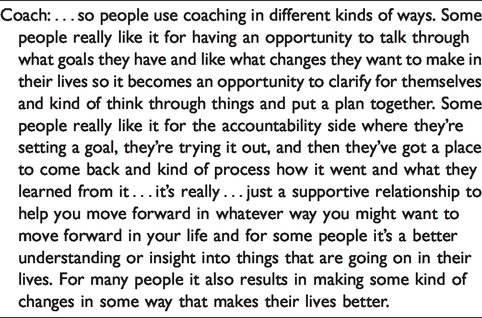
Some patients came to the initial telephone coaching session with an idea of what the coaching process involved, but most did not. In all but 2 of the cases, health coaches began by asking about the patients their understanding of coaching and then providing descriptions as needed (Table 1). The health coaching relationship is clearly presented as a partnership that privileges the patient’s desire for change. Coaches were also referred to as “guides,” a “co-pilot,” a “cheerleader,” and as part of a “team” with the patient.
An exception to opening a health coaching relationship in this way was seen with a patient who had previously had health coaching and was currently in crisis, having been informed that the tinnitus she was experiencing may be related to a condition which could require brain surgery. The other exception was a patient who had spoken with another treatment team member about what was involved in health coaching and initiated the conversation about the Wheel of Health without the need for a description of the process.
Using Key Procedures for Action Planning
Health coaches asked patients to engage in a future self-visualization exercise in which patients met their future selves who had an optimal level of health and well-being. This was presented as a way of getting in touch with their inner wisdom and what they truly want. Patients were often surprised at the power of the exercise (Table 2).
Exemplars for Using Key Procedures for Action Planning.

In addition to using the visualization to help the patients clarify what they want, the coaches used the Wheel of Health to help patients consider their lives from a broader perspective. Subsequently, the Wheel of Health was used to narrow in on general areas or even more specific areas in which the patients wanted to set goals based upon their values and preferences. A third strategy for identifying patient values and potential targets for change used with half of the patients was that of recalling peak experiences, that is, past happy memories and examining what made that time so happy.
In summary, coaches typically described the coaching process to their patients as a way to begin to contextualize coaching and used the future self-visualization, Wheel of Health exercise, and peak experiences exercise to help patients identify areas that are most important to them, or areas where there is a gap between what the patient wants and currently has. By identifying their values and the most important areas for change, health coaches help patients narrow down their focus for behavior change.
Supporting Action and Building Momentum
In most of the cases, the coach supported the patient to take action through use of extensive listening, reflection of the patient’s feelings or perspectives regarding their current situation and asking nonleading questions about what the patient wanted to do next. Once the patient identified an area of importance as a general domain for change, they began the process of setting a goal and designing small action steps—specific and measurable actions to which patients could commit immediately (Table 3).
Exemplars for Supporting Action and Building Momentum.

In addition to having patients set and commit to small and realistic steps right from the initial sessions, coaches supported patients as active learners by following up in subsequent sessions on progress toward the self-determined goals. For about a third of the patients, a theme of the coach serving as an accountability partner was reflected from the beginning of the coaching partnership, even in the first sessions. An additional aspect of action planning and building momentum was that of the coach inviting a larger perspective—inviting the patients to consider how specific changes fit in with the larger context of their lives.
In summary, future self-visualizations, conversations on current and desired states of areas outlined on the Wheel of Health, and peak experiences exercise as well as a focus on the patient’s values undergirded the process of moving patients into action. Action planning involved creating action steps and then following up on progress toward these steps with frequent reinforcement of self-efficacy.
Active Listening and Inviting Patients to Articulate Learning
The integrative health coaches used active listening processes, reflection, and nonjudgmental, open-ended questioning to support the patient as active learner. In about half of the cases, the coaches helped patients develop insight by specifically inquiring what the patient was learning about himself/herself, the issue at hand, and their own change process. By thoughtfully responding, patients increased their own awareness of their wants and values, potential barriers that could prevent their action steps, resources that they could draw on, and choices they could make. Coaches frequently asked patients to reflect on what they were experiencing to enhance their active learning (Table 4).
Exemplars for Active Listening and Inviting Patients to Articulate Learning.

Finally, given that the focus of the original pilot trial was moderate to severe dysfunction from tinnitus, it is not surprising that 23 of the 26 cases discussed what patients learned related to the pattern of tinnitus.
In summary, coaches helped patients take an active learning role by initially describing the health coaching process and then using structured exercises to step patients into envisioning more optimal health and well-being and exploring what the patient actually wanted to obtain or achieve. Ensuing conversations were characterized by having patients set and report on self-determined action steps, using extensive active listening on the part of the health coaches, and nonjudgmental exploration through reflection and questions. The coaching process at this point included highlighting patient values, reinforcing self-efficacy, and identifying potential barriers and resources. Finally, coaches repeatedly asked patients to articulate their learning throughout the process.
Discussion
While is it noted that health coaching arises from a learning paradigm rather than the biomedical model, 21 this study is the first to use empirical means to investigate the process that integrative health coaches use to help patients step into a more active learning role in health care. In asking how coaches contextualize this more active paradigm for patients, we identified 4 main themes, each of which contributes to this process. First, health coaches explain health coaching. The explanations appear to lay the groundwork for the active learning paradigm, but the coaches’ actual behavior as seen in the next 3 themes seems more instrumental in truly activating the patient.
The key processes that the coaches use to help patient identify what they truly want are unique to health coaching and atypical of conventional medicine. 22 Specifically, integrative health coaches use a Wheel of Health to broaden the patient’s perspective of their health issues and a related gap analysis to identify what they want and where to start.2,20 Having patients complete the Wheel of Health prior to the first coaching visit begins the paradigm shift as it summons them to consider multiple areas in their lives as part of a broader perspective of health and well-being.2,20 The future visualization process then invites patients to look ahead and clearly imagine greater health and well-being. They are repeatedly invited to consider what they truly want (eg, peace, a fulfilling job, etc.) rather than what they don’t want (eg, continued distress or disease). Connecting to what one intrinsically wants is motivating in and of itself.23–25 In addition, these processes in IHC incorporate key principles of adult learning theory that affirm that adults are goal oriented, self-directed, and intrinsically motivated and can learn best when the lessons are practical, relevant, and incorporate their own life experience. 26 The coaches also elicit articulation of what the patient feels and experiences during the visualization, drawing them into an active learning paradigm where sensory information can deepen the “stickiness” of their motivation. 27
Third, health coaches help patients take an active learning role by eliciting self-determined goals, supporting them to take immediate action in small, doable steps and report back on what they learned. The coach conveys acceptance of the patient as a person, without investment in the specific outcome. Rather, the coach clearly communicates their investment in supporting the patient’s learning and growth as they move toward whatever the patient chooses as a health and well-being goal. Action steps are often framed as experiments, which can provide important information about what will and will not work for the individual patient.
Finally, as noted in several of the themes emerging from the qualitative data, the process of contextualizing coaching relies heavily on extensive active listening. The coach helps the patient become an active learner mostly through skillful listening processes that include reflection and exploration of the patient’s feelings, perspectives, and what she/he is learning. This is consistent with prior studies showing that in coaching sessions, the patient (rather than the provider) speaks considerably more than typically seen in conventional medicine. 21 Furthermore, well-trained coaches generally reflect the patient’s experience about twice as much as asking them questions. 28
There are several limitations to this study. First, given our theoretical understanding of social constructivism, we acknowledge that there could be many ways to interpret the data. 15 Second, we only studied a small group of patients and their health coaches, given the intensity of qualitative analysis. That said, 72 transcripts of full coaching sessions including longer, initial sessions is considered a very large behavioral sample for qualitative research.
This study is one of very few studies that utilize verbatim transcripts from coaching sessions. Hence, it offers direct sampling of these health-care interactions of interest. The paper thus contributes to a slowly growing literature on the specific processes involved in IHC and how they actually work to support patients in taking a more engaged and active learning stance in their own health care.
Footnotes
Acknowledgments
The authors wish to thank Deb Tucci, MD for her co-leadership of the parent trial, Linda Duda, MSW, PCC, CPCC, and Julie Kosey, MS, PCC, RYT, NBC-HWC, for providing the integrative health coaching in this study. The authors are also extremely grateful to the Integrative Medicine study coordinator, Elizabeth Bechard, BA, RYT, NBC-HWC, and 6 additional individuals (postgraduate, graduate, and medical students) who carefully transcribed the coaching calls verbatim: Sarah Cassel, MD; Mark Dreusicke, MD, NBC-HWC; Shawheen James; Haley Mendoza-Romero; Christelle Tan; and Britney W. Turner, MA.
Declaration of Conflicting Interests
The author(s) declared the following potential conflicts of interest with respect to the research, authorship, and/or publication of this article: RQW serves as the Chief Science Officer for eMindful Inc. and is on the Board of Directors for the nonprofit National Board for Health and Wellness Coaching (a nonprofit affiliate of the National Board of Medical Examiners). She has current funding from Meharry Medical College, the National Institute of Diabetes, Digestive and Kidney disease, and Abbie Vie. She declares no conflicts of interest regarding the publication of this paper. The remaining authors declare no conflicts.
Funding
The author(s) disclosed receipt of the following financial support for the research, authorship, and/or publication of this article: Data for this secondary analysis came from a parent study funded by the National Institute for Deafness and Communication Disorders (R21-DC011643 to coprincipal investigators Debara L Tucci, MD and RQW).
